Peace for the World World ! Your War Our Lives

The Dalai Lama
A Brief Colonial History Of Ceylon(SriLanka)
Sri Lanka: One Island Two Nations
A Brief Colonial History Of Ceylon(SriLanka)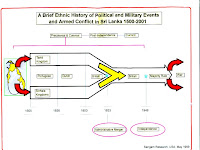
Sri Lanka: One Island Two Nations
(Full Story)
Back to 500BC.

Tuesday, March 1, 2022
Ukraine obliterates Russian convoys in two drone strikes: Air Force releases footage of attacks near Kyiv and in the south of the country using Turkish-made drones
- The Ukrainian military published a video on Sunday which shows a Turkish armed drone carrying out strikes against Russian forces
- Aerial footage was shot by a Turkish-made Bayraktar TB2 drone
- Video was published on the Facebook page of the Ukraine forces' commander-in-chief, who said the strike took place near the city of Malyn, northwest of Kyiv
- On Saturday, Ukrainian forces released video from a drone video which showed another Russian convoy being struck, this time in the southern city of Kherson


Lt. Gen. Mykola Oleshchuk, the chief of Ukraine's Air Force, confirmed they used 'life-giving' Bayraktar TB2 drones.
The Ukrainian Embassy released footage of a Russian convoy consisting of more than a dozen vehicles blown to pieces by the strike.
The footage was shot near the city of Malyn, about 60 miles northwest of Kyiv.
Ukrainian drone strikes Russian missile launcher
Ukraine's Air Force claims to have conducted successful drone attacks against Russian forces

In one image shot by a Turkish drone, a purported convoy of Russian trucks is shown driving

Seconds later, the entire group are blown to bits having been the victims of a drone strike

Ukrainian servicemen push a Bayraktar TB2 drone, or unmanned combat aerial vehicle (UCAV), file photo from June 2021
The Air Force said that one of the strikes occurred in the town of Chornobaivka, in southern Ukraine.
The area has been the focus of intense fighting in the past few days.
'Never a rose without a thorn,' the embassy wrote in one of the tweets. 'Russian invaders have to put up with Bayraktar TB2s.'
On Saturday, Ukrainian forces released another drone video which showed a Russian convoy being hit by a drone strike, this time in the southern city of Kherson.
The first shipments of the Turkish-made drones began arriving in Ukraine in 2019 reports the Wall Street Journal.
The TB2 aircraft are able to stay in the air for 25 hours at a height of 25,000 feet with the pilot able to control it from several hundred miles away.
Ukrainian forces have managed to halt the advance of Russian troops on the capital, blowing bridges into the city to hinder the advance of Moscow's soldiers.
Russian forces were on Sunday afternoon destroyed in Bucha, near the Gostomel air base in the north west of Kyiv, after becoming trapped when the Irpin bridge into the city was destroyed.
Footage posted online purported to show the harrowing aftermath of what military experts said was likely a drone strike on the Russian Airborne Forces column, with parts of vehicles strewn across the road in a warp, fiery heap.
Earlier on Sunday, Ukrainian servicemen were pictured roaming in the centre of Kyiv to enforce a 39-hour curfew to keep people off the streets.
Mayor Klitschko said no Russian troops had managed to enter the city despite the bombardment.


A Russian tank burning in the Ukrainians city of Sumy, in north-eastern Ukraine, pictured on Sunday

Ukraine's Ministry of Defense on Sunday claimed it has killed more than 4,300 Russian soldiers in the first three days of fighting. Russia has not released an updates on its military losses. Pictured: An Ukrainian Territorial Defence fighter examines a destroyed Russian infantry mobility vehicle GAZ Tigr after the fight in Kharkiv on Sunday

Russian forces entered Ukraine's second largest city of Kharkiv on Sunday
Goncharenko: 'Ukrainian forces are winning and we will not surrender'
He also warned those outside after 5pm and before 8am will be considered part of 'the enemy's sabotage and reconnaissance groups' - he later said there were no Russian troops inside the city.
But he announced that at least nine civilian had been 'lost or killed' in the capital, among them one child, since the start of the invasion.
Satellite imagery taken on Sunday also showed a large deployment of Russian ground troops moving in the direction of the Ukrainian capital Kyiv from approximately 40 miles away, a private U.S. company said.
The images released by Maxar Technologies showed a deployment comprised of hundreds of military vehicles and extending more than 3 miles.
The company has been tracking the buildup of Russian forces for weeks. The latest pictures could not be independently verified.

A handout satellite image made available by Maxar Technologies shows Russian ground forces in convoy near of Ivankiv, Ukraine

This Maxar satellite image shows a column of Russian military vehicles as they move towards Kyiv, on the P-02-02 road (Shevchenka Road) on the outskirts of Ivankiv
Ukraine's health ministry said on Sunday that 352 civilians, including 14 children, had been killed since the beginning of Russia's invasion. It also said that 1,684 people, including 116 children, had been wounded
It was a day a day when the expected assault on Kyiv again failed to materialize and the Ukrainians claimed to have driven Russian forces out of the country's second city Kharkiv.
Oleh Sinehubov, head of the Kharkiv regional administration, today said Ukrainian troops had managed to reclaim the city. In a post on Telegram, he said: 'Control over Kharkiv is completely ours!
'The armed forces, the national police, and the defence forces are working and the city is being completely cleansed of the enemy.'
Kharkiv's defence came as Ukraine's Ministry of Defence today claimed Ukrainian troops had killed or injured more than 4,300 Russian soldiers in the first three days of fighting. Russia has not released an updates on its military losses.

After a grueling night of Russian attacks on the outskirts of the city on Sunday, mayor Vitali Klitschko was silent for several seconds when asked if there were plans to evacuate civilians if Russian troops managed to take Kyiv
Kyiv Mayor Klitschko: We are proud of our army that defends Ukraine

Charred military vehicles and rubble are seen in Bucha, Ukraine, on Sunday


By Jagath Asoka –FEBRUARY 28, 2022

Dr. Jagath Asoka
I lived in Kharkov, Ukraine for six years from 1978 to 1984. I will never forget Ukrainians for taking care of me, educating me, giving me a place to live, and financially supporting me for six years—these are the things that parents do for their own children. Kharkov is the place where I discovered love. My love and gratitude for Ukrainians are indescribable.
I keep on thinking of the people that I know and that I knew. Even though I kept telling some of them that an attack was about to happen, they kept saying “Don’t believe what the Americans say.” I did not argue with them but kept quiet, which was very unusual for me. They hoped for the best, but they refused to prepare for the worst. That is the story of this infamy in a nutshell. Some of the places in Kharkov that I see on CNN were the places that I used to hang out. I am saddened, but I think this is the end for Putin, or the beginning of his end.
I know that Ukrainians will fight. I also think that the Russian soldiers do not have a dog in this fight. Ukrainians are their friends, brothers, sisters, cousins, uncles, aunts, grandfathers, and grandmothers, not their enemies. This is Putin’s war. While Putin’s cronies—the crooks—brook him, the entire world bucks him and is praying for his peril.
In 1989, when the Berlin Wall came down, Putin was a KGB officer in Dresden, East Germany. His comfortable life collapsed suddenly. When irate crowds stormed the headquarters of the secret police building where he conducted his espionage, Putin asked for help, but Moscow was silent. This is when Putin bluffed. Putin convinced the crowd that that his offices were part of the Soviet military installation. This is a good example of how easily political elites can be overthrown. Even now Putin fears demonstrations and that is why he has banned demonstrations now. Demonstrations remind him of Dresden: What the power of people can do to despots.
Ukrainians thought that Putin was bluffing.
Ukrainian people have showed us what real freedom looks like: the real freedom is what you’re going to do with what has been done to you. Instead of surrendering to Russians, Ukrainians have chosen to fight back. The Ukrainians are radically free, free to their roots! Their country is nothing else but what they build by themselves. Ukrainians have shown that they are responsible for their freedom and the quality of their own lives. The quality of their lives depends on their choices and their ability to assume responsibilities. Ukrainians are way more powerful than they think; they are way more powerful than they even want to be. They are carrying the weights that are heavier than what they can carry: assuming responsibility for their own freedom. They are not making excuses for not having powerful weapons to defend their country. They are using Molotov cocktails against mighty Russian army!
I sincerely believe that Putin is marching toward his own death; look at the way he conducts his meetings; it seems like he is sitting in a mausoleum, at a large white marble table; during his meetings, he keeps everyone, at least, five meters away from him. Simply, it is eerie. He has taken his first step: He attacked Ukraine. He called his attack on Ukraine “de-Nazification.” Ukrainian President Volodymyr Zelensky is a jew, a grandson of a Holocaust survivor. I wonder what Hitler and Stalin are thinking in Hell.
I sincerely believe that most Russians do not support this war. Some of them are showing it openly by demonstrating, risking their own lives. I think in Russia, only one in a thousand who are against the war would participate in an anti-war demonstration, the war against Ukraine; others are simply scared. There are still scared of the old KGB tactics. I think Russians will get rid of Putin. It is just a matter of time. St. Petersburg, the home of Pushkin, Gogol, and Dostoevsky is the place for this new revolution. Putin is going to join Muammar al-Qaddafi, Saddam Hussein, and Osama Ben Laden.
Countries like China, India, and Israel are showing their true colors.
In a nutshell, the future of the world depends on this war. When Putin is gone, Russian will join the EU like Ukraine did.
Read More
The invasion of Ukraine by Russia: What is the real reason behind this?

Russia accuses NATO countries of “flooding” Ukraine with weapons and the US of stoking tensions to contain Russia’s development

Tuesday, 1 March 2022
A reflection back into history perhaps might help us understand the current set of unfortunate events taking place in Ukraine; we need to understand the past in order to understand the present.
As the dust settled after World War I, Ukraine was defeated and divided; enabling the Soviets control of much of the country. The Ukrainian Bolsheviks, who had defeated the national government in Kiev, established the Ukrainian Soviet Socialist Republic, which on 30 December 1922 became one of the founding republics of the Soviet Union.
Then came a devastating blow in 1932, the great famine began and up to 10 million Ukrainians starved to death. It was made worse by the policies of the new head of the communist party, Joseph Stalin. At a subsequent time came the Great Terror; these were the two waves of Stalinist political repression and persecution in the Soviet Union, which resulted in the killing of some 681,000 people.
The calamity included 80% of the Ukrainian cultural elite and three-quarters of all the Ukrainian Red Army’s higher-ranking officers who were wiped out.
At the outbreak of the Second World War, Adolf Hitler invaded the Soviet Union in June 1941.

This was the beginning of four straight years of non-stop total war. Looking back into the battle of Kiev, German forces encircled and laid siege to the capital city. More than 600,000 Soviet soldiers were killed or taken captive there. The total losses inflicted upon the Ukrainian population during the then war was estimated between five and eight million, including over half a million Jews were killed by Nazi death squads, sometimes with the help of Ukrainian collaborators.
The republic was heavily damaged by the war. More than 700 cities, and 28,000 villages were destroyed. Material losses comprised an estimated 40% of Ukraine’s national wealth.
When Ukraine boomed following the Second World War, industrial output grew to 2.2 times from 1940 to 1955. Soviet Ukraine soon became a regional leader in industrial production, and an important centre of Soviet arms and high-tech research for industries.
Ukraine produced many prominent Soviet sports players, scientists, and artists over this period as well as much of the Soviet leadership, including Leonid Brezhnev, who ousted Nikita Khrushchev and became the Soviet leader from 1964 to 1982.
Another event that was profound occurred; on 26 April 1986, when a reactor in the Chernobyl Nuclear Power Plant exploded, resulting in the worst nuclear reactor accident in history.
The Soviet Union began to break apart under the weight of the “War of Laws,” which was the constant conflict between the Soviet Federal Government and its various republics, who were each seeking greater autonomy.
Then followed the unsuccessful August 1991 coup d’etat against Mikhail Gorbachev, the former President of the Soviet Union, which sealed the fate for Russia. A few days after the coup, Ukraine and Belarus declared their independence from the Soviet Union. The Baltic States, which had earlier declared their independence, sought international recognition.
On 24 August 1991, the Ukrainian parliament officially declared independence. But then the economy immediately sank into depression and lost 60% of its GDP from 1991 to 1999. A new currency, the Hryvnia, was introduced in 1996. The economy was stabilised by the end of the 1990s.
The Machiavellian second President of Ukraine set the stage for the 2004 ascendance of Prime Minister Viktor Yanukovych to the Presidency in elections which the Ukrainian Supreme Court ruled were rigged. Yanukovych was then thrown out of power in the peaceful Orange Revolution in favour of opposition leaders Viktor Yushchenko and Yulia Tymoshenko, who became President and Prime Minister. Yanukovych then regained the Prime Ministership in 2006, but lost a snap election just a year later that saw Tymoshenko become Prime Minister again.
In January 2009 the natural gas crisis culminated in Russia stopping the supplying of gas to Ukraine in the middle of winter to exert pressure. Since Ukraine is itself the main supply route to much of Europe, this was a catastrophic problem which needed to be resolved urgently. Tymoshenko eventually signed an agreement to reopen the pipeline, but not before Ukraine incurred major economic losses. As a result of the political fallout.
Yanukovych persisted by not going away; he was re-elected President again in 2010. And in October, 2011, Tymoshenko was sentenced to seven years in prison for abuse of office because of the signing of the natural gas deal with Russian President Vladimir Putin.
In 2012 the European Union and Ukraine began negotiations for it to join the 28 nations; thereby establishing a political and economic association between the parties.
Russia was totally against this agreement whereby Ukraine was going towards the influence of the European Union and Russia started placing embargo on Ukrainian goods. This resulted in a 10% decline in Ukrainian export revenue of $ 1.5 billion in losses as an attempt to put pressure on the Ukrainian government. This was intended to disrupt the signing of an association agreement with the EU, scheduled to be signed at the November 2013, Vilnius Summit.
President Viktor Yanukovych urged the parliament to adopt laws that would enable Ukraine to meet the EU’s criteria.
Yanukovych initially approached the European Union for a loan bailout which was offered but it was such a paltry amount consisting of $ 828 million which was inadequate, stating that his country would need at least $ 22 billion to cover the cost of upgrading the economy to European standards.
At this juncture Ukraine was very vulnerable, the Americans incited social unrest by providing financial, logistical and material assistance for the three-month-old Euromaidan protests which began at the end of 2013. During this time Yanukovych was feeling the economic pressure and abruptly suspended efforts to join the EU.
President Yanukovych then turned around and signed an agreement with Vladimir Putin, President of Russia, who offered $ 15 billion in financial aid with a 33% discount on Russian natural gas.
As a result, the Euromaidan protests escalated and became more violent, with many now calling for the ousting of Yanukovych and a rejection of the Russian deal in favour of a complete embrace of Europe.
The extent of the Obama administration’s meddling in Ukraine’s politics was breathtaking. Russian intelligence intercepted and leaked to the international media a Victoria Nuland.
The assistant secretary of state for European and Eurasian Affairs, in a telephone call with the US Ambassador to Ukraine Geoffey Pyatt discussed in detail their preferences for specific personnel in a post Yanukovych government. The US favoured candidates like Arseniy Yatsenyuk, the man who became prime minister after Yanukovych was out of
power. During the telephone call, Nuland stated enthusiastically that “Yats is the guy” who would do the best job.
Nuland and Pyatt were engaged in such planning at a time when Yanukovych was still Ukraine’s lawful president. It was startling to have diplomatic representatives of a foreign country with a country that routinely touts the need to intervene in democratic processes and the sovereignty of other nations; plotting about removing an elected government, and replacing it with officials meriting US approval. The agitator provocateur has now been promoted to high office as Ambassador Victoria Nuland, Under Secretary for Political Affairs.
After the collapse of the Soviet Union, Ukraine had the world’s third-largest nuclear weapons stockpile of which Ukraine had physical but not operational control. Russia alone controlled the codes needed to operate nuclear weapons. In a treaty called the Budapest Memorandum on security, assurance was given by nuclear powers Russia, the United Kingdom and America to respect the independence and sovereignty of the existing borders of Ukraine to refrain from the threat or use of force against the country. Those assurances played a key role in persuading the Ukrainian government in Kiev to give up the largest nuclear arsenal, consisting of some 1,900 strategic nuclear warheads.
The Warsaw Pact which was an Eastern military alliance consisting of Albania Bulgaria, Czechoslovakia, Eastern Germany, Hungary, Poland, Romania and the Soviet Union officially disbanded in 1991 following the dissolution of the Soviet Union.
Despite the termination of the Warsaw Pact, The North Atlantic Treaty Organization (NATO) western military alliance consisting of America, Canada and the Western Nations of Europe, in total had 30 member countries, which decided to expand its territory into Poland, Hungary, Czech Republic, Bulgaria, Estonia, Latvia, Lithuania, Romania, Slovakia, and Slovenia.
With the expansion of NATO, Russia seemed cornered by the military alliance therefore; perhaps being forced into a place of no possible escape. One would ponder; if NATO expands to Ukraine, then they would be utterly surrounded hence, will be unacceptable to the Russian psyche.
Russians think that deploying NATO troops in the former Eastern bloc countries bordering Russia is a threat to national security. This element has been expressed to NATO and the European Nations but they have been ignoring it for a considerable period of time.
Volodymyr Zelenskyy, the current President of Ukraine, as of January 2021, was preparing to formally apply for EU membership in 2024, in order to join the European Union in the 2030s.
President Putin has also argued that if Ukraine joined NATO, the alliance might try to recapture Crimea. Due to its strategic location and the navigability of the city’s harbours, Sevastopol, Crimea has been an important port and naval base throughout its history. Since the city’s founding in 1783 it has been a major base for Russia’s Navy Black Sea Fleet, and it was previously a closed city during the Cold War. The Port of Sevastopol is considered to be a key hold for maritime routes between the Black Sea and the Sea of Marmara; including the Mediterranean Sea, and the Atlantic Ocean. The port is one of the few warm deepwater ports available to Russia in the Black Sea.
Russia accuses NATO countries of “flooding” Ukraine with weapons and the US of stoking tensions to contain Russia’s development. Putin has complained, Russia has “nowhere further to retreat to; he stated, “Do they think we’ll just sit idly by?”
According to Putin, the West promised back in 1990 that NATO would expand “not an inch to the east” but did so anyway.
To conclude; would the above events be the motivator for the current state threatening world peace?
The above action has precipitated the current circumstances, perhaps as to why Russia has invaded Ukraine with a blitzkrieg pre-emptive strike. As they say in a game of chess you do not want to be checkmated because that will be the end of the game for Russia.
The Battle for Russia and Ukraine
Russian President Vladimir Putin urged Ukraine’s military to overthrow their political leaders and negotiate peace.


by Anwar A. Khan-
Russian air and land forces are already pressed into Ukraine from three sides in Europe’s first full-scale military conflict in decades, and also its first of the social-media era. Statements, video, and still images captured and distributed by officials, militaries, journalists, the public, and inevitably, provocateurs and propagandists, suggest that the three-way Russian advance is being contested yet moving ahead.
The fighting apparently began with Russian missile strikes around 9:30 p.m. Eastern time on Wednesday last.
“It is likely that you will see this unfold in multiple phases. How many, how long, we don’t know. But what we are seeing are initial phases of a large-scale invasion,” a U.S. senior defense official told reporters in Washington early on Thursday. “Thus far, we have seen an advance on what are essentially three main axes of assault.”
One is northward from Crimea toward Kherson; another southward “basically from Belarus to Kyiv”; and the third from Belarus southwest toward Kharkiv, Ukraine’s second-largest city.
“These three axes are what we believe, clearly designed to take key population centers,” the official said. “I’m saying they’re making a move on Kyiv…They have every intention of decapitating the government and installing their own method of governance.”
“We see the heaviest fighting in and around Kharkiv, right now,” the official said.
Russian forces had fired more than 100 missiles, mostly short-range ones but also medium-range missiles and cruise missiles from warships in the Black Sea, the official said.
As well, “They used approximately 75 fixed-wing heavy and medium bombers as a part of this initial onslaught,” said the official.
“The targets thus far…have been primarily focused on military and air defense—so barracks, ammunition warehouses, nearly 10 airfields targeted. We do not have a good sense of total damage,” or casualties, the official said.
U.S. officials had not yet confirmed reports of Russian ground troops in Ukraine. But local reporting and social media, including from Ukrainian government sources, showed images across the country of downed aircraft, destroyed tanks, civilian casualties and captured Russian troops.
On Facebook, the Ukrainian Land Forces posted a video on Thursday last purporting to show Russian equipment being destroyed by the Ukrainian military. The Ukrainian Ministry of Defense also claimed that troops destroyed three Russian tanks and two Russian soldiers had been captured.
CNN reported that Russian “airborne forces” had captured the Antonov airport outside of Kyiv, showing video of men in uniforms carrying weapons and equipment. The reporter, Matthew Chance, said the soldiers were setting up an air bridge to bring in more Russian forces. The New York Times also reported video footage of Russian military helicopters attacking the airport located in Hostomel.
Ukrainian military buildings and equipment were also attacked.
Emine Dzheppar, Ukraine’s first deputy minister of foreign affairs, tweeted a video circulating online purportedly showing a Russian military jet firing on a civilian location in Kharkiv.
As of midday Eastern time, 40 Ukrainian soldiers were killed and more injured, Oleksiy Arestovich, an adviser to the Ukrainian president, told the New York Times.
The invasion is also being witnessed from space. An image captured by satellite company Planet purports to show black smoke billowing from Chuhuiv Air Base in Ukraine’s Kharkiv Oblast.
In Ukraine’s Chernobyl exclusion zone, Russian troops seized the Chernobyl nuclear power plant, Mykhailo Podolyak, an aide to Ukrainian President Volodymyr Zelenskyy. told Reuters. The site of the worst nuclear disaster in history is still contaminated from radioactive material.
Zelensky, in a tweet, said that he and French President Emmanuel Macron called for the establishment of a no-fly zone over Ukraine, but as of now it’s unclear how it would be enforced.
Since January, the Defense Department has alerted some 8,500 U.S. troops to be on stand by for the NATO Response Force and ordered another 5,000 to deploy to NATO countries like Poland in an effort to assure allies and deter Russian aggression as intelligence warned of the potential for an invasion of Ukraine.
On Thursday, President Joe Biden announced that he had approved U.S. troops to head to Germany. The deployment involves 7,000 service members, most of them from the 1st Armored Brigade Combat Team and 3rd Infantry Division from Fort Stewart, Georgia. Other troops from Fort Bragg, in North Carolina, will deploy in the coming days to serve as enablers, mostly in transportation and artillery, a senior defense official said Thursday.
Once they arrive in Germany, the troops could be moved elsewhere in Europe to support a range of missions as needed, Pentagon spokesman John Kirby said.
If the multinational NATO Response Force is activated, it is possible that these soldiers could also be used as part of that force because they would already be prepositioned in Europe, the senior defense official said. This new deployment brings the total number of U.S. troops responding to the Ukraine crisis, domestically and from around Europe, to around 14,000.
Biden has also spoken to Defense Secretary Lloyd Austin and Joint Chiefs Chairman Gen. Mark Milley about “preparations for additional moves” if necessary to protect NATO allies.
The U.S. continues to insist that no American troops will enter Ukraine to fight. This week Biden also announced repositioning of troops in Europe, including AH-64 attack helicopters and an infantry battalion task force with 800 troops. Six F-35s from Germany were being sent eastward, two each to Lithuania, Estonia, and Romania, the senior official said.
Ukraine’s armed forces earlier reported that at least 40 soldiers had died. The Ukrainian presidential adviser said up to 10 civilians had been killed. The mayor of Mariupol said three civilians had been killed there and emergency services in Kharkiv said a boy had been killed after shelling struck an apartment building. The local administration in Odesa said 22 people had died in a strike on a military base.
Since 2014, Russia has been conducting cyber warfare and kinetic operations against Ukraine in an attempt to halt Ukraine’s turn to Europe, prevent Ukraine from joining NATO, and promote Russia’s economic and geopolitical goals in the region.
Russia's reasons for exerting pressure on its smaller neighbor are deeply rooted in economics, history and culture. Russia has designs on Ukraine’s natural gas pipelines. Gas has long been an ...
Russian missiles pounded Kyiv on Friday last and troops advanced on the city as families were forced to evacuate or take cover in shelters.
The United Nations said it had reports of at least 127 civilian casualties - 25 killed and 102 injured - “caused by shelling and air strikes”.
Russian President Vladimir Putin urged Ukraine’s military to overthrow their political leaders and negotiate peace.
War is killing, destruction…and we experienced the Brobdingnagian havoc in 1971 to establish Bangladesh. Knowing everything, Uncle Sam deliberately supported Pakistan like a rogue state to annihilate us from own soil. We shall never pardon Uncle Sam under any setting!
The general people around the world don’t want war under any setting. And everybody across the world wants this problem to be solved not by war, but by diplomacy. I categorically say I want peace in and around Ukraine and everywhere in the world.
-The End –
The writer is an independent political analyst based in Dhaka, Bangladesh who writes on politics, political and human-centred figures, current and international affairs
Subscribe to:
Posts (Atom)