Peace for the World World ! Your War Our Lives

The Dalai Lama
A Brief Colonial History Of Ceylon(SriLanka)
Sri Lanka: One Island Two Nations
A Brief Colonial History Of Ceylon(SriLanka)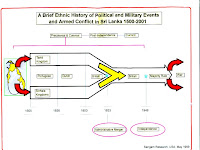
Sri Lanka: One Island Two Nations
(Full Story)
Back to 500BC.

Wednesday, November 3, 2010
Tamil identity and aspirations
Conciliation Resources

Tamil identity and aspirations
Tamil identity and aspirations
Alfred Jeyaratnam Wilson with A. Joseph Chandrakanthan (August 1998)
Two nations, one island — the immanent dichotomy
Constructed for the administrative convenience of British colonial rulers, a unified Ceylon first came into being in 1833. Given that Tamils would always be the minority in such a state, there was a risk that their long-standing political and cultural autonomy could become threatened and undermined. Nevertheless, as the 19th century progressed, Tamils proved especially responsive to the educational opportunities provided by Christian missionaries from Britain and elsewhere. Combining as they did educational advantage with entrepreneurial flair, Tamils moved en masse not only into the colonial administration, but also into property and commercial enterprise in Colombo and the Western ProvinceFULL STORY
.
Tuesday, November 2, 2010
Sri Lanka’s “Free” Media
Media bosses who are nothing but political stooges dominate the “independent” press

 The Sri Lankan media such as it is represented by The Editors Guild of Sri Lanka, The Newspaper Publishers Society and the Sri Lanka Press Institute, is so captive that they continue to be held – nay, to be servile and subservient to a government that has effectively wiped its feet on the so called independent press.
Oct 31 2010 / Comments Off / Read More »
Monday, November 1, 2010
Jaffna Public Library Comes Under Attack, Again
Presidential Secretariat Allegedly Involved
 Pandemonium reigned in Jaffna when the Public Library was stormed by hundreds of unarmed assailants on October 23.
Hundreds of people in over 30 buses stormed the library at about 7 pm, says retired Municipal Council Commissioner C.V.K Sivagnanam in a letter to President Rajapaksa, dated October 27.
The Sunday Leader sought clarification from TNA M.P. Suresh Premachandran. He corroborated the story as written in the letter by Sivagnanam to the President to be accurate.
Sunday, October 31, 2010
Argentina: a possible forum to prosecute war criminals
[ Fri, 29 Oct 2010, 22:18 GMT]
Monday, October 25, 2010
Britain reiterates support for independent inquiry into Sri Lanka war crimes
[TamilNet, Thursday, 28 October 2010, 00:39 GMT]
 British Prime Minister David Cameron Wednesday reiterated his government’s support for an independent inquiry into war crimes committed during the closing stages of Sri Lanka’s protracted war. Mr. Cameron comments on his government’s stance, made in response to a question from opposition MP Siobhian McDonagh, come a week after similar comments by British Foreign Secretary William Hague in the wake of his meeting with his Sri Lankan counterpart, Prof. G. L. Peiris.

Prime Minister, David Cameron

Siobhain McDonagh
Ms. McDonagh’s question elicited a chorus of approval from the packed House, in an otherwise acrimonious PMQ session.
Mr. Cameron replied: “I think the Honourable lady makes a fair point. We do need to see an independent investigation of what happened. Everyone has read the papers and seen the T.V. footage, but we need an independent investigation to work out whether what she suggests is right”.
The chairman of the All Party Parliamentary Group on Tamils (APPG-T), Mr. Lee Scott MP (Conservative), welcomed the British government’s position.
“I absolutely agree with the Prime Minister. The statement by the Foreign Secretary last week clearly shows that the coalition government is serious about finding a permanent and fair political solution to [Sri Lankan] conflict,” he said.
“In my view, an independent international inquiry is an important first step.”
In a press statement issued by Britain’s Foreign and Commonwealth Office (FCO) on October 20, Foreign Secretary William Hague was quoted as saying “the political settlement needs to address the needs of all Sri Lanka's communities”.
“The Foreign Secretary discussed the work of the Lessons Learnt and Reconciliation Commisson with Professor Peiris and hoped that it would engage with the UN Panel of Experts,” the statement further said.
“The Foreign Secretary stressed the need for Sri Lanka to have a credible and independent process to address allegations of violations of international humanitarian and human rights law during the conflict.”
“He hoped that Sri Lanka would show clear commitment towards democracy, human rights law and freedom of the press,” the FCO statement said, adding: “the two Ministers also discussed wider bilateral relations and areas of common interest.”
Meanwhile, a spokesperson for the Global Tamil Forum (GTF) welcomed the British government’s reaffirmation of support for an independent inquiry.
“It is clear that there is continuity in Britain’s policy on accountability for war crimes, despite the change in government early this year,” he said. “In that sense Sri Lanka is a litmus test of international community’s commitment to the International Humanitarian Law, as well as the principles of democracy, good governance and, in particular, human rights.”
Referring to Sri Lanka’s hiring of the British PR firm, Bell Pottinger, the GTF spokesman noted the contradiction between Colombo paying the firm £3million per year, whilst at the same time receiving £13.5m over the past 2 years in humanitarian funding.
Related Articles:
04.08.10 British PR firm whitewashing Sri Lanka’s reputation - report
Saturday, October 23, 2010
Sri Lanka's historic Jaffna library 'vandalised'

1 November 2010 Last updated at 12:45 ET
 Organised Sinhalese mobs attacked and burnt the library over two days in mid-1981
The historic Jaffna public library in Sri Lanka has been closed to tourists a week after a large group of visitors vandalised it, say reports.
The library has emotional significance for the island's Tamil minority as it serves the city usually regarded as their cultural capital.The burning of the library by mobs 30 years ago helped trigger the Tamil Tiger insurgency.
It was reportedly vandalised by a large group of Sinhalese visitors.
Sri Lanka: Jaffna Public Library destroyed by Sinhala Police

Monday, June 2, 2008
Sri Lanka: Jaffna Public Library destroyed by Sinhala Police On the night of June 1st 1981
http://yarlphoenix.blogspot.com/For Tamils this is only an example, albeit the most glaring, in the grand scheme of genocide in Sri Lanka. Living in a country that constitutionally displays a penchant for Nazi style mono-ethnicity and ethnic purity (in a flag, an official language, and a state religion) for the last fifty years, and having lived through multiple state-sponsored pogroms to eradicate the identity of all others (the Non-Sinhala-Buddhists), there can be no doubt that this was an act of genocide.


Remembering the Jaffna
- K. Nesiah (Education and Human Rights in Sri Lanka)
On the 2nd of June every year, Tamils all over the world wake-up with sorrow and grief - over an event that took place twenty-one years ago. It started with the citizens of Jaffna waking up, that many years ago on this fateful morning, to an absolute horror.
On the night of 1st June 1981, t he splendid Jaffna public library, housing 97,000 rare books and manuscripts, was burned to the ground. The shock experienced by the men, women and children of Jaffna that morning is indescribable. That day all Tamils lost a piece of themselves. It was the most magnificent piece of architecture (leave aside the treasure it contained) ever created in Thamileelam.
This act of arson was carried out, not by a bunch of nameless hooligans, but by a posse of two hundred officers of the Sri Lankan police force, taken to Jaffna by two senior Sri Lankan Cabinet Ministers (Cyril Mathew and Gamini Dissanayake, both self-professed Sinhala supremacists), ostensibly to oversee an election.
These two Sinhala Cabinet Ministers, who watched the library burn from the verandah of the nearby Jaffna Rest House, subsequently claimed that it was an ‘unfortunate incident’, where a ‘few’ policemen ‘got drunk’ and went on a ‘looting spree’, all on their own. This ‘justification’ has been echoed, and re-echoed, by many Sinhala leaders and the Sinhala media.
Let us look back.
Monday, June 2, 2008

Remembering the Jaffna
Public Library
“A city’s public library is the eye of the city by which the citizens are able to behold the realness of their heritage, and behold the still greater greatness of their future.”
“A city’s public library is the eye of the city by which the citizens are able to behold the realness of their heritage, and behold the still greater greatness of their future.”
- K. Nesiah (Education and Human Rights in Sri Lanka)
On the 2nd of June every year, Tamils all over the world wake-up with sorrow and grief - over an event that took place twenty-one years ago. It started with the citizens of Jaffna waking up, that many years ago on this fateful morning, to an absolute horror.
On the night of 1st June 1981, t
 he splendid Jaffna public library, housing 97,000 rare books and manuscripts, was burned to the ground. The shock experienced by the men, women and children of Jaffna that morning is indescribable. That day all Tamils lost a piece of themselves. It was the most magnificent piece of architecture (leave aside the treasure it contained) ever created in Thamileelam.
This act of arson was carried out, not by a bunch of nameless hooligans, but by a posse of two hundred officers of the Sri Lankan police force, taken to Jaffna by two senior Sri Lankan Cabinet Ministers (Cyril Mathew and Gamini Dissanayake, both self-professed Sinhala supremacists), ostensibly to oversee an election.
These two Sinhala Cabinet Ministers, who watched the library burn from the verandah of the nearby Jaffna Rest House, subsequently claimed that it was an ‘unfortunate incident’, where a ‘few’ policemen ‘got drunk’ and went on a ‘looting spree’, all on their own. This ‘justification’ has been echoed, and re-echoed, by many Sinhala leaders and the Sinhala media.
Let us look back.
Sri Lanka: Jaffna Public Library destroyed by Sinhala Police
http://yarlphoenix.blogspot.com/Toronto Star- Amid Sri Lanka’s boom, life for Tamils remains bleak

News | World
Amid Sri Lanka’s boom, life for Tamils remains bleak
Sat Oct 23 2010

Father Cryton Outschoorn, a priest at Our Lady of Guadalupe, in Trincomalee, Sri Lanka. He says some residents are still frightened a year after the end of the country's civil war.
Rick Westhead/Toronto Star  By Rick Westhead
TRINCOMALEE, SRI LANKA—The weathered wooden bench that serves as an open-air confessional booth at Our Lady of Guadalupe Catholic Church doesn’t enjoy much down time nowadays.
Tissainayagam speaks at 2010 Mackler Award ceremony
[TamilNet, Saturday, 23 October 2010, 02:31 GMT]
2009 recipient of the prestigious Peter Mackler Award, Tamil journalist J.S. Tissainayagma, who was incarcerated in Sri Lanka prison for his writing, and was unable to receive the award in 2009, spoke at the 2010 Award ceremony held Friday at 6:00 p.m. at the National Press Club in Washington D.C. Tissainayagam was announced as the Award's first recipient on August 31, 2009, the same day he was convicted on terrorism charges relating to his work as a journalist. 2010 Mackler award winner is a 24-year old Russian, Ilya Barabanov, the deputy editor of the New Times, an opposition magazine in Russia.
J.S. Tissainayagam
Tissainayagam praised Barabanov's work in Russia, and said that while Russia and Sri Lanka are countries with different culture and people, the threats journalists face in both countries are similar. He added that fellow journalists in countries outside authoritarian regimes are the main hope to keep the pressure on these governments spotlighting the dangers journalists face in those countries.
Tissainayagam added that the decreasing emphasis in investigative journalism in the U.S. and in other western countries due to the shortage of funds and support resources is a major concern for journalists. He cautioned that with focus mainly on countries where there is on-going war with the US, coverage of events in remote parts of the world will not receive the attention they deserve to the detriment of journalists living and working in these countries.
Barabanov addressed the gathering in Russian with a live English translator.
Ilya Barabanov is deputy editor of Novoye Vremya (New Times) which has been the target of an attempted illegal search and a lawsuit by the Russian government. Barabanov, 24, has decried the aborted search & seizure of The New Times editorial offices. He charged that the search, carried out in connection with a case filed against the news weekly by the Russian interior minister’s OMON security forces, violated Articles 41 and 49 of the Russian Media Law.Full story >>
Why the media silence on Sri Lanka's descent into dictatorship?

- Monday 12 July 2010
- Edward Mortimer: Local journalists who speak out against human rights abuses fear for their lives and the world press turns a blind eye Continue reading...
Lasantha Wickrematunge lies in state during his funeral ceremony in Colombo. Photograph: Lakruwan Wanniarachchi/AFP/Getty ImagesPosted by Edward Mortimer

BBC HARD talk - Democracy Sri Lankan-Style: June 2010 2 of 3
Friday, October 22, 2010
Sri Lanka 'pays PR firm £3m to boost post-war image
 Bell Pottinger helped promote the Sri Lankan foreign minister's recent UK visit
The Sri Lankan government is paying a top British PR firm about £3m ($4.7m) a year to try to enhance the country's post-war image, the BBC understands.
Bell Pottinger Group was recently hired to lobby UK, UN and EU officials.The government says it employs several PR companies but will not disclose their names or the amount paid. Bell Pottinger also refused to give details.
Sri Lanka's authorities strongly deny alleged human rights abuses in the defeat of Tamil Tiger rebels last year. [ full story
BBC News [ full story ]
Tourist arrivalsWednesday, October 20, 2010
Foreign Secretary calls for Sri Lanka to work towards a comprehensive and lasting political settlement

20 October 2010
In a meeting today with Sri Lankan Foreign Minister Professor GL Peiris, Foreign Secretary William Hague said the political settlement needs to address the needs of all Sri Lanka's communities. 
The Foreign Secretary stressed the need for Sri Lanka to have a credible and independent process to address allegations of violations of international humanitarian and human rights law during the conflict. He hoped that Sri Lanka would show clear commitment towards democracy, human rights law and freedom of the press.
The two Ministers also discussed wider bilateral relations and areas of common interest.
Subscribe to:
Posts (Atom)