Peace for the World World ! Your War Our Lives

The Dalai Lama
A Brief Colonial History Of Ceylon(SriLanka)
Sri Lanka: One Island Two Nations
A Brief Colonial History Of Ceylon(SriLanka)
Sri Lanka: One Island Two Nations
(Full Story)
Back to 500BC.

Friday, June 29, 2012
Hudson in hospital after Eliyantha White’s treatment

 Chairman of Sri Lanka Broadcasting Corporation (SLBC), Hudson Samarasinghe has been hospitalized recently after being treated by Presidential physician, Eliyantha White. After receiving White’s treatment, Samarasinghe has suffered from internal bleeding and the President had directed that he be immediately admitted to the Apollo Hospital.
Thursday, 28 June 2012
Samarasinghe had recovered after being treated a few days in the ICU, but he reportedly suffers from a poor memory. He has told people who had visited him in hospital never to receive any treatment from White and that he provided some intoxicating powder drug as treatment. Samarasinghe has added that he had a narrow shave with death.
Although Chief Government Whip Minister Dinesh Gunawardena said in parliament a few months back that Eliyantha White was not the President’s personal physician, has been assigned security personnel from the Ministerial Security Division (MSD).
The Silumina newspaper has recently reported that Eliyantha White is a medical advisor to the President. When a minister had questioned the editor of the newspaper about White being the President’s physician, the editor had responded saying the report that was published was sent by the President’s photographer, Sudath Silva.

 Sri Lanka’s Tamils face identity crisis

The National Identity Card was introduced in Sri Lanka in 1972

27 June 2012
Without a national identity card, many Tamils in Sri Lanka cannot avail of basic services and it makes them suspect in the eyes of the police, writes Ponniah Manikavasagam of the BBC’s Tamil service.
In a remote and dusty part of Kilinochchi district in the Tamil-dominated northern Sri Lanka, people gather around a group of officials working with an election monitoring service called the People’s Action for Free and Fair Elections (Paffrel).
Sitting in the shade, out of the fierce mid-day heat, officials from Paffrel, along with various government and non-governmental organisations, discuss with local people the status of their National Identity Cards (NIC), a document which is a legal requirement for all citizens of 16 years or over.
 Tens of thousands of people were displaced in 2009 in the final chapter of the long conflict between the rebel Liberation Tigers of Tamil Eelam (LTTE) and the Sri Lankan military.
Tens of thousands of Tamils do not have an identity card
Thursday 28 June 2012
 Post-civil war Sri Lanka may be on an upward economic curve but, for Tamils in the north, military control remains a way of life
Tamil women in Mullaitivu, north-east Sri Lanka. Locals say the wait for justice and reconciliation continues. Photograph: Ishara S Kodikara/AFP/Getty Images
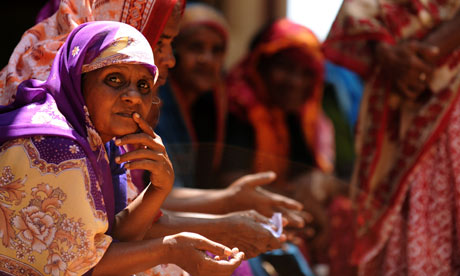
Three years after its civil war, Sri Lanka has emerged as a middle-income country on course to meet most of the millennium development goals. GDP rose by around 8% during 2011 and tourism is set to bring in more than $1bn this year. Yet this national success story obscures the tale of an unsettled north that remains under military control.
The northern Tamil districts of Jaffna, Kilinochchi, Mullaitivu, Mannar and Vavuniya lost three decades to conflict, which ended in the defeat of the Liberation Tigers of Tamil Eelam (LTTE) by government forces in May 2009. Although open warfare has ceased, and despite major government investment in the reconstruction of the region, Tamils say they are still waiting for justice and reconciliation.
Jutting out at the island’s most northern tip, the Jaffna peninsula was largely cut off from the rest of Sri Lanka until 2009. Today, Jaffna still seems in a daze. Plants grow up through bullet holes and weeds have crept into gutted homes without roofs or residents.
With one soldier for every 10 civilians, life on the peninsula does not yet bear the hallmarks of peace. Tensions run high as the Sri Lankan army maintains tight control over the region through checkpoints and military bases. Following a meeting with Hillary Clinton in Washington, the external affairs ministry secretary Karunatilaka Amunugama, criticised international pressure to reduce the military presence. “Sri Lanka does not go to other countries and call on those countries to remove their troops from one place to another,” he said. “It is simply not done because it is an internal matter.”
Speaking on the third anniversary of the end of the civil war, President Mahinda Rajapaksa used his annual victory speech to defend the proliferation of military camps in the north and east against what he characterised as a backdrop of strong pro-LTTE activity in the diaspora.
In Jaffna, the animosity is palpable. “The military [are] supposed to have no administrative duties here,” said Anpu, 22, a student who did not give his surname. “But they interfere every day; we even need their permission to bury our dead.” Accusations of political abductions and the harassment of civilians continue. The destruction of symbolic Tamil sites –including a Jaffna graveyard containing the bodies of 2,000 LTTE fighters, which was bulldozed to make way for an army base in 2010 – has further strained the social fabric.
But despite the friction, the north is slowly reopening for business. The potholed road from the south, which was badly damaged during the war and closed to public vehicles until 2009, is undergoing improvements. It is still controlled by a gauntlet of military outposts and flanked by de-mining teams, but trade has started to benefit from a relaxation of permit restrictions.
According to the government, 98% of those displaced during the war have been resettled in “an environment of confidence and satisfaction”. Although this statement overlooks issues with land rights and lagging mine clearance, it is clear that effort has been put into ensuring a support system for returnees.
Government funding has kickstarted much-needed modernisation of damaged and dilapidated water and sanitation systems in the north. In 2010, a report by the Asian Development Bank (ADB) said less than 0.5% of residents in the Jaffna peninsula had access to piped water, compared with a country average of more than 32%. With a $164m cash injection from the ADB, L’Agence Française de Développement and the Sri Lankan government, that is set to change.
But a recent report by the Centre for Policy Alternatives said: “While the government has repeatedly expressed interest in developing a framework for reconciliation, there are also concerns that the government is opting for a postwar model of economic development to consolidate peace rather than substantively address issues of democracy, a political solution, human rights and accountability.”
“A lot of people feel that if you address the economic issues the rest will fall into place,” says Priyanthi Fernando, executive director of the Colombo-based Centre for Poverty Analysis. “But it needs to be a mix of practical solutions to immediate problems and being able to go behind those practicalities to understand the root of the conflict.”
Export-oriented, the next chapter in Sri Lanka’s economy will rely heavily on foreign support. The UN Human Rights Council resolution adopted in March has stepped up pressure on the Sri Lankan government to investigate allegations of war crimes by troops in the final months of the war and act on the conclusions of the commission of inquiry on lessons learnt and reconcillation. Among those recommendations is the suggestion: “The military presence must progressively recede to the background to enable the people to return to normal civilian life and enjoy the benefits of peace.”
“This infrastructure will not be accepted as a trade-off for our rights,” says Anpu. “And it will not overwrite the need for the justice for our dead.”
‘Sri Lankan Navy should stop harassing fishermen’

CHENNAI, June 28, 2012
Tamil Nadu Chief Minister Jayalalithaa writes to Prime Minister Manmohan Singh on the plight of Indian fishermen “traditionally fishing” in contentious Katchatheevu.
Observing that Indian fishermen hailing from Tamil Nadu have been “traditionally fishing” in contentious Katchatheevu, Chief Minister Jayalalithaa on Thursday urged Prime Minister Manmohan Singh to ask Colombo to stop its navy from harassing them.
Referring to the latest incident, she said fishermen in 45 boats fishing near Katchatheevu on June 26 were harassed by Sri Lankan Navy personnel.
They reportedly chased the fishermen away after cutting the ropes and damaging nets of 10 boats, resulting in a huge loss to the fishermen, she said in a letter to Dr. Singh.
“You are aware that I have brought to your kind attention the various incidents of attack on Indian fishermen from Tamil Nadu by the Sri Lankan Navy/miscreants within the past 12 months and sought your intervention,” she said.
This latest incident of harassment has shocked the state of Tamil Nadu and created a “psychological fear” in the minds of the fishermen, she said.
“I wish to reiterate that from time immemorial fishermen of Tamil Nadu have been traditionally fishing in the waters near Katchatheevu, notwithstanding any geographical or political boundaries,” she said.
The Chief Minister requested Singh to take up the issue with Sri Lanka and impress upon them the need to instruct their Navy to exercise restraint and refrain from harassing “innocent” Indian fishermen pursuing their livelihood in their traditional waters, she said.
Katchatheevu, an islet on the Palk Straits, was ceded to Sri Lanka by India in 1974.
Sri Lanka has been objecting to Tamil Nadu fishermen fishing in that area.
Population plunge in Sri Lanka’s Tamil base
2012-06-27
 COLOMBO - Sri Lanka’s first national census in 30 years has shown a dramatic 20 percent drop in the population of the Jaffna peninsula, the long-time base of Tamil rebels during the island’s ethnic conflict.
According to a preliminary census report released Wednesday, the population in Jaffna, which the rebels once ran as a de facto separate state in the northeast, had fallen from 734,000 in 1981 to 583,000.
Work on the census began last year.
The report offered no analysis, but a Tamil legislator in the national parliament said it reflected an exodus during the fighting between Tamil rebels and government forces from 1972 to 2011 that claimed an estimated 100,000 lives.
“Our estimate is that out of the one million Tamils who fled the fighting and are living abroad, at least 80 percent were from Jaffna,” said Suresh Premachandran.
“If not for the war, the population in Jaffna would have been over 1.4 million,” he added.
One likely consequence of the new census figures will be a reduction in ethnic Tamil minority representation in the national parliament, which is dominated by members of the Sinhalese majority.
Seats in the 225-member parliament are allocated on the basis of a region’s population. Nine seats are currently allocated for Jaffna, but Premachandran said that would now drop to six.
The census put the national population at 20.27 million, about 600,000 down on estimates based on a sample survey carried out in 2001.
Sri Lanka’s ethnic conflict ended in May 2009, with the final defeat of the Liberation Tigers of Tamil Eelam (LTTE) by government forces.
NOWWOW, the new kid on the block


 Anyone who had been glancing through the many pages of web-based news media for the latest developments on the home front couldn’t have missed out on the poignant story presented in reporting and pictures of a group of poor kids of Kilinochchi proudly posing with their new bikes presented to them by the Member of Parliament Mr. Sivagnanam Shritharan, thanks to the initiative of a North American Charity called New Opportunities for Wounded, Widowed and Orphans of War (NOWWOW). The students who live far away from their schools will now have an impetus not to miss out on the classes. NOWWOW feels that it has made use of an excellent opportunity to ensure that the hopes and dreams for the future of Vanni don’t falter due to negligence. NOWWOW is the new kid on the block, but it is determined to cater to the livelihood of one widow at a time, the future prospects of one student at a time, the care and parenting support for one orphan at a time and medical help for one disabled at a time.
New Opportunities for Wounded, Widowed and Orphans of War – that’s the groundbreaking new charity out there!

 Anyone who had been glancing through the many pages of web-based news media for the latest developments on the home front couldn’t have missed out on the poignant story presented in reporting and pictures of a group of poor kids of Kilinochchi proudly posing with their new bikes presented to them by the Member of Parliament Mr. Sivagnanam Shritharan, thanks to the initiative of a North American Charity called New Opportunities for Wounded, Widowed and Orphans of War (NOWWOW). The students who live far away from their schools will now have an impetus not to miss out on the classes. NOWWOW feels that it has made use of an excellent opportunity to ensure that the hopes and dreams for the future of Vanni don’t falter due to negligence. NOWWOW is the new kid on the block, but it is determined to cater to the livelihood of one widow at a time, the future prospects of one student at a time, the care and parenting support for one orphan at a time and medical help for one disabled at a time.
SOS of Eezham Tamils seeks global Tamils, world humanity to respond
 [TamilNet, Wednesday, 27 June 2012, 19:20 GMT]
Mu’l’livaaykkaal was only a beginning for the Sinhala State and its international abetters to perpetuate genocide of Eezham Tamils to suit overlapping agendas. After three years of Colombo’s accelerated structural genocide facilitated by the international community of establishments, the Tamil leaders in the island have once again voiced an SOS in unison on Tuesday, appealing to global Tamils and global community of humanity, to intervene and save their nation from militarised annihilation. Gagged, but experiencing the realities of the hoodwink of ‘post-war reconciliation,’ the voices coming from the island show better clarity and bearing, compared to the hijacked diaspora confused over where to address the issue and a Tamil Nadu leadership silent after a resolution that doesn’t address fundamental solutions, political observers in the island said.

Leaders and representatives of different political parties, TNA, TNPF, TULF, DPF and Sinhala representatives of USP and NSSP along with affected Tamil civilians staged a demonstration at Thirumu’rika’ndi in Vanni on Tuesday against land grab and militarised annihilation of the nation of Eezham Tamils.
While on one hand the agent State in Colombo is engaged in genocidal land grab, its international abettors on the other, aim for large scale land grab in the island. In the process, they facilitate each other.
What is now voiced in the island is in sharp contrast to what the parliamentarians of New Delhi, section of Chennai based media, former peace facilitators and international crisis managers at the behest of the US Establishment try to hoodwink the world public opinion and try to blunt the struggling spirit of the diaspora, the political observers in the island said.
Extracts of the speeches made by the leaders of the demonstration along with their voice recordings, are given here for the diaspora, Tamils in Tamil Nadu and the global community of humanity to grasp what is happening in the island and to plan out an appropriate global strategy to meet the situation:
Selvarajah Kajendren (TNPF):
Selvarajah Kajendren at Thirumu’rika’ndi on 26 June 2012 by TamilNet

Mano Ganesan (DPF):
ano Ganesan at Thirumu’rika’ndi on 26 June 2012 by TamilNet
S. Sritharan (ITAK, TNA):
Mavai Senathiraja (ITAK, TNA):
ritharan and Mavai Senathirajah at Thirumu’rika’ndi by TamilNet
Suresh Premachandran (EPRLF, TNA):
Suresh Premachandran at Thirumu’rika’ndi on 26 June 2012 by TamilNet
 M.K. Sivajilingam (TELO, TNA):
MK Sivajilingam at Thirumu’rika’ndi 26 June 2012 by TamilNet
Full story »
 [TamilNet, Wednesday, 27 June 2012, 19:20 GMT]
 Mu’l’livaaykkaal was only a beginning for the Sinhala State and its international abetters to perpetuate genocide of Eezham Tamils to suit overlapping agendas. After three years of Colombo’s accelerated structural genocide facilitated by the international community of establishments, the Tamil leaders in the island have once again voiced an SOS in unison on Tuesday, appealing to global Tamils and global community of humanity, to intervene and save their nation from militarised annihilation. Gagged, but experiencing the realities of the hoodwink of ‘post-war reconciliation,’ the voices coming from the island show better clarity and bearing, compared to the hijacked diaspora confused over where to address the issue and a Tamil Nadu leadership silent after a resolution that doesn’t address fundamental solutions, political observers in the island said.
Leaders and representatives of different political parties, TNA, TNPF, TULF, DPF and Sinhala representatives of USP and NSSP along with affected Tamil civilians staged a demonstration at Thirumu’rika’ndi in Vanni on Tuesday against land grab and militarised annihilation of the nation of Eezham Tamils.
While on one hand the agent State in Colombo is engaged in genocidal land grab, its international abettors on the other, aim for large scale land grab in the island. In the process, they facilitate each other.
What is now voiced in the island is in sharp contrast to what the parliamentarians of New Delhi, section of Chennai based media, former peace facilitators and international crisis managers at the behest of the US Establishment try to hoodwink the world public opinion and try to blunt the struggling spirit of the diaspora, the political observers in the island said.
Extracts of the speeches made by the leaders of the demonstration along with their voice recordings, are given here for the diaspora, Tamils in Tamil Nadu and the global community of humanity to grasp what is happening in the island and to plan out an appropriate global strategy to meet the situation:
Selvarajah Kajendren (TNPF):
Selvarajah Kajendren at Thirumu’rika’ndi on 26 June 2012 by TamilNet
Mano Ganesan (DPF):
ano Ganesan at Thirumu’rika’ndi on 26 June 2012 by TamilNet
S. Sritharan (ITAK, TNA):
Mavai Senathiraja (ITAK, TNA):
ritharan and Mavai Senathirajah at Thirumu’rika’ndi by TamilNet
Suresh Premachandran (EPRLF, TNA):
Suresh Premachandran at Thirumu’rika’ndi on 26 June 2012 by TamilNet

MK Sivajilingam at Thirumu’rika’ndi 26 June 2012 by TamilNet
Full story »
Queen and Martin McGuinness shake hands
27 June 2012
The Queen shook hands with former IRA commander Martin McGuinness.
Video

The final day of the Queen’s two-day visit to Northern Ireland was marked by an historic handshake and a huge party.
 Her Majesty and former IRA commander Martin McGuinness shook hands for the first time.
The meeting between the monarch and Northern Ireland’s deputy first minister took place at a charity event in Belfast on Wednesday morning.
In the afternoon she attended a Diamond Jubilee party attended by 20,000 in Stormont.
The Queen and Mr McGuinness shook hands at a private meeting and later shook hands in public.
Wednesday, June 27, 2012
Refugees for 20 Years, Tamil Catholic Families Forced to Live in the Jungle

In
practice, for more than 20 years they have not had a home, or jobs to be able to
survive.

Refugees in Sri Lanka, courtesy: asianews.it
|
(MANAAR, Sri Lanka AsiaNews) - They live in the jungle, on the
ground without a roof or a tent over their heads, surrounded by elephants,
snakes and other wildlife.
There
are 145 families, 285 Tamil Catholics from the village of Mullikulam in Mannar
District (Northern Province, Sri Lanka).
In
theory, these people would be among the first groups of civil war refugees (IDPs
– Internally Displaced People) to enjoy the resettlement programs promoted by
the government.
In
practice, for more than 20 years they have not had a home, or jobs to be able to
survive.
A
group of people – including two Catholic priests, a Buddhist monk and two
members of NGOs – visited the community and said they were “shocked” by the
conditions in which these people find themselves.
“What
crime”, said Ven. Buddhiyagama Chandrarathana Thero, “could these people have
ever committed, to live like animals?”
 |
The population of Mullikulam
The
first settlements in the area of Mullikulam date back to 1800. Tamil and
Catholic, the population has always lived from agriculture and artisanal
fishing. Thanks to the rainy season, the area is rich in water, which the
inhabitants have used for large crops of rice.
 |
However, since the start of the conflict – which hit the
northeastern provinces of Sri Lanka – the community has lost all political,
social, economic, cultural and environmental rights.
The
population was forced to leave the village for the first time in 1990. In 2002,
with the signing of a peace agreement thanks to the mediation of Norway, the
people returned to their villages. But in 2007, when the conflict resumed, the
people once more found themselves without anything.
 |
“The
army”, one evacuee, who remains anonymous for reasons of safety, told AsiaNews,
“told us to leave all our stuff and not take anything with us. It was only
supposed to be for three days, then we would return to our homes.
Five
years have passed.” They were all scattered throughout Thalvuoadu,
Valkeipetrankandal, Thalaimannar, Nanattan, Madukkarai and Mannar, while another
400 families are living in their homes.
Why can’t we return to our village?
Since
2009, by which time the war was over, many worked to support their cause and to
ask that these people be resettled in their homes.
Among
many others was also the Bishop of Mannar, who together with other bishops of
the north went all the way to President Mahinda Rajapaksa.
 |
The
same population has tried in every way to attract the attention of the
authorities to their case, but without success. The government has always
“justified” their silence on the issue by claiming the need to keep the area a
“high security zone.”
fact,
some say the issue results from a project of the Sri Lankan Navy, which
allegedly has chosen to build a new naval base right in the area of Mullikulam.
“We will let you use our land”, some evacuees have tried to say, “even if it is
ours by right. But at least, let us live nearby.”
The government’s solution
After
numerous appeals, peaceful marches and petitions, in February 2012 the Secretary
of Defense agreed to visit the people, to find a solution.
The
reply came from the authorities: “You cannot return to your homes. You will be
settled near the village of Mullikulam”. That is, in the jungle of
Marichchikattu.
“We
had no choice”, said another community leader, also anonymous, “we no longer
wanted to be a burden for all those who have helped us over the years. So, on
June 15 we moved to this forest. Our hope is to establish ourselves in the
village of Manangkadu.
But
we have absolutely nothing. After 30 years, we have to rebuild our lives
again.”
Winifreeda Cross, a fisherwoman, says: “Even today, there is no way
to have a peaceful life. There are mosquitoes everywhere that keep us from
sleeping at night. Moreover, in the surrounding areas it’s full of
elephants.
We
came here because we have decided to sacrifice our lives for the future of our
children. But we are afraid. If we don’t manage to survive these difficulties,
what will we do?”.
However, the problems don’t “just” concern the jungle. The area
where they live now, in fact, belongs to the State Forestry Department. This
means that without an official license, people cannot touch the land, neither to
build houses, nor to cultivate it.
“There would be fishing”, says Francis Joseph, a community leader,
“which has always been one of our main activities.
The
Navy has given us permission to fish in the area. But how can we do this,
without equipment? When we were displaced, we had to leave
everything.”
Hopes for the future
From
June 15 until today, the Navy has “built” two bathrooms, and given them a tank
of water, enough for the minimum needs of these people. Nothing compared to the
real needs of the community.
“We
need boats”, said Fr. Sarath Iddamalgoda, a human rights activist, “fishing
nets, fishing lines, motors, lamps, mosquito nets, dry food rations, kerosene.
We are witnessing an intolerable discrimination, because for no reason these
people are being prevented from returning to their places of origin.” courtesy: AsiaNews
Special thanks to Asia News
WikiLeaks:‘There Will Be No Investigation, No One Will Be Able To Find Out What Happened To Keith’ – Gota
 June 27, 2012
By Colombo Telegraph-
“Rajapaksa reportedly went on to say that the investigation of the Noyahr incident would lead nowhere. ‘There will be no investigation. It will reach a certain point and stop. No one will be able to find out what happened.’ He castigated journalists in general for focusing attention on Sri Lanka’s human rights record. ‘Human rights mean nothing. We do not want to be bothered about it while we’re fighting a war. Because of the international campaign, we can’t arrest anyone. But I don’t care; I will do what I want. The military will campaign for criminal defamation laws to stop all this. The fundamental rights provisions of the Constitution have to be repealed.’”the US Embassy Colombo informed Washington.

‘Human rights mean nothing. We do not want to be bothered about it while we’re fighting a war. Because of the international campaign, we can’t arrest anyone. But I don’t care; I will do what I want.
Secretary to the ministry of Defence Gotabhaya Rajapaksa made above remarks with Sanath Balasooriya and Poddala jayantha , the president and the secretary of Sri Lanka Working Journalists Association.
The Colombo Telegraph found the related leaked cable from theWikiLeaks database dated June 2, 2008. The cable is classified as “CONFIDENTIAL” and written by the US Ambassador to Colombo Robert Blake. The cable details the media suppression situation just after the abduction and beating of defense journalist Keith Noyahr. The cable also details a meeting Secretary to the ministry of Defence Gotabhaya Rajapaksa and two media workers Sanath Balasooriya and Poddala jayantha has had with.
Related posts:
Below we give the relevant part of the confidential cable;
REF: COLOMBO 507
Classified By: AMBASSADOR ROBERT O. BLAKE, JR. REASONS: 1.4(b,d).
¶1.  (C) SUMMARY: The Defense Secretary summoned two media
workers from the government-owned publishing house.  He
reportedly harangued them for over two hours for
participating in a rally to protest the abduction and beating
of defense journalist Keith Noyahr.  The journalists told us
that Gothabaya told them that "groups that revere Army
Commander Fonseka" would kill them if they persisted in their
campaign for media freedom.  Five media organizations
released a letter to the Defense Secretary deploring his
actions.  Several other journalists reported surveillance,
harassment and intimidation by shadowy groups likely linked
to the Defense Ministry.  The CEO of the independent
newspaper Noyahr works for has fled the country.  The paper's
editor told us he fears for his life and for his family and
may seek temporary refuge abroad.  The paper's majority owner
is reportedly negotiating to divest his shares in the
company.  Government spokesmen have generally been dismissive
of the threats to the media.  The Defense Ministry will
reportedly seek draconian censorship and criminal defamation
legislation to shut down any criticism of the government's
conduct of the war.  The campaign against media critics of
the administration appears aimed at discovering their sources
within the military's disgruntled officer corps and is likely
linked to the Army Commander's effort to gain another
extension of his term beyond the normal retirement age.  End
summary.
¶6. (C) Rajapaksa reportedly went on to say that the investigation of the Noyahr incident would lead nowhere. "There will be no investigation. It will reach a certain point and stop. No one will be able to find out what happened." He castigated journalists in general for focusing attention on Sri Lanka's human rights record. "Human rights mean nothing. We do not want to be bothered about it while we're fighting a war. Because of the international campaign, we can't arrest anyone. But I don't care; I will do what I want. The military will campaign for criminal defamation laws to stop all this. The fundamental rights provisions of the Constitution have to be repealed."
BLAKE
Subscribe to:
Posts (Atom)