Peace for the World World ! Your War Our Lives

The Dalai Lama
A Brief Colonial History Of Ceylon(SriLanka)
Sri Lanka: One Island Two Nations
A Brief Colonial History Of Ceylon(SriLanka)
Sri Lanka: One Island Two Nations
(Full Story)
Back to 500BC.

Friday, August 31, 2012
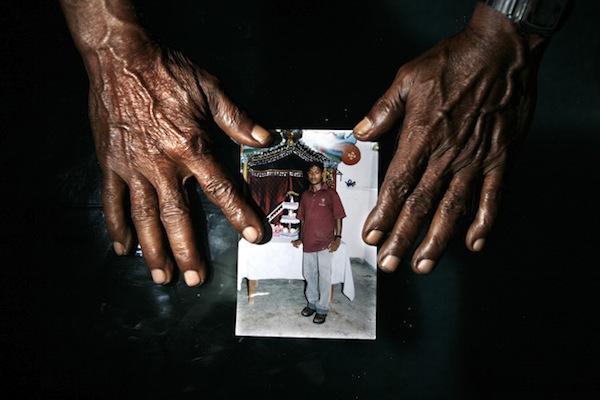
The Disappeared in Sri Lanka
Groundviews
Photo from HRW
A speech made today at a Vigil to Remember the Disappeared in Sri Lanka on The International Day of the Victims of Enforced Disappearances, held from 5-6pm at the State Library of Victoria premises in Melbourne, Australia.
I am honoured to have been asked to speak at this Vigil, to Remember the Disappeared in Sri Lanka on this important occasion, of The International Day of the Victims of Enforced Disappearances.
Sri Lanka is party to diverse declarations and conventions of the United Nations on human rights. Therefore, the main responsibility of protecting peoples’ rights lies with the government of the day.
Today’s vigil calls upon the government of Sri Lanka to release the names of those individuals, who surrendered to the government forces during the last phase of the armed conflict in 2009. This Vigil also demands the government of Sri Lanka to put an end to the practice of enforced disappearances.
These disappearances can be categorised into those enforced in the north east of the country, during the armed conflict between the LTTE and the government forces; and in the south in 1971, and again in the 1989-1990 period, during the insurrections between the Sinhala youth and the government forces.

VIDEO: TO THE STREET, IN THE NAME OF EDUCATION…
 University students took to the streets today (29) to protest against the situation of education in the country. Olcott Mawatha was closed opposite the Fort Railway station due to this protest march.
The Inter University Students’ Federation (IUSF) convener Sanjeewa Bandara stated that the protest is against many destructive decisions taken by the government. (Pic by Manjula Charantha)

VIDEO: TO THE STREET, IN THE NAME OF EDUCATION…
A disappearance every five days in post-war Sri Lanka

Groundview
Photo courtesy WSWS
On 21st at 2.31pm, August 2012, 32 year old Vasanthamala sent a sms from her mobile to her relatives saying she had been taken by the Criminal Investigation Department (CID) in Vavuniya. Around 8pm the same night, she made short phone calls to her mother and father, and said she was alright. When her parents had tried to find out where she was calling from, the call had been cut off and has been switched off thereafter, to date as her parents are still unable to get through to her.
When her father tried to complain to the Vavuniya Police, they had refused to accept the complaint stating that she must have eloped with a man. The complaint was only accepted once her father visited the Police station the following day along with his wife. Prior to the arrest, on the 19th of August, some persons claiming to be from the CID, had called Vasanthamala’s mother and told her that her daughter would be arrested unless she produced some documents to the Vavuniya Police. Even in July, 2012, the Police had made inquiries regarding Vasanthamala.
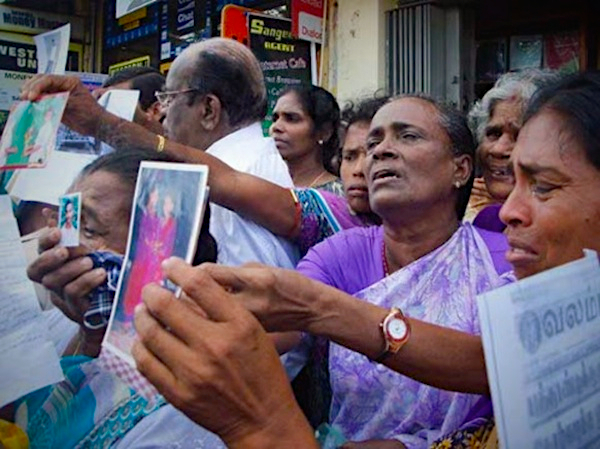
Vasanthamala’s parents were amongst the around 500 families of disappeared persons who gathered in Vavuniya today, 30th August 2012, the International Day of the Disappeared, demanding for justice, accountability and the whereabouts of their loved ones. . The families staged a peaceful protest on the A9 road in front of the Vavuniya bus stand, and later held a public meeting at the Vavuniya Urban Council hall. Most of the families were Tamil and from the North and the East, with many families of former LTTE leaders who have gone missing after surrendering, and also families of soldiers who are missing in action.
The event was held as disappearances (mostly in the form of abductions), continued to be reported at a rate of more than one every five days in post-war Sri Lanka. Twenty one disappearances (including attempted abductions) have been reported by Sri Lanka’s English media in the 100 days between April 1st and July 9th2012. This brings the total number of disappearances reported from 1st January to 9th July to 57. [1]
Lecturers go on strike, and the government has a drastic response
Sri Lanka’s universities-
Shuttered
 THE Buddhist monk, staring intently at the smoke rising from an incense stick, said the government was destroying state-provided education because it was “easier to control uneducated fools”. Maduluwawe Sobitha is an influential figure among Sri Lanka’s majority Sinhala population. He is also a loud critic of the government of President Mahinda Rajapaksa. The monk’s new National Movement Against Social Injustice is, with other groups and unions, backing a university lecturers’ strike for more state spending on education. Almost 5,000 academics stopped work on July 4th. Like them, he is angry that the government spends a mere 1.9% of GDP on schools and universities.
On August 23rd the higher education minister, S.B. Dissanayake, responded by closing down indefinitely the country’s state universities and institutes. He accused lecturers of dragging students into their campaign. Yet students, among them young Buddhist monks, still protest, demanding that the universities be reopened. On August 29th police in Colombo fired water cannon and tear gas at hundreds of students marching in support of academics. Members of the Inter University Students’ Federation (IUSF) retaliated by flinging whatever they could lay their hands on, including rocks and spent tear-gas canisters, at police.
This kind of volatility rattles Mr Rajapaksa’s regime. Universities are hotbeds of political activity, particularly by anti-government Marxist groups such as the People’s Liberation Front. The IUSF is affiliated with this party. That might be one reason why, in 2011, the higher education ministry ordered all universities to hire security from a firm run by the defence ministry, which happens to be headed by one of the president’s brothers. New university entrants also had to complete a course in “leadership training”—run by the army.
Arjuna Aluwihare, a former vice-chancellor and past chairman of the University Grants Commission, sees all this as a sign of the regime’s insecurity in the face of those who disagree with it. Some factions in the government think opponents are spoiling to instigate an Arab spring-style revolution. Mr Dissanayake openly accuses university lecturers of being part of a plot to bring about regime change.
That seems a far cry from the academics’ aims. They first asked for a 20% salary hike to stem a brain drain. But as talks between Mr Dissanayake and the Federation of University Teachers’ Associations (FUTA) crumbled, their wish list only grew. It now includes a demand for spending on education to be raised to 6% of GDP. They also want universities to be freed from government meddling. Schoolteachers are protesting, too, against a rapid decline in the quality of primary and secondary education. But toppling the government, Nirmal Ranjith, the FUTA president, laughs, “is not our business”.
Now Mr Rajapaksa has assigned another brother, Basil, to sort out the mess. He claims to be optimistic that the dispute can be resolved. But back at his temple, Maduluwawe Sobitha pledges support for the campaigners. It is in the country’s best interest, he insists while adjusting his robes, to have fewer fools around.
Scores Missing After Australia-Bound Refugee Boat Reports Distress

By MATT SIEGEL-August 30, 2012
SYDNEY, Australia — Ninety or more people remained missing Thursday after a boat carrying about 150 migrants sank off Indonesia, in another disaster this year for asylum seekers from the Middle East and Asia trying to reach Australia by sea.
The Australian home affairs minister, Jason Clare, expressed grave concern for the passengers and said that a “massive” search-and-rescue effort was under way to locate survivors. At least seven commercial ships and one military vessel were combing the waters around 40 nautical miles south of the Indonesian island of Java, he said, where the boat issued the first of two distress calls early on Wednesday morning.
Thousands of asylum seekers try to reach the remote Australian territory of Christmas Island each year on rickety, overcrowded vessels, leading to accidents at seathat have killed more than 600 people since late 2009. Australia’s Parliament passed legislation this month to allow boat refugees to be deported to offshore detention centers in an effort to stem the record number of arrivals, but the policy has not yet had any significant impact.
Six survivors were pulled from the wreckage of the ship early on Thursday, and 39 more were rescued later in the day by navy and merchant vessels, Mr. Clare said. He had warned earlier that rescuers had a shrinking window to locate any additional survivors.
“Potentially dozens and dozens haven’t survived,” Mr. Clare said in Sydney.
The Associated Press reported that a total of 55 people had been rescued, and that the captain of a rescue vessel said he saw bodies in the water.
A Liberian-flagged merchant vessel, the APL Bahrain, was reported by The Australian, a daily newspaper, to have rescued the first group of six survivors, all of them men. The survivors reportedly told the chief officer of the ship that women and children had been on the stricken vessel, which Mr. Clare said was believed to have been carrying up to 150 passengers. It was unclear whether women and children were among the survivors.
Australia had initially handed over responsibility for the search to the Indonesian search-and-rescue authority, Basarnas, which stopped looking for survivors Wednesday after failing to find any during its initial sweep. A spokesman for Basarnas told the Australian Broadcasting Corporation that it regretted calling off the search, but Mr. Clare defended the Indonesian agency’s actions.
“Don’t underestimate how difficult this task is; don’t underestimate how big the sea that we’re searching is,” he said.
This has the potential to be the largest disaster of its kind in terms of loss of life since at least June, when around 90 asylum seekers are believed to have drowned when their boat capsized during a similar journey from Java.
Australia has tried for years to come up with a policy that would deter would-be immigrants from trying to reach Christmas Island, a territory in the Indian Ocean that is Australia’s closest point to Indonesia. Prime Minister Julia Gillard had proposed sending asylum seekers to Malaysia for processing, but the plan was rejected by Australia’s highest court, and negotiations over a replacement plan broke down.
Sri Lankan Govt Must Answer about Thousands of Disappeared Tamils. UN denied Entry.
Thursday, 30 August 2012
 “There are concerns that some of the disappeared girls are being used as sex slaves by the Sri Lankan security forces”
/EINPresswire.com/ August 29, 2012: London ——
On the International Day of the Disappeared on August 30, Transnational Government of Tamil Eelam (TGTE) called upon the Sri Lankan Government to tell the truth about the thousands of Tamils, including babies, who disappeared.
It is reported that UN Working Group on Involuntary or Enforced Disappearances repeated requests to visit Sri Lanka was denied by the Sri Lankan Government.
“If the Sri Lankan Government has nothing to hide why should they deny UN’s visit?” asked Mr. Deluxon Morris, TGTE’s Minister for investigation of Genocide, war crimes and crimes against humanity. “Thousands of families are desperately looking for their loved ones who were taken into custody by the Sri Lankan Government forces.”
“There are concerns that some of the young girls who have disappeared are being used as sex slaves by the Sri Lankan security forces” said Mr. Deluxon Morris.
“Sri Lankan Government has routinely used disappearance as a tactic to terrorize the Tamil population. Sri Lanka has the unique distinction of disappearing whole families. This includes babies, women and elderly. Several Catholic and Hindu Priests also disappeared without any trace.” said Deluxon Morris.
The disappearance list goes on to include journalists, human rights defenders and ordinary citizens. These people were taken from homes, Refugee (IDP) camps, hospitals, work places and from streets. Several witnessed these people being arrested by the Sri Lankan Security forces.
Several family members of the disappeared testified before the Sri Lankan Government’s own Lessons Learnt and Reconciliation Commission (LLRC). In its website this commission has published only testimonies of Government officials. But it has not published testimonies from the families whose loved ones have disappeared. “This calls into question of LLRC’s credibility and impartiality”, said Deluxon Morris.
TGTE also urged the UN Working Group on Involuntary or Enforced Disappearances to have special focus on Sri Lanka in the upcoming UN meetings. According to this working group, it has received information of about 12,460 cases of disapperances in Sri Lanka.
About TGTE:
Transnational Government of Tamil Eelam (TGTE) was created in the aftermath of the bloody end of Sri Lanka’s war; resulting tens of thousands of Tamil civilians were killed and sexually assaulted by the Sri Lankan security forces. UN documented war crimes and recommended an International Commission of Inquiry.
Transnational Government of Tamil Eelam (TGTE) is a democratically elected government of the Tamil Diaspora of Sri Lanka. Its actions are non-violent, democratic and diplomatic. It held internationally supervised elections in twelve countries to elect Members of Parliament (MPs). These MPs drafted and ratified a Constitution and elected a Prime Minister, a 10 member Cabinet and a Speaker.
For information contact:
Deluxon Morris (UK): Tel: +(44)794-002-0758 or Email: warcrime@tgte.org
Web: www.tgte-us.org , www.en.naathamnews.com
It is reported that UN Working Group on Involuntary or Enforced Disappearances repeated requests to visit Sri Lanka was denied by the Sri Lankan Government.
“If the Sri Lankan Government has nothing to hide why should they deny UN’s visit?” asked Mr. Deluxon Morris, TGTE’s Minister for investigation of Genocide, war crimes and crimes against humanity. “Thousands of families are desperately looking for their loved ones who were taken into custody by the Sri Lankan Government forces.”
“There are concerns that some of the young girls who have disappeared are being used as sex slaves by the Sri Lankan security forces” said Mr. Deluxon Morris.
“Sri Lankan Government has routinely used disappearance as a tactic to terrorize the Tamil population. Sri Lanka has the unique distinction of disappearing whole families. This includes babies, women and elderly. Several Catholic and Hindu Priests also disappeared without any trace.” said Deluxon Morris.
The disappearance list goes on to include journalists, human rights defenders and ordinary citizens. These people were taken from homes, Refugee (IDP) camps, hospitals, work places and from streets. Several witnessed these people being arrested by the Sri Lankan Security forces.
Several family members of the disappeared testified before the Sri Lankan Government’s own Lessons Learnt and Reconciliation Commission (LLRC). In its website this commission has published only testimonies of Government officials. But it has not published testimonies from the families whose loved ones have disappeared. “This calls into question of LLRC’s credibility and impartiality”, said Deluxon Morris.
TGTE also urged the UN Working Group on Involuntary or Enforced Disappearances to have special focus on Sri Lanka in the upcoming UN meetings. According to this working group, it has received information of about 12,460 cases of disapperances in Sri Lanka.
About TGTE:
Transnational Government of Tamil Eelam (TGTE) was created in the aftermath of the bloody end of Sri Lanka’s war; resulting tens of thousands of Tamil civilians were killed and sexually assaulted by the Sri Lankan security forces. UN documented war crimes and recommended an International Commission of Inquiry.
Transnational Government of Tamil Eelam (TGTE) is a democratically elected government of the Tamil Diaspora of Sri Lanka. Its actions are non-violent, democratic and diplomatic. It held internationally supervised elections in twelve countries to elect Members of Parliament (MPs). These MPs drafted and ratified a Constitution and elected a Prime Minister, a 10 member Cabinet and a Speaker.
For information contact:
Deluxon Morris (UK): Tel: +(44)794-002-0758 or Email: warcrime@tgte.org
Web: www.tgte-us.org , www.en.naathamnews.com
Solution To The University Crisis: A View From An Academic

 Mr CA Chandraprema in his article published in the SundayIslandof 19th August has dedicated two paragraphs to my detailed response to his previous criticism of the current trade union action of academics. Even though he states that his faith in academia has been restored after reading my article, I find that his faith is still wavering as it has not stopped his dismissal of the key issues and usual endorsement of Government view. I was however encouraged enough to write a further article to address the concern he has raised why ‘senior academics’ were not involved in negotiations and in drafting the FUTA demands.

By Amal S. Kumarage -
Prof. Amal S. Kumarage
 Mr CA Chandraprema in his article published in the SundayIslandof 19th August has dedicated two paragraphs to my detailed response to his previous criticism of the current trade union action of academics. Even though he states that his faith in academia has been restored after reading my article, I find that his faith is still wavering as it has not stopped his dismissal of the key issues and usual endorsement of Government view. I was however encouraged enough to write a further article to address the concern he has raised why ‘senior academics’ were not involved in negotiations and in drafting the FUTA demands.
Missing the Issue by asking ‘Who’ instead of ‘What”
Sri Lankan society has steadily been conditioned to filter any information based on who says it rather than what is said. From branding all dissent as ‘unpatriotic’, all criticism as ‘politically intent’ and even opinion as ‘unnecessary’, society has been conditioned to listen to and believe in a single source as opposed to appreciating different views. This sadly, in spite of our long legacy of education, reflects the lack of a truly educated populace. In the context of the current trade union action, the attempts at dismissing FUTA as extreme and painting all universities and academics as clowns in a circus are attempts at yet again distancing the populace from one of the last bastions of resistance to popular political ideology that seems bent on making people accept explanation without inquiry and leadership without accountability. Many responses to my earlier article called it ‘realistic’ and ‘moderate’. Thus I stand on that confirmation to propose the following as a direction towards solving the university crisis.
Slipping and Sliding: Irresponsible Stewardship
The Table 1 shows funding for full time undergraduate courses for the last 3 years where detailed figures are available.
Family members of misplaced person stage protest in Vavuniya
[ Thursday, 30 August 2012, 12:28.31 PM GMT +05:30 ] To commemorate the international misplace person day organizers of the local and the international human rights organizations organized special protest in front of the Vavuniya bus depot today.
 Protesters urge the government to release the name list of misplaced persons in the country.
Members of the Tamil National Alliance and the Democratic People Front refused to take part in this protest.
 On the international misplaced persons day victims urge to hold special investigations on misplaced persons under the direction of united nation.
Family members of misplaced persons in Vavuniya were present at this protest.
 Family members of the misplace persons stress to grant opportunity to meet UN panel.
Family members of the misplaced persons, Human rights house, Mannar People organizations and several other movements organized this protest.
Large crowd gathered at the protest and urge to release their husband and children. They also stress to release information’s about their loved one.
Hundreds of people were present at the protest stage in front of the Vavuniya bus depot today.
Protesters stated Lankan government is the only responsible for the disappearance of their relatives.
At last protesters marched up to the Vavuniya cultural center. Many leaders delivered speech at the meeting.
Organizers stated this protest was organised by none government organizations in the district.
[ Thursday, 30 August 2012, 12:28.31 PM GMT +05:30 ]
To commemorate the international misplace person day organizers of the local and the international human rights organizations organized special protest in front of the Vavuniya bus depot today. Protesters urge the government to release the name list of misplaced persons in the country.
Members of the Tamil National Alliance and the Democratic People Front refused to take part in this protest.
 On the international misplaced persons day victims urge to hold special investigations on misplaced persons under the direction of united nation.
Family members of misplaced persons in Vavuniya were present at this protest.
 Family members of the misplace persons stress to grant opportunity to meet UN panel.
Family members of the misplaced persons, Human rights house, Mannar People organizations and several other movements organized this protest.
Large crowd gathered at the protest and urge to release their husband and children. They also stress to release information’s about their loved one.
Hundreds of people were present at the protest stage in front of the Vavuniya bus depot today.
Protesters stated Lankan government is the only responsible for the disappearance of their relatives.
At last protesters marched up to the Vavuniya cultural center. Many leaders delivered speech at the meeting.
Organizers stated this protest was organised by none government organizations in the district.
World marks day of the missing

AUGUST 29, 2012 8:54 AM • ASSOCIATED PRESS

FILE - This a Monday, April 30, 2007 file photo of Argentina’s Mothers of Plaza de Mayo hold torches as they rally with torches to mark the 30th anniversary of their first protest around Buenos Aires Plaza de Mayo to demand the return of their disappeared children on April 30, 1977. Tens of thousands of people throughout the world are listed as missing in armed conflicts and after illegal arrests, detentions, abduction or any other form of deprivation of human rights and liberty. On the International Day of the Disappeared on Thursday Aug.30, 2012 the International Commission on Missing Persons (ICMP) called on all governments to provide answers to families on the fate and whereabouts of the missing persons.(AP Photo/Eduardo Di Baia, File)
Tens of thousands of people around the world are missing today because of armed conflicts or human rights abuses such as abductions and illegal arrests and detentions.
As it prepares to mark the International Day of the Disappeared on Thursday, the International Commission on Missing Persons urged governments to provide families with answers about the fates and whereabouts of their missing loved ones. Human rights groups called such disappearances a crime against humanity that must be stopped.
WHO IS A MISSING PERSON?
Individuals reported missing because of in-country or international armed conflicts, or disturbances that require action by a neutral and independent body. Also, people who have been taken into custody by officials who refuse to publicly acknowledge that or conceal the fate and whereabouts of the disappeared persons.
WHICH ARE THE MOST PROMINENT CASES?
ARGENTINA _ Some 13,000 people are officially considered missing, thanks to the 1976-83 dictatorship in the military junta’s campaign to eliminate political dissenters. Human rights groups say that number is 30,000. People were kidnapped, thrown in the back of trucks and taken to clandestine torture camps. Many were drugged, chained and thrown alive from airplanes into the Rio de la Plata river. A “Never Again” commission formed shortly after Argentina’s democracy was restored in 1983 documented thousands of crimes against humanity during the military regime, but hardly any of the violators were prosecuted until Nestor Kirchner was elected president 20 years later.
BOSNIA _ Bosnian Serb troops overran the U.N.-protected enclave of Srebrenica in July 1995, killing an estimated 8,000 people. Most of the Bosnian Muslim men and boys were executed and buried in mass graves. Serbs tried to hide the crime by digging up the graves and distributing the remains in several other secret sites. The process led to the bones of the same people being found in several graves, or not found at all. More than 10,000 people, out of the 14,000 people still missing from the 1991-95 wars in the former Yugoslavia, are linked to the Bosnian conflict.
CAMBODIA _ In 1975-1979, Cambodia’s brutal Khmer Rouge orchestrated a genocidal reign of terror ostensibly aimed at creating an agrarian utopia. By the time it was over, an estimated 1.7 million people were dead from executions, starvation and overwork. That number includes many missing people. Although several hundred mass grave sites have been found, most were never dug up. There has never been any comprehensive research or study to determine the number of missing. Countless families in Cambodia today have missing relatives who were never found and are presumed dead. A U.N.-backed tribunal was set up in 2006, but after six years and $160 million it has just begun the trials of three top Khmer Rouge leaders and only convicted former prison chief, Comrade Duch.
IRAQ _ An estimated 15,000 people have been missing in Iraq since the U.S.-led war, which began in 2003 and ended last year. Kamil Amin, a spokesman for Iraq’s human rights ministry, said it has created a database of the missing, based on their relatives’ accounts of their names, addresses, when they were last seen and the kind of clothes they were wearing when they disappeared. However, the ministry did not ask for international assistance in locating the people “because we consider the cases of those missing people as isolated and criminal cases.”
KOREAS _ North Korea abducted about 86,000 South Koreans during the 1950-1953 Korean War and 700 others after it, according to the Seoul-based, government-affiliated National Committee on Investigating Abductions during the Korean War. South Korea has asked North Korea to return the abductees, but the North denies kidnapping them, according to committee official Kim Suk-nam.
TURKEY _ Although many mass graves in Turkey can be traced to the beginning of the century, a map recently published in the daily Radikal highlights the startling extent of such sites dating from the 1990s, when the war between the Turkish state and the Kurdish nationalist Kurdish Workers’ Party was at its prime. The bodies of thousands of people were unceremoniously dumped into mass graves, says Amnesty International.
PAKISTAN _ Pakistan has joined a list of countries practicing enforced disappearance. People who have disappeared include foreign and Pakistani nationals suspected of links to terrorist groups and political opponents of the Pakistani government pushing for greater rights for their communities, including Baloch and Sindhis.
SRI LANKA _ Its civil war ended in 2009 after government troops defeated Tamil Tiger rebels who were fighting for a separate state in the country’s north and east. Since then both government forces and rebels have been accused of rights violations during the conflict. The government has maintained a heavy military presence in the north, despite international calls for a reduction of troops there. Scores of ethnic Tamils suspected of having links with the rebels have disappeared, and so have several dissidents.
OTHER COUNTRIES OR REGIONS WITH MANY MISSING PERSONS
Armenia, Azerbaijan, Brazil, Burundi, Chile, Colombia, Croatia, East Timor, Eritrea, Ethiopia, Georgia, Guatemala, Israel, Iran, Ivory Coast, Jordan, Kuwait, Kyrgyzstan, Lebanon, Libya, Mexico, Nepal, Peru, Russia, Senegal, Serbia, Kosovo, Uganda, Western Sahara.
Chinese Defence Minister in Sri Lanka to strengthen ties

ANANTH KRISHNAN-BEIJING, August 30, 2012

ANANTH KRISHNAN-BEIJING, August 30, 2012

Chinese Defence Minister Liang Guanglie arrived in Colombo on Wednesday on a five-day visit aimed at solidifying military ties that have grown increasingly close following the end of the war in Sri Lanka.
General Liang’s trip comes amid reports that China will pledge US$ 100 million to help take forward Sri Lankan Army projects in the war-ravaged north and northeast.
During his five-day visit, General Liang and his 25-member delegation are scheduled to visit a number of military facilities in the north.
He is expected to give a lecture at the Defence Services Command and Staff College at Sapugaskanda, as well as visit an Army Cantonment in Panagoda and the Defence Services College in Colombo, for which China has provided some financial assistance.
He will also meet with President Mahinda Rajapaksa. On arrival at the Bandaranaike International Airport on Wednesday morning, General Liang was greeted by the Commander of the Sri Lankan Army, Lieutenant General Jagath Jayasuriya, Commander of the Navy Vice Admiral DWAS Dissanayake and Commander of the Air Force Air Marshal HD Abeywickrama, the Sri Lankan Ministry of Defence said in a statement.
In June, Sri Lanka and China pledged to deepen defence ties when Lieutenant General Jayasuriya visited Beijing. China’s substantial military assistance to the Sri Lankan government during the closing stages of the war in 2009 has been seen by Sri Lankan officials as crucial to their victory over the LTTE – a point stressed by every visiting Sri Lankan official to Beijing in recent months. General Liang said then that China was “willing to make joint efforts with Sri Lanka to boost bilateral relations”.
China has also reiterated its support to Sri Lanka against persistent international pressure over its reconciliation process, with Chinese officials stressing that it was their view that Sri Lanka should address its internal issues without international interference. China has assured Sri Lanka, as a permanent member of the UN Security Council, of its continued support against any international pressure.
Following his visit, General Liang will travel to New Delhi on Sunday, September 2, for a five-day visit to India, which will mark the first visit by a Chinese Defence Minister in seven years.
Subscribe to:
Posts (Atom)