Saturday, January 31, 2015


article_image
by Rajan Philips-

"We cannot rewrite history, but we can right history," said Justice John C. Hayes III last week in a South Carolina Court in the US, while retroactively vacating the guilty verdicts against nine African Americans for sitting at an all-white lunch counter in a popular restaurant in Rock Hill, South Carolina, on January 31, 1961. They were 18-year-old high school students then and went to jail, refusing bail, and inspiring other Civil Rights activists of that era. Now in their seventies they had to wait for 54 years to have history righted. By that standard, the righting of judicial history in Sri Lanka took just two years to be accomplished. Even two months ago, no one could have imagined such a swift reversal of the vulgar and highhanded impeachment of Chief Justice Shirani Bandaranayake in January 2013. What took place on Wednesday and Thursday was a necessary course correction, which necessarily took an unusual detour.

Mohan Pieris, the hitherto ‘de facto’ Chief Justice, was sent home packing on the technicality that he had been appointed to a non-vacant position by virtue of the procedural flaw in the then government’s impeachment resolution. In other words, the Rajapaksa government had not technically impeached the Chief Justice, even though it crowed it did so disregarding procedural objections, and bullied Dr. Bandaranayake to vacate her office and her official residence. Quite properly, the ‘de jure’ Chief Justice returned to the Supreme Court just for one day and retired, enabling the government to appoint Justice K. Sripavan as the new Chief Justice. History has been righted. The proposed constitutional changes should make sure that the judiciary is never again monkeyed with by the Head of State and/or Head of Government, as it has been since 1978.

The High Noon drama could have been avoided if Mohan Pieris had gracefully walked away from a position that he had disgracefully come to occupy. Pieris should have vacated his position just as the Governor of the Central Bank and the Secretaries to the Ministries of Defence and Finance vacated theirs after the January 8 election. He should have known that the reinstatement of Shirani Bandaranayake was an undertaking in the opposition manifesto (Paragraph #94) at the election, and he dug his hole deeper by attending a controversial meeting at Temple Trees with the outgoing president in the wee hours of January 9 morning, while vote counting was still going on. What additional signal did he need after the mighty national snub of not being called upon to deliver the oath of office to the newly elected President? He had the gall to ask for a diplomatic posting, but got clever by half and did not take it when he was offered one. In the end, he had no place left to go except his private home.

He is the master of his own misfortune, but as a Catholic he should know there is still life after trespasses both in this world and the next. He could use the upcoming Lent Season for a religious retreat, sing ‘God of Mercy and Compassion’ in atonement, rediscover his moral moorings in the Bible, and start bandying the message of his reformation to others as Felix Dias did after 1977.

That said, the government could have managed the inevitable surgery at the apex of the judiciary with some solemnity and earnestness through timely statements in parliament. The back and forth in the media between Pieris and government ministers was not an edifying instance of good governance. Parliament and not media scrums should be the first and the main forum for messaging. The general media can and will broadcast what transpires in parliament, but there is no point in persisting with the parody of cabinet briefings bypassing parliament that became a feature during the Old Regime. Nor is it necessary for cabinet ministers to offer broadsides on matters way outside their portfolios. They should be disciplined to mind and speak to their portfolios and files only.

Unlike the High Noon at Hultsdorp, the Central Bank came in for a quiet reallocation from the responsibilities of the Finance Minister to those of the Prime Minister, by way of a gazette notification. This is a significant departure from normal practice which should have warranted a statement by the Prime Minister in parliament. Not surprisingly, no one in parliament raised any concern about this. The matter has received some publicity thanks to Dr. WA Wijeywardena, a former Central Bank Deputy Governor, writing about it in one of his weekly articles. While calling the move "legally and operationally unworkable", Dr. Wijewardena, to my mind, is being charitable in also arguing that the new move could be "a step toward the bank’s independence." He does not give much credence to the litigation involving the new Finance Minister and the Central Bank’s implication in it, as being a plausible reason for listing the Central Bank under the Prime Minister instead of the Finance Minister. But no one knows the government’s real reason for this departure from normal practice, and the Prime Minister and the government have not helped the cause of good governance by doing things opaquely by gazette notification without a transparent explanation in parliament.

It was apparent during the election campaign that the topic of good governance was not just a Colombo fad, but one that resonated well in the villages and outstations. When people outside Colombo began using expressions like yahapalanaya, they were not parroting in the vernacular what the Colombo elites are accused of picking up from UN texts and Wikipedia accounts about good governance, but were giving verbal expression to their experience of bad governance under the Old Regime. The people do not know the text book attributes of good governance but they sure know what they want from a new government after experiencing under the Old Regime everything they do not want to see in any government. Needless to say, most of what the Old Regime did was in contravention of the norms of good governance, and while exposing the misdoings of the Old Regime the new administration must also demonstrate how it is doing things differently. At Hultsdorp, the government did what it had to do. In regard to the Central Bank, the government owes an explanation to parliament and through it to the people.

Mohan Peiris says his removal as CJ was ‘unlawful’

Mohan Peiris says his removal as CJ was ‘unlawful’
logoMohan Peiris says that he has not retired, resigned or vacated the office of Chief Justice and that, however, due to exertions by external forces he has been displaced from office through an “unconstitutional process.”
January 31, 2015 

Mahindananda’s era of mirth and merriment ends; Transport Director of ex President’s secretariat also served with same order


LEN logo(Lanka-e-News- 27.Jan.2015, 11.45PM) When bribery and corruption charges against former sports minister Mahindananda Aluthgamamage involving a sum of Rs. 14 million rupees that was suppressed hitherto was taken up again by the commission inquiring into bribery and corruption , it was decided by the commission that the passport of ex minister shall be impounded ,in order to temporarily prevent him from fleeing from the country.
It is worthy of note though the JVP filed action against the ex minister long ago, the notorious Rajapakses who are a byword for corruption and monumental frauds suppressed the investigation.
The corrupt regime , in order to get all its foul and filthy work done to the regime’s advantage during the period of the elections appointed a most incompetent Ganesh Dharmawardena as the Director general in place of former Directress general of the commission Ms.Lakshmi Jayawickrema after having her removed earlier on.
Ganesh is an ordinary junior lawyer and has not been associated with the government service . He became notorious when he took under his custody the file of Aluthgamage while there were glaring monumental charges of bribery against Aluthgamage , and suppressed the investigations.
On top of this , when an inland revenue officer who was a relative (brother) of ex President was caught red handed by the officers of the commission while accepting a bribe of Rs. 400,000 .00 in cash , the Chairman and Director general of the commission together suppressed the inquiries. Now , it has become imperative that this file is investigated.
Meanwhile , the Fort magistrate ,Colombo , Thilina Gamage gave an order yesterday (26) to impound the passport of Keerthi Samarasinghe who was the transport Director attached to the Presidential secretariat during the corrupt Rajapakse era, while directing the Immigration and emigration department to bar his foreign travel.
This order was given by court following the CID informing court that the on going investigations will be hampered if Keerthi Samarasinghe leaves the country.
---------------------------
by     (2015-01-28 01:37:49)

Over Rs. 700 million spent by Rajapaksa government for a bid

namal 12
Saturday, 31 January 2015 
Details of the massive wastage of public funds by the previous Mahinda Rajapaksa government are now being exposed.
Among the many incidents of such wastage of public funds is the wasting of over Rs. 700 million on a bid that Sri Lanka actually lost.
Finance Minister Ravi Karunanayake said during the budget speech that over Rs.760 million of public money was wastefully spent on the unsuccessful presentation of the Commonwealth Games bid by the former regime.
Former Central Bank Governor Ajith Nivad Cabraal was the co-chairman of the Hambantota 2018 bid.
Cabraal travelled to St Kitts together with a 160 strong delegation that included co-chairman Minister Mahindananda Aluthgamage, UPFA MP Namal Rajapaksa, provincial councilor Anarkali Akarsha and former national cricketers Muttiah Muralitharan and Aravinda de Silva among others.
The failed Commonwealth Games bid is just one in many instances wear the public has had to bear the lavishness of the former regime.

Does One Violate Buddha’s Teaching By Worshiping Objects?

Colombo Telegraph
By Kapila Abhayawansa -January 30, 2015
Prof Kapila Abhayawansa
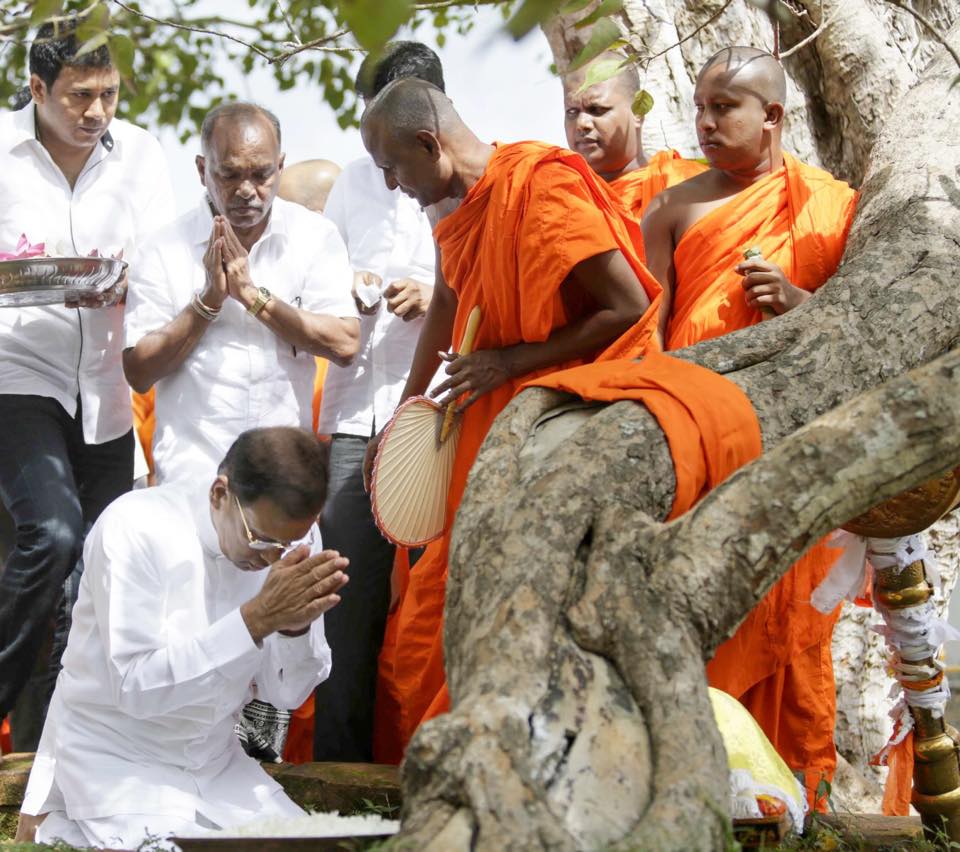
I have read the article entitled “The President’s Faux Pas” written bySharmini Serasinghe in Colombo Telegraph dated 27th January. Referring to President’s homage to Bo tree, she observes: “, it is with deep despair, that I as a Buddhist noted, you President Maitripala Sirisena paying homage to a Bo tree, even though it is venerated by a majority of the Buddhist populace of this country. Furthermore, by paying homage to a Bo tree, you Mr. President are also openly violating the teachings of the Buddha, who denounced the worship of objects!”.
Maithri Sri Maha bodhi 1In my opinion, the President is not the one who violated the teachings of the Buddha by paying homage to Bo tree but Sharmini Serasinghe by saying that the Buddha denounced the worship of objects.
As the above mentioned statement of Sharmini leads to misinterpretation of the teachings of the Buddha I would like to make the following remarks:
In fact, the Buddha never denounced the worship of sacred objects as a mark of respect. What the Buddha denounced was the homage of object as a path to liberation. It is explicitly pointed out by the Buddha in the verses 188 to 192 of the Dhammapada.

Into The Jungle With Sri Lanka’s Last Hunter-Gatherers

A trip into the jungle with members of one of Sri Lanka’s oldest tribes reveals a way of life both richly entwined with nature, yet ever more precarious.

Tom Sykes
Tom Sykes -01.31.15The Daily Beast
Over two thousand years ago, a lion made love to a beautiful woman in India, and their son, Sinhabahu, was born with lion paws for hands and feet. Sinhabahu in turn had a son called Vijaya, who became the first, legendary king of Sri Lanka (the people call themselves Sinhalase—meaning ‘lion people’) after he and 700 followers arrived on the tropical island, off India’s South East coast, some time around 500BC.

Bangladesh plastics factory fire kills at least 13 people

Scores were injured and more people may have died at Nasim Plastic House in a crowded market in the suburb of Mirpur, police official says
Bangladesh Plastic Factory Fire Firefighters and locals try to douse the fire at a plastic factory in Mirpur. Photograph: Suvra Kanti Das/ Suvra Kanti Das/ZUMA Press/Corbis
Saturday 31 January 2015 
At least 13 people including two women were killed when a fire swept through a plastics factory in Bangladesh’s capital Dhaka on Saturday.
Scores were injured and more people may have died at Nasim Plastic House in a crowded market in the suburb of Mirpur, a police official said.
“We are searching under a collapsed wall ... There might be more bodies under the debris,” fire service and civil defence director AKM Shakil Newaz said.
Fire department control official Mohammed Farhaduzzaman said the fire broke out Saturday evening at the five-storey factory.
He said 13 bodies were recovered from the gutted building and three people were hospitalized with burn injuries.
About 70 workers were inside the factory when the blaze broke out, said police.
The issue of safety in Bangladeshi factories was thrust into the spotlight by the collapse of the Rana Plaza building in April 2013, which killed more than 1,100 garment workers.

Yazidis battling ISIS appeal Israel and Netanyahu for help

Iraqi minority militia says Yazidis support Israel, fight similar enemies, ask for weapons, aid, and training.

Yazidi fighters gather on the summit of Mount Sinjar,  in Iraq, Dec. 21, 2014.
Yazidi fighters gather on the summit of Mount Sinjar as they head to battle ISIS militants, in Iraq, Dec. 21, 2014.Photo by AP
Haaretz.com

By  | Jan. 30, 2015
An official in a militia organized by Iraq’s Yazidi minority has issued a public call for Israeli assistance.
Lt. Col. Lukman Ibrahim, speaking to Al-Monitor, said the militia needs weapons and aid, and would like Israeli assistance so it can fight Islamic State, or ISIS. He said the Yazidis support Israel and fight similar enemies.
Israel has yet to respond to the Yazidi request.
The militia, with 12,000 members, was organized in August to defend against ISIS, which has persecuted and killed the minority since capturing Yazidi cities last year. Most of the fighters are untrained.
“We appeal to the Israeli government and its leader to step in and help this nation, which loves the Jewish people,” Ibrahim was quoted as saying by Al-Monitor. “We would be most grateful for the establishment of military ties — for instance, the training of fighters and the formation of joint teams. We are well aware of the circumstances the Israelis are in, and of the suffering they have endured at the hands of the Arabs ever since the establishment of their state. We, too, are suffering on account of them.”
A Yazidi doctor who lives in Germany said that Yazidis and Jews can also find common ground in both being victims of genocide.
“What happened to us is the biggest genocide since the Holocaust of the Jews in Europe,” said Dr. Mirza Dinnay, a pediatrician, told Al-Monitor. “In the Holocaust, the goal was to annihilate an entire people, the Jews. IS has a similar plan — to exterminate an entire people, the Yazidis.”

Israeli Soldier Posts Photos Of Herself Smiling Next To Blindfolded Palestinian Prisoners

Highlighting the cold indifference and cruelty that has come to characterize the Israeli occupation, a recently discharged soldier has posted photos of herself smiling as she sits besides blindfolded Palestinian prisoners.
Eden Abergil2
(ANTIMEDIA) Meet Eden Abergil – a former Israeli soldier who recently posted photos of herself smiling next to blindfolded Palestinian prisoners, on Facebook.
Abergil titled the Album that contains these photos, “The army…the most beautiful time of my life.”
The photos were flooded with sexual innuendos and other remarks about Abergil. One comment states, “You’re the sexiest like that,” and Abergil’s response to this comment mocks the detained man in the photo by saying: “I wonder if he’s got Facebook,” and “I have to tag him in the picture.”
The photos have gotten backlash from both the Israeli army and the Palestinians alike. So much backlash, that the photos have even been compared to the infamous Abu Ghraib photos that showed American soldiers smiling and giving a ‘thumbs up’ next to prisoners who were being tortured and humiliated.
abu-ghraibBut because Abergil is a former solider and not currently active, it’s unclear whether or not any legal action will be taken against her for posting such shameful photos and Abergil insists she did nothing wrong. If the tables were turned, I’m sure she wouldn’t think so. But we digress.
However, this is clearly not an isolated incident. There have beencountless reports of detainees being tortured, terrorized and humiliated by both the IDF in Israel/Palestine and by U.S. soldiers in various locations including Abu Ghraib and Guantanamo Bay or ‘Gitmo’. In fact, it’s almost overwhelming how often this happens and needless to say it is disgusting and shameful.
Ah well, for “love of God and country,” right?

Leader of Lebanon’s Hezbollah warns group is ready for war with Israel

Ukraine peace talks collapse, Kiev and separatists trade blame

Ukrainian politician Viktor Medvedchuk (R) arrives to take part in peace talks in Minsk January 31, 2015. REUTERS-Vasily Fedosenko1 OF 9. Ukrainian politician Viktor Medvedchuk (R) arrives to take part in peace talks in Minsk January 31, 2015. 
ReutersBY ANDREI MAKHOVSKY AND RICHARD BALMFORTH-Sat Jan 31, 2015
(Reuters) - Peace talks on Ukraine collapsed on Saturday after just over four hours with no tangible progress towards a new ceasefire but with Ukraine's representative and separatist envoys angrily accusing each other of sabotaging the meeting.
Ukraine's representative, former president Leonid Kuchma, left the talks in Minsk, Belarus, telling Interfax news agency that separatist officials had undermined the meeting by making ultimatums and refusing "to discuss a plan of measures for a quick ceasefire and a pull-back of heavy weapons".
Denis Pushilin, one of the separatist officials, told the Russian news agency RIA that they were ready for dialogue "but not ready for ultimatums from Kiev while shelling by their forces is going on in the background of towns in the Donbass (industrialised eastern Ukraine)".
The meeting of the "contact group", which also involves a Russian envoy and an official from the Organization for Security and Cooperation in Europe, took place in the Belarussian capital even as fighting between Kiev's forces and the Russian-backed rebels raged on in Ukraine's east, claiming more civilian and military lives.
The outcome dashed hopes that a new ceasefire could be put together soon to stem nine months of conflict pitting Ukrainian government forces against Russian-backed separatists who have declared "people's republics" in eastern Ukraine.
Shortly before the Minsk talks broke up, German Chancellor Angela Merkel, French President Francois Hollande and Russia's Vladimir Putin in a three-way phone call had expressed the hope the meeting would at least produce a ceasefire agreement.
More than 5,000 people have died since the conflict erupted last April following Russia's annexation of Crimea in response to the ousting of a Moscow-backed president in Kiev by street protests.
The conflict has produced the gravest crisis between Russia and the West since the Cold War with the United States and the European Union imposing sanctions on Moscow because of what they say is incontrovertible proof that it is providing arms and men in support of the separatists. Moscow denies this is so.
Kuchma also reproached the two main separatist leaders in eastern Ukraine, who signed key agreements in Minsk last September, for failing to attend Saturday's follow-up meeting of the "contact group".
He said Kiev remained adamant that it wanted the separatists to honour agreements made in Minsk last September for a ceasefire as part of a 12-point blueprint for peace. Much-violated from the start, that truce collapsed completely with a new rebel advance last week.
Interfax quoted him as saying he awaited to hear Russia's reaction to the outcome soon.
WIDESPREAD VIOLENCE
The September Minsk peace plan also called for tighter control of the joint Russia-Ukraine border, through which Kiev says Moscow is funnelling fighters and equipment, and the freeing of prisoners held by the sides.
Much has changed on the ground, however, since September.
The separatists have set up self-proclaimed "people's republics", while their forces, which Kiev says are supported by 9,000 Russian regular troops, have seized more than 500 square km (190 square miles) of territory beyond that agreed in the Minsk talks and threaten to seize control of the east's two main regions entirely.
Both sides have accused each other of deadly artillery and mortar strikes on civilian targets in the past two weeks, including on a cultural centre in the main regional city of Donetsk on Friday that killed at least five people waiting for humanitarian hand-outs.
Heavy shelling continued on Saturday in Ukraine's eastern regions as the separatists sought to tighten a circle around government forces clinging on to control of the strategic rail and road junction of Debaltseve.
Regional police chief Vyacheslav Abroskin, in a Facebook post, said 12 civilians had been killed on Saturday by separatist artillery shelling of the town, which lies to the northeast of Donetsk.
Defence Minister Stepan Poltorak said 15 Ukrainian soldiers had been killed and 30 wounded in clashes across the east.
Debaltseve is on the main highway linking Donetsk and the other big rebel-controlled city of Luhansk and is also a vital rail link for goods traffic from Russia which Kiev accuses of arming the rebels.
The rebels were also continuing to threaten Mariupol, a town of half a million in the southeast of the country on the coast of Sea of Azov, military spokesman Andriy Lysenko said.

(Additional reporting by Natalia Zinets in Kiev and Paul Carrel in Berlin; Editing by Alison Williams)