Peace for the World World ! Your War Our Lives

The Dalai Lama
A Brief Colonial History Of Ceylon(SriLanka)
Sri Lanka: One Island Two Nations
A Brief Colonial History Of Ceylon(SriLanka)
Sri Lanka: One Island Two Nations
(Full Story)
Back to 500BC.

Thursday, March 31, 2016
Three arrested with illegal firearms

 March 30, 2016
Two individuals have been arrested for possession of illegal firearms and live ammunition from a house in Habaraduwa, the police said.
Acting on a tipoff, a team from the Habaraduwa police made the arrest last evening.
The police have seized five firearms and 69 live bullets during the raid. The suspects have been identified as residents of Unawatuna and Boralesgamuwa, according to the police.
They will be produced before the Galle Magistrate today. Meanwhile, in another raid, a 29-year-old was arrested with a T-56 firearm and 29 live bullets in Elpitiya.
 March 30, 2016
 Two individuals have been arrested for possession of illegal firearms and live ammunition from a house in Habaraduwa, the police said.
Acting on a tipoff, a team from the Habaraduwa police made the arrest last evening.
The police have seized five firearms and 69 live bullets during the raid. The suspects have been identified as residents of Unawatuna and Boralesgamuwa, according to the police.
They will be produced before the Galle Magistrate today. Meanwhile, in another raid, a 29-year-old was arrested with a T-56 firearm and 29 live bullets in Elpitiya.

Detection of bombs , suicide kit in Chavakacheri : Truth uncovered – Did MR’s brother in law and wife conspire with LTTE Oothaselva


 (Lanka-e-News
-30.March.2016, 11.30PM) Following the discovery of highly explosive
materials and a suicide kit today at Maravanpulaw, Chavakachcheri , the
intelligence division has been able to unearth a wealth of information
in that connection.
(Lanka-e-News
-30.March.2016, 11.30PM) Following the discovery of highly explosive
materials and a suicide kit today at Maravanpulaw, Chavakachcheri , the
intelligence division has been able to unearth a wealth of information
in that connection.
Three bags containing highly explosive materials , a suicide kit , 4
bombs, 10 packets of cartridges, along with two batteries were found
hidden at this venue . The intelligence division is harboring
suspicions that these explosives , kits and devices were meant to be
used on the 3 rd of April targeting the president and VIPs at the
function to be held in Jaffna district under the leadership of
president Maithripala,
Based on information received by the Intelligence division , by the time the security division discovered these bombs , explosives ,suicide kit , batteries and cartridges today , the owners of the house had fled away. These explosives etc . being kept wrapped in a Sinhala newspaper had drawn the attention of the security division.
Based on information received by the Intelligence division , by the time the security division discovered these bombs , explosives ,suicide kit , batteries and cartridges today , the owners of the house had fled away. These explosives etc . being kept wrapped in a Sinhala newspaper had drawn the attention of the security division.
Previously , a conspiracy that was hatched by ex president Mahinda
Rajapakse along with some LTTE cronies in a camp of the forces was
exposed by Jaffna UNP organizer Thyagaraja Thuwarakeshwaram . Thereafter
, the security division based on the veracity of that exposure , was
very vigilant .
The prominent pro Rajapakse conspirators Hendavitharane and Wakishta
formerly of the intelligence division co ordinating the elections at
Kurunegala on behalf of ex president Mahinda Rajapakse ; fielding a pro
LTTE er as a candidate on behalf of Mahinda Rajapakse for Kurunegala ;
the statement made by Thyagaraja Thuwarakeshwaram ‘ and the discovery of
these explosives etc . are being extensively investigated by the
security division to ascertain whether all these have any connection.
The exposure made by Thyagaraja Thuwarakeshwaram is as follows :
''I have most clearly and strongly explained this matter to
His excellency the president Miathripala Sirisena , Hon. Prime minister
Ranil Wickremesinghe and defense minister Ruwan Wijewardena .At the
next Thai pongal day , there is need for heavy security . Therefore ,
it is only with detailed security plans the Thai Pongal day shall be
held here. I am openly stating this .
You know on the 20 th , Oothaselva ,Oothasedhu and Dr. Lohan Gunawardena plotted a conspiracy to murder president Maithripala Sirisena on his way to a camp . This was planned together with Mahinda Rajapakse’s brother in law , a high ranking officer of the intelligence division and his wife who arrived at a place at Nelliady belonging to Oothaselva where the conspiracy was hatched.
You know on the 20 th , Oothaselva ,Oothasedhu and Dr. Lohan Gunawardena plotted a conspiracy to murder president Maithripala Sirisena on his way to a camp . This was planned together with Mahinda Rajapakse’s brother in law , a high ranking officer of the intelligence division and his wife who arrived at a place at Nelliady belonging to Oothaselva where the conspiracy was hatched.
They have 17 weapons in their possession . Those are the weapons
that were robbed from the LTTE. He is one who had been in high ranks.
In addition ,he is engaged in diverse fund collecting activities .'' Thyagaraja revealed with grave concern.
Meanwhile defense secretary Karunasena Hettiarachi stated, simply
because explosives were found at Chavakacheri, it cannot be concluded
that there is a threat to national security. After the war , on various
occasions there had been reports of such explosives etc . having been
detected . If anybody is saying by that there is a threat to national
security , he is making such statements because he does not know
anything about country’s security , Hettiarachi went on to point out.
On the other hand , Dr. G.L. Peiris who participated in a media
conference on behalf of the opposition of coconut robbers exclaimed,
‘don’t consider the Chavakacheri incident as trivial.’
---------------------------
by (2016-03-30 21:29:50)
by (2016-03-30 21:29:50)
Israel’s West Bank land grabs biggest in decades
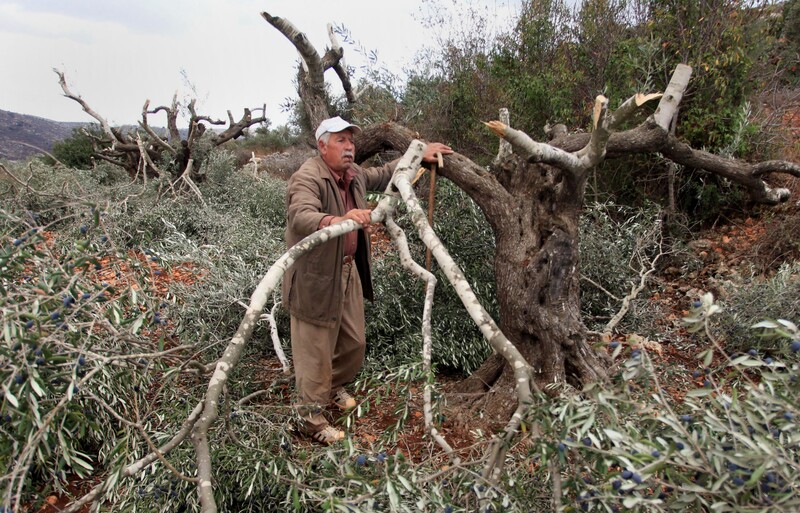
A Palestinian olive farmer inspects damage to his trees cut down by
Israeli settlers from the settlement of Eli, close to the village of
Qaryout, near the occupied West Bank city of Nablus, on 19 October 2013.
Israel recently declared village lands to be part of the settlement.

Charlotte Silver-30 March 2016
This month, Israel announced two sweeping land grabs in the northern and central occupied West Bank, prompting anti-settlement group Peace Now to warn that the Israeli government had reverted to its major land confiscation policies pre-dating the 1993 Oslo accords.
On 21 March, Israeli authorities began notifying Palestinian residents
of the Nablus-area villages of al-Sawiya, al-Lubban al-Sharqiya and
Qaryout that their land would be declared “state land” and become part
of the Israeli settlement Eli.
The villages had been appealing the inclusion of their lands in the settlement to Israel’s high court since 2014.
The total amount seized is unclear, with Palestinian sources reporting 1,200 dunums (300 acres) and Israel’s occupation administration COGAT reporting 612 dunums would be added to Eli.
A week prior to that, Israel announced it
would confiscate 2,342 dunams (579 acres) of land near Jericho and
along the corridor between Jerusalem and the Dead Sea, a valuable
thoroughfare for the tourism industry.
According to Peace Now, the land will be used to construct hundreds of
new housing units, as well as tourist sites and souvenir shops along the
road.
Within this area are also 20 villages of the Bedouin Jahalin tribe, which Israel has been trying to forcibly displace.
Israel intends to build thousands of settler housing units in the area
between Jerusalem and Jericho, in the occupied West Bank, which it
calls E1.
The new Israeli colonies would further isolate East Jerusalem from the
rest of the occupied West Bank and divide the West Bank from north to
south.
While Prime Minister Benjamin Netanyahu delayed the massive E1 project in 2013 in response to international pressure, he has quietly revived construction plans.
Last December, Peace Now reported it had obtained documents under the
freedom of information law that showed the housing ministry was planning
to build thousands of homes in E1.
Lip service
The United Nations criticized this month’s land seizure near Jericho, calling the move an “impediment to the two-state solution.”
The UN reiterated the long-standing position that “settlements are
illegal under international law,” but other than occasional verbal
admonishment, the international organization and its member governments
have taken no action to hold Israel accountable.
The US State Department also criticized Israel for “fundamentally undermining the prospects for a two-state solution.”
“In a way, they are cutting off the West Bank with this latest announcement because the lands are located in a strategic area,” Jamal Juma, the coordinator for the Stop the Wall grassroots campaign, told Middle East Eye.
“They lie next to the Green Line on one side and extend all the way to
the Jordan Valley,” he added, using a common term for the 1949 armistice
line that separates Israel as it was established in 1948 from the West
Bank, which it occupied in 1967. “If carried out, this will mean that
the entire north of the West Bank will be cut off from the middle of the
West Bank.”
Less than two years ago, Israel announced the seizure of 1,000 dunums near Bethlehem, eliciting similar disavowals – and a similar absence of concrete action – from US and UN officials.
Peace Now said then that there had not been such a large land seizure in the West Bank since the 1980s.
Uninterrupted confiscations
Peace Now, an organization as committed to preserving Israel as a Jewish-majority state as it is to ending the occupation of the West Bank, has maintained for years that despite a tripling of the settler population since theOslo accords, the two-state solution remains viable.
Peace Now has based its argument on the fact that most of the growth has
occurred within so-called settlement blocs that would remain under
Israel’s control according to hypothetical “land swaps” which would retroactively legitimize its land grabs.
By expanding the definition of these settlement blocs, Israel can
conceal the extent to which its control over the West Bank has continued
to deepen in spite of the peace process.
Yiftah Curiel, the spokesperson for Israel’s London embassy, recently claimed that
“90 or 95 percent of the settlements are within what’s called
settlement blocs … So, I think that the settlements are not the main
obstacle perhaps to peace as some would like to view them.”
Indeed, most of the land on which settlements now stand was declared “state land” by Israel’s military during the 1980s,
after Israel’s high court ruled that settlements could not be built on
private Palestinian land expropriated through military orders.
So instead, after that 1979 ruling, Israel began expropriating large
swaths of Palestinian land simply by declaring it “state land.”
Following the Oslo accords, the Israeli government stopped officially
establishing new settlements and slowed down on issuing declarations of
“state land.”
This led to the spread of “outposts” – Israeli settlements that are illegal according to Israeli law, but have nonetheless been enabled through secret government assistance followed by retroactive approval.
Israel also continued to officially expand existing settlements, often onto lands that had been expropriated previously.
All Israeli settlements are illegal according to international law.
Since 1999, Israel has continued to declare tens of thousands of dunums of
land in the West Bank “state land” through a process of supposedly
reexamining declarations made in the 1980s, as well as land with
“undefined ownership.”
Through this process, Israel has retroactively legitimized at least two dozen outposts.
For example, last October, Israel announced that it intended to
authorize a cluster of five West Bank outposts containing hundreds of
buildings spread across six square kilometers.
Occupation authorities revealed the step in response to a petition filed by human rights group Yesh Din calling
for the immediate evacuation of the settlers because they were living
on Palestinian land and had been involved in violent attacks on
Palestinians.
The recent land confiscation near Nablus is being described by
Israeli authorities as a border correction, not a confiscation, because
it is based on the findings by the so-called Blue Line Team that
re-examines the earlier “state land” declarations.
Between 1999 and 2011, the Blue Line Team reviewed 195,000 dunams of land and classified the “overwhelming majority” as state land.
Libya's unity leader promises to 'turn the page' after arrival in capital
Fayez al-Sarraj sets up temporary seat of power in naval base but faces immediate calls to leave or hand himself in from rival Tripoli authorities


The leader of Libya's unity government has arrived in Tripoli, promising
to "turn the page" on the country's troubled post-Gaddafi era despite
opposition to its authority from two rival parliaments already vying for
control.
Fayez al-Sarraj sets up temporary seat of power in naval base but faces immediate calls to leave or hand himself in from rival Tripoli authorities


Wednesday 30 March 2016
Fayez al-Sarraj, named prime minister-designate under a UN-brokered
power-sharing deal, arrived from Tunisia on Wednesday with six deputies
to set up a temporary seat of power in a naval base despite threats from
competing factions.
The six deputies are members of the Presidential Council, which was
established based on a UN-mediated deal signed by splintered groups from
the two parliaments last year. The council formed the new unity
government headed by Sarraj.
But Sarraj faced immediate challenges to his authority with Khalifa
Ghweil, the prime minister of Tripoli's General National Congress,
calling his government illegal and urging Sarraj to leave or hand
himself in.
Sarraj and other officials were prevented from flying into Tripoli by a
rival parliament based in the capital, with authorities even closing the
airspace several times to prevent them flying in.
A third parliament, based in Tobruk in the east, also has not ratified the UN-backed administration.
"It is time for all of us as Libyans to work together for the sake of
Libya," Sarraj said upon his arrival, according to his government's
Facebook page.
Watchdog Chief: Corruption Is An ‘Existential’ Threat to U.S. Efforts in Afghanistan


The United States has spent 15 years fighting in Afghanistan; more than 2,000 American lives have been lost there since the war began, and hundreds of billions of dollars have been spent in an attempt to rebuild it. A watchdog who oversees U.S. spending there warned it could all be for naught.
Special Inspector General for Afghanistan Reconstruction (SIGAR) John
Sopko, speaking Wednesday at the University of Pittsburgh, said
government corruption in Afghanistan is an “existential” threat both to the future of the country and American efforts to stabilize it.
“I thought I knew all about corruption, but I can tell you that what I
have seen and heard in the last four years in Afghanistan puts to shame
what we call corruption here,” Sopko, who has been head of SIGAR since 2012,
said in prepared remarks. “And this pervasive corruption poses a deadly
threat to the entire U.S. effort to rebuild Afghanistan.”
Sopko, who has issued similar warnings
in the past, said graft in Afghanistan has yet to receive the attention
it deserves, despite the threat it poses. His office is preparing a
report on how the U.S. government failed to understand corruption and
how to combat it. Sopko said Washington has little idea of how fraud
could threaten the entire U.S. security and state-building mission.
“During the U.S. invasion of Afghanistan in 2001 and for some years to
follow, the United States partnered with abusive warlords and their
militias to pursue al Qaeda and the Taliban, and supported the
installation of these warlords and their militias at high levels of the
Afghan government,” he said. “The United States also failed to recognize
that vast sums of money injected into the Afghan economy, with limited
oversight and pressures to spend, created conditions for corruption.”
An existential threat is something that could upend an entire country. For instance, Israeli Prime Minister Benjamin Netanyahu views a nuclear-armed Iran as a threat to its very existence. As recently as last week, President Barack Obama said the
Islamic State is not an existential threat to the United States.
Whether graft could cause Afghanistan to collapse is unclear.
Sopko has been sounding the bell on wrongdoing in Afghanistan for years.
Since SIGAR was created in 2008, it has issued 210 audits, alert
letters, and inspections that contained 630 recommendations. He also
said SIGAR investigations led to 103 arrests, 139 criminal charges, 103
convictions or guilty pleas, and 86 sentencings. But even he
acknowledged that this has not been enough to change U.S. or Afghan
practices; he noted Afghanistan ranked 166 out of 168 countries in
Transparency International’s CorruptionIndex.
He then outlined the vast extent of fraud within Afghanistan. He said
firms there pay a 35 percent bribe for government services or licenses, a
practice commonly known throughout the Mideast and South Asia as baksheesh.
More than one-third of private firms operating in Afghanistan are
expected to pay out bribes during tax inspections, and 60 percent to get
construction permits, Sopko said. According to Integrity Watch
Afghanistan, close to $2 billion in bribes were paid from 2012 to 2015.
“In 2016, the Afghan government faces the risk of a political
breakdown,” Sopko concluded. “But we at SIGAR are convinced that the
dangers of letting corruption run rampant are greater than the risk of
disrupting the entrenched practices of Afghan officials.”
Photo credit: Getty Images
Cambodia: Wealthy prisoners can soon pay for cushier digs

The prison cell believed to have
once been occupied by the infamous gangster Al Capone. Image for
representational purposes. Pic: Nicolas Raymond / Freestock.ca

PUTTING a new twist to the phrase, “paying for your crime”, Cambodia’s
wealthier criminals may soon be able to pay for upgraded facilities at a
soon-to-be-built private prison complex in the country’s capital, Phnom
Penh.
Interior Minister Sar Kheng proposed the plan last week, saying that it
had already received a stamp of approval from Prime Minister Hun Sen,
wrote the Phnom Penh Post.
“The prisoners and the families who have money, they can [pay] rent and
stay there,” Kheng said, adding that such a facility would also help the
government generate revenue.
According to Kheng, the idea to have a privately-run prison as a means
to address the problem of overcrowded prisons was inspired by
Australia’s penal system.
A spokesman for the Interior Ministry’s General Department of Prisons,
Nuth Savna, approved of the proposal, saying it was a good idea to build
additional facilities for moneyed prisoners, as they could afford to
pay for more comfortable lodgings while serving their prison term.
“They are used to living in good conditions and they may want to
continue living in good conditions. So they have that option,” he said.
However, experts have chimed in with their doubts about the plan’s efficacy.
Speaking to Phnom Penh Post,
University of Canberra School of Law and Justice associate professor
Lorana Bartels questioned whether private prisons were more efficient
than their government-run equivalent.
In addition, Australia National University criminology professor Roderic
Broadhurst had ethical concerns over whether it would be fair for
private contractors be in charge of an detainee’s punishment,
particularly if wealthy prisoners could pay for better treatment.
Human rights lawyer Keo Bunthea concurred, saying that the government
should fulfill its duty to all Cambodian prisoners before attempting to
outsource the service.
“They need to provide adequate services for all inmates, not just the wealthy,” he added.
Main image via Freestock.ca
Boeing says it will cut more than 4,500 jobs

 Wed Mar 30, 2016
Boeing Co will eliminate about 4,000 jobs in its commercial airplanes
division by the middle of this year and another roughly 550 jobs in a
division that conducts flight and lab tests, company spokespeople told
Reuters.
The planemaker will reduce 1,600 positions in the commercial airplanes
division through voluntary layoffs, while the rest of the cuts are
expected to be completed by leaving open positions unfilled, spokesman
Doug Alder said.
"While there is no employment reduction target, the more we can control
costs as a whole the less impact there will be to employment," Alder
said.
The job cuts, which will include hundreds at executive and managerial
positions, will not done through involuntary layoffs, Alder said.
Boeing will also cut about 10 percent of the approximately 5,700 jobs in
its test and evaluation division, which conducts flight and lab tests,
spokeswoman Sandra Angers told Reuters.
The company had a total of 161,400 employees as of Dec. 31.
Reuters had reported last month that Boeing was considering offering
voluntary layoffs to its professional engineers and technical workers.
In February, Ray Conner, chief executive of Boeing's airplane business,
warned employees that job cuts were necessary to "win in the market,
fund our growth and operate as a healthy business."
The Seattle Times had earlier reported that Boeing has taken steps to reduce its workforce.
(Reporting by Bhanu Pratap; Editing by Savio D'Souza)
Book Sales Are Up. Reading Is Down. Are You on the Side of the Competitive Edge?


28% of American adults say they have not read a book in the past year –
book as in words…be it digital, print, whatever. And while I don’t know
the matching statistics globally – help me if you can by checking your
country’s stats – I imagine most of us are facing the same sad fact.

Sad as in this isn’t a print vs. digital coup or a traditional vs. new triumphor some Luddite vs. leading-edge victory…it
plainly and simply means some people are just not reading, and I find
this profoundly disturbing and potentially harmful to the future
evolution of humanity.
And yet:
According to last week’s New York Times,
“Sales at bookstores rose 2.5 percent in 2015 over the previous year,
to $11.17 billion, for the first annual increase since 2007, according
to the United States Census Bureau.”
And, as I have written before about
the increase in sales of children’s printed books…all over the world…a
trend I find exciting, powerful and a sign of hope for the future, as
parents rediscover the joys of a fully tactile, immersive, interactive experience that involves and benefits both the reader and the audience.
Tell the truth! Have you bought a book recently…digital or otherwise?
Read it? Enjoyed it? Experienced it? Immersed in it? Shared it? Old
author or new…makes no difference…
Full confession time – as one who used to haunt bookstores and buy tens
of books at a visit, and then, as time moved on, download even larger
quantities to my Kindle and then my Kindle App, I find that I have
slacked off.
Maybe it was time…I had so much “content” to cover; maybe it was
fatigue…how much could I really absorb; maybe it was lethargy…who cares
because I’m reading short summaries of everything…
Beyond Pedagogies of Repression
One
of the most serious challenges facing teachers, artists, journalists,
writers, and other cultural workers is the task of developing a
discourse of both critique and possibility. This means developing
languages and pedagogical practices that connect reading the word with
reading the world, and doing so in ways that enhance the capacities of
young people as critical agents and engaged citizens.

by Henry A. Giroux
Courtsey: Monthly Review
Courtsey: Monthly Review
Introduction
 ( March 29, 2016, Boston, Sri Lanka Guardian) At
a time when the public good is under attack and there seems to be a
growing apathy toward the social contract or any other civic-minded
investment in public values and the larger common good, education has to
be seen as more than a credential or a pathway to a job, and pedagogy
as more than teaching to the test. Against pedagogies of repression such
as high-stakes testing, which largely serve as neoliberal forms of
discipline to promote conformity and limit the imagination, critical
pedagogy must be viewed as crucial to understanding and overcoming the
current crises of agency, politics, and historical memory faced by many
young people today. One of the challenges facing the current generation
of educators and students is the need to reclaim the role that education
has historically played in developing critical literacies and civic
capacities. Education must mobilize students to be critically engaged
agents, attentive to important social issues and alert to the
responsibility of deepening and expanding the meaning and practices of a
vibrant democracy.
( March 29, 2016, Boston, Sri Lanka Guardian) At
a time when the public good is under attack and there seems to be a
growing apathy toward the social contract or any other civic-minded
investment in public values and the larger common good, education has to
be seen as more than a credential or a pathway to a job, and pedagogy
as more than teaching to the test. Against pedagogies of repression such
as high-stakes testing, which largely serve as neoliberal forms of
discipline to promote conformity and limit the imagination, critical
pedagogy must be viewed as crucial to understanding and overcoming the
current crises of agency, politics, and historical memory faced by many
young people today. One of the challenges facing the current generation
of educators and students is the need to reclaim the role that education
has historically played in developing critical literacies and civic
capacities. Education must mobilize students to be critically engaged
agents, attentive to important social issues and alert to the
responsibility of deepening and expanding the meaning and practices of a
vibrant democracy.
At the heart of such a challenge is the question of what education
should accomplish in a democracy. What work do educators have to do to
create the economic, political, and ethical conditions necessary to
endow young people with the capacities to think, question, and doubt, to
imagine the unimaginable, and to defend education as essential for
inspiring and energizing the citizens necessary for a robust democracy?
In a world that has largely abandoned egalitarian and democratic
impulses, what will it take to educate young people to challenge
authority, resist the notion that education is only training, and
redefine public and higher education as democratic public spheres?
Read More
Sea levels set to 'rise far more rapidly than expected'
New
research factors in collapsing Antarctic ice sheet that could double
the sea-level rise to two metres by 2100 if emissions are not cut
Antarctica’s
snowfall was expected to keep the ice sheet in balance but it is less
stable than previously thought. Photograph: Steve Mandel / Barcroft
Media


The UN’s climate science body had predicted up to a metre of sea level rise this
century - but it did not anticipate any significant contribution from
Antarctica, where increasing snowfall was expected to keep the ice sheet
in balance.
According a study, published in the journal Nature, collapsing Antarctic ice sheets are expected to double sea-level rise to two metres by 2100, if carbon emissions are not cut.
Previously, only the passive melting of Antarctic ice by warmer air and
seawater was considered but the new work added active processes, such as
the disintegration of huge ice cliffs.
“This [doubling] could spell disaster for many low-lying cities,” said
Prof Robert DeConto, at the University of Massachusetts Amherst, who led
the work. He said that if global warming was not halted, the rate of
sea-level rise would change from millimetres per year to centimetres a
year. “At that point it becomes about retreat [from cities], not
engineering of defences.”
As well as rising seas, climate change is also causing storms to become
fiercer, forming a highly destructive combination for low-lying cities
like New York, Mumbai and Guangzhou. Many coastal cities are growing
fast as populations rise and analysis by World Bank and OECD staff has
shown that global flood damage could cost them $1tn a year by 2050 unless action is taken.
The cities most at risk in richer nations include Miami, Boston and Nagoya, while cities in China,
Vietnam, Bangladesh and Ivory Coast are among those most in danger in less wealthy countries.
The new research follows other recent studies warning of the possibility of ice sheet collapse in Antarctica and suggesting huge sea-level rises. But the new work suggests that major rises are possible within the lifetimes of today’s children, not over centuries.
“The bad news is that in the business-as-usual, high-emissions scenario,
we end up with very, very high estimates of the contribution of Antarctica to
sea-level rise” by 2100, DeConto told the Guardian. But he said that if
emissions were quickly slashed to zero, the rise in sea level from
Antarctic ice could be reduced to almost nothing.
“This is the good news,” he said. “It is not too late and that is
wonderful. But we can’t say we are 100% out of the woods.” Even if
emissions are slashed, DeConto said, there remains a 10% chance that sea
level will rise significantly.
Active physical processes are well-known ways of breaking up ice sheets
but had not been included in complex 3D models of the Antarctic ice
sheet before. The processes include water from melting on the surface of
the ice sheet to flow down into crevasses and widen them further.
“Meltwater can have a really deleterious effect,” said DeConto. “It’s an
attack on the ice sheet from above as well as below.”
Today, he said, summer temperatures approach or just exceed freezing
point around Antarctica: “It would not take much warming to see a pretty
dramatic increase [in surface melting] and it would happen very
quickly.”
The new models also included the loss of floating ice shelves from the
coast of Antarctica, which currently hold back the ice on land. The
break-up of ice shelves can also leave huge ice cliffs 1,000m high
towering over the ocean, which then collapse under their own weight,
pushing up sea level even further.
The scientists calibrated their model against geological records of
events 125,000 years ago and 3m years ago, when the temperature was
similar to today but sea level was much higher.
Sea-level rise is also driven by the expansion of water as it gets warmer and in January scientists suggested this factor had been significantly underestimated, adding further weight to concerns about future rises.
Recent temperatures have been shattering records and on Monday, it was announced that the Arctic ice cap had been reduced to its smallest winter areasince records began in 1979, although the melting of this already floating sea ice does not push up ocean levels.
Subscribe to:
Posts (Atom)