Peace for the World World ! Your War Our Lives

The Dalai Lama
A Brief Colonial History Of Ceylon(SriLanka)
Sri Lanka: One Island Two Nations
A Brief Colonial History Of Ceylon(SriLanka)
Sri Lanka: One Island Two Nations
(Full Story)
Back to 500BC.

Friday, September 30, 2016
AMENDMENT TO THE CRIMINAL PROCEDURE CODE CONTRAVENES SRI LANKA’S HR OBLIGATIONS – BASL

(The proposed amendment restricts detainees rights)
 29/09/2016
In a letter to the President Maithiripala Sirisena the Bar Association
of Sri Lanka (BASL) has opposed the proposed amend to the Criminal
Procedure Code. The BASL say that “the amendment contravenes Sri Lanka’s
obligations in terms of international human rights law especially the
provisions of the International Covenant on Civil and Political Rights
(ICCPR). It has been observed that the right to liberty and security of
persons and the right of due process established by law require the
State to permit access to counsel from the inception of the detention
and that there ought to be prompt and regular access to lawyers”
The letter sent by BASL to President Sirisena follows:
A Bill has been published in the Gazette on the 12th of August 2016,
proposing to amend the Criminal Procedure Code, which will deprive a
suspect who has been arrested access to an Attorney-at-law until a
statement is recorded from him/her.
The Bar Association of Sri Lanka is gravely concerned about this
proposal as it will deprive arrested suspects from having prompt access
to lawyers.
It is common knowledge that incidents of torture and police brutality
occur mostly between the period of arrest and the conclusion of the
recording of the suspect’s statement. Depriving suspects under arrest
and detention of access to their lawyers until the conclusion of their
statements will enhance incidents of torture and police brutality and
leave arrested suspects vulnerable at the hands of errant police
officers.
The new Bill will defeat the progressive steps which were previously
taken consequent to a settlement reached in the Supreme Court in a
Fundamental Rights Application. After the settlement the Inspector
General of Police made rules under the Police Ordinance cited as Police
(Appearances of Attorneys-at-Law at Police Stations) Rules 2012. These
Rules recognised the right of a lawyer to represent his/her client at a
police station and required the officer in charge of the police station
to facilitate such representation.
These rules recognise the right which all persons including suspects
have to access their Attorneys-at-law at any time, including the period
immediately after arrest and while being in detention. The new Bill is
contrary to the settlement reached in the Supreme Court and will be an
affront to the Rule of Law.
The Bar Association is also of the view that the new Bill contravenes
Sri Lanka’s obligations in terms of international human rights law
especially the provisions of the International Covenant on Civil and
Political Rights (ICCPR). It has been observed that the right to liberty
and security of persons and the right of due process established by law
require the State to permit access to counsel from the inception of the
detention and that there ought to be prompt and regular access to
lawyers.
Furthermore the Protection of Victims of Crime and Witnesses Act No. 4
of 2015, grants an aggrieved party a right of representation at the
police station from the inception. However a suspect’s right to be
represented will be limited by the proposed Bill resulting in unequal
treatment.

Proposed Amendment To Criminal Procedure Code Is An Attack On Suspects And Legal Profession

September 29, 2016
The proposed amendment to the criminal procedure code continued to
attract criticism, this time with the Asian Human Rights Commission
(AHRC) expressing their opposition to the proposed amendment.

Wijeyadasa Rajapakshe – Minster of Justice
In a statement, AHRC said that this amendment is not merely an attack on
the rights of a suspect. It is also a fundamental attack on the rights
of the legal profession, the Commission also called on the Bar
Association of Sri Lanka (BASL) to come forward and express their
protest on this issue.
“The very idea of legal representation is for the purpose of ensuring
that the client obtains the protection of law within a framework of rule
of law and the due process of law. The notion of rule of law as well as
the due process of law abhors the use of coercive methods in
interrogations and recording of statements of suspects,” the statement
said.
According to the AHRC, in the past, members of the profession and BASL
fought for a long time to gain the right of representing suspects while
in police custody and it was after many decades of struggle that the
Inspector General of Police issued a Government notification under
Section 55 of the Police Ordinance (Chapter 53) stated;
“…3. (1) Every Attorney-at-Law, who enters the precincts of a police
station established under the Police Ordinance (Chapter 53) situated in
any part of Sri Lanka, in his capacity of an Attorney-at-Law for the
purpose of representing and watching the interests of a person who is
the client of such Attorney-at-Law, shall be treated cordially and
courteously and given a fair and patient hearing by the police officers
attached to such Police Station, whatever their rank. (2) Every police
officer attached to a Police Station shall not at any time during which
he is dealing with an Attorney-at-Law present in such police station for
the purpose of representing and watching the interests of a person who
is his client, use physical force on the person of such Attorney-at-Law
or resort to the use of abusive language or any other form of
intimidatory conduct…”
This was published in the Government Gazette of the Democratic Republic
of Sri Lanka (Extraordinary) No. 1758/36 Friday, May 18, 2012.
According to the AHRC, a strange justification for the new amendment has
been that the lawyers, if they are given a chance to meet the suspects
before the interrogation and recording of a statement, may advise the
suspect to make false statements. “Apart from being an insult to the
entire legal profession of which the Bar Association of Sri Lanka should
take strong note, the truth is to the contrary. For long years, getting
false statements from the suspects by way of the use of torture and ill
treatment and by other threats has been the practice of the Sri Lankan
police,” the statement said.
“Under the circumstances, it is surprising that the Bar Association of
Sri Lanka has not yet come forward to defend this hard earned right of
the legal profession in Sri Lanka. It is to be hoped that the Bar
Association President Geoffrey Alagaratnam PC, and his Bar Council will
come forward immediately to express their protest on this issue and make
sure that the Government withdraws the words ‘after the recording of
the statements” from the said amendment and instead clearly state the
right of the suspect for a legal counsel immediately on his arrest,” the
statement added.
Court case to be filed tomorrow against Wimal Weerawansa’s wife!

 Sep 29, 2016
A
court case is due to be filed tomorrow (30) against Shashi Weerawansa,
wife of NFF leader, former minister Wimal Weerawansa, for having
submitted false information and documents to the controller of
immigration and emigration and obtaining a passport in an improper
manner, reports say.
On the attorney general’s instructions, the CID will submit the complaint against her to the Colombo chief magistrate’s court.
In a lengthy statement given to the CID, Shashi has said that her
husband had filled her passport application in his own handwriting and
gave her all the documents needed. However, AG’s Department sources say a
case will not be filed against the ex-minister.
Digital revolution soon ! Taxes on Smart phones to be withdrawn – 2 million dollars saving per day –Harin (video)

 (Lanka-e-News
-29.Sep.2016, 6.50PM) There are only 28 % users of smart phones in
Sri Lanka (SL) at present, and in the next budget the taxes thereof are
to be totally withdrawn in order that that SL will experience a smart
phone revolution , said Digital minister Harin Fernando . He is having
discussions with the Finance minister in this connection , the minister
added.
(Lanka-e-News
-29.Sep.2016, 6.50PM) There are only 28 % users of smart phones in
Sri Lanka (SL) at present, and in the next budget the taxes thereof are
to be totally withdrawn in order that that SL will experience a smart
phone revolution , said Digital minister Harin Fernando . He is having
discussions with the Finance minister in this connection , the minister
added.
Addressing a media briefing at Sri Kotha , all data of all the citizens
via their fingerprints can be gathered following this digital
revolution , the minister pointed out. When that happens , an individual
can get down even his passport to his home using the smart phone .
After this digital revolution , the country can save a sum of US dollars
2 million per day , the minister went on to assert.
When this is under way , a Cyber security center shall be established ,
and discussions are under way now with a Microsoft establishment in
this connection , minister Harin Fernando elaborated.
Making reference to the unscrupulous ,hollow and shallow politicos who are filling their coffers selling the forces, the minister said , ‘nodhakanin vitharak’ in pure Sinhala. It was during the Rajapakse era legal action was filed against this officer of the forces , and during that period the case was heard 40 times. Though it is only the verdict that has to be delivered now under the present government , but portraying the forces as the hunted is futile , Harin observed.
Making reference to the unscrupulous ,hollow and shallow politicos who are filling their coffers selling the forces, the minister said , ‘nodhakanin vitharak’ in pure Sinhala. It was during the Rajapakse era legal action was filed against this officer of the forces , and during that period the case was heard 40 times. Though it is only the verdict that has to be delivered now under the present government , but portraying the forces as the hunted is futile , Harin observed.
Video footage of Harin’s speech is hereunder
---------------------------
by (2016-09-29 13:36:35)
by (2016-09-29 13:36:35)
Bambalapitiya businessman murder: nine suspects remanded

 September 29, 2016
Nine suspects arrested in connection with the murder of Bambalapitiya businessman Mohamed Shakeeb Sulaiman has been further remanded until 13 October, Ada Derana reporter said.
The suspects were remanded after being produced before the Colombo Magistrate’s Court this morning.
Sulaiman was found dead in Mawanella last on August 24 three days after he was abducted near his residence in Bambalapitiya. According to the complaint lodged with Bambalapitiya Police by the victim’s wife, Sulaiman had returned home after attending a function at around 11.15pm on August 21 and had called out to his wife from outside their home in Kothalawala Avenue in Colombo 04.
 September 29, 2016
 Nine suspects arrested in connection with the murder of Bambalapitiya businessman Mohamed Shakeeb Sulaiman has been further remanded until 13 October, Ada Derana reporter said.
The suspects were remanded after being produced before the Colombo Magistrate’s Court this morning.
Sulaiman was found dead in Mawanella last on August 24 three days after he was abducted near his residence in Bambalapitiya. According to the complaint lodged with Bambalapitiya Police by the victim’s wife, Sulaiman had returned home after attending a function at around 11.15pm on August 21 and had called out to his wife from outside their home in Kothalawala Avenue in Colombo 04.
PC Kalinga finds new god!
 - Sep 29, 2016
These
days, one of the personalities with the biggest demand in the legal
circles is president’s counsel Kalinga Indatissa. Anyone summoned to the
FCID hurries to meet with him to obtain legal advice. For the first
meeting alone, he reportedly charges several millions of rupees. It is
said that three or four million rupees is nothing for those who are
having the FCID-phobia.
Anyway, Kalinga is a capable person. His Devale is being used as the
abode by various gods from time to time. Once it was Lalith Kotelawala,
then Mahinda Rajapaksa, now Pujith Jayasundara. The entire set of old
friends of the UNP is these days having Kalinga’s Devale as their abode.
When PC Kalinga writes letters to the police, he calls them as ‘My Dear
God,’ it is said. Seeing that calling, those in the police are much
flattered. And, there is nothing more left for Kalinga to flatter them.
The other thing is that PC Kalinga is a very honest man. More than Gods
Vishnu, Kataragama, Saman and Vibheeshana, it is those from the police
who fatten his bank account. Therefore, rather than the unseen gods,
what is wrong in calling the policemen who are visible to the eye, to be
called ‘My Dear God?’
Furthermore, just like he says, those who are being summoned by the FCID
are not those who observe Sil on the four Poya days of the month, but
those who had swindled money for the past 10 years. The first thing
those who swindle money should do is to save something for their court
cases. So, what PC Kalinga is asking for is that money.
Kalinga reveres those in the police, while those in the police revere Kalinga.
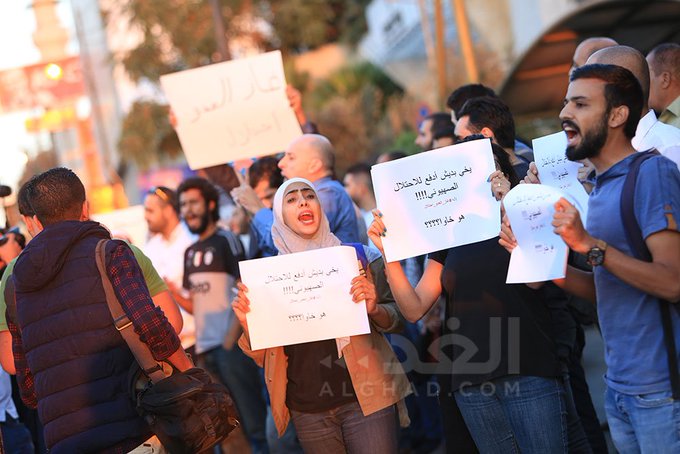
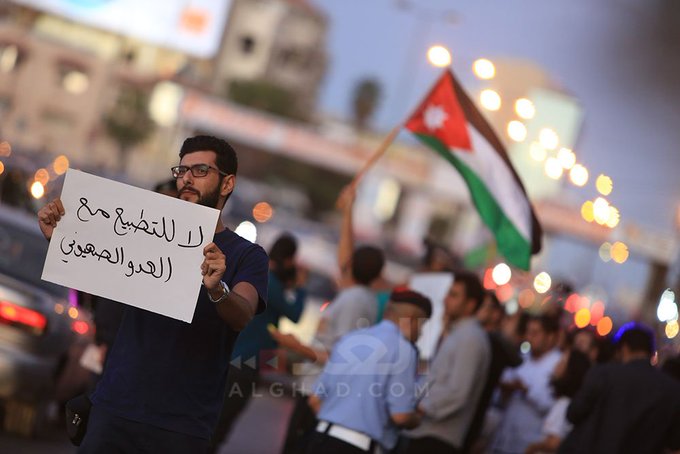
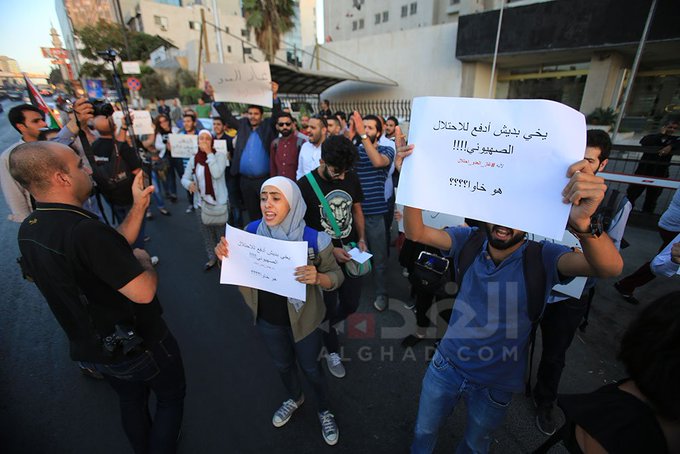
Jordanians demand scrapping of $10 billion gas deal with Israel
 -29 September 2016
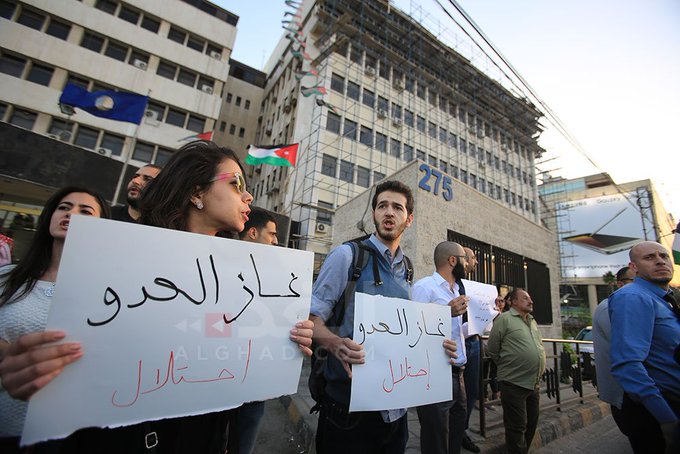
A protester against Israel-Jordan energy deal wears a T-shirt with the slogan “the enemy’s gas is an occupation.” (via Twitter)

Jordanians will rally in downtown Amman on Friday to protest a $10 billion deal signed this week by thegovernment-owned electricity company to buy Israeli-supplied natural gas.
Demonstrations are being planned in other cities, backedby a coalition of parties and groupings from across Jordan’s political spectrum.
“Signing this agreement blatantly ignores the will of the Jordanian
people who principally and unequivocally rejected the agreement through
two years of demonstrations across the country, national petitions
signed by Jordanians and their political parties, trade unions and civil
society organizations,” Jordan BDS, a group that backs the Palestinian boycott, divestment and sanctions movement, said on Wednesday.
After news of the signing broke, Jordanians took to the street outside
the electricity company headquarters on Tuesday to protest the deal:

On Thursday, students at the University of Jordan in Amman held a large rally against the deal
— mohammad abo alads (@abo_alads) 29 September 2016

The Islamic Action Front has also urged the government to cancel the deal. Affiliated to the Muslim Brotherhood, the Islamic Action Front and its allies won 15 seats in Jordan’s parliamentary elections earlier this month, a strong showing after the group had boycotted the polls for a decade.
The vast majority of
members of Jordan’s previous parliament had expressed opposition to a
deal. But the legislature has little power to check government policy.
“The government completely disregarded the wishes of the Jordanian
people whose representatives in parliament voted in an overwhelming
majority in December 2014 to reject the deal,” Jordan BDS said.
Despite the years of organized opposition, the final agreement was signed this week by US-based Noble Energy, which will extract the Israeli-controlled gas, and Jordan’s National Electric Power Company.
Within about three years, gas is expected to start flowing from the so-called Leviathan field
in the Eastern Mediterranean, one of a number of major gas finds that
are disputed between Israel, on the one hand, and the Palestinians and Lebanon, on the other.
US pressure
The administration of US President Barack Obama has actively promoted Noble Energy’s partnership with Israel’s Delek Group to extract the gas. The partnership has been forged despite concerns that it would create apowerful monopoly, inflating prices charged to industry and consumers.
The US has also exerted pressure on Jordan to buy Israeli-supplied gas,
under the pretext that such agreements promote regional cooperation and
peace.
Hillary Clinton raised the matter directly with Jordan’s King Abdullah when she was secretary of state in 2011,according to The New York Times.
Former US president Bill Clinton has also reportedly lobbied for the interests of Noble Energy in Israel.
Noble Energy, which lobbied the State Department while Hillary Clinton was in charge there, is also a major donor to the Clinton Foundation.
In the wake of the US efforts, Noble Energy struck deals with two major
Jordanian mining companies to buy $500 million worth of Israeli-supplied
gas.
According to The New York Times, these sales “paved the way” for the $10 billion deal that has just been finalized.
Gas deals all round
Human rights defenders have charged that
Israel’s ongoing maritime blockade of Gaza is motivated by a desire to
exploit the gas fields, while depriving Palestinians of the opportunity
to extract resources off their shores themselves.
Former UK prime minister Tony Blair has been heavily involved in lobbying to ensure that UK and Israeli firms may exploit the Gaza gas.
Meanwhile, Turkey’s normalization of ties with Israel – which came after Ankara dropped its demand that the blockade of Gaza be lifted – is widely seen as a prelude to gas deals between the two countries.
Egyptian gas has been flowing to Israel for years, under deals that
enriched a tiny minority while depriving the Egyptian people of
billions of dollars in revenue by selling to Israel at below market
prices.
The regime of Abdulfattah-al-Sisi, the army general who came to power in a military coup in Cairo in 2013, iscurrently negotiating a multi-billion dollar deal to buy Israeli-supplied gas, despite the fact that Egypt itselfpossesses vast resources and until recently was a net exporter.
Undermining BDS
Last year, Palestinian campaigners welcomed a decision by the Palestinian Authority to
cancel a $1.2 billion deal to buy Israeli-supplied gas. They had hoped
that this would put pressure on Jordan not go ahead with its own deal.
The Jordanian electricity company claims the purchase agreement from Israel will save cash-strapped Jordan $600 million a year.
Campaigners reject the agreement on principle, but are also challenging the economic arguments.
“We question the wisdom behind depriving the Jordanian labor market of
job opportunities that $10 billion marked for Israel in this agreement
could create for Jordanians who are suffering from poverty and
struggling to secure their livelihoods in an already burdened economy,”
Jordan BDS said.
Jordanian experts have also asserted that the deal is politically
motivated and makes little economic sense. Among them, economist Qasim
al-Hammouri told the newspaper al-Ghad that
Jordan had better options, including developing alternative energy,
importing liquefied natural gas and domestic exploration.
Former energy minister Muhammad Batayneh also questioned the terms of the deal, saying Israel would be the main beneficiary.
Bahjat Tabbara, a letter writer in the The Jordan Times newspaper, expressed concern that the deal would undermine the global movement for Palestinian rights.
“While most of the world is joining the boycott, divest and sanctions
movement to end Israeli occupation, Jordan’s purchase of Israeli natural
gas is an anomaly,” Tabbara wrote.
“How could anyone be expected to join the BDS movement when the Arab
country closest to the Palestinians geographically and culturally is its
largest energy export market?”
Social media users have been expressing their opposition to the deal with the hashtag #غاز _ العدو _ احتلال – the enemy’s gas is an occupation.
India says troops cross Kashmir border to attack as crisis escalates
Pakistan says two of its soldiers are killed and an Indian soldier captured on its side of contested territory’s border
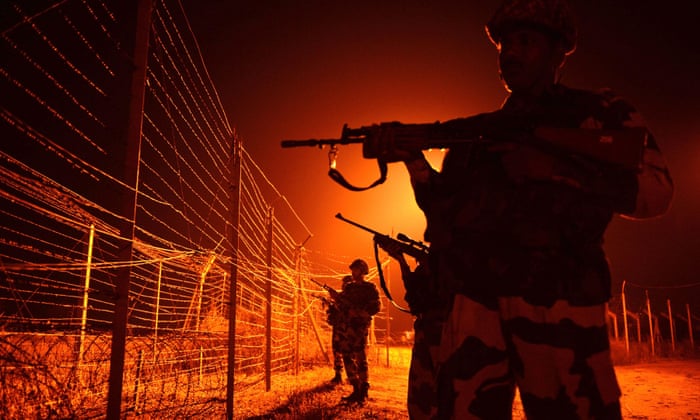 Indian
soldiers guard a border fence at an outpost along the line of control
in Suchit-Garh. Photograph: Tauseef Mustafa/AFP/Getty Images
Indian
soldiers guard a border fence at an outpost along the line of control
in Suchit-Garh. Photograph: Tauseef Mustafa/AFP/Getty Images
Elite troops have launched “surgical strikes” on Pakistan-based terrorists in the contested territory of Kashmir, India said on Thursday, in a major escalation of a deepening crisis between the nuclear-armed rivals.
The Indian army said troops conducted multiple nighttime raids across
the line of control (LOC), the ceasefire line agreed in 1972 that
divides the Himalayan region, to attack militants preparing to cross
into Indian-controlled territory.
Pakistan said two of its soldiers had been killed in exchanges of fire, but denied India had made any targeted strikes. Pakistan later
captured an Indian soldier on its side of the border, military
officials from both countries said. An Indian army spokesman said the
soldier had inadvertently crossed the frontier and had nothing to do
with the earlier raids.
It is the first time the Indian army has publicly acknowledged that its
troops have launched raids across the LOC. Lt Gen Ranbir Singh, India’s
director general of military operations, said there were “significant
casualties … to terrorists and those trying to shield them”.
Pakistan dismissed the Indian account as a lie. The army said two
soldiers had been killed and nine injured in cross-border shelling. “The
notion of a surgical strike linked to alleged terrorists’ bases is an
illusion being deliberately generated by India to create false effects.”
Pakistani troops had responded to unprovoked firing from India, it said.
The Pakistani prime minister, Nawaz Sharif, condemned the “unprovoked and naked aggression of Indian forces”.
Senior Indian government sources said special forces had crossed on foot
into Pakistan-controlled territory to strike up to eight hideouts
militants were using to shelter before crossing into Indian-administered
territory.
Intelligence in recent days had shown large numbers of people leaving
training facilities to prepare to cross, sources said. No Indian troops
were killed in the operation and no further attacks are planned, they
said.
The United Nations urged both sides to exercise restraint and resolve
their differences through dialogue. Stephane Dujarric, a UN spokesman,
said officials were following the increase in tensions in Kashmir with
great concern. UN military observers were in contact with both sides to
try to obtain further information, he said.

The violence follows at least nine clashes in two months between Indian
security forces in Kashmir and militants from across the ceasefire line.
Violent protests and a homegrown insurgency have also raged in the
disputed region since July, leading to more than 80 civilian deaths.
Indian officials said the number of incursions across the LOC, which had
declined in the past five years, had surged since the beginning of the
summer’s unrest. People were crossing over in teams of four and showing
evidence of military training, they said.
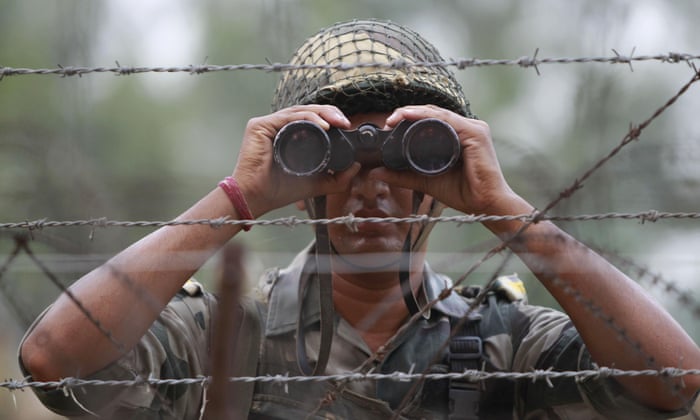 An Indian border security force soldier near Jammu in India. Photograph: Channi Anand/AP
The raids were the first military response to an attack on an Indian army outpost in Uri, close to the LOC, on 18 September.India blamed the assault, in which 19 soldiers were killed, on Pakistan-sponsored militants. It provoked calls for India to drop its policy of so-called strategic restraint against its neighbour.
India has launched a diplomatic offensive in the aftermath of the
attack, denouncing Pakistan at the UN as hosting the “Ivy League of
terrorism” and voicing support for separatists in Balochistan, a restive
Pakistani province.
Islamabad says India has provided no evidence the attack was the work of
Pakistan-based militants or the country’s intelligence agencies, which
have long been accused of links to anti-India jihadi groups.
Zahid Hussain, a Pakistani security analyst, describedThursday’s attacks
as a “very serious escalation”. “We have seen firing on the line of
control before, but this is much more dangerous in the context of the
rising tension between the two sides,” he said. “I am not saying that
this could lead to a full state confrontation, but this is how things
start to get out of control.”
India last announced it had conducted cross-border strikes in June 2015,
when it targeted rebel camps in Myanmar in response to an ambush that
killed at least 18 Indian soldiers in the north-eastern state of
Manipur. Delhi described the raid as unprecedented at the time and
signalled similar tactics could be used along its western border with
Pakistan.
On Wednesday, in a sign of deepening Pakistani isolation in the region, India and three other countries announced they would boycot the
forthcoming South Asian Association for Regional Cooperation summit,
which was scheduled to be held in Islamabad in November.
The Indian prime minister, Narendra Modi, has also raised the
possibility of Delhi altering or walking away from a major river-sharing
agreement that permits Pakistan to draw water from three rivers that
flow downstream from India, providing water to 65% of the country’s
landmass.

A New Jersey Transit commuter train crashed into Hoboken Terminal during rush hour Thursday morning, killing at one woman and injuring more than 100 at one of busiest transportation hubs in the Northeast, Gov. Chris Christie (R) said.
By Lindsey Bever, Martine Powers, Mark Berman and Faiz Siddiqui-September 29 at 2:16 PM
 Christie said 108 people were hurt, including the train’s operator, who was critically injured. He said the operator was cooperating with the investigation.
Christie said 108 people were hurt, including the train’s operator, who was critically injured. He said the operator was cooperating with the investigation.
“This train came at a high rate of speed into the station and crashed through all the barriers, bringing it all the way to the internal wall of the Hoboken terminal,” Christie said. He added that officials would not speculate on the cause of the crash. “We have no indication that this was anything but a tragic accident.”
Accountant Jim Finan was sitting toward the rear of the first car when he realized the train was coming in much too fast.
“We were getting to the platform, but we were still at full speed,” Finan, 42, said. “The train didn’t slow down at all…The only thing that stopped the train is the fact that it slammed into the building.”
The scene was horrendous. People were bleeding profusely from cuts to their head, he said, and one man seemed to be holding his severed thumb in place. Others had cuts on their hands. Finan pulled off the rubber around an emergency-exit window and another man pushed the window out. They both helped two women crawl out of the train before NJ Transit workers began opening the doors.
Christie lauded the resilience of northeast residents, who have weathered a succession natural disasters and rail accidents in recent years and, most recently, a bombing in Manhattan’s Chelsea neighborhood that injured 31.
“Regular commuters left the safety of where they were standing, to rush to the train, to help first responders evacuate injured people off the train,” Christie said of the Hoboken crash. “This region has developed a resilience that is admired by the rest of the world because of the way we’ve been tested.”
New York Gov. Andrew Cuomo described the devastation at the afternoon news conference.
“When you see the destruction up close, the silver lining is that there’s only been one fatality so far,”
Cuomo said. “Because the destruction is significant. And the power of train coming in is obviously devastating in its impact.”
The woman who died has not been identified. Christie said she was killed by debris created by the crash.
“I pray the number doesn’t go up,” said state Assemblyman Raj Mukherji (D), who represents Hoboken.
“We’re just praying for those affected. And we’re praying that the death toll doesn’t increase.”
The crash, Christie said, appeared to be accidental in nature.
At about 8:45 a.m., a Pascack Valley Line train, which was traveling from Spring Valley, N.Y., crashed into Hoboken Terminal, according to New Jersey Transit.
Most of the people injured in the crash were in the first car or standing on the platform; passengers in the other cars were better able to escape, according to WABC.
New Jersey Transit said some passengers were trapped under the debris, though Christie said late Thursday morning that all of those people had been removed and transported to hospitals.
“My train just derailed and crashed into the Hoboken train station,” one passenger wrote. “Thankfully all I got was a crack to my head, please pray for the rest.”
Emergency responders flooded the area and were seen treating some people outside the station in Hoboken, a major suburb of New York City.
An official with the Jersey City Medical Center said that none of the people brought to that facility appeared to have life-threatening injuries, but he said that some of the people brought there had serious wounds.
Most of the people brought to the medical center from Hoboken were injured on the train, he said during a briefing outside the hospital. Some patients with injuries such as lacerations were quickly released from the hospital to free up space for others who were injured.
Hoboken University Medical Center officials said at a midday news conference that the facility was treating 20 patients, mostly for lacerations and bruises. All were in stable condition.

The Federal Railroad Administration and the National Transportation Safety Board have dispatched investigation teams, and New Jersey’s attorney general is also investigating the crash.
The FBI office in Newark said it has been in touch with law enforcement officials and had offered its assistance in responding to the crash. The New Jersey State Police also sent troopers to the scene, which it said was being managed by the New Jersey Transit agency.
Officials, including those at the NTSB, did not immediately speculate on what caused the crash. But transportation officials, rather than law enforcement authorities, took the initial lead in the investigation, suggesting that terrorism was not immediately suspected.
At a press conference at Reagan National Airport, NTSB Vice Chairwoman Bella Dinh-Zarr said investigators will examine similarities between this and a similar crash in May 2011 involving a PATH train, among other issues.
Train 1614 struck the building on Track 5, NJ Transit said. The train came to a halt in a covered area between the station’s indoor waiting area and the platform, according to the Associated Press, which noted that a metal structure covering the area collapsed.
“It simply did not stop,” WFAN anchor John Minko, who witnessed the crash, told 1010 WINS. “It went right through the barriers and into the reception area.”
Mukherji, the assemblyman, said the crash caused “major structural damage” to the terminal; by late morning, engineers were evaluating the building’s structural integrity.
One passenger, Bhagyesh Shah, told NBC New York that he was standing near the back of the train when it started “plowing through the platform.”
“It was for a couple seconds, but it felt like an eternity,” he said.
Shah told the station that the first two cars were packed with passengers; after the crash, he said, people started breaking windows to escape.
“I saw a woman pinned under concrete,” he said. “A lot of people were bleeding; one guy was crying.”
Another passenger, Joe Breen, said the train had just passed through a tunnel and had stopped before it started up again.
“It was going, I’d speculate, 10 to 15 miles per hour into the station, and it never slowed down,” Breen told CBS News. “It rammed into the barrier and basically kept going.”
Breen said passengers who had been standing in the aisle, preparing to get off, “kind of flew back,” with some hitting their heads.
An average of 60,000 people travel every weekday through Hoboken Terminal, which is the fifth-busiest station in the New Jersey Transit system. In addition to New Jersey Transit, the station also serves trains from Metro-North, the Port Authority Trans Hudson, and the Hudson-Bergen Light Rail system, along with New York Waterway ferries.
The terminal is the end of the line for New Jersey Transit’s Pascack Valley route, so trains are supposed to slow down as they enter the busy railyard; they then proceed into the station, coming to a stop before the concrete barrier at the end of the platform.
One question that will be on the minds of investigators, federal transportation officials and lawmakers:
Whether the crash could have been prevented by positive train control, a federally-mandated technology system that is designed to prevent collisions or derailments. The technology can automatically apply the brakes to trains if they are moving too fast while traveling into a station. The NTSB’s Dinh-Zarr said investigators will look at whether the lack of positive train control was a factor.
Rail systems around the country, including New Jersey Transit, had been legally required to install the technology on their systems by last December — but they were given an eleventh-hour reprieve by Congress, which voted to extend the deadline for the life-saving technology by another three years.
This is a developing story. Stay tuned for updates.
Katherine Shaver, Ashley Halsey III and Lori Aratani contributed to this report.
Subscribe to:
Posts (Atom)