Peace for the World World ! Your War Our Lives

The Dalai Lama
A Brief Colonial History Of Ceylon(SriLanka)
Sri Lanka: One Island Two Nations
A Brief Colonial History Of Ceylon(SriLanka)
Sri Lanka: One Island Two Nations
(Full Story)
Back to 500BC.

Wednesday, November 30, 2016
On the need for introspection The rise of intolerance, warped narratives and fascism

2016-11-29
 During
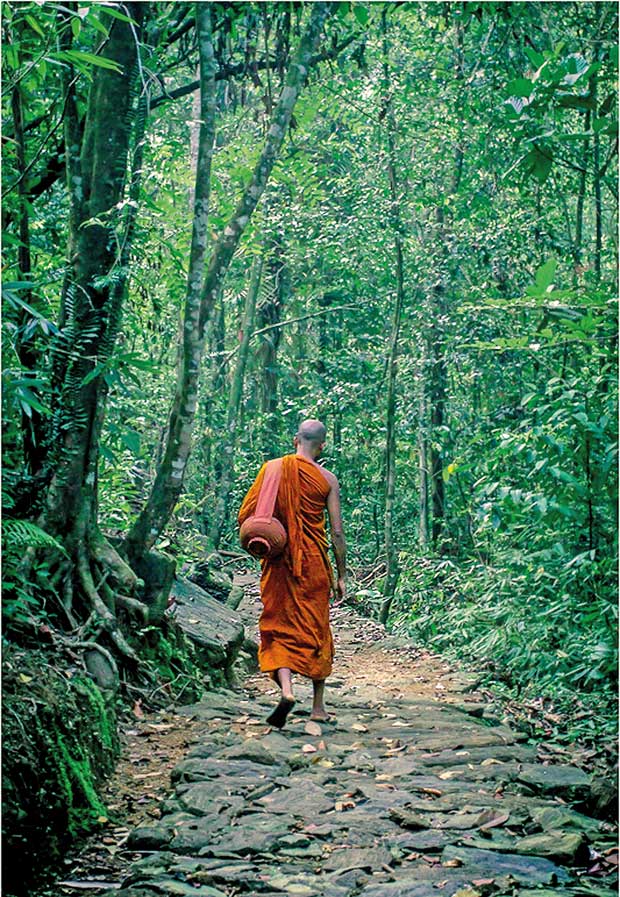
my resident time at the Na Uyana Aaranya, Malsiripura in my early
twenties, the first two books introduced to me by Ven. Ananda Thera were
-- the ‘ Milinda Panna’ in Sinhala and the Kalama Sutta, of which the
small library possessed an English translation. It was not by chance
that I ended up in the monastery. My childhood friend was, now Ven.
Watagoda Maggavihari. I had met him once at the same place prior to him
being ordained and a year or two after, I packed my bags on the trek to
experience solitude. Although time and tide were never within a man’s
reach to curtail, I have made it a point to meet Ven. Maggavihari, the
most scholarly among my friends at Royal College and one of the most
talented of sportsmen on the field, at least annually to discuss life,
politics, the unknown and the unfathomable. The discussions are yet to
be as memorable as the lesson taught to the Kalamas.
During
my resident time at the Na Uyana Aaranya, Malsiripura in my early
twenties, the first two books introduced to me by Ven. Ananda Thera were
-- the ‘ Milinda Panna’ in Sinhala and the Kalama Sutta, of which the
small library possessed an English translation. It was not by chance
that I ended up in the monastery. My childhood friend was, now Ven.
Watagoda Maggavihari. I had met him once at the same place prior to him
being ordained and a year or two after, I packed my bags on the trek to
experience solitude. Although time and tide were never within a man’s
reach to curtail, I have made it a point to meet Ven. Maggavihari, the
most scholarly among my friends at Royal College and one of the most
talented of sportsmen on the field, at least annually to discuss life,
politics, the unknown and the unfathomable. The discussions are yet to
be as memorable as the lesson taught to the Kalamas.

2016-11-29
 During
my resident time at the Na Uyana Aaranya, Malsiripura in my early
twenties, the first two books introduced to me by Ven. Ananda Thera were
-- the ‘ Milinda Panna’ in Sinhala and the Kalama Sutta, of which the
small library possessed an English translation. It was not by chance
that I ended up in the monastery. My childhood friend was, now Ven.
Watagoda Maggavihari. I had met him once at the same place prior to him
being ordained and a year or two after, I packed my bags on the trek to
experience solitude. Although time and tide were never within a man’s
reach to curtail, I have made it a point to meet Ven. Maggavihari, the
most scholarly among my friends at Royal College and one of the most
talented of sportsmen on the field, at least annually to discuss life,
politics, the unknown and the unfathomable. The discussions are yet to
be as memorable as the lesson taught to the Kalamas.
During
my resident time at the Na Uyana Aaranya, Malsiripura in my early
twenties, the first two books introduced to me by Ven. Ananda Thera were
-- the ‘ Milinda Panna’ in Sinhala and the Kalama Sutta, of which the
small library possessed an English translation. It was not by chance
that I ended up in the monastery. My childhood friend was, now Ven.
Watagoda Maggavihari. I had met him once at the same place prior to him
being ordained and a year or two after, I packed my bags on the trek to
experience solitude. Although time and tide were never within a man’s
reach to curtail, I have made it a point to meet Ven. Maggavihari, the
most scholarly among my friends at Royal College and one of the most
talented of sportsmen on the field, at least annually to discuss life,
politics, the unknown and the unfathomable. The discussions are yet to
be as memorable as the lesson taught to the Kalamas. 
How Ampitiye Sumana received a sound beating from policeman!

 Nov 29, 2016
Information
is coming to light about yet another ‘heroic’ by chief incumbent of
Mangalarama Vihara in Batticaloa, Ampitiye Sumana. The then DIG in
charge of Batticaloa in 2011 was a devoted Buddhist, and he used to pay
visits to all temples in the district, offer alms and inquire into the
welfare of the resident monks.
One day when he went to Mangalaramaya, Sumana asked him a favour, “DIG
Mahattaya, give me a Sinhala Buddhist son.” Puzzled by the request, he
asked, “What, Apey Hamuduruwane. Why are you asking me to give a son?”
“Give me a son from the police. I live amidst hundreds of Tamil
villages. Send me a son from the police to guard me and my temple,” he
appealed. Understanding that the temple and the Thera face a certain
security risk even through the war was over, the DIG sent a PC on the
next day for the temple’s protection.
Sumana generously gave denims, T-shirts, underwear, perfumes to the son of the police. He did the police duty very gladly.
Around midnight on a moonless day, Sumana had a Ganja smoke, went to
where the policeman was sleeping and was about to do something naughty,
when he woke up. Sumana, who tried to perform a sexual act, was pushed
aside by the policeman, who then gave him a sound beating. Sumana fled
the temple and went into hiding.
On the following Monday, the policeman went to the DIG’s office carrying
along with him the service weapon and his travelling bag. The DIG
apologized to the PC for having sent him to the temple without knowing
the true man behind Sumana, and asked him to keep it a secret, in order
to prevent any disrespect to Buddhism due to such acts by persons like
Sumana. The policeman in question presently serves at a police station
in the eastern province.
That is why it is said that patriotism is the last bunker of the villain.
An Anxious Nation Waits Silently

By Vishwamithra1984 –November 30, 2016
“Self-respect is the root of discipline: The sense of dignity grows with the ability to say no to oneself.” ~Abraham Joshua Heschel
It is indeed a great experience to commute between work and home in
Colombo. The traffic jams, the painstaking waiting in traffic lights
which are turned off during the worst hours so that a live constable
could direct traffic without allowing the undisciplined motorists to
beat the red light and thereby cause new jams which are beyond the realm
of road-discipline and to unscramble the traffic gridlock is a
herculean task, whether the duty officer is an experienced one or not.
To move again is a dream come true. Day in and day out, those who use
our roads are confronted with this awfully distasteful task of
navigating in a stormy ocean of traffic, motor and pedestrian, trying
one’s way. A moving nightmare, this spectacle plays out without a break,
mirroring a nation whose compass is lost for some time; sometimes,
never to find it again in this lifetime.

Photo via Colombo Roads Traffic Facebook
This pitiful panorama of life at large is being displayed out for all to
see and experience, reflecting a people’s impatience, their callous
disregard for law and order, failure on the part of those who charged
with maintaining a semblance of order and discipline on road, the
Traffic Police. Politicians of the last regime who used to whistle past
helpless ‘others’ to their unknown destinations, official or otherwise,
may be absent today, yet the absolute indiscipline of the subject people
is no less than it was during any time. This unadulterated
road-rowdiness is in display wherever one chooses to travel- an
incredible agony for the onlooker and an excruciating wait-and-run for
the motorist. All those who use our roads suffer a collective
suffocation of life, commute and everything else that really matters in
day to day existence. But the inconceivable human stories that surround
all those who use our roads, the traffic and other outfits of
travelling, are never told in full mournful detail. So I decided to make
an attempt- with my own humble pen.
The mass of commuters waiting at bus stops, hundreds of school children
in their own personal hordes chatting and joking about the various
goings-on in their respective classes, a Buddhist monk hurrying back to
his temple before dark; some in three-wheelers, some in four-wheelers
and yet others treading the good earth, for they are nor fortunate, or
yet unfortunate, to use mo-bikes, and other commuting paraphernalia that
populate our narrow streets of the urban and suburban Colombo.
Their needs, their wants, their weeping and laughter, their comings and
goings, their daily struggle to put food on the table for their
families, all these and more make an integral part of the glorious
mosaic of life. Its splendor, its lamentation, its begrudging complaints
and its magnificent celebrations, its snail-paced drag and its
nauseating speed and its waits and insufferable disappointments and its
hidden jealousies and hatreds, its wicked motives and cruel executions,
all these play an enormous role in a man’s day, whether he travels by
bus, three-wheeler, mo-bike or on foot, the core does not change. Deep
inside that core resides humanity’s essentials, its values and those
values’ validity and vitality. This great human drama is being played
around every corner of this globe. Not only in Colombo, not only in
other urban cities, not only in the great suburbs. It’s being enacted in
the remotest hamlets and villages.
Another Rs.20 million from Ranil to Mahinda


Rs.20 million has been allocated from a supplementary estimate to extend
the buildings of the official residence of retired President Mahinda
Rajapaksa which was renovated and handed over to him recently. The
supplementary estimate was presented to parliament by the Leader of the
House Lakshman Kiriella.
The allocation to construct an extension to former president Mahinda
Rajapaksa’s official residence has been presented to parliament on
24.05.2016.
Earlier too Maithri – Ranil government allocated Rs.30 million to renovate the residence according to the liking of Mr. Rajapaksa.
Earlier too Maithri – Ranil government allocated Rs.30 million to renovate the residence according to the liking of Mr. Rajapaksa.
Dane’s ‘Don’ well confirmed – Caught red handed..!

 (Lanka-e-News
-29.Nov.2016, 5.20PM) Recently , an insane racist Dane was remanded ,
and now it has come to light who is the ‘Don’ of this Dane , who is
behind all the ruthless unrest , racism , extremism, violence , trauma
and turmoil that are being unleashed in the country ; he is no less a
person than the discarded and deposed ex president of the country
Medamulana Mahinda Rajapakse !
(Lanka-e-News
-29.Nov.2016, 5.20PM) Recently , an insane racist Dane was remanded ,
and now it has come to light who is the ‘Don’ of this Dane , who is
behind all the ruthless unrest , racism , extremism, violence , trauma
and turmoil that are being unleashed in the country ; he is no less a
person than the discarded and deposed ex president of the country
Medamulana Mahinda Rajapakse !
The leader of a mafia organization is called a ‘Don’ in their parlance
though this word has other connotations .The leader of the extremist
organization to which Dane belongs is this ‘Don’ who brought the country
to the brink of irretrievable disaster when he was ruling the country ,
and therefore was thrown out lock , stock and barrel by the people.
The photograph herein clearly confirms who this Don is who still
seeking to wallow in destructive extremism and racism with selfish
ruthless motives to the detriment of the country with a view to regain
power based on his inordinate greed for ruthless despotic power.
It is the general consensus ,there can be nothing more difficult in
this world than to search and capture such a rare barbaric brute of a
Don who during the two terms as president resorted to all the villainies
and most destructive activities most viciously and vigorously against
civilized society and the people of his own country by design and not
by accident. Yet , strangely this brute is still persisting in those
destructive activities even after being ousted from power when these are
leaders who should be behind bars or within lunatic asylum or in a
museum exhibited as a rare specie of a human being that breathes evil ,
thinks evil , acts evil , stokes evil and spreads evil in this world.
When it is a universally acknowledged fact that Sri Lanka is a country that was most battered and bruised by a 30 years old cruel ethnic war, an ex president of the country himself once again leading the campaign to arouse communal hatred and racism once again is most reprehensible and abominable. Nothing can be more cruel or savage specially when it is a power greedy ex president of the country himself who is indulging in these traitorous and devastating activities against the country while also parading as its savior.
When it is a universally acknowledged fact that Sri Lanka is a country that was most battered and bruised by a 30 years old cruel ethnic war, an ex president of the country himself once again leading the campaign to arouse communal hatred and racism once again is most reprehensible and abominable. Nothing can be more cruel or savage specially when it is a power greedy ex president of the country himself who is indulging in these traitorous and devastating activities against the country while also parading as its savior.
It is therefore being questioned widely and rightly by the patriotic
citizens of the country whether this traitorous ‘Don of Dane’ who is
also suffering from senile decay is sane or both Don and Dane are insane
?
---------------------------
by (2016-11-29 12:14:04)
by (2016-11-29 12:14:04)
Nine SL sailors held on ship in Houthi rebel stronghold

 2016-11-29
The Government is keeping in touch with the Sri Lankan Embassy in Oman and the Consulate in Dubai, UAE to get the nine Sri Lankan sailors held by Houthi rebels of Yemen released, Foreign Affairs Ministry said today.
Ministry sources said the ship with the nine Sri Lankan sailors aboard had been held by the rebels in an area controlled by them because of a dispute that had taken place between the cargo supplier and the cargo receiver.
“We have instructed our mission in Oman, which is monitoring the situation in Yemen at the moment, to get back to us after the negotiations are concluded. We have also informed our consulate in Dubai to initiate discussions with relevant parties since the headquarters of the shipping company is based in Dubai. However, no response has been received by us so far,” sources said.
They said a court case was pending between the cargo handler and the receiver. The release of the sailors was getting delayed because of external issues such as communication among factions and lengthy court proceedings, they said.
However, sources said there was no threat to the lives of the sailors and they have in fact contacted the authorities over the phone to inform them that they are alive and well.
The ship with 26 people on-board, including the nine Sri Lankans, was taken over by the rebels two months ago.
According to foreign media reports, Houthi rebels of Yemen and their political allies have formed a new government in the country yesterday. (Lahiru Pothmulla)

 2016-11-29
The Government is keeping in touch with the Sri Lankan Embassy in Oman and the Consulate in Dubai, UAE to get the nine Sri Lankan sailors held by Houthi rebels of Yemen released, Foreign Affairs Ministry said today.
Ministry sources said the ship with the nine Sri Lankan sailors aboard had been held by the rebels in an area controlled by them because of a dispute that had taken place between the cargo supplier and the cargo receiver.
“We have instructed our mission in Oman, which is monitoring the situation in Yemen at the moment, to get back to us after the negotiations are concluded. We have also informed our consulate in Dubai to initiate discussions with relevant parties since the headquarters of the shipping company is based in Dubai. However, no response has been received by us so far,” sources said.
They said a court case was pending between the cargo handler and the receiver. The release of the sailors was getting delayed because of external issues such as communication among factions and lengthy court proceedings, they said.
However, sources said there was no threat to the lives of the sailors and they have in fact contacted the authorities over the phone to inform them that they are alive and well.
The ship with 26 people on-board, including the nine Sri Lankans, was taken over by the rebels two months ago.
According to foreign media reports, Houthi rebels of Yemen and their political allies have formed a new government in the country yesterday. (Lahiru Pothmulla)
Australian lawmakers urge end to Israeli abuses of Palestinian children

Some of the 49 members of Australia’s parliament who signed a letter urging Israel to end its military detention of Palestinian children participate in a press conference organized by the Australia Palestine Advocacy Network in Canberra, 28 November. (via Facebook)
Ali Abunimah-28 November 2016

“Israel is the only country in the world that automatically prosecutes
children in military courts. And only Palestinian children,” dozens of
members of the Australian house of representatives and senate say in a
letter released by the Australia Palestine Advocacy Network on Monday.
“Up to 700 Palestinian children are arrested each year by the Israeli
military, and this number is increasing,” the 49 lawmakers add, citing
United Nations reports that ill-treatment of Palestinian children is
“widespread, systematic and institutionalized.”
The lawmakers call on Israel to comply with its obligations under the UN
Convention on the Rights of the Child and “to not arrest or detain
Palestinian children unless this is a last resort, and if they are
detained, to immediately institute protections for those children
including that their safety and best interests are prioritized, and that
they are permitted a fair trial.”
Growing debate
The letter is part of a growing debate on Israel’s human rights abuses.
Earlier this month, Maria Vamvakinou, a member of the main opposition
Australian Labor Party, introduced a motion calling on Australia “to raise concerns with the Israeli government about the treatment of Palestinian children.”
Though parliament has yet to vote on the measure, a number of lawmakers have given speeches calling on Israel to end its abuses of Palestinian children:
“We are very encouraged to see this issue resonating with members of
parliament in Australia,” Beth Miller from the human rights group
Defense for Children International-Palestine told The Electronic
Intifada. “The situation on the ground for Palestinian children is
increasingly dire. This is a welcome sign that more leaders are ready to
take bold action to ensure justice and accountability.”
International success
The initiative in Australia was the result of international cooperation among advocates for Palestinian rights.
Over the summer, members of APAN – the Australia Palestine Advocacy Network – contacted the No Way to Treat a Child campaign about its successes in winning US congressional support for Palestinian children’s rights.
Led by the American Friends Service Committee and Defense for Children
International-Palestine, the No Way to Treat a Child campaign has gained
traction in notoriously difficult political territory for those working
to hold Israel accountable for its abuses.
“We were thrilled that organizers in Australia heard of our advocacy
with members of the US Congress about Palestinian children in Israeli
military detention,” Jennifer Bing of the American Friends Service
Committee told The Electronic Intifada. “We had several email and Skype
exchanges to share strategies and effective messaging with those often
silent about Palestinian human rights.”
In June, 20 US lawmakers urged President Barack Obama to send a “clear signal” to Palestinian children that their lives are valued.
In a letter initiated by Minnesota congresswoman Betty McCollum,
the lawmakers urged the president to appoint a special envoy to protect
the rights of Palestinian children under Israeli occupation.
A year earlier, 19 US lawmakers called on Secretary of State John Kerry to “prioritize the human rights of Palestinian children” in relations with Israel.
While Obama did not act on the lawmakers’ request, and unconditionally awarded Israel the biggest US military aid package in history earlier this year, the lawmakers’ willingness to speak out is a sign of the greater opennessand contestation over Palestinian rights within the Democratic Party.
One of the signers of the letter to Obama was Minnesota congressman Keith Ellison, a leading contender to be chair of the party’s top governing body, the Democratic National Committee.
‘Tragedy of huge proportions’: Brazilian soccer club’s moment of glory ends in deadly plane crash
 Fans
in Chapeco, Brazil, gather to mourn the players of team Chapecoense who
were killed in a plane crash in Colombia. (Nelson Almeida/AFP/Getty
Images)
Fans
in Chapeco, Brazil, gather to mourn the players of team Chapecoense who
were killed in a plane crash in Colombia. (Nelson Almeida/AFP/Getty
Images)

By Dom Phillips, Samantha Schmidt and Brian Murphy-November 29 at 5:13 PM
 RIO DE JANEIRO — It was the culmination of
an astonishing climb to the top of South America’s soccer world: a
modest club from Brazil heading to the finals of a continent-wide
tournament. Then came a distress call from the cockpit of the plane
carrying the team to Colombia.
RIO DE JANEIRO — It was the culmination of
an astonishing climb to the top of South America’s soccer world: a
modest club from Brazil heading to the finals of a continent-wide
tournament. Then came a distress call from the cockpit of the plane
carrying the team to Colombia.
Moments later, radar contact was lost late Monday with the charter jet
carrying 77 people, including players and coaches from Brazil’s
Chapecoense soccer club. The wreckage was found wedged in the folds of a
muddy and rain-soaked hillside about 50 miles from Medellín — with just
six survivors answering the calls of rescuers.
One by one on Tuesday, authorities in white coveralls collected the
bodies — scattered over the low brush or inside the splintered cabin —
and carried them down the mountain on stretchers.
Among the 71 dead: a player who recently learned he was to be a father, a
goalie beloved for his acrobatic saves, and coaches who helped bring
Chapecoense to the biggest moment in its 33-year history. Survivors
included at least three Chapecoense players, two airline crew members
and a journalist, Colombia’s civil aviation agency said.
The plane was initially reported to be carrying 81 people, but
authorities said later that four did not actually board. Disaster
management officials at the crash scene said Tuesday afternoon that all
of the bodies there have been removed and that one “black box” recorder
has been found.
Fans
in Chapeco, Brazil, gather to mourn the players of team Chapecoense who
were killed in a plane crash in Colombia. (Nelson Almeida/AFP/Getty
Images)
Carlos Eduardo Valdés, chief of Colombia’s Forensic Science Institute,
said the remains were being taken to Medellin for identification. He
said the identification process — through fingerprints and dental
records, with DNA testing as a last resort — could take another four or
five days.
The tragedy threw soccer-mad Brazil into collective grief and an
official three-day mourning period. All matches in South America were
canceled for a week in a show of solidarity. Across the globe, the sport
paid homage: a moment of silence by Spain’s FC Barcelona and Real
Madrid clubs before practice, and condolences from current and former superstars including Argentina’s Diego Maradona.
“A tragedy of huge proportions,” said Medellín’s mayor, Federico Gutierrez.
Outside Chapecoense’s home stadium in Chapeco, about 800 miles south of
Rio de Janeiro, tearful backers gathered in a spontaneous vigil. And, in
a mournful twist of the online age, team websites and players’ Twitter
feeds were filled with images of joyful Chapecoense players in their
last hours as they began the trip to Colombia — including a poignant last video by defender Felipe Machado.
The team’s official website changed its logo from green to black.
“This is a very sad day for soccer,” wrote Gianni Infantino, president of world’s soccer’s governing body FIFA.
Meanwhile, aviation experts tried to piece together the cause of the disaster.
Authorities initially suspected a fuel shortage — with the British
Aerospace 146 aircraft near the limit of its range — but investigators
increasingly began to study a possible electrical failure on board, said
an official for the Colombian aviation agency. The official spoke on
condition of anonymity under normal rules to brief reporters.
Colombia’s El Tiempo newspaper reported that the pilot requested
priority landing because the plane was low on fuel and that it may have
subsequently suffered an electrical fault.
A team of British aviation specialists headed to Colombia to join the
probe, which will include analysis of flight data recorders recovered
from the crash site.
The plane, operated by the charter company LaMia Airlines, left from
Santa Cruz de la Sierra, a city in southern Bolivia, where the team had
arrived on a commercial flight. The company was originally based in the
Venezuelan city of Merida, but said it shifted operations to Colombia,
the Associated Press reported.
The same plane had carried Argentina’s national team earlier this month,
Argentine state-run media reported. British Aerospace, now known as BAE
Systems, said the 146 model aircraft began service in 1981 and that
about 220 are currently in use.
“At this sad time that the tragedy falls on dozens of Brazilian
families, I express my solidarity,” Brazilian President Michel Temer
said in a statement. “We are putting all the means to help families and
all the possible assistance.” Temer declared three days of official
mourning and promised government help for the families of victims.
Chapecoense had been scheduled to play in the finals of the Copa
Sudamericana against Atlético Nacional of Medellín. The first match of a
home-away series — which would decide the second-most coveted soccer
crown in South America — was set for Wednesday.
In an interview with TV Globo news at Chapecoense’s home stadium, Ivan Tozzo, the team’s vice president, wiped away tears.
“It is very sad the news we received this morning. We never expected
it,” he said, speaking from the team’s dressing room. “A team getting
international attention, and a tragedy like this happens, it is very
difficult and a very big sadness, but we will put faith in God.”
The president of the team’s board, Plínio de Nes Filho, said he spoke to
team members just before they left Brazil. “They said they were going
in search of a dream to turn this dream into a reality for us,” he said,
according to the news site O Globo. “The dream ended.”
The aviation authority confirmed on its Facebook page Tuesday morning
the names of the passengers who initially survived the crash. Several
members of the soccer team — including Alan Luciano Ruschel, Hélio
Hermito Zampier Neto and Jakson Ragnar Follmann — were among those
rescued from the crash site.
Goaltender Marcos Danilo Padilha also was found alive, but he later died while receiving medical treatment, the team said.
Two crew members — Ximena Suárez and Erwin Tumiri — were also rescued, along with Brazilian journalist Rafael Henzel.
The club posted a brief statement on its Facebook page: “May God
accompany our athletes, officials, journalists and other guests
traveling with our delegation.” It said it would have no further comment
until it had more details on the crash.
The club was seen as a Cinderella story just two years after breaking
into Brazilian soccer’s first division. It defeated Argentine powerhouse
San Lorenzo last week to make it into the two-game championship round.
On Sunday, it lost to Sao Paulo team Palmeiras in a game that decided
the Brazilian championship.
The team’s ascent from the depths of Brazilian soccer was the talk of the South American sporting world.
“It is common for Brazilians to say that the country has 12 clubs with
actual chances to win the national title at the start of every season,”
wrote Plus55 of the Chapeco team this week. “A small club, however, is
slowly breaking this logic and has a real shot at becoming 2016’s most
successful Brazilian club at the international level.”
The team’s climb was not sudden, however. It started winning lesser
championships in 2010, moving up the ranks of Brazilian soccer from the C
division to the A division. It started playing with elite Brazilian
teams in 2014, the article noted, “and has not been relegated since,
another rare feat as novice teams are likely to head back” to the B
division “in the blink of an eye.”
Some players stayed behind because of injuries. A forgotten passport
kept the son of the team’s coach, Caio Júnior, off the flight that
claimed the life of his father.
“We are strong. We will get through this,” the son, Matheus Saroli,
posted on his Facebook account, according to soccer site Lance.
World soccer has been hit by aviation tragedies before.
In 1958, the core of the Manchester United soccer team was among those
killed in the crash of a British European Airways plane attempting to
take off from Munich-Riem Airport. The team, nicknamed the “Busby
Babes,” was returning from a European Cup match in Belgrade and, at the
time, was widely hailed as one of the powerhouses in international
soccer.
Schmidt and Murphy reported from Washington. Julia Symmes Cobb in Medellin contributed to this report.
France, Britain push Syria gas attack sanctions; Russia opposed
 A
still image taken on September 7, 2016 from a video posted on social
media said to be shot in Aleppo's Al Sukari on September 6, 2016, shows a
boy breathing with an oxygen mask inside a hospital, after a suspected
chlorine gas attack, Syria. Social Media via Reuters/File...
A
still image taken on September 7, 2016 from a video posted on social
media said to be shot in Aleppo's Al Sukari on September 6, 2016, shows a
boy breathing with an oxygen mask inside a hospital, after a suspected
chlorine gas attack, Syria. Social Media via Reuters/File...
| UNITED NATIONS-
 France
and Britain are pressing to sanction those responsible for chemical
weapons attacks in Syria, though Russia says it would not support a
United Nations Security Council resolution.
France
and Britain are pressing to sanction those responsible for chemical
weapons attacks in Syria, though Russia says it would not support a
United Nations Security Council resolution.
An inquiry by the United Nations and the Organization for the
Prohibition of Chemical Weapons (OPCW) found that Syrian government
forces were responsible for three chlorine gas attacks and that Islamic
State militants had used mustard gas.
French U.N. Ambassador Francois Delattre said on Tuesday that a draft
resolution "sanctioning those responsible for the use of chemical
weapons" was essentially ready and would be circulated to the 15-member
council as soon as possible.
British U.N. Ambassador Matthew Rycroft said the draft resolution would
"make sure that those members of the regime who were involved in that
abhorrent use of chemical weapons in Syria will face the consequences."
The inquiry found the Syrian government's 253 and 255 squadrons,
belonging to the 63rd helicopter brigade, were responsible for gas
attacks and said that those "with effective control in the military
units ... must be held accountable."
Russian U.N. Ambassador Vitaly Churkin said, however, there was "just
not enough material proof to do anything" and described the French and
British bid to impose sanctions as a "misplaced effort."
"We wouldn't support any action on this," Churkin told reporters. He
said the important thing was the council had earlier this month been
able to extend the mandate of the inquiry for another year. He said
Russia hoped that would serve as a deterrent.
Chlorine's use as a weapon is prohibited under the Chemical Weapons
Convention, which Syria joined in 2013. If inhaled, chlorine gas turns
to hydrochloric acid and can kill by burning lungs and drowning victims
in the resulting body fluids.
Syria agreed to destroy its chemical weapons in 2013 under a deal
brokered by Moscow and Washington. The Security Council endorsed that
deal with a resolution that said in the event of non-compliance,
"including unauthorized transfer of chemical weapons, or any use of
chemical weapons by anyone" in Syria, it would impose measures under
Chapter 7 of the U.N. Charter.
Chapter 7 deals with sanctions and authorization of military force by
the Security Council. The French/British draft could propose targeted
sanctions - a travel ban and asset freeze - on people or entities linked
to the attacks.
(Reporting by Michelle Nichols; editing by Grant McCool)
Epical Castro Has Nothing to do with Today’s Resistance!

Today,
the most important question is to take Castro out of this superficial
worshiping propaganda machinery and dig into the people’s history to
understand what really went wrong in this nation.
 by Nilantha Ilangamuwa-Nov 28, 2016
(November 28, 2016, Colombo, Sri Lanka Guardian) Mere
propaganda of personalities is neither going to achieve the true success
of the nation nor improve the living condition of the people who
sacrificed much more than what our popular leaders on the headlines did.
People in Cuba and the world is mourning and celebrating the death of
Dr Fidel Alejandro Castro Ruz who ruled the island nation located just
90 miles away from its top enemy United States of America. For some, he
is a true legendary hero, but others he is a brutal dictator who
assassinated the very meaning of a nation.
What is the lesson need to be learned here? Give a damn to Batista who
is the corrupted puppet whose woebegone govern policies has created the
path to control Cuba by one person, Castro, for decades. No election,
but celebrations on revolution. No essentials to general life, but mere
statistics on the success of the socialist way. The list is much bigger
than the bearded face portraits placed on most of the walls in Cuba.
Castro has taken the last breath. It is somewhat an end of an era of
this tiny Caribbean Island.
I’m not in a hurry to brand Castro as a bad man which I would never
agree, but, the system he has developed was, unfortunately, unable to
solve the very problems of the society. When Pol Pot failed in achieving
prosperous change even by killing one-fourth of his countrymen and
women, defeated Pol Pot finally declared the experiment had failed,
therefore he had failed. But Cuba is different from Cambodia. In fact,
Cuba is different from most of the others who attempted liberation
through “socialism”. Cuba remains in world politics and played a
significant role in the international affairs from sending well-trained
doctors to heal the sick around the globe to preventing the most deadly
political crisis in our history – the missiles crisis. But, it is unfair
to engage in blindfolded praise of Castro while ignoring the public in
the country.
Let our old distorted and deteriorated so-called leftists who were
enjoying all in the capitalist societies while wearing leftist clothes
on the stage commemorate and write epics on Fidel and his death. Those
hypocrites are always grabbing the opportunities and deteriorate the
space of true resistance. Let them sell the old songs as usual. But, the
real challenge before us is to deconstruct Fidel’s ideology and
understand the commitments by the common people in Cuba. Such will
facilitate an opportunity to re-design the resistance to be compatible
with and capable of addressing the core notions of the social contrasts.
Castro read himself much earlier than anyone else. He was groomed as a
dynamic and charismatic youth activist since the day he delivered a
speech against US Marine Corps who urinated the statue on the José
Martí, a Cuban national hero and an important figure in Latin American
literature. It is something that makes one be proud of him as a fellow
human being. Unlike most of other politicians, he has written constantly
not the jargon but some meaningful lines of understanding. He would
have no worries before his death as he went far than his imagination. He
is bigger than his life. But, what about the rest who were falling in
love with his bearded face with a Havana cigar which is little more than
a commodity and useful tool in highly motivated propaganda?


Let’s take Castro into our mind as per his respect for self-dignity.
Let’s leave our older generation to blindfolded worship and honour
before the memories they have on Castro continuing in their habitual
commemorations of Ho Chi Min, Che and Mao even Stalin and Pol Pot. But,
how relevant is his ideology in the present context is our question.
Neither his strategies nor his economic policies are going to solve what
the present youth are demanding. In this situation, Castro will remain
like the wallpaper as the subject of the past. It is hardly believable
that Castro’s ideology can represent in the resistance against
suppression where pleasure is used as the tool to oppress society.
Nonetheless, no doubt Castro has become an icon in the pages of history.
But he is now mere symbolic figure among the youth population in which
almost all are spending most of their time with smartphones and other
fancy utilities in the world today. Since the announcement of his death
by his brother, the President of Cuba, Rahul Castro, like other sharing
through social media the Facebook which is owned by billions of unique
users who are selling their personal life for nothing, has come under
the Castroism rain. Most of them were based on what they have heard from
someone else and it’s highly unlikely that one would find anyone who
would have a relative and comprehensive viewpoint of the people in Cuba
today. Why should people in this nation don’t matter while a handful of
leaders who controlled the island dominated all attention of wider
world?
Today, the most important question is to take Castro out of this
superficial worshiping propaganda machinery and dig into the people’s
history to understand what really went wrong in this nation. Castro has
accomplished his mission much earlier under severer difficulties just
because of the thoughts and needs of majority were sacrificed for
Castro. This blind love kept the Castro’s administration going
indefinitely and it handed over the power to the leader to decide the
ultimate. At the same time, undemocratic despicable attempts and brutal
embargo to overthrow Castro by the United States strengthened Castro
while giving him legitimacy to suppress the dissidents and the general
public. As a result, many more prisons were constructed, and the local
spy agencies systematically suppressed the civil liberties of society in
that part of the world. The abuse so much that Castro himself admitted
that the system (model) he had developed was no longer working even in
Cuba. This is the nucleus of the system that would deconstruct
Castroism.
But, we made the same mistakes over and over again in attempting to
deconstruct those who were larger than life personalities. Right after
the death of most leftist icons their credits were turned into a blind
credence by their followers than making use of their contribution to
re-design the political formula to understand what needed to be done to
save the positive and prevent the negative. Modern day resistance
against systemic crimes in ruling structures will not succeed without
the total destruction and elimination of the old pattern of credence.
A new era has begun much earlier than anyone thought. Our yesteryear
heroes have left after taking and rendering some meaning to life. But,
we seem to be already late to constellate and consolidate to determine
who can resist future oppression except for nothing more than pleasure.
Castro fought guerrilla warfare, but present oppressor has to calculate
systematic ways of eliminating privacy, climate change, nuclear arsenal
and much more.
To successfully face the real challenges in the post-Castro era one
needs to look into Huxley’s significant understanding of social control
than the Orwellian theory of a boot stamping on a human face.
Subscribe to:
Posts (Atom)