Peace for the World World ! Your War Our Lives

The Dalai Lama
A Brief Colonial History Of Ceylon(SriLanka)
Sri Lanka: One Island Two Nations
A Brief Colonial History Of Ceylon(SriLanka)
Sri Lanka: One Island Two Nations
(Full Story)
Back to 500BC.

Tuesday, January 31, 2017
Yet another garbage judge to make judiciary stink ! Bandarawela womanizer requests WP officers !

 (Lanka-e-News-
30.Jan.2017, 10.00AM) By the appointment of yet another ‘stinking’
judge the grace and dignity of the judiciary which is already
tottering is being made to collapse completely ! The name of this judge
is Piyamantha Fernando the chief magistrate transferred recently from
Trincomalee to Bandarawela courts.
(Lanka-e-News-
30.Jan.2017, 10.00AM) By the appointment of yet another ‘stinking’
judge the grace and dignity of the judiciary which is already
tottering is being made to collapse completely ! The name of this judge
is Piyamantha Fernando the chief magistrate transferred recently from
Trincomalee to Bandarawela courts.
He is best known as a worst womanizer . When he was the judge at
Bandarawela court , he had forcibly held the hand of a lady typist and
said , ‘your hand is very soft’. The typist who least
expected a judge to behave this disgracefully was shocked, and had with
difficulty withdrawn herself from the grip . She had then reported it
to the Judicial Service Commission (JSC).
Piyamantha’s uncontrollable womanizing nature and sex starved habits
became most manifest when he requested women police officers for his
security detail .When the senior police officers told him that the
police department has no provision to provide women police officers for
the security of a magistrate , he had replied , at least to provide
women police officers to get over the loneliness of his wife.
To the dismay and disappointment of this womanizer , the police had told
him even to grant that request , there are no provisions.
Sexually frustrated Piyamantha who was infuriated over the refusal of the police to gratify his ‘itchy –scratchy’ whims and fancies has thereafter borne a deep grudge against the police. Since that day he had been insulting and berating the police officers openly at every opportunity , based on reports.
Sexually frustrated Piyamantha who was infuriated over the refusal of the police to gratify his ‘itchy –scratchy’ whims and fancies has thereafter borne a deep grudge against the police. Since that day he had been insulting and berating the police officers openly at every opportunity , based on reports.
In the circumstances , the pro good governance masses that threw
out the Rajapakses lock , stock and barrel for encouraging and
mollycoddling all the cads , crooks and the corrupt during their
nefarious decade are in earnest anticipation of a clean up in respect of
the judiciary with a view to punish such rascals at least under the
good governance government , now that an independent judicial service
commission has been appointed.
---------------------------
by (2017-01-30 04:34:07)
by (2017-01-30 04:34:07)

No one in JVP party to earn money - Anura

 Jan 30, 2017
Certain
media reports have claimed that you own properties in Ireland. Lanka
News web Opening his statement on this JVP leader Anura Dissanayake
said , No one in our political party is engaged in politics to earn
money. If anyone has such an intention, the doors of the party are not
open to them.
So we would like to ask these rumor generators to work on allegations
that could at least hold on a few days without making these lame
allegations. I would like to challenge these accusers to meet me in
public for a media discussion. Rather than writing in assumed names or
anonymously in websites or unnamed fb pages, they could prove their case
in public.
He went on to add that “ Anyone who could make their case with
responsibility could do so. We have never been afraid of accusations in
the past. In the future there could be more of such allegations. Only
the JVP has been able to protect its political chastity. It is only the
JVP that can honestly fight against fraud and corruption. Certain groups
in both the UNP and SLFP are trying to prove that the JVP too is in
their camp. So we expect these accusations to get worsen in the future.
But that is not going to discourage us.
AshWaru Colombo
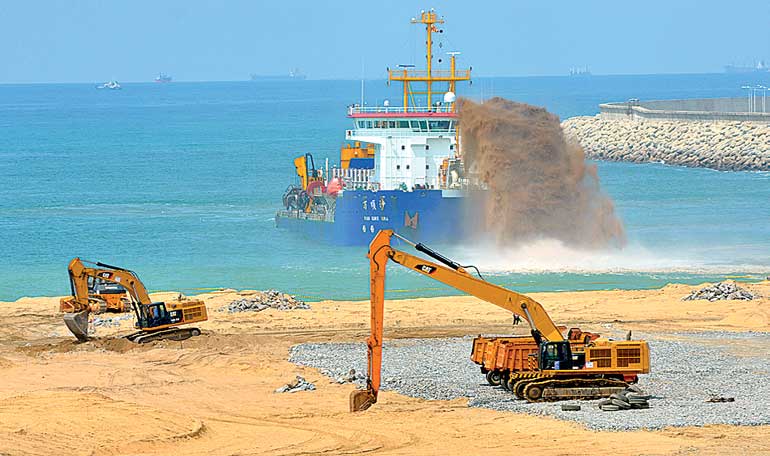
Port City - Pic by Shehan Gunasekara-Tuesday, 31 January 2017
 Gazette
notifications giving sweeping tax concessions for the Port City and a
mixed development project at Slave Island have been presented to
Parliament by the Government. The Port City project, renamed the
Colombo International Financial City (CIFC), was restarted by the
Government after the signing of a fresh agreement in August. However,
the initial exemptions proposed under the Strategic Development Project
Act of 2008 under the administration of former President Mahinda
Rajapaksa in 2014 expired before they could be presented to Parliament.
Gazette
notifications giving sweeping tax concessions for the Port City and a
mixed development project at Slave Island have been presented to
Parliament by the Government. The Port City project, renamed the
Colombo International Financial City (CIFC), was restarted by the
Government after the signing of a fresh agreement in August. However,
the initial exemptions proposed under the Strategic Development Project
Act of 2008 under the administration of former President Mahinda
Rajapaksa in 2014 expired before they could be presented to Parliament.The $ 1.3 billion project, expected to be implemented over the next eight years, was adopted as a Strategic Development Project by the Cabinet on a proposal made by Development Strategies and International Trade Minister Malik Samarawickrama.
A new set of exemptions for the Port City was outlined in an Extraordinary Gazette Notification released on 19 September. Under the slew of exemptions, foreigners working for the Chinese company are exempted from Pay As You Earn (PAYE), ports and airport development levy, CESS, Nation Building Tax of 2% and Customs Duty. The new gazette was submitted to Parliament on Friday.
The provisions of the Inland Revenue Act, No. 10 of 2006 relating to the imposition of income tax on the Project Company on the profit and income generated from the activities from the said Project shall not apply for the period of twenty five (25) years (“Tax Exemption Period”), the gazette said.
“The said Tax Exemption Period shall commence from the year in which the Project Company makes taxable profit or six (06) years after commencement of construction of the project, whichever occurs earlier,” it added. The gazette is likely to be re-issued ahead of the Government presenting it before parliament for approval.
The project tripartite agreement was signed by the Megapolis and Western Development Ministry, Urban Development Authority and the China Harbour Engineering Company (CHEC). The Sri Lanka Ports Authority (SLPA), which was a party to the previous agreement made under former President Mahinda Rajapaksa’s Government was exempted from the new version as the Port City would now be part of the new Government’s larger Megapolis project.
The Tata mixed development project in Slave Island is also reported to have been given similar concessions.
CHEC, which is a subsidiary of the Chinese-State run China Communications and Construction Company (CCCC), has also carried out other large scale construction projects in Sri Lanka, including the Hambantota port and Sooriyawewa cricket stadium.
Lankan nabbed with foreign currency worth Rs. 111mn at BIA

 A
42-year-old Sri Lankan man was arrested by the Customs at the
Bandaranayaike International Airport (BIA) while attempting to smuggle
foreign currency worth Rs.111 million to Dubai last evening.
A
42-year-old Sri Lankan man was arrested by the Customs at the
Bandaranayaike International Airport (BIA) while attempting to smuggle
foreign currency worth Rs.111 million to Dubai last evening.

2017-01-30
 A
42-year-old Sri Lankan man was arrested by the Customs at the
Bandaranayaike International Airport (BIA) while attempting to smuggle
foreign currency worth Rs.111 million to Dubai last evening.
A
42-year-old Sri Lankan man was arrested by the Customs at the
Bandaranayaike International Airport (BIA) while attempting to smuggle
foreign currency worth Rs.111 million to Dubai last evening.
The Suspect who is a resident of Mount Lavinia was a passenger of UL 225 flight bound to Dubai, UAE.
Currencies in US dollar, Euro, Swiss Francs, Saudi Riyal, Dirham, Qatar
Riyal and Sterling Pound in his possession had been seized.
Superintend of Customs at BIA, D. Bopege, who made the arrest conducts further investigation. (Chathuranga Paradeep and TKG Kapila)
Saudi air attacks in Yemen may amount to war crimes, says UN
At
least 292 civilians were killed in 10 targets studied by UN, which
found no evidence that eight of the attacks had 'legitimate military
objectives'

Smoke rises in Sanaa after a Saudi coalition air attack (Reuters)

Monday 30 January 2017
A UN investigation of 10 air strikes by the Saudi-led coalition in Yemen
has concluded that most of the attacks did not involve legitimate
military targets and may amount to war crimes, according to a report
obtained by AFP on Monday.
A UN panel of experts also said in the report that Yemen's Houthi rebels
had tortured and ill-treated detainees in violations that could also
amount to war crimes.
The panel investigated 10 air strikes between March and October last
year that killed at least 292 civilians, including at least 100 women
and children.
"In 8 of the 10 investigations, the panel found no evidence that the air
strikes had targeted legitimate military objectives," said the report
sent to the Security Council on Friday.
"For all 10 investigations, the panel considers it almost certain that
the coalition did not meet international humanitarian law requirements
of proportionality and precautions in attack."
"The panel considers that some of the attacks may amount to war crimes."
The Saudi-led coalition launched its air campaign in Yemen in March 2015
to support Yemen's president, Abd Rabbuh Hadi, and push back the rebels
who seized Sanaa and other parts of the country.
The panel said the violations by the Saudi-led air campaign "are
sufficiently widespread to reflect either an ineffective targeting
process or a broader policy of attrition against civilian
infrastructure".
Warning to allies
About 10,000 civilians have died in the war, according to UN officials,
who rank the humanitarian crisis in Yemen as among the world's worst.
The bombing campaign "while devastating to Yemeni infrastructure and
civilians, has failed to dent the political will of the Houthi-Saleh
alliance to continue the conflict," the report said.
The Houthis are allied with forces loyal to Yemen's former president Ali Abdullah Saleh, who is on a UN sanctions blacklist.
The panel warned that those supporting the coalition may also face UN sanctions.
Led by Saudi Arabia, the coalition includes Bahrain, Kuwait, Qatar and
the United Arab Emirates with some support from Egypt, Jordan, Morocco
and Sudan.
The United States is offering support to logistical and intelligence
activities, but the report said officers from Britain, France and
Malaysia were also working at the coalition's Riyadh headquarters.
"All coalition states and their allies also have an obligation to take
appropriate measure to ensure respect for international humanitarian law
by the coalition," said the experts.
Saudi Arabia has rejected accusations of deliberately targeting
civilians in Yemen and charges that Iran is arming the Houthis to expand
its influence in the region, a claim denied by Tehran.
The experts said they had "not seen sufficient evidence to confirm any
direct large-scale supply of arms" from Iran to the Houthis, but that
there were "indications" that Iran-made anti-tank guided weapons were
supplied to the rebels.
 Then-President Barack Obama holds a year-end news conference in Washington, D.C., Dec. 16, 2016. SAUL LOEB/AFP/Getty Images
Former president Barack Obama rejected the idea Monday that President Trump based his immigration executive order on a policy adopted by his own administration, and he endorsed the protests that have been taking place across the country in response to the new restrictions.
Trump has said that his move to ban the entry of migrants from seven
Muslim-majority countries into the United States, and to suspend
temporarily the admission of refugees, was based in part on a decision
in 2011 by then-President Obama to ban the admission of Iraqis to the
country after evidence surfaced that two Iraqis seeking resettlement had
been linked to terrorist activity in their homeland. The Obama and
Trump administrations also identified the same seven countries as
harboring terrorism threats.
Former Obama administration officials have denied that there was ever a
halt to the awarding of visas to Iraqis, though the processing of these
applications slowed after they were subject to more intense scrutiny.
Obama, who has remained publicly silent about his successor since
leaving office 10 days ago, pledged before leaving office to only speak
about Trump's policy moves “where I think our core values may be at
stake.” On Monday, his spokesman Kevin Lewis said in a statement, “With
regard to comparisons to President Obama’s foreign policy decisions, as
we’ve heard before, the President fundamentally disagrees with the
notion of discriminating against individuals because of their faith or
religion.”
Alluding to the widespread protests taking place in major airports and
cities in response to the new immigration policy, Lewis said that Obama
“is heartened by the level of engagement taking place in communities
around the country.”

“In his final official speech as President, he spoke about the important
role of citizen and how all Americans have a responsibility to be the
guardians of our democracy — not just during an election but every day,”
Lewis said. “Citizens exercising their Constitutional right to
assemble, organize and have their voices heard by their elected
officials is exactly what we expect to see when American values are at
stake.”
Sorry, Mr. President: The Obama Administration Did Nothing Similar to Your Immigration Ban

 BY JANUARY 30, 2017
There are so many reasons to detest the Donald Trump administration’s executive order on “Protecting the Nation from Foreign Terrorist Entry into the United States,” that it’s hard to know where to start.
Others have already argued eloquently about its cruelty in singling out the most vulnerable in society; its strategic folly in insulting countries and individuals the United States needs to help it fight terrorism (the ostensible purpose of the order in the first place); its cynical incoherence in using the September 11 attacks as a rationale and then exempting the attackers’ countries of origin; its ham-handed implementation and ever-shifting explanations for how, and to whom, it applies; and, thankfully, its legal vulnerability on a slew of soon-to-be-litigated grounds, including that it may violate the Establishment and Equal Protection clauses of the U.S. Constitution.
In light of all that, and particular in light of the new White House’s acknowledged aversion to facts, it may seem like a minor point that President Donald Trump and his advisors, in seeking to justify and normalize the executive order, have made a series of false or misleading claims about steps taken five years earlier by the Barack Obama administration. In case you missed it, a statement from the president published Sunday afternoon read:
“My policy is similar to what President Obama did in 2011 when he banned visas for refugees from Iraq for six months. The seven countries named in the Executive Order are the same countries previously identified by the Obama administration as sources of terror.”
Leaving aside the unusual nature of team Trump looking to his predecessors’ policies for cover, it seems worth pointing out this statement obscures at least five enormous differences between the executive order the White House issued on Friday and what the Obama administration did.
1. Much narrower focus: The Obama administration conducted a review in 2011 of the vetting procedures applied to citizens of a single country (Iraq) and then only to refugees and applicants for Special Immigrant Visas (SIVs), created by Congress to help Iraqis (and later Afghans) who supported the United States in those conflicts. The Trump executive order, on the other hand, applies to seven countries with total population more than 130 million, and to virtually every category of immigrant other than diplomats, including tourists and business travelers.
2. Not a ban: Contrary to Trump’s Sunday statement and
the repeated claims of his defenders, the Obama administration did not
“ban visas for refugees from Iraq for six months.” For one thing,
refugees don’t travel on visas. More importantly, while the flow of
Iraqi refugees slowed significantly during the Obama administration’s
review, refugees continued to be admitted to the United States during
that time, and there was not a single month in which no Iraqis arrived
here. In other words, while there were delays in processing, there was
no outright ban.
4. Orderly, organized process: The Obama administration’s review was conducted over roughly a dozen deputies and principals committee meetings, involving Cabinet and deputy Cabinet-level officials from all of the relevant departments and agencies — including the State, Homeland Security and Justice Departments — and the intelligence community. The Trump executive order was reportedly drafted by White House political officials and then presented to the implementing agencies a fait accompli. This is not just bad policymaking practice, it led directly to the confusion, bordering on chaos, that has attended implementation of the order by agencies that could only start asking questions (such as: “does this apply to green card holders?”) once the train had left the station.
5. Far stronger vetting today: Much has been made of Trump’s call for “extreme vetting” for citizens of certain countries. The entire purpose of the Obama administration’s 2011 review was to enhance the already stringent vetting to which refugees and SIV applicants were subjected. While many of the details are classified, those rigorous procedures, which lead to waiting times of 18-24 months for many Iraqi and Syrian refugees, remain in place today and are continually reviewed by interagency officials. The Trump administration is, therefore, taking on a problem that has already been (and is continually being) addressed.
*Bonus: Obama’s “seven countries” taken out of context: Trump’s claim that the seven countries listed in the executive order came from the Obama administration is conveniently left unexplained. A bit of background: soon after the December 2015 terror attack in San Bernadino, President Obama signed an amendment to the Visa Waiver Program, a law that allows citizens of 38 countries to travel to the United States without obtaining visas (and gives Americans reciprocal privileges in those countries). The amendment removed from the Visa Waiver Program dual nationals who were citizens of four countries (Iraq, Iran, Sudan, and Syria), or anyone who had recently traveled to those countries. The Obama administration added three more to the list (Libya, Somalia, and Yemen), bringing the total to seven. But this law did not bar anyone from coming to the United States. It only required a relatively small percentage of people to obtain a visa first. And to avoid punishing people who clearly had good reasons to travel to the relevant countries, the Obama administration used a waiver provided by Congress for certain travelers, including journalists, aid workers, and officials from international organizations like the United Nations.
Bottom line: No immigration vetting system is perfect, no matter how “extreme.” President Obama often said that his highest priority was keeping Americans safe. In keeping with America’s tradition and ideals, he also worked to establish a vetting system that worked more fairly and efficiently, particularly for refugees who are, by definition, in harm’s way. President Trump should defend his approach on the merits, if he can. He should not compare it to his predecessor’s.
This post has been updated.
Subscribe to FP Premium for 20% off now!
Quebec mosque attack suspect liked Trump, Israeli army, French far-right

Ali Abunimah-30 January 2017
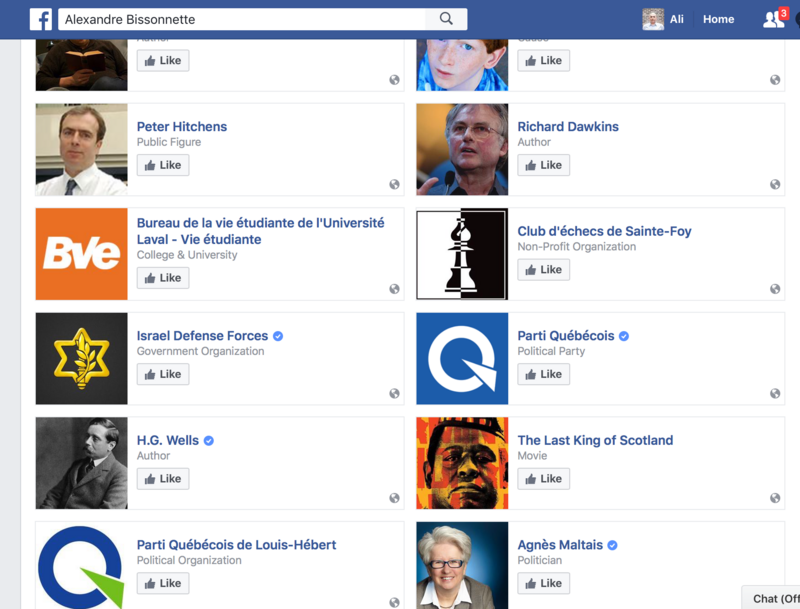
A screenshot from Bissonnette’s Facebook page shows he “liked” the official account of the Israeli army.

 This post is being updated as new information is available.
Social media postings by the suspect in the shooting attack that killed six persons and injured 19 at
a Quebec City mosque on Sunday evening indicate he was a fan of US
President Donald Trump, French far-right leader Marine Le Pen, the
Israeli army and other far-right groups.
Alexandre Bissonnette, 27, was arrested as a suspect in the slayings
several miles from the mosque, after he called police himself, the
newspaper Le Soleil reported.
Pakistan orders house arrest for alleged brain of 2008 Mumbai attacks
 Hafiz
Muhammad Saeed, chief of the banned Islamic charity Jamat-ud-Dawa,
looks over the crowed as they end a ''Kashmir Caravan'' from Lahore with
a protest in Islamabad, Pakistan July 20, 2016. REUTERS/Caren Firouz/Files
Hafiz
Muhammad Saeed, chief of the banned Islamic charity Jamat-ud-Dawa,
looks over the crowed as they end a ''Kashmir Caravan'' from Lahore with
a protest in Islamabad, Pakistan July 20, 2016. REUTERS/Caren Firouz/Files
| ISLAMABAD/LAHORE-Tue Jan 31, 2017

Pakistan on Monday ordered Hafiz Saeed, accused by the United States and
India of masterminding the 2008 attacks on the Indian financial capital
Mumbai that killed 166 people, to be placed under house arrest.
The move came after years of pressure and could ease recently escalating
tensions between the nuclear-armed neighbours. Saeed's continued
freedom has long infuriated Islamabad's arch-foe India.
The United States has offered $10 million for information leading to the
arrest and conviction of Saeed, who heads the Muslim charity
Jamaat-ud-Dawa (JuD). Washington says JuD is a front for the
Pakistan-based militant group Lashkar-e-Taiba (LeT).
"A large police team arrived (at JuD headquarters) and told us that
Hafiz Saeed would be placed under house arrest," Nadeem Awan, a
spokesman for the group based in the eastern city of Lahore, told
Reuters.
An Interior Ministry source confirmed Saeed and the other men "are under
house arrest" and on the exit control list, meaning they could not
leave the country. India's foreign ministry did not immediately respond
to requests for comment.
It was unclear why Pakistan decided to act now. A senior Pakistani
defence ministry official said Islamabad had not heard anything from the
new administration of U.S. President Donald Trump but had been feeling
U.S. pressure on the issue.
"Trump is taking hard decisions against Muslim countries, there is open
talk of actions against Pakistan also. So yes, this was a
consideration," said the official.
Other government officials have said recently that a broader diplomatic
campaign - pushed by India - to isolate Pakistan over its failure to go
after some Islamist groups has taken a toll, even involving pressure
from longtime ally China.
RAMPAGE IN MUMBAI
The Mumbai attacks in 2008 brought Pakistan and India to the brink of
war after 10 gunmen killed commuters, foreigners and some of India's
wealthy elite in a rampage that included attacks on two luxury hotels, a
Jewish centre and a train station.
India accused Pakistan of sponsoring the attack through LeT, which Saeed founded in the 1990s.
Pakistan has denied any state involvement and Saeed - who has distanced
himself from LeT - has said repeatedly he was not responsible.
Saeed was put under house arrest after the Mumbai attack but was released about six month later in June 2009.
Awan said Islamabad had been under pressure from the United States to
take action against Saeed or face sanctions. "This government has
buckled under the pressure," he said.
The Punjab provincial government said Saeed and four other men were in
"protective custody" because they violated a U.N. Security Council
resolution passed after the Mumbai attacks.
Interior Ministry documents seen by Reuters named Saeed and four other
men as members of JuD and Falah-e-Insaniat Foundation (FiF), a charity
wing of JuD headed by Saeed.
One document said the government believed FiF was "acting in a manner that may be concerned in terrorism".
PROSECUTIONS RARE
Previous Pakistani announcements of action against anti-India militant groups have rarely led to serious punishments for them.
Western countries have for decades accused Pakistan of harbouring
Islamist militant groups and using them as proxies against bigger
neighbour India, with whom it has fought three wars since independence.
Islamabad denies having such a policy.
In recent months, Saeed has been holding regular press conferences about
the security crackdown in Indian-controlled Kashmir, trying to
highlight alleged civil rights violations against the mainly Muslim
population there.
He told Reuters last month that he had no fear of arrest despite the
appointment of a new army chief and a new head of the Inter-Services
Intelligence (ISI) spy agency.
Successive Pakistani governments have vowed to crack down against
militant groups but lack of action against Saeed has often been seized
on by India as proof that Islamabad was dragging its feet on tackling
banned outfits.
(Writing by Drazen Jorgic; Editing by Tom Heneghan)
Balochistan: Stuffed Birds Could Never Fly


( January 30, 2017, Islamabad, Sri Lanka Guardian) It
is simply ‘the Return of a Native’ but for some of the people the news
of surrender of Ferrari commander Lal Din Bugti of Balochistan before
security forces might be ‘shocking news’. According to media reports,
Lal Din Bugti along with six associates surrendered on 28th January in
Quetta and pledged to fight for defence of the country till the last
moment of his life. According to security sources, the separatist
commander and his colleagues laid down arms in front of Mir Attaullah
Kalpor Bugti and FC officer Col Awais. The government sources told media
that these Ferrari commanders were involved in anti-state activities
including blowing up gas pipelines and other heinous crimes. Now at the
call of their conscience, they are back to the lap of their motherland
Pakistan. I think a sinner seeking for forgiveness must always be
welcomed and honoured. The days are not in far future when all Ferrari
commanders who have been playing in the hands of the Indian agencies
since long would realize that their motherland is waiting for them with
tearful eyes.
For the last many years Indian agents are trying their best to misguide
the people of Balochistan that the government of Pakistan is exploiting
the natural resources of Balochistan and nothing is being done for the
betterment of the people of Balochistan. This blame game is the very
foundation of all so-called separatist movements in Balochistan
patronized by the Indian agencies. India will have to search for some
other blame or allegation to malign Pakistan after the completion of
CPEC as this project would not only reduce unemployment and poverty but
also become a source of economic stability in Balochistan. With the help
of propaganda tools our friends in India are trying to sow the seed of
hatred in the hearts of the people of Balochistan but they should keep
in mind that truth is truth though most of the time it is bitter. No war
could be won on the basis of propaganda. Instead of spreading hatred
against CPEC, India must come forward with open eyes and open arms and
take some advantage from the CPEC by supporting it. With the help of
propaganda and disinformation, the marvelous CPEC project cannot be
maligned anymore. There is always a very clear difference between truth
and propaganda. The people of Balochistan are very well aware of this
difference.
Most of the impartial analysts are of the opinion that the CPEC project
is going to be a game-changer not only for Pakistan but for the whole of
region. Unfortunately some so-called analysts, who certainly feel pride
in working as mouth-piece of others, are trying to misguide people. A
few weeks back, a much esteemed newspaper of India ‘the Indian Express’
published an article with the same misguiding contents. The title of the
article was ‘Corridor of Uncertainty’. The author of this article tried
all his best to present that picture of Pakistan, of the Security
Forces of Pakistan, of the people of Pakistan and of the CPEC which is
certainly not corresponding to the reality. He says, “The only big thing
going for an isolated Pakistan is the China-Pakistan Economic Corridor
(CPEC). Unable to tackle with its internal security problems — for which
it now wrongly blames India — it prefers focusing on the good times the
world thinks the Chinese investment of $46 billion will bring.” In
short the CPEC project has become a pain in the neck for the
‘well-wishers’ of Pakistan.
In another article ‘CPEC is not a holy Cow’ the author says, ‘Pakistan
faces many serious problems; and among them is the status and
invulnerability of holy cows, and people who are above the Pakistani
laws. Bitter fact is growth in number of holy cows, accumulation of
wealth and power they possess.’ He further says, ‘I am a citizen of
State of Jammu and Kashmir and my loyalty is with State and its people. I
don’t have to be loyal to neighbours of Jammu and Kashmir or to those
who occupy us. The CPEC runs without permission through our land, Gilgit
Biltistan which is part of the former Princely State of Jammu and
Kashmir. My fear is despite much hype and attraction, CPEC will prove to
be a white elephant for Pakistan; and it could be Pakistan’s Waterloo.’
This article is a mixture of confusions and misunderstandings. Though
the writer has very passionately rather emotionally tried to plead the
‘stuffed’ point of view but in his heat and haste, he contradicted his
own narrated arguments. He admits that ‘Gilgit Biltistan is part of the
former Princely State of Jammu and Kashmir’. It means he has accepted
the fact that the present day Gilgit Biltistan has nothing to do with
Jammu and Kashmir as it once used to be a part of Jammu Kashmir.
Secondly on one hand he says, ‘my loyalty is with State and its people, I
don’t have to be loyal to neighbours of Jammu and Kashmir’ but at the
same time he expresses his worries about Pakistan that ‘CPEC will prove
to be a white elephant for Pakistan.’ It seems that the writer is not
very much clear about the point of view he has planned to express.
Usually one has to face this situation of confusion when one is
presenting some other’s point of view. Speaking for others could be good
at times but becoming the mouth-piece of someone already with bad
repute is never wise. The stuffed birds could never fly.
Subscribe to:
Posts (Atom)