Peace for the World World ! Your War Our Lives

The Dalai Lama
A Brief Colonial History Of Ceylon(SriLanka)
Sri Lanka: One Island Two Nations
A Brief Colonial History Of Ceylon(SriLanka)
Sri Lanka: One Island Two Nations
(Full Story)
Back to 500BC.

Friday, March 31, 2017
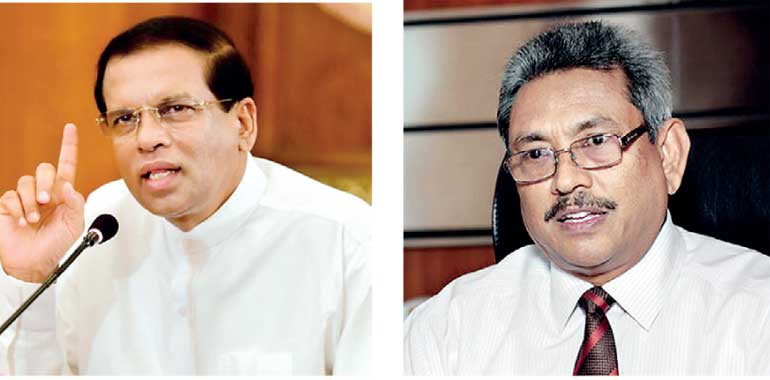

 Friday, 31 March 2017
And then, like a violent silver streak that lights up the overcast sky from east to west, there comes the occasional flash of electricity to wake us up. Then follows the thunderbolt whose reverberations echo across the country and die down only in the muffled cloisters off the corridors of power. There was one such electrical event over the mediascape a few days ago. If the resultant concussion hasn’t shaken up the establishment a bit, there is something a tad wrong with the new political culture we have drawn overhead like some grand canopy of hopeful atmosphere.
WHEN IT RAINS, IT POURS – after a drought in progress on headline-arresting cases, a sudden downpour this week in a landmark case involving an erstwhile defence secretary might have caught media as much as its masses unaware. While progress in cracking the details of the assassination of an iconic editor is painfully slow, government can get away with the plea that the wheels of justice eventually grind sure… What could be of concern however is that all parties among the powers that be – prosecuting the advent of peace with justice with agendas inimical to the national interest, and at odds with their coalition partners – are not under the same stormy heaven as the rest of the citizenry outside the canopy of the all-embracing umbrella of the new/streamlined/same old political culture are
Rest assured it’s the “dog bites man” kind of news… In any other milieu – where the media would break the story to an unaware public – it would be a “man bites dog” type of headliner. In topsy-turvy-land, however, the splashes that the media makes have long since paled into puddles by the time the spectacular surmises and summary speculations get up there in 72 point bold. Which is to say that the co-called news these days often goes by another moniker in the marketplace: rumour, gossip, faction, common knowledge, conventional wisdom, the sense that while the headline is over the top, the happenings have been under the radar for so long that they’ve flown over the cuckoo’s nest...
PRESIDENT’S BROTHER LED “DEATH SQUADS”. Really? How terribly surprising for a dismayed citizenry! Yawn… is that a silver streak, a bird, a plane, superman? No, it’s a former defence secretary cum military mandarin with a wing down… it’s the international media reporting on it rather than the local press sitting up and taking due note that makes it remotely interesting in the first place.
Maybe the time, as well… Perhaps there’s more to it than meets the eye, that – as Al-Jazeera reported – “a police report has implicated the brother of a former Sri Lankan president saying he directed a top-secret death squad that targeted journalists and dissidents. For the rest of the CID’s testimony to a magistrate’s court earlier this week – including the hoary chestnut that the erstwhile high-ranking bureaucrat led a clandestine unit culpable inter alia of assassinating gadfly editor Lasantha Wickrematunge comes as something of an anticlimax. Or it could be that in a climate such as we enjoy today (we use the word “enjoy” with critical appreciation), such passé revelations have become so much par for the course that we tend to take them for granted in ways that we never did before. Under a previous regime in which transparency was as clear as, well, an overcast sky with war-clouds obfuscating the picture.

Which reminds me of another tried and tired cliché: As also reported by Al-Jazeera, it transpires that a special secret unit outside the formal chain of command – of course! – of the former army commander (now a field marshal and the general blue-eyed boy of the powers that be, being something of a past presidential candidate and future vote attractor) – targeted the then authoritarian government’s thorns-in-the-side… The plot thickens, as they say. Again, yawn…
Be the boredom of the meteorological media audiences as they may, the bolt from the blue is not the alleged guilt of Gotabaya Rajapaksa, nor is it the ostensible innocence of Sarath Fonseka in any political killing or war-criminal-type wrongdoing. The surprising streak across the falling-night sky is the volte-face of a far more prominent player in the saga… no less than the defence minister and commander-in-chief himself. In a statement that has surprised – if not shocked – both political partners and previously supportive opponents, the president has enacted something of a Pontius Pilate washing off of hands (but with some wiggle-room…). In a statement – to which the background and context are clearly proceedings in the magistrate’s court earlier in the week – the head of state has categorically said that (to quote a media report) “the government will disavow any member of the armed forces or police who is accused of participating in the murder of both journalists and sportsmen, or those who abducted and murdered for reasons not related to the war on terrorism. Reading in-between the lines, perhaps the statement is not as categorical as it initially appears. Because further down the track, he clarified his take… again, per media, “that the government would do whatever was necessary to protect war heroes against accusations of war crimes committed against terrorists” – adding the rider that “these protections do not apply to those whose actions can in no way be attributed to fighting the LTTE...”
As plain as pikestaff? Or as clear as cirrus-flecked heavens can be when obscured by the gathering gloom of rain-bearing strato-nimbus clouds! Could it be, we mean to ask, that the c-i-c of the security forces has changed his mind – as far as it is not unusual for politicians to be blown by trade winds fair and foul – since his last strongly worded sentiments less than six months ago? On that occasion, the h-o-s waxed eloquent on how hauling a senior bureaucrat and a trio of ex-commanders of the navy into court was not justice being served, but rather the blatant execution of a political agenda. At the time, he was clearly riled that the heads of the CID, FCID, and Bribery Commission – to say nothing of fellow consuls in the coalition – had not consulted him in the matter of the former defence secretary being asked to account for the loss of an estimated Rs. 11.5 billion in revenue to the state as a result of the defence ministry’s decision to permit private security firm Avant-Garde to run a floating armoury. The controversy took on a personal flavour when perhaps scurrilous reportage insinuated close ties between the sitting president and the ousted senior secretary, at one time ostensibly the most powerful bureaucrat in the civilian hierarchy and demonstrably de facto defence minister.
Therefore the president’s pique of outrage then must be counterpointed by his seemingly more balanced valence today. A man – even if he is head of state, especially if he is head of a government committed to globalism – can harbour personal opinions on how to handle terrorists, rogue bureaucrats, miscreant naval chiefs, et al. However if and when his sentiments are in danger of being interpreted as policy, that’s when the bolt from the blue becomes a lightning-strike headed towards ground zero. In this context, the position of the coalition partners could be made clearer in the national interest. Respect for the mandate granted this government by the people demands it. Expect to hear the thunder soon…
In the meantime, in the absence of atmospheric clarity, a meteorological approach to weather conditions (see my own ‘Beaufort Scale for Senior Bureaucrats’ – below) might shake government and citizenry out of their apathy.
0.“Calm.” The former regime is ousted democratically. Democracy trumps military bureaucracy.
1.“Light Air.” Coalition partners enjoy honeymoon. Autocrats in exile.
2.“Light Breeze.” Reformist agenda is aired. Includes ensuring ‘peace with justice’.
3.‘Gentle Breeze.” Meets with resistance in the House. Horse-traded MPs and cabinet ministers fear being implicated in former regime’s wrongdoings.
4.“Moderate Breeze.” Realpolitik rules the day, but after deals are struck, legislation is passed. The Full Monty isn’t possible; former bureaucrats look like they might be let off the hook.
5.“Fresh Breeze.” 19A, RTI, give government ratings a boost. Former regime and mandarins seen to be in the doldrums.
6.“Strong Breeze.” Joint opposition gives split SLPF a hard time. President rumoured to be in cahoots with former senior bureaucrats.
7.“High Wind.”Government renews transitional justice pledged in Geneva. President fears international pressure will compromise his domestic popularity if security forces are implicated in war crimes.
8.“Fresh Gale.” Reformist camp prosecutes former mandarins with a vengeance.Graves are dug up, key bodies exhumed.
9.“Strong Gale.” Joint opposition alleges political agenda being ground like an axe. CID, FCID, perceived as state lackeys of conservative wing of coalition powers.
10.“Storm.” The c-i-c and h-o-s lashes out at coalition partners.
11. “Violent Storm.” Former defence secretary looking increasingly culpable of masterminding political death-squads.
12.“Hurricane.” Impasse over delivering on mandate as regards peace with justice drives coalition partners apart; reformist agenda flounders in choppy seas; roof comes off the national government with good intentions but no sea-legs to stay the course.

Why 4,000 acres dropped from Mavillu ?

 Mar 30, 2017
A
forest reserve called Mavillu has been declared by bringing together
the Mavillu, Veppal, Marichchakaddi-Karadakkuli, Vilaththikulam and
Periyamurippu reserves located north of Wilpattu national park, but
3,0380 acres of previously cleared, but now becoming jungle once again
as well as the entire coastal area have been dropped from the forest
reserve, says the Environment Conservation Trust.
Accordingly, a shallow lake system adjacent to the Kallaru Oya and the
dry-evergreen forest system as well as the coastal green belt, cacti and
shrub jungles have been dropped from the forest reserve, it says.
The ECT stresses 4,000 acres have been cleverly taken out of the forest
reserve with future development projects in mind. This is not the real
method of conserving environment, it notes, adding that if the intention
is honest, all areas, including the coastal belt, and excluding where
permanent habitats are located, should be added to Wilpattu national
park as per clause two of the fauna and flora ordinance, the ECT says.
That will help conserve the hydro catchments for Modaragan Aru, Kallaru
and Aruvi Aru or Malwatu Oya, all located south of the forest reserve,
as well as the shallow lake system and the coastal belt. If no
conservation takes place and habitations expand, a severe water shortage
and an escalation of human-elephant conflict will be unavoidable.
Ashika Brahmana
The
Ramanathan Kannan affair:-Showdown over Alagaratnam’s final letter to
Chief Justice-New BASL President holds out hope of a solution-BASL and
JSA to meet separately tomorrow
By C. A. Chandraprema-March 30, 2017, 12:00 pm

 The
controversy over appointing Ramanathan Kannan, a member of the private
bar from Batticlaoa, as a High Court judge over the heads of many senior
District Court judges and officials of the Attorney General’s
Department, is now coming to a head with an emergency general meeting of
the Judicial Services Association being called for tomorrow. According
to members of the legal fraternity, this is the first time the JSA is
holding a meeting of this nature. The main subject to be discussed at
this meeting will be the appointment of Ramanathan Kannan to the HC and
also the attitude of the BASL with regard to this matter. When Kannan
was appointed to the High Court, the Judicial Services Association
protested vehemently, writing to the President, the Judicial Services
Commission and the BASL against this appointment. In the discussions
that ensued, it transpired that the decision making bodies in the BASL -
the Executive Committee and the Bar Council and even the Secretary of
the BASL had been completely unaware that the then President of the BASL
Geoffrey Alagaratnam had recommended Ramanathan Kannan for appointment
as a High Court Judge to the President and the Chief Justice.
The
controversy over appointing Ramanathan Kannan, a member of the private
bar from Batticlaoa, as a High Court judge over the heads of many senior
District Court judges and officials of the Attorney General’s
Department, is now coming to a head with an emergency general meeting of
the Judicial Services Association being called for tomorrow. According
to members of the legal fraternity, this is the first time the JSA is
holding a meeting of this nature. The main subject to be discussed at
this meeting will be the appointment of Ramanathan Kannan to the HC and
also the attitude of the BASL with regard to this matter. When Kannan
was appointed to the High Court, the Judicial Services Association
protested vehemently, writing to the President, the Judicial Services
Commission and the BASL against this appointment. In the discussions
that ensued, it transpired that the decision making bodies in the BASL -
the Executive Committee and the Bar Council and even the Secretary of
the BASL had been completely unaware that the then President of the BASL
Geoffrey Alagaratnam had recommended Ramanathan Kannan for appointment
as a High Court Judge to the President and the Chief Justice.
 The
Island exclusively reported on the contents of this letter earlier this
month. This letter has effectively retracted the recommendation made
earlier by the JSC in favour of Kannan’s appointment to the High Court.
Following the receipt of this letter, the Secretary to the President
wrote back to the JSC on 8 March 2017 asking for a recommendation that
Kannan be removed from the position of High Court judge. (Letter
reproduced here.) Up to now, the JSC has not written to the President in
terms of Article 111(2)(b) recommending Kannan’s removal. Whether it is
necessary for the JSC to make such a recommendation to remove Kannan is
questionable because the present government removed Mohan Peiris from
the position of Chief Justice saying that there was a flaw in the way
his predecessor had been removed and since his predecessor had not in
fact been removed, Peiris had never been the CJ! The yahapalana
President himself bragged openly in public that he had used his
executive power to remove Peiris.
The
Island exclusively reported on the contents of this letter earlier this
month. This letter has effectively retracted the recommendation made
earlier by the JSC in favour of Kannan’s appointment to the High Court.
Following the receipt of this letter, the Secretary to the President
wrote back to the JSC on 8 March 2017 asking for a recommendation that
Kannan be removed from the position of High Court judge. (Letter
reproduced here.) Up to now, the JSC has not written to the President in
terms of Article 111(2)(b) recommending Kannan’s removal. Whether it is
necessary for the JSC to make such a recommendation to remove Kannan is
questionable because the present government removed Mohan Peiris from
the position of Chief Justice saying that there was a flaw in the way
his predecessor had been removed and since his predecessor had not in
fact been removed, Peiris had never been the CJ! The yahapalana
President himself bragged openly in public that he had used his
executive power to remove Peiris.
By C. A. Chandraprema-March 30, 2017, 12:00 pm
 The
controversy over appointing Ramanathan Kannan, a member of the private
bar from Batticlaoa, as a High Court judge over the heads of many senior
District Court judges and officials of the Attorney General’s
Department, is now coming to a head with an emergency general meeting of
the Judicial Services Association being called for tomorrow. According
to members of the legal fraternity, this is the first time the JSA is
holding a meeting of this nature. The main subject to be discussed at
this meeting will be the appointment of Ramanathan Kannan to the HC and
also the attitude of the BASL with regard to this matter. When Kannan
was appointed to the High Court, the Judicial Services Association
protested vehemently, writing to the President, the Judicial Services
Commission and the BASL against this appointment. In the discussions
that ensued, it transpired that the decision making bodies in the BASL -
the Executive Committee and the Bar Council and even the Secretary of
the BASL had been completely unaware that the then President of the BASL
Geoffrey Alagaratnam had recommended Ramanathan Kannan for appointment
as a High Court Judge to the President and the Chief Justice.
The
controversy over appointing Ramanathan Kannan, a member of the private
bar from Batticlaoa, as a High Court judge over the heads of many senior
District Court judges and officials of the Attorney General’s
Department, is now coming to a head with an emergency general meeting of
the Judicial Services Association being called for tomorrow. According
to members of the legal fraternity, this is the first time the JSA is
holding a meeting of this nature. The main subject to be discussed at
this meeting will be the appointment of Ramanathan Kannan to the HC and
also the attitude of the BASL with regard to this matter. When Kannan
was appointed to the High Court, the Judicial Services Association
protested vehemently, writing to the President, the Judicial Services
Commission and the BASL against this appointment. In the discussions
that ensued, it transpired that the decision making bodies in the BASL -
the Executive Committee and the Bar Council and even the Secretary of
the BASL had been completely unaware that the then President of the BASL
Geoffrey Alagaratnam had recommended Ramanathan Kannan for appointment
as a High Court Judge to the President and the Chief Justice.
In any event, the BASL has no constitutional role in the appointment of
judges. According to Article 111(2) (a) the President appoints judges to
the High Court on the recommendations of the Judicial Service
Commission, which is headed by the Chief Justice. Before making such
recommendation the JSC will have to consult the Attorney General as
well. If the Chief Justice wishes to make inquiries about the
suitability of a candidate, he can make such inquiries from prominent
members of the legal profession entirely at his own discretion. The
President of the BASL can be among the senior lawyers consulted in this
manner. But, this will be an inquiry made at the discretion of the CJ or
other member of the Judicial Services Commission and the BASL President
has no legal right to recommend anybody for appointment to the High
Court. However, after the present yahapalana government came into power,
a group within the BASL has been trying to arrogate to themselves a key
role in the appointment of judges.
For their part, the yahapalana authorities have also been trying to give
the BASL that power obviously as a reward for the role played by many
lawyers in the regime change project of January 2015. The first draft of
the 19th Amendment had a provision making it mandatory for the
Constitutional Council and the Judicial Services Commission to consult
the BASL when appointing judges. This was shouted down by the Opposition
and the provision was dropped when the 19th Amendment was finally
passed. However, the BASL President appears to have arrogated to himself
a de facto power not just to intervene but to take the initiative in
the appointment of judges. What happened in the case of Ramanathan
Kannan was not anybody in the JSC asking the BASL President for his
opinion, but the then BASL President Geoffrey Alagaratnam taking the
initiative to canvass for Kannan’s appointment as a HC judge.
The sacking of Mohan Peiris
Following the representations made to him by Geoffrey Alagaratnam, the
President had asked the JSC to make a recommendation to appoint Kannan
as a High Court judge and the JSC sent him the recommendation. At the
time the JSC made this recommendation, they had been under the
impression that the entire BASL was behind the representations made by
Alagaratnam. After things hit the fan, however, the Secretary to the
BASL wrote a letter to the Judicial Services Association stating that
neither the BASL Executive Committee nor the Bar Council had made any
recommendation that Ramanathan Kannan be appointed a High Court judge
and, therefore, the BASL has not made any such recommendation. Following
this letter from the BASL Secretary, the Judicial Services Commission
wrote to the President on 23 February 2017 (which letter we reproduce
with this article) stating that if no proper recommendation has been
made by the BASL to appoint Ramanathan Kannan as a High Court judge, the
recommendation made by the JSC in terms of Article 111(2)(a) of the
Constitution ‘has no force or validity in law’.
 The
Island exclusively reported on the contents of this letter earlier this
month. This letter has effectively retracted the recommendation made
earlier by the JSC in favour of Kannan’s appointment to the High Court.
Following the receipt of this letter, the Secretary to the President
wrote back to the JSC on 8 March 2017 asking for a recommendation that
Kannan be removed from the position of High Court judge. (Letter
reproduced here.) Up to now, the JSC has not written to the President in
terms of Article 111(2)(b) recommending Kannan’s removal. Whether it is
necessary for the JSC to make such a recommendation to remove Kannan is
questionable because the present government removed Mohan Peiris from
the position of Chief Justice saying that there was a flaw in the way
his predecessor had been removed and since his predecessor had not in
fact been removed, Peiris had never been the CJ! The yahapalana
President himself bragged openly in public that he had used his
executive power to remove Peiris.
The
Island exclusively reported on the contents of this letter earlier this
month. This letter has effectively retracted the recommendation made
earlier by the JSC in favour of Kannan’s appointment to the High Court.
Following the receipt of this letter, the Secretary to the President
wrote back to the JSC on 8 March 2017 asking for a recommendation that
Kannan be removed from the position of High Court judge. (Letter
reproduced here.) Up to now, the JSC has not written to the President in
terms of Article 111(2)(b) recommending Kannan’s removal. Whether it is
necessary for the JSC to make such a recommendation to remove Kannan is
questionable because the present government removed Mohan Peiris from
the position of Chief Justice saying that there was a flaw in the way
his predecessor had been removed and since his predecessor had not in
fact been removed, Peiris had never been the CJ! The yahapalana
President himself bragged openly in public that he had used his
executive power to remove Peiris.
Yet, when it comes to Kannan, that executive power which had enabled the
government to sack a Chief Justice with just a chit from the
Presidential Secretariat seems to be strangely paralysed. In a situation
where the JSC has officially and in writing, retracted the
recommendation they made earlier that Kannan be appointed to the HC, his
removal by the President on the basis that he had not been
constitutionally appointed, should have been automatic. Instead, what we
see is the Presidential Secretariat writing back to the JSC asking for a
recommendation in terms of Article 111(2) (b) of the Constitution, for
Kannan’s removal. In the meantime, the various parties responsible for
Kannan’s appointment to the High Court including, of course, Geoffrey
Alagaratnam have been fighting tooth and nail to safeguard their protégé
in the High Court. One way in which these parties seek to keep Kannan
in the High Court is by foisting the blame for his appointment on former
Chief Justice K. Sripavan.
As Alagaratnam argued, in his speech, at Sripavan’s farewell, despite
any canvassing, importuning, or writing of letters he (Alagaratnam) may
have done to the President and to the Chief Justice on behalf of Kannan,
it was up to the CJ and the JSC to exercise ‘due diligence’ before
recommending Kannan to the President for appointment to the High Court.
The gist of this argument is that now that Kannan has been appointed as a
judge of the High Court by a mistake made by the former Chief Justice
who had assumed that Alagaratnam was speaking on behalf of the BASL, he
(Kannan) cannot be removed unless some wrong doing is proved on his
part. This mind you, is the argument put forward by the very person who
is squarely responsible for misleading both the Chief Justice as well as
the President of the country by giving them the impression that he was
speaking on behalf of the entire BASL.
Mind numbing perfidy
In a previous interview with this newspaper Hemantha Warnakulasuriya
described those promoting the appointment of Ramanathan Kannan as a
‘mafia’ within the BASL. Given the perfidious statements being made to
keep Kannan in a position to which he should never have been appointed
in the first place, this does indeed look like the work of a mafia in
action. What takes the cake is that Geoffrey Alagaratnam just before he
stepped down from the position of President of the BASL, had written a
letter to the new Chief Justice Priyasath Dep telling him among other
things that the BASL at its Special meeting on 21 March 2017 had
considered the recommendation of a committee of senior silks and past
BASL presidents and had decided that the BASL should not get involved in
recommending the removal of a High Court judge who has now been
appointed and that this can only be done by the President on the
recommendation of the JSC.
In this letter Alagaratnam had also unrepentantly claimed that the BASL
has ‘every right’ to make recommendations to the President to appoint
eminent members of the bar for judicial appointments and called on the
President to consider the recommendations made by the BASL for
appointments to the judiciary from time to time. This letter dated 22
March 2017 is also reproduced with this article and in it we once again
see an element of absolute perfidy when Alagaratnam says that the BASL
decided not to get involved in recommending the removal of a High Court
judge who had already been appointed. He seems to have conveniently
forgotten that it was he who recommended the appointment of that judge
and misleading both the former Chief Justice and the President in the
process.
The main question that this letter brings to the fore, is whether the
BASL should have any role at all in recommending judges for appointment
as asserted in this letter? If the private bar has a role in appointing
the judges who will be hearing their cases, that is going to corrupt the
entire justice system. What happened in the case of Ramanathan Kannan
is precisely what should never happen again. Kannan a lawyer practicing
in the Batticlaoa courts was recommended for appointment as a judge by
the President of the Batticaloa Bar – which certainly smacks of someone
being recommended for high judicial office by a friend and colleague.
Now Kannan is a High Court judge who owes his appointment to two
practicing lawyers. If this is replicated over and over again, before
long we will have a good number of judges at all levels of the judiciary
who owe their positions to certain members of the private bar.
In the context where a High Court judge is now holding office without
having fulfilled the constitutional requirements to be appointed a HC
judge, the Judicial Services Association and the BASL will both be
holding important meetings to decide what positions they will take on
this matter. Tomorrow will be the acid test for the new President of the
BASL U.R. de Silva, who will be presiding over a meeting of the BASL
for the first time. Certain comments made by the new BASL President give
us reason to believe that he may not follow in the footsteps of his
predecessor. Addressing a press conference last Wednesday, De Silva told
reporters that the BASL did not approve of the appointment of Kannan to
the HC and that the former BASL President Alagaratnam had recommended
Kannan in his private capacity, using letterheads of the BASL and that
it was wrong to have done so. He had also said that, according to the
BASL Constitution, the President of the association could not issue such
letters without the knowledge of the Executive Committee. Thus, there
is now hope that this whole disreputable episode will be brought to a
close with the BASL also standing for Kannan’s removal after the
separate BASL and JSA meetings to be held tomorrow.
Prohibiting Inhuman Strikes By Doctors & Ungrateful Students

By Asoka N.I. Ekanayaka –March 29, 2017
Prof. Asoka N.I. Ekanayaka
The latest despicable threat by the GMOA to
reportedly launch the “biggest strike ever in the country’s history”
represents a crude piece of trade union megalomania. It is tantamount to
a kind of “medical thuggary” that is a disgrace to the medical
profession. In our day and age doctors (prosperous members of a once
noble profession) and University students (unashamed young dependents on
public charity ) have become strange bedfellows in launching disruptive
“strikes” that cause enormous suffering and inconvenience to the
public. The fact that doctors (by virtue of professional obligation) owe
a debt of service to the millions who are sick and dying, and students
(by virtue of their neediness) a debt of gratitude to the millions who
pay for their education – only underline the absurdity of such strikes.
Unfortunately Sri Lankans seem to have an amazing capacity to bow their
heads and humbly endure such abuses however wicked and irrational by
such groups who in pursuance of their selfish vested interests,
particular ideological hang up, or political agenda don’t give a damn
for the public interest. One wonders whether deeply embedded in the
psyche of the Sri Lankan masses is a primeval fatalism brought on by
belief in Karma that makes them resigned to exploitation, on the basis
that since bad things happen because they were destined to happen anyway
there is nothing anyone can do about it. Otherwise one would expect
that by now millions of people in this country fed to the teeth by their
striking tormentors, would be crying “enough is enough” and calling for
government action to in one way or another prohibit the scandal of
strikes by doctors and students.
Indeed from the perspective of governance It is now clear that strikes
by predatory doctors and university students have become a serious
impediment to good governance, desirable reforms and the enforcement of
order and discipline in the health and higher education sectors.
Doctors have repeatedly shown a diabolical tendency to use draconian
trade union power in pursuance of a selfish agenda demanding unrealistic
perks and privileges, while intimidating the government and interfering
in matters of state policy that are completely outside their remit.
Their protests over SAITM, ETCA,
budget proposals etc. are recent examples of such arrogant abuse of
power. The extraordinary power wielded by doctors enabling them to force
the hand of governments to act against the public interest, derives
from their freedom to strike at will and hold the public to ransom. The
terrible hardships inflicted on the sick and suffering by striking
doctors (with the possibility of patients dying due to direct or
indirect medical neglect) inevitably puts intolerable pressure on
governments to compromise principle and concede to doctors on any terms
so as not to prolong public agony. That puts doctors in a winning
position against the rest of society every time, however unjustified
their cause.
For the GMOA to cynically claim that their strikes are for the ultimate
good of the public whom they consciously penalize is sheer arrogance and
adds insult to injury. For anyone to imply that the sick and dying
might willingly accept the denial of treatment because they too support
the doctor’s cause – is the height of lunacy. Most people (especially
the sick) in this country don’t care a hoot about SAITM. Indeed they
would’nt even know what those letters stand for ! Patients are neither
masochists nor martyrs that they should be happy to endure yet more pain
and suffering in support of the selfish agenda of doctors. Such
fantasies reflect the self righteous blindness of the medical
establishment and how out of touch with reality many doctors have become
in our society !
Nor should anyone be deluded by the glib reassurance of doctors that
their strikes will not imperil the lives of patients because as a
generous concession to the great Hippocrates and out of lofty compassion
for the toiling masses they have condescended to maintain essential
services in ICU, emergency, and paediatric units. The truth is that the
actual number of people who die, suffer some complication, or whose
health is in some way compromised directly or indirectly as a result of a
doctor’s strike is an imponderable that is incapable of statistical
documentation. For example we will never know the number of people who
having developed some sinister symptom at home died, suffered some
complication, or whose eventual recovery was compromised because they
were put off from promptly going to hospital by the knowledge that
doctors were on strikes and fear that services might be restricted.
In the case of university students their ability to strike and boycott
classes with impunity makes it impossible to effect necessary policy
changes in higher education and maintain campus discipline. The
punishment of students for grave offenses like the torture of new
entrants (ragging),
invariably provokes disruptive strikes instigated by aggressive
militant student unions. Such strikes bring academic programs to a
standstill intimidating university authorities into backing down so as
to restore normalcy whatever the sacrifice of principle. Furthermore the
power of students instigated by politically oriented student unions to
retaliate with strikes paralyzing academic programmes across the
universities, seriously limits the ability of governments to institute
enlightened reforms in the higher education sector.
Alongside the above considerations there is the abomination of ugly
posters and placards that pollute hospital premises when doctors are on
strike in contempt of the rights of worried patients to a tranquil non
confrontational hospital environment. Nor must we forget the chaos and
disruption resulting from rowdy street demonstrations and public
meetings that accompany strikes by doctors and university students, with
rioting mayhem and traffic blocks on public roads causing severe
inconvenience to the general public
For the foregoing reasons there is a strong case for action to prohibit
strikes by doctors (and possibly other hospital workers) as well as
university students. Apart from pragmatic considerations there is a
strong intellectual and philosophical justification for such an
initiative based on some important principles.
In the case of doctors the prevention and treatment of disease is a life
and death issue. As a vocation the practice of medicine is dominantly a
life and death concern. In this respect the medical profession stands
alongside those in the police, armed services, and fire services who
traditionally do not resort to strike action in a civilized society,
because to do so would jeopardize the lives of people. If at all doctors
have a greater and more immediate impact on life and death in the
community.
Navy recovers 630kg of Glyphosate

 March 30, 2017
Naval personnel attached to North-western Naval Command recovered 630 kilograms of Glyphosate enclosed in 21 sacks and concealed in a scrub at Keeramundam in Kalpitiya.
Accordingly, 1500 packets of D-Era Glyphosate and 4800 packets of Anu 71 Glyphosate each weighing 100 g were recovered by the Navy yesterday (29), based on an intelligence tip off.
As per recently revealed information, Glyphosate is used to mix with manure in agriculture and has been banned in Sri Lanka. The seized items were handed over to Registrar of Pesticides Department of Agriculture in Peradeniya for further investigations, SLN said.
The Navy had also arrested two suspects with 4,205 packets of Glyphosate while transferring them by a lorry in the general area of Periyapadu on 21st of this month.
 March 30, 2017
Naval personnel attached to North-western Naval Command recovered 630 kilograms of Glyphosate enclosed in 21 sacks and concealed in a scrub at Keeramundam in Kalpitiya.
Accordingly, 1500 packets of D-Era Glyphosate and 4800 packets of Anu 71 Glyphosate each weighing 100 g were recovered by the Navy yesterday (29), based on an intelligence tip off.
As per recently revealed information, Glyphosate is used to mix with manure in agriculture and has been banned in Sri Lanka. The seized items were handed over to Registrar of Pesticides Department of Agriculture in Peradeniya for further investigations, SLN said.
The Navy had also arrested two suspects with 4,205 packets of Glyphosate while transferring them by a lorry in the general area of Periyapadu on 21st of this month.
Palestinians aim to “break wall of silence” with hunger strike

Palestinians rally in solidarity with prisoners held in Israeli jails, in front of the Red Cross office in Gaza City, 27 March.APA images

Two Palestinians being held in extreme isolation by Israel are undertaking hunger strikes to draw attention to their cases.
Kifah Quzmar,
27, announced his hunger strike on 26 March after spending 19 days
under interrogation without access to a lawyer. He has been jailed
repeatedly in the past by the Palestinian Authority.
Mahmoud Saada, 41, launched his hunger strike on 12 March after being interrogated since his arrest in mid-February.
Neither of them has been sentenced or placed under administrative detention, Israel’s practice of holding Palestinians indefinitely without charge or trial based on secret evidence.
Severe health concerns
“They’re clearly being subject to this extended interrogation in an attempt to compel coerced confessions,” Charlotte Kates of Samidoun, a Palestinian prisoners support network, told The Electronic Intifada.
“One reason why they have launched these hunger strikes is to attempt to
break the wall of silence around Israeli interrogation tactics,” Kates
added.
Saada was arrested on 16 February at a checkpoint in the occupied West
Bank. Samidoun reports he has mostly been denied access to a lawyer
while being subjected to prolonged interrogation.
In his third week without food, Saada faces serious health risks. His
family, who have not been able to visit him, are particularly concerned
because Saada has a kidney and colon condition for which he had two
surgeries in 2015.
But his family knows little of his condition or what kind of care he is
receiving because Saada has only been granted one legal visit since his
arrest and has been denied all family visits.
On 26 March, after two weeks on hunger strike, Saada, a father of four
children all under 10 years old, was taken to a hospital in the Jalameh
detention center in the northern West Bank.
The next day, an Israeli military court extended his interrogation for
nine more days. Saada’s lawyer was not allowed to attend his hearing.
Dozens of students in prison
 Israeli forces arrested Birzeit
University student Kifah Quzmar on 7 March while he was returning to
the West Bank via the Allenby Bridge crossing with Jordan.
Israeli forces arrested Birzeit
University student Kifah Quzmar on 7 March while he was returning to
the West Bank via the Allenby Bridge crossing with Jordan.
For the first four days of his arrest the Israeli authorities denied they
had detained Quzmar, who Samidoun describes as a “popular, well-known
student.” The authorities refused him access to a lawyer for the first
19 days of his interrogation.
Quzmar has been arrested multiple times by the Palestinian Authority for criticizing the regime on social media.
Last year, Palestinian Authority undercover police arrested Quzmar
at a cafe in downtown Ramallah, seizing him in the bathroom and
dragging him outside. Quzmar was reportedly arrested for calling the PA
“rotten” on Facebook, but was released on bail and never charged.
Within the first three weeks of his detention, Israeli forces
transferred Quzmar to four different prisons and interrogation centers.
He is currently being held at Ashkelon prison in the south of
present-day Israel, according to Samidoun.
When he announced his hunger strike on 26 March, Quzmar demanded he be
charged or released. On the same day, an Israeli military court extended
his interrogation for eight more days. Quzmar’s lawyer,
Anan Odeh, says that he is enduring “severe and continuous pressure” during his interrogation.
According to Samidoun, there are 60 Birzeit students in Israeli jails.
Palestinians subjected to lengthy interrogation like Saada and Quzmar often endure abuse, ill-treatment and torture.
Earlier this month, an Israeli military court ordered Palestinian activist Salah Khawaja, accused of contact with an “agent of an enemy state,” to 12 months in prison.
Khawaja is a prominent activist in the West Bank and a member of the Palestinian Boycott, Divestment and Sanctions National Committee and a leader of the Anti-Apartheid Wall campaign, also known as the Stop The Wall campaign.
Before being sentenced, Khawaja was subjected to torture during a
lengthy interrogation period, during which he was denied access to
lawyer.
Jamal Juma’ of Stop the Wall reported this
week that Khawaja has been transferred for medical treatment because he
is suffering from severe back pain following his interrogation.
Trump: ‘We must fight’ hard-line conservative Freedom Caucus in 2018 midterm elections
House Speaker Paul D. Ryan (R-Wis.) said he shares President Trump's frustration with hardline conservative Freedom Caucus members who blocked the Republican health-care bill. Trump tweeted a warning to the group March 30, saying they would "hurt the entire Republican agenda if they don’t get on the team, & fast." (Reuters)
 President Trump threatened Thursday to try to knock off members of the
House Freedom Caucus in next year’s elections if they don’t fall in line
— an extraordinary move that laid bare a civil war within a Republican
Party struggling to enact an ambitious agenda.
President Trump threatened Thursday to try to knock off members of the
House Freedom Caucus in next year’s elections if they don’t fall in line
— an extraordinary move that laid bare a civil war within a Republican
Party struggling to enact an ambitious agenda.
House Speaker Paul D. Ryan (R-Wis.) said he shares President Trump's frustration with hardline conservative Freedom Caucus members who blocked the Republican health-care bill. Trump tweeted a warning to the group March 30, saying they would "hurt the entire Republican agenda if they don’t get on the team, & fast." (Reuters)
In a morning tweet, the president warned that the powerful group of
hard-line conservatives who blocked the health-care bill last week would
“hurt the entire Republican agenda if they don’t get on the team, &
fast.”
The president vowed to “fight them” as well as Democrats in the 2018
midterm elections, a threat that his allies said was intended in the
short term to make members of the Freedom Caucus think twice about
crossing him again. But Trump’s vow was met with defiance by many in the
group, including some who accused him of succumbing to the
establishment in Washington that he had campaigned against.
Later in the day, Trump singled out three of the group’s members in another tweet, saying if they got on board, “we would have both great healthcare and massive tax cuts & reform.”
The Freedom Caucus will hurt the entire Republican agenda if they don't get on the team, & fast. We must fight them, & Dems, in 2018!

Most of the roughly three dozen Freedom Caucus members were elected from
very safe Republican districts, and many of them faced no primary
opposition in their last election. To make good on his threat, Trump
would have to recruit GOP candidates to make the case that the
Republican incumbent they face was unhelpful to an unorthodox
president.
Trump’s frustrations with the Freedom Caucus reflect only part of his
challenge in moving legislation, even in a Congress where both chambers
are controlled by his own party. If Trump does too much to mollify
members of the Freedom Caucus, he risks alienating a similar number of
moderate Republicans in districts won or narrowly lost by last year’s
Democratic presidential nominee, Hillary Clinton.
And on many pieces of Trump’s congressional agenda, he’ll need the
support of at least some Democrats, particularly in the Senate, an
uncertain prospect given the toxic partisan environment on the Hill.
House Speaker Paul D. Ryan (R-Wis.) told reporters a few hours after
Trump’s first tweet on Thursday that he sympathized with Trump.
“I understand the president’s frustration,” said Ryan, who has been
unable to push the health-care bill through his own chamber. “About 90
percent of our conference is for this bill to repeal and replace
Obamacare and about 10 percent are not. And that’s not enough to pass a
bill.”
Ryan said he had no immediate plans to bring the health-care bill back
to the House floor, saying it was “too big of an issue to not get
right.”
Trump and his White House advisers have been frustrated by the
intransigence of Freedom Caucus members, led by Rep. Mark Meadows
(R-N.C.).
In a series of White House meetings, Trump lobbied them intensively to
support the GOP plan to replace President Barack Obama’s signature
domestic achievement, only to see the bill collapse last Friday after
Meadows and some of his allies said they would not vote for it. The bill
also faced strong opposition from more moderate Republicans who were
concerned that it went too far in cutting Medicaid and leaving millions
of people without insurance.
House Freedom Caucus Chair Mark Meadows (R-N.C.)
and Rep. Andy Harris (R-Md.) spoke to reporters about the House GOP
health-care plan, which failed to come to a vote March 23.(The Washington Post)
“This has been brewing for a while,” a White House official said of
Trump’s decision to target Freedom Caucus members and other GOP foes.
“Our view is: There’s nothing as clarifying as the smell of Air Force
One jet fuel. So if he needs to bring in the plane and do a rally, he’s
going to think about doing that,” said the official, who spoke on the
condition of anonymity because the official was not authorized to speak
publicly.
The official added that Trump and White House aides are “sick and tired”
of seeing Freedom Caucus members on television in recent days.
Trump’s threat comes as Republican leaders are bracing for a month of
potential GOP infighting over spending priorities. Congress must pass a
spending bill by April 28 to avert a government shutdown, but the path
ahead is narrow and filled with obstacles.
Beyond that, the same divide that derailed the health-care legislation
could imperil the next marquee legislation that Trump wants to tackle:
tax reform.
White House press secretary Sean Spicer told reporters Thursday that
Trump remains committed to “a bold and robust agenda,” adding: “He’s
going to get the votes from wherever he can.”
Since Friday’s debacle, Trump and his aides have increasingly talked up
the possibility of working with Democrats on a reboot of the health-care
bill and other priorities — but that prospect has also divided
Republicans on Capitol Hill.
In in a television interview that aired Thursday morning, Ryan said he
does not want to see Trump have to work with Democrats on revamping the
Affordable Care Act — a seven-year pledge by Republicans — only to draw
flak from some members of his own party, including Sen. Bob Corker
(R-Tenn.).
“He’s irritated,” anti-tax advocate Grover Norquist said in explaining
Trump’s decision to lash out at Freedom Caucus members. “During the
health-care discussions, the Freedom Caucus would say they’d support him
if they got one thing, then they’d want another thing. If you’re Trump,
you wonder, ‘Why are these people meeting with me if they’re always
going to be a ‘no’ vote?’ There was room for give, and they wouldn’t
give.”
If Trump gets involved in Republican primaries, Norquist said he thinks it’s possible Trump could “get some scalps.”
Though Trump’s job approval numbers are sagging nationally, he remains
popular in many of the districts from which the Freedom Caucus members
were elected. However, most Freedom Caucus members won a larger
percentage of the vote last year in their districts than Trump did.
On Capitol Hill, Trump’s tweet was met with a range of reactions — with
some members saying it could prove counterproductive and others praising
him for using the power of his office in a way he hasn’t to this point.
Though Trump met with dozens of lawmakers in the days before the House
health-care bill was pulled, he did little to single out wavering
members, either on Twitter or by visiting their districts to make the
case for the bill.
Rep. Mark Sanford (R-S.C.), who has called for health-insurance reform
to work its way through Congress more slowly, said that with Trump’s
tweet on Thursday, the president was taking exactly the wrong approach
to House Freedom Caucus members.
“The idea of threatening your way to legislative success may not be the
wisest of strategies,” Sanford said Thursday. “His message yesterday was
that he wanted to work with Democrats; I guess the message today is ‘we
need to fight against Freedom Caucus members and Democrats.’. . . It’s a
case of shooting messengers who were, rightfully, pointing out problems
in a bill that the American public has not shown a proclivity toward.”
Rep. Jim Jordan (R-Ohio), another Freedom Caucus member, said the break
with Trump on the health-care legislation was based on real policy
differences, not a lack of loyalty.
“The president can say what he wants and that’s fine. But we’re focused on the legislation,” Jordan told reporters.
Some of the harshest responses to Trump came via Twitter, his preferred
means of provocative communication. Those included a tweet from Rep.
Justin Amash (R-Mich.), who said that Trump’s support of the health-care
bill signaled he was now part of the Washington establishment that he
had campaigned against.
“It didn’t take long for the swamp to drain @realDonaldTrump,” said
Amash, a member of the Freedom Caucus and one of Trump’s frequent GOP
critics. “No shame, Mr. President. Almost everyone succumbs to the D.C.
Establishment.”
Rep. Kevin Cramer (R-N.D.), who’s not part of the Freedom Caucus, said he was among the lawmakers sympathetic to Trump.
“There’s a fair number of us who are applauding him,” said Cramer,
adding that he saw the tweet as being true to Trump’s blustery,
aggressive nature. But Cramer, an early Trump campaign supporter, also
acknowledged some Freedom Caucus members would only be emboldened by the
tweet.
Rep. Chris Collins (R-N.Y.), however, said Trump’s focus on the Freedom Caucus was well placed.
“He’s obviously frustrated, as many of us are, and there’s only one
place where the finger-pointing should go, and that’s to the Freedom
Caucus,” he said.
Collins, a member of the Tuesday Group, a group of moderate House
Republicans, rejected the notion — put forth this week by members of
both groups — that there could be an accommodation on the health-care
bill forged between them.
“The Tuesday Group will never meet with the Freedom Caucus, with a capital N-E-V-E-R,” Collins said, spelling out the last word.
The only way the health-care bill could be rekindled, he added, would be
if Freedom Caucus members became willing to accept a bill that was
substantially the same as the one that failed Friday.“Frankly, I don’t
see that happening,” Collins said.
Some Republicans said they see potential for Trump forging a governing
coalition that includes some Democrats, which would allow him to look
past the Freedom Caucus.
“Trump is a New York-type bargainer who wants to get something done even
if that means working with Democrats,” said Rep. Peter King (R-N.Y.), a
moderate Republican. “That approach will give him a lot of room to
maneuver on taxes and infrastructure. Once you break the barrier that
every bill has to have total Republican support, you can be more
creative.”
Michael Steel, who was a senior aide to former House speaker John A.
Boehner (R-Ohio), said there is potential in some districts for Trump to
dislodge Freedom Caucus members if he puts his political organization
behind the effort.
“If the president chooses to support primary challengers to House
members who’ve been unhelpful, it wouldn’t necessarily be an ideological
challenge,” Steel said. “It would be based on loyalty to the president,
or lack thereof.”
But Steel added: “You don’t necessarily have to wait for 2018 for this
to have an effect. Even the threat could work in the short term.”
There is precedent for Republican leaders taking aim at Freedom Caucus
members. A spate of 2015 ads purchased by the American Action Network, a
nonprofit issue advocacy group with ties to House GOP leaders, targeted
Jordan and two other hard-liners for opposing a Department of Homeland
Security funding bill.
Those ads infuriated members of the Freedom Caucus, then only months
old, and spawned a confrontational relationship that culminated in
Boehner’s resignation six months later.
One open question is whether the National Republican Congressional
Committee, the GOP’s House campaign arm, would intervene on behalf on
incumbents in the Freedom Caucus who are targeted by Trump.
Rep. Steve Stivers (R-Ohio), the NRCC’s chairman, chuckled Thursday
after a reporter read him Trump’s tweet about the Freedom Caucus and
asked him whether the NRCC might intervene.
“I want to be very clear: We have a policy of helping out incumbents
that pay their dues,” Stivers said, referring to the hundreds of
thousands of dollars GOP lawmakers are expected to raise for the
committee each election cycle. “As long as . . . they pay their dues,
we’re gonna be there for them. . . If I was them, I’d take a look and
see how I’m doing on my dues.”
Philip Rucker, David Weigel, Sean Sullivan and Scott Clement contributed to this report.
Yemen war: Saudi general hit by egg, arrest attempt in London
General Ahmad al-Asiri was attending meeting in London and originally denied cluster bombs had been used in Yemen

Security guards hold back protesters in London as General Ahmad al-Asiri (far right) is ushered into the building (screengrab)
 Thursday 30 March 2017
A peace activist attempted to put a Saudi general under citizen's arrest in London on Thursday for his part in the war in Yemen.
Major General Ahmad al-Asiri is an adviser in the Saudi defence
ministry, and a spokesperson for the now two-year-long war against the
Houthi movement in Yemen, which has claimed at least 10,000 lives and devastated the country. He is in London to speak at the European Council on Foreign Relations, a think tank.
The UN has warned of a catastrophe in Yemen, where some 18 million people need food assistance and face starvation.A peace activist in London attempted to put a Saudi general under citizen's arrest for his part in the war in Yemen pic.twitter.com/BbeNrnDqn7— Middle East Eye (@MiddleEastEye) March 30, 2017
Sam Walton, who attempted the citizen's arrest - which is an arrest
carried out by a regular citizen and not a law-enforcement official -
said that Asiri shouldn’t be welcomed in the UK.
“Asiri represents a regime that has killed thousands in Yemen and shown a total contempt for international law.
“Asiri shouldn’t be welcomed and treated like a dignitary, he should be arrested and investigated for war crimes.”
‘Asiri shouldn’t be welcomed and treated like a dignitary’- Sam Walton, activist
The Saudi major general arrived at what was billed as a private
roundtable with egg stains on his suit. He told the seminar he was
delayed by “people who did not differentiate between protesting and
attacking”.
The spokesman for the Saudi-led coalition in Yemen acknowledged that
only a political solution would solve the brutal two-year war, but
insisted that what he called a “ temporary” solution would not be
enough.
“We can’t accept Yemen divided into two parts under the militias and
under the government. We need a unified Yemen until the umbrella of the
Yemeni government, under the umbrella of the United Nations, respecting
the international law, acting with the countries as a state, not as
militias,” General Asiri said.
Denial of HRW claims
He claimed the Houthis had fired over 40 Scud missiles at Saudi cities
and that the kingdom had the right to protect its borders.
He said that Saudi Arabia has learned the lessons of Western
intervention in Libya, when the Nato-led force dismantled the structure
of the state and left a vacuum to be filled by militias. Riyadh would
not let this happen in Yemen, he said.

He accused the Houthis of commandeering international aid and reselling
it on the black market, and denied there were serious problems of food
and water scarcity in areas controlled by the rump government of
President Abdrabbuh Mansour Hadi, which is now installed in the southern
city of Aden.
He also denied claims by Human Rights Watch that
a boat carrying 145 Somali immigrants had been attacked by a coalition
helicopter off the coast of Hodeida, killing at least 32 abroad last
week.
After the talk, the Saudi general was led out of a side door under the protection of officers.
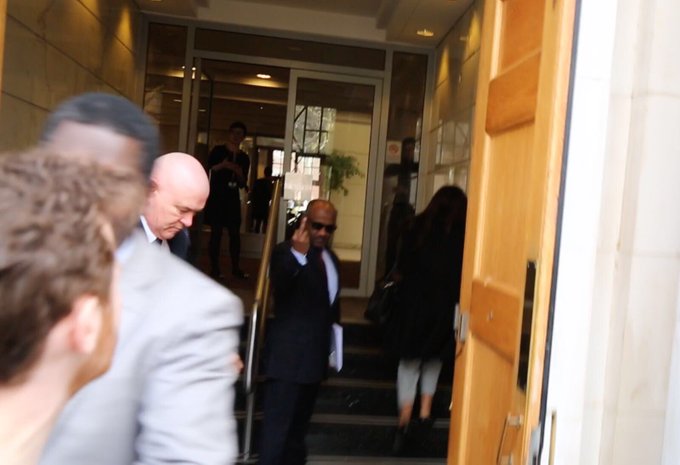
Saudi Major General Ahmed Asiri giving protesters the finger. He is responsible for war crimes#StopArmingSaudi
Photo caption @MoosaAkrawi

Last November, Asiri claimed that Saudi forces had not used cluster bombs - only for the Saudi-led coalition to later admit they had been used in Yemen.
Since the war in Yemen began, the UK has licensed $4.1 billion worth of arms to the Saudi government, according to the Campaign Against Arms Trade.
Andrew Smith, of CAAT, said that Asiri “is a mouthpiece for a
devastating bombing campaign that has killed thousands of civilians and
destroyed vital infrastructure,” and as such “should not be getting
invited to address parliamentarians and think tanks to whitewash
the atrocities that are taking place.”
“The voices that need to be heard are those of Yemeni people who are
victims of a humanitarian catastrophe - not those that are inflicting
it. If the UK is to play a positive role in bringing peace then it must
end its complicity and end the arms sales."
Subscribe to:
Posts (Atom)