Peace for the World World ! Your War Our Lives

The Dalai Lama
A Brief Colonial History Of Ceylon(SriLanka)
Sri Lanka: One Island Two Nations
A Brief Colonial History Of Ceylon(SriLanka)
Sri Lanka: One Island Two Nations
(Full Story)
Back to 500BC.

Wednesday, May 31, 2017
Another reshuffle soon


May 30, 2017
A deputy and state minister amendment concurrent with the cabinet
reshuffle that took place on 22nd May is to be carried out soon say
reports.
Accordingly, Mr. Eran Wickramaratne, the current Deputy Minister of “State Enterprise Development would be appointed as the Deputy Minister of Finance while Mrs. Anoma Gamage who is the current Deputy Minister of Petroleum and Petroleum Gas would be appointed as the Deputy Minister of Foreign Affairs.
Mr. Harsha de Silva is to be appointed as the Deputy Minister of National Policies and Economic Affairs, a portfolio held by Prime Minister Ranil Wickremesinghe.

Rathupaswala : real murderers are still at large


 May 30, 2017
The
real perpetrators who killed innocent people in Rathupaswala on August
01 in 2013 are still roaming in the society freely. The military officer
who ordered troops that attacked civilians, Brigadier Deshapriya
Gunawardhana was arrested by the Criminal Investigations Department
(CID) along with three other suspects. Through his lawyers Brigadier
Gunawardhana has told the Gampaha Magistrate courts that he merely
executed an order came from above.
It is obvious that such an order can only be made to a brigadier either
by the then Secretary Defence Gotabaya Rajapaksa or Army Chief Daya
Rathnayake.
CID scared of Gotabaya?
The explanation given by the Brigadier leaves a strong legal assumption
on the involvement of Gotabaya Rajapaksa and Daya Rathanyake in these
killings with a strong possibility of holding them responsible. With
enough evidence to prove it is highly questionable why they are still
not being arrested by the CID. In such a backdrop Justice Minister
Wijedasa Rajapaksha told the Parliament that as long as he serves in the
ministerial position he will not allow anyone to arrest Gotabaya
Rajapaksa or Mahinda Rajapaksa. In addition to this assurance, President
Maithripala Sirisena has ordered the Police not to arrest any war hero
without his consent. Brigadeir Gunawardhana was arrested while the
President was on a tour in Australia but he has not resisted the arrest.
Anura Senanayake being smart
Brigadier Gunawardhana has told his lawyers that this operation got
messed up because of DIGAnura Senanayake. “He is only a talk show. He
has not made any Police note on the given orders. IF he ever mentioned
that Rathupaswala has situation that need military support in
controlling it we all would be released. Now I have to take the whole
brunt,” he has said.
As of now, media who are in support of Brigadier Gunawardhana is
continuing to state that whatever that happened in Rathupaswala he
should be treated with clemency for his dedication during the war in
rescuing the southern parts of Nandikadal. And the same media continue
to state that he has not ordered to shoot civilians at Rathupaswala. But
in contrary, the Attorney General’s Department has received a video
footage showing Brigadier Gunawardhana shouting the order to shoot
protesting people.
According to sources from the Attorney General’s Department there is
ample evidence to prosecute the brigadier and the other soldiers under
section 294 (murder) of the Penal Code.
When he was remanded on the 31, brigadier Gunawardhana has commented
addressing everyone present at the scene saying “now my arrest will
bring so much credit to the Yahapalana Government. Won’t it?”
Brigadier Gunawardhana was further remanded till May 31, 2017.

 Sunday, May 28, 2017
Caught between the grinning devil of Rajapaksa racism and the
incompetent (if not corrupt) deep blue sea of the
Sirisena-Wickremesinghe unity alliance, Sri Lankans are increasingly
being left helpless.
Is this not obscene conduct?
With the passing of each day, examples abound of this odious dilemma. It is the height of callousness for example, that the Government could have justified asking for millions for luxury vehicles for ministers at the very same time that the country is facing a financial crisis.

Now to compound that idiocy, we are being told that a supplementary
estimate had been presented in Parliament this week to purchase vehicles
for members and officers of the steering committee of the Constituent
Assembly. Jokes are being cracked as to what or who exactly will this
Assembly steer, except themselves and that too, into a corner by all
accounts. But this news, coming on top of hundred deaths, another
hundred reported missing and scores left homeless following major floods
during the past few days begs an important question. Is this not
obscene behaviour, in the very basic meaning of that term, taken in the
context of conduct deeply offending morality?
There is little point in directives being given by the President or the
Prime Minister to give relief to the affected. Victims of the Salawa
disaster, the Meethotamulla garbage dump and countless other victims are
still languishing without succor, months after they lost their homes
and saw the lives of family members being snatched away. So, what
possible faith can be posed in these directives?
A matter of palpable hypocrisy
Today it is a sad irony that much of the woes afflicting Sri Lanka’s ‘yahapalanaya’ Government could have been predicted early on. Indeed, chaos could have been prevented if the feet of this Presidency and this Government had been held firmly to the fire by civil society leaders who turned unblushing defenders of unconscionable government policies almost overnight, even though they had loudly railed against those very same policies when perpetuated under the Rajapaksa rule.
It was this palpable hypocrisy that exposed the very shame of the façade
of good governance, paraded to all and sundry in January 2015. To add
to that shame, justifiable questions raised at the outset regarding
government policy showing worrying signs of departure from the standard
that had been promised were looked at askance.
It was as if the ‘yahapalanaya’ government could do no wrong. It is this pitiable naivete, taken at its best interpretation or callous self-interest taken at the worst, which is to blame. It is this attitude which led to many preferring to stay quiet while a monstrous Counter-Terror policy framework was being drafted secretively.
Engaging in one stupidity after another
And it was no wonder that the late Ven Madulwawe Sobitha had become deeply disillusioned by the very ‘change’ that he (more than any other) had brought about. Unlike unfortunate beings like the rest of us however, he has the luxury of not witnessing the plight that the country has been reduced to. For one stupidity succeeds another. Indeed, if this was April 1st, one might be tempted to laugh off the very idea of subjects that have no relevance to the particular ministry in issue being grouped under that ministerial portfolio purely because of the demands of a particular minister.
This is the laughable situation which has arisen according to reports
not yet denied by the Government, that former Finance Minister Ravi
Karunanayake, (now the new Foreign Affairs Minister), may continue to
claim agencies that he controlled earlier. These include the National
Lotteries Board, Mahapola Trust Fund, Colombo Stock Exchange, Securities
and Exchange Commission (SEC), Sri Lankan Airlines, EPF, ETF and
National Insurance Trust Fund.
This continuance may be enabled by a state ministry portfolio according to reports. On all accounts, lists of ministers, deputy ministers’ portfolios that have been sent for gazetting, omits the respective subjects coming under each. One hopes that sanity will prevail but given what has been occurring so far, expectations cannot be too high.
The continued discarding of the law
In the midst of all this, religious and communal violence is on the rise. Some months ago, I likened the Witness Protection Authority, showcased internationally but non-functional domestically, to the elusive Scarlet Pimpernel. Victims seeking protection looked for the Authority here, they sought it there but could not find it.
Now we have other elusive individuals being added to this list. Head of
the Bodu Bala Sena (BBS) Galaboda Gnanasara who has returned to his old
ways of fomenting religious hatred has managed to elude team upon team
of law enforcement officers. It is nothing short of a nasty miracle, one
might add. When the Aluthgama incident occurred under the Rajapaksa
Presidency, it was pertinently warned in these column spaces that
problems of extreme radicalism and religious hierarchies aside, what
distinguishes post-war Sri Lanka is the discarding of the law and the
impunity afforded to saffron clothed terror groups.
State complicity irrefutably marked the Aluthgama and Beruwala violence
at the time. Then as now, government inaction only aggravates the
problem. Enough law exists for the purpose, apart from the Penal Code
and including the International Covenant on Civil and Political Rights
(ICCPR) Act No 56 of 2007. In that context, a Prime Ministerial
directive to hold area police responsible for failing to stop religious
violence in their respective areas is farcical. Not so long ago, the
Inspector General of Police (IGP) was captured on television assuring
the Minister of Law and Order that a favored individual protected by the
government will not be arrested. This showed the extent to which the
command structure of the police has been subverted. No action was taken
either against the IGP or against the relevant Minister.
Acts of omission are equally culpable
So to announce that it will hold lower level police officers responsible without this Government implementing the law at the highest levels sounds hollow. Commitment must be evidenced through action and not through words. It is the same relentless and unsparing logic as in regard to flood relief.
Unlike in the case of the Rajapaksa regime, one cannot accuse this
Government of actively fomenting racism or communal violence. But let it
be clearly said that acts of omission are equally culpable in the eyes
of the law.
It is by this standard that the unity alliance will be judged and assessed by all right thinking Sri Lankans, apart from those who are selectively deaf, blind and mute as it were.
Is BBS an existential threat to the Dharma?


 The
Bodu Bala Sena (BBS) is not a representation of the Dharma as preached
by Siddhartha Gautama, the Buddha. The BBS consists of some erratic
persons robed in saffron and backed by some unruly groups of laymen,
mostly of youth. They pretend to be the sole saviours and guardians of
the great Dharma that had been passed down from generation to
generation. On the contrary, they are an existential threat to the
serenity, purity and sublimity of the teachings of the Enlightened One.
The
Bodu Bala Sena (BBS) is not a representation of the Dharma as preached
by Siddhartha Gautama, the Buddha. The BBS consists of some erratic
persons robed in saffron and backed by some unruly groups of laymen,
mostly of youth. They pretend to be the sole saviours and guardians of
the great Dharma that had been passed down from generation to
generation. On the contrary, they are an existential threat to the
serenity, purity and sublimity of the teachings of the Enlightened One.
Buddhism is the embodiment of some of the greatest teachings that mankind has known; teachings that, in his first sermon, the Buddha said elucidated the very essence of life in general:
- It is of paramount significance that the Mahanayakes of the Malwatte and Asgiriya Chapters confront Gnanasara
2017-05-31
“As fire, though one takes the shape
of every object which it consumes, so the Self, though one, takes the
shape of every object in which it dwells.” ~The Upanishads: Breath of
the Eternal
The
Bodu Bala Sena (BBS) is not a representation of the Dharma as preached
by Siddhartha Gautama, the Buddha. The BBS consists of some erratic
persons robed in saffron and backed by some unruly groups of laymen,
mostly of youth. They pretend to be the sole saviours and guardians of
the great Dharma that had been passed down from generation to
generation. On the contrary, they are an existential threat to the
serenity, purity and sublimity of the teachings of the Enlightened One.Buddhism is the embodiment of some of the greatest teachings that mankind has known; teachings that, in his first sermon, the Buddha said elucidated the very essence of life in general:
“I teach one thing and one thing only: Suffering and the end of suffering, which is the ultimate goal of Buddhism.
The Buddha presented and explained this very doctrine in his major
discourses. The teachings have expanded and evolved since the Buddha’s
time, thanks to his closest disciples. Yet, the doctrine still underlies
the core Buddhist teachings. In his first sermon at the Deer Park, he
taught the Four Noble Truths: The existence of suffering, The cause of
suffering, that the cause of suffering can end, and the path to the end
of suffering.” (Source: Venerable Walpola Rahula’s article, The Buddhist
Review Magazine).
Taken against the perspective of the first sermon of the Buddha, the
self-proclaimed disciples of the Great Teacher are a long way off the
nobility of the teachings. It is not only Galagoda Aththe Gnanasara,
whose sole and exclusive motive seems to be making political capital
out of the general suspicions that exist among ethnic groups and turning
that suspicion into support of a particular political cabal, but also
the lay followers of that school of thought who are as guilty in flaming
communal fires.
There is no dispute that the conduct of a person in leadership of this
cabal is a gross contamination of the Dharma. It is even more astounding
that Mahanayakes, who are presumed to be presiding over the ‘Order of
the Monks’ have opted to remain mute over a very fundamental violation
of the great Teachings.
In such a disappointing circumstance, the average Buddhist, whose
isolated faith alone keeps him or her adhering to the Teachings is much
more noble and honourable than those who parade the streets in yellow
robes.
Taken against the perspective of the first sermon of the Buddha, the self-proclaimed disciples of the Great Teacher are a long way off the nobility of the teachings. It is not only Galagoda Aththe Gnanasara, one of those imposters, whose sole and exclusive motive seems to be making political capital out of the general suspicions that exist among ethnic groups and turning that suspicion into support of a particular political cabal, but the lay followers of that school of thought are as guilty in flaming communal fires.
Unlike other religions, Buddhism does not revolve around a rigid
hierarchical system in the order of the clergy. At the pace temples are
springing up at almost every street corner in the urban areas and every
culvert in the rural hamlets, a foreign visitor may wonder how religious
the average Sri Lankan is.
An old woman, whose children have gone away after marriage to their own
homes, who is attending to the needs of the temple and its caretaker
Monk, who is waking up each morning with the first rays of the sun and
picks out the jasmine flowers in her own humble homestead to offer to
the shrine in her one-room home, is lost in a maze of uncomfortable
choices.
Her universe has become substantially small; it has shrunk to the size
of her immediate environment; even her immediate family is outside her
little universe now. But her faith in the Dharma has grown; it has grown
with each passing day not because she is beginning to understand the
nuanced incomprehensible ‘Abhidharma’ but for her fear of losing time
with its passage on her own age.
Whether this old woman is at the threshold of attaining a blissful state
of a sublime mind or not, her blind faith in the Dharma keeps her from
doing any harm to another individual.
An iota of that faith is worth a thousand sermons preached by a corrupt
monk. It is that faith that has been desecrated by these hoodlums in
saffron.
Such crude violation of man’s faith in a religion is a mortal sin. While
I, the writer, am unwaveringly opposed to what Indian thinker, Jiddu
Krishnamurthy called ‘organised religion’.
The traditional ‘custodians’ of the Teachings of ‘Tathāgata’, the
Buddhist clergy, though not so rigidly regimented like Catholicism or
the Anglican Church, are increasingly looking antagonistic towards other
faiths and embracing the ‘fundamentalist’ character of Buddhism; such
tolerance of perverted versions of the Dharma is utterly ‘un -Buddhist’
in the least and is dangerously debasing the core teachings.
Galagoda Aththe Gnanasara is conducting himself in the most disgraceful
manner; his guile and the very persona that is reflecting that guile do
not seem to have been scrutinised and investigated in a sensible and
acceptable way by the Nayake Theras of ‘organised Buddhism’. What is
particularly harmful to the notion of sublimity of this great philosophy
is when such a hoodlum pretends to be a sacred one in a yellow robe
pontificating to gullible yet wholly faithful followers, while in his
own lifestyle alleged to be far from the sacrosanct quality of
Buddhism.
The core teachings of Buddha is not in danger; it was never in danger
for such an unassailable teaching cannot be erased from the memory of
man, nor could it be corrupted by mere mortals whose worth is not
comparable even to the dust and soil the Great Teacher trampled upon.
What is being corrupted and defiled is the popular version of the
philosophy that is catering for the millions of followers and thereby
making it incomparable to the core values and morals of Buddhism.
Karuna (Loving-kindness), Metta (Compassion), Mudita (Sympathetic Joy)
and Upekkha (Equanimity) seem to have had no influence over these monks
who have chosen to lead the lay public along a destructive path of hate
and vengeance.
When yellow-robed charlatans desecrate the minds of the lay public,
greedy and opportunistic politicians gather around these hapless men and
women like hyenas gather around a prey made immovable and helpless by a
cruel predator.
The lamentable tale of human misery continues in the most sordid manner.
Public at large do not seem to care. They are not made aware of the
dastardly behaviour of the thugs in saffron; they are not informed of
the ruthless manner in which they accumulate wealth and power by way of
greedier politicians; they simply do not know the price of the whiskey
these robed thugs consume with roast chicken as a bite during the hours
after dusk.
In effect, the public so misinformed and misrepresented are the bite for
a hungry pack of political hyenas, who roam the jungle of politics in
Sri Lanka.
Re-emergence of the BBS is not imminent. Yet, the tirades of Galagoda
Aththe Gnanasara can be heard and felt. They say terrorism is an attempt
at Government by the nation-less.
They know no borders and they know no morals. Basic human principles
have been sacrificed in the name of the most scientific and rational
teachings man has ever known, Buddhism.
When yellow-robed charlatans desecrate the minds of the lay public, greedy and opportunistic politicians gather around these hapless men and women like hyenas that gather around a prey made immovable and helpless by a ferocious predator.
While those principles, precepts and deep philosophy would remain
untouched- for they are untouchable- the mundane man is gripped by the
wicked soldiers of the Senaas and Balakaayes.
Buddhism has been corrupted by the invasion of gods and demi-gods from
popular Hinduism; the sacred sanctity of the core and profound
philosophical principles of the universe and man have been lost in a
haze of superstition.
These gods have come to occupy our temples. What is even more harmful
and atrocious is the spoiling of the mind, the ultimate temple of man.
Matters of mind have been corrupted, soiled, debased and defiled by
these foreign elements of other religions. Mindless march of Aameesa
Pooja has overtaken the still, unspoiled, incorrupt and tranquil
Prathipatthi Pooja.
The mind of man that was primarily responsible for landing a man on the
moon; that was responsible for the wonder of modern age, computer and
the social media also made the most mindless and ruthless weapons man
has known, the atom and hydrogen bombs.
The environment created these demons or the demon created the
environment is the most inscrutable question for which an answer is
still a-begging.
A very few have had the courage of conviction to challenge the onslaught of the kinds of Gnanasara and other charlatans.
It is of paramount significance that the so-called Mahanayakes of the Malwatte and Asgiriya Chapters confront Gnanasara.
It is time we, as a nation and as sensible and reasonable men and women,
allocated precious time to find timely remedies for a malignant tumour
that is Gnanasara and his disgraceful clan.
In April 2014, under another pseudonym, I wrote in an open letter to the Mahanayakes thus:
“All you may be able to do is make an appeal. I fully realise that, in terms of the Order of the Buddha Sasana, individual monks are not subject to any hierarchical disciplinary action. But what would stop Your Reverence from making an appeal in the name of humanity, in the name of the Dharma that you are purported to protect and disseminate and in the name of the continuation of the Buddha Sasana? Standing in the middle doesn’t get you anywhere. You have to take the turn in the right direction.
It still rings true.
“All you may be able to do is make an appeal. I fully realise that, in terms of the Order of the Buddha Sasana, individual monks are not subject to any hierarchical disciplinary action. But what would stop Your Reverence from making an appeal in the name of humanity, in the name of the Dharma that you are purported to protect and disseminate and in the name of the continuation of the Buddha Sasana? Standing in the middle doesn’t get you anywhere. You have to take the turn in the right direction.
It still rings true.
The writer can be contacted at: Vishvamitra1984@gmail.com

Tuesday, 30 May 2017
 When it
comes to applying the rules of democracy in a country like ours, there
ought to be a caveat included for the likes of Mr. Galaboda Aththe
Gnanasara, viz. freedom of speech!
When it
comes to applying the rules of democracy in a country like ours, there
ought to be a caveat included for the likes of Mr. Galaboda Aththe
Gnanasara, viz. freedom of speech!I refuse to dignify this man with revered titles such as ‘Thera’ or ‘Reverend’, since as a Buddhist, I don’t regard him as a Buddhist monk, but find him utterly and completely reprehensible, offensive, an acute source of embarrassment and irritation. Furthermore, he has singlehandedly denigrated the status of the entire Buddhist clergy in this country.
Shaving one’s head and donning a saffron robe does not make one a Buddhist monk, one’s actions do. This man is nothing but a charlatan in robes and a social menace to all; Buddhists included!
His foster political parents; demagogues of a bygone era appeared to be enchanted by this ageing puppet’s performances, and seemingly gave succour to it with impunity, for reasons best known to them. But, with the political regime change the man appeared to have been silenced for a while, until the Homagama High Court drama made him erupt like a volcano and got him landed behind bars. This is where the likes of him rightfully belong. Alas, the relief for us was short lived.
"If the authorities fail to put a final stop to this flagrant menace and shut him up for good, it will only be a matter of time before more common thugs go shopping for saffron robes, shave their heads, masquerade as Buddhist monks, and take the law into their hands. In such a grim scenario, what will our leaders prioritise, law and order, or votes at the next election?"

Upon being bailed out, he had to open his gab again and thrashed all hope of him having reformed, even while incarcerated as a common criminal. His public announcement upon his release, on the need to educate Buddhist monks on the laws governing this country, was an insult to the entire Buddhist clergy of this land.
He publicly requested the Mahanayake Theras and the Buddha Sasana Minister to include a course on the prevailing law enforcement system in the country, at the end of the Pirivena education or in the Bachelor of Arts (BA or Master of Arts (MA) course at the end of any Buddhist education in the country.
What this man appeared to imply through this remark was that, pseudo monks like himself behave the way they do, as they have no understanding of the laws of this land, and lack basic common sense. This man should be advised that it’s better to keep his trap shut and be thought a fool, than open it and remove all doubt!
Before his volte-farce viz the laws of the land, and his seemingly newfound respect for it, this man is on record for stating that they of the Bodu Bala Sena (BBS) would not subject themselves to the Roman Dutch law, which he deems as ‘suddhage neethiya’ (white man’s law), and would only abide by the law of the Dhamma. By this, he, not only unashamedly acknowledged his ignorance of the lex terrae, but also the Dhamma. This man has indeed a lot of learning to do!
Is his performance within the Homagama High Court, running riot and hurling invective at the widow of the slain journalist Prageeth Ekneligoda, and insulting the court and court officials which ultimately landed him behind bars, his idea of the “law of the Dhamma”?
To call this man a joker, is to be kind to him!
Never mind ignorance of the laws of the land or even the Dhamma, the latter which most labelled Buddhists don’t have a clue of anyway, isn’t it the basic of common sense and etiquette to know how to conduct one’s self, at least within the hallowed precincts of a court house?
Isn’t it common sense and decency to know that stoning and destroying the livelihood of others, spewing venom at them for their religious beliefs are totally against accepted norms of civilised behaviour, let alone the teachings of the Buddha?
The air of defiance and the obvious lack of remorse or shame displayed by this man as he walked out of remand, only proved that his theatrics were far from over. And now, almost a year and a half later, the man rises again!
"Shaving one’s head and donning a saffron robe does not make one a Buddhist monk, one’s actions do. This man is nothing but a charlatan in robes and a social menace to all; Buddhists included!"
Reportedly, several police teams have been deployed to arrest this saffron robed miscreant, “…on charges of disturbing, obstructing, and threatening police officers and committing acts bound to cause racial and religious disharmony among various communities.”
If the authorities fail to put a final stop to this flagrant menace and shut him up for good, it will only be a matter of time before more common thugs go shopping for saffron robes, shave their heads, masquerade as Buddhist monks, and take the law into their hands. In such a grim scenario, what will our leaders prioritise, law and order, or votes at the next election?
Brig. Shantha Dissanayake summoned to CID!
 May 30, 2017
Brig.
Shantha Dissanayake of the Sri Lanka Army was summoned by the CID
yesterday (29) for questioning in connection with the Rathupaswala
killings.
His summoning was the result of revelations made in a statement given by
Brig. Deshapriya Senanayake, presently in remand custody. At the time
of the incident in August 2013, Brig. Dissanayake was the security
forces commander for the western province.
Brig, Dissanayake was questioned at length and has been told to be present on another day for further questioning.
Brig. Dissanayake was the immediate senior of Brig. Gunawardena, and
after it comes to be known as to who had ordered him to shoot at the
Rathupaswala protestors, the CID expects to reveal the person who is
responsible. A controversial arrest is expected within days.
Why Israel can’t defeat a Palestinian poet

“By persecuting me, the Israeli authorities are trying to erase
Palestinian voices and to silence any artistic expression that opposes
the occupation,” says poet Dareen Tatour.
Budour Youssef Hassan-29 May 2017

Dareen Tatour felt sad as she watched this year’s “march of return” on television.
The poet had wanted to attend the event in memory of Palestinian
villages that Israel has tried to erase from history. Being under house
arrest prevented her from doing so.
“I have been taking part in the march of return for as long as I can
remember,” she said. “I am gutted that I could not attend for the past
two years.”
Tatour, who is also a photographer, has spent much time capturing images
of the villages depopulated and people displaced by the Nakba, the 1948 ethnic cleansing of Palestine. These include al-Kabri, where this year’s march took place.
Located on the western slopes of the Galilee, it was destroyed by Zionist forces on 20-21 May 1948 – a week after Israel declared itself a state.
Tatour was arrested in October 2015, at a time when many Palestinians were in open revolt against the Israeli authorities.
It transpired that she was arrested for writing the poem, “Resist, my
people, resist them.” She was later charged with incitement to violence.
After being released from three months in prison, Tatour was placed under house arrest.
The Israeli authorities alleged that restricting her movements was necessary as she constituted a “threat to public safety.”
After more than a year of complete house arrest, she was placed under a curfew following a recent hearing at a Nazareth court.
Under terms approved by the court, she is allowed to leave her home –
accompanied by a family member – between 9am and 7pm. Yet she is still
banned from using the internet.
Missing “small details”
In response to that easing of restrictions, Tatour went for a walk in
Nazareth’s Old City. It was something she had dreamed of for a long
time.
“Before all of this started, I used to walk in the streets of Nazareth’s
Old City regularly, with my camera, and I would always discover new
details,” she said. “And it is those small details that I really miss
and which I learned to appreciate even more while under house arrest.”
The terms of her house arrest have been severe.
For six months after being released from custody, she was forced to live in Kiryat Ono, a town near Tel Aviv,
always accompanied by at least one family member. As well as having an
internet ban, she had to wear an electronic tag. This meant she was
under constant surveillance.
According to Tatour, those six months were akin to being in solitary
confinement or exile. “I was separated from everything I loved, at times
staring at the wall for hours,” she said. “Writing was the only thing
that kept me afloat.”
In July 2016, she was allowed to return to Reineh and to remove the tag.
House arrest has “stretched me and my family to the very limits, both emotionally and financially,” she said.
She had to rent the apartment in the Tel Aviv area and her legal expenses have left her in debt. A crowdfunding campaign to help defray those expenses has been set up. She is unemployed.
Her plight has won support from writers and activists around the world, including such well-known authors as Alice Walker and Eve Ensler.
Freedom facade
Despite the internet ban, Tatour has been kept informed of the
international solidarity efforts. Friends visiting her have brought
copies of articles about her and letters from supporters.
“By persecuting me, the Israeli authorities are trying to erase
Palestinian voices and to silence any artistic expression that opposes
the occupation,” she said. “But this solidarity keeps our voices loud
and counters Israel’s attempt to isolate us.”
Tatour never thought that her poem would get so much attention. “After
all, it was a simple, spontaneous call for resisting occupation,” she
said. “But Israel’s response to the poem is evidence that all Israeli
talk about democracy and freedom of expression is a facade. For us
Palestinians this has always been clear.”
Tatour identifies uncertainty as one of her biggest problems. “I feel
like all this time has been snatched away from my life,” she said.
“While I’m sure it will come to a close at some point, I don’t know
when.”
A verdict in her case is likely to be delivered in June. If found guilty
of incitement, Tatour may be imprisoned for up to nine months. All that
she is guilty of, she added, is resisting Israel “with my pen and
poems.”
She is working on a memoir about her experience in custody and house
arrest. “Despite the pain and mental fatigue, this experience has been
like a rebirth,” said. “It’s the rebirth of a new Dareen, a stronger,
more resilient woman who is convinced that intimidation and the
deprivation of freedom cannot defeat her.”
Budour Youssef Hassan is a Palestinian writer based in Jerusalem. She blogs at budourhassan.wordpress.com.
At least 31 killed, 69 wounded in massive Daesh bombings in Baghdad
The
attacks come just days into the holy month of Ramadan when Muslims fast
during daylight hours. After sundown, families break their fast and
restaurants and cafes quickly fill up with people staying up long into
the night.

By Tues., May 30, 2017
BAGHDAD—A massive bombing by Daesh, also known as ISIS or ISIL, outside a
popular ice cream shop in central Baghdad and a rush hour car bomb in
another downtown area killed at least 31 people on Tuesday, Iraqi
officials said.
Later in the day, bombings in and around the Iraqi capital killed seven more people.
The attacks come as Daesh militants are steadily losing more territory
to U.S.-backed Iraqi forces in the battle for Mosul, the country’s
second-largest city. The Sunni extremists are increasingly turning to
insurgency-style terror attacks to distract attention from their losses.
The nighttime attack outside the ice cream parlour in the bustling
Karrada neighbourhood killed 17 people and also wounded 32, police and
health officials said.
A closed-circuit camera captured the moment of the explosion, the video
showing a busy downtown avenue, with cars driving down the street when
the blast strikes. A huge fireball then engulfs a building, forcing the
cars to scramble to get away. Other videos of the attack posted on
social media show wounded and bloodied people crying for help on the
sidewalk outside the ice cream parlour.
In the second attack, an explosives-laden car went off during rush hour
near the state-run Public Pension Office in Baghdad’s busy Shawaka area,
killing 14, a police officer said. At least 37 people were wounded in
that attack, he added.

In separate online statements, Daesh claimed responsibility for the two
attacks, saying its suicide bombers targeted gatherings of Shiites. The
Associated Press could not verify the authenticity of the statements but
they were posted on a militant website commonly used by extremists.
Later Tuesday, seven people died and 19 were wounded in four separate
bombings in and around Baghdad, officials said. The attacks targeted
commercial areas and a patrol of Sunni anti-Daesh tribal fighters, they
said. No group immediately claimed those attacks.
Tataouine: Tunisia's jobless search for answers after deadly protest
Demonstrations may have subsided after the death of protester, but frustrations endure among unemployed

One in four youths are unemployed in Tataouine (AFP)

Tuesday 30 May 2017
TATAOUINE, Tunisia – Pupils
throw firecrackers and play in front of the city's high school, locals
pack the shops for Ramadan, and men throng the cafes for a spot of early
morning socialising.
But beyond this picture of everyday life lay the scars of protest in
Tataouine. Only days before, on 23 May, burned tyres littered the
streets, whose scorch marks are still visible, and the protest camps
surrounding the local oil refinery remain, only their residents have now
since departed.
Russians parade in blackface ahead of Cameroon-Germany match
Other
marchers at Carnaval Sochi Fest parade were seen carrying bananas as
city prepares to host Confederations Cup, once more raising racism
concerns
Some
participants in the Carnaval Sochi Fest 2017 parade wore blackface,
while others carried bananas. Photograph: Artur Lebedev/Tass

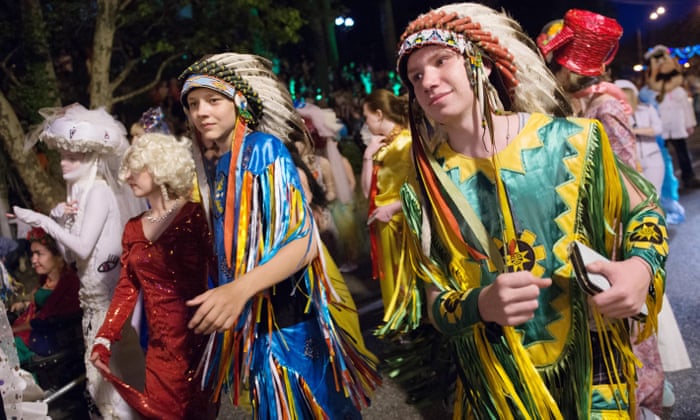
Participants dressed in ‘bright costumes’. Mexico will play New Zealand at Fisht stadium in Sochi Photograph: Artur Lebedev/TASS
 People
in blackface and carrying bananas marched in an official parade in
Sochi less than a month before the city hosts Cameroon for a Confederations Cupmatch, once again raising concerns about racism at football matches in Russia.
People
in blackface and carrying bananas marched in an official parade in
Sochi less than a month before the city hosts Cameroon for a Confederations Cupmatch, once again raising concerns about racism at football matches in Russia.
A photograph from state news agency Tass showed a man in a Cameroon jersey
with his face and arms painted black beating a drum at the Carnaval
Sochi Fest parade on Saturday. A second man in blackface is visible
behind him, wearing an Afro wig and carrying a drum and bananas on a
string.
Another man can be seen draped in a Mexican flag, wearing a sombrero and
what appears to be a stick-on black mustache. Two young men in a
different photograph were wearing what appeared to be Native American
headdresses and fringed costumes.
Cameroon will play Germany at Fisht stadium in Sochi, which was built
for the 2014 Winter Olympics, on 25 June. Mexico will play New Zealand
at the stadium on 21 June.
Sochi’s mayor led more than 3,000 marchers in “bright costumes” down a
main street to officially open the southern city’s beach season. The
marchers in blackface were part of a section dedicated to the
Confederations Cup, which will serve as a dry run for the World Cup
that Russia will host next year.
Late on Tuesday, the Sochi city government said in a statement that the
parade was a “celebration of the different continents and a testimony of
Russia’s open attitude toward traditions from around the globe.”
“By no means did the carnival parade intend to insult anyone,” it said.
“On the contrary, it was organized with the friendliest of goals in
mind: to create a positive atmosphere. We look forward to warmly
welcoming the Cameroon national team and its fans, as well as the
representatives of all other countries, during the FIFA Confederations
Cup.”
But Russia’s track record of football-related racism has raised
questions about whether non-white fans and players will be comfortable
at the two huge international football tournaments.
A 2015 report by the Fare network and the Moscow-based Sova Centre for information and analysis documented 99 racist and far-right displays and 21 racially motivated attacks by
Russian football fans during the 2012-13 and 2013-14 seasons. In one
case, hooligans beat up fans of Anzhi Makhachkala, a club from Russia’s
mostly Muslim Caucasus region, outside matches in Moscow and St
Petersburg in August 2012.
International players have also been targeted. A banana was thrown at
Brazilian left back Roberto Carlos at a match in St Petersburg in 2011,
and fans in Moscow held up a banana banner directed at Nigerian striker
Peter Odemwingie in 2010.
Zenit St Petersburg’s Brazilian striker Hulk said in 2015 he encounters racism in “almost every game” in Russia, and Ghanaian player Emmanuel Frimpong said he was “racially abused” by the crowd while playing for FC Ufa.
Russia has promised racism will not be an issue at the tournaments it will host, and the Russian Football Union appointed former
Chelsea midfielder Alexei Smertin anti-racism and discrimination
inspector in February. But even this news didn’t come without
controversy, as Smertin had said in 2015 that “there’s no racism in
Russia”.
The head of the official Russians supporter group at Euro 2016,
Alexander Shprygin, has far-right affiliations and has been photographed
performing a Nazi salute. He was among fans detained after violent
clashes at the Russia-England match and was later deported.
Lolade Adewuyi, a Nigerian journalist who was present at the Sochi
parade, told Associated Press that he didn’t believe the marchers were
trying to offend but were simply unaware of the impact of their actions.
Subscribe to:
Posts (Atom)