Peace for the World World ! Your War Our Lives

The Dalai Lama
A Brief Colonial History Of Ceylon(SriLanka)
Sri Lanka: One Island Two Nations
A Brief Colonial History Of Ceylon(SriLanka)
Sri Lanka: One Island Two Nations
(Full Story)
Back to 500BC.

Wednesday, January 31, 2018
SriLankan Airlines: ‘Bugger Off’ Gracefully Or Be ‘Sacked’ – Director Board To Decide CEO Ratwatte’s Fate

January 30, 2018
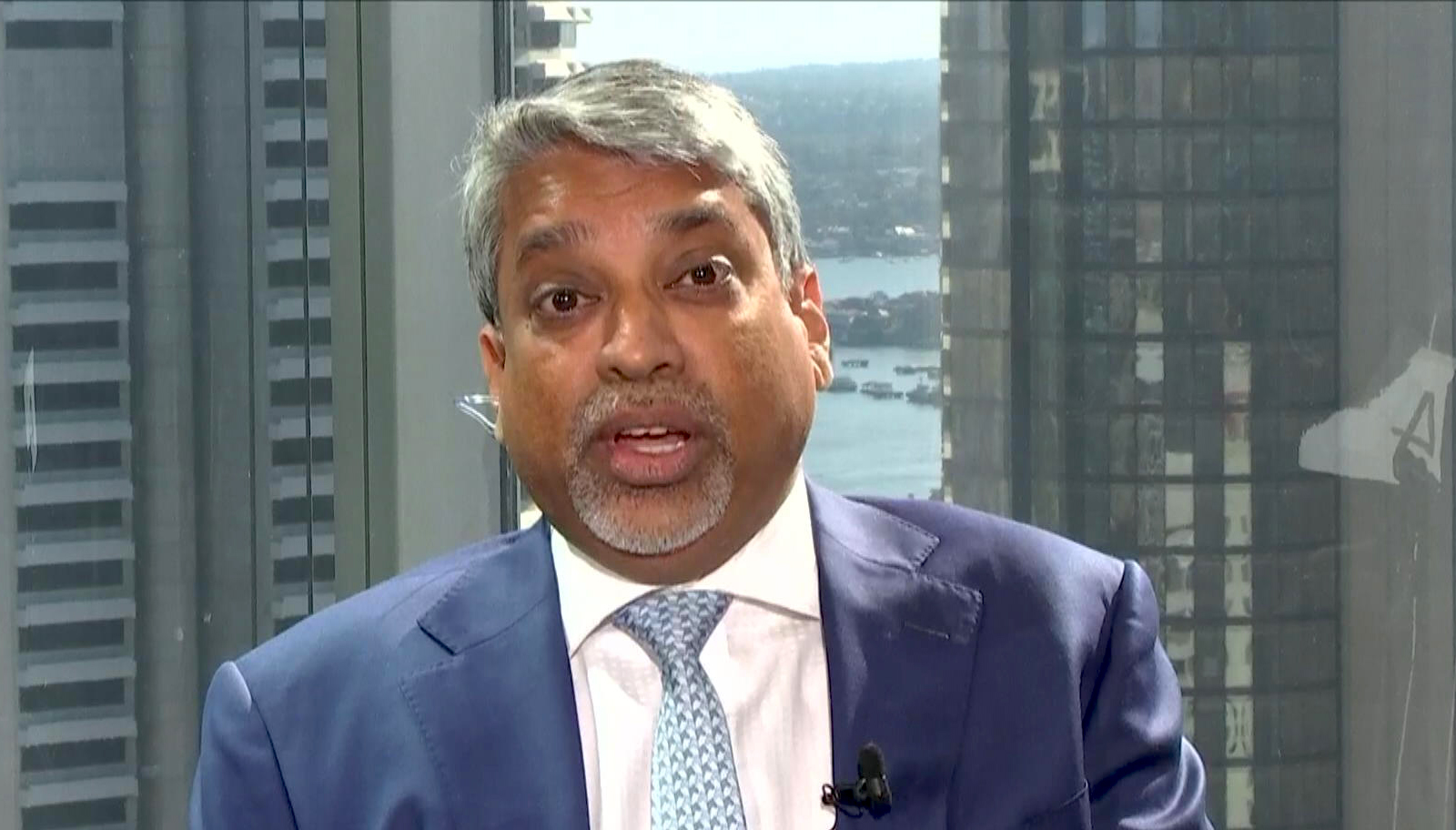
 SriLankan Airlines CEO
Suren Ratwatte who is currently holidaying in Melbourne Australia is to
tender his resignation before the 2nd of February 2018, Colombo
Telegraph reliably learns.
SriLankan Airlines CEO
Suren Ratwatte who is currently holidaying in Melbourne Australia is to
tender his resignation before the 2nd of February 2018, Colombo
Telegraph reliably learns.
Earlier when the Board of Directors of SriLankan Airlines had convened
on the 25th of January 2018, they had unanimously agreed that the
services of CEO Ratwatte should be terminated. Their decision had been
conveyed to CEO Ratwatte and he was verbally asked to resign last week.
The Board of Directors who are scheduled to meet once again on the 2nd of February 2018 will now decide on an exit package which they will implement by the end of February 2018, if in the event CEO Ratwatte does not tender his resignation.
Ratwatte is the brother of Charitha Ratwatte a close confidante and current advisor to Prime Minister Ranil Wickremesinghe
The Sunday Times newspaper in its headlined article titled “SriLankan Board votes to sack CEO Ratwatte” published on 28th January 2018 went on to state “However, the Sunday Times learns that Prime Minister Wickremesinghe has said that a ‘caretaker board of directors’ had no power to take such action. He said the removal of the CEO would be a matter for the Minister in charge of the airline, Kabir Hashim to decide. There was also a Ministerial Committee and a separate Restructuring Committee of the airline that needed to be consulted”.
Sources close to the Prime Minister’s office when contacted said “The above statement published in the Sunday Times is incorrect. The Board of Directors has every right to sack the CEO of SriLankan Airlines. This is not a ‘caretaker’ Board of Directors, but a fully-fledged Board appointed over two years ago. They have every right to decide whats good for the airline”.
A very close associate of Chairman Ajith Dias speaking to Colombo Telegraph said “The Board of Directors has decided to give Suren Ratwatte the opportunity of resigning. This is the noble way of asking him to serve his three month notice period prior to departing. He would then stand to be paid his wages during his notice period which would be approximately Rs 9 million. He also has the opportunity then to seek employment elsewhere. If in the event he is terminated it does not look too good for him. After all he made a decision to leave behind a very lucrative package at Emirates Airline where he was flying the A380 as a Captain and opt for a lower wage when joining the national carrier”.
Meanwhile last December, employees of the national carrier had begun to despise the presence of CEO Ratwatte in office.
The airline’s Alliance of Unions that represents every employee sent in a
letter to the Board of Directors and copied President Maithripala
Sirisena and Premier Ranil Wickremesinghe seeking his removal. This was
after employees began to lose faith and trust in his competence,
decision making abilities and and most of all his abuse of power.
Read More

How to crash an airline – slaughter and slaying of SriLankan

 Wednesday, 31 January 2018
“Ladies and gentlemen, this is your Captain speaking. We have a major issue at hand. We’ve lost power in both of our engines and are on free fall. Keep your seat-belt fastened and brace for impact.”
It’s not just SriLankan Airlines that’s in the red requiring immediate resuscitation but the nation’s economy as well. It should have reached the stars after the battle was won in 2009. It seems God did not confer such great blessings on Mother Lanka. Or were the citizens just cheated, deceived and taken on a huge ride where billions if not trillions of rupees just got evaporated?
Anyway, the nation is in a dilemma, exponentially increasing issues. They seem to cascade. Only responses are meaningless rhetoric, characteristic hyperbole and downright balderdash. The jolly citizen Silva from the island paradise shrieks “ohama yang, ohama yang”.
It’s outrageously ironical that at a time when the global airline industry continues to grow with projected global revenues expected to exceed a trillion dollars our own “cash cow” with all her inherently radiant beauty, dazzling features and great attributes as a unique marketable product remains calamitously struck, wantonly abused, egregiously misused and the entity converted to cacophonous bagnio. SriLankan Airlines has become a notorious synonym for blatant nepotism and a hot place for political “droppings” of all hues.
 Reminiscent
of a typical village setting in South India where invitees preparing
for a social event in the city hire a bus and load all and sundry for
the journey. Some even bring poultry, others dare with the four-legged.
This is exactly how the National Airline has turned out to be. Treated
and managed especially by the previous regime in the most despicable
manner. Obscene salaries disproportionate to performance. Hiring and
firing of CEOs analogous to changing of undergarments, not to mention
political rewards for party loyalists courtesy of SriLankan Airlines.
Reminiscent
of a typical village setting in South India where invitees preparing
for a social event in the city hire a bus and load all and sundry for
the journey. Some even bring poultry, others dare with the four-legged.
This is exactly how the National Airline has turned out to be. Treated
and managed especially by the previous regime in the most despicable
manner. Obscene salaries disproportionate to performance. Hiring and
firing of CEOs analogous to changing of undergarments, not to mention
political rewards for party loyalists courtesy of SriLankan Airlines.Then there is the ugly spectacle of the Emirates-appointed Chief Executive of SriLankan Airlines Peter Hill. He had his work permit revoked following a dispute with the former Sri Lankan President. It all started when Hill refused to bump 35 passengers from a full London-Colombo flight to make way for Sri Lanka’s President and his jumbo entourage. The rest is history.
The disreputable panderers to make the rotting more interesting increased the number of birds and created another brand, another airline. Filled it with sybarites and profligates to advance its decrepitude and moribundity. Politically-connected septuagenarians, paramours of VIPs, female acolytes of youth-wing political parties and general loafing factotums found unhindered refuge in the bordello. If this was not enough, flights were diverted to pick up friends of politicians and VIPs. Surely the canine species too got royal treatment from the airline. Its signature ‘You’re our world’ was indeed inclusive and expansive. The debilitating scourge well lubricated with taxpayer’s funds.
Doomed to crash
SriLankan Airlines, the flag carrier of Sri Lanka and a member of the oneworld alliance, was doomed to crash from the very inception. Launched in 1979 as Air Lanka, successors to the original Sri Lankan Flag carrier Air Ceylon, it never actually took off due to politics and politicians of “Aasikland” – a rare breed indeed. She just kept plummeting to earth, only supported by timely interventions to prolong the inevitable.
Following acquisition in 1998 by Emirates hopes were re-ignited. A re-branded jet flying low over Colombo Galle Face was really something. I remember that day quite vividly. Like a kid watched the aircraft pass me. Its livery emboldening, partnership solid. It was heart soothing.
As a hard-core marketer and a firm believer in its business philosophy I thought the worst was certainly over for the airline. How woefully wrong was I?
Intoxicated with power and exuding disdain and heedlessness, the previous regime didn’t care two hoots. It had to do what it had to do. A treasure trove converted to a s**t-hole – to borrow a term from the “great” Donald Trump. It’s no surprise why the earlier tagline – ‘Taste of Paradise’ – had to go. A little bird whispers that dwellers of paradise had disowned the airline and kept a distance whenever the “dhandu monara” got closer, “Appachhia ganda” seemed to have been the stentorian exclamation.
The airline business
The airline business is not transportation business, certainly not. Such optics are inherently detrimental and constitutes a gnawing myopia. It’s service, hospitality and more importantly experience. The accent is on how to evolve and efficiently manage the evolution. Every member of the airline fraternity strives to out beat the other by providing a pleasant and outstanding experience and being rewarded with higher customer satisfaction and loyalty.
Success is not overnight. It takes years of hard work, commitment and tenacity. This is why the management needs support from governments and not unsolicited interventions. They are a drain on precious and scarce resources. If the complex business mantra of managing an airline is easily replicable, tomorrow Zimbabwe could purchase an Airbus 380 superjumbo and catapult itself to a number one position.
That’s not how it works. It starts with a brand that’s strategically developed. It does not work in a lacuna but in relation to competition and in a clearly identified space. In this regard what Sri Lanka has in terms of product attributes is far superior to either Singapore, Dubai or Qatar but thanks to our politicians we lost it all and maybe lost it for good.
Brand identity
A brand is a complex amalgam. It represents meaning through a process of multi-dimensional action. Main function of a brand is to create distinction and clarity in an extremely busy marketplace. One should be able to differentiate the offering clearly from the competition. The manifestation of the brand must resonate well with the target audience. A beating drum that pulses through how you and your employees make decisions, interact with one another, and deliver on your promise.
This brand identity must be cleverly, persuasively and decisively communicated and customer/s must see reciprocal consonance not dissonance. Your brand is not one but all of the above, working together constantly to form a cohesive whole. It’s much more than swapping out the logo on the homepage. ‘Marketing from the Inside Out’ means thinking strategically and holistically about identity and purpose.
Take the iconic Singapore Airlines (SIA) and its long and enduring journey. Training, training and training takes a service to real tangible heights. This is the success of SIA. This is the core – the service, not easily replicated. Service levels are so highly systematised at SIA it tells its male and female cabin crew and airport staff how to cut their hair, what color makeup to wear, how many teeth to show in a smile, when not to smile, how to make even the plebeians in economy feel like they are getting great personal service, etc. This is what is known as going to the length, breadth and depth of an ecosystem.
Also SIA prides itself in the advantage of a politics-free top management. SriLankan Airlines can learn a lot from this. Service that is unparalleled, whether cabin crew or ground staff. Flights rarely delayed. The refresh paper towel is unique, its redolence patented.
Good food and with choice, importance to local menus and cuisine. Choice of international brand of beverages. SIA maintains a young fleet and works with close coordination with the Singapore Tourism Board in attracting millions of tourists.
In 2016 the Emirates Group announced its 28th consecutive year of profit and steady business expansion. The Dubai-based aviation group ended the financial year (to 31 March 2016) with record profits of $2.2 billion up 50% year on year, despite global economic and political challenges. Emirates Airline’s total passenger and cargo capacity reached 56.4 billion ATKMs (Available Ton Kilometres), cementing its position as the world’s largest international airline.
Even India which opened its economy long after Sri Lanka did has put its house in order vis-à-vis the airline industry. Post liberalisation has paid dividend after the initial correction. Deregulation seem to be working.
“It’s your captain again we’ve managed to get power in one of our engines but instead of proceeding to Colombo we’re diverting the flight to Mumbai to pick up a cat for a VVIP. Enjoy our traditional hospitality in the meantime.”
Funds spent for Rajapaksa memorial not indicated in annual reports

DA Rajapaksa Foundation Owes SLRDC Rs 47 Million For Rajapaksa Memorial

Investigations have revealed that the funds spent for the construction
of the D.A. Rajapaksa Memorial and Museum by the Sri Lanka Land
Reclamation & Development Corporation (SLLRDC) was not indicated in
the 2013, 2014 and 2015 annual reports of the Rajapaksa Memorial,
Educational, Cultural and Social Services Foundation as current
liabilities.
This was revealed in the evidence of the Land Reclamation and
Development Corporation Deputy General Manager (Finance) J.A.
Pushpakumara, based on the advice of the Attorney General on whether the
funds spent on the construction of the D.A.Rajapaksa Memorial and
Museum was indicated in the Land Reclamation and Development Corporation
annual reports of 2013, 2014 and 2015.
The reason that the funds spent were not indicated in the records was
that according to the Board Paper No. HSD-3714 submitted by the then
Land Reclamation and Development Corporation Chairman Harshan de Silva,
to the Board of Directors dated February 21, 2014, the Board of
Directors had agreed to recover the funds spent on the construction of
the D.A. Rajapaksa Memorial and Museum through staging of musical shows
and other events, it was revealed.
Hence, based on that decision, no specific person or organisation was
named for the recovery of the funds spent, and according to the annual
reports of 2014 and 2015 of the Land Reclamation and Development
Corporation it is indicated as sales expenditure and not indicated as a
sum owed to the company, Pushpakumara’s statement revealed.
It was also revealed that the said Board Paper had been approved by the
then Board of Directors of the Land Reclamation and Development
Corporation and its former Chairman Liyana Arachchige Prasad Harshan de
Silva, Gamaethiralalage Badra Undulawathie Kamaladasa, Sudammika Kevinda
Attigala, Saman Kumara Abraham Galapatti and Murukku Devage Mahinda
Saliya.
Meanwhile, at the time the Land Reclamation and Development Corporation
was under the Urban Development Authority and prior to implementation of
decisions taken by the director board, it was required to obtain the
approval of the Defence Secretary. Accordingly, as per the order of
Circular No. MOD/SEC/PA/01/[115], a concise report of the decision taken
by the Land Reclamation and Development Corporation board of directors
of board paper no. HSD-3714, was handed over to the then Defence
Secretary Gotabhaya Rajapaksa.
His signature on the said document is proof that he had seen the concise
report and had deliberately granted approval knowing very well that it
was a construction based on his family’s private needs.
However, although it was determined to recover the monies spent on the
D.A. Rajapaksa memorial by staging fund raising events, there was no
proper plan or mechanism for the recovery of these funds.
On August 04, 2015 subsequent to a request made by the Land Reclamation
and Development Corporation General Manager Mallika Senadgeera, a part
payment of Rs. 25 million was paid, it was revealed. But by that time
the FCID had already commenced investigations and initiated legal
action.
It was also revealed that the Rajapaksa Memorial, Educational, Cultural
and Social Services Foundation which was established under Parliament
Act No.23 of 1998 with the intention of carrying out social service
activities.
Its Chairman was MP Chamal Rajapaksa, Deputy Chairmen former President
Mahinda Rajapaksa and D.E.W. Gunasekara, Secretary Uthpalawarna
Wijesinghe, Treasurer Lalith Chandradasa and other members were
Gotabhaya Rajapaksa and several others. Although it was investigated as
to whether the Rajapakse Memorial, Educational, Cultural and Social
Services Foundation had entered into an agreement with the Land
Reclamation and Development Corporation, no information was found
regarding such an agreement.
Meanwhile, although it is required that this foundation carries out an
audit annually, no such audit was carried out. Therefore, the FCID has
also commenced an investigation on how the Rajapaksa Memorial,
Educational, Cultural and Social Services Foundation had earned money.
Violence against women in Britain Legal system needs major overhaul

 By Emma Batha-2018-01-30
Violence against women and girls is 'endemic' in Britain and the legal system needs a major overhaul in order to protect them, experts said on Tuesday.
A report by the Fawcett Society, a leading women's rights charity, called for misogyny to be made a hate crime and urged tougher laws around sexual harassment, domestic violence, equal pay and employment rights.
It also called for 'up-skirting,' taking photos surreptitiously up women's skirts, to be made an offence.
The charity commissioned a review of sex discrimination laws amid concerns that protections enshrined in European Union law could be eroded or weakened when Britain leaves the bloc.
Retired High Court Judge Laura Cox, who led the review, said they had received "deeply disturbing" evidence of increasing levels of violence, abuse and harassment against women.The report found half of women had suffered sexual harassment at work and nearly two-thirds in a public place. One in five had experienced sexual assault.
It highlighted evidence of a blame culture with 38 per cent of men saying a woman was totally or partially to blame if she was assaulted after going out at night in a short skirt and getting drunk. A third of women agreed.
The report also called for a review on the admissibility of evidence on a victim's sexual history in rape trials.
"What we see is a deeply misogynistic culture where harassment and abuse are endemic and normalised coupled with a legal system that lets women down because in many cases it doesn't provide access to justice," Fawcett Society Chief Executive Sam Smethers said in a statement.
The report also said progress on closing the pay gap had stalled and a lack of transparency prevented women from challenging unequal pay.
The issue was highlighted this month when the BBC's China correspondent Carrie Gracie quit after revealing that she was earning far less than senior male colleagues.
The experts also recommended extending protection from pregnancy discrimination to six months after maternity leave ends, saying many pregnant women and working mothers were being pressured into leaving their jobs.
Lawmaker Maria Miller, who chairs Parliament's Women and Equalities Committee, said the report showed there was still "significant work to be done" on pay, family-friendly working rights and sexual harassment.
She called for "a revolution in the workplace" to ensure fairness for women, men and their families.
The committee recently launched an inquiry into sexual harassment in public places.
Slovenia to recognize Palestinian state next month — TV report
Luxembourg, Ireland, Belgium also reportedly gearing up to follow suit, while French is said to be pushing for EU free trade deal with PA
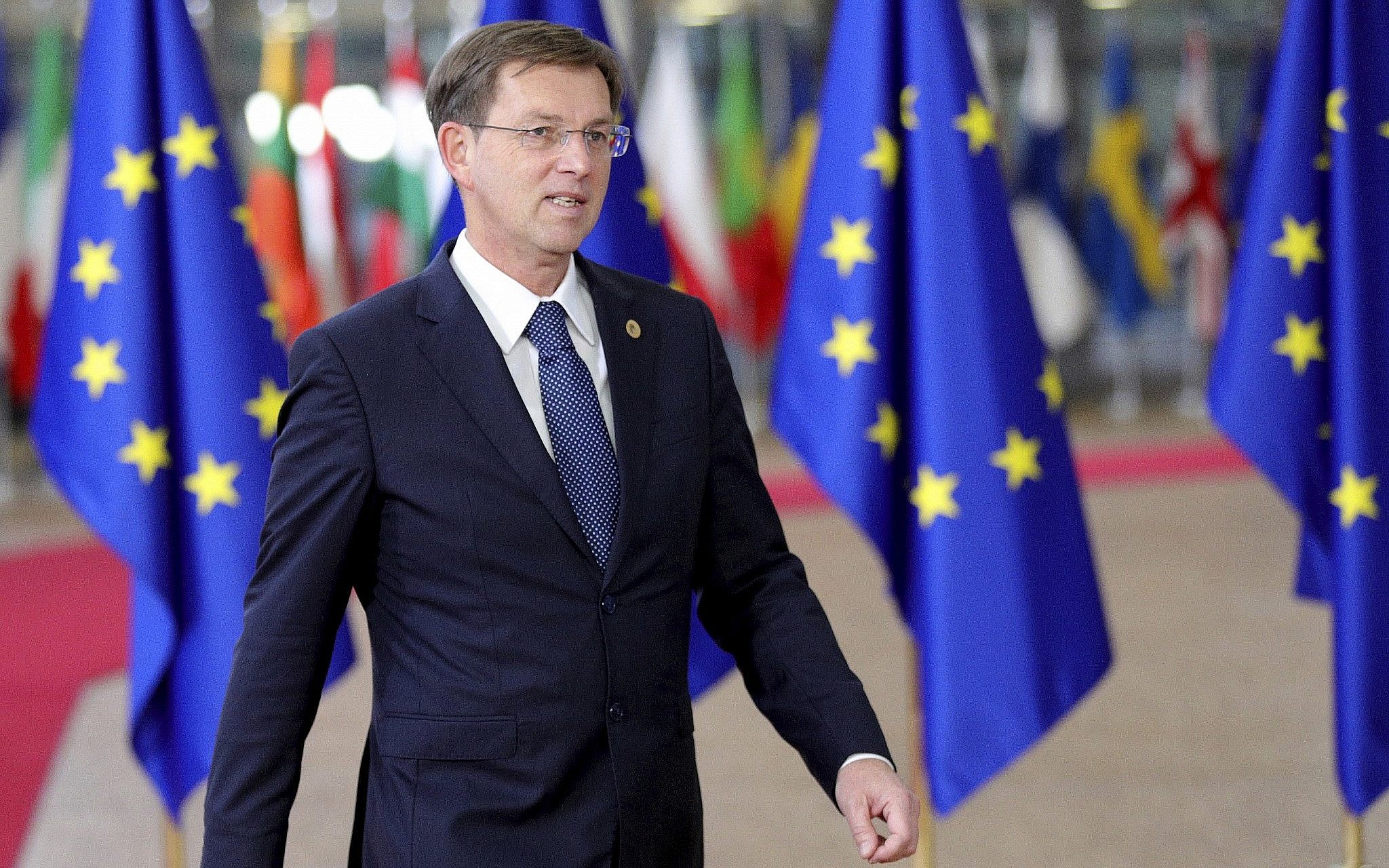
Slovenian
Prime Minister Miro Cerar arrives for an EU summit at the Europa
building in Brussels on December 14, 2017 (AP Photo/ Olivier Matthys)
21 January 2018
 The
moves follow US President Donald Trump’s December recognition of
Jerusalem as the capital of Israel and plan to move the US Embassy to
the city from Tel Aviv.
The
moves follow US President Donald Trump’s December recognition of
Jerusalem as the capital of Israel and plan to move the US Embassy to
the city from Tel Aviv.
Trump said his declaration reflected reality on the ground, and was not
intended to prejudge any future arrangement between Israel and the
Palestinians regarding the disputed city, though he later said it had
taken Jerusalem off the table. Welcomed by Prime Minister Benjamin
Netanyahu and leaders across most of the Israeli political spectrum, the
move caused an uproar throughout the Muslim world and was panned by the
United Nations, the European Union, and many European countries.
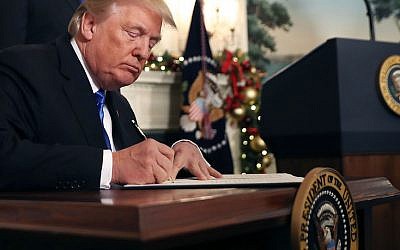
US President Donald Trump signing a proclamation that the US government
will formally recognize Jerusalem as the capital of Israel, at the White
House in Washington, DC, December 6, 2017. (Chip Somodevilla/Getty
Images via JTA)
Last month, Slovenian Parliament Speaker Milan Brglez told Palestinian
Ambassador Salah Abdel-Shafi that Slovenia’s recognition of a
Palestinian state was “not in doubt,” but just a question of timing.
Slovenian Prime Minister Miro Cerar said at the time that although all
three Slovenian coalition parties had voted in favor of recognition, his
country should wait until a group of EU member states decided to act
together.
The Slovenian government decided to move ahead on plans to recognize a
Palestinian state a week ago, the Channel 10 report said. It said that a
vote on recognition was expected to be held by the Slovenian
parliament’s foreign affairs committee on January 31, followed by a vote
of the full parliament in February.
The Slovenian ambassador in Tel Aviv, Barbara Sušnik, told The Times of
Israel that the issue of recognizing Palestinian statehood has been
pending in the country’s parliament since 2014, and is only now coming
to a vote.

President Reuven Rivlin with the Ambassador of Slovenia, Barbara Susnik, November 2015 (Israeli Ministry of Foreign Affairs)
She confirmed that the foreign affairs committee will vote on the matter on January 31.
If the committee votes in favor of recognizing Palestine, the issue
will be brought to a vote in the full plenary of the Parliament.
As opposed to many other Western democracies, it is Slovenia’s
legislative branch, not its executive, which has the last word on
foreign policy matters such as recognizing states.
Sušnik said it was difficult to predict how the parliamentarians would
vote, but hinted that there was a good chance they would seek to assert
the Palestinians’ right to self-determination.
“The elected representatives of the people will decide the way they
decide. It’s their decision,” she said. “For the people of Slovenia, the
principle of self-determination of nations is very important, because
that is how Slovenia became independent 26 years ago, when we exercised
the right to self-determination. All nations have the right to
self-determination.”
Sušnik stressed that a possible recognition of Palestine should not be
seen as a move hostile to Israel. “We established friendly relations
with Israel more than 25 years ago, and we appreciate them a lot,” she
said. “We’re committed to good relations with Israel. Our embassy in Tel
Aviv was opened in the summer of 1994, right after diplomatic relations
were established. Unfortunately, Israel never opened an embassy in
Slovenia.”
The Channel 10 report said that Israel’s Foreign Ministry has been
trying to recruit Slovenian lawmakers to oppose the move, although
expectations are low that the process can be stopped.
According to the report, Luxembourg’s foreign minister called several
days ago for a group of European countries to come together and
recognize a Palestinian state, and is reportedly trying to convince
France to lead the initiative. Ireland’s foreign minister, who recently
visited Israel, conveyed at the time that his country was seriously
considering recognizing a state of Palestine, the report said. It also
named Ireland and Belgium as countries that could soon recognize
Palestinian statehood.

Palestinians protest against the US for withholding $65 million from
Palestinian aid programs, in front of the UN Relief and Works Agency
offices in the Nusseirat refugee camp, central Gaza Strip, January 17,
2018. (AP Photo/Adel Hana)
Channel 10 quoted a senior Israeli official as saying, “Our position is
that recognition of a Palestinian state, which is not within the
framework of an agreement, harms the chance of achieving peace and even
pushes it further away.”
The French newspaper Le Monde, meanwhile, reported on Sunday that France
is trying to upgrade the Palestinian Authority’s status at the European
Union, stopping short of full recognition of a Palestinian state.
The French are reportedly pushing for an EU free trade agreement with the Palestinians, similar to the one signed with Israel.
PA President Mahmoud Abbas is scheduled to arrive in Brussels on Monday,
where he will meet with the foreign ministers of the Union’s 28
countries. The issue of recognition of a Palestinian state is expected
to be at the top of the agenda for the talks.
After Trump recognized Jerusalem as the capital of Israel in December,
the Palestinian leadership declared Washington could no longer fulfill
the historic and central role in the peace process it has held for over
two decades.
Last week, the Central Committee of the Palestine Liberation
Organization’s (PCC) — the second-highest decision-making body for
Palestinians — ratified that the US had “lost its eligibility to
function as a mediator and sponsor of the peace process” until it
reverses the Jerusalem decision.
President of the Palestinian Authority Mahmoud Abbas delivers a speech
at the European Union Parliament in Brussels on June 23, 2016. (AFP
PHOTO / JOHN THYS)
Sweden was the first western European country to recognize Palestine, in October 2014.
In December 2014, in a symbolic move not binding on government policy,
French lawmakers voted in favor of recognizing Palestine as a state,
following similar moves in Britain and Spain, as European countries
tried to restart the stalled Middle East peace process. Italy followed
suit in 2015.
Palestinian teenager shot dead by Israeli soldiers in West Bank
Laith Abu Naim was shot in the head by Israeli soldiers in village of Al-Mugheer

Laith Abu Naim was killed in the village of Al-Mugheer, north of Ramallah (Screengrab)

Tuesday 30 January 2018 -
Israeli soldiers shot dead a Palestinian teenager on Tuesday in the occupied West Bank, the Palestinian Health ministry said.
Laith Abu Naim, 16, was shot in the head as soldiers stormed the village
of Al-Mugheer, north of Ramallah, according to a ministry statement.
Hundreds of residents marched through Al-Mugheer condemning Abu Naim's death and chanting, "We want to live in freedom."
A spokeswoman for the Israeli military said, "Violent riots are taking
place in this area and burning tyres and stones were thrown at the
soldiers."
She said she was unable to confirm that any Palestinians had been hit by gunfire.
Abu Naim's death comes amid growing tensions after US President Donald
Trump's decision to recognise Jerusalem as the capital of Israel.
Nineteen Palestinians had been killed since Trump's announcement, with
the majority of the deaths taking place during demonstrations by
Palestinians.
US Vice President Mike Pence confirmed earlier in January that the
United States will move its embassy to Jerusalem before the end of
2019.
The announcement came during an address to the Israeli parliament, which
saw Palestinian-Israeli MPs escorted out of the Knesset, after
protesting Pence's visit to Jerusale
مسيرة في بلدة المغير شرق رام الله قبل قليل عقب استشهاد الفتى ليث أبو نعيم. pic.twitter.com/6XcCNzy25v— شبكة قدس الإخبارية (@qudsn) 30 January 2018
"In the weeks ahead, our administration will advance its plan to open the United States embassy in Jerusalem – and that United States embassy will open before the end of next year," Pence said.
"Jerusalem is Israel’s capital – and, as such, President Trump has
directed the State Department to immediately begin preparations to move
the United States embassy from Tel Aviv to Jerusalem."
Saeb Erekat, secretary-general of the Palestine Liberation Organisation,
denounced Pence's speech as "messianic" and a "gift to extremists".
Jordan's King Abdullah also renewed concerns over the US decision to
recognise Jerusalem as Israel's capital, during high-level talks with
Pence on Sunday.
Abdullah emphasised to Pence that East Jerusalem had to be the capital
of a future Palestinian state and that the two-state solution was the
only path to peace between Israel and Palestine.
"The US decision on Jerusalem ... does not come as a result of a
comprehensive settlement of the Palestinian-Israeli conflict," the
monarch told Pence at the start of the talks in the royal palace in
Amman.
Israel occupied the West Bank, including East Jerusalem, during the 1967
war. Pence was in Amman on the second leg of a three-country tour that
concluded in Israel.

 Tamara Nassar-29 January 2018
Israel has sentenced two of the youngest Palestinian children in military custody to months in prison.
Abdel Raouf al-Bilawi, 13, from Dheisheh refugee camp in the West Bank
city of Bethlehem, was sentenced to four months for throwing stones at
occupation forces, the most common charge leveled against Palestinian
children in Israeli military courts, according to prisoners rights
group Samidoun.
Al-Bilawi was detained by occupation forces in December and his trial was postponed seven times, until he was sentenced on 22 January. He was also fined $100.
Israeli occupation forces have a policy of deliberately maiming and disabling Palestinian youths who resist their frequent invasions of Dheisheh refugee camp. Many others are arrested.
Al-Bilawi is currently thought to be the youngest Palestinian prisoner held by Israel, according to Shehab News Agency.


In this video, his mother says that Israel does not see her son as a child and treats him like a grown man.
#شاهد.. الطفل عبدالرؤوف البلعاوي من مخيم الدهيشة في بيت لحم، أصغر أسير في معتقلات الاحتلال .. ماذا قالت عائلته؟ pic.twitter.com/zNS5W4Jipz— Pal.Info.Center (@PalinfoAr) 9 January 2018

#شاهد.. الطفل عبدالرؤوف البلعاوي من مخيم الدهيشة في بيت لحم، أصغر أسير في معتقلات الاحتلال .. ماذا قالت عائلته؟
“They are not at all taking into consideration that he’s a child.”
Al-Bilawi was interrogated for hours, shackled and verbally abused until
he confessed under pressure, his family told local media.
His older brother Ala al-Bilawi has been jailed by Israel for the last six months.
Kangaroo courts
“Israel has the dubious distinction of being the only country in the
world that systematically prosecutes an estimated 500 to 700 children
each year in military courts lacking fundamental fair trial rights,” according to Defense for Children International-Palestine.
Israel’s military kangaroo courts have a near-100 percent conviction rate for Palestinians.
There are currently about 350 Palestinian children in Israeli jails.
Youngest female prisoner
Razan Abu Sal, 13, was also sentenced on 16 January to four months in prison and a fine of approximately $700, also allegedly for throwing stones.
Razan, from al-Arroub refugee camp in Hebron, is the youngest Palestinian female prisoner held by Israel.
She was arrested with her sister Roa on 13 January in Hebron. Her sister’s case was delayed by the military court.
Palestinian teenager Muhammad Bilal Tamimi was
brought before the Israeli military court on 28 January, but no
decision was made to release him from detention, which is in its third
week.
His mother, Manal Tamimi, wrote about Muhammad’s condition in a Facebook post. This was the first time his parents were able to see him since he was arrested.
“[He] looks very tired, his face turned to yellow and he lost around
seven kilos or more,” she wrote. “He didn’t have enough food or sleep
during the past 17 days and he went through so many interrogation
sessions days and nights.”
Muhammad, 19, was taken prisoner during a night raid on the village of Nabi Saleh on 11 January.
He is a relative of Palestinian child prisoner Ahed Tamimi.
Seized while getting pizza
Abdul Khalik Burnat, 17, from the Palestinian village of Bilin, was also brought before the Ofer military court on 28 January after some 50 days in prison.
His father Iyad Burnat called it “a long day of deliberate humiliations and insults.”
Writing on Facebook,
Iyad described: “A court filled with soldiers wearing military uniforms
and a child in a cage, his feet in chains, wearing a brown uniform and a
broad smile. A smile that says, I am strong!”
Like with so many other children, occupation forces accuse Abdul Khalik of throwing stones at the army or its fortifications.
His father Iyad is a prominent advocate of unarmed resistance in Bilin, who featured in the award-winning documentary 5 Broken Cameras.
Abdul Khalik was “kidnapped, beaten and detained on the night of 10
December while getting pizza along with his friends Hamzah Al-Khatib and
Malik Rahdi,” according to Samidoun.
A year ago, Abdul Khalik was shot in the head with a rubber-coated
bullet. Israeli forces also previously detained him in a night raid in
March 2017, while he was under treatment for his injuries, Samidoun
added.
Abdul Khalik’s next hearing was scheduled for 11 February.
Medical neglect
On 25 January, Israel’s high court denied the appeal of a woman with severe burns.
Israa Jaabis, 32, appealed her
11-year sentence citing her “inability to perform essential functions
behind bars and the lack of adequate medical treatment provided to
her,” according to Samidoun.
Sixty percent of her body is covered in burns and she has lost eight
fingers. Jaabis needs multiple surgeries, suffers intense pain and
cannot care for herself.
Jaabis, from occupied East Jerusalem, sustained severe burns and
other injuries after a cooking gas canister she was transporting caused
a fire in her car in October 2015. She was then accused of attempting
to detonate the car when she was hundreds of meters from an Israeli
checkpoint.
“The situation was treated as a ‘terror attack’ rather than a medical
emergency by the occupation forces on the scene,” Samidoun said.
Her family says Jaabis was moving to a new apartment in East Jerusalem
and had been transferring furniture for days, including the gas canister
when it exploded.
Jaabis had reportedly been told that she would lose her Jerusalem residency if she did not move back to the city.
She is one of 34 Palestinian women, including eight girls, currently being held in HaSharon prison, and one of almost 60 Palestinian women held by Israel.
Death from cancer
Palestinian prisoner Hussein Husni Atallah, 57, died of cancer on 20 January, after spending more than 20 years behind Israeli bars.
Atallah’s son, Muhammad, told the Ma’an News Agency that the family
learned of his death from the Red Cross after a severe deterioration in
his health.
An Israel court denied repeated requests from
his lawyers to release him, despite medical reports from the Red Cross
and the prison doctor attesting to the severity of his illness.
After losing consciousness, Atallah was reportedly transferred from Ramle prison to Israel’s Asaf Harofeh hospital.
The Palestinian Authority’s prisoners commission and the Palestinian
Prisoners Club condemned Israel’s refusal to allow Atallah to spend his
final days with his family.
Meanwhile, Ayoub al-Asa, 33, from the West Bank city of Bethlehem, has been on hunger strike for approximately 20 days.
Israel transferred him from solitary confinement in Ofer prison to solitary confinement in the Naqab prison on 27 January in retaliation for his fast.
Al-Asa is protesting the extension of his detention without charge or trial since he was arrested in June 2017.
Subscribe to:
Posts (Atom)