Peace for the World World ! Your War Our Lives

The Dalai Lama
A Brief Colonial History Of Ceylon(SriLanka)
Sri Lanka: One Island Two Nations
A Brief Colonial History Of Ceylon(SriLanka)
Sri Lanka: One Island Two Nations
(Full Story)
Back to 500BC.

Saturday, March 31, 2018
Footsteps to Freedom II: Walking hand in hand towards better mental health and suicide prevention
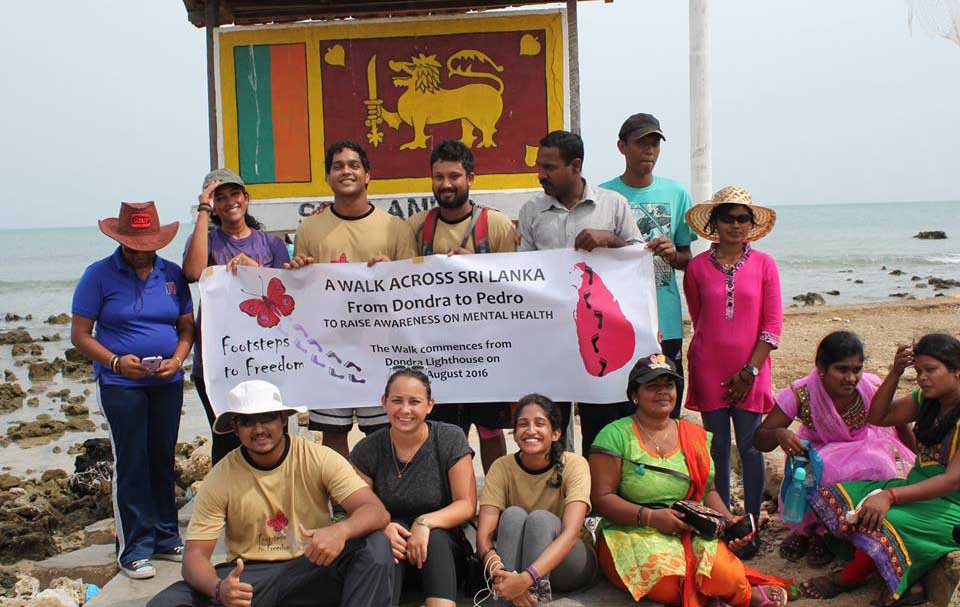
 (Lanka-e-News
- 30.March.2018, 11.30PM) In 1995, Sri Lanka reported an approximate
47 deaths by suicide per day for every 100,000 persons. Over two
decades later, the country reports an approximate 8-10 deaths due to
suicide per day in 2018. The number of attempts at death have increased
to an average of twenty. These are just reported statistics; combined
with those unreported, Sri Lanka remains a country with an above average
rate of suicide- and consequently, with a below average level of
satisfactory mental health.
(Lanka-e-News
- 30.March.2018, 11.30PM) In 1995, Sri Lanka reported an approximate
47 deaths by suicide per day for every 100,000 persons. Over two
decades later, the country reports an approximate 8-10 deaths due to
suicide per day in 2018. The number of attempts at death have increased
to an average of twenty. These are just reported statistics; combined
with those unreported, Sri Lanka remains a country with an above average
rate of suicide- and consequently, with a below average level of
satisfactory mental health.
In an attempt to raise awareness on suicide prevention, mental health
and to shatter the stigma revolving around mental health problems, three
individuals involved in the fields of psychology and suicide prevention
will embark on a 72 day walk around the coastline of Sri Lanka.
“Footsteps to Freedom” was curated by counselling psychologist Nivendra
Uduman in 2016 and demonstrated a successful reach with over 100
workshops conducted in 44 days due to his commitment to raising
awareness on these issues.
This year, he is joining hands with colleagues for a second journey
around Sri Lanka. “Footsteps to Freedom is an initiative that aims to
shatter the stigma on mental illness and encourage those suffering from
mental illness to seek help. With the 2018 walk, we also hope to connect
deeply with people from all backgrounds and communities, empower them
to seek help for themselves and to look out for the wellbeing of their
community,” said Uduman.
In April, Uduman along with Ranil Thilakaratne and Sara Nazoor, who are
actively involved in promoting suicide prevention and better mental
health for all Sri Lankans will walk along the coastline, once again
with the intention of raising awareness on mental health and suicide
prevention.
The walk (scheduled to start on April 01st in Mount Lavinia) will
consist of a series of planned and unplanned awareness raising sessions
for established organisations and schools along with tea shops, bus
stands and smaller village community gatherings throughout the period of
72 days. The sessions will focus on how one can recognise warning signs
of those at risk of suicide, helplines available, actions an individual
can take prior to seeking professional help etc, all of which will
contribute towards creating a sustainable foundation that would promote
better mental health and psychosocial wellbeing.
The World Health Organisation predicts that depression will be the
leading cause for disability by 2020. WHO also reports that 322 million
in the world currently suffer from depression, with nearly 800,000
deaths by suicide occurring annually.
In his first 550 km+ walk around the country, from Dondra to Point
Pedro, Nivendra conducted over 100 sessions to raise awareness on mental
health in 44 days. In 2018, Uduman is walking once again with Ranil
Thilakaratne, from the CCCline 1333 and Sara Nazoor, a trainee
psychologist over a span of 72 days covering approximately 1400
kilometres. The walk will be in aid of two charities working in the
areas of emotional wellbeing and suicide prevention in Sri Lanka:
CCCline1333 and Shanthi Maargam.
For more information on Footsteps to Freedom or interviews please contact: Nivendra Uduman on +94 777 346 334
---------------------------
by (2018-03-30 21:06:21)
by (2018-03-30 21:06:21)

Why Should The Technicalities Of The Plastic Bag Ban Continue To Concern The Masses?

Piyumani Ranasinghe
 Improving
the common man’s knowledge on the ban on polythene in Sri Lanka is a
critical juncture that requires most of the investment in ensuring that
the momentum of the ban does not dissipate. Even if ignorance is
considered bliss, the quintessential element of successful enforcement
of any environment regulation requires regular awareness. Hence, the
prevailing command and control mechanisms in addition to all market
based approaches require the enlightenment of the consumer with regard
to the current ban, which in the books of environmental policy making is
considered, making a partial ban on destructive plastic actually work.
In this regard, it is vital to reiterate the origins of the ban in Sri
Lanka at the wake of the Meetotamullagarbage
dump tragedy. Even as you read this, garbage is being piled up, either
legally or illegally in a landfill somewhere close to your neighborhood.
Thus, the partial ban that is enforced currently ought to be considered
a plausible way forward towards a complete ban on the destructive
polythene bag, which is not only an action point in achieving the
sustainable developmental goals as a nation, but also vital in resolving
the persisting solid waste management crisis in the island.
Improving
the common man’s knowledge on the ban on polythene in Sri Lanka is a
critical juncture that requires most of the investment in ensuring that
the momentum of the ban does not dissipate. Even if ignorance is
considered bliss, the quintessential element of successful enforcement
of any environment regulation requires regular awareness. Hence, the
prevailing command and control mechanisms in addition to all market
based approaches require the enlightenment of the consumer with regard
to the current ban, which in the books of environmental policy making is
considered, making a partial ban on destructive plastic actually work.
In this regard, it is vital to reiterate the origins of the ban in Sri
Lanka at the wake of the Meetotamullagarbage
dump tragedy. Even as you read this, garbage is being piled up, either
legally or illegally in a landfill somewhere close to your neighborhood.
Thus, the partial ban that is enforced currently ought to be considered
a plausible way forward towards a complete ban on the destructive
polythene bag, which is not only an action point in achieving the
sustainable developmental goals as a nation, but also vital in resolving
the persisting solid waste management crisis in the island.
What exactly is prohibited?
In
terms of polythene products, the ban on polythene currently covers, the
manufacture, sale, offer for sale or free of charge, exhibition and the
use of polythene or any product of polythene that is 20 microns or
below in thickness (GN 2034/33). In addition to that, it also bans the
manufacture, sale, exhibition and the use of polythene food wrappers
commonly known as lunch sheets (GN 2034/34). In fact, the Gazette
notification 2034/34 is inclusive of both high and low density
polyethylene alongside polypropylene which was used as raw material in
the production of the said food wrappers in the past. Instead,
compostable lunch sheets are an alternative available in the Sri Lankan
market today. Biodegradability of these plastics are due to the fact
that the products are manufactured amalgamating raw materials such as
Corn Starch, Poly Lactic Acid (PLA) and Poly Butylene
Adipate-co-Terephthalate (PBAT) that have been specifically engineered
to facilitate the process of biodegradation and compostability, based on
scientific tests run as per the EN13432 standard, which is a standard
recognized in the European Union that defines the criteria compostable
packaging has to meet.
Grocery
bags manufactured from high density polyethylene is also prohibited
under the current ban alongside (GN 2034/35), the use of all forms of
polythene, polypropylene and polyethylene as decorations in political,
social, religious, national or cultural occasions are also banned (GN
2034/37). Importantly, the manufacture, sale and the use of lunch boxes,
plates, cups, spoons from expanded polystyrene (commonly known as rigifoam) is also prohibited (GN 2034/38).
Importantly,
activities varying from regular use, manufacture, sale, giving for
free, exhibition, use in decorations to open burning of refuse and other
combustible material inclusive of plastic (GN 2034/36) is prohibited
under the current ban; rendering all aforementioned activities
punishable offences in the Republic of Sri Lanka, which will result in a
Rs. 10,000 fine alongside 2 years of imprisonment.
Factors affecting Compliance to the Ban
The
factors affecting the compliance of the polythene ban is distinct
according to the consumer and retailer. In terms of the consumer, the
primary factor at the face of compliance is the level of enforcement of
the ban, according to Lane and Potter (2007). For example, in Gupta
(2011) notes that, irrespective of the production, distribution and use
of plastic bags ban in Bangladesh, violations of the regulation are
common. Cost is also a factor that determines compliance with the
regulations on the part of the consumer. Consumers often prefer
cost-free bags that can be used conveniently. Convenience can depend on
various cultural factors as well as the individual choice on the
consumer. However, as stressed by Winter and May (2001), awareness of
the ban and its consequences is a predominant factor in terms of
compliance. Additionally, factors such as education, age as well as
something as general as attitudes of the consumer can affect compliance.
It should be understood that motivation primarily defines compliance
(Becker, 1968). In Sri Lanka, awareness is a key issue in ensuring ban
compliance. According to Environmental Foundation Limited (EFL),
consumer identification of banned items is a crucial problem, even for a
person who’s willing to adapt. Hence, the public outreach in terms of
awareness in identifying biodegradable or compostable plastics is an
indispensable step that can be taken up by the Central Environmental
Agency (CEA), considering it a priority.
The
retailer on the other hand is interlinked to the policy making process
itself and has the ability to strike a balance between the public
interest of the environmental regulation as well as other market
oriented interests. For example, the retailers can benefit by reducing
the cost of procuring polythene bags and profit by selling reusable or
compostable bags. This is currently a practice being adopted by
Supermarkets of Sri Lanka, where in certain cases compostable bags are
sold at Rs.1.50 each. However, it is also vital to ensure that small
scale retailers have sufficient means of adhering to the regulations.
Moreover, purchasing compostable bags can be an inconvenient and
unnecessary cost in the consumer’s eye. Thus, the CEA should enable
certain mechanisms that balance both the interests of the consumer and
the retailer in ensuring the smooth transition to eco-friendly
alternatives, which is in return fundamental to ban compliance.
Awareness is positively correlated to compliance in terms of the
retailer as well. Compliance in terms of retailers largely bounces
between the costs incurred and the risk of being caught (Bishal, 2016).
Read More
Good men and women of society: Poor and marginalised need your voice of advocacy

This appeal is addressed to all good men and women of Sri Lanka, especially those younger generation leaders in the cities and rural villages, please raise voices of advocacy and publicly apply pressure to change for good and address the interests of the poor and marginalised rural householders
– Pic by Shehan Gunasekara
- Thitha aththa – the bitter truth! From published statistics and those networked with the rural villagers, the marginalised and poor rural folk
 Saturday, 31 March 2018
Seventy years after independence, governed by democratically-elected
governments of various colours, parliamentary and presidential systems
of governance, following economic policies based on capitalism, market,
socialism, mixed, middle path and now social market, devolved governance
and administration, appealing visions and policy pronouncements of
political leaders with charisma and purported commitment, a capable
executives in administration, with proven rule of law and justice
systems in place, having Sri Lanka strategically located by time zones
and shipping lanes, endowed with resources both physical and human,
experiencing major natural calamities only rarely, and with no real
external threats of aggression/pressure, a nonaligned foreign policy,
boasting of a proud heritage with historical achievements, touched by
the blessings of the Buddhist philosophy and all other major religions,
giving residence to Sinhalese/Tamils/Muslims/Malays and Burgers and
receiving global visitors as tourist hot spot and called the ‘Lung of
Asia,’ whereas sadly, a majority of our citizens/the country:
- Have not reached the living standards of citizens our Eastern Asian neighbours, who some time ago lagged behind us in socio-economic shared standards
- Are subject to severe socio- economic inequality
- Are poor and fail to see a future of hope of being in a similar status to citizens of Singapore
- Yet a developing country with per capita GDP of $ 4,000
- Severe disparities in
- Regional shares of GDP with Western having 44% and Southern 11%, Central and North Western 10% and other five all around 6%, 5% or 4%
- Median monthly per capita household monthly incomes in the Western Province is Rs. 10-12000, and in Northern and Eastern Provinces Rs. 4-6,000 and all others 6-8,000
- Several districts classified with high unemployment and underemployment
- Availability of State services and infrastructure support
- 80% of the tax revenue from value based taxes impacting on all citizens and only 20% from income based taxes, thus placing severe burdens on the poor and marginalised households
- Low tax revenue to GDP
- Low savings ratio
- Low levels of Foreign Direct Investments
- As of 2012, the World Bank reported that public spending on social safety net programs in Sri Lanka decreased as a percentage of GDP from 2.2% in 2004 to 0.3% in 2009. As a result, Sri Lanka moved from being a country with relatively high safety net spending to one with limited resource allocation for safety nets.
- Sri Lanka’s main safety net program, Samurdhi suffers from poor targeting and benefit adequacy
- Growing numbers affected by or in danger of suffering from Chronic Kidney Disease
- Significant deficit budgeting annually
- Fiscal gap if computed likely to be in the red indicating bankruptcy
- Net external debt exceeds $ 50 trillion
- Have turned to the IMF for bailout support packages on several occasions
- A low growth economy
- Peace and harmony regularly challenged by ethno religious conflicts
- A 30-year-long terrorist menace has reversed growth options
- High prevalence of bribery, corruption and money laundering and the country tagged as a high risk jurisdiction
- Political stability challenged on many an occasion and has severely impacted on growth and prosperity
Visions and commitments
- Mahinda Chinthana – A Brighter Future
- Sri Lanka: The emerging ‘Wonder of Asia’
- A prosperous country; a land of plenty
- Disciplined and law-abiding society
- Comforts, convenience and satisfactory lifestyles
- Developed road network and transport system
- A unitary state, not to be divided
- Shared values, rapid development and lasting peace
- Respect for fauna and flora
- Priority for youth
- Focus on modern education and knowledge systems
- A Healthy society
- Entrepreneurs with strength to conquer the world
- Reawakening the performing arts
- People return, rather than migrate
- Vision 2025 of the Current Regime – Our vision is to make Sri Lanka a rich country by 2025. We will do so by transforming Sri Lanka into the hub of the Indian Ocean, with a knowledge-based, highly competitive, social-market economy. We will create an environment where all citizens have the opportunity to achieve higher incomes and better standards of living. To achieve this we must create the conditions which will generate economic growth with equity. The structural transformation necessary to achieve this vision is currently underway. The ‘Empowered Sri Lanka’ document laid the foundation for this transformation by identifying the priorities of raising incomes, ensuring employment and housing for all, and improving the quality of life for all citizens. We will position Sri Lanka as an export-oriented economic hub at the centre of the Indian Ocean. We recognise the fundamental reality that Sri Lanka has a domestic market of only 20 million consumers with a modest per capita income, and must rely on external demand for sustained, high, and long-term growth. We will strategically position Sri Lanka as the hub of the Indian Ocean, securing opportunities for local businesses in global production networks (GPNs). This outward-looking approach will increase the efficiency of the domestic economy, contributing to a better life for all Sri Lankans. We will stamp out corruption by encouraging competition and enabling transparency to give all Sri Lankans an equal chance at prosperity.”
Reality of the majority of our citizens, especially those in rural village households
- News 1st Gammedda Reports 2016 and 2017 concluded that “even though many rural development projects were implemented by various governments throughout the history, none of these programmes have been successful in identifying the real needs of the rural community. An attitudinal change among people should be fostered to address the gaps in development. It is only then, Sri Lanka would be able to achieve balanced as well as sustainable development.”
- The three main issues identified related to;
- Below acceptable level infrastructure, with the lack of connectivity and access via bridges and village roads to towns where education, health, other services and market opportunities are available
- Water problems dominated the next major hidden issue, with the lack of clean drinking water and water for irrigation and household consumption being major demands in all provinces
- Lack of opportunities for generation livelihoods supportive incomes sufficient for basic sustenance was the next major issue. The lack of markets for produce, lack of financial capacity for even home garden cultivation activities and in some cases the total lack of opportunities for young and old and especially female householders, to engage in economic activities were key constraints
- Thereafter a host of other key issues emerged in areas linked to lack of acceptable housing, human –animal conflict, education and schools, transportation, health land ownership challenges, consequential impact of war and natural disasters, environmental pollution and irrigation.
- The common thread that appears to run through these segments of society, equally across the island, appears to be that their needs and aspirations have not been recognised and prioritised by the State, due to the villagers being powerless and voiceless; and being unfocussed by all levels of persons in governance (village, Pradeshiya, Local Government and district level). The only focused attention appears to emerge closer to elections, where promises and commitments are freely given; but never honoured post elections
- The bottom of the pyramid citizens in rural Sri Lanka seek budgetary allocations, focused governance attention and effectively implement projects in meeting their basic needs, including;
- Adequate allocations for education to correct the present inequities ( there is significant variation in learning outcomes among provinces) including the need to improve educational outcomes in rural and estate sectors and among students from the types of schools attended by low income households;
- In war-torn areas households without homes and female headed households without livelihood supportive employment or home garden cultivation options;
- Villages, households and schools without safe drinking water, adequate competent teachers and teaching aides;
- Villages without irrigation for cultivation and water for household consumption;
- Fisher families with their livelihood options negatively impacted by development and external threats (e.g. Colombo Port City construction linked sand mining, wind turbines constructed in Puttalam, Indian bottom trawling incursions to Sri Lankan territorial waters and due to restrictions in high security zones in the north/east
- Villages impacted by the human elephant conflict
- Villages affected by Chronic Kidney Diseases
- Villages without easy access to schools, hospitals, administrative centres, markets
- Villages regularly impacted by floods and risks of landslides and other natural calamities

Villages whose sources of water supply are uncertain due to droughts and
supply systems, tanks and associated canals and rivers are not in an
effective system of functioning
Thitha Aththa –
The bitter truth!
Those networked with the rural villagers, the marginalised and poor rural folk assert that:
- There are in many villages those severely impacted by poverty and those due to drought, lack of water resources for farming and household elders suffering from Chronic Kidney Disease, where households manage with one meal a day and where mothers forego meals in order to feed the children
- Poverty, village low productivity and inadequate household incomes are leading to severe malnutrition
- Government focused major development projects with heavy resource allocations have very limited trickle down impact on village households and inclusivity and equity does not appear to be a priority of the those in charge of governance
- High levels of alcohol consumption and dangerous substance abuse have also led to lower household spendable incomes and productivity
- Consumption oriented and higher aspiration marketing and misrepresented credit/loan marketing promotions have led to heavy indebtedness in most village households
- The potential total population in danger of being impacted by Chronic Kidney Disease is three to four times those now identified
- The irrigation authorities and many other departments of the State have failed to address collapse of and low functionality of the total infrastructure and systems associated with the supply irrigation water for farming; and thus odd unplanned interventions in cleaning tanks and canals does not effectively strengthen the viability of the system
- Adequate research and out of the box solutions with required leadership to manage effectively the human-elephant conflict has led to both affected segments being severely impacted
- Adequate research and out of the box solutions with required leadership to eradicate chronic kidney disease and dengue is beginning to have severe impact on village households
- The migration of young and youth out of villages moving out to cities and overseas employment results in the villages comprising of elders and young and this severely impacts household income generation
- The lack of acceptable housing with sanitation is a common feature of many villages
- Acceptable schooling options that will assure educational outcomes empowering the young to become market sought human capital
- Research and advisory services with assistance in addressing post-harvest losses, enhancing value addition and linkages to distribution and marketing options not made available
- Lives and livelihoods support of village households to realise 2025 Vision have not been focused by the Government
- Limited transportation and road and bridge networks for remote villages
The elected representatives and those in political and executive
governance, irrespective of party colour appear to have ignored their
social contract led commitments.
This appeal is therefore addressed to all good men and women of Sri
Lanka, especially those younger generation leaders in the cities and
rural villages, please raise voices of advocacy and publicly apply
pressure to change for good and address the interests of the poor and
marginalised rural householders.
‘We’re Humans’ goes to Digana seeking ‘National Unity’


Another stage of the forum begun by the ‘Inception of Change’
organization to apprise the masses regarding crises that could spread
throughout the country due to the communal tendency that began in Digana
area in Kandy District was held at Digana yesterday (29th).
The forum was also attended by National Bhikkhu Front, Sri Lanka Muslim
Council, JVP, Manavadhi Kalakruwo, Aluth Parapura, State employees for
People’s Service, University Teachers for Social Equality and several
other organizations.
Prof. Ven. Aththangane Rathanapala Thero, JVP Leader Anura Dissanayaka,
Prof. Liyanage Amarakeerthi, Mr. M.N. Ameen from Sri Lanka Muslim
Council, Former Ministry Secretary Ashoka Peiris, Dr. Swamynathan Wimal
and Dr. Nirmal Ranjith Devasiri addressed the gathering.
A ‘peace’ musical show’ was also held with the participation of artistes
Sunil Perera, Mithra Kapuge, Samanali Fonseka, Sulakshan Ashokan,
Madhawa Sudantha and several other artists.
‘Inception of Change’ organization will hold ‘We’re Humans’, the
National Forum for Unity at Matara on 3rd April and at Ampara on 8th
April.


Article on tobacco farming: misleading

 2018-03-31
Response to Daily Mirror Article “Manipulative tobacco cultivation no more a profitable livelihood. Tobacco Free Nation: Sri Lanka’s Dream” dated March 26.
The All Island Cigarette Tobacco Barn Owner’s Association (AICTBOA), would like to respond to the alleged misleading information and allegations contained in the article Manipulative tobacco cultivation no more a profitable livelihood. Tobacco Free Nation: Sri Lanka’s Dream published on March 26.
In fact, Sri Lanka was one of the first countries in the world to eliminate the use of wood for tobacco curing
We would like to start by saying that this article and the attempt made by Dr. Mahesh Rajasuriya to tarnish the image of tobacco farmers and tobacco farming in Sri Lanka is a good example of people with little or no understanding of the subject voicing opinions, which are not based on facts.
Firstly, we would like to point out that tobacco is a cash crop, which was introduced to farmers by the Sri Lankan Government in the 1950s and fully supported by successive Governments until very recently.
Under the patronage of previous Governments, tobacco cultivation has been an important part of the agrarian communities spanning 70 years and three farmer generations.
Currently, there are more than 20,000 farmers growing cigarette tobacco using less than 0.01% of the country’s arable land.

These farmers depend on tobacco cultivation to earn a living while more than 300,000 livelihoods are dependent on this crop and its value chain.
Tobacco cultivation infuses over Rs. 1.5 billion to the rural economy annually.
“In addition to that, it (Tobacco cultivation) compels farmers to use child labour...”
As the All Island Cigarette Tobacco Barn Owner’s Association representing over 20,000 cigarette tobacco farmers in Sri Lanka, we vehemently deny this as false.
We ensure our farmers are educated and aware of Ceylon Tobacco Company’s (CTC’s) strict policy of not using child labour in tobacco growing.
The attempt made by Dr Mahesh Rajasuriya to tarnish the image of tobacco farmers and tobacco farming in Sri Lanka is a good example of people with little or no understanding of the subject voicing opinions, which are not based on facts.
In fact, this is a clause included in the contract that is signed between the farmers and the company. We can confidently say that there have been no reported cases of child labour in cigarette tobacco farming in Sri Lanka.
It is sad that Dr. Rajasuriya has made a general statement accusing tobacco farmers in Sri Lanka of using child labour without looking at the reality or speaking to farmers to understand the situation.
“Furthermore, tobacco is not a magical crop as it is portrayed in media and promotional campaigns. It is labour-intensive, weather dependent and can be harmed by wild animals, it involves a high initial investment and is not profitable as it is portrayed to be.”
As Dr Rajasuriya, points out, tobacco is a labour-intensive crop. Growing tobacco requires between 320 to 340 man-days per hectare. This means tobacco provides direct employment to many people living in rural areas who would otherwise have no way to earn a living. We must also point out that tobacco cultivation generates indirect employment for many people. All in all, we look at the “labour intensity” that Dr Rajasuriya speaks of as a positive thing.
Moreover, as in the case with all other agricultural crops tobacco is also weather dependent and like paddy, sugar cane and coconut, tobacco is also attacked by wild animals. However, through experience we know that it is a more resilient crop and can survive even in harsh conditions.
Tobacco cultivation generates indirect employment for many people. All in all, we look at the “labour intensity” that Dr Rajasuriya speaks of as a positive thing.
Tobacco requires only 1/7th of the water required to grow paddy making it an ideal crop for the dry zones in Sri Lanka. This and the fact that tobacco is a guaranteed source of income are reasons why many farmers have continued to grow it despite being harassed by certain government authorities and anti-tobacco NGOs.
“In many developing countries wood is used as a fuel to cure tobacco leaves and to construct curing barns”
Here is an example of the anti-tobacco lobby using false information to mislead the public about tobacco cultivation. We say with complete confidence that in Sri Lanka cigarette tobacco curing is carried out using paddy husk only. Paddy husk is a waste material that is available in many agricultural areas and our farmers shifted to the use of paddy husk during the 90s.
In fact, Sri Lanka was one of the first countries in the world to eliminate the use of wood for tobacco curing. Furthermore, 100% of the tobacco barns are automated and even the paddy husk is used in a more efficient manner. This technology was developed locally by one of our own farmers. Instead of recognizing these facts and achievements, we find it sad that, anti-tobacco groups keep levelling baseless accusations at us.
“It has also been found that tobacco cultivation involves a lot of pesticides, which need to be used in all stages of tobacco growth. Tobacco depletes soil nutrients at a higher rate and requires regular input of chemical fertilizers.”
This is yet another statement that is not applicable in the Sri Lankan context. Tobacco farmers adopt integrated pest management systems to control pests. Furthermore, CTC helps farmers by testing the soil and recommending of site-specific fertilizers based on soil mapping.
Recently the University of Peradeniya also conducted a study to test the soil quality in tobacco lands. This study found that tobacco had no adverse impact on soil fertility. This can be further proven by the fact that we use the same lands to cultivate paddy during the Maha season.
“Cultivating tobacco affects the quality of life of farmers and their families. It affects their health and well-being. It causes exhaustion and stress, induces wheezing and other respiratory diseases such as the green tobacco sickness.”
The green tobacco disease has been identified by CTC as a potential risk to tobacco farmers if it is not managed properly. It is not a secret, and in fact, the company talks about this risk openly and works very closely with our association to educate farmers in Sri Lanka on precautionary measures to follow. We have introduced simple yet effective methods to ensure the farmers are not impacted. We invite anyone interested to visit the tobacco growing areas and speak to tobacco farmers before making claims without any backing.
Furthermore, exhaustion and stress are part and parcel of any farmer’s life and anyone who understands anything about farming and agriculture will know this. Farmers in Sri Lanka exert a lot of effort not just to grow their crops but also to sell the harvest at the end of the season.
“Material on credit and forward buying approaches of the CTC engage the farmers in a viscous cycle of tobacco cultivation, which leads to many negative effects as explained earlier. The main pitfall is farmers being blind-folded to measure economic gain based on the amount of money received at one time rather than the calculation of actual profit when accounted for all the costs including the cost of labour of the farmer and his family members.”
Cigarette tobacco farmers are the only farmers in the country who receive support and security through the forward contract system that is followed by CTC. This means that unlike farmers of other crops, we are guaranteed the purchase of the full crop grown at a pre-agreed, competitive price. We find it disturbing that Dr Rajasuriya feels this is pitfall and a vicious cycle. We would like to inquire from him if a sustainable income and a guaranteed sale of crop are signs of being stuck in a vicious cycle.
-Jayantha Egodawela
President,
All Island Cigarette Tobacco Barn Owner’s Association
Institutional Reforms: A Must To Sustain Female Participation In Politics

By Harini Fernando –MARCH 30, 2018

Harini Fernando
The
last Local Government(LG) election was a significant milestone for the
female population in Sri Lanka. Even though Sri Lanka has produced the
world’s first ever female Prime Minister and subsequently had a female
president who served for two terms, women’s engagement in politics has
always been notably low. Regardless of the fact that Sri Lanka has the
highest literacy rate in South Asia after Maldives, female
representation in politics has been the lowest in the region.
Specifically, at the Local Government level it has been as low as 1.9%
which is alarming for a country with a female population of 52%.
However, with the newly introduced 25% women’s quota, this has increased
up to 10%.
Although
there was a 25% quota for women, only 10% of the candidates were
females. Therefore, in the practical application of the quota, the
elections commission had to face difficulties. As the elections
commissioner Mahinda Deshapriya said, ‘the elections commission [was] in
quandary between abiding by tenets of natural justice and applying the
letter of the law.’ Therefore, in the upcoming elections, it is
essential for Sri Lanka to have a clearly defined law with
non-conflicting clauses, in order to gain the maximum benefits of this
quota. Moreover, if in the aftermath of a democratic election, the
circumstances force the government to make amendments on the female
quota, that is distinctly unfair and undemocratic. On the other hand, it
should be appreciated that in the ‘Additional List,’ 50% had to be
females.
For
decades now Sri Lanka has mostly witnessed women who already have some
political background/affiliation coming into the limelight in politics.
This has been the case since the time of Sirimavo Bandaranaike. At the
recent LG elections too we saw a similar wave where the wives, widows,
daughters and sisters of existing local government or parliamentary
politicians competing at the election. At the end of their posters and
banners they never forgot to mention how the candidate was affiliated to
the politician (e.g.: the wife of…/the daughter of…). This brings into
our attention how the socio-cultural barriers restrict women from
venturing into ‘non-traditional’ spheres such as politics. The
traditional expectation of women being housewives, mothers and/or
teachers, makes people doubt the leadership qualities of women which
eventually result in the reduced participation of women in politics.
Moreover, even women have internalized these patriarchal norms and do
not believe themselves capable of leading the society. Their
capabilities are undervalued and under-utilized due to the societal
restrictions. This was largely seen during the election campaign where
certain male candidates attempted to mock their opposing female
candidates.
The
real issue of the lack of women’s participation mostly lies with
existing institutions and structures. Most of the unions starting from
student unions and labour unions, the female representation is
alarmingly low. No executive positions are being held by females. Even
though the majority of university students are females, the student
unions are run by males and the same applies to organizations such as
teachers’ unions where the majority of teachers are females, but the
unions are led by males. It is such political movements that will act as
platforms and help individuals to develop themselves as leaders and
eventually enter into national politics. Giving females the opportunity
to actively engage in these movements will encourage them to venture
into national level politics. When women are devoid of such
opportunities, often men are seen making decisions for women. For
instance, abortion laws are being passed with minimum consultation with
females. Therefore, it is extremely important to introduce a women’s
quota even in student unions and labour unions in order for the voice
and opinions of women to be heard. Such measures will gradually empower
women as more capable and more confident politicians.
Read More
Israeli forces kill 12 Palestinians in Gaza border protests: Gaza medics

Tens of thousands of Palestinians, pressing for a right of return for refugees to what is now Israel, gathered at five locations along the fenced 65-km (40-mile) frontier where tents were erected for a planned six-week protest, local officials said. The Israeli military estimate was 30,000.
Families brought their children to the encampments just a few hundred metres (yards) from the Israeli security barrier with the Hamas Islamist-run enclave, and football fields were marked in the sand and scout bands played.
But as the day wore on, hundreds of Palestinian youths ignored calls from the organisers and the Israeli military to stay away from the frontier, where Israeli soldiers across the border kept watch from dirt mound embankments.
The military said its troops had used “riot dispersal means and firing towards main instigators.” Some of the demonstrators were “rolling burning tires and hurling stones” at the border fence and at soldiers.
Two Palestinians were killed by tank fire, the Gaza Health Ministry said. The Israeli military said the two were militants who had opened fire at troops across the border.
Live fire was used only against people trying to sabotage the border security fence and at least two of the dead were Hamas operatives, an Israeli military official said.
Gaza health officials said one of the 12 dead was aged 16 and at least 400 people were wounded by live gunfire, while others were struck by rubber bullets or treated for tear gas inhalation.
Palestinian President Mahmoud Abbas declared Saturday would be a national day of mourning.
The Palestinian protest was launched on “Land Day,” an annual commemoration of the deaths of six Arab citizens of Israel killed by Israeli security forces during demonstrations over government land confiscations in northern Israel in 1976.
RIGHT OF RETURN
But its main focus was a demand that Palestinian refugees be allowed the right of return to towns and villages which their families fled from, or were driven out of, when the state of Israel was created in 1948.In a statement, the Israeli military accused Hamas of “cynically exploiting women and children, sending them to the security fence and endangering their lives”.
The military said that more than 100 army sharpshooters had been deployed in the area and earth-moving vehicles piled up the dirt mounds to stop any attempt to breach the barrier.
Major General Eyal Zamir, head of Israel’s Southern Command, said his forces had identified “attempts to carry out terror attacks under the camouflage of riots”.

Hamas, which seeks Israel’s destruction, had earlier urged protesters to adhere to the “peaceful nature” of the protest.
Israel has long ruled out any right of return, fearing an influx of Arabs that would wipe out its Jewish majority. It argues that refugees should resettle in a future state the Palestinians seek in the Israeli-occupied West Bank and Gaza. Peace talks to that end have been frozen since 2014.
The protest, which also coincided with Good Friday and the start of the Jewish holiday of Passover, is scheduled to culminate on May 15, the day Palestinians commemorate what they call the “Nakba,” or “Catastrophe” when the Israeli state was created.
The protest organisers include Hamas and representatives of other Palestinian factions.
There were also small protests in the Israeli-occupied West Bank, and about 65 Palestinians were injured.
In Gaza, the protest was dubbed “The March of Return” and some of the tents bore names of the refugees’ original villages in what is now Israel, written in Arabic and Hebrew alike.
 Citing
security concerns, Israel, which withdrew troops and settlers from Gaza
in 2005, blockades the coastal territory, maintaining tight
restrictions on the movement of Palestinians and goods across the
frontier. Egypt, battling an Islamist insurgency in neighbouring Sinai,
keeps its border with Gaza largely closed.
Citing
security concerns, Israel, which withdrew troops and settlers from Gaza
in 2005, blockades the coastal territory, maintaining tight
restrictions on the movement of Palestinians and goods across the
frontier. Egypt, battling an Islamist insurgency in neighbouring Sinai,
keeps its border with Gaza largely closed.
Reporting by Nidal al-Mughrabi and Maayan Lubell; Writing by Ori Lewis and Stephen Farrell; Editing by Richard Balmforth
Anatomy of a righteous slap
 Ahed Tamimi in an Israeli military court, 1 January 2018.-ActiveStills
 Jay Saper-27 March 2018
Fifty years ago, just months after Israel began its occupation of Ahed Tamimi’s West Bank village of Nabi Saleh, Beate Klarsfeld walked up to the podium where German Chancellor Kurt Georg Kiesinger was going to speak and slapped him in the face.
Klarsfeld, a German Lutheran whose father fought for Hitler’s army, saw her act as a symbolic refusal by a younger generation to condone the crimes committed by their parents. She demanded that Kiesinger, a former Nazi, resign from his post.
While slapping the chancellor garnered Klarsfeld international attention, her activism preceded the spotlight.
Klarsfeld had already been fired from her job at the Franco-German Youth Office for writing newspaper articles critical of Kiesinger.
Klarsfeld wrote that if major architect of the Holocaust Adolf Eichmann represented the banality of evil, “Kiesinger represents the respectability of evil.”
Klarsfeld’s firing did not bring public attention to Kiesinger’s Nazi past, but it did solidify her commitment to pursuing a path that would. She felt further compelled to act to honor the memory of Sophie and Hans Scholl, who organized the White Rose resistance group and were guillotined by the Nazis in 1943.
On 7 November 1968, by posing as a reporter, Klarsfeld gained access to the Christian Democrat Union party congress in Berlin. With her notebook in her hand, she walked up to the chancellor.
Having tried other methods to no avail, Klarsfeld later explained that slapping the former Nazi felt like “the only way to make this unbearable truth be heard.”
That same evening, a judge sentenced Klarsfeld to a year in prison and berated her for what he described as an act of violence.
Klarsfeld offered a different perspective: “Forcing us to live under a Nazi chancellor is an act of violence, but a woman slapping a man in the face is not.”
Arresting Ahed
On 19 December 2017, Israeli soldiers broke into 16-year-old Ahed Tamimi’s home in Nabi Saleh.They ripped her from her bed after a video surfaced online of Tamimi slapping an Israeli soldier who walked onto her family’s land with a rifle slung around his neck.
Israeli soldiers had shot her 15-year-old cousin Muhammad Fadel Tamimi shortly before, causing grievous injuries to his head.
Ahed Tamimi, like Klarsfeld, was a committed activist long before her slap provoked international attention.
When Israeli settlers seized land and a spring from Nabi Saleh in 2009, the people of the village rose up. The protests grew into weekly demonstrations, in which women and girls, including Tamimi, have played particularly active roles.
Israeli soldiers have fired live ammunition, rubber-coated metal bullets and tear gas at protesters in Nabi Saleh. They have doused villagers with skunk water and pierced their ears with sound cannons that became commonly used by police forces in the United States during the rise of the Black Lives Matter movement.
Israeli soldiers have repeatedly raided Nabi Saleh in the middle of the night to take children and adults to jail for participating in the protests.
At the weekly demonstration on 9 December 2011, Israeli soldiers killed Ahed’s cousin Mustafa Tamimi by shooting him with a tear gas canister at close range. The soldier who killed Mustafa faced no charges.
Almost a year later, Israeli soldiers fatally shot another member of the family, Rushdi Tamimi, with live ammunition.
A greater violence
If Klarsfeld’s slap invited the public to grapple with the violence of having a former Nazi lead Germany in the wake of the Holocaust, Tamimi’s slap also points towards a greater violence: the experience of everyday life of Palestinians under Israeli occupation.At a time when the Israeli government has sharply criticized Poland’s new law that criminalizes any mention of Polish collaboration with the Nazis, Israel has moved forward in denying its own complicity in the conditions of violence that incited Tamimi to act.
Whereas the Israeli government conferred honorary citizenship upon Klarsfeld for her activism, that same government forced Tamimi to spend her 17th birthday behind bars.
Jay Saper is a member of Jewish Voice for Peace and an early childhood educator and community organizer who lives in Brooklyn, New York.
Anti-Semitism row 'stirred up' to attack Corbyn, says suspended Labour official
Labour MPs are calling on Jeremy Corbyn to suspend the party's former disputes chief amid the ongoing row over anti-Semitism


 LONDON - A
senior Labour official who was forced to resign as chair of Labour’s
disputes panel after she opposed the suspension from the party of a
Holocaust denier, has claimed the anti-Semitism row threatening to
divide the party is “being stirred up to attack" Jeremy Corbyn.
LONDON - A
senior Labour official who was forced to resign as chair of Labour’s
disputes panel after she opposed the suspension from the party of a
Holocaust denier, has claimed the anti-Semitism row threatening to
divide the party is “being stirred up to attack" Jeremy Corbyn.
On Thursday night almost 40 Labour MPs and peers, including several
members of the frontbench team, called on Corbyn to suspend Christine
Shawcroft amid the ongoing row over anti-Semitism within the party.
This
came after Shawcroft, a key Corbyn ally, was asked to resign from her
role on Wednesday by Corbyn after it emerged she opposed the suspension
from the party of a Holocaust denier.
Now,
the Labour MPs, led by Siobhain McDonagh MP, have called for Corbyn to
demand that Shawcroft should also be removed from the party’s powerful
National Executive Committee (NEC).
However, Shawcroft responded on
Friday with a Facebook post claiming that she would "not support a
Holocaust denier" and claiming the "whole row" over anti-Semitism is
being used to attack Corbyn.
She wrote: "This
whole row is being stirred up to attack Jeremy, as we all know. That
someone who has spent his whole life fighting racism in all its forms
should find himself being accused of not doing enough to counter it,
absolutely beggars belief."
Her comments, which look likely to reignite the row, threatened to
overshadow a Passover message issued by Corbyn on Friday in which he
said he hoped to move towards closer relations with the Jewish
community.
In
the message, released on Friday afternoon, he admitted Labour needs to
"do better" in the fight against anti-Semitism and insisted he was an
"ally" in the fight against abuse.
However, he risked angering Jewish groups by saying it is “sometimes harder to see [anti-Semitism] closer to home”, than abroad.
His
Passover message, which comes after he issued five separate media
releases on anti-Semitism this week, came after Jewish Labour peer Lord
Winston told the BBC's This Weekprogramme that Corbyn had “encouraged and endorsed” anti-Semites.
'Deeply offensive to Jews'
In
a leaked letter to the party leader, the group of around Labour 40 MPs
and peers, which includes several Corbyn allies, said it was “deeply
concerned” that Shawcroft is still serving as a member of the NEC.
The
letter added that her continued role on the body is “deeply offensive”
to the Jewish community, as well as Labour members who are battling
widespread allegations of anti-Semitism.
Frontbenchers
Mike Kane, a shadow schools minister, Jonathan Reynolds, a shadow
Treasury minister, and Lord Hunt, a shadow health minister, also signed
the letter.
It
was also signed by Luciana Berger, Margaret Hodge and Ruth Smeeth, in
addition to a number of backbenchers who have been consistently critical
of Corbyn’s leadership.
But senior party sources told the website PoliticsHome that
Shawcroft will not step down as she is not standing for re-election to
the NEC, so will automatically be removed in September.
Corbyn
allies have also reportedly insisted that as Shawcroft was elected to
the NEC, the party leader does not have the power to remove her. Critics
say he could however call for her to stand aside.
Corbyn supporters have also said
that the anti-Semitism complaints are a "smear" against the party
leader, in comments which have sparked furious debate on social media
and counter-claims of anti-Semitism. Corbyn himself has said this is not
the case.
Unbridled power in the Labour Party
In an interview with BBC Radio 4’s Today programme,
Lord Blunkett, a former Labour home secretary, said that “in an ideal
world” Shawcroft would be suspended from the party, but that it was
unlikely because figures around Corbyn had “acquired unbridled power in
every element of the Labour Party structure”.
Jennifer Gerber, director of Labour Friends of Israel, said:
"Christine Shawcroft should be suspended from the Labour Party and
kicked off the NEC. Those who defend Holocaust deniers should have no
place in the Labour Party. If Jeremy Corbyn is serious about his new
zero tolerance approach to anti-Semitism he will deal with this as a
matter of urgency."
Corbyn
personally told Shawcroft to step down as chair of Labour’s disputes
panel after it emerged that she sent an email defending Alan Bull, a
former party candidate suspended over anti-Semitism allegations.
As Jews across our country start to prepare for #Passover, I would like to wish everyone in the Jewish community a Chag Sameach. pic.twitter.com/vUmxnJHWGw— Jeremy Corbyn (@jeremycorbyn) 30 March 2018
As Jews across our country start to prepare for #Passover, I would like to wish everyone in the Jewish community a Chag Sameach.

Bull was accused of sharing an article on Facebook with the headline
“International Red Cross report confirms the Holocaust of 6m Jews is a
hoax”. He initially said the post had been edited, before saying he
posted the article without comment to spark debate.
In
her email to party colleagues, Shawcroft, who is also a director of the
Corbyn-backing grassroots Momentum campaign group, said the local party
had made a complaint as it wanted to attack Bull for “political
reasons” and that his post had been “taken completely out of context and
alleged to show anti-Semitism".
Her
email was subsequently leaked to the Times newspaper, prompting Corbyn
to call for Shawcroft to stand down from her role overseeing Labour’s
disciplinary process.
She
said: "I sent this email before being aware of the full information
about this case and I had not been shown the image of his abhorrent
Facebook post.”
An ongoing scandal
The
letter comes as Corbyn is battling to confront the ongoing
anti-Semitism scandal surrounding the party, which saw leading Jewish
groups protest outside Parliament on Monday. The row shows no sign of
going away, and Commons leader Andrea Leadsom has announced that MPs
will debate anti-Semitism in the Commons on 17 April.
The letter also comes as the Daily Telegraph reported fresh allegations that
Labour had quietly reinstated at least six councillors who had posted
anti-Semitic messages online. The newspaper reported that it had seen
evidence that senior party members were investigated over posts made on
social media, including messages about blood libel, Zionism, linking Israel to the Islamic State group and the Holocaust and other anti-Semitic tropes.

Is it any wonder that Labour can't be bothered to deal with the disgusting antisemitism in their party when they are so reliant on the votes of Britain's exploding Muslim population? It's a question of maths for these people, not justice!
Support us at leave.eu/get-involved

Chris
Doyle, director of the Council for Arab-British Understanding, who
works with British Jewish groups and Palestinian justice campaigners,
told MEE in a statement: “The number of people spreading or casting a
blind eye to ignorant, prejudiced ahistorical conspiracy theories,
Holocaust denial, and the like is just appalling, no ifs no buts. It is
in all parties but this does not mean the left does not have an issue.”
He
added: "My issue with Jeremy Corbyn is the lack of leadership on the
issue and the way that he has handled it, which has created a climate
where many Jews do genuinely feel very uncomfortable being part of the
party he leads. Like many, I do not believe he himself is anti-Semitic
but I do argue that he simply has not acted hard and fast enough to make
it as unacceptable as it should be."
Sue Lukes, a member of Jewish
Voice for Labour (JVL), told MEE it was "perfectly possible" to accept
there was an issue with anti-Semitism within a "small percentage" of
Labour supporters and to claim that the issue was being used politically
against Corbyn.
She said: "To a certain extent, it
is difficult to stir things up unless there is some basis for it, and
there may be an issue but people are [jumping] on the back of it to
pursue other aims in the party."
JVL was founded last year to campaign for Palestinian rights, but has
been accused by some in the Labour Party of not doing enough to call out
anti-Semitism. It also organised the counter-protest against Monday's
"Enough is Enough" anti-Semitism rally. Corbyn has described its members
as "good people".
Zero tolerance for anti-Semitism?
Corbyn has emailed party members to
pledge a “zero tolerance” approach to anti-Semitism. He said: “Abuse
and personal attacks of any kind, on social media or in person, are
never acceptable.
“I
am committed to ensuring our party is a welcoming and secure place for
everyone. I offer all Jewish members my assurance that this applies
equally to them. I want all of us to hear Jewish voices and listen.
“If
you are not Jewish, I want you to better understand the importance of
this issue and what we can do together to ensure our party remains true
to our values.
“Zero
tolerance for anti-Semitism means what it says. We will not accept it.
We have to get this right, all of us. Because divided societies cannot
achieve justice.”
In further fallout from the row,
MPs issued a formal protest after pro-Brexit group Leave.EU was accused
of posting an Islamophobic tweet which suggested Labour was not
addressing anti-Semitism to gain electoral support from British Muslims.
The tweet read: "Is it any wonder that Labour can't be bothered to deal
with the disgusting antisemitism in their party when they are so reliant
on the votes of Britain's exploding Muslim population? It's a question
of maths for these people, not justice!"
 Protesters stage a demonstration at a rally against anti-Semitism in the Labour Party on Monday (MEE/Jamie Merrill)
The message was condemned by MPs on all sides of the House of Commons,
including by Conservative MP Anna Soubry and Labour MP Wes Streeting,
who serve as co-chairs of the All-Party Parliamentary Group on British
Muslims, which lodged a complaint.
Streeting said: "Muslim and Jewish communities will be disgusted by this
cynical attempt to stir up hatred and division. Muslims and Jews know
what it is like to experience prejudice based on their race and religion
and will stand together against this type of rhetoric."
Subscribe to:
Posts (Atom)