Peace for the World World ! Your War Our Lives

The Dalai Lama
A Brief Colonial History Of Ceylon(SriLanka)
Sri Lanka: One Island Two Nations
A Brief Colonial History Of Ceylon(SriLanka)
Sri Lanka: One Island Two Nations
(Full Story)
Back to 500BC.

Thursday, June 28, 2018
Bellana Seeks To Bleed NBTS Through Tender To Sell Excess Plasma
Dr Rukshan Bellana, quasi administrator of the National Blood Transfusion Services (NBTS), known as a frontman for the brother of Health Minister Rajitha Senaratne has
been accused of a tender fraud in the form of influencing, manipulating
and delaying a tender for the benefit of a drug company from which he
is allegedly receiving monies as bribes.
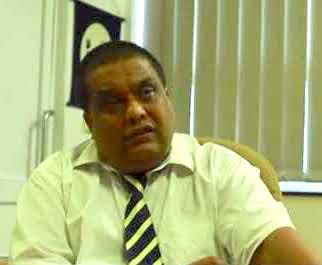
Dr Rukshan Bellana

It is revealed that although the Technical Evaluation Committee (TEC)
had recommended that a tender for the sale of excess plasma be offered
to the highest bidder (ABC Pharma) from among eligible bidders to ensure
that the highest income is brought to the country, Bellana has tried to
prevail on the members of the TEC to award it to DGH Medical Group,
effectively causing a loss of Rs 47 million to the government.
ABC Pharma had offered Rs 5600.00 per litre of plasma whereas DGH Medical Group has offered only Rs 4535.00.
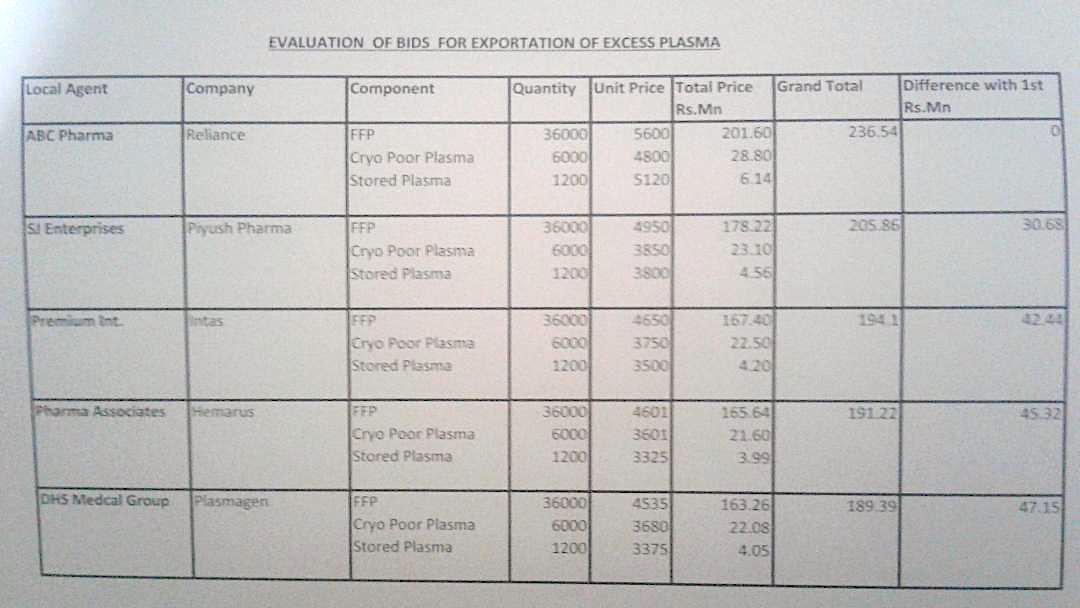
Price comparison
After the TEC declined to accede to Bellana’s request, he had received a
letter purporting to have been written by a blood donor protesting the
TEC decision. The letter is dated June 22, 2018 and has been received on
the same day as per the date-stamp and this despite the strike that has
crippled the postal service of the entire country. Bellana has since
referred the letter to the Sri Lanka College of Transfusion Specialists,
possibly to stir up a controversy and push the Tender Board to recall
the tender.
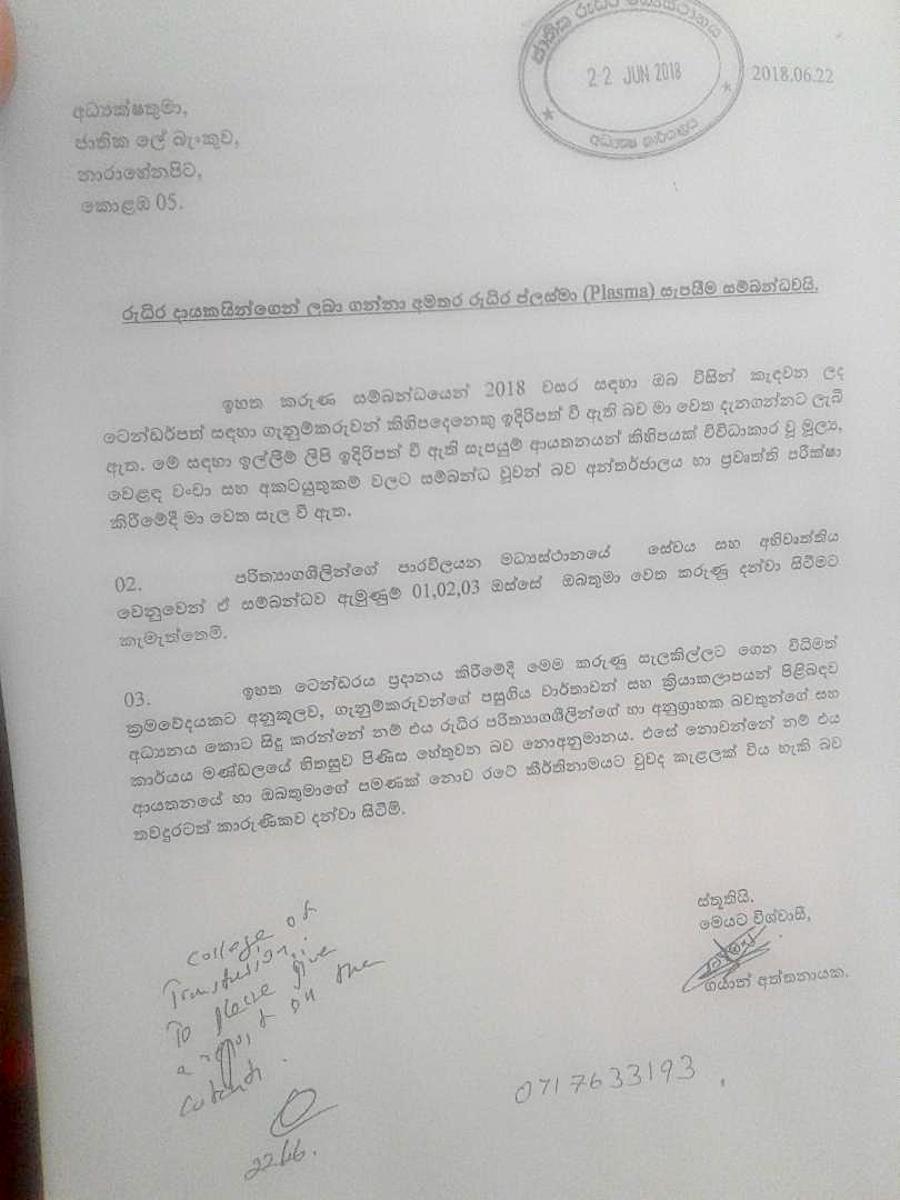
Donor complaint
Colombo Telegraph reliably learns that ABC pharma which has learned
about the violation of the Procurement Guidelines by Bellana has made
their representations to Rajitha Senaratne, Minister of Health.
Colombo Telegraph earlier exposed the voice recordings where
Bellana clearly states that the minister’s brother has discussed the
purchase with his and that Dr Anil Jasinghe (Director General Health
Services), Dr. Hemantha Beneragama (Deputy Director General , Laboratory
Services) and Janaka Chandragupta (Additional Secretary Development)
have all briefed him about the ministerial sibling’s interest in the
purchase.
Speaking to Colombo Telegraph on Tuesday, Dr Bellana acknowledged the
authenticity of the voice recordings published by Colombo Telegraph. He
further said he was victimised because his speech against President
Maithripala Sirisena where he said that the former Health Minister (Maithripala Sirisena)
was corrupt. When asked whether he had evidence to say the President as
the then Health Minster was corrupt, he said “yes”. He agreed to
provide the evidence to Colombo Telegraph. He also said he would give
his side of the story, but so far he’s failed to do so.
Read More

Mahinda’s media sec. arrested at Singapore Airport

by
 According
to sources Mr Rohan Weliwita, former Chairman of controversial CSN
channel of Rajapaksas and the Media Secretary of former President
Mahinda Rajapaksa, was arrested at Singapore International Airport
yesterday (25th), detained and had been released after three hours.
According
to sources Mr Rohan Weliwita, former Chairman of controversial CSN
channel of Rajapaksas and the Media Secretary of former President
Mahinda Rajapaksa, was arrested at Singapore International Airport
yesterday (25th), detained and had been released after three hours.
Mr Rohan Weliwitta has gone to Singapore for a private visit when he was
arrested by Singapore Airport authorities and questioned regarding
money laundering and his passport.
Mr Rohan Welivita’s passport had been suspended in connection with an
investigation being carried out by the FCID over money laundering but
has been temporarily released say sources.
Source: ‘Lankadweepa’
Source: ‘Lankadweepa’
ROAD ACCIDENTS KILLED 1,459 UPTO NOW


Road indiscipline of Sri Lankans is the main cause for road traffic
accidents, Traffic Police Division Deputy Director ASP W.D.A. Dhananjaya
said.
By June 25 this year (2018) 1,459 persons had been killed due to road
traffic accidents.Annually 900 pedestrians die while trying to cross the
road, he said.
The ASP said that annually around 3,000 get killed due to road accidents
and one third of the total number of accidents related deaths occur due
to road accidents.
Twenty three people are killed daily due to accidents and nearly 9,000
deaths are reported annually due to accidents, Health Ministry’s Non
Communicable Diseases Unit Director Dr. Thilak Siriwardana said.
Addressing a press conference held at the Health Promotion Bureau (HPB)
in Colombo yesterday he said the majority of the persons who get killed
due to accidents belong to the productive age.
Motor Traffic Department’s Assistant Commissioner (Technical) J.A.S.
Jayaweera said that at the moment there are 7.1 million registered
vehicles in Sri Lanka and 5.2 million of them ply on the roads.
“The number of drivers can be similar. But the issue is 80 percent of
them are not safe.Three wheelers and motor bicycles are considered
unsafe and people should be discouraged from buying them,” he said.
Celebrating pride: Women’s rights activism and LGBT advocacy

While involvement in LGBT advocacy varies vastly amongst women’s rights organisations and individual activists, such advocacy has become more and more visible in recent years. Here members and supporters of Sri Lanka’s LGBT community participate in an event organised to mark World AIDS Day in Colombo – AP
 Thursday, 28 June 2018
 Is
sexuality a feminist issue? This question was posed memorably by
women’s and human rights activist, Sunila Abeysekera, in 1999, and
answered by her in the affirmative.
Is
sexuality a feminist issue? This question was posed memorably by
women’s and human rights activist, Sunila Abeysekera, in 1999, and
answered by her in the affirmative.We want to pose this question, once again, as we mark ‘Pride’, the shorthand for efforts made in many parts of the world this month to push for the recognition of lesbian, gay, bisexual and trans (LGBT) existence and rights. We are interested in how Sunila approached this question--making it a debate that was internal to women’s movements and asking feminists to reflect on their ownership of these issues.
There has been solidarity for LGBT issues from women’s rights activists, and some support from a few women’s organisations over the past two decades, in Sri Lanka, but it is fair to say that these issues have not been at the forefront of the collective mainstream women’s rights agendas. However, what may not be apparent are the strategic efforts of individual women’s rights activists and an increased number of organisations. In the past few years, some have been trying from their location as women’s rights activists, to support advocacy for Sri Lanka’s lesbian, gay, bisexual and trans (LGBT) communities, and their efforts have paid off.
While involvement in LGBT advocacy varies vastly amongst women’s rights organisations and individual activists, such advocacy has become more and more visible in recent years. It dates as far back as the mid-to-late 1990s, coinciding with the emergence of LGBT advocacy groups in Sri Lanka. The awareness that women’s rights activists can create on matters of sexuality was increasingly evident in the lead up to the change of government (in 2015) and the period thereafter, when women’s rights activists were placed in a position to politically leverage change.
Following the 2015 elections, the National Unity Government’s election to power was a time when the State made a commitment to portray an agenda of re-establishing respect for human rights, the rule of law, and good governance. They initiated a number of consultative processes to obtain the views of the public on these matters. Civil society activists, therefore, had some chance to shape this agenda. Many helped envisage this desired social and political reform and participated in the mechanisms driving it.
Women’s rights activists also made their voice heard in many of these consultative processes, and, in doing so, some created opportunities within the scope of women’s rights and wider social justice issues with which they were concerned, for taking LGBT issues into account.
If this tactic was not entirely new, the circumstances made it an important one. In a post-war context, when transitional justice mechanisms were being crafted towards achieving some degree of truth, justice, reparations and guarantees of non-recurrence, there was no automatic recognition that same-sex sexuality and gender non-conformity were areas that had been impacted by over thirty years of war and had to be included in the range of issues around which public consultations were being conducted.
This awareness had to be created by civil society actors, and women’s rights activists, including LGBT rights activists took up the challenge of doing so. LGBT concerns did not feature in any previous discussions on transitional justice, such as within the Lessons Learnt and Reconciliation Commission (LLRC) and other Commissions dealing with conflict related violations.
A good example of such efforts were the attempts to engage with the Consultation Task Force for Reconciliation Mechanisms in August 2016. Women’s rights activists were successful in convening a focus group discussion with LGBT individuals and organisational representatives with the Western Province Zonal Task Force on Reconciliation Mechanisms.
This discussion and a written submission on the issues facing LGBT persons, in relation to Transitional Justice, helped shape the final report and recommendations of the Consultation Task Force. Some of the concerns raised in this discussion and submission focused on the prevailing laws, the creation of an enabling environment, addressing the needs of LGBT people, the surveillance of work done by human rights defenders, and sexual violence.
Though women’s rights activists had a hand in creating this opportunity, they were by no means the only actors. Sri Lankan LGBT groups such as Equal Ground, Women’s Support Group, and individuals, had and have been working for decades at national and international levels, for state recognition for these issues. Groups and individuals were quick to grasp openings for change, especially on reconciliation mechanisms and constitutional reform, when they presented under the new regime.
Thus, it is not a question of assigning special value to what women’s rights activists were able to do over what other actors could, but a case of opportunities that they, as women’s rights activists, were positioned to access at that moment in time. This was the result of a complex set of circumstances, not least of which was the changed state-civil society relationship in which the state took the approach of ‘consulting’ civil society on key matters. Women’s rights activists were prominent amongst those who were ‘consulted’, not only for gender-specific issues but across a range of human rights and social justice issues, which gave them some measure of leveraging power.
Critical in this process were the sittings of the Public Representations Committee (PRC) that called for oral and written submissions on Constitutional reform. Women rights activists from women’s organisations chose to include sexual orientation and gender identity concerns in submissions on bodily integrity, calling for the securing of LGBT rights as fundamental rights in the new Constitution the State was seeking to draft.
Their voice served to strengthen the advocacy of LGBT activists, and the PRC report recommended that the Bill of Rights include a clause that ‘No person or group shall be discriminated against on the grounds of …. sexual orientation and sexual or gender identities’. The Committee acknowledged submissions from all over the island and from many sources to protect the rights of LGBT persons, as they explicitly provided input to initiate a dialogue on the rights of the community as well as Constitutional protections.
Women rights activists were also instrumental in including a number of provisions for the protection of LGBT rights into the National Action Plan for the Protection and Promotion of Human Rights 2017 - 2021, NHRAP. Not only did some civil society actors including women’s rights activists constructively participate in committees in relevant areas of expertise in the formulation of the NHRAP, but they additionally lobbied for improvement at the Universal Periodic Review, where the NHRAP was finally presented and discussed.
A shift in thinking was evident in the inclusion, initially, of a clause on equality and non-discrimination on the grounds of sexual orientation. This was originally included and flagged as a voluntary pledge in the national report but scaled back by the end of the review process, with Sri Lanka not committing to support recommendations on decriminalisation as a result of Presidential intervention. Thus, equality provisions in the NHRAP, though actionable, remain confined to gender identity, and in no way guarantee that sexual orientation is a basis for equality and non- discrimination.
Even prior to 2015, some women’s rights activists engaged with a number of international and national mechanisms for progressing women’s rights, to advance LGBT human rights issues in Sri Lanka. The Opposition Leader’s Commission on the Prevention of Violence Against Women and Girls, comprising a number of women’s rights activists and scholars, offers a recent example at the national level.
Initially set up under the Leader of the Opposition, Ranil Wickremasinghe and continuing under his purview as Prime Minister, as a Task Force on Violence Against Women, it challenged the limits of who could be included under the category of ‘woman’ and the type of violence that could be recognised under the well-known women’s rights rubric of ‘violence against women’.
LGBT organisations and individuals were able to make submissions before the Task Force, on violence visited on lesbians, bisexual women and trans persons (LBT) persons. It was a notable opportunity for LBT people to ensure that a state mechanism recognised and documented this abuse (the Commission’s report was finalised in 2014), and integrated it into its action plans.
Women’s rights groups have been engaging with international treaty body mechanisms, with specific reference to the Convention on the Elimination of All Forms of Discrimination against Women (CEDAW), International Covenant on Economic, Social and Cultural Rights (ICESCR) and the Universal Periodic Review (UPR). Submissions were made on LBT rights, supporting similar reports submitted by LBT groups, in a unique form of collective strategising.
Women’s rights groups have sought to go beyond the limits of the law and decriminalisation, calling for the state to put in place policies to address prejudice, negative stereotyping and discrimination, which are deeply embedded in value systems and practices against the LGBT community. Such framings have included the right to non-discrimination, to be free from all forms of violence and cruel, inhuman and degrading treatment, and the right to privacy, freedom of expression and association.
Women’s rights groups have also highlighted the right to work, social security, physical and mental health, and education – all areas in which persons of diverse sexual orientation and identity suffer discrimination.
Many women’s rights activists have come to the table, willing to be part of a real change, and their efforts have been a precedent. But what has been the outcome of all their collective and individual strategising, consultations and submissions? Only a negligible part of these efforts have been recognised, leave alone implemented, by successive governments through the years. Unfortunately, heteropatriarchal roadblocks seem to be still in place. The positive stand against discrimination and violence against LGBT people is a lifelong collective and individual effort – these efforts are our pride!
(The Cat’s Eye column is written by an independent collective of feminists, offering an alternative feminist gaze on current affairs in Sri Lanka and beyond.)
Full freedom eludes Gaza’s exiles

For young people like author Mousa Tawfiq, currently living in Paris,
pursuing opportunities outside Gaza comes with great sacrifice.

I have experienced more freedom over the past 10 months than at any other time in my life.
Being a student in Paris means I do not have to contend with obstacles that Palestinians living under occupation face every day.
My freedom has nonetheless come with a major condition attached. While I
can move around in much of Europe, I am prevented from visiting my
family and friends in Gaza.
In September 2017, I crossed through Erez, the military checkpoint
separating Gaza from Israel. The Israeli troops at that checkpoint made
me sign a document stipulating that I would stay away from Gaza for a full 12 months.
In practice, I am prevented from entering Gaza for even longer.
If I traveled to Gaza for a vacation this coming September, there is a
high probability I wouldn’t be allowed to leave again or that I would be
obstructed from doing so.
The crossings at both Erez and Rafah – on Gaza’s border with Egypt – are
frequently closed to Palestinians. As a result, there would be no
guarantee that I could make it back to France before term resumes in the
autumn.
I could, therefore, lose the scholarship I have been granted to study communications at Paris 8 University.
The masters program I am following lasts for two years. I don’t know yet what I will do when it is completed.
But I do know one thing: I won’t rush back to Gaza. I fully intend to pursue the opportunities that were denied me in Palestine.
Homesick
My experience is shared by many other young people from Gaza now studying abroad.
Gaza is often – and accurately – described as an open-air prison. It is
only natural that people locked inside that prison want to escape from
it.
Yet once we manage to escape, we are homesick. We long to see our loved ones, who remain inside the prison.
The freedom we taste on the outside is fraught with uncertainty.
In most cases, we have been allowed to study in the West for limited
periods of time. Once our courses are over, we need to apply for
permission from the authorities if we are to stay in our countries of
residence. Permits to remain are usually issued only if we have managed
to find employment or get admitted to a different academic course.
If we are lucky, the work we do will be rewarding both financially and
emotionally. But there is always the risk that we will have to accept an
unsatisfying job just so that we can have legal status.
Telling Europeans about the limits on our freedom can be exhausting.
“Basically, I can now travel to wherever I want, though I cannot travel
back to Gaza,” Said Alyacoubi, who is studying immunology at Oxford
University, said.
“In fact, I do not know how or when I will be able to see my family or
friends back home. Explaining this to people who ask is a headache.
There is no way to explain that my home is currently unreachable.”
Aged 26, Alyacoubi also left Gaza in 2017. Not being able to use his medical skills to assist people in Gaza saddens him.
“I still have that feeling of being imprisoned and deprived of my
freedom of movement,” he said. “We are divided from our home and our
people.”
“I want to watch the sunset”
Rola Mattar has been studying business administration in Paris since
2016. Being away from her family in Gaza is proving very tough.
She has spoken with her mother about trying to meet in Jordan. But she
is not sure that her mother will be able to travel because of the
restrictions imposed under Israel’s siege on Gaza.

Rola Mattar has been living away from her family in Gaza for two years.
“During vacations, everybody goes home to see their loved ones,” the
25-year-old said. “I feel so bad. I can’t even describe how bad I feel. I
want to see my cousins, to eat my mother’s cooking, just to watch the
sunset from the rooftop of my family’s house.”
The absence is especially noticeable during occasions that are supposed
to be joyful. “I’m thinking about my graduation day,” said Mattar.
“Everyone will have their family beside them but I won’t. It’s really
unfair that we Gazans get through all kinds of difficulties and yet we
still suffer in every aspect of our lives.”
Excluded from joy
Tamam Abusalama left Gaza when she was 19. Today, she is 25.
Since leaving, she has made what she called one “humiliating trip” back
to Gaza. Five years ago, she traveled there from Turkey, where she was
then studying. At the end of her stay, she spent many days shuttling
between her family’s home and the Rafah crossing before she was finally
allowed to travel back to Turkey.
Now studying communication science in Brussels, Tamam is one of four
siblings living outside Gaza. Her brother Majed lives in Germany, while
her sisters Majd and Shahd live in Spain and Britain.
The three recently met each other for the first time in six years. They had a holiday together in Spain.
“We decided to meet every two months in a new city just to benefit from
our current freedom of movement,” said Tamam. “Our happiness couldn’t be
complete without my parents and my young brother who are in Gaza. But
still it was a dream that came true.”
The pain of being separated from loved ones was particularly acute for
Tamam during the major Israeli offensives against Gaza in November 2012
and the summer of 2014.
“I spent my days waiting for any call or message from my family,” she
said. “That was the moment when you wished to be back, giving them a hug
before it is too late.”
Tragically, it was too late for a member of her extended family. One of
Tamam’s uncles was killed during the 2014 Israeli attack. She was unable
to mourn his death alongside her family.
She has also had to miss out on happier events such as when her younger brother Mohammed was married in Gaza last year.
After his wedding, Tamam wrote an article highlighting
the injustice of her being excluded from the celebration, of how she
had to settle for watching videos rather than being there in person.
That story encapsulates what Palestinians in exile have to endure.
Modern technology may allow us to communicate in ways that previous
generations could not imagine. Yet it does not remove the heartbreak of
being prevented from going home – even for a holiday.
Mousa Tawfiq is a journalist, formerly based in Gaza, currently living in Paris.
Decency wins — and Trump gets smacked down
Trump's policy of family separation was part of a broader pattern of attacks against immigrants and should never have existed, argues Elias Lopez.
On the same day that the Supreme Court upheld President Trump’s travel ban in a tortured ruling, a district court judge hearing a suit on behalf of a class of migrants separated from their children struck a blow for common decency and family reunification. The Post reports:
Judge Dana M. Sabraw of the United States District Court for the Southern District of California granted a preliminary injunction sought by the American Civil Liberties Union. He said all children must be reunited with their families within 30 days, allowing just 14 days for the return of children under 5 to their parents. He ordered that parents must be entitled to speak by phone with their children within 10 days.
The court slammed the administration
for “a chaotic circumstance of the Government’s own making.” Sabraw,
appointed by President George W. Bush, found: “This
situation has reached a crisis level. The news media is saturated with
stories of immigrant families being separated at the border. People are
protesting. Elected officials are weighing in. Congress is threatening
action. Seventeen states have now filed a complaint against the Federal
Government challenging the family separation practice.”
In issuing an injunction, the court found there was a likelihood that the plaintiffs would succeed on a due process claim. (“We are a country of laws, and of compassion. We have plainly stated our intent to treat refugees with an ordered process, and benevolence, by codifying principles of asylum. The Government’s treatment . . . [of] class members does not meet this standard, and it is unlikely to pass constitutional muster.”) The court continued:
The practice of separating these families was implemented without any effective system or procedure for (1) tracking the children after they were separated from their parents, (2) enabling communication between the parents and their children after separation, and (3) reuniting the parents and children after the parents are returned to immigration custody following completion of their criminal sentence. This is a startling reality. The government readily keeps track of personal property of detainees in criminal and immigration proceedings. Money, important documents, and automobiles, to name a few, at all levels — state and federal, citizen and alien. Yet, the government has no system in place to keep track of , provide effective communication with, and promptly produce alien children. The unfortunate reality is that under the present system migrant children are not accounted for with the same efficiency and accuracy as property. Certainly, that cannot satisfy the requirements of due process.
The court cited at length the findings of the Children’s Defense Fund
regarding the extensive harm done to children forcibly separated from
their parents. The court expressed the shock and dismay many ordinary
Americans are feeling:
The facts set forth before the Court portray reactive governance — responses to address a chaotic circumstance of the Government’s own making. They belie measured and ordered governance, which is central to the concept of due process enshrined in our Constitution. This is particularly so in the treatment of migrants, many of whom are asylum seekers and small children. The extraordinary remedy of classwide preliminary injunction is warranted based on the evidence before the Court.
In contrast to the Supreme Court’s travel ban ruling, constructed to
avoid identifying the president as an abject racist whose intent should
have invalidated his executive order, this court did not avert its eyes.
In ordering the reunification of children younger than 5 within 14
days, older children within 30 days and a halt to child separation, the
judge followed a long tradition recognizing that anyone here — illegally
or not — enjoys the benefits of ordered, fair government. (The entire
country has been deprived of that under this president.) In this
instance, the American people can be proud of their judiciary.
Consider, if you will, the Justice Department lawyer arguing in effect,
“No, really, we can treat these kids worse than property.” Justice
Department attorneys need to seriously consider their professional and
own moral code of conduct in continuing to defend the administration’s
inhumane practices. One hopes that every Justice Department lawyer will
read the opinion, reflect on the judge’s admonitions and in the future
refuse to sign on to briefs or undertake oral arguments in defense of
barbarism. In the meantime, a significant victory for real family values
and constitutional government has been won.
Alexandria Ocasio-Cortez: who is the new progressive star of the Democrats?
From cocktail waitress to insurgent Democrat victor. Alexandria Ocasio-Cortez beat one of the party’s most senior congressman in a stunning New York election victory Alexandria Ocasio-Cortez, the winner of a Democratic congressional primary in New York. Photograph: Mark Lennihan/AP
 Lauren Gambino-
Just one year before Alexandria Ocasio-Cortez unseated a powerful 10-term New York congressman to have a chance at becoming the youngest person in Congress, she was mixing cocktails at Flats Fix tacos and tequila bar in Manhattan.
“Women like me aren’t supposed to run for office,” Ocasio-Cortez, a 28-year-old progressive and member of the Democratic socialist party, says in a campaign ad.
But, at the urging of progressive activists, Ocasio-Cortez not only ran – she won.
Her victory is part of a larger story of a Democratic party in revolt. A wave of first-time female and progressive candidate are storming the ramparts of an establishment that has not only seen its power recede at every level of government – but also failed to keep Donald Trump out of office.
In an interview on cable channel MSNBC this morning she said. “Our campaign was focused on just a laser-focused message of economic, social and racial dignity for working-class Americans, especially those in Queens and the Bronx.”
Her win was all the more remarkable for having been outspent by Crowley during the campaign by 10 to 1. “I started this race out of a paper bag. I had flyers and clipboards and it really was just nonstop knocking on doors and talking to the community,” she said.
Ocasio-Cortez is an almost made-for-TV foil to the Queens-born billionaire in the Oval Office.
After college she returned home to the Bronx and found work as an educational director. But she was forced to take on another job when the recession hit. Ocasio-Cortez worked “18 hour shifts” as a waitress and bartender to help her mother, a house cleaner, fight foreclosure after her father, a small business owner, died of cancer.
As she explained on MSNBC this morning, this life story has informed her politics. “My mother cleaned homes and drove school buses, and when my family was on the brink of foreclosure … I started bartending and waitressing. I understand the pain of working-class Americans because I have experienced the pain.”
In 2016, she organized for Senator Bernie Sanders, the Vermont independent, in New York during the Democratic presidential primary, which he lost. She linked arms with progressive activists at Standing Rock to protest the construction of a natural gas pipeline that crossed Native American land. Trump has revived the project that Barack Obama had blocked.
In May of 2017, she launched what was by all accounts a long shot bid to challenge congressman Joe Crowley of New York. Crowley, who is twice her age, was widely rumored to be next in line to lead House Democrats.
For 20 years Crowley, head of the Queens county Democratic party and the fourth-ranking Democrat in the House of Representatives, ran the deep-blue borough where more than 130 languages are spoken. He was synonymous with the party machine young progressive Democrats like Ocasio-Cortez were ready to expel.
“We’ve got people – they’ve got money,” she said in a campaign ad, adding: “It’s time we acknowledge that not all Democrats are the same.”
Ocasio-Cortez ran a grassroots campaign, blanketing the borough with canvassers who pounded the pavement and courted young, black and Latino voters who make up the constituency.
She argued that Crowley was out of touch with the working-class people of his district and was beholden to Wall Street and corporate interests.
Last week, Crowley sent a Latina surrogate to debate Ocasio-Cortez, citing a scheduling conflict. Ocasio-Cortez ridiculed the decision, accusing him in a sharply-worded tweet of sending someone with a “slight resemblance to me”.
“The way the Queens Democratic party machine has worked, they operate on a politics of exclusion,” Ocasio-Cortez told WNYC after she launched her campaign.
The Democratic socialist ran on issues that remain largely outside of the Democratic mainstream.
 Alexandria
Ocasio-Cortez at the Tornillo-Guadalupe port of entry gate on 24 June
in Tornillo, Texas. Photograph: Joe Raedle/Getty Images
Alexandria
Ocasio-Cortez at the Tornillo-Guadalupe port of entry gate on 24 June
in Tornillo, Texas. Photograph: Joe Raedle/Getty ImagesOcasio-Cortez called for the abolition of the Immigration Customs Enforcement (Ice), an agency that has increasingly become a target of left leaning activists over its treatment of immigrants in its care.
She also called for a single-payer healthcare plan that would guarantee healthcare for all Americans, a proposal known as Medicare for All and championed by Sanders. She also called for tuition-free college and a universal-jobs guarantee, under which the federal government would provide a job for every American.
Last weekend before Tuesday’s election, Ocasio-Cortez left her New York district for west Texas to participate in a protest against family separations.
At her victory party on Tuesday night, a visibly shocked Ocasio-Cortez clasped her hands over her mouth, her eyes wide as she stared at the television as the results flashed across the screen to show that the 28-year-old progressive had slayed one of the Democratic party’s most powerful giants.
“How are you feeling?” the TV reporter asked. “Can you put this into words?
“Nope,” she said. “I cannot put this into words.”
Earlier today on MSNBC she had found the words to articulate a very clear vision and offer the Democratic establishment a clear challenge. “What is the vision that will earn the support of working-class Americans – what we need to do is lay out a plan and a vision and getting into twitter fights with the president is not where we’re going to find progress.”
At his election night party in Jackson Heights, Crowley thrummed a guitar.
“This is for Alexandria Ocasio-Cortez,” he said as the band struck up Bruce Springsteen’s Born to Run.
Ahead of NATO Summit, U.S. President Exhorts Allies to Pay Up
European officials worry that Trump could roil yet another international summit.
 U.S.
President Donald Trump delivers a speech next to NATO Secretary General
Jens Stoltenberg at NATO headquarters in Brussels on May 25, 2017.
(Emmanuel Dunand/AFP/Getty Images)
U.S.
President Donald Trump delivers a speech next to NATO Secretary General
Jens Stoltenberg at NATO headquarters in Brussels on May 25, 2017.
(Emmanuel Dunand/AFP/Getty Images)
Organizers of this year’s NATO summit in Brussels are worried that U.S. President Donald Trump might spoil the event with a single boorish tweet — much as his internet missives marred the summit meeting of G-7 nations earlier this month in Canada.
But while the North Atlantic Treaty Organization’s pivotal meeting is still two weeks off, Trump has already surprised the participants: Instead of tweets, he is sending out letters.
In a sharply worded message to at least some countries in the 29-member alliance that didn’t meet defense spending thresholds — one that followed a general template but included additional language tailored to specific countries — Trump wrote that Americans were tired of funding Europe’s defense and wanted to see other NATO members carrying more of the load.
“[It is] increasingly difficult to justify to American citizens why some countries do not share NATO’s collective security,” said the letter, which was described to Foreign Policy by U.S. officials and foreign diplomats.
“I, therefore, expect to see a strong recommitment by [country] to meet the goals to which we all agreed,” it said.
The version being sent to Germany contained some of the harshest language, according to the officials.
Though it’s not uncommon for U.S. administrations to push allies on burden-sharing, the letter — its tone and its timing — underscored the precariousness of international parleys in the Trump era. NATO summits are usually choreographed affairs, with shoulder-to-shoulder photo-ops and boilerplate communiques.
The coming meeting, starting July 11 and featuring the leaders of all NATO countries, could be a fiasco thanks to Trump’s unpredictable and brash behavior.
“A no-news summit would be a good summit,” said one European diplomat who preferred not to be named discussing the upcoming event. “But at this point, we’re all scared shitless.”
The meeting will feature announcements on some policy breakthroughs: a new NATO program in Iraq to train Iraqi security forces, a joint initiative with the European Union to increase “military mobility” for allied forces moving around within Europe, the opening of two new command structures — one focused on maritime issues in Norfolk, Virginia, and one on logistics in Germany, and the possible launching of talks with Macedonia to join the alliance.
It will likely be followed by a meeting between Trump and Russian President Vladimir Putin.
But the optics of a warm interaction between the two men would be especially jarring if it came on the heels of a troubled NATO summit.
“Allies are concerned that praise will be heaped on Putin … while simultaneously Trump is sharply criticizing allies for not doing enough on defense spending,” said Julie Smith, an expert on trans-Atlantic security at the Center for a New American Security, a Washington-based think tank.
Norwegian Foreign Minister Ine Eriksen Soreide, speaking at an event at the think tank on Tuesday, said maintaining alliance cohesion is critical in the run-up to a Trump-Putin meeting. She said it was important for Putin to “understand that the president of the United States also speaks on behalf of an alliance.”
When asked for comment, the State Department referred all questions to the White House, but a spokesman there did not immediately respond to queries.
Relations between the United States and its European allies and Canada are already tense over a spiraling trade war, Trump’s withdrawal from the Iran nuclear deal, his administration’s continued singling out of Germany, and the U.S. exit from the Paris climate agreement.
At the G-7 meeting in Canada, Trump made the attacks personal, chiding Canadian Prime Minister Justin Trudeau on Twitter as “weak and dishonest” and refusing to sign the meeting’s joint communique with the other six top global economic powers.
“What I think most troubles the alliance is that some of these angry words might get translated into angry action,” said Adam Thomson, a former British ambassador to NATO who now heads the London-based European Leadership Network. “That could be quite a bit more serious.”
Trump roiled the NATO summit last year with his refusal to endorse the alliance’s collective defense clause and the shove he gave Montenegro’s leader at a photo-op. The issue of defense spending could be this year’s main source of contention.
In 2014, following the Russian invasion of Ukraine and spiraling crises in the Middle East, NATO members set a goal for each country to spend 2 percent of its GDP on defense by 2024 — a long-standing NATO benchmark that few members honored.
At the beginning of this year, eight of the 29 members either met or were nearing the 2 percent target: the United States, United Kingdom, Poland, Estonia, Lithuania, Latvia, Romania, and Greece.
Six others — Bulgaria, France, Hungary, Montenegro, Slovakia, and Turkey — have unveiled plans to reach the target by 2024. Two, Norway and Denmark, may not meet the 2 percent threshold by 2024 but have plans to significantly boost defense spending. Norway, for example, plans to purchase 52 new F-35 fighter jets.
That leaves the majority of NATO allies without plans to meet the spending target, including Germany, Europe’s strongest economy.
“There’s a lot of good news about the alliance, but there’s dangers that will all get eclipsed by Trump’s recriminations on 2 percent,” Alexander Vershbow, a scholar at the Atlantic Council and former deputy secretary-general of NATO, said.
Officials said the State Department had been quietly trying to press Trump to avoid negative messaging at the summit and focus on the overall increase in defense spending, even if countries aren’t meeting the benchmark. That’s something NATO Secretary-General Jens Stoltenberg has touted in recent interviews, including with Foreign Policy.
One more concern for the Europeans is the possibility that U.S. Defense Secretary James Mattis’s influence in the administration is declining. Mattis has overseen a significant buildup of U.S. military presence and funding in Europe despite Trump’s sharp dismissal of NATO allies. He “looms as the most important safeguard for allies to cling to,” Vershbow said.
“I think quite a few people here view Mattis as the last voice of reason,” said one European defense official.
For European leaders, it’s one more reason to brace for trouble at the summit.
“I don’t think anybody would be dumb enough to predict what would happen,” said one NATO official based in Brussels. “I’m hopeful [the summit] will go smoothly in that he’ll only make a few obnoxious remarks.”
Game Over; The End of Ethiopia’s TPLF Regime

If this new Ethiopian leader manages to stay alive, there is hope for Ethiopia, that the nationalities, starting with the Oromo’s, the largest, who have been calling for independence, will reconsider their quest for separation and continue as one country.

( June 25, 2018, Eritrea, Sri Lanka Guardian) Game
Over! The Tigray People’s Liberation Front which has ruled Ethiopia
since 1991 has been ousted from power in Ethiopia, replaced by a new
breed of leadership who have quickly moved to reassure the people that a
real change is in the making.
This past Wednesday, June 20, was a busy day for the new Prime Minister
Abiy, an ethnic Oromo, Ethiopia’s largest nationality, traveling to the
site of the latest ethnic massacre and addressing the leadership of the
Gurage community calling on them to end the ethnic violence and bring
peace to their land by dialogue and mediation. This was all broadcast
live for all Ethiopians, both at home and abroad, to see via satellite
television and warmly received by those to whom he directly spoke.
Next door, here in Eritrea we sat glued to our tv’s late into the night
watching Ethiopian television broadcast the address our President Issias
Aferwerki had made early that morning during our annual Martyrs Day
commemoration where he held out an olive branch of peace to our
neighbors in Ethiopia, repeated over and over. The Ethiopian P.M. then
went live and thanked the Eritrean President and promised a future of
peace and prosperity in brotherly respect. And he did it in Tigrinya,
the de facto national language of Eritrea.
We could only pinch ourselves in disbelief, to have our long time
enemies in Ethiopia suddenly change so positively, I mean EVERYTHING the
Ethiopian P.M. has been saying could not be more true.
The Ethiopian P.M. has gone on tv and described his governments past
actions, and he acknowledges he was a part of this, as “terrorist”
regarding its treatment of its political prisoners. He has addressed the
T.P.L.F regimes past policy of divide and rule via instigation of
ethnic bloodshed and spoke to what needs to be done to heal divisions
and move forward.
Here in Eritrea what we are hearing is music to our ears for the
Ethiopian P.M. is saying just what our President Issias Aferwerki has
been saying for two decades now, that we shouldn’t be fighting, instead
uniting, to build a more humane and just society absent of foreign
intervention.
If this new Ethiopian leader manages to stay alive, there is hope for
Ethiopia, that the nationalities, starting with the Oromo’s, the
largest, who have been calling for independence, will reconsider
their quest for separation and continue as one country.
While one must respect the right to self determination reality is that
the “Prison House of Nations” that has been Ethiopia up to now is best
transformed into a modern, peoples democracy rather than torn asunder
and left to fend for themselves as small, independent countries. This
new P.M. could be the one to give them hope and allow a violent upheaval to be avoided.
new P.M. could be the one to give them hope and allow a violent upheaval to be avoided.
The Horn of Africa, the Horn of Hunger, the Horn of War and Famine may
be seeing the birth of a new era, where Ethiopia no longer invades its
neighbors at the behest of the USA. Where Ethiopians are able to leave
behind their lives of hunger and thirst, of being cold, sick and
illiterate and start to feed, clothe, house, medicate and educate its
people, and turn a perpetual famine victim into a modern, prosperous
land.
For us here in Eritrea after 20 years of war followed by no war, no
peace, we have hardened ourselves to not seeing a light at the end of
the tunnel. This new leadership in Ethiopia is almost to much to
believe, its almost like a dream to us still. Could we really live as
brothers and sisters with our huge neighbor to our south?
Just as with North Korea the Trump Regime has broken with decades of
past policy towards the the Horn of Africa and allowed common sense and
experience to hold sway. It may be just pragmatism, but those veteran
diplomats in the US State Department know they have little choice in the
matter, any further support for the TPLF regime would have been
counterproductive and damage American credibility let alone result in
the disintegration of Ethiopia, possibly followed by a South Sudan
scenario.
One thing is for sure, and Eritrean President Issias Aferworki said it
with glee when he spoke at our Martyrs Day commemoration, “Game Over!”
for the T.P.L.F regime, shocking all in attendance into spontaneous
applause. What we have only dreamed about is now reality here in the
Horn of Africa, and if the seasonal rains arrive this year and another
drought is averted, then we can truly be blessed with “selam(peace) and
rain for the Horn of Africa”.
Thomas C. Mountain is an independent journalist and historian in Eritrea, living and reporting from here since 2006. See thomascmountain on Facebook or best reach him at thomascmountain at gmail dot com
Algeria under new scrutiny over migrants 'abandoned' in the desert
Activists
say thousands expelled from Algeria are arriving in Niger, but local
media says focus on country is part of a 'humanitarian conspiracy'

NGOs and UN agencies are expressing alarm at the situation of migrants being expelled from Algeria to Niger (Twitter/OIM)

Wednesday 27 June 2018
ALGIERS – A report by the Associated Press alleging
that Algerian authorities have "abandoned" more than 13,000 people in
the Sahara desert has brought fresh scrutiny on the North African
country's treatment of migrant travellers.
The American news agency report, which was published on Monday,
collected over a dozen testimonies in Niger and also cited a survey
conducted by the United Nations' International Organisation for Migration (IOM), which had interviewed thousands of migrants from sub-Saharan Africa who had left Algeria.
It said that those abandoned had included pregnant women and children
and that some of them had been threatened at gunpoint to walk through
the desert without food or water.
The report also came just a few weeks after Reuters exposed in late May incidents of slavery and torture committed by people smugglers working on migration routes in southern Algeria.
Concerns about mass deportations, “ethnic profiling” and
suspicions of abuse have been raised by NGOs and, more recently, by the
UN, which has denounced Algeria’s hardened stance on migration policies
over the past few months.
28,000 expulsions
Officially, Algiers has acknowledged having deported nearly 10,000 undocumented migrants to their native countries since 2016.
Sayid Salhi of the Algerian League for Human Rights (LADDH) spoke to
Middle East Eye about what he called "an increase in expulsions in
recent months". He estimates that some "28,000 migrants on the Niger
border have already been deported".
Alhoussan Adouwal, who works for the IOM in Assamaka, a town in Niger on the Algerian border, concurred.
"I have never seen deportations like the ones I am currently witnessing. They are arriving by the thousands," he said.
 The testimonies published by AP also include videos made by migrants (screenshot)
Algerian authorities insist that the expulsions are being carried out
"in cooperation with the governments of the countries in question", but a
petition signed by several Algerian NGOs in late May challenged the
state’s official position.
"No readmission agreements or requests for the possible return of
nationals have been communicated by the governments of these countries,"
the petition read. "More than 1,500 migrants have been deported in
recent weeks in operations marked by abuse and in direct violation of
international human rights law.
'It would make more sense to point the finger at the people responsible for all the tragedies suffered by the African migrants'- The Algerian Red Crescent
"Only Niger has been reached out to since 2014 regarding the return of
its nationals, the majority of whom are women and children, in the
context of an obscure agreement with the Algerian government."
In October, Amnesty International's Algerian office claimed
that arrests "were based on ethnic profiling, since the police and
constables were not checking passports or other official documents to
establish whether the migrants were residing legally in Algeria or not.
"Among the migrants arrested and deported, some were undocumented, whereas others had valid visas."
Anger in Algiers
As of Tuesday, Algerian authorities had yet to comment on the latest allegations. Earlier in June, the president of the Algerian Red Crescent pushed back against NGO and UN critiques of the deportations.
“It would make more sense to point the finger not at the Algerian
government, which has the upper hand in the present case, but at the
people who caused all the tragedies being unwillingly suffered by the
African migrants," said Saida Benhabiles.
READ MORE ►
On 27 May, the Representative of Algeria to the UN was instructed by the
Ministry of Foreign Affairs "to inform the office of the High
Commissioner for Human Rights of the Algerian authorities’ strong condemnation of
its spokesperson’s unacceptable comments, and to ask for explanations
as to why such unfounded accusations against Algeria were being made".
In Algiers, Prime Minister Ahmed Ouyahia further
stated: "Since Algeria has not agreed to become a detention centre for
African migrants for Europe’s benefit, we are under fire from outside
organisations, which have gone as far as to accuse Algeria of racism."
The European Union was earlier this month reported to
be considering a plan to set up migrant screening centres in North
African countries, although Dimitris Avramopoulos, the European
commissioner for migration, subsequently said that no countries in the
region had agreed to the plan.
Algerian authorities and local media have hit back at criticism of its
treatment of migrant travellers by accusing its critics of stoking
conspiracy theories: "It is not migrants we are afraid of, but the
people who manipulate them," the Ministry of the Interior claimed back in April.
In an article deriding "Anglo-Saxon media accusations", the Algerian news site Algerie Patriotique said on Monday that criticism of Algeria was part of a "humanitarian conspiracy".
- The article is based on an a translation of a story that was originally published by Middle East Eye's French website.
Subscribe to:
Posts (Atom)