Peace for the World World ! Your War Our Lives

The Dalai Lama
A Brief Colonial History Of Ceylon(SriLanka)
Sri Lanka: One Island Two Nations
A Brief Colonial History Of Ceylon(SriLanka)
Sri Lanka: One Island Two Nations
(Full Story)
Back to 500BC.

Saturday, November 30, 2019
Why I’m suing EU for trading with settlements
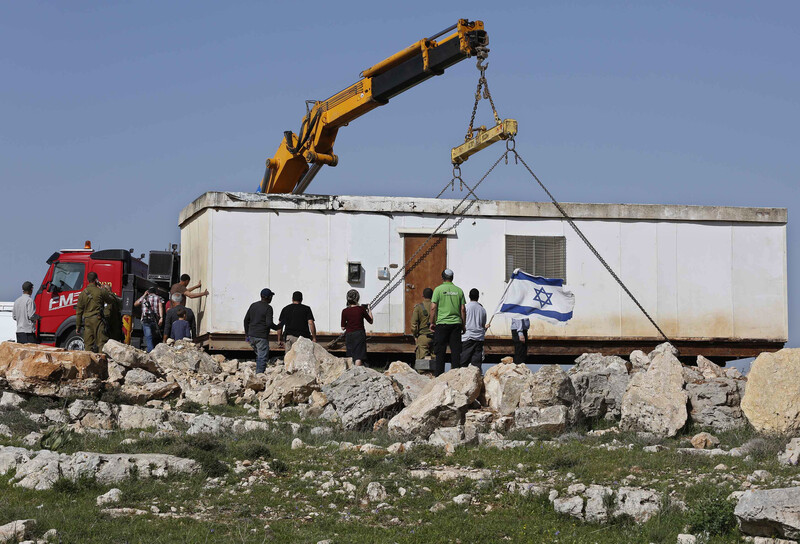
The EU has a legal obligation not to assist Israel’s colonization of the West Bank. (Wisam Hashlamoun/APA Images)

I am part of a group of seven people who are suing the European Union’s executive over its trade with settlements in territories under military occupation.
It may seem strange that we are taking this action around the same time that the EU’s top court ruled that all products from Israel’s settlements in the occupied West Bank and Golan Heights must be labeled accurately.
Yet it should be emphasized that despite this verdict, the EU still allows trade with settlements. By doing so, the EU and its governments violate their obligations under international law.
Trading with settlements – all of which breach the Fourth Geneva
Convention – is tantamount to conferring recognition on them. It also
helps occupying powers to maintain and expand their illegal colonies.
Since the European Court of Justice verdict was delivered earlier this month, the US has, in effect, given its approval to Israel’s settlement activities. The declaration by Mike Pompeo, the secretary of state, that the US does not view the settlements as illegal is itself a grave assault on international law.
It is all the more urgent, then, that the EU finally takes a tough stance against settlement activities.
Those activities contribute to a whole range of international law violations.
They obstruct the rights of Palestinians to self-determination. They involve the acquisition of land by force and the transfer of Israel’s civilian population to territories under military occupation – which, by definition, is a war crime.
And – by ensuring the domination of one ethnic group over another – they reinforce an apartheid system.
Obligation
When one state systematically violates the highest rules of international law – as Israel does – other states have an obligation not to recognize or assist the violations.
The duties of non-recognition and non-assistance are automatic. No UN resolution should be required to tell states what they should refrain from doing.
Trading with Israel’s settlements is exactly the kind of measure that
the European Union should avoid in order to fulfill these duties.
Both the Brussels bureaucracy and the individual governments in the EU have to shoulder their responsibilities.
Power over trade policy is held by the EU’s executive, the European Commission.
Yet each EU government has the power to halt
the importation of goods from Israel’s settlements. To date, none of the
28 governments in the EU have exercised that power.
As well as refusing to accept its responsibilities, the EU has tried to shield itself from accountability.
The seven people suing the European Commission are doing so because it
has declined to act when we have previously challenged it.
We have used a mechanism known as the European citizens’ initiative to try and ensure that the EU upholds international law in its trade policy toward occupying powers.
The citizens’ initiative has been presented by
Brussels officials as a form of “participatory democracy.” Under it,
ordinary citizens can recommend changes in any area where the European
Commission has the power to legislate.
Contradictory
Our initiative was submitted to the European Commission in June.
We urged the European Commission to reassess its trade policy. We argued
that the European Commission has to ensure that its policy complies
with international law.
Without mentioning Israel’s settlement activities directly, the
initiative defends principles relevant to any territory in the world
under military occupation. These principles would apply, for example, to
Western Sahara, which is occupied by Morocco.
We were simply seeking that the EU uphold international law. Banning goods from a territory under military occupation would not be a formal sanction.
In September, the European Commission decided not to even register our initiative.
In the letter refusing registration, the European Commission claimed that the issues we raised fell outside its remit.
Not only was that claim wrong, it was also very odd.
The European Commission contradicted a stance it had taken in the recent past.
When Ireland’s parliament, the Oireachtas, was discussing legislation aimed at banning such goods, the European Commission insisted last year that it alone bears responsibility for EU trade policy.
Both the European Commission and EU governments bear collective responsibility for guaranteeing that trade policy respects international law.
At the very least, then, the European Commission can issue a legal opinion on the trade in settlement goods and seek that EU governments follow its recommendations.
Undoubtedly, the European Commission has many intelligent people on its
staff, who are fully aware of the institution’s duties under
international law. Yet for political reasons – probably including the
influence of professional lobbyists – they are willing to accommodate
Israel’s illegal activities.
The European Commission knows that a ban on settlement goods is necessary. It has been told so by legal scholars and by Michael Lynk, the UN’s special rapporteur on human rights in the West Bank and Gaza.
Despite all the advice at its disposal, the European Commission has tried to stop Ireland from banning settlement goods.
The European Commission is not allowing any real scrutiny. In 2005, it reached a “technical arrangement” with Israel on how to deal with trade in settlement goods.
The team behind our court case has requested a copy of that deal under the EU’s
freedom of information rules. The European Commission refused to give
it to us, stating that Israel has demanded that the arrangement be
kept secret.
It is hard to imagine how disgraceful this situation is. The European
Commission – which handles trade policy for one of the world’s largest
trading blocs – has been strongarmed by Israel to protect an arrangement
that is neither public nor legal.
The European Commission has repeatedly called on Israel to halt its settlement activities. By failing to back up its words with action, the EU’s executive is ensuring Israel’s settlements thrive and expand.
The situation is dangerous and must be challenged. That is why we are going to court.
Tom Moerenhout is a professor of international and public affairs at Columbia University in New York.

How many children does Boris Johnson have? The British prime minister won’t say.


But just how many children does the prime minister have? Johnson doesn’t want to say.
Appearing on British radio station LBC on Friday, Johnson was confronted
by an angry listener who had called the show to reference his 1995
article for the Spectator. The caller, identified as “Ruth,” told the
prime minister: “I don’t appreciate what you’ve said about single
mothers,” before adding: “Why are you happy to criticize people like me
when you refuse to discuss your family?”
Johnson, who has been married twice, has four children — two daughters
and two sons — with his most recent ex-wife, Marina Wheeler, who he
separated from in 2018. Rumors have long swirled in Britain that Johnson
has a fifth child, a daughter,
from an affair. Johnson’s personal life has often hit the headlines in
Britain, with the 55-year-old frequently being accused of adultery
during his 25-year marriage. “Boris Johnson booted out by wife Marina
after she accused him of cheating AGAIN,” wrote the Sun in September
2018.
Johnson has also been accused of having an affair with American business
executive Jennifer Arcuri, who recently divulged on national television
that Johnson had told her he did, indeed, have five children.
Video from Friday’s interview quickly began circulating on social media,
with Labour leader Jeremy Corbyn sharing the clip and writing: “This is
what holding Boris Johnson to account looks like.”

This is what holding Boris Johnson to account looks like
Johnson frowned and sighed heavily before attempting to defend his past
writing: “These are 25-year-old quotations culled from articles written I
think before I was even in politics,” he said.
“I mean absolutely no disrespect to you,” he told the caller, who went
on to describe how Johnson’s comments had impacted the lives of
children. “My children suffered the stigma attached to the comments Mr.
Johnson made at the time,” she said.
“I love my children very much, but they are not standing at this
election. I’m not therefore going to comment on them,” Johnson said in
the interview. “I am not going to put them onto the pitch.”
When asked whether he was thinking of having more children with current
girlfriend 31-year-old Carrie Symonds, who moved into Downing Street in
the summer, Johnson said, “I’m not going to get into discussions.”
In June, police were called to an address in southeastern London after
an alleged altercation between the two. Symonds was reportedly heard by
neighbors shouting, “Get off me” and “get out of my flat” during the
incident.
First remains of UK truck victims arrive in Vietnam

Vehicles
carrying some of the remains of the 39 UK truck victims leave Noi Bai
airport in Hanoi on November 27, 2019 The first remains of the 39 people
found dead in a truck in Britain last month arrived in Vietnam early,
an airport security source said. Source: Nhac NGUYEN / AFP

26 November 2019
The first remains of the 39 people found dead in a truck in Britain last
month arrived in Vietnam early Wednesday, an airport security source
said.
The bodies arrived on a commercial Vietnam Airlines flight from London
to Hanoi, where ambulances and security personnel waited at the airport.
“The plane landed with 16 bodies on board… we are waiting to transfer
the bodies to local authorities,” the source told AFP, speaking on
condition of anonymity.
An official letter seen by AFP confirmed that 16 bodies would arrive in
Vietnam Wednesday. The 16 victims came from three provinces in central
Vietnam.
The other remains are expected to arrive in the coming days, though officials have not confirmed the date publicly.
Families have been frozen in grief for weeks waiting for their
relatives’ return, and many have taken out hefty loans from the
government to cover the cost of repatriation.
The remains were expected to be delivered later Wednesday to relatives
in three central provinces — Nghe An, Ha Tinh and Quang Binh — so
families could hold funerals and burial ceremonies.
The bodies of 31 men and eight women were discovered in a refrigerated
lorry in an industrial state in Essex east of London on October 23.
Police initially identified the victims as Chinese but families in
Vietnam later came forward with fears their relatives were on the truck.
The United Kingdom is a top destination for Vietnamese illegal migrants.
Many arrange trips through brokers who promise them well-paid jobs, and
end up working in nail bars or on cannabis farms, deep in debt for their
dangerous trips over.
‘VIP route’
Several families of the 39 victims told AFP they borrowed thousands of dollars to pay for their relatives’ trips to Europe.
They are now further in debt having taken loans from the government to bring their relatives back.
Families were given two options for repatriation: $1,774 to bring back
ashes, or $2,858 for the cost of a coffin carrying the body.
Though relatives were encouraged by authorities to opt for ashes “to
ensure speed, low cost and sanitation safety”, many paid more for the
bodies to carry out traditional burials.
Cremation is rare in the Vietnam countryside, where many of the victims were from.
Most hailed from just a handful of central Vietnam provinces, which are
among the poorest in the country and where well-entrenched networks of
illegal brokers can easily facilitate risky trips abroad.
Ten of the victims were teenagers, including two 15-year-old boys, and 30 of the group came from Nghe An and Ha Tinh provinces.
They paid thousands of dollars to brokers who promised the truck was the
safer option — billed as the ‘VIP route’ — their families told AFP.
On Monday, the Northern Irish driver of the truck, 25-year-old Maurice
Robinson, pleaded guilty to conspiring to assist illegal immigration.
He also admitted to acquiring cash that came from criminal conduct, but
did not plead guilty to 41 other charges levelled against him.
Several other people have been arrested in the UK over the incident
while Vietnam has held at least 10 people, though none have been
formally charged. © Tran Thi Minh Ha/Agence France-Presse
Iraqi prime minister says he will resign
The announcement from Adel Abdul Mahdi's office was met with cheers from protesters in Baghdad's Tahrir Square
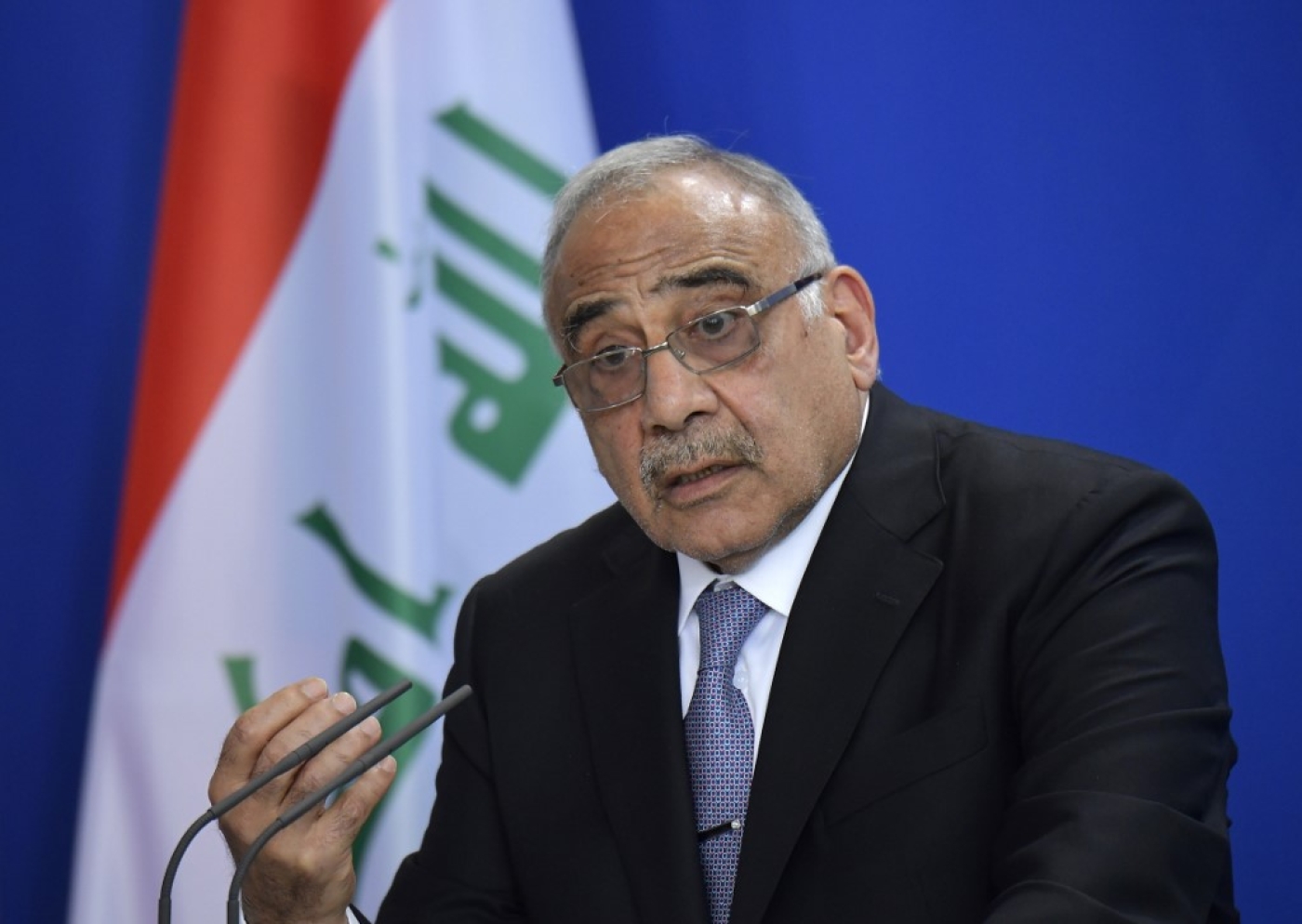
Parliament is to convene an emergency session on Sunday to discuss the crisis (AFP)

Iraqi Prime Minister Adel Abdul Mahdi said on Friday that he would
present his resignation to parliament so lawmakers could choose a new
government, according to a statement from his office.
Abdul Mahdi's decision came in response to a call for a change of
leadership by the country's top Shia cleric Grand Ayatollah Ali
al-Sistani, the statement said.
"I will submit to the esteemed parliament a formal letter requesting my resignation from the premiership," Abdul Mahdi said.
The announcement was met with cheers from protesters in Baghdad's iconic Tahrir Square.
The statement did not say when he would resign. Parliament is to convene an emergency session on Sunday to discuss the crisis.

The prime minister's decision came as the death toll in Iraq from weeks
of anti-government unrest rose on Friday to more than 400 people, mostly
unarmed protesters, a Reuters count based on police and medical sources
showed.
Scores of people have been shot dead by security forces across Iraq
since protesters torched the Iranian consulate in the southern city of
Najaf late on Wednesday in the latest escalation in the violence.
The deaths bring the total nationwide to 408 since 1 October, according
to Reuters. More than 15,000 people have also been wounded according to
the AFP news agency.
Sistani call
Earlier on Friday, Sistani had urged parliament to drop its support for the current cabinet following the unrest.
"The parliament, from which this current government is drawn, is asked
to reconsider its choice in this regard and act according to Iraq's
interest... [to] preserve the blood of its children," Sistani said in a
weekly sermon delivered by his representative in the holy city of
Karbala.
Sistani said attacks on peaceful protesters were "forbidden" but also urged demonstrators to reject violence.
Protesters "must not allow peaceful demonstrations to be turned into attacks on property or people", he said.
Iraq's "enemies and their apparatuses are trying to sow chaos and
infighting to return the country to the age of dictatorship... everyone
must work together to thwart that opportunity", Sistani said, without
elaborating.
Clashes between protesters and security forces broke out early on Friday
in Nasiriyah, killing three protesters and wounding several people,
hospital sources told Reuters.
Unemployed youths
The protests, which began in Baghdad on 1 October and have spread
throughout southern cities, are the most complex challenge facing the
Shia-dominated ruling class that has controlled state institutions and
patronage networks since the 2003 US-led invasion that toppled longtime
Sunni ruler Saddam Hussein.

Protesters are mostly unemployed youths who are demanding the departure of Iraq's entire political elite.
Security forces have used live ammunition, tear gas and stun grenades against mostly unarmed protesters.
Some demonstrators have lobbed petrol bombs, bricks and fired slingshots at police.
In a statement on Thursday evening, the influential Shia cleric Muqtada
al-Sadr called on the government to resign immediately or it would mean
"the beginning of the end of Iraq", warning that the country could turn
into Syria if the problems were not addressed.
Malta's PM expected to quit in crisis over journalist's murder
Joseph Muscat faced increasing pressure over handling of Daphne Caruana Galizia case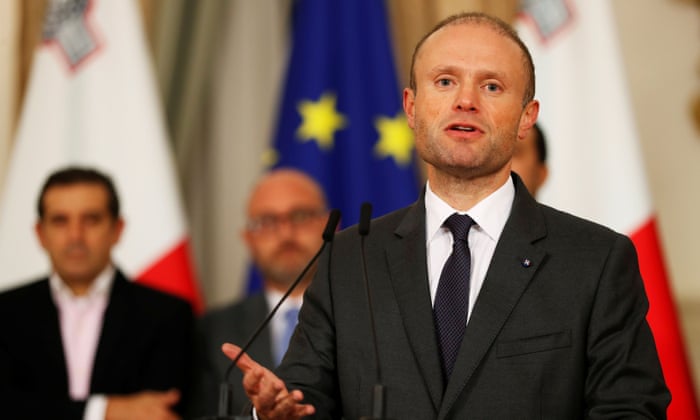 Joseph Muscat at a press conference in Valletta in the early hours of Friday morning. Photograph: Yara Nardi/Reuters
Juliette Garside in Valletta@JulietteGarside-
 Malta’s
prime minister, Joseph Muscat, has told associates he plans to resign
imminently after the political and legal crisis stemming from the murder
of journalist Daphne Caruana Galizia engulfed his government this week.
Malta’s
prime minister, Joseph Muscat, has told associates he plans to resign
imminently after the political and legal crisis stemming from the murder
of journalist Daphne Caruana Galizia engulfed his government this week.His decision follows the arrest and questioning of one of Muscat’s key allies by police investigating the 2017 murder of the prominent investigative journalist, who had exposed corruption at the highest levels of government and business circles in Malta.
After two years of stalled investigations into the murder, the authorities in the Mediterranean country have moved rapidly in recent days, with a series of arrests that have destabilised Muscat’s government. Earlier on Friday, following an unscheduled cabinet meeting that ran through the night, Muscat had vowed to stay in the job until the investigation was complete.
However, details of a split within his cabinet soon emerged. It is now understood he plans to make a televised address to announce his departure. The exact timing is to be decided, with local media saying the prime minister was waiting for news of whether the police charge a businessman suspected of ordering Caruana Galizia’s assassination.
The deputy prime minister, Chris Fearne, is understood to be ready to take on the role of acting prime minister until a new leader is selected in January.
This week, two ministers and Muscat’s chief of staff stepped down from their posts. The chief of staff, Keith Schembri, was arrested on Tuesday and released late on Thursday without being charged. He denies any wrongdoing.
Early on Friday, Muscat’s cabinet turned down a request for pardon by the main suspect, the businessman Yorgen Fenech, in return for information about alleged conspirators. Fenech was detained while trying to leave Malta on his yacht last week.
Caruana Galizia, Malta’s best-known investigative journalist, was killed on 16 October 2017 when a bomb placed under the driver’s seat of her rental car was remotely detonated.
In February 2016 she had used a leak of offshore information known as the Panama Papers to reveal that Muscat’s energy minister, Konrad Mizzi, and his friend Schembri had become the beneficiaries of secretive Panama shell companies shortly after entering office.
The EU’s smallest member state has come under unprecedented international scrutiny, with politicians across Europe raising concerns about the rule of law.
Sven Giegold, a German Green MEP, who took part in a European parliament mission to Malta on the case, said on Friday: “Joseph Muscat’s resignation was long overdue. But his resignation must not be a substitute for a comprehensive investigation into the murder of Daphne Caruana Galizia. Financial crime and corruption on the island must end. Those responsible must be identified and convicted. We owe this not least to Daphne and her family.”
During a hearing for Fenech on Thursday, his lawyers deposited in court a letter to Malta’s president, George Vella, formally asking for a pardon. It stated that Fenech was ready to supply information related to, among others, Schembri, Mizzi and Chris Cardona, who suspended himself from the post of economy minister earlier this week. The letter described all those he was prepared to give evidence against as being “close to the prime minister”.
Cardona declared upon resigning that he had “absolutely no connection with the case”, but had decided to step back “in the national interest” after being questioned by police last weekend. Mizzi, who resigned on Tuesday, said he had not committed any crime but was leaving “in light of political, extraordinary and general circumstances in the country”. Schembri’s lawyer did not respond to a request for comment.
Adding pressure on Muscat was a rebuke from the Council of Europe’s commissioner for human rights. In a letter to Muscat that was released on Friday, Dunja Mijatović said she was “seriously concerned” by allegations of political interference in the investigation. She urged the government “to ensure that the investigation is fully independent in order to bring long overdue justice to her family and Maltese society as a whole”.
Earlier on Friday, Jean-Claude Juncker, the outgoing European commission president, declined to comment on the unfolding scandal, saying he didn’t have the details. At a press conference on his last day in office, Juncker said he was “highly concerned” about the rule of law across the EU: “As far as the rule of law is concerned I am worried [that] in more than one country the rule of law is not respected entirely.”
Mikhail Gorbachev’s Pizza Hut Thanksgiving Miracle

In 1997, the former Soviet leader needed money, and Pizza Hut needed a spokesman. Greatness ensued.

It’s dangerous for leaders to outlive their countries. Whether they move
on or become obsessed with returning to power, they cannot escape their
role as symbols of a vanished world—a condition fraught with both
nostalgia and danger.
Nobody knows that burden like Mikhail Gorbachev, the final leader of the Soviet Union. Since his involuntary retirement, Gorbachev has raised money for worthy causes, attempted to make a comeback in Russian politics, and, notoriously, made an advertisement for Pizza Hut.
[youtube https://www.youtube.com/watch?v=fgm14D1jHUw?feature=oembed]
The ad would have become a footnote were it not for its long second life online, where it’s rediscovered every few years. There’s an undeniable voyeuristic frisson of seeing a man who once commanded a superpower hawking pizza.
Each time it repeats, it leaves behind a new flood of clickbait—Time listing it among the “Top 10 Embarrassing Celebrity Commercials” in 2010, Mental Floss using Gorbachev’s birthday as a hook to link to it in 2012, Thrillist naming it the sixth-most bizarre celebrity endorsement of all time. Most of the facts dredged up in these deluges are recycled from a 1997 New York Times article.
More serious authors treat the commercial as a free-floating signifier to prove whatever thesis they are peddling, as when Jacobin cites it as another data point showing that Gorbachev was a sellout or David Foster Wallace uses it to prove the vacuity of popular culture.
But the conventional stories don’t really hold up. Gorbachev isn’t actually the star of the commercial. He doesn’t even speak. He’s a bystander to the commercial’s central drama, a fight over Gorbachev’s legacy between a fiery, pro-reform young man and a dour, anti-Gorbachev middle-aged man—possibly father and son. The two exchange charges and defenses of Gorbachev’s record—“Because of him, we have economic confusion!” “Because of him, we have opportunity!” “Complete chaos!”
“Hope!”—before an older woman settles the argument: “Because of him, we have many things … like Pizza Hut!”
In a lot of ways, it’s a beautiful short film and a very weird advertisement: Who would have thought that a bunch of Muscovites bickering about the end of communism would be a natural pitch for pizza?
For the people who created the ad—the executives, the agents, the creatives—it was a professional landmark. But for Gorbachev himself, the story of the ad is a tragedy: one man’s attempt to find—and to fund—a place in a country that wanted nothing more to do with him.

Yeltsin’s final victory would come in the 1996 election. That year, Gorbachev challenged Yeltsin by launching his own bid for the presidency—scraping just 0.5 percent of the first-round vote. After that victory, Yeltsin left the foundation alone. Yet the years of presidential harassment had taken its toll on Gorbachev’s finances. In 1991, the heads of the former Soviet republics had voted to give Gorbachev a pension of 4,000 rubles per month—but it was not indexed to inflation. By 1994, according to Meduza, his pension was worth less than $2 a month.
Gorbachev had suffered the same fate as many Soviet retirees, who had looked forward to generous pensions only to find themselves forced to hustle and scrape to get by as the Russian economy collapsed around them—shrinking by 30 percent between 1991 and 1998. The foundation, too, was tottering, with even Gorbachev’s significant lecture fees unable to sustain both his family and the foundation and its staff, let alone any projects he might want to pursue to leave a legacy. Even generous donations from Ted Turner only went so far.
Gorbachev was determined to stay in Russia and fight for reform, not to take up a life of well-compensated exile abroad. To do that, he would need money to fund his center, his staff, and his activities—urgently. As Gorbachev later told France 24 when asked about the ad, “I needed to finish the building. The workers started to leave—I needed to pay them.”
To keep his vision going—and to stay relevant in a world moving beyond him—he would need a lot of money. More, even, than he could make by giving lectures. More than anyone in Russia could, or wanted to, give him.

That connection helped provide the hook that Pizza Hut’s advertising creatives needed. For the advertising firm BBDO, Pizza Hut was a big client in a challenging category. Conveniently for BBDO, that translated into big-budget commercials. Pizza Hut ordered dozens of ads a year from BBDO, with a mixture of ordinary TV spots touting weekly specials and major campaigns featuring spokespeople like Dennis Rodman and Donald Trump.
Keeping such a big client happy was a priority for the firm. By 1997, Pizza Hut’s international arm was looking for new spokespeople. As a global brand, then-Pizza Hut advertising executive Scott Helbing recalled in an interview, the company “needed an idea that truly traveled across continents” for “a truly global campaign that would play in any country in the world.”
Former BBDO art director Ted Shaine, who helped create the ad with Tom Darbyshire, a young copywriter at the time, recalled that BBDO “heard that [Gorbachev] was willing to do something.” Others suggest that somebody at BBDO came up with the idea and sought Gorbachev out.
However it happened, the core idea of the ad remained stable throughout the monthslong process of negotiating and filming it. It would not focus on Gorbachev but on an ordinary Russian family eating at Pizza Hut. It would be shot on location, featuring as many visuals that screamed “Russia” as possible.

The concept obviously exploited the shock value of having a former world leader appear. But the ad played on the fact that Gorbachev was far more popular outside Russia than inside it. As late as October 1991, a Wall Street Journal/NBC News poll showed that 54 percent of Americans wanted to see Gorbachev as the head of the Soviet Union, compared with only 18 percent for Yeltsin. And warm feelings toward Gorbachev persisted in the West long after the Soviet Union dissolved. “In contrast to his unpopular standing at home,” the political scientist Andrew Cooper writes in Diplomatic Afterlives, “Gorbachev retained superstar standing abroad as a visionary statesman.” At home, Gorbachev was a pariah. Abroad, he was an elder statesman and celebrity, far more beloved than the buffoonish Yeltsin.
Actually brokering the deal took months. Katie O’Neill Bistrian, now chief marketing officer of the collaborative workspace firm Work Well Win, took on the role of representing Gorbachev. Then in her mid-20s and a firebrand executive at the sports and talent management company IMG who routinely brokered deals for stars like Derek Jeter, she viewed the Gorbachev deal as something that she could execute.
There was a hitch: IMG didn’t actually represent Gorbachev. Nobody did. O’Neill Bistrian’s first challenge, then, was to work through contacts, particularly IMG head Mark McCormack, to connect to people in Gorbachev’s circle to broker the deal.
The negotiations took months. Partly, this represented a negotiating tactic: The longer the negotiations drew out, the higher Gorbachev’s talent fee would be. But it also represented real hesitation on Gorbachev’s part.
Taubman argues that Gorbachev’s loss of station and purpose hit his wife, Raisa Gorbachev, hard, not least because it meant that the betrayals of 1991 were compounded by public criticism and even charges of treason. Raisa likely feared that the Pizza Hut ad could only further harm his reputation. On the other hand, only international sources could provide the funds that Gorbachev needed. (The exact amount that Gorbachev would receive for the commercial is secret, but it may have been one of the largest talent fees in history—an amount that would be easily in the seven figures today, adjusted for inflation.)
While Gorbachev’s circle prolonged the negotiations, O’Neill Bistrian told BBDO that another figure was available: Muhammad Ali. IMG had just begun to represent the once-polarizing figure, who, by the 1990s, had transformed into a beloved national icon. Pizza Hut and BBDO leapt at the chance. (Concluding both the Gorbachev and Ali deals would get O’Neill Bistrian her own endorsement deal, for Samsung monitors—the only trace of O’Neill Bistrian’s involvement in the deal until now.)
Gorbachev finally assented—with conditions. First, he would have final approval over the script. That was acceptable. Second, he would not eat pizza on film. That disappointed Pizza Hut. “We always wanted the hero of the ad to eat the pizza,” Helbing said.
O’Neill Bistrian suggested a compromise: A family member would appear in the spot instead. Gorbachev’s granddaughter Anastasia Virganskaya ended up eating the slice. Pizza Hut accepted.

(Incidentally, Red Square seems to have been chosen more for cinematic needs than for veracity. The commercial shows a Pizza Hut storefront on Red Square itself, but that’s fake—the Russian signage behind several Pizza Hut logos establishes that the door Gorbachev and Virganskaya are filmed entering is actually a jewelry store.)
The team encountered challenges. “The weather was horrible,” Shaine recalled: low light, bitterly cold, and not even enough snow to make Red Square look as Americans felt it should—until a couple of inches fell on the day of the shoot itself. Worse, it wasn’t clear that the commercial would even happen. After months of reluctance to agree to the shoot, Gorbachev arrived late, the first of a few occasions when the BBDO team thought the agreement might collapse. (When the former leader arrived at Red Square, Shaine greeted Gorbachev by saying, “Well, this is a big production we’re involved in.” “I know,” Gorbachev replied through his interpreter. “I’ve been to many big productions in this place.”)
Filming the interior scenes took the better part of a day in a different location, inside a real Moscow Pizza Hut. (Even though the bulk of the commercial is just a conversation around a table, multiple sources stressed that filming such a scene—with its complicated sightlines—is enormously challenging.) Coincidentally, it also happened to be Thanksgiving Day in the United States. Since the commercial was being shot at a working Pizza Hut, the cast and crew—including Gorbachev—ate pizza, which was “one of the most interesting Thanksgiving dinners I’ve ever had,” said Shaine, who was seated with Gorbachev.
In b-roll shot during the production, Helbing interviewed Gorbachev on camera. Gorbachev justified his decision to do the commercial on two grounds. First, the former leader argued, “pizza is for everyone.” It was nicely communal: “It’s not only consumption. It’s also socializing.”
But the more important reason, Gorbachev confessed, was that he needed the money.

Yuval Weber, the Bren chair of Russian military and political strategy at Marine Corps University’s Krulak Center, uses the commercial as a primary document in his classes in Russian history to illustrate the stresses of the transition from communism. Weber argues that Darbyshire and Shaine succeeded maybe even better than they knew at depicting Russian life at that moment. “You have the fundamental note of hope from the American side, that basically pizza or Western culture can solve the really intractable problems of Russian politics,” Weber said. “You have the Russians depicting a legitimate family—a stylized family dispute on something important. The actors themselves are portraying very real stereotypes about contemporary Moscow.”
“The disagreement about the big issues totally would have been plausible describing the Moscow intelligentsia that those actors are portraying in the commercial itself,” Weber said. “My guess, based on the clothes that the actors chose or that the costume designers chose, is that grandmother is clearly a philologist, some sort of drama teacher, literature teacher, foreign-language teacher. Dad? He’s an engineer of some type. The son is a businessman. And they represent the ’50s generation, the ’70s generation, and the ’90s generation. That would have been beyond an American audience, but … I’ve always thought the actors brought [those choices].”
You can also read the ad as a metatextual comment on itself. As Helbing
observed: “If you see the spot and hear what they’re kind of saying
about what he’s brought, that was truly what those actors were
discussing. We would never have been sitting in that Pizza Hut with
Gorbachev eating a pizza if it hadn’t been for what he had done.”
With filming concluded, the Americans flew back to the States. The footage went to Clayton Hemmert, an editor and co-founder of the firm Crew Cuts, who had the task of assembling a narrative from the raw footage. “When you get down to it,” Hemmert said, “you have hundreds of thousands, millions, of frames of film that could be juxtaposed in any order and put any sound behind it, so your options are tremendous.” His smooth cutting of music and dialogue gave the ad its chaotic, argumentative energy.
Hemmert played a key role in shaping the ending. “If you listen to that sound ‘Hail to Gorbachev,’ it sounds like the entire nation of Russia is chanting ‘Hail to Gorbachev,’” Hemmert said. The commercial closes with the cheers resounding throughout Red Square and then all of Moscow in progressively wider shots with celebratory music underneath. “It has this impression, you might say the illusion, that the entire nation feels this is a wonderful thing that happened.”
Of course, it is an illusion—in this case, taking the actor’s dialogue, adding reverb, and layering the chants over each other. But it’s also one that suited both the marketing needs of Pizza Hut and the myth-making needs of Gorbachev. Pizza Hut gets to be not only the avatar of global capitalism but also the restaurant that brings people together. In the commercial’s fiction, at least, Gorbachev gets the hero’s reception that Raisa always thought he deserved.

Weber reflected on what that might have meant for the fictional family in the commercial. “They would have been the ones crushed. The son, he’s exactly the sort of guy who would have been overleveraged. Dad isn’t in great shape. Grandmother hangs on but in worse shape because grandson probably can’t support her as much,” he said. Whatever optimism made the pro-Gorbachev slant of the ad even dimly plausible as a representative sampling of Muscovite opinion vanished. News reports suggest that the Pizza Hut location in which the commercial was filmed itself closed during the crash.
And that means that this fictional family, like most Russians, probably spent the early 2000s supporting the increasingly hard-line Vladimir Putin, seeing him as “the only person who can take them back to stability and potential for growth,” Weber said. Out with pizza, in with the vertical of power.

For Russians, the debate about his legacy that the ad foregrounded has been conclusively resolved. In a 2018 poll by the respected Levada Center (another byproduct of Gorbachev’s reforms), 66 percent of Russians responded that they regretted the collapse of the Soviet Union. So, of course, does Gorbachev. His ambition was to perfect the country, not to end it.
Yet Russians seem to blame him for the catastrophe. A 2017 Levada poll found that only 1 percent of Russians expressed admiration for Gorbachev, 30 percent professed to dislike him, and 13 percent said their overall attitude was one of disgust or hatred. (Yeltsin, who died in 2007, received almost identical ratings.) As a leader, Russians rank Gorbachev well below Joseph Stalin.
No Russian crowd, in other words, is going to chant “Hail to Gorbachev!” anytime soon.
Nobody knows that burden like Mikhail Gorbachev, the final leader of the Soviet Union. Since his involuntary retirement, Gorbachev has raised money for worthy causes, attempted to make a comeback in Russian politics, and, notoriously, made an advertisement for Pizza Hut.
[youtube https://www.youtube.com/watch?v=fgm14D1jHUw?feature=oembed]
The ad would have become a footnote were it not for its long second life online, where it’s rediscovered every few years. There’s an undeniable voyeuristic frisson of seeing a man who once commanded a superpower hawking pizza.
Each time it repeats, it leaves behind a new flood of clickbait—Time listing it among the “Top 10 Embarrassing Celebrity Commercials” in 2010, Mental Floss using Gorbachev’s birthday as a hook to link to it in 2012, Thrillist naming it the sixth-most bizarre celebrity endorsement of all time. Most of the facts dredged up in these deluges are recycled from a 1997 New York Times article.
More serious authors treat the commercial as a free-floating signifier to prove whatever thesis they are peddling, as when Jacobin cites it as another data point showing that Gorbachev was a sellout or David Foster Wallace uses it to prove the vacuity of popular culture.
But the conventional stories don’t really hold up. Gorbachev isn’t actually the star of the commercial. He doesn’t even speak. He’s a bystander to the commercial’s central drama, a fight over Gorbachev’s legacy between a fiery, pro-reform young man and a dour, anti-Gorbachev middle-aged man—possibly father and son. The two exchange charges and defenses of Gorbachev’s record—“Because of him, we have economic confusion!” “Because of him, we have opportunity!” “Complete chaos!”
“Hope!”—before an older woman settles the argument: “Because of him, we have many things … like Pizza Hut!”
In a lot of ways, it’s a beautiful short film and a very weird advertisement: Who would have thought that a bunch of Muscovites bickering about the end of communism would be a natural pitch for pizza?
For the people who created the ad—the executives, the agents, the creatives—it was a professional landmark. But for Gorbachev himself, the story of the ad is a tragedy: one man’s attempt to find—and to fund—a place in a country that wanted nothing more to do with him.
For the world, the death of the Soviet Union was a geopolitical
earthquake. For Gorbachev, it was a forced retirement at the hands of
his rival—and successor as Russian leader—Boris Yeltsin. According to
the biographer William Taubman in Gorbachev: His Life and Times,
Gorbachev reciprocated Yeltsin’s hatred, telling one journalist: “When
they hang me, make sure that they don’t hang Yeltsin from the same birch
tree.”
Initially, Yeltsin and Gorbachev avoided direct conflict. But within
months of the Russian Federation’s establishment, Gorbachev began
criticizing Yeltsin publicly. In retaliation, the Russian president
ordered an audit into whether Gorbachev’s foundation was illegally using
Communist Party funds. Then the Kremlin systematically removed the
foundation’s sources of support, ginned up protests to harass the
foundation, and finally cut its office space to a few thousand square
feet.Yeltsin’s final victory would come in the 1996 election. That year, Gorbachev challenged Yeltsin by launching his own bid for the presidency—scraping just 0.5 percent of the first-round vote. After that victory, Yeltsin left the foundation alone. Yet the years of presidential harassment had taken its toll on Gorbachev’s finances. In 1991, the heads of the former Soviet republics had voted to give Gorbachev a pension of 4,000 rubles per month—but it was not indexed to inflation. By 1994, according to Meduza, his pension was worth less than $2 a month.
Gorbachev had suffered the same fate as many Soviet retirees, who had looked forward to generous pensions only to find themselves forced to hustle and scrape to get by as the Russian economy collapsed around them—shrinking by 30 percent between 1991 and 1998. The foundation, too, was tottering, with even Gorbachev’s significant lecture fees unable to sustain both his family and the foundation and its staff, let alone any projects he might want to pursue to leave a legacy. Even generous donations from Ted Turner only went so far.
Gorbachev was determined to stay in Russia and fight for reform, not to take up a life of well-compensated exile abroad. To do that, he would need money to fund his center, his staff, and his activities—urgently. As Gorbachev later told France 24 when asked about the ad, “I needed to finish the building. The workers started to leave—I needed to pay them.”
To keep his vision going—and to stay relevant in a world moving beyond him—he would need a lot of money. More, even, than he could make by giving lectures. More than anyone in Russia could, or wanted to, give him.
As the Soviet Union shrank, Pizza Hut expanded.
The American firm had broken into the Soviet Union just before it died,
thanks in part to Gorbachev’s policies of openness. That’s one reason
why the commercial could exist in the first place: It was filmed on
location in a Moscow Pizza Hut near Red Square, which had opened in 1990
as part of a Soviet-era deal with
the chain’s then-parent company, PepsiCo. That arrangement, which had
been hailed as the “deal of the century,” flopped when the Soviet Union
collapsed, killing both the Russian economy and the restaurant’s supply
chain. (Overnight, Lithuanian mozzarella became an expensive import from a foreign country.)That connection helped provide the hook that Pizza Hut’s advertising creatives needed. For the advertising firm BBDO, Pizza Hut was a big client in a challenging category. Conveniently for BBDO, that translated into big-budget commercials. Pizza Hut ordered dozens of ads a year from BBDO, with a mixture of ordinary TV spots touting weekly specials and major campaigns featuring spokespeople like Dennis Rodman and Donald Trump.
Keeping such a big client happy was a priority for the firm. By 1997, Pizza Hut’s international arm was looking for new spokespeople. As a global brand, then-Pizza Hut advertising executive Scott Helbing recalled in an interview, the company “needed an idea that truly traveled across continents” for “a truly global campaign that would play in any country in the world.”
Former BBDO art director Ted Shaine, who helped create the ad with Tom Darbyshire, a young copywriter at the time, recalled that BBDO “heard that [Gorbachev] was willing to do something.” Others suggest that somebody at BBDO came up with the idea and sought Gorbachev out.
However it happened, the core idea of the ad remained stable throughout the monthslong process of negotiating and filming it. It would not focus on Gorbachev but on an ordinary Russian family eating at Pizza Hut. It would be shot on location, featuring as many visuals that screamed “Russia” as possible.
The concept obviously exploited the shock value of having a former world leader appear. But the ad played on the fact that Gorbachev was far more popular outside Russia than inside it. As late as October 1991, a Wall Street Journal/NBC News poll showed that 54 percent of Americans wanted to see Gorbachev as the head of the Soviet Union, compared with only 18 percent for Yeltsin. And warm feelings toward Gorbachev persisted in the West long after the Soviet Union dissolved. “In contrast to his unpopular standing at home,” the political scientist Andrew Cooper writes in Diplomatic Afterlives, “Gorbachev retained superstar standing abroad as a visionary statesman.” At home, Gorbachev was a pariah. Abroad, he was an elder statesman and celebrity, far more beloved than the buffoonish Yeltsin.
Actually brokering the deal took months. Katie O’Neill Bistrian, now chief marketing officer of the collaborative workspace firm Work Well Win, took on the role of representing Gorbachev. Then in her mid-20s and a firebrand executive at the sports and talent management company IMG who routinely brokered deals for stars like Derek Jeter, she viewed the Gorbachev deal as something that she could execute.
There was a hitch: IMG didn’t actually represent Gorbachev. Nobody did. O’Neill Bistrian’s first challenge, then, was to work through contacts, particularly IMG head Mark McCormack, to connect to people in Gorbachev’s circle to broker the deal.
The negotiations took months. Partly, this represented a negotiating tactic: The longer the negotiations drew out, the higher Gorbachev’s talent fee would be. But it also represented real hesitation on Gorbachev’s part.
Taubman argues that Gorbachev’s loss of station and purpose hit his wife, Raisa Gorbachev, hard, not least because it meant that the betrayals of 1991 were compounded by public criticism and even charges of treason. Raisa likely feared that the Pizza Hut ad could only further harm his reputation. On the other hand, only international sources could provide the funds that Gorbachev needed. (The exact amount that Gorbachev would receive for the commercial is secret, but it may have been one of the largest talent fees in history—an amount that would be easily in the seven figures today, adjusted for inflation.)
While Gorbachev’s circle prolonged the negotiations, O’Neill Bistrian told BBDO that another figure was available: Muhammad Ali. IMG had just begun to represent the once-polarizing figure, who, by the 1990s, had transformed into a beloved national icon. Pizza Hut and BBDO leapt at the chance. (Concluding both the Gorbachev and Ali deals would get O’Neill Bistrian her own endorsement deal, for Samsung monitors—the only trace of O’Neill Bistrian’s involvement in the deal until now.)
Gorbachev finally assented—with conditions. First, he would have final approval over the script. That was acceptable. Second, he would not eat pizza on film. That disappointed Pizza Hut. “We always wanted the hero of the ad to eat the pizza,” Helbing said.
“We always wanted the hero of the ad to eat the pizza,” Helbing said.Gorbachev held firm. “‘As the ex-leader, I just would not,’” Helbing recalled Gorbachev saying.
O’Neill Bistrian suggested a compromise: A family member would appear in the spot instead. Gorbachev’s granddaughter Anastasia Virganskaya ended up eating the slice. Pizza Hut accepted.
At last, filming could begin. Helbing, Shaine, Darbyshire, O’Neill Bistrian, the director Peter Smillie,
and several others flew to Moscow in November 1997. Preproduction
(casting, costuming, and location scouting) took several days before
principal photography, which took place over two days—one for the
exterior shots and one for the interior scenes.
BBDO Chairman Philip Dusenberry insisted that the agency’s
advertisements be cinematic in their quality. The Gorbachev production
lived up to that standard. Informed estimates put the commercial’s
budget in the low millions of dollars. Darbyshire, who wrote the script
in English, went through three translators to get the right level of
idiomatic Russian. To capture the beautiful establishing shots of Red
Square and its domed churches, the crew hefted the film cameras high
atop the Kremlin itself. And somehow the production managed to get the
whole square shut down for the entire shoot.(Incidentally, Red Square seems to have been chosen more for cinematic needs than for veracity. The commercial shows a Pizza Hut storefront on Red Square itself, but that’s fake—the Russian signage behind several Pizza Hut logos establishes that the door Gorbachev and Virganskaya are filmed entering is actually a jewelry store.)
The team encountered challenges. “The weather was horrible,” Shaine recalled: low light, bitterly cold, and not even enough snow to make Red Square look as Americans felt it should—until a couple of inches fell on the day of the shoot itself. Worse, it wasn’t clear that the commercial would even happen. After months of reluctance to agree to the shoot, Gorbachev arrived late, the first of a few occasions when the BBDO team thought the agreement might collapse. (When the former leader arrived at Red Square, Shaine greeted Gorbachev by saying, “Well, this is a big production we’re involved in.” “I know,” Gorbachev replied through his interpreter. “I’ve been to many big productions in this place.”)
Filming the interior scenes took the better part of a day in a different location, inside a real Moscow Pizza Hut. (Even though the bulk of the commercial is just a conversation around a table, multiple sources stressed that filming such a scene—with its complicated sightlines—is enormously challenging.) Coincidentally, it also happened to be Thanksgiving Day in the United States. Since the commercial was being shot at a working Pizza Hut, the cast and crew—including Gorbachev—ate pizza, which was “one of the most interesting Thanksgiving dinners I’ve ever had,” said Shaine, who was seated with Gorbachev.
In b-roll shot during the production, Helbing interviewed Gorbachev on camera. Gorbachev justified his decision to do the commercial on two grounds. First, the former leader argued, “pizza is for everyone.” It was nicely communal: “It’s not only consumption. It’s also socializing.”
But the more important reason, Gorbachev confessed, was that he needed the money.
The Gorbachev commercial wasn’t just a piece of advertising ephemera. It
was also a multimillion-dollar short film—and the creators were as
concerned with artistic standards as selling pizza. Besides the expense
and effort of the shoot and the postproduction (an original score
recorded live!), the dialogue is entirely in Russian with English
subtitles—even though Americans hate subtitles.
The aim of these choices was to show Pizza Hut as a global brand with,
as Helbing calls it, a “gravitas” that Little Caesars or Domino’s
couldn’t match. To do that, Darbyshire and Shaine tried to capture a
story that would reflect Russian reality—not just American stereotypes.Yuval Weber, the Bren chair of Russian military and political strategy at Marine Corps University’s Krulak Center, uses the commercial as a primary document in his classes in Russian history to illustrate the stresses of the transition from communism. Weber argues that Darbyshire and Shaine succeeded maybe even better than they knew at depicting Russian life at that moment. “You have the fundamental note of hope from the American side, that basically pizza or Western culture can solve the really intractable problems of Russian politics,” Weber said. “You have the Russians depicting a legitimate family—a stylized family dispute on something important. The actors themselves are portraying very real stereotypes about contemporary Moscow.”
“The disagreement about the big issues totally would have been plausible describing the Moscow intelligentsia that those actors are portraying in the commercial itself,” Weber said. “My guess, based on the clothes that the actors chose or that the costume designers chose, is that grandmother is clearly a philologist, some sort of drama teacher, literature teacher, foreign-language teacher. Dad? He’s an engineer of some type. The son is a businessman. And they represent the ’50s generation, the ’70s generation, and the ’90s generation. That would have been beyond an American audience, but … I’ve always thought the actors brought [those choices].”
With filming concluded, the Americans flew back to the States. The footage went to Clayton Hemmert, an editor and co-founder of the firm Crew Cuts, who had the task of assembling a narrative from the raw footage. “When you get down to it,” Hemmert said, “you have hundreds of thousands, millions, of frames of film that could be juxtaposed in any order and put any sound behind it, so your options are tremendous.” His smooth cutting of music and dialogue gave the ad its chaotic, argumentative energy.
Hemmert played a key role in shaping the ending. “If you listen to that sound ‘Hail to Gorbachev,’ it sounds like the entire nation of Russia is chanting ‘Hail to Gorbachev,’” Hemmert said. The commercial closes with the cheers resounding throughout Red Square and then all of Moscow in progressively wider shots with celebratory music underneath. “It has this impression, you might say the illusion, that the entire nation feels this is a wonderful thing that happened.”
Of course, it is an illusion—in this case, taking the actor’s dialogue, adding reverb, and layering the chants over each other. But it’s also one that suited both the marketing needs of Pizza Hut and the myth-making needs of Gorbachev. Pizza Hut gets to be not only the avatar of global capitalism but also the restaurant that brings people together. In the commercial’s fiction, at least, Gorbachev gets the hero’s reception that Raisa always thought he deserved.
Yet the commercial itself is more open-ended than it might appear on first viewing. “At the very end, when everyone is saying ‘Za Gorbacheva,’ it resounds throughout Moscow and all the landmarks. But the last shot was an old lady, a babushka,
dressed in black who basically looks into a great distance. And in a
sense, it’s played for laughs. But that’s also her looking off into the
future, which is still unclear,” Weber said.
The future turned out to be much dimmer than the ad anticipated. A
little less than a year after the ad was filmed, in August 1998, the
Russian financial system collapsed. The economic recovery that had begun
to take hold was wiped out. As the Moscow Times wrote, “The whole Russian economy fell to pieces at a stroke.”Weber reflected on what that might have meant for the fictional family in the commercial. “They would have been the ones crushed. The son, he’s exactly the sort of guy who would have been overleveraged. Dad isn’t in great shape. Grandmother hangs on but in worse shape because grandson probably can’t support her as much,” he said. Whatever optimism made the pro-Gorbachev slant of the ad even dimly plausible as a representative sampling of Muscovite opinion vanished. News reports suggest that the Pizza Hut location in which the commercial was filmed itself closed during the crash.
And that means that this fictional family, like most Russians, probably spent the early 2000s supporting the increasingly hard-line Vladimir Putin, seeing him as “the only person who can take them back to stability and potential for growth,” Weber said. Out with pizza, in with the vertical of power.
Everyone with whom I spoke about making the commercial remembers it
fondly. They got to meet a world leader; they succeeded in drawing
attention to the brand; and the commercial received a unexpected second
life online, keeping their work alive in a profession where most product
is disposable.
For Gorbachev, however, the ad’s legacy seems less bright—mostly because he never found the path he’d meant for it to fund. The commercial funded his foundation and loyal retainers for a while. Yet a year later, he told the Guardian that he had lost his own savings in the 1998 crash.The commercial funded his foundation and loyal retainers for a while. Yet a year later, he told the Guardian that he had lost his own savings in the 1998 crash.Raisa died of cancer in 1999. And despite Gorbachev’s ambitions that his post-presidency could push his country toward greater openness, Russia has slipped ever further along a much less free path than he once envisioned.This year, Putin commemorated two decades in power. A tightening of laws on foreign support for nonprofits inside Russia squeezed the Gorbachev Foundation; many of his family members have reportedly moved to Germany. In a book released last month, Gorbachev even weakly offered praise for his successor on the grounds that Putin “inherited chaos” and that his moves could be justified if “the aim of authority is to create conditions for developing a strong modern democracy.”
For Russians, the debate about his legacy that the ad foregrounded has been conclusively resolved. In a 2018 poll by the respected Levada Center (another byproduct of Gorbachev’s reforms), 66 percent of Russians responded that they regretted the collapse of the Soviet Union. So, of course, does Gorbachev. His ambition was to perfect the country, not to end it.
Yet Russians seem to blame him for the catastrophe. A 2017 Levada poll found that only 1 percent of Russians expressed admiration for Gorbachev, 30 percent professed to dislike him, and 13 percent said their overall attitude was one of disgust or hatred. (Yeltsin, who died in 2007, received almost identical ratings.) As a leader, Russians rank Gorbachev well below Joseph Stalin.
No Russian crowd, in other words, is going to chant “Hail to Gorbachev!” anytime soon.
Subscribe to:
Posts (Atom)