Peace for the World World ! Your War Our Lives

The Dalai Lama
A Brief Colonial History Of Ceylon(SriLanka)
Sri Lanka: One Island Two Nations
A Brief Colonial History Of Ceylon(SriLanka)
Sri Lanka: One Island Two Nations
(Full Story)
Back to 500BC.

Friday, January 31, 2020
“The coverage of violence against women fluctuates between silence and sensationalism”


 Anne-Marie Impe is
the author of the handbook and her professional career is at the
crossroads of journalism and lifelong education, writing and action. She
started in Dakar, Senegal, where she was responsible for creating
communication tools and campaigns for citizen participation and
community development. She is the former editor-in-chief of the magazine
Enjeux internationaux and she is currently a guest professor of
journalism at the Graduate Institute of Social Communications (IHECS). Impe‘s
areas of expertise are the elderly, social justice and human rights,
Africa, and especially, how to cover violence against women. For this,
we asked her some questions about the handbook and how to improve the
journalistic work when reporting about gender violence.
Anne-Marie Impe is
the author of the handbook and her professional career is at the
crossroads of journalism and lifelong education, writing and action. She
started in Dakar, Senegal, where she was responsible for creating
communication tools and campaigns for citizen participation and
community development. She is the former editor-in-chief of the magazine
Enjeux internationaux and she is currently a guest professor of
journalism at the Graduate Institute of Social Communications (IHECS). Impe‘s
areas of expertise are the elderly, social justice and human rights,
Africa, and especially, how to cover violence against women. For this,
we asked her some questions about the handbook and how to improve the
journalistic work when reporting about gender violence.Which is the main purpose of the handbook?
This manual has three main objectives: firstly, to provide the keys required to understand the various forms of violence against women, like genital mutilations, the so-called «honour» killings, intimate partner violence or murders. These forms of violence are described in 10 information sheets which propose definitions of the different terms, statistics and explanations. Secondly, the manual aims at triggering a permanent reflection on journalism and the best way to inform on violence against women: which words and which images should we use, how to interview a woman who has suffered violence… Lastly, it suggests a number of advice and examples of good practices drawn from experienced reporters and codes of conduct used by different media around the world.
What, in your opinion, is the main problem journalists face when reporting about gender violence?
The coverage of violence against women fluctuates between silence and sensationalism too often. Even if the situation has evolved since the launch of the #MeToo movement, in most societies a heavy silence still surrounds the issue. However, although many journalists do an excellent work, when the media tackle the subject, sensationalism and hype are persistent, as was recently the case with the coverage of the violence committed by Daesh against Yezidi women, for instance, or with the use of rape as a weapon of war in the Eastern region of the Democratic Republic of the Congo.
What is the most common mistake?
One of the major mistakes consists in only speaking of the aggressor while ignoring the victim, or in using an inadequate vocabulary which trivializes the act. For instance one should not use the expression «a seduction attempt» when it is a blatant sexual aggression. Similarly, one should avoid the expression «she confesses/admits to having been raped» (which suggests that she would have some responsibility) and one should replace it by «she was raped» or «she declares/reports that she was raped». Avoid euphemisms such as «marital dispute», which minimise reality. Instead, use the term «homicide», or the expression «intimate partner violence», depending on the situation. The manual proposes a reflection on the vocabulary as well as numerous concrete examples.
What would be the main recommendation?
The first recommendation would be to bring these violences out of the shadow and remind everyone that these are not private intrafamily disputes nor isolated incidents. They are recurring and systemic acts which affect society as a whole and involve us all. They emanate from historically unequal relations of power between men and women, which have established relations of domination and discrimination, as it was already underlined in the 1993 UN Declaration on the elimination of violence against women. One should, therefore, draw the coverage of these violences out of the miscellaneous news or «news in brief» columns where they are too often confined and approach them as societal phenomenons which deserve to be reported on the frontpage or in prime time in order to highlight their structural character.

'Karoo firewalkers': Dinosaurs braved South Africa's land of lava
An undated image of Afrodelatorrichnus ellenbergeri, a set of hand-feet
impressions of a quadrupedal dinosaur, are seen preserved in a sandstone
layer in South Africa alongside an interpretive outline of the tracks,
in a combination of photos released January 29, 2020. Bordy et al. 2020
PLoS One/Handout via REUTERS
 Will Dunham-JANUARY 29, 2020
WASHINGTON (Reuters) - About 183 million years ago during the early part of the Jurassic Period, enormous amounts of lava flowed across the landscape in what is now South Africa, transforming the environment into a land of fire.
But fossil footprints described by scientists on Wednesday showed that intrepid dinosaurs and other animals managed to inhabit this region - now the semiarid Karoo region of South Africa - during quieter periods between the volcanic eruptions.
These “Karoo firewalkers,” as University of Cape Town geologist Emese Bordy called them, were some of the last animals known to have lived in this inhospitable region before it ultimately was engulfed by molten rock.
The researchers found a sandstone layer on a farm in the center of South Africa with five fossils trackways that were left by at least three different animals that walked across the moist sandy banks of a stream. One was a relatively small two-legged meat-eating dinosaur, another was a similarly small four-legged apparently plant-eating dinosaur and the third may have been a primitive mammal.
“For short time periods, the streams were flowing again, the sun was shining, the plants were growing and the animals, among them dinosaurs, were grazing and hunting,” said Bordy, who led the research published in the journal PLOS ONE. “This is attested by the vertebrate footprints of both meat- and plant-eating dinosaurs, plant remains, sediment deposits of streams and lakes, to name just a few.”
“The properties of the sandstone allow us to tell that the tracks were deposited in seasonal streams that run during flash flood events,” added Bordy, whose team also included postgraduate students Akhil Rampersadh, Miengah Abrahams and Howard Head. “Hot was hot back then, too. So no, they did not walk on the lava.”
During this time, there were major extinctions of species, especially in the oceans, caused mostly by gases emitted from immense lava flows that poured onto the land surface in South Africa. Even as it incinerated the landscape, the lava flows changed the chemistry of the atmosphere and seas.
Fossil footprints, in the absence of skeletal fossils, sometimes offer the only evidence that animals were present in an ancient environment. The sandstone containing the tracks was sandwiched in between layers of volcanic rock, revealing a picture of a functioning ecosystem that survived despite threats of devastation from further eruptions.
“This story helps us change the way we see life in stressful and hostile environments, and thus improves our understanding of the history of life on Earth,” Bordy said.
Saudi making 10,000 Saudis homeless
Locals are being uprooted to make way for regional development by a real estate company
 January 30, 2020
The residents of Sharaya Al-Nakhel reiterated their appeal to the Emir
of Mecca and his deputy to save them from the possible removal of the
houses they have inhabited for decades. Some of them have extracted
deeds and arguments for persistence, and some of them undertook the
procedures related to this matter including the announcement through
newspapers, while no one objected.
The residents continued their demands through a hashtag that was
trending in Saudi Arabia during the past hours (removal of Sharaya
Al-Nakhel in Mecca), and they said that they have legal deeds on their
sites, and about 10,000 people live in them. They added: “We have real
estate loans on them, and they include deeds dating back to 1298 Hijri,
in addition to the presence of a centre of the Emirate for eighty years,
a health centre, a complex of boys and girls schools and complete
services.”
Muhammad Al-Maliki said: Things have reached the granting of ownership
of more than 4 million meters for a company over the entire Sharaya
Al-Nakhel neighbourhood in Mecca, and for the displacement of the
village’s 10,000 residents.
Obaid Al-Huthali clarified that the residents of Sharaya Al-Nakhel have
been there for more than 100 years, and their mud houses are still proof
and are still standing to date. More than 10,000 people live in this
neighbourhood today, and the High Sharia Sciences Primary School was
established in 1369 Hijri, which is considered one of the oldest schools
in the Kingdom of Saudi Arabia.
The Mayor of the Holy Capital, Eng. Muhammad Al-Quwaihes, revealed that
the houses owned by citizens under legal deeds in Sharaya
Al-Nakhelneighbourhood will not be removed.
This comes following a dispute over ownership between a company and the residents of the Sharaya Al-Nakhel neighbourhood.
Al-Quwaihes stressed that all those who have legal deeds and the
company’s deed will be referred to the Ministry of Justice for legal
consideration, and the legal verdict will be implemented.
He pointed out that what is currently taking place is a committee formed
by an order of the emirate from a number of official bodies to define
the boundaries of the company’s deed and to set indicators, as part of
solving the problem of the overlapping deeds.
“The Municipality hopes that all citizens will cooperate with the
committee to solve the problem in a regular way and within the
directives of His Highness, Advisor to the Custodian of the Two Holy
Mosques, Governor of Mecca Region. In addition, electricity will not be
cut off from houses whose owners have legal deeds.
Doctors feel 'hopeless' after air strikes hit hospital in rebel-held Idlib
Russia's defence ministry denied that its forces had struck a hospital and bakery in Ariha Civil defence workers desperately try to quell flames caused by a suspected Russian air strike (MEE/Ali Haj Suleiman)
Mohamad Karkas -Areeb Ullah -Harun al-Aswad-30 January 2020
 Medical
workers describe a "hopeless" scene in the town of Ariha after
suspected Russian air strikes hit a civilian area in northwest Syria as
President Bashar al-Assad's forces ramp up a months-long ground campaign
to take complete control of rebel-held Idlib, the last major opposition
bastion in the country.
Medical
workers describe a "hopeless" scene in the town of Ariha after
suspected Russian air strikes hit a civilian area in northwest Syria as
President Bashar al-Assad's forces ramp up a months-long ground campaign
to take complete control of rebel-held Idlib, the last major opposition
bastion in the country.The suspected Russian air strikes killed at least 10 civilians and wounded 70 others near a bakery and medical clinic in Ariha, a town in Idlib province, according to medical workers and civil defence officials.
Images posted online showed the hospital completely destroyed and burning from the strikes which struck the medical facilities on Wednesday night.
The UK-based Syrian Observatory for Human Rights said Russian warplanes carried out the attack but Russia's defence ministry denied responsibility.
"Russia's aviation did not carry out any combat tasks in this area of Syria," it said in a statement.
Walid Aslan, the local director of the civil defence unit in Ariha, said the air strikes began at 10:30pm on Wednesday and lasted for fifteen minutes.
"A Russian warplane fired three high explosive vacuum guided missiles, targeting Al-Shami hospital, and destroyed seven residential buildings in the vicinity of the medical facility," Aslan told Middle East Eye.
"We had to pull children out of the rubble and work quickly before the area was struck again."
Aslan said that rescue workers managed to find one woman alive amidst the rubble. Other rescue workers were frantically trying to put out the flames caused by the air strike on the residential areas.
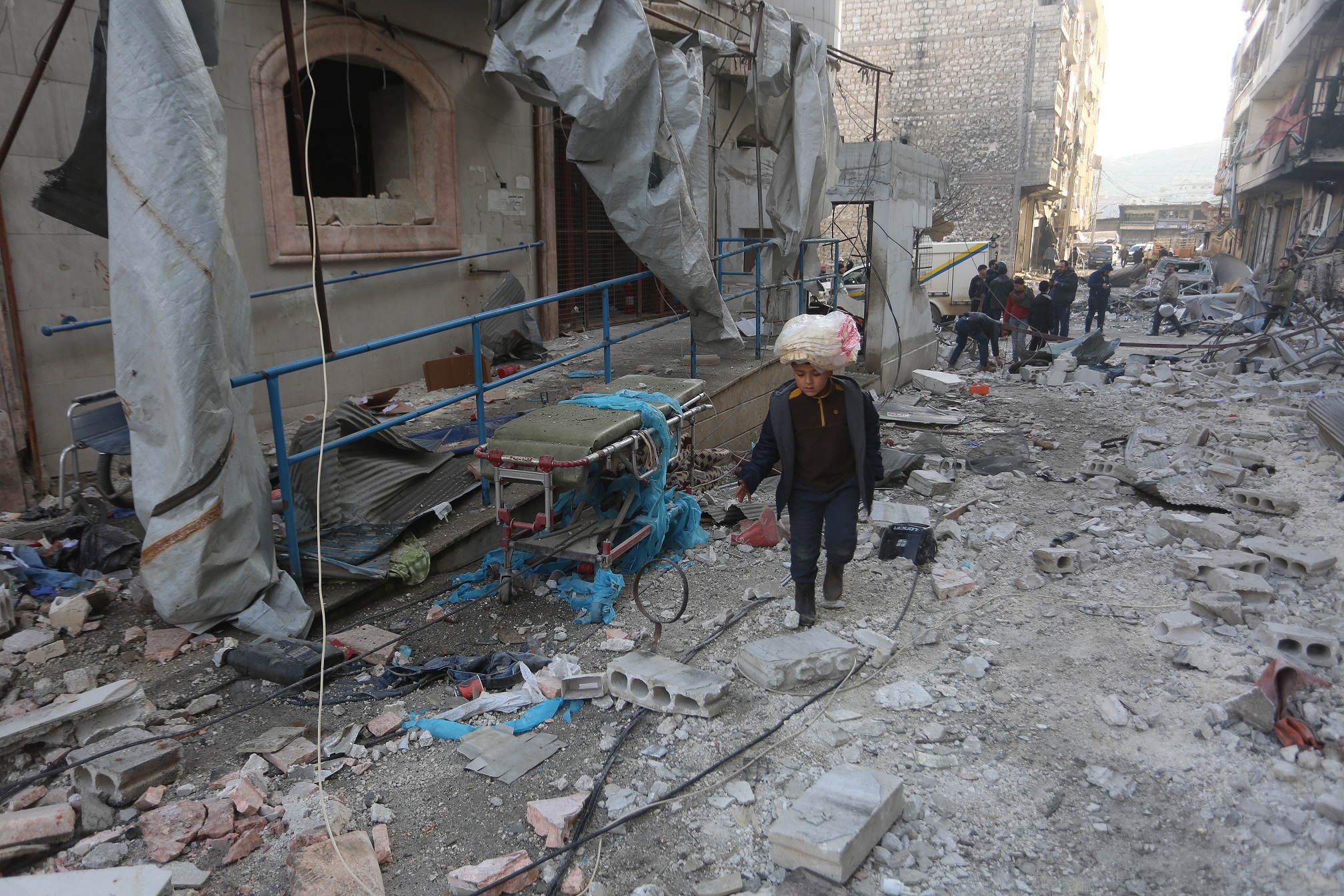
Doctor Zuhair al-Qirat, a senior official at Al-Shami hospital, said the facility served the whole population in the Ariha district and contained several departments.
He told MEE that the coordinates for the hospital had been shared with the United Nations which were then given to Russia to prevent it from being targeted by air strikes.
"I was in the emergency room when the first air strike took place. My colleagues and I suffered minor injuries from the first air strike," Qirat told MEE.
"We tried to hide in the residential buildings close to the hospital when the first air strike hit. My colleague Dr Zakwan Tamaa was still inside when the second air strike hit the hospital and suffered serious injuries."
Qirat said they found charred bodies in the rubble.
Doctor Tayseer, a surgeon at the hospital, said there were many women and children among the casualties. He also witnessed Tamaa getting wounded by the strike.
"The first attack was near the hospital and shattered the windows and doors. Some walls crumbled to the ground. Civilians around the hospital started screaming for help and some people went out to help them," said Tayseer, using only his first name.
"Dr Tamaa, who administers anaesthesia, was struck in the head, stomach and chest in the second air strike. We don't think he is doing well and it feels very hopeless at the moment."
Ground offensive
Government forces have ramped up their offensive in areas near Maarat al-Numan after it took control of the strategic rebel-held town in the Idlib province.Aziz Mohammed, an activist from Mardikh, near Maaret al-Numan, said there has not been any major ground development in the area on Thursday.
"Government forces are still stationed at the town of Maar Dabsa, nine kilometres south of Saraqeb, but the bombardment has not let up," Mohammed told MEE.
The state-run news agency SANA said intense clashes took place in Maar Dabsa and Khan al-Subul as government forces chased rebel fighters who have fled Maaret al-Numan.
The news agency said the army continued advancing on the Saraqeb and Maaret al-Numan axis.
“The government’s artillery has been targeting the main road leading to Saraqeb,” said Obeida al-Fadel, who runs Idlib Media Centre.
Saraqeb is located east of Idlib and is the third-largest city adjacent to the strategic M5 highway, a major artery that runs between government-held cities and sought by the government.
“Civilians are put in a difficult position. They don’t know where and how to flee and save themselves from the attacks,” he told MEE.
Saraqeb has been almost empty of civilians, but Fadel said the remaining families, 60 in total, were evacuated by the civil defence, or White Helmets, on Thursday.
Despite several ceasefire agreements between Russia and rebel backer Turkey, government forces have steadily taken areas in the south of the opposition enclave.
Tens of thousands of civilians have fled the areas targeted by the government’s advance into the region in recent weeks towards the Turkish border further north.
Turkish President Recep Tayyip Erdogan accused Moscow on Wednesday of "not honouring these agreements" and said Ankara is losing patience with the military assault in Idlib.
Government forces have retaken around 27 towns and villages from their rivals in southern Idlib since 24 January, according to AFP.
More than 388,000 civilians have been displaced in the northwest since December, the United Nations said.
- Additional reporting by Nadda Osman in London.
Pakistan backs Palestinian state with pre-1967 borders, Jerusalem as capital

Pakistan wants "independent state of Palestine on the basis of internationally-agreed parameters," says FO. — Reuters/File

Pakistan on Wednesday backed Palestine's demand for making Jerusalem as the capital of its independent state on the basis of pre-1967 borders, a statement released by the Foreign Office said.
The announcement comes a day after US President Donald Trump presented his Middle East plan as a solution to one of the world's longest-running conflicts.
The plan unveiled by Trump would allow the Palestinians to establish a capital on the outskirts of east Jerusalem but would leave most of the city under Israeli control. It also envisages a Palestinian state in parts of the West Bank, but would allow Israel to annex its settlements in the occupied territory.
The Foreign Office, in its statement today, said Pakistan has "seen the peace plan that the United States has presented for the Middle East".
However, the FO clarified that while Pakistan "has consistently supported a two-state solution, as enshrined in the relevant Security Council and General Assembly Resolutions", it wants the "establishment of a viable, independent and contiguous State of Palestine, on the basis of internationally-agreed parameters, the pre-1967 borders, and with Al-Quds Al-Sharif [Jerusalem] as its capital".
UN resolutions on the issue term all Israeli settlements in the West Bank illegal and call for a solution based on borders before the 1967 Arab-Israeli war, with agreed land swaps.
"Pakistan continues to support a just and lasting solution of the Palestinian issue, through dialogue and negotiations," the statement said.
It added that Pakistan wants a solution that "leads to the realisation of the legitimate rights of the Palestinians, including the right of self-determination."
According to Associated Press, the plan sides with Israel on key contentious issues that have bedeviled past peace efforts, including borders, and attaches nearly impossible conditions for granting the Palestinians their hoped-for state.
The plan prompted a lukewarm response from Europe and the UN, and a furious rebuke from key Muslim countries who denounced it as a betrayal of the Palestinians.
Palestinian president Mahmud Abbas — who had taken part in previous US-led peace talks with Israel but stayed away from Trump's proposal — vowed that "this conspiracy deal will not pass".
He pledged to "resist the deal in all its forms" after meeting with various Palestinian factions in the West Bank city of Ramallah.
"Our people will take it to the dustbin of history," he said.
Netanyahu, on the other hand, called it a historic breakthrough equal in significance to the country's declaration of independence in 1948. "It's a great plan for Israel. It's a great plan for peace," he said.
Turkish President Recep Tayyip Erdogan also lambasted Trump's plan as “absolutely unacceptable”, AFP said.
“Jerusalem is sacred for Muslims. The plan to give Jerusalem to Israel is absolutely unacceptable. This plan ignores Palestinians' rights and is aimed at legitimising Israel's occupation,” Erdogan was quoted by AFP as saying.
With input from Associated Press and AFP
Pakistan arrests Pashtun rights leader critical of military
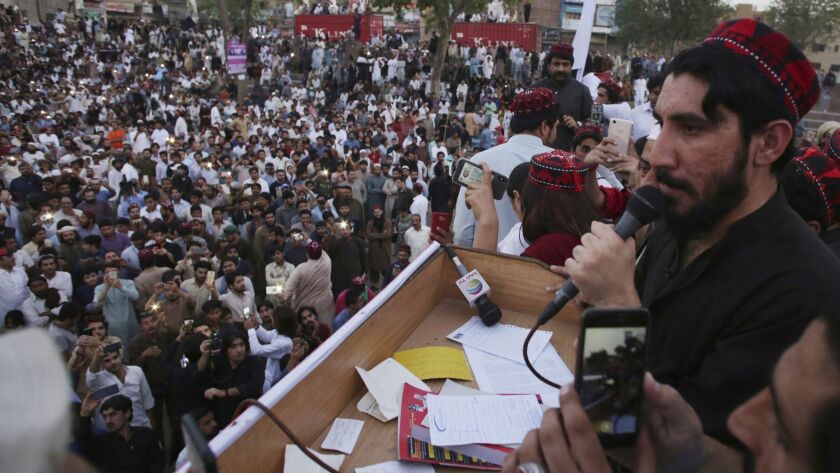 Manzoor
Ahmad Pashteen, a leader of the Pashtun Protection Movement, addresses
supporters at a rally in Lahore, Pakistan, in April 2018.(K.M. Chaudary /
Associated Press)
Manzoor
Ahmad Pashteen, a leader of the Pashtun Protection Movement, addresses
supporters at a rally in Lahore, Pakistan, in April 2018.(K.M. Chaudary /
Associated Press) ZULFIQAR ALI-JAN. 27, 2020
PESHAWAR, Pakistan — Pakistani
authorities on Monday arrested a young and charismatic rights activist
from the Pashtun community, the nation’s largest minority group, who has
been a thorn in the government’s side because of his repeated critiques
of brutality, censorship and extrajudicial killings.
The activist, Manzoor Ahmad Pashteen, leads the Pashtun Protection Movement, widely known as PTM. For the last two years, the movement has leveled fierce criticisms against the country’s powerful police and military.
Pashteen was arrested in the northern provincial capital of Peshawar on charges of sedition and hate speech against the army. A magistrate authorized his detention, in Peshawar Central Prison, for 14 days on a judicial remand. Four of Pashteen’s supporters were also detained.
The alleged offense is that Pashteen declared in a televised program on Jan. 21 that he did not accept the Pakistani Constitution because it denied fundamental rights to minorities. Authorities also accused him of fomenting ethnic divisions in Pakistan and using derogatory language against the state.
Human rights advocates immediately criticized the arrest, saying the government was misusing laws banning sedition, conspiracy, hate speech and intimidation to stifle legitimate dissent.
“Using criminal laws to chill free expression and political opposition has no place in a democracy,” said Brad Adams, Asia director at Human Rights Watch. “The Pakistan government should find ways of resolving political disagreements with dialogue rather than intimidation. Peaceful dissent is the essence of democracy and should not be treated as sedition.”
The PTM represents Pashtuns in the often-dangerous region previously known as the Federally Administered Tribal Areas, which borders Afghanistan.
The tribal areas were governed by early 20th century regulations — dating to the era of British imperial rule — that allowed collective punishment for communities, including property destruction and denial of access to courts. In recent years, the region has come under attacks by the Taliban, government military offensives and U.S. drone strikes. In May 2018, Pakistan’s parliament passed a constitutional amendment merging the tribal areas with the province of Khyber Pakhtunkhwa — of which Peshawar is the capital — and extending constitutional protections to the former tribal areas.
Asserting the constitutional rights of Pashtun people, the movement has
organized protests against the government to demand accountability for
extrajudicial killings, enforced disappearances and casualties from land
mines. The authorities have cracked down on Pashteen’s followers,
using arbitrary arrests and intimidation as instruments of coercion.
The PTM has also called for police and military officers who have abused human rights to be held accountable, possibly through a truth and reconciliation process.
Addressing reporters, Pashteen protested his innocence.
“We are struggling for our constitutional rights and that is not acceptable to certain quarters,” he said. “We have trust in the court, provided no one interferes in its functioning.”
Mohsin Dawar, a senior leader of PTM and member of parliament, said: “This is our punishment for demanding our rights in a peaceful and democratic manner. Manzoor’s arrest will only strengthen our resolve. We demand the immediate release of Manzoor Pashteen.”
At a news conference in Islamabad, Pakistan’s capital, Dawar called Pashteen’s arrest an “abduction.”
Amnesty International also called for Pashteen’s “immediate and unconditional” release.
The group said on Twitter: “Manzoor Pashteen has been arbitrarily detained for exercising his human rights to freedom of expression and peaceful assembly. He must be released immediately and unconditionally.”
The activist, Manzoor Ahmad Pashteen, leads the Pashtun Protection Movement, widely known as PTM. For the last two years, the movement has leveled fierce criticisms against the country’s powerful police and military.
Pashteen was arrested in the northern provincial capital of Peshawar on charges of sedition and hate speech against the army. A magistrate authorized his detention, in Peshawar Central Prison, for 14 days on a judicial remand. Four of Pashteen’s supporters were also detained.
The alleged offense is that Pashteen declared in a televised program on Jan. 21 that he did not accept the Pakistani Constitution because it denied fundamental rights to minorities. Authorities also accused him of fomenting ethnic divisions in Pakistan and using derogatory language against the state.
Human rights advocates immediately criticized the arrest, saying the government was misusing laws banning sedition, conspiracy, hate speech and intimidation to stifle legitimate dissent.
“Using criminal laws to chill free expression and political opposition has no place in a democracy,” said Brad Adams, Asia director at Human Rights Watch. “The Pakistan government should find ways of resolving political disagreements with dialogue rather than intimidation. Peaceful dissent is the essence of democracy and should not be treated as sedition.”
The PTM represents Pashtuns in the often-dangerous region previously known as the Federally Administered Tribal Areas, which borders Afghanistan.
The tribal areas were governed by early 20th century regulations — dating to the era of British imperial rule — that allowed collective punishment for communities, including property destruction and denial of access to courts. In recent years, the region has come under attacks by the Taliban, government military offensives and U.S. drone strikes. In May 2018, Pakistan’s parliament passed a constitutional amendment merging the tribal areas with the province of Khyber Pakhtunkhwa — of which Peshawar is the capital — and extending constitutional protections to the former tribal areas.
The PTM has also called for police and military officers who have abused human rights to be held accountable, possibly through a truth and reconciliation process.
Addressing reporters, Pashteen protested his innocence.
“We are struggling for our constitutional rights and that is not acceptable to certain quarters,” he said. “We have trust in the court, provided no one interferes in its functioning.”
Mohsin Dawar, a senior leader of PTM and member of parliament, said: “This is our punishment for demanding our rights in a peaceful and democratic manner. Manzoor’s arrest will only strengthen our resolve. We demand the immediate release of Manzoor Pashteen.”
At a news conference in Islamabad, Pakistan’s capital, Dawar called Pashteen’s arrest an “abduction.”
Amnesty International also called for Pashteen’s “immediate and unconditional” release.
The group said on Twitter: “Manzoor Pashteen has been arbitrarily detained for exercising his human rights to freedom of expression and peaceful assembly. He must be released immediately and unconditionally.”
India: Mixed Bag Of Achievements

The Modi Government must be complimented for taking hefty decisions on the defence front. Yet, the truth is that its focus has been on symbolism and politicising the military
 by Ashok K Mehta-2020-01-30
The format of the Republic Day parade is still evolving in finding the
right balance between displaying military prowess, cultural heritage,
technological growth and socio-economic developments. When it was first
held in 1950 at the National Stadium, it was entirely a military parade,
affirming, indeed asserting, civilian political control over the
erstwhile colonial armed forces, two of whose service chiefs were still
British. The parade was the acme of military traditions, customs and
ethos, synthesising the services into an apolitical, professional and
secular fighting machine.
Even today, when soldiers get into the battlefield, there is no uniform
war cry. In different fighting units, it is as varied as Allah hu Akbar
to Jai Mata Di to Aayo Gorkhali. This richness in diversity of military
ethos was and is still embodied in the code of conduct contained in the
credo set for officers passing out of the Indian Military Academy, which
was established in 1932 by Field Marshal Philip Chetwode. It was about
dedication to country first, devotion to soldiers under command next and
personal safety remaining last, always and every time. This gold
standard has been seamlessly blended with the eternal values of the
Indian Constitution that are currently under test on account of a
variety of national issues. Most of them affect the heart and soul of
the military where customs and traditions are sacrosanct.
Seemingly odd customs have a place, too. Like 13 hobnails on the sole of
“ammunition boots.” In the photographs that appeared of Captain Tania
Shergill leading the all-male Corps of Signals contingent, one can count
the number of nails on her boots. These show on dead soldiers in
trenches in celebrated World War films like 1917 and Dunkirk. In World
War I, India lost 74,000 soldiers but names of just 13,516 of them are
etched on the walls of India Gate. Around 80,000 lives were sacrificed
in World War II, which have gone completely anonymous. This is a serious
omission and needs to be rectified by constructing a monument in the
name of the unknown soldier if names of the dead are not traceable.
Prime Minister Narendra Modi was instrumental in hastening the
construction of the National War Memorial (NWM) behind India Gate, which
bears the names of 25,942 martyrs since independence. Last year, the
Army alone suffered 80 fatal casualties in Jammu & Kashmir, the
North-east and the United Nations Peacekeeping Operations, according to a
Press report released on Army Day, January 15.
Last Sunday’s parade was blessed with good weather and recorded many
firsts. Instead of the Amar Jawan Jyoti at India Gate, martyrs — sadly
only post-independence ones — were remembered by Prime Minister Modi at
the NWM; the new Chief of Defence Staff (CDS), Gen Bipin Rawat, joined
the other three service Chiefs and Defence Secretary as official hosts
of the parade. The Air Defence Regiment made its marching debut, so did
several US hi-tech fixed-wing aircraft and helicopters in the flypast,
marking a significant shift from an inventory wholly Soviet/Russian to
one significantly diversified.
The indigenous anti-satellite weapon and gravity-defying stunts by women
bikers of the Central Reserve Police Force (CRPF) took a bow. Absent
perhaps for the first time was a Gorkha-marching contingent though the
Kumaon Regiment in Gorkha hats made up for it. But not quite.
Altogether, 16 marching contingents and 22 tableaux comprised the
parade. The tableau from Jammu & Kashmir was a brazen attempt to
portray it as a normal State after the abrogation of Article 370 and its
demotion from a full-fledged State to a Union Territory. Both matters
are now in the Supreme Court.
As in the past, the climax of the parade was the flypast by the Indian
Air Force (IAF). Most aircraft on the ORBAT joined the show, which
started with the newly-arrived American CH-47F Chinook heavy-lift
helicopter and the AH-64E Apache attack helicopter. These were followed
by Made in India Dorniers, C-130J Super Hercules special operations
aircraft and the game-changing strategic airlift C-17 Globemaster III.
The Russian aircraft in the flypast included Sukhoi 30 MKI, MiG 29 and
Mi17 medium-lift helicopters.
Making its debut in the flypast was the indigenously-developed Netra
airborne early warning and control system on a Brazilian Embraer
aircraft flanked by two Sukhoi MKIs, which should have pleased the chief
guest, Brazilian President Jair Bolsonaro. British-made upgraded
Jaguars flew in formation as did the MiG 29 fighters. As always,
aerobatics were left to a single Sukhoi 30 MKI, which appeared low and
then disappeared into a vertical shoot into cumulo-nimbus, distressing
palpitating hearts.
The Republic Day parade did not end with the flypast but as has become
the norm, with Prime Minister Modi’s roadshow, walking down the Rajpath,
accompanied by six Tata-made Range Rovers and 25 dark-suited security
personnel carrying the briefcase with nuclear security codes. Defence
Minister Rajnath Singh, anxious to leave, was seen gesticulating towards
the Modi cavalcade, virtually enquiring if the marchpast was over.
The Modi Government has delivered on One Rank, One Pension (OROP),
accelerated the construction of NWM, conducted surgical ground and
airstrikes and appointed a CDS. These are all pretty hefty achievements.
Speaking at a media conclave last week, Information and Broadcasting
Minister Prakash Javadekar listed the achievements of the Modi
Government: Triple talaq, Article 370, Ram mandir, Citizenship Amendment
Act (CAA), National Population Register (NPR) and National Register of
Citizens (NRC)… The maximum applause he attracted was from his reference
to the Balakot airstrikes. Yet, as the fiscal budget for 2020-21 will
show on Saturday, the investment made by the Government towards defence
modernisation is to borrow a famous phrase by General Zia-ul Haq,
“peanuts”, barely sufficient for the payment of carryover liabilities.
The truth is that the focus of the Government is on symbolism and over
time, further politicising the military. Like yesterday, even at the
annual National Cadet Corps (NCC) parade at Cariappa Parade Ground in
New Delhi, Modi made an inappropriate election speech. It was,
therefore, heartening to see that the new Army Chief, Gen MM Naravane,
while briefing the media before the Army Day, talked of the Constitution
and its Preamble, which is being widely read out by the youth across
the country in reaction to CAA. The General hinted that the military is
not committed to the ideology of any political party in power. But the
very next week, during the Army Day parade, unsuspectingly he read out
chapter and verse of Government-stated virtues of nullifying Article
370, a matter sub-judice in the Supreme Court.
Later today, you will listen to the solemn hymn and melody, Abide With
Me, bringing down the flag at the Beating Retreat ceremony, signalling
the end of the annual January series of parades, reflecting pomp,
pageantry and pride. Momentarily banished, this immortal piece of music
will, after all, be played. People protested against its removal in
order to “Indianise” the ceremony because it was a Christian and
colonial melody without knowing its relevance to military tradition and
customs. More absurd changes were attempted in the past.
(The writer, a retired Major General, was Commander IPKF South,
Sri Lanka and founder member of the Defence Planning Staff, currently
the Integrated Defence Staff.)
The broken Brexit promises, half-truths and dodgy predictions from all sides

 By Georgina Lee-30 Jan 2020
The last four years have kept us busy at FactCheck HQ, sifting through the claims, promises and stats put out by politicians on the thorniest issue facing British politics today: Brexit.
With Britain finally set to leave the EU, here’s our round up of the biggest broken promises, u-turns, half-truths and dodgy predictions of the Brexit saga — from all sides.
We’ve set them out in roughly chronological order, with some exceptions for clarity.
Get ready to relive it all…
Before and after the 2016 referendum
‘We send the EU £350 million a week. Let’s fund our NHS instead’That was the infamous claim plastered across the Vote Leave bus. But as FactCheck and others reported at the time, it ignored the money we get back from the EU as a rebate. A more reliable contemporaneous figure would have been £234m a week.
Leading Leave campaigner Boris Johnson was rapped on the knuckles by the head of the UK Statistics Authority for the error.

But the director of the independent Institute for Fiscal Studies, Paul Johnson, pointed out that the government’s own analysis said Brexit would weaken public finances, and that the “divorce bill” and other commitments to replace EU funding already cancelled out the savings from the membership fees.
Boris Johnson on whether to Brexit at all
In 2001, Mr Johnson wrote that Britain’s interests are “still, on balance, served by maintaining our membership” of the EU.
But in 2016, the now-Prime Minister famously did not declare a position on Brexit until the referendum campaign was underway, and was still “deciding” as late as 6 February 2016, just four months before the vote. He reportedly wrote an unpublished column supporting remain, before plumping for Brexit later that month. FactCheck looked at his changing positions on Europe in more detail here.

In 2016, the then-Home Secretary said: “Remaining a member of the European Union means we will be more secure from crime and terrorism.”
Two years later, having set out to deliver the Brexit she’d campaigned against, Mrs May put forward a Brexit deal that she claimed “protects our security with a close relationship on defence and on tackling crime and terrorism, which will help to keep all our people safe.”
David Cameron on staying on
Two weeks ahead of the referendum, Mr Cameron was asked about his position in the event of a Leave win: “Will I carry on as Prime Minister? Yes.” He pledged to “construct a Government that includes all the talents of the Conservative Party”.
But just hours after the results revealed his side’s defeat, he stepped down, saying “I don’t think it would be right for me to try to be the captain that steers our country to its next destination.”

Before the ballot, Mr Cameron told Parliament: “If the British people vote to leave, there is only one way to bring that about, namely to trigger Article 50 of the treaties and begin the process of exit, and the British people would rightly expect that to start straight away.”
Indeed, his own Treasury’s analysis of what might happen in the event of our departure from the EU was based on the assumption that the process would begin immediately after the vote.
But he reneged on this promise after the referendum, leaving the job to his successor, Theresa May — who eventually began the formal process of leaving the EU some nine months later.
George Osborne on the ‘immediate’ recession
One of the leading Remain campaigners, then-Chancellor George Osborne, said before the referendum that “a vote to leave would represent an immediate and profound shock to our economy. That shock would push our economy into a recession.”
These were predictions about what would happen in the two years following the Brexit referendum. But we now know that there was no recession in that period.
Though it’s worth saying that the prediction was based on the assumption that we would trigger Article 50 immediately after the referendum, which did not happen. We don’t know if Mr Osborne’s prediction would have come true had we begun the process of leaving straight away.
Boris Johnson on Brexit and the Irish border
Asked what he thought would happen at the border if the UK voted to leave the EU, Mr Johnson — who was then Foreign Secretary — said during the referendum campaign: “I think the situation would be absolutely unchanged.”
He went on to talk about the “Common Travel Area”, which allows UK and Irish citizens to move freely between the two countries.
But as Mr Johnson now knows, there’s a lot more to the Irish border than the Common Travel Area. As both he and his predecessor Theresa May found, Brexit has huge implications for the customs arrangements between the UK and Ireland.
Remainer MPs who voted to trigger Article 50
Despite campaigning to Remain in the EU in 2016, many MPs voted to trigger Article 50 the following year.

John Major on a second referendum
In May 2016, just weeks before the Brexit vote, the former Prime Minister asserted: “There will not be another referendum on Europe. This is it.” He was campaigning for Remain.
But a few months later, in November, Sir John said the case for a second referendum was “perfectly credible”.

In 2012, David Davis said: “If a democracy cannot change its mind it ceases to be a democracy”, a claim that proponents of a second Brexit referendum have levelled against him in the years since.
But when he became Brexit Secretary, Mr Davis seemed to have done a 180-degree spin, declaring in 2017: “there will not be a second referendum”.
Jo Swinson on whether to hold the first Brexit referendum
In 2008, Ms Swinson, who was then a backbench MP, said: “The Liberal Democrats would like to have a referendum on the major issue of whether we are in or out of Europe.”
But in 2019, she declared: “I don’t forgive David Cameron for calling the referendum,” adding that the former Prime Minister’s “shocking misjudgement” had “put the interests of the Conservative Party ahead of the national interest.”
After the referendum
Vince Cable on a second referendumIn September 2016, a few months after the referendum, then-leader of the Lib Dems said: “We must accept the public have voted on the matter.” He said calls for a second referendum were “politically counter-productive” and “disrespectful” to voters.
But in 2018, Mr Cable seemed to change his mind: “Brexit is not inevitable — it can and it must be stopped,” he said, adding that a second referendum was “the only democratic way out of the maze”.
Jeremy Corbyn on a second referendum
After the vote in 2016, Mr Corbyn was adamant: “We’ve had a referendum, a decision has been made… we must abide by the decision.”
But his party’s 2019 manifesto committed to negotiate a new deal with Brussels and put it to the public in a second referendum with the option to remain in the EU.

“We will be leaving the European Union on 29 March. I believe we shall be leaving on 29 March with a good deal.”
The former PM committed to leave the EU on 29 March 2019 on no fewer than 133 occasions, according to Parliamentary records. Not only was she forced to delay the UK’s departure, she also failed to get her deal through.
By the time she left office in July 2019, Brexit had still not happened.
Boris Johnson talking Turkey
In January 2019, Mr Johnson claimed he “didn’t say anything about Turkey in the referendum… I didn’t say a thing about Turkey”, referring to the 2016 campaign.
In fact he, and the Vote Leave campaign he was part of, made several references to the country and migration from it in the run-up to the Brexit vote, as FactCheck reported.
Dominic Raab on warning of no-deal Brexit
The Foreign Secretary said in July 2019 that he and his fellow Leave campaigners had “made clear” that there was a chance that no deal would be struck between the UK and the EU. He claimed: “There’s all sorts of interviews [from the 2016 referendum campaign] which said that of course we’d prefer a deal, but that there would be a risk”.
But a FactCheck investigation of Vote Leave and Mr Raab’s personal websites, various BBC webpages, online newspaper archives, YouTube, radio and elsewhere found no evidence that he had warned of no-deal Brexit before the 2016 referendum.
The BBC found one example of a radio interview where Mr Raab was pressed on the possibility of trading with the EU on WTO terms, but he said he thought the outcome was unlikely.
Nigel Farage on delaying Brexit
Speaking ahead of the Conservative leadership election in May 2019, Mr Farage said: “Let’s make sure the country is ready on the 31st October to leave the European Union on whatever terms.”

So it seems Mr Farage’s commitment leaving “on whatever terms” did not include Boris Johnson’s Brexit deal.
Boris Johnson on when Brexit will happen
Mr Johnson’s pitch as prospective Conservative leader was that he would guarantee the UK’s departure from the EU by 31 October 2019.
In September 2019, just a few weeks after taking office, he declared he’d “rather be dead in a ditch” than ask the EU for an extension to Article 50.
But in October, he did just that, under the terms of the so-called “Benn Act”, pushing Brexit day back to January 2020.
Defenders of Mr Johnson blame the delay on Parliament, though others have suggested that perhaps he shouldn’t have made the promise in the first place, given the likelihood of MPs blocking it.
This ‘deal of the century’ for the Middle East will be just another bleak milestone
By backing Israeli annexation and denying Palestinians their rights, Donald Trump is only perpetuating the conflict Palestinians in Rafah protest against US Middle East peace plan. Photograph: APA Images/News Pictures/Rex/Shutterstock
@ian_black-
Donald Trump’s long-awaited “deal of the century”, unveiled with boastful fanfare on Tuesday in the presence of a beaming Benjamin Netanyahu, is not by any stretch of the imagination a plan that will allow Israelis and Palestinians to work out how they can live together in peace, equality and dignity.
It is unlikely to lead to any kind of negotiations, because the Palestinians were already understandably furious at a series of unilateral US moves that undermined decades of international consensus about how to resolve the world’s most intractable conflict – involving the status of Jerusalem, the legality of Israeli settlements and the ever-emotive question of Palestinian refugees. It ignores countless UN resolutions, the Oslo accords of 1993, the Arab peace initiative of 2002 and the fundamental idea that Palestinians, like Israelis, have the inalienable right to self-determination.
True, Trump’s team did use the term Palestinian “state” rather than define the end goal more honestly as “limited autonomy”. But their insistence on Palestinian submission to Israeli demands, and the truncated nature of the demilitarised territory such a “state” would hypothetically control (lacking a say over its own borders, airspace and territorial waters), along with the disarming of Hamas in the Gaza Strip, all combine to make the s-word meaningless.
The US has now granted its approval to Israeli annexation of the Jordan valley, which makes up 30% of the West Bank. It has given the green light for the application of Israeli sovereignty to the settlements built illegally since the 1967 war, which now house 600,000 Israeli Jews. The demand that Israel freeze existing settlements (though only in areas allotted to the Palestinians) for four years pales into insignificance compared to the recognition of that basic principle.
On Jerusalem, Trump has built on his previous controversial transfer of the US embassy from Tel Aviv by talking about the capital of that future Palestinian state in the “eastern” side of the city, and suggesting that its notional capital will be located beyond Israel’s security wall in Abu Dis – a dreary and unprepossessing suburb.
The US plan’s reference to the hypersensitive Palestinian refugee question is blunter than the “just and agreed solution” called for by the Arab League in recent years, which is sufficiently vague to accommodate various possibilities, including a symbolic “return”. Positive analysis of Trump’s approach – especially in the US and Israel – has hailed the deal as a welcome “reframing” of the conflict, a “paradigm shift”.
But if, as the president warned, this “could be the last opportunity for Palestinians”, it will turn out to be another bleak milestone. One expert even compared its potential implications to Britain’s Balfour declaration of 1917, which pledged to establish a “Jewish national home” in Palestine while cautioning that nothing should prejudice the “civil and religious rights of its existing non-Jewish communities”, who then made up 94% of the population.
It is unclear what happens next. Netanyahu, the first Israeli prime minister facing corruption charges while in office, will press ahead next week with a cabinet decision on unilaterally annexing the Jordan valley. If that happens, it will pose a serious and immediate diplomatic challenge for the rest of the world, including the EU and Britain (days after Brexit), because it will remain illegal under international law.
Trump unveils 'ultimate deal' for Middle East peace – video
The Trump deal will be alarming for neighbouring Jordan, whose 1994 peace treaty with Israel was only signed because there was an Israeli-Palestinian peace process in place. That has become increasingly unpopular in the Hashemite kingdom in recent times. The United Arab Emirates, Bahrain and Oman all sent their ambassadors to the White House ceremony on Tuesday (although Saudi Arabia was conspicuously absent), and the announcement of $50bn of investment in the future Palestinian state will largely be down to those Gulf states.
But popular Arab support for the Palestinians will constrain even those autocratic regimes from going along wholeheartedly with the plan or seeking open “normalisation” of their semi-clandestine links with Israel.
Then there is the question of Israel’s self-interest. By supporting de jure annexation of the Jordan valley and continuing to deny Palestinians full rights, Trump will be perpetuating the conflict and maintaining what is often described as a “one-state reality”. That risks propelling the Jewish state further towards becoming a Middle Eastern version of apartheid-era South Africa – two peoples in the same territory with unequal rights, status, legal systems and opportunities.
Younger Palestinians are already disenchanted with the legacy of Oslo and angry that Mahmoud Abbas, the Palestinian president, still serves as an effective “security subcontractor” for Israel. For them, the US plan will reinforce the view that the only solution is to seek equal rights for Arabs and Jews in one single democratic state between the Mediterranean and the Jordan, to use the increasingly fashionable phrase – even though no one has a remotely workable strategy for achieving that goal. Abbas did indeed respond to the plan by threatening to suspend security coordination with Israel. But he has threatened that countless times before.
The past, as ever, really does matter. It cannot just be ignored. Trump and Netanyahu should have taken time out from their relentless self-promotion to read the piercingly accurate conclusion of the Palestinian-American historian Rashid Khalidi, in a book published this week: “There are now two peoples in Palestine, irrespective of how they came into being, and the conflict between them cannot be resolved as long as the national existence of each is denied by the other. There is no other sustainable solution, barring the unthinkable notion of one people’s extermination or expulsion by the other.”
• Ian Black is a former Middle East editor and diplomatic editor of the Guardian and a visiting senior fellow at the Middle East Centre, LSE. His latest book is Enemies and Neighbours: Arabs and Jews in Palestine and Israel, 1917-2017
Gunman fires at anti-CAA protest rally in Delhi
 30 January 2020
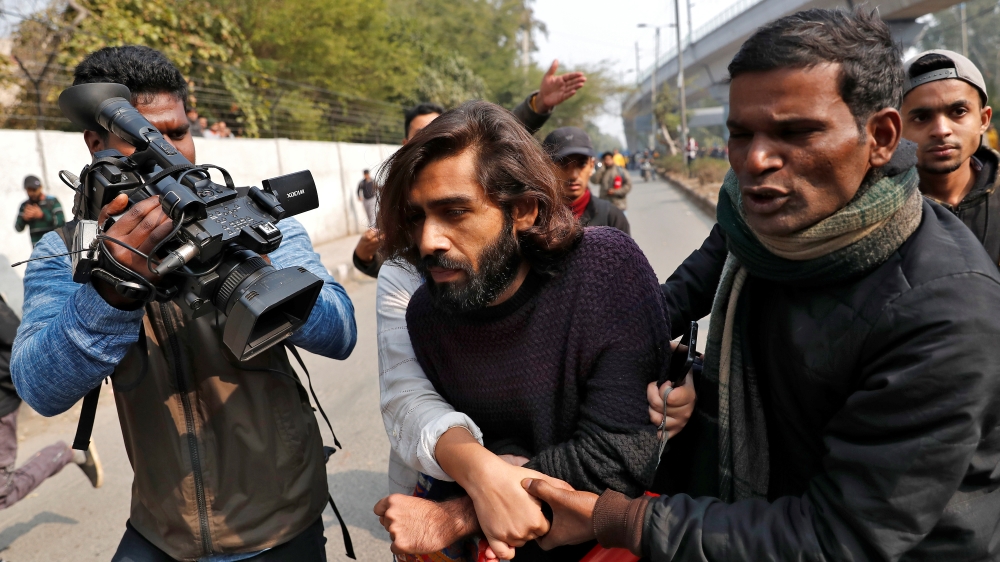
Teenage suspect in police custody after he fires at protesters near Jamia Millia Islamia university, injuring a student.
A gunman has fired at a protest rally against India's new citizenship
law near the Jamia Millia Islamia (JMI) university in capital New Delhi,
witnesses and officials said.
The alleged assailant, identified by the police as a 17-year-old
teenager, brandished a single-barrel weapon and shouted slogans against
the protesters before firing at them, wounding a JMI student on
Thursday.
More:
The deputy commissioner of police in Southeast Delhi said the teenage
suspect has been arrested and an investigation was being conducted into
the incident.
'Who wants freedom?'
"He [the gunman] was shouting, 'Delhi Police Zindabad' [long live Delhi police] and 'Who wants Aazadi [freedom], come, I'll shoot you'," said witness Nazim Qazi, who was also part of the protest."And then he shot one fire. A student named Shadab was hurt and has been taken to the nearby Holy Family hospital," he added.
Another witness told Al Jazeera that JMI students were marching towards the memorial of Mahatma Gandhi, the leader of India's independence struggle, when the attack happened.
The march was organised to coincide with the death anniversary of
Gandhi, who was shot dead by a member of the Hindu far right, Nathuram
Godse, in 1948.
A photograph taken by the Reuters news agency showed the suspect, dressed in a black jacket and brandishing a single-barrel weapon, standing metres away from dozens of policemen deployed outside the university, where protesters had gathered for the march.
Witnesses said the assailant shouted slogans against the protesters before firing at them.
"The police stood nearby," Ahmed Zahir, a witness, told Reuters.
Meanwhile, India's Home Minister Amit Shah posted on Twitter that Delhi Police officials have been ordered to conduct a "detailed inquiry" into the incident.
Who is the suspect?
The suspect's purported Facebook page, now suspended, showed that he called himself a "Rambhakt" (devotee of Hindu god, Lord Ram). He was live on Facebook just before the attack, the page showed.The teenager's Facebook account also revealed his apparent hatred towards Muslims and his sympathies for the ruling Bharatiya Janata Party (BJP).
His social media profile suggested he is a member of the far-right Bajrang Dal, the youth wing of the World Hindu Council, which forms a part of what is called the Sangh Parivar (Sangh Family) in India.
The Sangh Parivar is named after their parent organisation, the Rashtriya Swayamsevak Sangh (RSS or National Association of Volunteers), which draws its inspiration from the German Nazis.
On Thursday, hours before he shot at the JMI student, the suspect made several posts on his Facebook page, in which he threatened the protesters and asked his friends to follow his activities.
"Shaheen Bagh, tera khel khatm (your game is over)," read one of his posts, referring to a peaceful protest being led by women in a Muslim-dominated neighbourhood in New Delhi, a stone's throw from where he incident happened.
In another Facebook post on Thursday, he wrote: "Meri antim yatra pe mujhe bhagwa me le jaiye aur Jai Shri Ram ke naare hon (On my final journey, drape me in saffron clothes and chant Hail Lord Ram)."
Weeks of protests
Protests against the Citizenship Amendment Act (CAA), which fast-tracks Indian citizenship for non-Muslim minorities from three neighbouring countries, have flared since last December.Prime Minister Narendra Modi's government insists the law is required to help persecuted minorities who fled to India before 2015 from Afghanistan, Bangladesh and Pakistan.
However, protesters insist the law - as well as a proposed national register for citizens - discriminates against the country's Muslim minority and violates India's secular constitution.
In recent days, BJP leaders have called for action against the protesters, whom they call "anti-nationals".
This week, India's Minister of State for Finance, Anurag Thakur, encouraged supporters at a state election rally in New Delhi to chant slogans, calling for "the traitors to be shot", drawing a reprimand from the country's election commission.
Last month, Delhi police officers stormed the JMI library and beat students who were protesting against CAA. Dozens of students were injured in the police action that caused a public outcry.
Subscribe to:
Posts (Atom)