Peace for the World World ! Your War Our Lives

The Dalai Lama
A Brief Colonial History Of Ceylon(SriLanka)
Sri Lanka: One Island Two Nations
A Brief Colonial History Of Ceylon(SriLanka)
Sri Lanka: One Island Two Nations
(Full Story)
Back to 500BC.

Thursday, March 31, 2022
The Bar Association of Sri Lanka is gravely concerned of the signs of a looming economic crisis (Statement)

.png)
By Sri Lanka Brief-
STATEMENT ON THE ECONOMY
The Bar Association of Sri Lanka (BASL) is gravely concerned of the signs of a looming economic crisis in Sri Lanka and its possible impact on the Rule of Law and Democracy and on the living conditions of the people.
The spiralling inflation, shortages of essential goods including gas, the unavailability of foreign currency, the inability to remit monies overseas, the downgrading of Sri Lanka’s ratings by multiple international rating agencies; the temporary closure of the fuel refinery at Sapugaskanda; reports of the operations of certain foreign airlines being suspended; warnings of a possible power crisis are all indicators which demonstrate the urgency of the need for the Government to address the economic crisis without any further delay.
“It goes without saying that the worst affected by economic hardship are the most vulnerable in society.”
In this respect, a downturn in the economy can have far reaching adverse consequences to the Rule of Law and Governance of a Country. At its worst, economic decline can result in a complete breakdown of Law and Order, but even prior to that, serious repercussions flow from growing financial hardships that have to be borne by citizens that perpetuates inequality and the ability of citizens to enjoy or vindicate their rights, be they public or private rights. It goes without saying that the worst affected by economic hardship are the most vulnerable in society.
It is an undisputed fact that since March 2020 there has been a gradual erosion of foreign reserves from approximately USD 7 billion. Although it was announced by the Central Bank that the reserves have increased to USD 3 billion, it remains to be ascertained how much of that are usable reserves to repay the debt and used to redress the prevailing balance of payments crisis. Even out of the available reserves a large proportion contains moneys obtained in the form of short-term foreign exchange swaps.
There have been several sovereign credit ratings downgrades in the corresponding period by all the major credit rating agencies. The latest being the downgrades by Fitch Rating Agency to CC and Standard and Poor’s (S & P) to CCC. The International Sovereign Bonds yields across all tenures have remained in double digits for over a period of 2 years. This has made rollover of maturing sovereign bonds not feasible.
“Debt to GDP from approximately 85% in 2019 is now estimated to have risen to approximately 104% of GDP. However, in the same period the government revenue as a percentage of the GDP has fallen from approximately 12% to 10%.”
There have also been reports of a flight of foreign capital both from the equities and as well as the money markets. Foreign participation in both markets at present is only negligible. The Economist magazine named Sri Lanka as one of the most vulnerable countries to the expected fallout in emerging markets from the anticipated raising of interest rates by the Federal Reserve of the United States. Debt to GDP from approximately 85% in 2019 is now estimated to have risen to approximately 104% of GDP. However, in the same period the government revenue as a percentage of the GDP has fallen from approximately 12% to 10%. Year on Year headline inflation in the month of November 2021 was recorded at 9.92% and December 2021 recorded a double digit figure of 12%, the highest in the past 7 years. The Net International Reserve Position of the Country has been negative for over three months consecutively. All of this has resulted in the scarcity of foreign exchange to sustain essential imports.
The ability of the government to meet its total dollar requirements of approximately USD 6.9 billion in 2022 is being questioned, although the Central Bank has pledged that such commitments will be met. Questions as to the stability of the financial sector are also being raised.
“The Joint Chambers have warned that if conditions do not improve many local companies would look to relocate their business operations overseas and that the ability to attract Foreign Direct Investment (FDI) into the country will be constrained.”
The BASL notes with deep concern the statement made in late December by the Joint Chambers of Commerce calling upon the government that if actions as envisaged by the recently announced Roadmap by the Central Bank of Sri Lanka are not materialized within the anticipated timeframes to reconsider other alternative courses of action available to the country such as engaging with the IMF to explore the funding options they can offer. The Joint Chambers have warned that if conditions do not improve many local companies would look to relocate their business operations overseas and that the ability to attract Foreign Direct Investment (FDI) into the country will be constrained.
The BASL acknowledges that the government has been confronted with extraordinary challenges in the form of the pandemic which has caused disruptions to the economic activities. It also recognizes the fact that the government has taken measures to address the challenges arising thereof. Similarly, the Government has sought to undertake remedial measures to address the fallout from the prevalent crisis consequent to the loss of access to financial markets and the resulting paucity of foreign exchange domestically thereof. However, none of those measures have brought about the desired results and have failed to build confidence to reverse the flight of foreign capital from the equities and money markets. Neither have these steps resulted in regaining access to international financial markets to raise debt.
Enjoyment of a living standard based on desired lifestyle choices and income has become a challenge. Our members who are mostly self-employed are particularly vulnerable and adversely impacted by these events as savings and assets form the bedrock of their economic safety net.
Some of the measures taken by the Government have directly impeded the ability of our members to perform their professional duties, particularly the purported regulation that compels the conversion of foreign inflows into rupees within a stipulated time period.
We believe that the present crisis is the crescendo of the crisis emanating from the systematic undermining of the rule of law and governance based on executive convenience and expediency rather than on institutional independence and autonomy over a long period of time by successive governments.
In these circumstances, the BASL calls upon the government to seek the assistance of acknowledged independent and non-partisan experts both domestically and internationally and also of multilateral institutions that have a proven record of providing resources financially as well as in the form of technical expertise that will enable sustainable solutions to this crisis.
It is our belief that such assistance will result in the prescriptions that manifest to the world Sri Lanka’s belief in institutions as a country where effective governance is not contingent on personalities. It will manifest the fact that Sri Lanka has the desire and institutional capacity to respond to the exigencies brought by the present crisis via prescriptions that subscribe to the Rule of Law. Moreover, it is our belief that only such a response will create the institutional framework that ensures the efficient collection of revenue and the result in the efficient allocation of scarce resources and the formulation of monetary policy that ensures economic stability rather than a permissive one which facilitates executive expediency and convenience.
The achievement of these outcomes is in our opinion indispensable to resolve the crisis at hand.
Rajeev Amarasuriya
Secretary
Bar Association of Sri Lanka
14th January 2022

Unimplemented Undertakings, Resolutions & Promises Of Sri Lanka

%20(1)%20(1)%20(1).gif)
By Kumarathasan Rasingam – MARCH 31, 2022

Kumarathasan Rasingam
Sri Lanka’s defiance and delaying tactics in implementing its own undertakings and several UNHRC Resolutions by demanding extensions and lame excuses to implement these in good faith and in time.
The UN High Commissioner for Human Rights Michele Bachelet mentioned some of the incidents under the section on “Impunity in emblematic cases” in her annual report to the UN Human Rights Council in March 2021. The relevant excerpt is as follows:
“In previous reports to the Human Rights Council, OHCHR has tracked the investigation and prosecution of emblematic cases as a key measure of Sri Lanka’s commitment to ending impunity.
These include:
The killing of five Tamil students in Trincomalee;
Killing of 17 humanitarian workers in Muttur in 2006;
The assassination of journalist Lasantha Wickrematunge in 2009;
The disappearance of Prageeth Ekneligoda in 2010
The killing of protestors by army personnel during a demonstration at Weliweriya in August 2013;
The anti-Muslim riots in Aluthgama in 2014 and Digana, in 2018, as well as others.
Despite investigations over the years by domestic Commissions of Inquiry and the police, and the arrest of some suspects and trials at bar, not a single emblematic case has been brought to a successful conclusion or conviction.”
UNHRC Resolution 19/2 Of March 22, 2012
On March 22, 2012 – the United Nations Human Rights Council (UNHRC) meeting in Geneva passed a US-sponsored resolution on human rights violations in Sri Lanka.
The resolution urges the Colombo government to implement the recommendations of its own Lessons Learnt and Reconciliation Commission (LLRC), to take steps “to ensure justice, equity, accountability and reconciliation.” It calls for an “action plan” and for the UN Human Rights Commissioner to work “in consultation with, and with the concurrence” of the Sri Lankan government in implementing the LLRC proposals.
In other words, the UN resolution calls for an “action plan” from the very government that is responsible for the military’s killing of tens of thousands of civilians in the communal war with the separatist Liberation Tigers of Tamil Eelam (LTTE), as well as other gross abuses of democratic rights. President Mahinda Rajapakse set up the LLRC to fend off international criticism and whitewash the government and the military.
UNHRC Resolution 22/1 Of March 21, 2013
Commission of Inquiry on Lesson Learnt and Reconciliation on November 2011
The following recommendations were put forward for implementation.
In this regards the commission has made 3 recommendations:
1) To investigate the specific instances referred to in observations. And any reported cases of deliberate attacks on civilians. If investigations disclose the commission of any offenses, appropriate legal action should be taken to prosecute/punish the offenders.
2) Conduct a professionally designed household survey covering all affected families in all parts of the island to ascertain first-hand the scale and the circumstances of death and injury to civilians, as well as damage to property during the period of the conflict.
3) The Government of Sri Lanka should institute an independent investigation into the execution videos of the film Sri Lanka killing fields with a view to establishing the truth or otherwise of these allegations and take action in accordance with the laws of the land.
UNHRC Resolution 25/1 Of March 2014
The UNHRC recognized the importance of preserving and analysing evidence relating to violations and abuses of human rights and related crimes in Sri Lanka with a view to advancing accountability. In the circumstances the UNHRC has decided to strengthen the capacity of the UN High Commissioner for Human Rights to collect, consolidate, analyse and preserve information and evidence and to develop possible strategies for future accountability processes for gross violations of human rights or serious violations of international humanitarian law in Sri Lanka. The UNHRC also authorized the High Commissioner to advocate for victims and survivors, and to support relevant judicial and other proceedings, including in Member States, with competent jurisdiction.
UNHRC Resolution 30/1 Of October 01, 2015
The United Nations Human Rights Council (UNHRC) adopted the resolution entitled ‘Promoting reconciliation, accountability and human rights in Sri Lanka’ on 1 October 2015, Resolution 30/1. (After a resolution promoted by the European Union (EU) was defeated in 2009 and a resolution tabled by Sri Lanka was adopted by an overwhelming majority. An attempt to table a resolution critical of Sri Lanka in 2010 was aborted). Resolution 30/1 has been described by some critics as a constitution amendment project for Sri Lanka. Interestingly, it was co-sponsored by Sri Lanka. In 2017, Sri Lanka obtained a two year grace period to implement the resolution, further confirming the country’s acquiescence with Resolution 30/1.
UNHRC Resolution 34/1 Of March 23, 2017
Guided by the Universal Declaration of Human Rights, the International Covenants on Human Rights and other relevant instruments, Reaffirming Human Rights Council resolution 30/1 of 1 October 2015 on promoting reconciliation, accountability and human rights in Sri Lanka, Recalling Human Rights Council resolutions 19/2 of 22 March 2012, 22/1 of 21 March 2013 and 25/1 of 27 March 2014, Reaffirming that it is the responsibility of each State to ensure the full enjoyment of all human rights and fundamental freedoms of its entire population, Reaffirming also its commitment to the sovereignty, independence, unity and territorial integrity of Sri Lanka, Welcoming the visits made to Sri Lanka by the United Nations High Commissioner for Human Rights, from 6 to 9 February 2016, and by the Secretary-General, from 31 August to 2 September 2016, Welcoming also the visit made by the Working Group on Enforced or Involuntary Disappearances from 9 to 18 November 2015, the advisory visits made by the Special Rapporteur on the promotion of truth, justice, reparation and guarantees of non-recurrence, the joint visit by the Special Rapporteur on the independence of judges and lawyers and the Special Rapporteur on torture and other cruel, inhuman or degrading treatment or punishment from 29 April to 7 May 2016, and the visit by the Special Rapporteur on minority issues from 10 to 20 October 2016, Welcoming further the steps taken by the Government of Sri Lanka to implement Human Rights Council resolution 30/1, and recognizing in this context the need for further significant progress,
Read More
Where Arts Faculties should be headed – a rejoinder

%20(2)%20(1)%20(2)%20(1)%20(1)%20(2)%20(1)%20(1)%20(1)%20(1)%20(1)%20(1)%20(1).png)
By FARZANA HANIFFA-2022/03/22
Over a month ago, I wrote in this column about the way the current Quality Assurance processes, including the Qualifications framework, has little space for Humanities and Social Sciences (H and SS) knowledge (The Island Feb.1 2022). Prof. Susirith Mendis, Former Vice Chancellor of the University of Ruhuna, responded to my column by arguing that the knowledge imparted by H (and SS) was important but that the Sri Lankan University system had failed to produce good quality practitioners of these disciplines (The Island Feb. 16 2022). He stated further that these academics were therefore unable to address and critique neoliberal tendencies in recent developments in Education Reform. He also claimed that the Arts faculties were not playing the role that they should, i. e., function as “the spirit and the soul” of the university.

Prof. Mendis is largely correct in claiming that our H (and also SS) faculties are in crisis, and his intervention is appreciated. I agree, for instance with the Professor’s suggestion that the Arts education reform process requires critique. The compulsion to teach badly defined “employability skills” involves an erasure of the knowledge and perspective that an H and SS educations offers. It is difficult however to agree with some other elements of Prof. Mendis’ critique. His placing of responsibility at the feet of H and SS academics is inadequately informed by the history of developments in Arts Faculties and ultimately personalizes a structural problem for which broader interventions are required. Prof. Mendis’ critique also reflects the elite politics and class dynamics at play in the public conversation about Arts Education as well as the Education reform process. Unless this critique’s own prejudices are addressed, we will not be able to push the conversation forward on the issue.
That there is a crisis in Arts education in Sri Lanka is not news. As members of Arts Faculties, we wish that our Faculties were better equipped research centres, that our students had greater competence in both critical thinking and English language ability when they come to us, that gender relations in our faculties were not from the last century, that our faculties – by and large sites of Sinhala Buddhist hegemony– had wider ethnic representation and more space for the discussion of ethnoreligious tensions in the country, and that our postgraduate programmes were supported and regulated better, and, most of all, we wish that the speedy neoliberalisation of our faculties that is ongoing—emulating a failing model from the west– can be more successfully resisted. Our Kuppi columns are an attempt to draw attention to the failings within our universities and also to show that the public commentary, regarding this crisis, is not asking the right questions and that the policymakers are not responding to the right problems.
There are historical reasons for the current state of the Arts Faculties. Prof. Mendis’s piece is more sophisticated than many but his position reflects the standard criticisms of Arts faculties and the nostalgia for a bygone era where the humanities (mainly in the English language) flourished. Prof. Mendis asks if anti-colonial thinking—that brought about the preoccupation with swabhasha—is legitimate, and bemoans the nativism that has been the result of our flirtation with such theories. He alleges that the emphasis on the local has produced closed-minded academics uninformed by global development, unable to think out of the box.
Much of this criticism is valid and has in fact been discussed in this column (See Harshana Rambukwella, The Island Nov. 23 2021.). The crisis in Arts Education has also been discussed by both Kumudu Kusum Kumara (2013) and Prabha Manurathna (2018) in excellent essays that elevate the conversation substantially. Kumara discusses the transformation to swabasha as a national level policy that upended the university system. As Kumara points out, the policy of teaching H and SS disciplines only in the local languages drove out academics from the university system and required those who stayed to teach in Sinhala and Tamil without access to adequate translated reading materials. Instruction was conducted only through delivery of lectures and student reading was largely confined to handed down lecture notes. Education policymakers did not invest in substantive translation programmes or fund research by H and SS academics to produce knowledge in the local languages. To date, the lack of support for Arts Faculties continues: the STEM faculty student to teacher ratio is 10:1 while in Arts faculties it is 18:1. Talking about the nativism of Sinhala-speaking academics without discussing the structural conditions that led to the policy and then limited the resources with which they could work, is disingenuous. Further, no attempt has been made to recognise the many who have flourished in the local universities despite such policies.
That English capacity is important for high quality training in the H and SS is not disputed. As we know, English speaking skills are wielded like a sword by the Sri Lankan middle class and excellence, competence, and trustworthiness are considered a function of English-speaking ability in such circles. Current Higher Education policymaking regarding English is driven by its value as a class marker more than as an instrument towards greater subject specialisation or a broader perspective.
That the mostly Tamil and Sinhala speaking staff at the University struggle to express themselves well in English should not be considered a sign of their lack of ability across the board, but a reflection of the swabasha policy itself. Experts from the UGC, running workshops for quality assurance, routinely talk down to us when we don’t ask questions using the “right” language. It is time that education policymakers better recognise the intellectual and emotional labour required of academics whose first language is not English, to function under such conditions. I raise this point only partially in response to Professor Mendis; most critics of Arts Faculties – from other faculties within the universities—speak to and of their colleagues in Arts Faculties as incompetent based on their verbal performance in English. Such a perspective draws from a larger position regarding the “failures” of the Arts Faculties’ that is similar to the one articulated by Prof. Mendis.
Prabha Manurathna’s essay on Arts Education draws attention to the “actual Arts student” that enters the local university system. Drawing attention to the students’ class background Manurathna critiques how the current reform process imagines their transformation. A recent audit report that was discussed in this column also referenced the kind of students that the Arts Faculties attracted. They were the students who went to schools that didn’t have Science Education facilities; they were from the poorest districts in the country, and they were mostly women. The report described them as the weakest students entering universities, following the least useful degree programme. They were also the largest percentage of university entrants. The recommendation from the Audit Office was that technology education needed to improve so that students from these underprivileged areas could be better equipped for the future, and a technologically capable workforce would be produced. The report even suggested that as a ‘developing country’ we could not afford to have so many Arts Graduates, or invest in the fine Arts. The report is evidence of the low regard for H and SS education at the policy level and we have critiqued this report (Farzana Haniffa, The Island 27 April 2021). The report also confirms that Arts Faculties are home to large numbers of students from severely under-sresourced schools and very strained social and economic circumstances.
The elitism at work in the prevailing critiques of Arts Faculties, including in Prof. Mendis’ essay, is reflected in the absence of a sociopolitical analysis of the demographic that Arts Faculties in Sri Lanka largely serve. It is also reflected in the aspirations expressed as to what the Arts and Humanities should offer students. In Arts Faculties in Sri Lanka we are struggling to empower students with huge disadvantages. It is well to remember that the celebrated homes of Humanities that Prof. Mendis references – like Harvard University– are elite institutions that benefited from the exploitation of the downtrodden and the enslaved. They were engaged in the reproduction of the elite and not in producing emancipatory knowledge or opportunities for the struggling urban and rural underclass.
It is not the Harvards of this world that we should emulate, but contexts that have enabled the emergence of labour struggles and cultural critique informed by class analysis. It is also here that our decolonial critique needs to be located. Our task should be to enable our students to better understand and critique the structural conditions behind their circumstances and equip them to change these conditions for their communities. It is to this end that we should gear our educational goals and not merely to equip individual students to escape class through “entrepreneurship.” Having students aspire to become CEOs of exploitative enterprises that trap future generations in poverty is the neoliberal project that we should resist.
(The author is Professor and Head in the Department of Sociology at the University of Colombo)
No Medicines, 10-Hour Power Cuts: Sri Lanka Nightmare Gets “A Lot Worse”

Image: Sri Lanka Economic Crisis: Sri Lanka’s 22 million people are no strangers to privation.
.png)
By Sri Lanka Brief-
Sri Lanka Economic Crisis: A critical lack of foreign currency has left Sri Lanka unable to pay for vital imports, leading to dire shortages in everything from life-saving medicines to cement.
Colombo/AFP: As Sri Lankans faint in day-long queues for fuel and swelter through stifling evening blackouts by candlelight, anger is mounting over the worst economic crisis in living memory.
A critical lack of foreign currency has left the island nation unable to pay for vital imports, leading to dire shortages in everything from life-saving medicines to cement.
Long lines for fuel that start forming before dawn are forums for public grievances, where neighbours complain bitterly about government mismanagement and fret over how to feed their families as food prices skyrocket.
“I’ve been standing here for the past five hours,” Sagayarani, a housewife, told AFP in Colombo while waiting for her share of kerosene, used to fire the cooking stoves of the capital’s poorer households.
She said she had seen three people faint already and was herself supposed to be in hospital for treatment, but with her husband and son at work she had no choice but to wait under the blistering morning sun.
“I haven’t eaten anything, I’m feeling very dizzy and it’s very hot, but what can we do? It’s a lot of hardship,” she said, declining to give her surname.
Trucks at the port are unable to cart food and building materials to other urban centres, or bring back tea from plantations dotted around Sri Lanka’s verdant inland hills.
Buses that normally transport day labourers across the capital sit idle, some hospitals have suspended routine surgeries, and student exams were postponed this month because schools ran out of paper.
“I’ve been living in Colombo for 60 years and I’ve never seen anything like this,” Vadivu, a domestic worker, told AFP.
“There’s nothing to eat, there’s nothing to drink,” she added. “The politicians are living in luxury and we are begging on the streets.”
Sri Lanka will be experiencing 10-hour daily power cuts from Wednesday, announced Public Utilities Commission of the island nation.
The Ceylon Electricity Board said in a statement that they were “compelled to take demand management measures due to inadequate power generation, as a result of fuel shortage and unavailability of generators.”
Expecting worse
Many among Sri Lanka’s 22 million people are no strangers to privation: throughout the global oil crisis of the 1970s, authorities issued ration books for essentials such as sugar.
But the government concedes the present economic calamity is the worst since the South Asian nation’s independence in 1948, and a popular local quip now is that the rationing system at least offered some certainty that goods would be available.
A series of misfortunes have pummelled the country — which emerged from decades of civil war only in 2009 — in recent years.
Farmers were hit by a crippling drought in 2016 and the Easter Sunday Islamist bombings three years later, which killed at least 279 people, led to a wave of cancellations from foreign travellers.
The coronavirus pandemic then decimated a tourism sector already reeling from the attacks and dried up the flow of remittances from Sri Lankans abroad.
Both are critical sources of foreign cash needed to pay for imports and service the nation’s ballooning $51 billion foreign debt.
But a far bigger factor was government “mismanagement”, said Murtaza Jafferjee, chairman of the Colombo-based Advocata Institute think tank.
He blamed years of chronic budget deficits, ill-advised tax cuts just before the pandemic that sent government revenue into freefall, and subsidies on electricity and other utilities that disproportionately benefited wealthier Sri Lankans.
The government has also frittered away public money on white-elephant projects, including a lotus-shaped skyscraper that dominates the Colombo skyline, with a revolving restaurant that now sits dormant.
Poor policy decisions have compounded the problems. Last year officials declared Sri Lanka would become the world’s first completely organic farming nation and overnight banned imported fertiliser, in an apparent effort to slow down foreign currency outflows.
Farmers responded by leaving their fields empty, driving up food prices, and months later the policy was abruptly dropped.
Sri Lanka is now seeking a bailout from the International Monetary Fund, but negotiations could stretch until the end of the year, and people are bracing for even leaner times ahead.
“I am expecting it to get a lot worse,” Jafferjee said.
“Unfortunately, they are unable to contain it, because the people who created the crisis are still in charge of economic management.”
‘Pushed to the brink’
By night, as the orange hue of street lights illuminates Colombo’s wealthier neighbourhoods, large pockets of the city are in near darkness.
Rolling power cuts that stretch for hours each day leave restaurants and corner stores trying to operate under dim candlelight. Other business owners give up and draw down their metal shutters for the evening.
Resentment is palpable and frustrations have occasionally boiled over. A motorcyclist was stabbed to death outside a petrol station last week after a dispute sparked by accusations of queue-cutting.
But most indignation is directed upwards to the administration of Gotabaya Rajapaksa, a member of a ruling family once beloved by much of the country’s Sinhalese majority for bringing the ethnic civil war against the Tamil Tigers to a brutal end.
Support for the Rajapaksa clan has since gone into a tailspin, with an angry crowd this month attempting to storm the president’s office.
Other demonstrations have for now been more subdued, organised through social media and taking the form of silent candlelight vigils during blacked-out nights.
“We’ve been pushed to the brink,” said Mohammed Afker, an engineering student standing alongside thousands of others at a rally staged by a leftist opposition coalition.
The 20-year-old told AFP that day-to-day struggles had left him little time even to contemplate what he knew were poor prospects for finding work after he graduated.
“We’re not even able to get essential items… We can’t even make tea at home,” he said.
Indian Foreign Minister meets Rajapaksa as Sri Lanka seeks US$1.5 billion more

%20(1).png)
28 March 2022
Indian External Affairs Minister S. Jaishankar met with Sri Lankan President Gotabaya Rajapaksa in Colombo earlier today as the island’s economy witnesses an unprecedented crisis in its independent history.
Jaishankar is in Colombo for the fifth BIMSTEC (Bay of Bengal Initiative for Multi-Sectoral Technical and Economic Cooperation) Summit on a three-day visit.
Rajapaksa hosted the minister and thanked him for India’s $1 bn credit to help Colombo pay for its import of essentials including food and medicine.
However, Sri Lanka has sought an additional credit line of $1.5 billion from India to import essentials.
"There is a very close discussion continuing for an additional support of $1.5 billion (with India) by way of oil support as well as other essential goods support of credit terms," said Sri Lanka’s Central Bank Governor Ajith Nivard Cabraal.
The new line of credit will be in addition to the US$1 billion support extended by New Delhi earlier this month. "India will be an ally for Sri Lanka's future progress," Cabraal said.
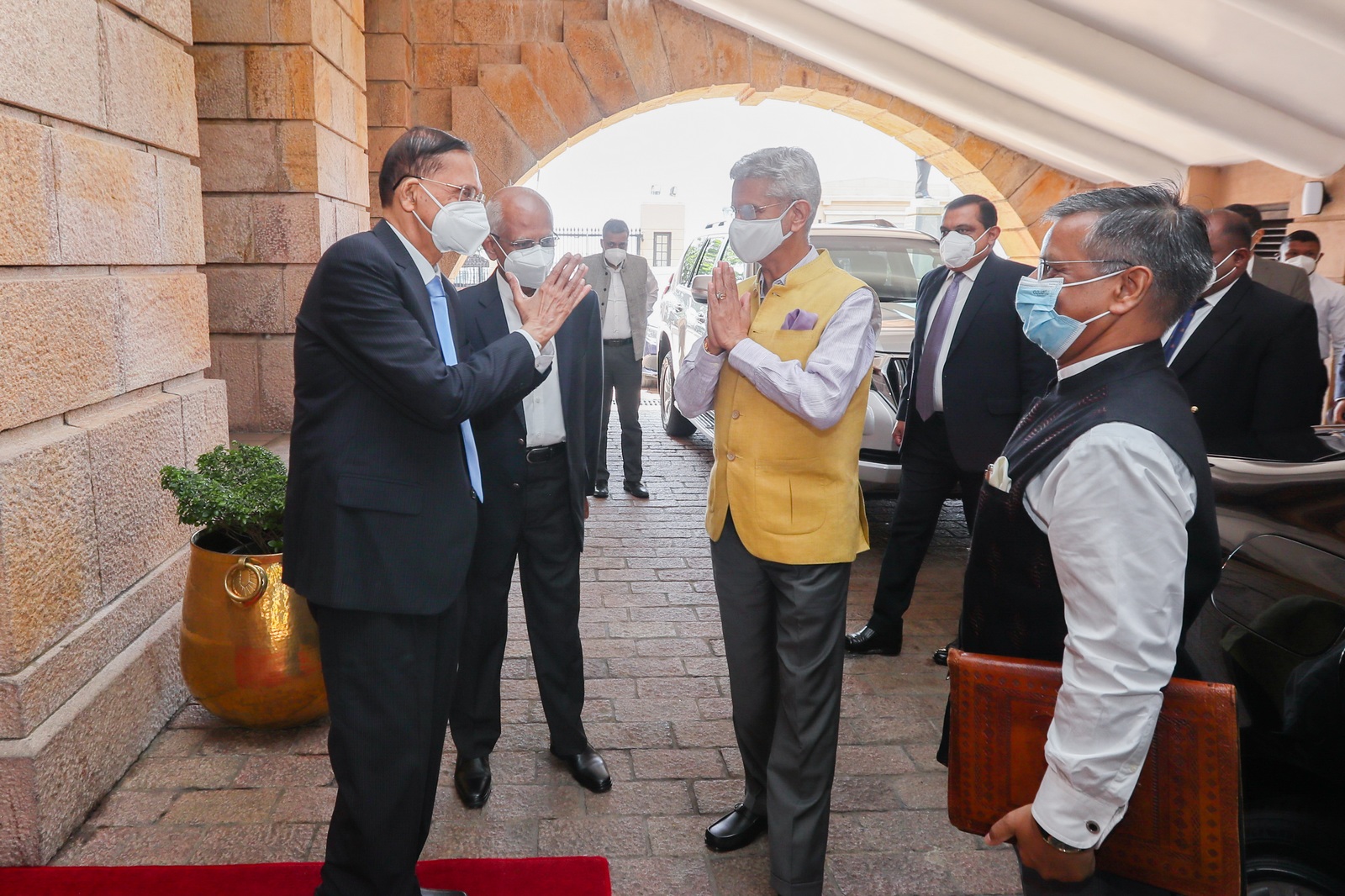
This year marks 75 years since the establishment of diplomatic relations between the two countries and a special memorial coin will be released to commemorate it during Jaishankar’s visit.
The External Affairs minister thanked Rajapaksa for his “gracious welcome”. He also had a meeting with Prime Minister Mahinda Rajapaksa in which he “witnessed the signing of an agreement on supporting Buddhist culture and heritage”. He also remotely inaugurated the Jaffna Cultural Centre which was constructed under India’s aegis.
"Reviewed various dimensions of our close neighbourly relationship," Jaishankar said in a tweet after meeting the Sri Lankan president. "Assured him of India's continued cooperation and understanding."
Jaishankar also held talks with a delegation of the Tamil National Alliance (TNA) and representatives of the upcountry Tamils including Jeevan and Senthil Thondaman.
The Jewish War: A Reading For Sri Lankans

%20(1)%20(1)%20(1).gif)
By Charles Ponnuthurai Sarvan –MARCH 31, 2022

Prof. Charles Sarvan
‘The Jewish War’ by Flavius Josephus
Josephus was born in CE 37 to a Jewish priestly family and attended a rabbinic school. He lived for three years with an ascetic hermit in the desert, and then returned to take up his priestly duties. (Page reference in what follows is to the Penguin Classics revised edition. The date of Josephus’ death is not known.) He opposed the Jews taking up arms against the Romans but only because he saw the attempt as doomed to failure. However, when the country was divided into Jerusalem and six regional commands, Josephus was placed in command of “the most northerly of the regions, Galilee” (page 11) where he acquitted himself as a brave and resourceful military leader. When his army deserted in the face of massive Roman attacks, Josephus joined a small group that retreated to a fortress town and continued the fight. The siege lasted two months and ended with the capture of Josephus. He would have been sent to Emperor Nero but saved himself by prophesying to Vespasian, the Roman commander that he, Vespasian, would soon be Emperor. The prophecy came true and thereafter Josephus had an honoured place in Rome, adding the Roman name Flavius to his own. He was granted citizenship and a pension for life. Ethnicity counted but citizenship was proudly prized. The claim was that a man who declared that he was a citizen of Rome (civis romanus sum) would be safe anywhere in the empire. For example, in the New Testament of the Bible (Acts, chapter 22), one reads the following in relation to Paul, later Saint Paul:
 But when they had stretched him out for the whips, Paul said to the centurion who was standing by, “Is it lawful for you to flog a man who is a Roman citizen and uncondemned?” When the centurion heard this, he went to the tribune and said to him, “What are you about to do? For this man is a Roman citizen.” So the tribune came and said to him, “Tell me, are you a Roman citizen?” And he said, “Yes”. So those who were about to examine him withdrew from him immediately, and the tribune also was afraid, for he realized that Paul was a Roman citizen.
Staying a little longer with the Bible, it is not without significance that though the author mentions Pontius Pilate, he makes no reference to Jesus: “When Pilate saw that he could prevail nothing, but that rather a tumult was made, he took water, and washed his hands before the multitude, saying, I am innocent of the blood of this just person: see ye to it” (Matthew, 27: 24). Josephus’ book is a full and, I must caution, a very detailed account of the war waged by the Jews, CE 66-70, against the Romans.
We must bear in mind that Josephus was living and writing under the protection and patronage of the Romans. He wrote for them (copies were gifted to Caesar), and not for his fellow Jews. In Sri Lankan terms, it would be as if either Douglas Devananda or Colonel Karuna were to write his account of the war between the state and the Tamil Tigers. Of Devananda, the Internet states that he is wanted outside Sri Lanka “on charges of murder, attempt to murder, rioting, unlawful assembly and kidnapping. He was sworn in as Minister of Fisheries and Aquatic Resources on 22 November 2019.” Colonel Karuna Amman fought for the Liberation Tigers of Tamil Eelam for over 20 years. The title of Josephus’ book is ‘The Jewish War’, and its very first sentence begins: “The war of the Jews against the Romans”. Truthfully, it should have been the war of the Romans against the Jews. So it is that, given Western power and influence, the reference usually is to ‘the Vietnam war’ and not to ‘the American war on Vietnam’. So too, is it ‘the war of the Tamil Tigers against the state’ or ‘the war of the state against the Tamil Tigers’? (I recall long, long years ago being asked a simple question by a simple farmer in Jaffna: “All we want is to lead our lives as we like. Why don’t they leave us alone?” Of course, the question was a simplification.) The use of the words ‘loyal’ and ‘loyalty’ by Josephus also betray his betrayal and new loyalty. Those who remain obedient to or supportive of imperial Rome are deemed by him to be “loyal”. Under other empires too, natives who sided with the imperial power against their own folk were advanced or given some token of recognition. They, as in erstwhile Ceylon, were collaborators. (I use ‘natives’ without apology. Once a term of insult, it is now one of contest, claim and pride.)
The Jews faced the Goliath of the Roman Empire which was grounded on, probably, the best army in the world at that time: highly trained, superbly disciplined and excellently equipped. (For the story of David and Goliath, see the Old Testament: 1 Samuel, Chapter 17.) There have been instances in history when a small army defeated a force numerically far superior but, as a general rule, the numerical ratio makes for a decisive difference in war, as the Tamil Tigers learnt. The comparatively tiny Jewish population was no match against the huge Roman Empire. So why did they fight, and how did they fight?
Justice includes elements such as freedom and equality, opportunity and dignity. But justice is never extended freely: it is demanded, fought and paid for with wounds and blood; with death and tears. As we have been told by several writers, a person who is not free is not fully human. She or he cannot realize her or his full potential. Professor Mary Smallwood in her ‘Introduction’ to this Penguin edition writes that the Jews rose up to free themselves from the Roman “yoke” (page 13). It is an apt lexical choice for a yoke is placed on the neck of an animal (or human being) to make it tractable. Those not free live under the political, economic and social yoke forcibly placed on them. So it is that, against the judgement of men like Josephus, the Jews took to arms, again and again, in an attempt to rid themselves of the alien and oppressive Roman yoke. Like the Tamil Tigers in another place and time far, far distant, they won many a battle but lost the war The longing of a people for independence and freedom may be forced to dormancy but, deep down, it doesn’t die.
The Jews fought with great courage, tenacity and skill and, despite his disloyal ‘loyalty’, Flavius Josephus acknowledges this: “the Jews stood shoulder to shoulder and held their ground magnificently” (page 172). Rather than being broken-hearted by disaster, “the Jews were stimulated by defeat to still greater determination” (page 191). What happened at the fortress of Masada is now disputed but Josephus recounts that 960 men, women and children took shelter there under their leader Eleazar. Facing certain defeat, they opted for mass suicide. First the men killed their wives and children: the wives so that they would not be violated; the children so that they would not be sent into slavery. With streaming eyes they embraced their wives, “and taking their children in their arms pressed upon them the last, lingering kiss” (page 404). Ten men were chosen by lot to be the executioners of the rest: “every man flung himself down beside his [dead] wife and children where they lay, put his arms round them, and exposed his throat to those who must perform the painful office” (ibid). The last ten men then freed themselves in turn from life. The very last man, after having made sure all were dead, also committed suicide. The Romans admired and respected courage – even when displayed by the enemy (page 405): “When they came upon the rows of dead bodies, they did not exult over them as enemies but admired the nobility of their resolve, and the way in which so many had shown an utter contempt of death in carrying it out without a tremor”. (In Sri Lanka, “after the final battle with the Tamil Tigers, desecrated bodies were found: those, particularly of females, with objects thrust into their private parts”.)
It’s interesting that Eleazar mentions Indian philosophy, and Indians who inform their friends that they are going to depart: “No one tries to stop them” (page 401). The bereaved, when they weep, weep for themselves and not for the dead because the departed are thought to be happy (ibid). To continue with this brief digression, Josephus describes a sect, the Essenes, who are “communists to perfection” (page 133). None of them will be found to be better off than the others. Among them, there’s neither humiliating poverty nor excessive wealth.
Etymologically, the term ‘diaspora’ is linked to scattering or dispersal (one reads of “the Tamil diaspora”) and Josephus observes that the Jews having been defeated, the sacred Temple destroyed for the second time, and their land occupied, “dispersed in great numbers among the native populations all over the world” (page 377). The Jewish scholar, Professor David Myers, comments that the Jews took with them a “portable homeland” consisting of their beliefs and culture, their rites and observances. They have been consistently disliked, observes Myers but it must be added that the worst suffering of the Jews in their exile-life was at the hands of Western Christians.
A dear relation of mine now settled in Canada is a pro-Zionist. This surprised me because, in my naivety, I had thought that Sri Lankan Tamils, because of their own experience, would instinctively side with the weaker, with those discriminated against; that they would, almost automatically, stand with and for the underdog. (Emma Goldman, also of Jewish origin, and many others come to mind.) I have read several books by and about the Jews, and have admiration for their achievement; sympathy for what they suffered over centuries. Again, because of their own experience, I had thought that Tamils would be against racism in any form and everywhere, including the self-avowed racism of Israel. Among the many books by Jews on their experience, one that is deservedly famous is Primo Levi’s ‘If This Is A Man’. Yet Levi who survived the Nazi concentration camp had the courage and honesty to write that the Palestinians had become the Jews of the Israelis. To my knowledge, Israel is the only country which officially declares that it is racist: the Nation-State Law explicitly states that the right to exercise national self-determination in Israel is limited to the Jewish people. Some members of population-groups (Jews, Sinhalese and others) settled happily and freely in countries outside their original homeland see no contradiction in denying minority-groups back “home” equality.
Read More
Subscribe to:
Posts (Atom)