Peace for the World World ! Your War Our Lives

The Dalai Lama
A Brief Colonial History Of Ceylon(SriLanka)
Sri Lanka: One Island Two Nations
A Brief Colonial History Of Ceylon(SriLanka)
Sri Lanka: One Island Two Nations
(Full Story)
Back to 500BC.

Wednesday, June 29, 2022
HUMAN RIGHTS DEFENDER AND JOURNALIST THARINDU UDAWARAGEDARA SUMMONED TO THE CRIMINAL INVESTIGATION DIVISION

Status:
Summoned and questioned
About the situation
.png)
24 June 2022
On 22 June 2022, Sri Lankan journalist, media rights campaigner and human rights defender Tharindu Uduwaragedara was served a notice requiring him to appear at the Criminal Investigation Department (CID) in Colombo for inquiry on 28 June 2022. Tharindu Uduwaragedara was not given clear reasons for the inquiry except that it relates to the content of his YouTube channel, and that a complaint had been made against him by the Intelligence Division of the Sri Lanka Air Force (SLAF).
About the HRD

Uduwaragedara is a well known independent journalist and media rights campaigner who has been reporting on the ongoing citizens protests across the country against government corruption, mismanagement and the lack of basic resources including medicines, food and fuel. He is the former president and active member of the Sri Lanka Young Journalist Association (SLYJA) and an Executive Committee member of the Sri Lanka Working Journalists Association (SLWJA). He has worked at several Sinhala language newspapers including Ravaya and Anidda, known for their investigative journalism and open critique of the government. Tharindu Uduwaragedara has his own YouTube channel Satahan Radio, dedicated to independent reporting on social issues and human rights violations.
24 June 2022
Human rights defender and journalist Tharindu Udawaragedara summoned to the Criminal Investigation Division
On 22 June 2022, Sri Lankan journalist, media rights campaigner and human rights defender Tharindu Uduwaragedara was served a notice requiring him to appear at the Criminal Investigation Department (CID) in Colombo for inquiry on 28 June 2022. Tharindu Uduwaragedara was not given clear reasons for the inquiry except that it relates to the content of his YouTube channel, and that a complaint had been made against him by the Intelligence Division of the Sri Lanka Air Force (SLAF).
Tharindu Uduwaragedara is a well known independent journalist and media rights campaigner who has been reporting on the ongoing citizens protests across the country against government corruption, mismanagement and the lack of basic resources including medicines, food and fuel. He is the former president and active member of the Sri Lanka Young Journalist Association (SLYJA) and an Executive Committee member of the Sri Lanka Working Journalists Association (SLWJA). He has worked at several Sinhala language newspapers including Ravaya and Anidda, known for their investigative journalism and open critique of the government. Tharindu Uduwaragedara has his own YouTube channel Satahan Radio, dedicated to independent reporting on social issues and human rights violations.
Tharindu Uduwaragedara has been actively documenting the citizen’s protest since March 2022 and his YouTube channel is a tool to voice the messages of those (mostly youth) who are protesting against scarce resources, governmental corruption and mismanagement. He has been present from the outset at Galle Face, in Colombo, where peaceful protesters have set up a protest site, Gota Go Gama calling for the resignation of President Gotabhaya Rajapaksa. Tharindu Uduwaragedara set up the International Media Center-Colombo tent at Gota Go Gama, to support journalists reporting from the protest site. Tharindu Uduwaragedara has been openly critical of the current government and its policies, lack of transparency and the crackdown and reprisals against peaceful protesters.
Sri Lankan authorities have reacted violently to the protests. Reprisals including physical violence against peaceful protesters, surveillance, intimidation and arrest/detention on baseless charges are ongoing in an attempt to quash legitimate dissent. On 20 June 2022, 9 protesters were arrested by Sri Lanka police in one night alone1. Many others have been called for questioning, arrested and later released on bail. There has been no accountability to date for violence by security forces and government supported mobs against peaceful protesters, most notably on 9 May 2022.
On 22 June 2022, the CID served summons to Tharindu Uduwaragedara’s mother’s home in Bandarawela, Badulla District, ordering him to appear for an inquiry at the CID headquarters in Colombo on 28 June 2022. The summons contained the name and number of a sub-inspector of the police to be contacted for further information. Tharindu Uduwaragedara telephoned this officer and asked why he was being called for questioning. The officer refused to share details, stating only that the inquiry was related to the content of his YouTube channel and that a complaint had been filed against him by the Intelligence division of the Sri Lankan Air Force. Tharindu Uduwaragedara filed a complaint with the Human Rights Commission of Sri Lanka on 22 June 2022 against this treatment which he believes is linked to his reporting and human rights work.
This is not the first time Tharindu Uduwaragedara faces reprisals for his work. He has been subjected to harassment and surveillance, including during the current protests. Uniformed officers and unidentified individuals suspected to be intelligence officers have routinely visited the Media Center tent and inquired about his whereabouts. Those protesting and reporting are photographed continuously by security and intelligence officers. The recent summons issued to Tharindu Uduwaragedara is part of a pattern of persecution against those raising their voice against the current regime.
Front Line Defenders is concerned regarding the summons issued to Tharindu Uduwaragedara as we believe this is directly linked to his legitimate journalism and peaceful human rights work. All citizens and especially journalists and human rights defenders must be safe from reprisals when carrying out peaceful protests and expressing legitimate dissent against Government policies.
1 https://economynext.com/sri-lanka-lawyer-and-activist-senaka-perera-summoned-by-cid-95206/

News Explainer: The Economic Crisis in Sri Lanka
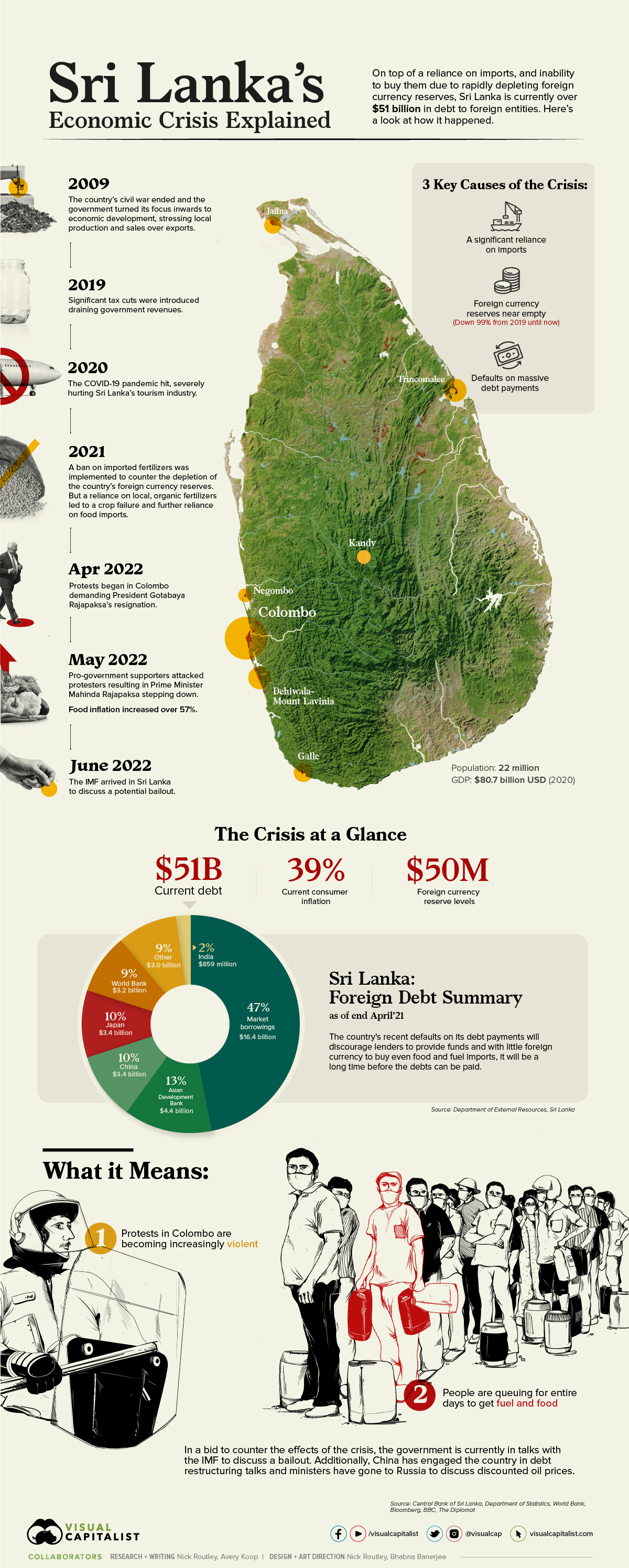
Explained: the Economic Crisis in Sri Lanka
%20(1)%20(1)%20(1).png)
Sri Lanka is currently in an economic and political crisis of mass proportions, recently culminating in a default on its debt payments. The country is also nearly at empty on their foreign currency reserves, decreasing the ability to purchase imports and driving up domestic prices for goods.
There are several reasons for this crisis and the economic turmoil has sparked mass protests and violence across the country. This visual breaks down some of the elements that led to Sri Lanka’s current situation.
A Timeline of Events
The ongoing problems in Sri Lanka have bubbled up after years of economic mismanagement. Here’s a brief timeline looking at just some of the recent factors.
2009
In 2009, a decades-long civil war in the country ended and the government’s focus turned inward towards domestic production. However, a stress on local production and sales, instead of exports, increased the reliance on foreign goods.
2019
Unprompted cuts were introduced on income tax in 2019, leading to significant losses in government revenue, draining an already cash-strapped country.
2020
The COVID-19 pandemic hit the world causing border closures globally and stifling one of Sri Lanka’s most lucrative industries. Prior to the pandemic, in 2018, tourism contributed nearly 5% of the country’s GDP and generated over 388,000 jobs. In 2020, tourism’s share of GDP had dropped to 0.8%, with over 40,000 jobs lost to that point.
2021
Recently, the Sri Lankan government introduced a ban on foreign-made chemical fertilizers. The ban was meant to counter the depletion of the country’s foreign currency reserves.
However, with only local, organic fertilizers available to farmers, a massive crop failure occurred and Sri Lankans were subsequently forced to rely even more heavily on imports, further depleting reserves.
April 2022
In early April this year, massive protests calling for President Gotabaya Rajapaksa’s resignation, sparked in Sri Lanka’s capital city, Colombo.
May 2022
In May, pro-government supporters brutally attacked protesters. Subsequently, Prime Minister Mahinda Rajapaksa, brother of President Rajapaksa, stepped down and was replaced with former PM, Ranil Wickremesinghe.
June 2022
Recently, the government approved a four-day work week to allow citizens an extra day to grow food, as prices continue to shoot up. Food inflation increased over 57% in May.
Additionally, the increasing prices on grain caused by the war in Ukraine and rising fuel prices globally have played into an already dire situation in Sri Lanka.
The Key Information
“Our economy has completely collapsed.”
PRIME MINISTER RANIL WICKREMESINGHE TO PARLIAMENT LAST WEEK.
One of the main causes of the economic crisis in Sri Lanka is the reliance on imports and the amount spent on them. Let’s take a look at the numbers:
- 2021 total imports = $20.6 billion USD
- 2022 total imports (to March) = $5.7 billion USD
In contrast, the most recent reported foreign currency reserve levels in the country were at an abysmal $50 million, having plummeted an astounding 99%, from $7.6 billion in 2019.
Some of the top imports in 2021, according to the country’s central bank were:
- Refined petroleum = $2.8 billion
- Textiles = $3.1 billion
- Chemical products = $1.1 billion
- Food & beverage = $1.7 billion
Of course, without the cash to purchase these goods from abroad, Sri Lankans face an increasingly drastic situation.
Additionally, the debt Sri Lanka has incurred is huge, further hampering their ability to boost their reserves. Recently, they defaulted on a $78 million loan from international creditors, and in total, they’ve borrowed $50.7 billion.
The largest source of their debt is by far due to market borrowings, followed closely by loans taken from the Asian Development Bank, China, and Japan, among others.
What it Means
Sri Lanka is home to more than 22 million people who are rapidly losing the ability to purchase everyday goods. Consumer inflation reached 39% at the end of May.
Due to power outages meant to save energy and fuel, schools are currently shuttered and children have nowhere to go during the day. Protesters calling for the president’s resignation have been camped in the capital for months, facing tear gas from police and backlash from president Rajapaksa’s supporters, but many have also responded violently to pushback.
India and China have agreed to send help to the country and the the International Monetary Fund recently arrived in the country to discuss a bailout. Additionally, the government has sent ministers to Russia to discuss a deal for discounted oil imports.
A Foreshadowing for Low Income Countries
Governments need foreign currency in order to purchase goods from abroad. Without the ability to purchase or borrow foreign currency, the Sri Lankan government cannot buy desperately needed imports, including food staples and fuel, causing domestic prices to rise.
Furthermore, defaults on loan payments discourage foreign direct investment and devalue the national currency, making future borrowing more difficult.
What’s happening in Sri Lanka may be an ominous preview of what’s to come in other low and middle-income countries, as the risk of debt distress continues to rise globally.
The Debt Service Suspension Initiative (DSSI) was implemented by G20 countries, suspending nearly $13 billion in debt from the start of the pandemic until late 2021.
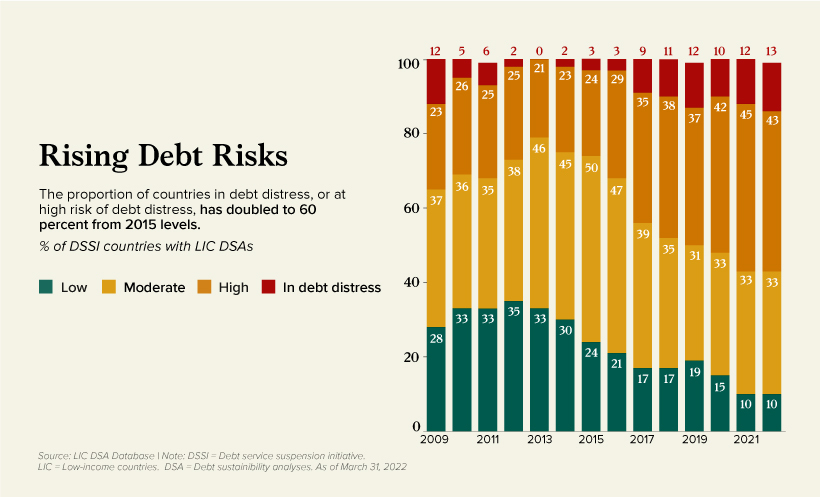

This visual reveals the share of DSSI countries that are also low income (LIC) and have had their debt sustainability analyzed, finding that the share close to debt distress is rising over time.
Some DSSI and LIC countries facing a high risk of debt distress include Zambia, Ethiopia, and Tajikistan, to name a few.
Going forward, Sri Lanka’s next steps in managing this situation will either serve as a useful example for other countries at risk or a warning worth heeding.
Economic crisis, public outcry, foreign reserves and remittances
%20(1)%20(3)%20(1)%20(1)%20(1).png)
Tuesday, 28 June 2022
Preamble
The recent announcements by the Government to resolve the economic crisis were mainly targeted to boost the foreign income by promoting tourism, granting five-year no-pay leave for public servants to work abroad, and creating skilled employment through the foreign employment bureau. Furthermore, as an incentive for remittance over $ 100,000, Government is to provide a duty-free allowance for importation of cars.
These initiatives are irrational, lack direction, ad-hoc, hard to believe that the economic crisis will end in a short pace of time as they are associated with high inertia, hard to kick start and doubtful to bring quick returns under these current circumstances. Promotion of tourism was one of the post-COVID key initiatives of the former Governor’s road map presented eight months ago but has never materialised as forecasted.
Background
The prime cause of the foreign exchange crisis began with the heavy borrowing under the guise of stimulating the economy aftermath of defeating LTTE militarily. The rapid growth in GDP resulted in investment on “white elephant projects”, with lack of foresight and vision. The assets built on borrowing have not made substantial return on investment, not sufficient to payback the loans, year on year. The loans were taken at commercial rates, above par, violating and departing from the best practices, no transparency thus opening room for exploitations, such as bargaining for commissions at various levels of the Government. These practices became the norm of day and continued to-date despite the Yahapalana Government coming to power to reverse the trend, promising to build and strengthen government machinery to find the crooks, recover stolen money.
In spite of the current crisis and people’s uprising, the craving for finished foreign goods has never stopped; one could see the items displayed in the leading supermarket shelves. Replenishment of such non-essential goods, require foreign exchange and will further deplete the foreign reserves. Sri Lanka requires imports which maximise the local content in construction, manufacturing and supply chain industry. Are the luxury goods for 10% of the people who consume 85% of the GDP? This imbalance needs urgent correction.
Lack of vision
The successive governments over many decades proved they had no clear vision for the long term but interestingly exploited every situation to fulfil the political gains, build personal wealth, treat henchmen and akin. In the past two decades in the aftermath of [a] Tsunami in Dec. 2004, [b] 30-year civil war, [c] Central Bank robbery during Feb. to April 2015, and [d] COVID-19 in 2020, Sri Lanka failed economically to capitalise from lessons learnt and act upon timely to rebuild the economy for the benefit of public. These are the chains of unfortunate events that have been overlooked, neglected and instead transformed to personal wellbeing.
To progress as a nation there should be a clear vision, not be subjected to changes with the change of governments. Vision is a long-term set of objectives in moving forward economically, socially, culturally and environmentally, followed by strategies in achieving the said objectives. Strategies may change depending upon the external and internal circumstances; for example, COVID-19 was an instance where countries sought different ways of delivery of services, thanks mainly to the ICT industry. Work from Home, online learning, conducting online meeting thus curtailing travelling, etc., are a few service delivery models despite having issues of availability of internet connections.
"The main issues that had major impacts on the economy were stopping imports on fertiliser, purchasing refined fuel, petrol and diesel instead of crude oil and the decision to shut down the petroleum refinery indefinitely. As a result of these policy actions and failed strategies, the food security of Sri Lankans was hindered, which necessitated to import food stuff and refined fuels at premium prices through selected dealers; the result of these actions impacted badly on the daily lives of citizens, wasting their time in long queues thus affecting productivity of the nation"
The roadmap, the tranches of programs/projects are then to be carefully worked out considering the dependencies, both external and internal supported by detailed business cases, environmental assessments for achieving objectives. We have witnessed in the recent past government showcasing initiatives with no tangible progress thereafter and not taking off the ground. The six months roadmap of then CBSL governor to redress foreign debts crisis and prevent becoming a defaulter finally proved as a blind shot missing the firing target.
The assassins who destroyed the economy to the current level are still denying to accept their responsibilities but enjoying life. In support of these decisions, the economic pundits of the Government have created fears among the public of negative consequences of going to IMF for assistance. One who authored a book titled “Handcuffs on Sri Lanka by IMF”, presented at one of the TV debates, nearly a year ago to attempt to discourage, frighten and paint bleak outcomes, now the same person is shedding crocodile tears about the financial crisis and inclination towards IMF path of resurrection. The strategies that have been adopted, and the policies pursued have driven the country to both political and economic turmoil resulting in suffering, hardships to common man and have fallen to deaf ears of the Government leaders.
Consequences of curtailing importations indiscriminately
The main issues that had major impacts on the economy were stopping imports on fertiliser, purchasing refined fuel, petrol and diesel instead of crude oil and the decision to shut down the petroleum refinery indefinitely. As a result of these policy actions and failed strategies, the food security of Sri Lankans was hindered, which necessitated to import food stuff and refined fuels at premium prices through selected dealers; the result of these actions impacted badly on the daily lives of citizens, wasting their time in long queues thus affecting productivity of the nation.
Each one had multiple devastating effects leading to depletion of foreign reserves, [a] with respect to enforcing organic fertiliser, farming lands have been ruined, loss of production, increases in price. [b] Decision to close down refinery for considerable length of time surely had caused high maintenance cost in bringing it back to operational level, importing of refined fuel, petrol and diesel, at high prices and also the production of by-products through the refining process which are essential for other activities viz: fertiliser, insecticides petroleum jelly, asphalt, etc. These by-products amount to approx. 20% in volume [Courtesy of Wikipedia]
It is extraordinary and difficult to gage the reasons for such policy decisions without assessing far-reaching consequences. Let’s assume that moving to organic fertiliser was to save some foreign reserves; however, shutting down the refinery and importing refined fuel at premium price created suspicion as to how Sri Lanka could preserve foreign reserves. To a common man, these two processes react in opposite directions. Is this for favouritism and for underhand deals of selected?
On the contrary, in April 2022, settlements were made at the maturity of some ISBs indicating that there is no foreign exchange crisis and defaulting of payments. This is another act of economic assassins having taken improper decisions with no fear despite the state of bankruptcy.
Taxation and interest rates
Taxing citizens is one of the revenue raising instruments, governments have to fulfil the demands of the nation through public service from tax revenue. However, the money collected should be spent wisely, intelligently, not favouring friends and supporters. In Sri Lanka, taxes were not equitable but skewed to the people most vulnerable in the society, favourites to amass wealth disproportionally. I wish to bring the following quote – In 1899 US supreme court stated in Nicol c Ames 173 US 509: “The power to tax is one great power upon which the whole national fabric is based. It is necessary to the existence of prosperity of a nation as is the air he breathes to a natural man. It is not only the power to destroy, but the power to keep alive.”
Extrapolating the above statement to the present Sri Lankan context, the ill-timed and illogical move to increase the tax to 12% which was brought down to 8% as soon as the current President was installed have aggravated the hardships to the battered community, adding to the spiralling cost of living. Nevertheless, economic pundits argue in favour saying, it is to balance the primary account; however, they were negligent of the fact that cumulative effect of such moves creates explosive repercussions in the current climate.
"The patchwork currently being pursued to bring more high-paying tourists, and concessions to Sri Lankans working abroad to boost foreign exchange remittance, will likely fail as there is no healthy sustainable environment prevailing in Sri Lanka. It appears such initiatives and propaganda are targeted to dissolve the public momentum against the Government preventing another day like 9 May 2022. The writer is of the opinion that the new generation is not that stupid to digest the sweeteners as the old folks did in the past"
Another decision was to increase the interest rate to limit the money circulation to stop the spiralling inflation and again the intention of Government to print trillion rupees to pay Government salaries, pensions and the like. This is a dichotomy; the two initiatives will never work in sync but has opposite direction. Furthermore, the rise in interest rates will destroy the SME sector which is the key of driving the economy. The timings of these moves as previously iterated were illogical and irrational.
The Interest Rate Parity (IRP) is the fundamental in determining and governing the relationship between two currencies. Adding to this, is the sovereign rating of a country which determines the health of the State in political, social and economic terms. The differential in rates regulate the demand subjected to “all things are equal”. In an unhealthy environment such as in Sri Lanka, fixing and holding the parity of Rs. against the market forces and subsequently dropping abruptly created room for manipulations of the foreign exchange market, such as; illegal transfers, growth of black marketers, etc. It is regrettable to note that the Government kept a blind eye, allowing for illegal practices to grow.
Capital Inflows (CI) and Free Trade Agreements (FTA)
CI and FTAs are two key instruments that should be rightly exercised to the advantage of national interest and not for the purpose of building capital reserves alone. Each of them has capital outflows too; therefore, the agreements need to be structured with a balance, not to misuse tax owed to the host country but prevent hiding in tax havens. The capital inflows for businesses are also targeted to optimise the cost of production, also taking the advantage of low operating costs of the host country thus increasing the revenues. Similarly, FTAs are bilateral agreements for equitable sharing of benefits between governments; furthermore, to be ensured whilst formulation and negotiations of agreements to prevent skewing of benefits to either party. The recent controversial case of granting to an Indian company for building a carbon neutral power plant in Trincomalee is a gross violation of best practices thus giving disproportionate advantage of the benefactor.
Conclusion
Over the past 30 months we have witnessed the inability and repeated failures of the Government in conducting and managing business. It reshuffled the cabinet of ministers a few times and recently appointed a cabinet with young members which lasted less than a month and then in May appointment of another new cabinet of ministers under the leadership of a new Prime Minister under the guise of multi-party coalition.
However, its composition failed to demonstrate such governance structure but handpicked favourites from the Opposition and the “independent” group, thus deceiving the public by popular and patriotic slogans saying that the need of the hour is not to be divided but to resurrect the country with joint efforts. The behaviours and attitudes of the majority of the 225 MPs have played the same card of patriotism; may I quote a popular phrase: “My First, Second and the Third is my Homeland”.
We have also seen several instances where Government top officials tendered resignations, suspected to be a result of political interferences. The cumulative effect caused Sri Lanka to become bankrupt which had never occurred in the history of the country.
Despite seeing the early signs of economic crisis back a year ago, the pundits have never had the humility to accept the reality, assess the ground conditions but vehemently opposed to reach out to IMF for relief.
The honeymoon period of the new cabinet is now over, it has not achieved any good but has seen growth of lengthy queues for food stuff, petrol, diesel and gas. People are dying while in the queue for long hours, over 24 hours and Government has not shown any sympathy but providing band-aid solutions; no empathy to the suffering of the people. The leaders have continuously shown their complacency and the group-think attitudes ignoring the public outcry but to find solutions with aberrant practices not through accepted norms.
Although the new cabinet promised to bring the 21A immediately, still nothing has moved in the right direction to address the unheeded public discontent and restore people’s inalienable sovereignty. At this hour of urgency, the most important requirement is to form a stable government thus restoring the acceptance, faith and trust among the international community and organisations, damaged, due to the violation of human rights, violation of fundamental rights, state and political interferences, and no concerns to the public demands; instead of carrying on with ad-hoc arrangements expecting that there will be natural cessation of protests.
The patchwork currently being pursued to bring more high-paying tourists, and concessions to Sri Lankans working abroad to boost foreign exchange remittance, will likely fail as there is no healthy sustainable environment prevailing in Sri Lanka. It appears such initiatives and propaganda are targeted to dissolve the public momentum against the Government preventing another day like 9 May 2022. The writer is of the opinion that the new generation is not that stupid to digest the sweeteners as the old folks did in the past.
The migration of the new Prime Minister, the night watchman who walks with the baggage of all wrongdoings in the midst of a hurricane and has so far failed to address the short-term needs of citizens, people sufferings are growing uneasiness but instead chasing a mirage in the desert storm, an illusion.
Finally, the writer believes that those who govern and lead will soon come to their senses, will leave their offices gracefully without causing further inflicting sufferings, pain and hardships to 22 million citizens. As per my belief, the sins the leaders accumulate by neglecting and not fulfilling the basic needs will never be pardoned without a complete self-contrite. May the God Almighty save this nation from the ongoing debacle and soon provide an escape route similar to when Moses saved the Israelites from Egyptian slavery by parting the Red Sea. Do not consider this as a superstitious belief!
Good Governance, Bad Governance and No Governance
Photo courtesy of Newsfirst
.png)
BASIL FERNANDO-
Good governance means a system of governance that ensures economic efficiency guaranteeing economic stability throughout a nation. This economic efficiency can only be brought about by the observance of transparency, accountability and integrity in all areas of public life. That situation could be brought about only when the system is founded on the basis of the rule of law. The rule of law is the foundation of good governance. When all these factors are present to a relatively satisfactory degree, it becomes possible to improve the wellbeing of the people. By people it means people of all groups such as entrepreneurs, working people, women, minority groups and children and other vulnerable groups. A healthy way of life is guaranteed in this manner to everyone. This does not mean a perfect society or an extraordinarily prosperous society. While aspiring to greater heights may remain a major goal, the most important achievements of good governance is to ensure an acceptable way of life to everyone without undue disturbances. Even if some imbalances happen now and then, it is possible for a system of good governance to deal with some situations and return to normal within the shortest possible time.
Bad governance
Bad governance is when any one of the aspects of good governance is absent. Then there is the gradual development of conflicts and confusion, which slowly undermines the basic aspects of economic and social stability. The most marked features of bad governance are the increase of corruption and the abuse of power. However, at this stage of the degeneration of the system of governance, there is still room and space for fighting back and to overcome the causes that created bad governance and gradually returning to a functional system of good governance. The stage of bad governance is a stage in between a stable form of governance and the total absence of governance.
No governance
No governance means where only the mask of a governing system exists but in fact the substance has completely disappeared. The test of no governance is the extent to which the principles of the rule of law have ceased to exist. If the most fundamental aspects of the rule of law have deteriorated to an extent that it is no longer workable, then what exists is no governance. No governance means that no one takes responsibility in real terms for things that go wrong including within the economy itself. Corruption and the abuse of power are no longer treated as abnormalities; they become a normal way of life within such a context. The administration of justice and enforcement of law happens only in the most superficial way. The appearance of public institutions remains but public institutions fail to perform the duties that they are entrusted with.
When people are confronted with economic collapse deprivations of all sorts, even threat to food and basic necessities such as education and health, their first reaction is to demand that the existing government correct the situation. However, if it has deteriorated to the stage of no governance, there is no possibility that whatever exists in the name of governance is able to respond positively to the demand. There will be constant protests and loud cries that take place on the streets while those who behave as if they are still the rulers can only make artificial gestures but cannot really do anything about it.
No governance in Sri Lanka
The situation in Sri Lanka has reached the stage of no governance. This is why there are demands such as that the entire parliament should resign. While these are just slogans, the mere fact that they have received wide approval from society shows that people are talking about a profound change that has taken place within their country, which they find difficult to accept and even the most vocal protestors find it hard to articulate.
A no governance situation is one that poses grave problems in terms of how to solve it. If what exists is a situation of bad governance, some changes can be brought about by way of pressures such as large scale protests and strikes. However, when there is no governance, then it is not possible to resolve the problems by merely putting pressure in a conventional form.
1978 Constitution and displacement of rule of law
The major cause for the development of no governance in Sri Lanka is the 1978 Constitution. It attempted an impossible form of governance. The entire concept and structure of the 1978 Constitution is based on the idea that the state institutions themselves are an obstacle to good governance. As institutions are based on the foundational principle of the rule of law, the rule of law itself was considered an obstacle for pursuing the kind of aims that the 1978 Constitution wanted to pursue.
What the 1978 Constitution wanted to pursue has hardly ever been tried except under some of the world’s craziest rulers such Jean-Bedel Bokassa, the former president of the Central African Republic. The 1978 Constitution was created with the idea that one man can rule the country. It was thought that one man, at the time President J. R. Jayewardene, was clever enough to make the decisions and that Parliament, judiciary and public institutions should be shaped in a way to adjust to whatever he wanted to do. Although this system had been described as the Executive Presidential system, it is not an Executive Presidential system but a one man system, which by the very definition is a contradiction. One man cannot be a system.
An absurdity
That one man can be a government was an absurd conception from the point of view of the concepts of governance and from the point of view of constitutional law. What was called a constitution was not in fact a constitution but the abrogation of the most fundamental notions of constitutionalism.
Therefore it was not a surprise that the country gradually descended to a situation of no governance, which is what the current situation is. The highest expression of the no governance situation is the total collapse of the economy due to the inability of the state to even pay back its loans. The loan taking and the expenditure of the funds obtained from the loans have been done without following any rules of governance. The no governance style of ruling has created the present economic catastrophe.
It is this no governance problem that needs to be addressed when talking about how to find a solution out of the present situation.
Sajith & Anura Should Dare Arrest; Take The Battle To Gota & Ranil
By Vishwamithra –JUNE 28, 2022
“Sacrifice: If you want something you’ve never had, you must be willing to do something you’ve never done.” ~Anonymous

%20(1)%20(1)%20(1).gif)
No General should send his troops where he himself cannot go. That’s a universal quality of leadership. Historical examples are aplenty; Gandhi and Nehru spent years in jail so that their soldiers couldn’t one day point the finger at them accusing them of betrayal or of self-preservation. Fear of and hesitancy and reluctance to undergo and endure physical hardships and mental collapse is not within the armor of great leadership. The question then is whether our current leaders in Sri Lanka are willing and ready to do whatever difficult tasks in order to accomplish the noble goals of the Aragalaya which began more than two months ago on the Galle Face Green. Unfortunately the answer is an emphatic NO.
Pontificating from atop political platforms or inside the well of the house of Parliament or before a media group is not leadership. In fact, it is naked and unequivocal cowardice. Both Anura Kumara Dissanayake and Sajith Premadasa fall into that group of leaders whose political ambitions have overtaken the need of the hour. Their apparent reluctance to extend the voice and action of the greater majority of our people beyond the traditional playground of politics is responsible for the lethargy and sluggishness of the Aragalaya that once was a cause of many unpredictable changes that were eventual effects of the process.
The two most formidable groups of politicians, Janatha Vimukthi Peramuna (JVP) and Samagi Jana Balavegaya (SJB) are silent today and their respective leaderships have displayed nothing but reluctance, hesitancy and haplessness when the call is for more vigorous, more steadfast and more authentic approach to the economic, political and social journey of the country.
After Ranil Wickremesinghe assumed the office of Prime Minister, the faint and slim hope that the people clung on to is evaporating before our very eyes. The youth whose stamina is seen to have been exhausted need a push and shove if the fundamental goals of the movement are to be met. Political leadership is one ingredient that was absent from the Aragalapitiya and that very subjective condition seems to be going abegging from the Aragalaya.
Had Mohandas Gandhi and Jawaharlal Nehru, Sarojini Naidu, Vijaya Lakshmi Pandit and the rest of Indian leadership during India’s Independence struggle stayed at home and asked their troops and followers to perform Satyagraha on the streets of India, what would have been the status of that great movement? The success of the Free India movement was greatly attributable to the exemplary leadership and the sacrifice they, the leaders of the movement, so willingly rendered. It would be great treachery to compare our Sajith and AKD to the Gandhis and Nehrus of India, yet a pertinent mention of the leaders of yesteryear in India is not an overstatement.
The Rajapaksas once again have managed to safeguard their closely guarded wealth and conceal the untold atrocities, thanks largely to the inclusion of Ranil Wickremesinghe, the greatest political traitor modern Sri Lanka has produced. Their preoccupation is with protecting and buttressing the status quo; the hope that the uprising, when it began its sparks and flashes to spread around the country, has had its desired effects, their presence was needed elsewhere. Not because the need is no more or the objective conditions have improved; it is solely because the soldiers have found another, more demanding and an unforgiving battleground: ever-lengthening queues for basic household essentials.
While differences between AKD and Sajith on matters of policies and principles are many, there is one stark similarity between the two: approach to attainment of their political goals which is based on the false assurance of ‘give us power we will know how to provide gas, fuel, medicines and fertilizer’. Their reading of the voter’s mind is as delusional as that of the Rajapaksa brothers- no plan, no roadmap no strategy and no tactics.
But today’s youth in the country are a different species. They are educated, they are well informed and they are indeed not parochial in their fundamental approach to politics, economic management and governance. Their erudition is far beyond the unsophisticated mindset of the current political leadership in the country. And by being so languid and timid in the methodology to resolving many intricate issues that confront the country of today, both AKD and Sajith have become enablers of the very system and organism which today’s youth wish to destroy and replace.
It is precisely that psyche which gives room and space to the current lot of politicians of the government to drag out issues which should not be procrastinated even by twenty four hours. Urgency and immediacy does not seem to be in the working formula of all our mainstream-politicians and as a result of this lack of attention and consideration, the countrymen are doomed to further difficulty and unspeakable hardships.
It is beyond all imagination that our politicians, whether they represent the government or the Opposition, could boast of a clear and detailed roadmap for the resolution of the multiple crises the citizenry is facing. One cannot grasp this reality; the tardiness that is the landmark of an unsuccessful leader has taken ahold of all our leaders and that is so amongst all parliamentarians. A total lack of empathy coupled with sheer incompetence, first to understand the complexities of the issues and then arrive at a consensus-rooted strategic and tactical plan, is costing the country each passing day.
One can easily understand the apathy and incompetence of the Rajapaksas and the Wickremesinghes; but how that same sense of apathy and incompetence has seeped into the mindset of men like AKD and Sajith and their respective sets of party men is utterly alarming. With that kind of political leadership, the country is perceptibly approaching total calamity, a calamity from which there won’t be any recovery.
At the very outset of this series of occurrences, the youth of the country, the real heroes of the Aragalapitiya showed a way forward. A new awakening of the mind with a fresh outlook into racial and religious divisions, rejection of decades-old traditions of polarized and polarizing politics flew out the gates and a fresh insight into a different vista of national life opened up. But the proposed marriage between the Rajapaksas and Wickremesinghe, at least among those who wished for a better day to come, put a halt to the growing intensity of the battle on the Galle Face Green.
That halt, first perceived as a temporary slag, became the norm in the ensuing weeks. Increasing demands of day-to-day needs of families took the youth away from the Aragalapitiya and placed them amongst the thousands of men and women that crowded the queues for household essentials. Our youth is not a generation that had fallen from nothingness; they too are part of their families and those families have needs outside protesting against the governing junta. A vicious cycle of demand and supply and its need to be fed without a stop began working against the interests of an uprising which one once thought is about to be delivered of- a new baby cloaked in a ‘system change’.
Changing a system, introduction of fresh principles and fresh structures takes time, in fact, a long, long time. Those who are not cultivated and refined to be patient and scrupulous must forget about transformation of a system; they must first follow the texts written and rewritten about successful political change. Political change, or even a spontaneous uprising as was evidenced amidst a falling economy and a rotting political culture, needs superior management skills if the desired results are to be achieved.
Read More
Financial literacy: A closer look at Sri Lanka – Part 2

%20(1)%20(3)%20(1)%20(1)%20(1).png)
Tuesday, 28 June 2022
Financial literacy and personal financing
Financial literacy skills are very important for MSMEs and people living in rural areas as knowledge on financial transactions and financial concepts is vital for proper budgeting in their households or businesses to accommodate timely payments. Financially literate people should be able to distinguish between the financial institutions from which the loans should be taken for asset enhancement or investment purposes and the financial institutions in which surplus funds should be saved or invested. The decisions taken without having proper financial knowledge may end up in loss of personal assets of individuals or SMEs which could have repercussions on economic stability.
Financial literacy and savings
Attitudes towards savings and people’s behaviour towards savings are crucial when it comes to financial literacy. Financially literate people and households tend to maintain a certain amount of their income as savings in a formal financial institution for future financial security, without spending their income in full. People who are well-informed about financial markets maintain their savings only in the formal financial sector and always pay attention to the level of their savings. People who are not financially literate tend to take greater risks by keeping their savings in the informal financial sector.
Financial literacy and borrowings
If individuals do not have adequate savings, they will have to obtain funding from another source to fulfil their various requirements. If the public knows and understands the debt instruments available in the money market, they will be able to get the amount of funds when needed from a formal financial institution at an affordable price. By using the loan for the purpose for which it was obtained, the expected goals can be achieved and the difficulty of repaying the loan can be minimised. If the individuals or MSMEs maintain an acceptable financial discipline, borrowing more will not be a problem for them. 
There is a tendency to pursue loans at high interest rates, mainly due to non-fulfilment of the requirements for obtaining loans from the formal sector, inability to meet certain conditions in the formal financial sector and the relative ease of access to loans from the non-formal sector due to the fewer documents required. Such informal lending institutions are active on a large scale throughout the country and many people in the country have fallen victim to these institutions, particularly women in the rural areas.
Financial literacy and investing
Simply, investment is putting money in various financial instruments, shares, properties etc. with the expectation of generating profits in the future. A large proportion of the Sri Lankan general public does not have an understanding about all the financial instruments available for them to invest their saved money. This stems from the lack of financial literacy. Except for the students who follow finance related degrees, the general public does not have the basic financial knowhow to save a percentage of their income on a regular basis, build up an emergency fund and invest a portion of their income in various financial instruments as a risk diversification method. Educating the general public about the investment approaches would enable them to use their savings in such a way that would have a positive impact on the economy, helping the country to achieve a higher GDP.
How to improve financial literacy level in Sri Lanka?
Many governments and private institutions have taken various initiatives to enhance the level of financial education among the public. In particular, having identified its importance, the Central Bank of Sri Lanka (CBSL) has given high priority in its Strategic Plan to enhance the financial literacy levels in the country. The CBSL has identified Financial Literacy and Capacity Development as one of the key areas in the National Strategy for Financial Inclusion implemented in collaboration with the Government of Sri Lanka. In addition to the CBSL, government agencies such as the Colombo Stock Exchange, public/private financial institutions and professional accounting firms implement knowledge exchange programs targeting various segments of the society.
Despite the measures that have been taken by the Government and other institutions to increase the financial literacy level of the country, there is ample space for further improvement. Nevertheless, the role played by these institutions should be appreciated and their efforts to enhance financial literacy in Sri Lanka should be coordinated and expanded. In addition, various other international organisations, and Non-Government Organizations (NGOs) operating in Sri Lanka are implementing financial education development programs for various sections of the society. However, it is observed that most of these initiatives are scattered and implemented in line with the mandates of the respective entities.
In order to achieve the desired results, those isolated efforts require to be well-coordinated and monitored through a centralised mechanism. The CBSL is in discussions with all parties within the National Strategy for Financial Inclusion as a comprehensive program to develop a common mechanism to promote financial education as a part of the development agenda. At present, the access to technology is in the process of being expanded, to include certain lagging areas that are economically marginalised, to prevent widening inequity.
Financial education for school core curriculum
Compared with the other countries in the South Asian region, Sri Lanka has a well-established free education system and the highest literacy rate in the region. However, according to a recent study of Sri Lankan university undergraduates with non-financial majors, indicated that only 42.83% were financially literate; and revealed that their knowledge in the investment sub dimension was even lower as 28.16%. (Edirisinghe S. et al, 2020). This gap could be improved by using the school curriculum to educate adolescents on financial literacy.
Financial education must be methodically included in school workbooks. Maintaining bank accounts in all public and private sector schools, such as savings, borrowing, budgeting, cash flow planning and investment, macroeconomic fundamentals such as government tax revenue, GDP, government expenditure, inflation and consumer education, should be included in the school curriculum. Children and adolescents need to be made aware of the need for formal retirement plans to ensure their future financial security.
The Ministry of Education is currently preparing the basis for such an approach. Every citizen of the country plays a direct or indirect economic role and involves in financial dealings. Therefore, not only children but all segments of the society like politicians, farmers, the workers in the public and private sectors, housewives, entrepreneurs of the country should be financially literate. Thus, programs related to financial education should be conducted using electronic, print and social media, covering the entire country. It is also important to make books, magazines and cartoons available in all media on topics related to financial literacy.
All higher education institutions, vocational training institutes, in addition to their core field of study, should include subjects on personal finance in their curriculum. People need to be familiar with electronic financial transactions. Financially educated citizens can manage their personal finances properly and have a positive impact on the overall economy, while balanced and participatory development also has a positive impact on maintaining a stable financial system. This will be a step towards reducing poverty in the country.
National Financial Inclusion Strategy
The primary objective of implementing a National Financial Inclusion Strategy (NFIS) is to create a well-informed and equitable approach to access the highest quality, the safest and the most affordable financial services accessibility to all individuals and households through the expansion of financial education. Enhanced financial inclusion provides timely financial services to all individuals, in particular entrepreneurs in the society at an affordable cost. Also, financial inclusion empowers households to manage formal cash flows and increase investment in entrepreneurial activities.
Furthermore, it encourages investments in new and more productive economic activities that contribute to economic growth and job creation, enhancing access to formal sector finance for MSMEs. It also provides opportunities for financially disadvantaged people to have a better quality of life, as well as access to and use of financial services and products that help them to plan ahead and better manage their finances. This NFIS aims to facilitate the provision of a wide range of financially accessible services to suit the financial needs of every individual and institution in the country, including those who are still outside the formal financial system, leading to economic growth.
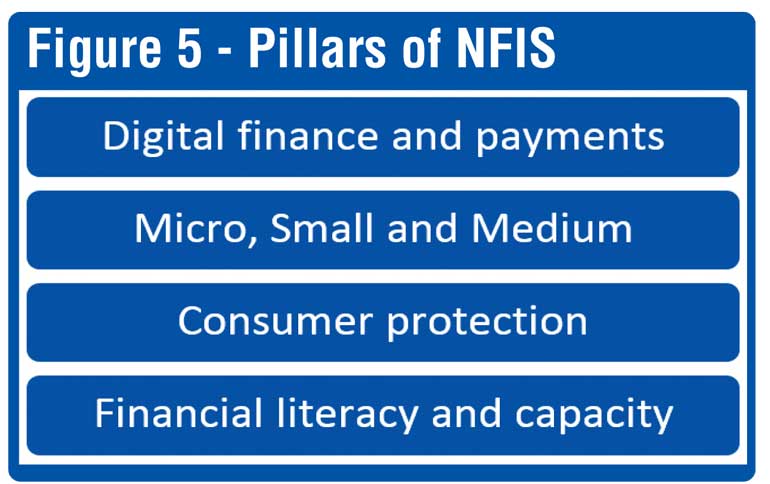
The NFIS for Sri Lanka has been articulated with the participation of many stakeholders in the public sector, private sector and the academic sector. There are four pillars under NFIS as shown in Figure 5.
Furthermore, since financial education has been highlighted as a major catalyst in the overall process of financial inclusion, priority has been given to intensify the relevant activities in the field under the NFIS. Such policies are included in the action plan of the NFIS with the consent of all stakeholders, including the institutions directly responsible for the implementation of the relevant policies. A coordinating and implementation control structure has been established to ensure the effective implementation of the NFIS.
Realising that Sri Lanka needs more than just easy access to financial products and services for financial inclusion, it has already taken the necessary steps to improve financial awareness. These include capacity development programs on financial literacy conducted by the CBSL through various Ministries and Government Institutions, skills development programs on MSMEs on financial management and low income and risk areas.
Conclusion
Considering the positive correlation between financial literacy and financial stability, propagating financial literacy among individuals, households, institutions, and the society would bring about future financial security and ensure the prosperity of a country. It shows that financial literacy of the society makes a positive contribution to the balanced and participatory development of a country and financial education is extremely important to increase financial literacy. All sections of the society should have the knowledge of financial transactions, financial markets, financial products, and simple financial concepts.
Improving personal financial management involves making regular savings as a habit, exercising prudence in borrowing and well-informed investment decision-making, all of which would help build up financial assets over time and develop suitable buffers such as contingent funds and retirement plans. Engaging in financial transactions without such knowledge and information could have socioeconomic consequences.
Many people who are living in the rural areas of Sri Lanka, especially the low-income segments, have been excluded from the formal financial sector due to lack of financial literacy. Financial literacy facilitates the understanding of what is needed to achieve a financially balanced, sustainable, and decent lifestyle. Improving financial education can benefit people in all walks of life, at all ages and in different income groups with different priorities.
The discipline created through proper financial education, enables individuals to establish greater economic security and stability during the latter part of their lives while increasing their incomes, savings, assets, and investments. It helps people to plan their pensions and savings wisely and provides them with the information and skills they need to make prudent investment choices to ensure they have adequate savings for a contented retirement.
A comprehensive public integration program is needed to improve financial literacy. The CBSL, in collaboration with the Government, is currently implementing the NFIS. Financial education is given high importance in this program and steps are being taken to include financial literacy related subjects in the school textbooks. The presence of people with financial literacy is crucial for the participatory and balanced development of a country. The steps to increase the levels of financial literacy must be taken since it will positively affect the country’s GDP per capita and is bound to have positive effects ripple across the country to help people withstand economic shocks.
References:
Bank Quest, The Journal of Indian Institute of Banking & Finance, January - March 2012
U Batsaikhan and M Demertzis (2018), Financial literacy and inclusive growth in the European Union, Policy Contribution Issue no. 08
Ramachandran, Ramakrishnan (2012), Financial Literacy and Financial Inclusion. 13th Thinkers and Writers Forum, Available at SSRN: https://ssrn.com/abstract=2204173
Antonia Grohmann and Lukas Menkhoff (2017), Financial literacy promotes financial inclusion in both poor and rich countries, DIW Economic Bulletin
Arora. A (2016), Assessment of Financial Literacy among working Indian women
Alliance for Financial Inclusion (2010), “Consumer Protection: Leveling the Playing Field in Financial Inclusion” Bangkok, Thailand
Financial Times (2020), Financial literacy among undergraduates: Research findings of concern,
Global Financial Literacy Excellence Centre, (n.d.). Retrieved from S&P GLOBAL FINLIT SURVEY: https://gflec.org/initiatives/sp-global-finlit-survey/
(The writer is Senior Assistant Director at the Central Bank of Sri Lanka.)
Subscribe to:
Posts (Atom)