Peace for the World World ! Your War Our Lives

The Dalai Lama
A Brief Colonial History Of Ceylon(SriLanka)
Sri Lanka: One Island Two Nations
A Brief Colonial History Of Ceylon(SriLanka)
Sri Lanka: One Island Two Nations
(Full Story)
Back to 500BC.

Friday, February 1, 2013
Sri
Lanka: Human Rights Failings Detailed


 (London) – The Sri Lankan government continued its
assault on civil society and failed to take meaningful steps towards
accountability for war crimes during the country’s armed conflict that ended in
2009, Human Rights Watch said in itsWorld Report
2013 released
today.
(London) – The Sri Lankan government continued its
assault on civil society and failed to take meaningful steps towards
accountability for war crimes during the country’s armed conflict that ended in
2009, Human Rights Watch said in itsWorld Report
2013 released
today.
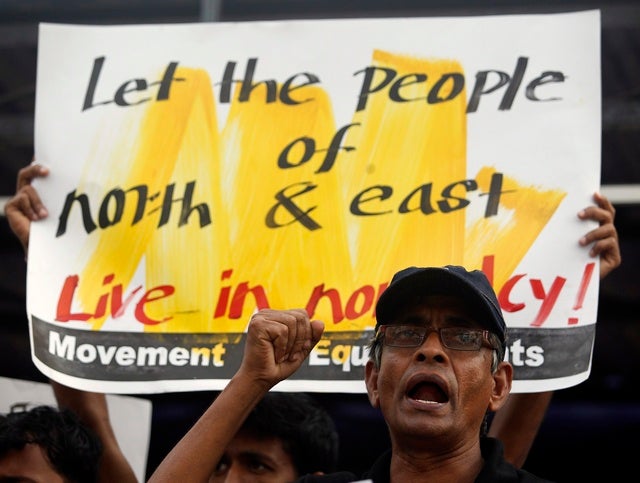
A
member of an equal rights movement shouts slogans during a protest against the
government in Colombo on December 18, 2012.
© 2012 Reuters

 (London) – The Sri Lankan government continued its
assault on civil society and failed to take meaningful steps towards
accountability for war crimes during the country’s armed conflict that ended in
2009, Human Rights Watch said in itsWorld Report
2013 released
today.
(London) – The Sri Lankan government continued its
assault on civil society and failed to take meaningful steps towards
accountability for war crimes during the country’s armed conflict that ended in
2009, Human Rights Watch said in itsWorld Report
2013 released
today.
In
its 665-page report, Human Rights Watch assessed progress on human rights during
the past year in more than 90 countries, including an analysis of the aftermath
of the Arab Spring.
There
was no fundamental progress on key human rights issues in Sri
Lanka over the past year, Human Rights Watch said. Overly broad detention
powers remained in place under various laws and regulations, leaving several
thousand people detained without charge. State security forces committed
arbitrary arrests and torture, including sexual assault, against ethnic minority
Tamils. Repatriated Tamils allegedly linked to the defeated Liberation Tigers of
Tamil Eelam (LTTE) were at particular risk, Human Rights Watch research found.
While the Tamil population in the north benefitted from greater access by
humanitarian groups, the military presence kept living conditions from being
normalized.
“The
Sri Lankan government needs to address the many problems that undermine basic
rights for people in the war-torn North and East,” said Brad Adams,
Asia director at Human Rights Watch. “Justice and accountability for abuses, an
end to torture in detention, and ending constraints on basic liberties continue
to prove elusive for the Tamil population.”
The
UN Human Rights Council, responding to the government’s prolonged failure to
investigate alleged laws of war violations, adopted a resolution in March 2012
calling on Sri Lanka to take all necessary steps to ensure justice and
accountability. It requested that the government expeditiously present a
comprehensive plan detailing the steps it had taken to implement the
recommendations of its own Lessons Learnt and Reconciliation Commission and
address accountability. The government replied with an ambiguous “action plan”
that presents unrealistic timetables and flawed processes for it to probe
civilian deaths and prosecute alleged perpetrators. The government has yet to
publicly release any information about concrete steps it has taken towards
implementing the recommendations set out in the Human Rights Council
resolution.
The
government demonstrated further disregard for human rights protections when,
during its Universal Periodic Review before the Human Rights Council in November
2012, it rejected 100 recommendations from member states, including some that
have a direct impact on accountability.
“UN
member states have made it clear through the Human Rights Council resolution in
March and the Universal Periodic Review hearings in November that Sri Lanka
needs to make fast and meaningful progress on its rights commitments,” Adams
said. “The Sri Lankan government should recognize that its past stalling tactics
have run their course and that it will need to take real action.”
President
Mahinda Rajapaksa and his brothers continued the trend of recent years to
accumulate power at the expense of democratic institutions, including the
judiciary, and constrict free speech and association. The government targeted
civil society through threats and surveillance. Statements by government
officials and government-controlled media named and threatened human rights
defenders who called for accountability for wartime abuses or criticized other
government policies.
“There
is ample evidence that Sri Lanka’s current government acts to serve its own
interests at great cost to democratic institutions and equal treatment of all
communities,” said Adams.
Local
activists expressed deep concern about the security of their staff and the
people they assist. The government shut down at least five news websites
critical of the government in 2012 and put in place onerous registration
requirements and fees for all web-based media services. The former editor of
theSunday Leader newspaper reported being threatened by Defence
SecretaryGotabaya Rajapaksa for publishing an article critical of him.
“When
a government fails to protect the rights of its citizens, the need for
international action increases,” Adams said. “The international community in
2012 focused renewed attention on Sri Lanka, and given the lack of progress on
accountability and the shrinking political space, should continue to do
so.”
