Peace for the World World ! Your War Our Lives

The Dalai Lama
A Brief Colonial History Of Ceylon(SriLanka)
Sri Lanka: One Island Two Nations
A Brief Colonial History Of Ceylon(SriLanka)
Sri Lanka: One Island Two Nations
(Full Story)
Back to 500BC.

Saturday, November 23, 2013
Sri Lanka-After the circus
A summit is not the public-relations success the president hoped for
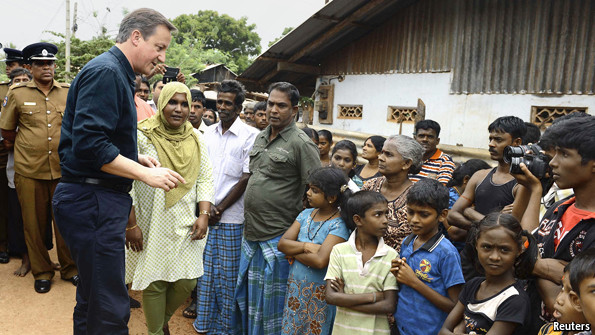
David Cameron in the Tamil north

 “HAS
the circus left town? Can I please return to Colombo now?” asked a
Twitter user on the morning after leaders of the Commonwealth left the
Sri Lankan capital after their summit ended on November 17th. With the
circus gone, the police chief gave hundreds of policemen three days off
to recuperate. Television advertisements touting the summit as a
“victory”—hosted despite calls for the venue to be changed because of
Sri Lanka’s dismal human-rights record—will soon cease.
“HAS
the circus left town? Can I please return to Colombo now?” asked a
Twitter user on the morning after leaders of the Commonwealth left the
Sri Lankan capital after their summit ended on November 17th. With the
circus gone, the police chief gave hundreds of policemen three days off
to recuperate. Television advertisements touting the summit as a
“victory”—hosted despite calls for the venue to be changed because of
Sri Lanka’s dismal human-rights record—will soon cease.
Whatever their differences about other matters, many Sri Lankans agree
that bad publicity tops the list of what the costly shindig has
achieved. International coverage focused heavily on persistent
allegations that war crimes were committed against civilians in 2009 as
Tamil Tiger rebels were crushed at the end of a brutal civil war; on the
disappearances of people both inside the war zone and outside it,
during and after the civil war; and on the suppression of the media.
The president, Mahinda Rajapaksa, had hoped that the hundreds of foreign
journalists who converged on Colombo would ignore such matters in
favour of reporting about the capital’s newly landscaped parks and a
magnificent line-up of garbed elephants. But at the three press
conferences he attended, Mr Rajapaksa was questioned repeatedly about
his failure to hold anyone to account for the deaths of nearly 40,000
civilians at the war’s end. The Commonwealth secretariat’s moderator
asked, cringingly, whether anyone had any questions not to do with Sri
Lanka and human rights. They did not.
The president and his hawkish government ought to have expected this,
but apparently miscalculated. The meeting had been preceded by calls for
a boycott. The prime ministers of Canada and Mauritius kept away,
citing human-rights concerns (Canada has a large and vocal Tamil
diaspora). In India, giving in to pressure from potential coalition
partners in Tamil Nadu, the prime minister, Manmohan Singh, also backed
out. In all, only 27 out of 53 heads of government showed up—the lowest
count in decades for a Commonwealth summit.
Of those who came, Britain’s prime minister, David Cameron, used his
visit to tell the government to carry out a credible and independent
investigation into alleged war crimes by March, when the UN Human Rights
Council next convenes. If it does not, he said, Britain would use its
position on the council to press for an international inquiry.
The Sri Lankan government is bristling. Ministers ask who Mr Cameron is
to issue deadlines to a sovereign country. The local press accuses him
of playing for the votes of Tamils in Britain. But ministerial aides
whisper that the government knows foreign governments are no longer
buying its excuses. Something more might have to be done before March.
One option is to turn to South Africa for guidance. Its president, Jacob
Zuma, has shared with the government and the Tamil National Alliance,
which runs Sri Lanka’s northern province after an election in September,
a suggestion for a truth and reconciliation commission. But it is hard
to believe that Mr Rajapaksa might follow through. Most of the proposals
made by the government’s own Lessons Learnt and Reconciliation
Commission (the word “truth” was avoided in the title) are yet to be
implemented. The government ordered the army to investigate a handful of
war-crimes allegations brought up by the commission. The army
exonerated itself.
Yet domestic pressure to do something more may increase. Even
government-friendly newspapers are starting to warn the president that
his troubles on this issue will not go away. Tamil and other politicians
may also push harder. But, the summit over, some activists fear a
government crackdown. People who met Mr Cameron during a visit to the
north, including relatives of the disappeared, may be at particular risk
of harassment and intimidation.
The president’s popularity among majority Sinhalese Buddhists,
meanwhile, is likely to grow. Already, they see him as a victim of an
international conspiracy to bring about regime change in favour of a
more pliable government. With India and the West looking less friendly
than ever, it might be tempting for Mr Rajapaksa to lean even closer to
China in the coming months. For all that, the president will remain as
the nominal head of the Commonwealth for the next two years, where
debate about his country is also likely to flare. Having asked to be in
the spotlight, the Sri Lankan president can hardly complain about the
heat.
