Peace for the World World ! Your War Our Lives

The Dalai Lama
A Brief Colonial History Of Ceylon(SriLanka)
Sri Lanka: One Island Two Nations
A Brief Colonial History Of Ceylon(SriLanka)
Sri Lanka: One Island Two Nations
(Full Story)
Back to 500BC.

Monday, August 24, 2015

 Sunday, August 23, 2015
As the intense heat of electioneering gradually subsides, sober relief
intermixed with reasonable wariness is reflected in the public mood this
week.
Uniting a quarrelsome opposition
Monday’s tensely played out general elections echoes this curious
combination of emotions in no uncertain terms. A deeply divisive
‘Satakaya-factor’ (a word play on the maroon shawl habitually worn by
former President Mahinda Rajapaksa) worked its anticipated black magic
as it united perpetually questioning ‘floating voters’ in opposition,
albeit less jubilantly than in January 2015.
 Eight
months of uncertain governance punctuated by an unseemly financial
scandal to boot under the alternative United National Party (UNP) proved
to be very much the lesser evil as against the threat of the
‘Satakaya’. The fundamental objective was clear. Prevent the former
President and his abominable band of Merry Men being catapulted into
power at all costs. This aim appears to have been realized at least for
now, even though many dissolute characters will sit in the chambers of
Parliament, no doubt equally intent as they were previously to
filibuster progressive legislation.
Eight
months of uncertain governance punctuated by an unseemly financial
scandal to boot under the alternative United National Party (UNP) proved
to be very much the lesser evil as against the threat of the
‘Satakaya’. The fundamental objective was clear. Prevent the former
President and his abominable band of Merry Men being catapulted into
power at all costs. This aim appears to have been realized at least for
now, even though many dissolute characters will sit in the chambers of
Parliament, no doubt equally intent as they were previously to
filibuster progressive legislation.
But what proved pivotal was President Maithripala Sirisena’s deft
balancing on a political tightrope between opposition forces which
brought him to power and members of his own party determined to stare
him down. The President asked for an affirmation of his January 2015
mandate, to which request the people responded, albeit tentatively and
cautiously.
The rejection of racism
That said, certain definitive trends were apparent. Rajapaksa supporters
had often derisively mocked that the January Presidential elections
came about only because of minority votes in the North and East. The
August general election result conclusively puts that despicable canard
to rest as majority Sinhalese polling divisions clearly turned against
racism and communalism.
Indeed, the Rajapaksa factor did not prove to be overwhelmingly decisive
even in the North-Western Province which the former President had
decided to contest from as a calculated move based on the human
contribution made from that Province to the war effort. While expectedly
large preferences came into his vote bank, this was by no means a
comprehensive routing of the UNP as predicted. In fact, the Rajapaksa
presence in Kurunegala only made people nervous; one rural estate
proprietor complained in pithy Sinhalese to me a week before the
elections’ I am not sure why he had to move from the South and come here
with all communalistic talk. He should have just stayed in the South.
Now his minions may start sending letters to us, grabbing all our
lands.’
This perception – and indeed – the raw reality of unbridled power which
the Rajapaksa Presidency demonstrated at the height of its rule proved
to be its undoing among Sinhala voters. This is a good lesson for cynics
who dismissed the January Presidential result as a political fluke
brought about by a one-off combination of factors. For those of us
struggling for years to mend gaping tears in Sri Lanka’s democratic
fabric, this is certainly heartening. So too is the electoral rejection
of racist political forces from the South to the North, particularly the
deservedly stinging slap across the face delivered to the Bodu Bala
Sena. That said, the election of major crooks on the UPFA ticket
including overt racists being returned from the Western Province
demonstrates a continuing tenacious Rajapaksa hold on a significant
urban voter base. This is not something to be complacent about.
The nature of the beast
Certainly the gravity of the democratic reform process which lies ahead
should not be underestimated in the face of such formidable challenges.
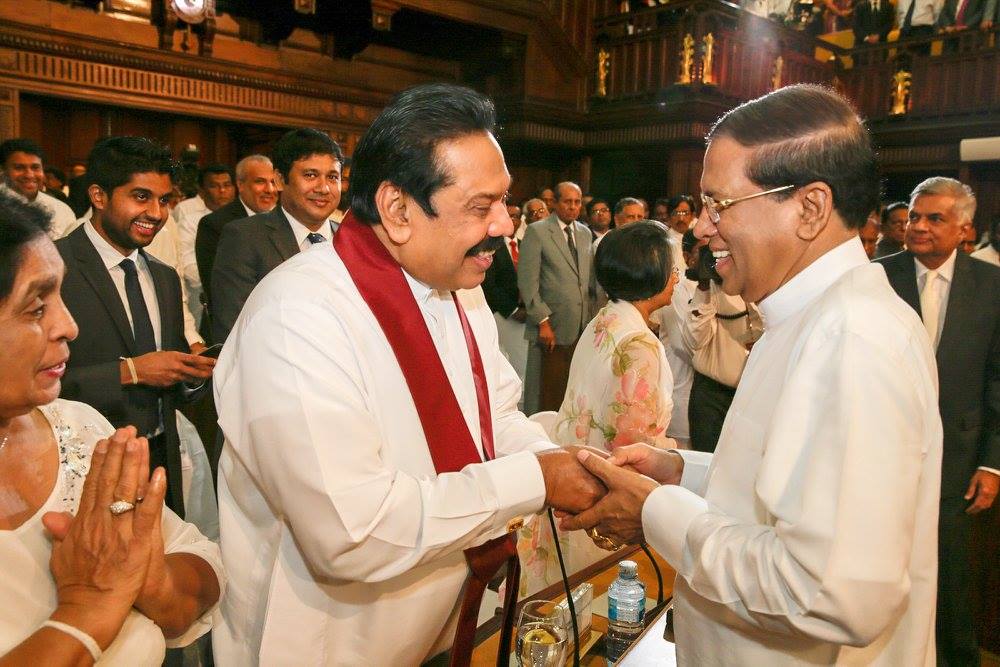
Even as the sight of former President Rajapaksa complete with immaculate
satakaya gracing the swearing in of the new Prime Minister at the
Presidential Secretariat sent uneasy shivers down the spines of some,
skeptics cannot be blamed for eying askance the commitment of the new
coalition government to actually implement the law against gross
corruptors of the previous regime. The UNP itself is not free from
blame. Its own failings in interim government were largely why it was
not afforded a totally enthusiastic peoples’ mandate to govern. Recent
mistakes should not be repeated if this fragile balance of power is to
prevail.
And President Sirisena’s opting to use the UPFA National List slots for
defeated candidates supporting him within the party is not an example to
be emulated. The unseemly controversies dogging the UPFA and the
Janatha Vimukthi Peramuna (JVP) National List nominees show us the true
nature of the political beast. In the final result, it is the thirst for
a coveted parliamentary seat which pushes fancy rhetoric of democratic
rights aside.
This mechanism of the National List is itself an aberration in any
event. For this election, the Lists of both major parties were stuffed
either with incompetents or by aged loyalists. Few were included on
merit. This device of a National List remains one of the many
democratically subversive features of the current Constitution. Serious
thought should be given if it should be continued.
Priorities for reform
In the final result, Sri Lankans and grizzled veterans of the Department of Elections headed by Mahinda Deshapriya may be deservedly proud of themselves for two peaceful and disciplined national elections held within an unprecedentedly short period. So much so that foreign election observers issued an injunction which may have seemed odd at any other time; namely that strict election laws unduly restricted candidates.
In the final result, Sri Lankans and grizzled veterans of the Department of Elections headed by Mahinda Deshapriya may be deservedly proud of themselves for two peaceful and disciplined national elections held within an unprecedentedly short period. So much so that foreign election observers issued an injunction which may have seemed odd at any other time; namely that strict election laws unduly restricted candidates.
As a new Parliament sits within coming weeks, the enactment of a
National Audit Act and the Right to Information Act need to be
prioritized. With a looming September report of the United Nations Human
Rights Council on war time accountability, systematic dismantling of
long standing structures enabling state impunity must be addressed. Mock
truth and reconciliation commissions or show trials will not suffice.
But the fear is that we may end up with much the same as before, with
one major party ruling in coalition together with a portion of the other
major party while the remainder of that party sits chaotically also in
the opposition.
Despite sunny talk of a National Government to address national issues, this is by no means a happy prognosis for Sri Lanka.
