Peace for the World World ! Your War Our Lives

The Dalai Lama
A Brief Colonial History Of Ceylon(SriLanka)
Sri Lanka: One Island Two Nations
A Brief Colonial History Of Ceylon(SriLanka)
Sri Lanka: One Island Two Nations
(Full Story)
Back to 500BC.

Tuesday, August 25, 2015
Sri Lanka's New Foreign Policy Presents Opportunities for India
Sri Lanka’s government wants a more balanced foreign policy and that’s good news for India.
 By Jhinuk Chowdhury-
August 24, 2015
One of the election platforms of the recently sworn-in Sri
Lankan prime minister, Ranil Wickremesinghe, has been to revise Sri
Lankan foreign policy, which has been excessively oriented toward China
in recent years, instead favoring a more balanced posture.
Under the previous regime of Mahinda Rajapaksa, both India and the West were increasingly alienated while the Chinese had free play in the country, crystallized in terms of investment in infrastructure or financing offers.
Wickremesinghe is expected to reverse this by devising a foreign policy
that is more broad-based, with renewed outreach to India, the United
States, Europe, and Japan.
As Sri Lanka continues this process, New Delhi–with Indian Prime
Minister Narendra Modi’s new focus on the Indian Ocean Region
(IOR)–could become Colombo’s most important partner as it strives to
revamp its economy and emerge from over a decade-long period of
international isolation.
As Wickremesinghe stated after
his victory in the recent elections, “It’s a new chapter in Sri Lankan
politics itself. Therefore, we should have close relations with India.”
With bilateral trade at
$5.2 billion in 2013-14, Modi, during his visit to Sri Lanka earlier
this year, pitched an expansion of the India-Sri Lanka free trade
agreement (FTA) and came out in favor of balancing bilateral trade,
which currently favors India.
Apart from an agreement on civil nuclear cooperation for peaceful use, Modi also pushed for a coal-based power project and over- and under-sea transmission line projects connecting India and Sri Lanka.
Experts say this could well lead to a “renewed wave“ of
Indian investment in the country. As India steps up its investment in
the Indian Ocean, financing projects like the Sittwe port in Myanmar,
and Chabahar port in Iran, Sri Lanka rises in importance.
So far, New Delhi has focused on reconstructing the war-ravaged Tamil-dominated northern areas of the country. Future focus will be on investment in the maritime realm.
Experts say that with the right amount of investment, Colombo and
Mumbai, today the busiest ports in South Asia, could become regional
hubs rivaling Singapore.
However, with its own infrastructure overhaul requirements, India cannot
entirely fulfill the needs of Colombo. Invariably Sri Lanka will have
to look toward investments from bigger powers.
The U.S., Japan and Australia are the most important countries that
Colombo can turn to. All three countries are highly interested in
deepening their footprints in the IOR.
The keen interest of Western powers in the region is evidenced by the
fact that immediately after Maithripala Sirisena assumed the presidency
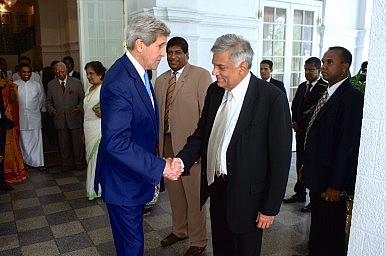
earlier this year, U.S. Secretary of State John Kerry visited the country, representing the first U.S. secretary of state visit since 2005.
Ahead of Kerry’s visit, a delegation of Sri Lankan naval officers were on board the USS Carl Vinson aircraft
carrier, underscoring the burgeoning naval relationship between the two
countries and their move toward increased maritime security
cooperation.
Sri Lanka will also have noticed that Japan, in its bid to counter
China’s growing involvement in the Asian infrastructure market,
announced a capital package of $110 billion dedicated to infrastructure development projects in Asia.
A significant part of the funds would be allocated to projects that will
be executed in collaboration with the Asian Development Bank. Sri Lanka
would certainly want a share of this.
Finally, in an interview with The Australian, Wickremesinghe also indicated his intent to restore relations with Australia by addressing the issue of asylum-seeker boats.
This new thrust in Sri Lankan foreign policy augurs well for India as it
steps up its efforts toward building partnerships across the IOR. Sri
Lanka’s proximity to these powers will help India’s aspirations for
multilateral leadership in the Indian Ocean gather more mass.
