Peace for the World World ! Your War Our Lives

The Dalai Lama
A Brief Colonial History Of Ceylon(SriLanka)
Sri Lanka: One Island Two Nations
A Brief Colonial History Of Ceylon(SriLanka)
Sri Lanka: One Island Two Nations
(Full Story)
Back to 500BC.

Sunday, September 27, 2015
How the people of Burkina Faso foiled a military coup
With arrested leaders reinstated and elections back on track, analysts say negotiated deal is a victory for democracy
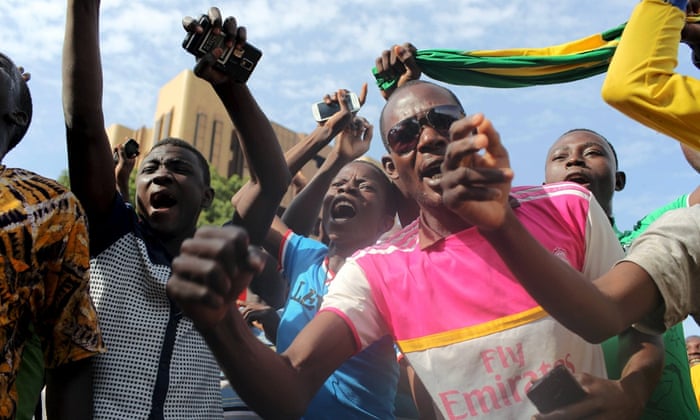
Anti-coup protesters sing the Burkinabé national anthem in Ouagadougou. Photograph: Joe Penney/Reuters

Simon Allison-Friday 25 September 2015
If there is one thing that Burkina Faso has
proved, it is that the country has an almost unlimited capacity to
confound the predictions of even the most seasoned observers.
When citizens protested against then president Blaise Compaoré last
year, no one expected the mass movement to work – or to see the
much-feared Compaoré, who had clung to power for 27 years, retreat into exile. And last week, when the head of the presidential guard arrested the interim leadership and declared himself in charge just three weeks before planned elections, few thought that General Gilbert Diendéré would be forced out within the week.
Yet this is exactly what happened.
The major reason for the coup’s defeat was that it was instantly unpopular. When the military takeover was announced on
18 September, there were spontaneous demonstrations in the capital
Ouagadougou. In October 2014, it was protests just like these –
organised under the banner of the Balai Citoyen (Citizen’s Broom) movement – that forced Compaoré out of office.
Emboldened by this success, the Burkinabé were not afraid to challenge the latest threat to democracy.
“The [popular protests against the coup] demonstrated that the Régiment
de sécurité présidentielle [the presidential guard] did not have control
over the vast majority of the country and would not be able to rule for
long,” said Eloise Bertrand, a researcher from the University of
Warwick and expert on Burkinabé opposition movements.
The second major factor was the resistance from the regular army, who
made it clear that they were willing to act against the elite
presidential guard. By ordering that Ouagadougou be surrounded,
army chiefs told General Diendéré – in a language that the long-time
military man would understand – that he would have to fight to maintain
his grip on power.
The third reason was that Diendéré and his loyalists – who have strong
ties to the Compaoré regime – were surprised by the vehemence of the
continental response. The coup was instantly condemned in the strongest
possible terms by the African Union (AU),
while regional body the Economic Community for West African States
(Ecowas) scrambled together a high-level mediation team.
“The AU considers the announcement by the military of the ‘dismissal’ of
President Michel Kafando and the attempt of substituting him with ‘new
authorities’ as null and void,” said the AU chairperson Nkosazana
Dlamini-Zuma in a statement.
This is unusually strong language for an institution that has a reputation for hedging its bets.
Ecowas played a more direct role. It was only after talks with the
Ecowas mediation team that interim president Michel Kafando was returned
to office, with the mediators instrumental in persuading Diendéré to
accept the deal.
“Ecowas played a highly significant role that demonstrates the potential
for effective regional intervention,” said Frank Charnas, CEO of risk
analysis firm Afrique Consulting. Charnas said that the Senegalese
president, Macky Sall, had initially led the efforts to resolve the
situation. But when civil society groups questioned his apparent
willingness to grant immunity to the coup leaders, the Nigerian
president, Muhammadu Buhari, took the lead.
This high-profile involvement has helped burnish Buhari’s credentials as
an African statesman. “Certainly, this may aid his image with regard to
foreign diplomacy … in the silent war for continental diplomatic
influence betweenNigeria and
Ecowas, and South Africa and Sadc [the Southern African Diplomatic
Community], the Burkina situation as it currently stands could be
chalked up as a victory for the west Africans,” said Charnas.
David Zounmenou, a senior researcher at the Institute for Security Studies,
agrees that Buhari’s role was pivotal. “Given his status as a former
coup leader and now democratically elected president, [Buhari] might
have been decisive in calling for the return of the interim president,
and that message was directly conveyed to the coup-makers,” he said.
For Zounmenou, the peaceful resolution of the Burkina Faso situation
reflects improving governance in the region as a whole. “Burkina Faso
will be a reminder that coups or military intrusion can no longer be
tolerated in west Africa. It is a strong signal to send coup-makers home
empty handed. This is the third leader removed from power in disgrace,
including Dadis Camara[Guinea], Amadou Sanogo [Mali] and now Gilbert Diendéré. Democracy has promising days ahead in the region,” he said.
In a further sign of progress in the region, Ecowas leaders narrowly
failed to pass a resolution in May outlawing all third terms for
presidents in the region (the move was blocked by Togo and Gambia).
Attention turns now to what happens next in Burkina Faso, where elections are tentatively planned for November.
Before they can go ahead, the country must tackle the issues which led
to the short-lived coup in the first place: the outsized role of the
presidential guard in government, the candidacy of members of Compaoré’s
former ruling party in the upcoming poll, and impunity for officials
implicated in crimes committed during Compaoré’s rule – including the
death of the legendary former president Thomas Sankara, with which
Diendéré has repeatedly been linked.
“It is a step in the right direction in the sense that the transition
has been preserved … it shows that the Burkinabé people are still ready
to defend what they fought for in 2014 and to prevent anyone from
confiscating their revolution,” said Bertrand.
