Peace for the World World ! Your War Our Lives

The Dalai Lama
A Brief Colonial History Of Ceylon(SriLanka)
Sri Lanka: One Island Two Nations
A Brief Colonial History Of Ceylon(SriLanka)
Sri Lanka: One Island Two Nations
(Full Story)
Back to 500BC.

Tuesday, July 26, 2016
Remembering Sri Lanka’s Black July
Taylor Dibbert-
 Sri
Lanka’s civil war pitted the almost exclusively Sinhalese military
against the Liberation Tigers of Tamil Eelam (LTTE). The LTTE fought for
a separate Tamil state in the northern and eastern parts of the
country. In May 2009, Sri Lankan military forces militarily defeated the
LTTE. However, the island nation’s ethnic conflict remains unresolved.
Sri
Lanka’s civil war pitted the almost exclusively Sinhalese military
against the Liberation Tigers of Tamil Eelam (LTTE). The LTTE fought for
a separate Tamil state in the northern and eastern parts of the
country. In May 2009, Sri Lankan military forces militarily defeated the
LTTE. However, the island nation’s ethnic conflict remains unresolved.
In this interview, Elil Rajendram examines war-related issues, the
current state of affairs in the country’s Tamil-dominated Northern and
Eastern Provinces and the ongoing search for justice.
Mr. Rajendram is co-spokesperson of the Tamil Civil Society Forum.
What is Black July? What happened on July 23, 1983?
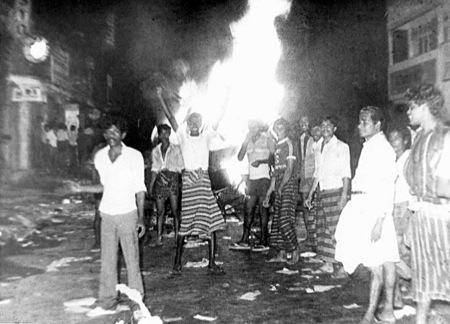
Black July was a pogrom that was unleashed on Tamils who were living in
Colombo and some other places. This happened after 13 Sri Lankan
soldiers were ambushed and killed by the LTTE in Thirunelvely, Jaffna.
After the incident in Jaffna, Sri Lankan soldiers killed 51 civilians in
Jaffna. The violence in the country lasted for several days and nearly
3,000 Tamils were killed. The death of the 13 soldiers was used to
justify violence against Tamils. Shops that Tamils owned were looted.
Tamils were even burnt alive and the police witnessed these incidents
without taking any preventative measures. Thousands of Tamils fled to
Jaffna, believing that staying in a predominantly Sinhalese area was not
safe for them.
The incident started a civil war between the Sri Lankan military and the LTTE.
What are the root causes of Sri Lanka’s longstanding ethnic conflict?
The institutionalized discrimination and injustice against Tamils in Sri
Lanka. This injustice is embedded in Sri Lanka’s constitution.
Mahinda Rajapaksa, the country’s
longtime president, lost a presidential election in January 2015. Since
the new government came to power, how much has changed in Sri Lanka’s
Tamil-majority Northern and Eastern Provinces?
Tamils speak about the “non-transition transition” while the Sinhalese
people residing in the Sinhala-majority South claim it is a real
transition. Why I state that it is a non-transition transition is
because militarization is at its peak. Abductions, arbitrary arrests and
sexual violence perpetrated by the military have not decreased.
Military involvement in the North and East is still strong. Most
military camps have become permanent and Sinhala colonization is
actually on the rise. Buddhist statues continue to be built in these
locations. However, as most human rights activists have noted, more
space for public dissent is available now.
The coalition government has set
out an ambitious transitional justice plan, including a truth commission
and a judicial mechanism to deal with alleged wartime abuses. How much
of that plan has been implemented? What would you like to see happen in
the next six to twelve months?
Since the end of armed conflict in 2009, Tamils have made it clear that
they would like to see an international inquiry to investigate the
crimes perpetrated by the government of Sri Lanka, including during the
last phase of the war. But a recent U.N. Office of the High Commissioner
for Human Rights inquiry has promoted a hybrid mechanism (which would
include both Sri Lankan and international participation). The Sri Lankan
government has now said that foreign judges will not be part of any
such mechanism; one can see this in the country’s print and electronic
media. For nearly 70 years, Tamils have not seen real justice via the
county’s judiciary system. We feel that the system is very biased and
favors the majority Sinhalese community.
How can the international community help Sri Lanka heal the wounds of war?
Only an international inquiry or international accountability mechanism
can ensure that the Tamil community sees justice. The international
community could help with that.
This interview has been edited for brevity and clarity.
