Peace for the World World ! Your War Our Lives

The Dalai Lama
A Brief Colonial History Of Ceylon(SriLanka)
Sri Lanka: One Island Two Nations
A Brief Colonial History Of Ceylon(SriLanka)
Sri Lanka: One Island Two Nations
(Full Story)
Back to 500BC.

Thursday, July 28, 2016
Revealed: the £1bn of weapons flowing from Europe to Middle East
AK-47s, machine guns, explosives and more travel along new arms pipeline from Balkans to countries known to supply Syria
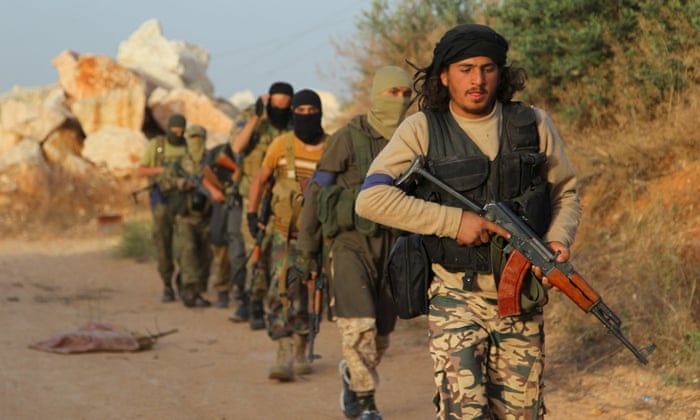
Jabhat al-Nusra fighters carry
assault rifles as they move towards their positions during an offensive
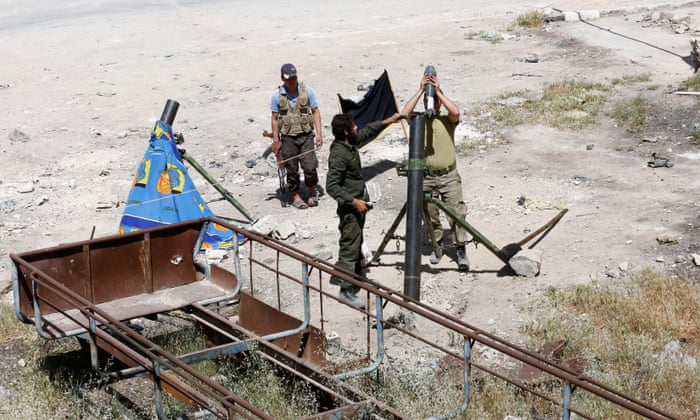
to take Ariha, Syria, in May 2015. Photograph: Ammar Abdullah/Reuters--Free Syrian Army fighters prepare to launch a mortar. Photograph: Reuters

The Serbian prime minister, Aleksandar Vučić. Photograph: Regis Duvignau/Reuters
Ivan Angelovski in Belgrade, Miranda Patrucic in Sarajevo and Lawrence Marzouk in London-Wednesday 27 July 2016

Eastern European countries have approved the discreet sale of more than
€1bn of weapons in the past four years to Middle Eastern countries that
are known to ship arms to Syria, an investigation has found.
Thousands of assault rifles such as AK-47s,
mortar shells, rocket launchers, anti-tank weapons and heavy machine
guns are being routed through a new arms pipeline from the Balkans to
the Arabian peninsula and countries bordering Syria.
The suspicion is that much of the weaponry is being sent into Syria,
fuelling the five-year civil war, according to a team of reporters from
the Balkan Investigative Reporting Network (BIRN) and the Organised Crime and Corruption Reporting Project (OCCRP).
Arms export data, UN reports, plane tracking, and weapons contracts
examined during a year-long investigation reveal how the munitions were
sent east from Bosnia, Bulgaria, Croatia, Czech Republic, Montenegro, Slovakia, Serbia and Romania.
Since the escalation of the Syrian conflict in
2012, the eight countries have approved €1.2bn (£1bn) of weapons and
ammunition exports to Saudi Arabia, Jordan, the United Arab Emirates and
Turkey – key arms markets for Syria and Yemen.
In the past, the region had virtually no track record of buying from central and eastern Europe. But purchases appear to be escalating, with some of the biggest deals approved in 2015.
Arms export licences were granted despite fears from experts and within
governments that the weapons could end up with the Syrian armed
opposition, arguably in breach of national, EU and other international
agreements.
Eastern and central European weapons and ammunition, identified from
videos and photos posted on social media, are now being used by
western-backed Free Syrian Army units, but are also in the hands of fighters from Islamist groups such as Ansar al-Sham, the al Qaeda-affiliatedJabhat al-Nusra, Islamic State, factions fighting for the Syrian president, Bashar-al-Assad, and by Sunni forces in Yemen.
Markings on some of the ammunition identifying the origin and date of
manufacture reveal significant quantities have come off production lines
as recently as 2015.
Responding to the findings of the investigation, Patrick Wilcken, an
arms control researcher at Amnesty International, and Bodil Valero, the
European parliament’s rapporteur on arms, said at least some of the
transfers probably breached EU, international and national laws on arms
exports.
“The evidence points towards systematic diversion of weapons to armed
groups accused of committing serious Human Rights Violations,” said
Wilcken. “If this is the case, the transfers are illegal under …
international law and should cease immediately.”
Origins of the trade route
The weapons pipeline opened in the winter of 2012, when dozens of cargo
planes, loaded with Saudi-purchased Yugoslav-era weapons and ammunition,
began leaving Zagreb bound for Jordan. Soon after, the first footage of
Croatian weapons emerged from Syria.
Croatia’s government has consistently denied any part in shipping
weapons to Syria, but Robert Stephen Ford, the US ambassador to Syria
between 2011 and 2014, said Zagreb had concluded a deal in 2012 that the
Saudis bankrolled.
This was just the beginning. Arms dealers in eastern Europe procured
assets from their own countries and brokered the sale of ammunition from
Ukraine and Belarus, even attempting to secure Soviet-made anti-tank
systems bought from the UK.
Since 2012, BIRN and OCCRP say, €806m worth of weapons and ammunition
exports were approved by the eastern European countries to Saudi Arabia, citing national and EU arms export reports and government sources.
Jordan secured €155m worth of export licences in this period, the
investigators say, while the UAE acquired €135m and Turkey €87m,
bringing the total for those four years to just under €1.2bn.
In a confidential document obtained by BIRN and OCCRP from November
2013, a senior official at Serbia’s defence ministry revealed concerns
that deliveries to Saudi Arabia would be diverted to Syria.
Jeremy Binnie, the Middle East arms expert for the publication Jane’s
Defence Weekly, said: “The militaries of Saudi Arabia, Jordan, and the
UAE and Turkey use western infantry weapons and ammunition, rather than
Soviet-designed counterparts. It consequently seems likely that large
shipments of such materiel being acquired by – or sent to – those
countries are destined for their allies in Syria, Yemen and Libya.”
The weapons are delivered by air and by sea. By tracking the movement of
aircraft and ships, BIRN and OCCRP were able to follow the flow of arms
in real time.
Detailed analysis of airport timetables, cargo carrier history, flight
tracking data and air traffic control sources helped pinpoint almost 70
flights that very likely carried weapons to Middle Eastern conflicts in
the past year.
Belgrade, Sofia and Bratislava emerged as the main hubs for the airlift.
Serbia’s aviation authority confirmed that 49 of the flights were
transporting weapons in a response to a freedom of information request.
EU flight statistics provide further evidence of the scale of the operation. They reveal that planes from Bulgaria and Slovakia have
delivered thousands of tonnes of unidentified cargo since the summer of
2014 to the same military bases in Saudi Arabia and the UAE pinpointed
by BIRN and OCCRP.
Arms bought by the Saudis, Turks, Jordanians and the UAE for Syria are
routed through two secret command hubs – called military operation
centres (MOCs) – in Jordan and Turkey, according to Ford.
The weapons are then transported by road to the Syrian border or
airdropped by military planes. The Saudis are also known to have
airdropped materiel, including what appeared to be Serbia-made assault
rifles, to their allies in Yemen.
“Each of the countries involved in helping the armed opposition retained
final decision-making authority about which groups in Syria received
assistance,” Ford said.
The Saudis and Turks are also known to have provided weapons directly to
Islamist groups not supported by the US and who, in some cases, are
fighting MOC-backed factions.
Washington has also bought and delivered large quantities of military
materiel from central and eastern Europe for the Syrian opposition in an
attempt to counter the spread of Isis.
Since December 2015, three cargo ships commissioned by the US military’s
Special Operations Command (Socom), in charge of the covert supply of
weapons to Syria, have left Black Sea ports in the Balkans for the
Middle East, according to American procurement documents and ship
tracking data.
Some 4,700 tonnes of Warsaw Pact weaponry – including heavy machine
guns, rocket launchers and anti-tank weapons, as well as bullets,
mortars, grenades, rockets and other explosives – have been delivered
from Bulgaria and Romania to military facilities in Jordan and Turkey,
according to procurement documents and ship tracking data. The latest
US-chartered ship left Bulgaria on 21 June carrying about 1,700 tonnes
of the same materiel to an unidentified Red Sea port.
SOCOM said in a statement the “munitions are to support Special Operations and its missions worldwide.
“We will not confirm types of equipment which may be used for training
and equipping partnered foreign forces in support of Special Operations
missions.”
Two weeks after a March 2016 delivery, Kurdish groups published on
Twitter and Facebook a photo of a warehouse piled with ammunition boxes
in northern Syria, claiming to have received a supply of US-brokered
weapons.
Reading the fine print
End-user certificates – official documents drawn up when receiving an export licence – issued by the Saudi defence ministry to a Serbian arms dealer, as well as a cache of contracts obtained by BIRN and OCCRP, revealed the scope of the buy-up for Syrian beneficiaries.
It ranged from hundreds of ageing T-55 and T-72 tanks to millions of
rounds of ammunition, multi-launch missile systems and rocket launchers,
although it is not clear what was delivered. Weapons and ammunition
listed include materiel from the former Yugoslavia, Belarus, Ukraine and
Czech Republic, much of which is present in large quantities in Syria.
An export licence issued to a Slovakian company in January 2015 granted
it the right to transport thousands of rocket-propelled grenade
launchers, heavy machine guns and almost a million bullets worth €32m.
The materiel was, again, produced across eastern Europe.
The Serbian prime minister, Aleksandar Vučić,
said at a press conference in June that his country could increase
production fivefold and still not meet the demand for arms.
“Unfortunately in some parts of the world they are at war more than ever
and everything you produce, on any side of the world you can sell it,”
he said.
Secrecy surrounding arms deals and a dearth of publicly available data
means that the exact items being delivered to the Middle East are often
unknown, but evidence collected, including UN and national arms export
reports and weapons contracts, reveals that much of it is Cold War-era
weaponry not in use by the militaries of Saudi Arabia, Jordan, UAE or
Turkey.
BIRN and OCCRP’s analysis of social media shows Czechoslovak, Yugoslav,
Serbian, Croatian and Bulgarian weapons being used in training and on
the battlefields of Syria, Yemen and Libya.
A Free Syrian Army commander from Aleppo, who asked to remain anonymous
to protect his safety, told BIRN and OCCRP that weapons from central and
eastern Europe were distributed from centrally controlled headquarters.
“We don’t care about the country of the origin we just know it is from
eastern Europe,” he said.
He said groups fighting pro-Assad forces rather than Isis were
struggling to access arms. “If you say that you are fighting Isis you
will get whatever you want but if you say that you are fighting against
the regime no one cares about you.”
Arms trade experts have told BIRN and OCCRP that sales of weapons to Saudi Arabia and
other countries supplying Syrian rebels are likely to be in breach of
national and EU law, as well as the international Arms Trade Treaty. But
no clear sanctions mechanism exists to punish countries that do not
meet these legally binding agreements.
Valero told BIRN and OCCRP that countries exporting weapons to Saudi Arabia from eastern Europe should feel ashamed.
She said EU member states – such as Czech Republic, Slovakia, Bulgaria,
Romania and Croatia – are bound by the union’s common position on arms
exports, while candidate countries also must align with the rules. This
requires governments to carry out risk assessments on the likelihood of
weapons being diverted to conflict zones and non-state actors.
“Countries selling arms to Saudi Arabia or the Middle East region are
not carrying out good risk assessments and as a result are in breach of
EU and national law,” she said. “I think these countries could be taken
to the European Court of Justice.”
Darko Kihalic, the head of the Croatia’s arms licensing department at
the Ministry of Economy, told BIRN and OCCRP that Zagreb follows the
legally binding EU Common Position on arms exports and other
international treaties.
Kihalic dismissed media reports that showed Croatian weapons were ending
up in war zones saying it did not constitute proof. But asked whether
he was aware that Croatian weapons bought by Saudi Arabia were turning
up in Syria, he said: “There is nothing more for us to check as the
document says that their ministry of defence or police forces will use
it [the weapon] and that they won’t resell it or export it.”
Saudi Arabia is not a “blacklisted” country, he said. “Are there misuses? There probably are.”
Valero and Wilcken, from Amnesty International, strongly opposed this view.
“All these states do have clear, legally binding responsibilities to
stop the transfer of arms where there is a risk that they will be used
for serious violations of international human rights and humanitarian
law, and to take mitigating measures to prevent diversion to
unauthorised end users,” said Wilcken.
In March, the Netherlands became the first EU country to stop arms exports to Saudi Arabia, citing mass execution and civilian deaths in Yemen.
Additional reporting by Lindita Cela, Jelena Cosic, Jelena Svircic, Atanas Tchobanov, Dusica Tomovic and Pavla Holcova.
