Peace for the World World ! Your War Our Lives

The Dalai Lama
A Brief Colonial History Of Ceylon(SriLanka)
Sri Lanka: One Island Two Nations
A Brief Colonial History Of Ceylon(SriLanka)
Sri Lanka: One Island Two Nations
(Full Story)
Back to 500BC.

Friday, September 9, 2016
Aid groups suspend cooperation with UN in Syria because of Assad 'influence'
Exclusive: Coalition withdraws from information-sharing programme, saying regime is manipulating relief effort
Syrians
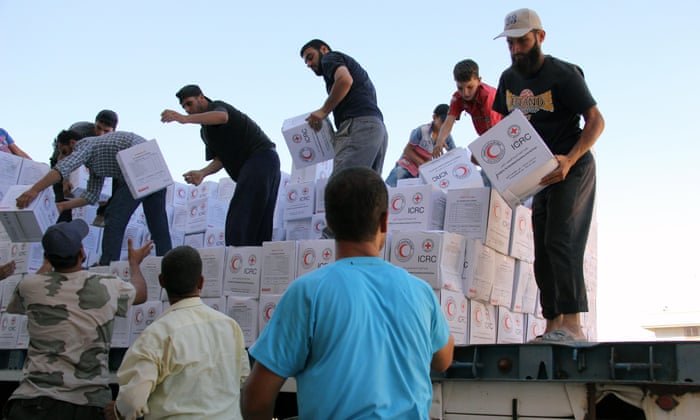
unload boxes after a 48-truck convoy from the ICRC, SARC and UN entered
the Syrian rebel-held town of Talbiseh. Photograph: Mahmoud Taha/AFP-Bashar
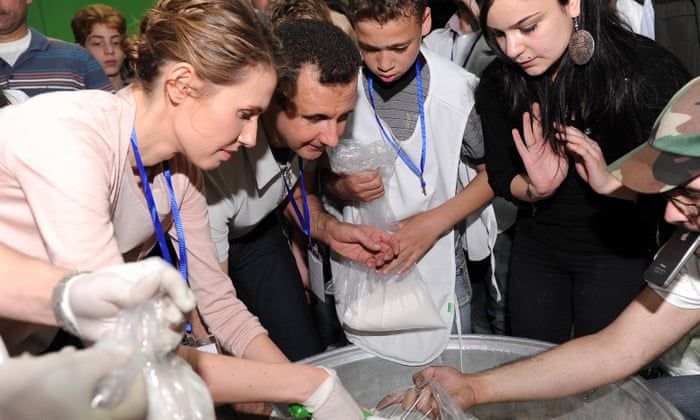
al-Assad and his wife, Asma, help pack aid supplies with volunteers at a
food distribution centre in Damascus. Photograph: AFP
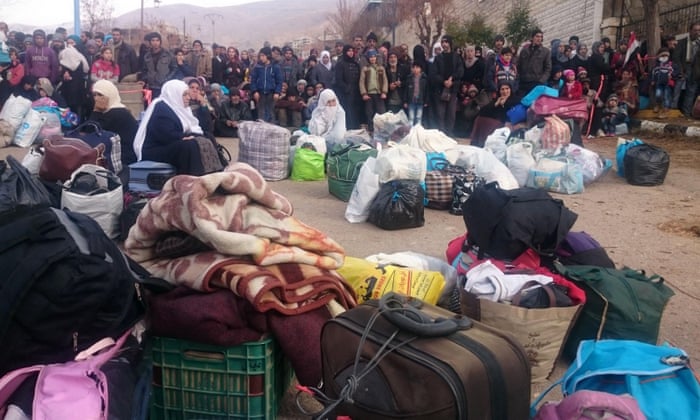
Syrians wait for the arrival of an aid convoy in the besieged town of Madaya. Photograph: Marwan Ibrahim/AFP/Getty Images

More than 70 aid groups have suspended cooperation with the UN in Syria
and have demanded an immediate and transparent investigation into its
operations in the country because of concerns the Syrian president, Bashar al-Assad, has gained “significant and substantial” influence over the relief effort.
The coalition, which includes some of Syria’s most widely known aid
organisations, told the UN it intends to withdraw from the UN’s
information-sharing programme in protest at the way some of its agencies
are functioning within the country.
In a letter to the UN (pdf),
the 73 groups made clear they could no longer tolerate the
“manipulation of humanitarian relief efforts by the political interests
of the Syrian government that deprives other Syrians in besieged areas
from the services of those programmes”.
The groups include the Syrian American Medical Society (Sams) and the
Syrian Civil Defence, or “White Helmets”, which help 6 million Syrians.
Their ultimatum is the culmination of months of frustration about the
delivery of aid to besieged areas of the country, and mounting concern
over the UN’s strategy – criticism the UN maintains is unfair.
Last week, the Guardian revealed the
UN has awarded contracts worth tens of millions of dollars to people
closely associated with Assad, including businessmen whose companies are
under US and EU sanctions.
The non-governmental organisations informed the UN Office for the
Coordination of Humanitarian Affairs (OCHA) of their concerns at a
meeting on Thursday afternoon in Gaziantep, Turkey.
The decision to withdraw from the Whole of Syria programme, in which
organisations share information to help the delivery of aid, means in
practice the UN will lose sight of what is happening throughout the
north of Syria and in opposition-held areas of the country, where the NGOs do most of their work.
In a letter given to OCHA, the groups said: “The Syrian government has
interfered with the delivery of humanitarian assistance in multiple
instances, including the blocking of aid to besieged areas, the removal
of medical aid from inter-agency convoys, the disregard for needs
assessments and information coming from humanitarian actors in Syria,
and the marginalisation of other humanitarian actors in the critical
planning phases of crisis response.”
The NGOs explained in their open letter they had concerns not just about
the UN, but also the Syrian Arab Red Crescent (Sarc), which works
closely with the UN and acts as a gateway for access to parts of the
country.
“The Whole of Syria information-sharing mechanism was created in order
to prevent gaps in the response by including all humanitarian actors
providing cross-border relief. Yet, UN agencies based in Damascus and
their main partner, Sarc, have been making the final decisions, shaped
by the political influence of the Syrian government.”
The letter added: “We are not hopeful that UN agencies based in Damascus
or Sarc will take concrete action to respond to the violations of human
rights in Syria in a way that might protect the Syrian people, or stop
the forced evacuation from several areas … we have little hope that the
UN-coordinated humanitarian response might operate independently of the
political priorities of the Syrian government.”
The groups said they thought it was reasonable to pressure the UN to help end the use of starvation as a “weapon of war”.
“That too has failed. This deliberate manipulation by the Syrian
government and the complacency of the UN have played hand in hand. The
people of Syria have suffered ever more as a result.”
The groups cited the case of the conjoined twins, Moaz and Nawras Hashash. The month-old boys died in Damascus while they were waiting to travel abroad for surgery.
“Syrian NGOs sent a complete proposal [to the UN and Sarc] … offering to
provide medical treatment. We received no response and were held on
standby until we received news of their death. We believe that the
inaction in this case summarises the inefficacy and inertia of the
humanitarian actors in Damascus, particularly Sarc leadership.”
The NGOs have called for a review of the controversial “four towns
agreement”, which ties the fate of residents in two towns besieged by
opposition forces to two besieged by government forces.
“We reported the death of 65 people resulting from malnutrition in
Madaya between November 2015 and May 2016, where medical evacuations
that could have saved patients’ lives were not permitted. Madaya is an
example of where over a million Syrians remain under siege with
extremely limited medical evacuations today.”
Speaking on behalf of the Syrian NGO alliance, Fadi Al-Dairi, the
co-founder of Hand in Hand for Syria, told the Guardian: “We have been
cooperating with OCHA, but we would add our points and OCHA Damascus
would remove them.
“Sometimes we would agree on reports and they would just take things off
afterwards, just remove it. We’re mainly worried about the political
pressure that the Syrian government has on the operation of the UN. As a
result, when you talk about besieged areas or medical evacuations, they
aren’t doing their job.
“The [UN] Turkey team, we are happy with them, but their bosses in
Damascus don’t listen to them. We lost confidence in the way they
operate and would like to see major changes to the way they work on the
Syrian response.”
The UN has repeatedly defended its operation in Syria in recent months and insisted it remains completely impartial.
In a letter to the Guardian,
Stephen O’Brien, the UN’s under-secretary general for humanitarian
affairs, said: “UN agencies must work with key government departments to
support the delivery of public services and humanitarian relief.
“Some governments, such as the one in Syria, insist that UN agencies
work with a list of authorised implementing partners. However, we choose
our partners from that list based on our own assessments of their
capacity to deliver and following due diligence processes.
“The impartiality of the UN’s humanitarian operations is fundamental to
saving lives and our focus is squarely on reaching people in need. To
achieve this, we must work with all to reach all.”
A UN spokesman told the Guardian: “Our choices in Syria are
limited by a highly insecure context where finding companies and
partners who operate in besieged and hard-to-reach areas is extremely
challenging.”
