Peace for the World World ! Your War Our Lives

The Dalai Lama
A Brief Colonial History Of Ceylon(SriLanka)
Sri Lanka: One Island Two Nations
A Brief Colonial History Of Ceylon(SriLanka)
Sri Lanka: One Island Two Nations
(Full Story)
Back to 500BC.

Wednesday, September 7, 2016
Building More Viharas In The North-East Will Negate Reconciliation Efforts

By Veluppillai Thangavelu –September 6, 2016
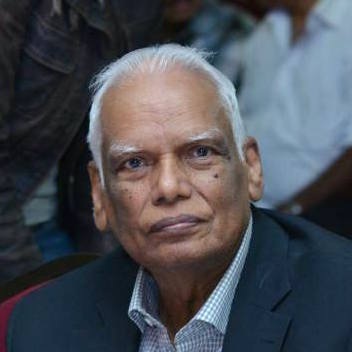
Veluppillai Thangavelu
On August 23, 2016 the Northern Provincial Council (NPC) passed a
resolution during the 56th sitting unanimously condemning the building
of a Buddhist vihara by Sri Lankan troops on land belonging to a Hindu
temple in Kilinochchi. The resolution was moved by NPC member
Subramaniam Pasupathipillai.
“The Kanakambikai Amman Temple has historical importance,” said Mr
Pasupathipillai “The military has occupied the house of the Gurukkal
located inside the temple premises and approximately 4.5 acres of land.
They are now constructing unlawfully a Buddhist vihara in the courtyard
of the house.”
Tamil National Alliance parliamentarian Sivagnanam Sritharan visited the
area recently, which has barbed wire fences around its perimeter.
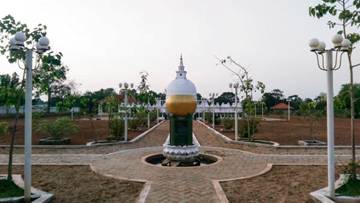
Mankulam
“This is a systematic campaign of ethnic cleansing of Tamils from their
traditional homeland,” Ceylon News quotes the MP as saying. “This is a
concerted Buddhist supremacist offensive by the government in the north
using the military force.”
The Tamil National People’s Front’s Selvarajah Kajendran also commented
on the development, stating that the move was “unacceptable”.
Northern Provincial Council Chairman C.V.K. Sivagnanam has forwarded the
said resolution to President Maithripala Sirisena and Prime Minister
Ranil Wickremesinghe. In his letter to the President and Prime Minister
the Chairman of NPC explained that the construction of the Buddhist
temple is on a 4.5 acres of land belonging to Kilinochchi Kanagambikai
Amman temple administration board, but presently occupied by the armed
forces. “This is a public encroachment of temple property and it is
completely against the religious and national reconciliation.
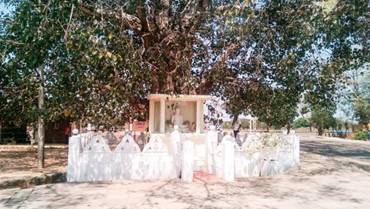
Paranthan
He also pointed out that this is a public encroachment of the temple
property and it is against the religious and national reconciliation
striving to be achieved by the government. Hence the NPC requests His
Excellency President and Hon. Prime Minister to take appropriate actions
to stop the construction of the Buddhist temple and to hand over the
land belonging to Kanagambikai temple to temple administration board.
On November 26, 2015 during the reign of President Mahinda Rajapaksa a
newly constructed ‘Ata Visi Buddha Mandiraya’ at the 24 Gemunu Watch
(GW) Headquarters under the Security Force Headquarters – Kilinochchi
(SFHQ-KLN) was opened by the army.
Major General Amal Karunasekara, Commander, SFHQ-KLN placed the Buddha
Statues at the ‘Ata Visi Buddha Mandiraya’ and conducted religious
observances by consecrating the peace. Senior Officers and other ranks
also attended the ceremony.
Troops from the Sri Lankan military orchestrated a religious ceremony
and placed 28 Buddha statues in the newly constructed Buddhist vihara
building in Kilinochchi.
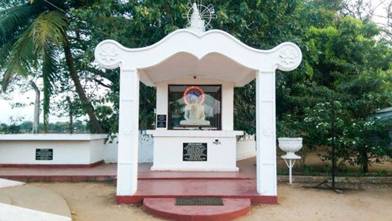
Iranai Madu
Buddhist monks attended the ceremony and blessed the newly constructed
‘Ata Visi Buddha Mandiraya’ at the Sri Lankan Security Force
Headquarters. Senior military officers and other ranks also attend the
ceremony. Apparently, the armed forces consider the Northeast provinces
as occupied territory, similar to Israeli occupied Palestinian (the West
Bank including East Jerusalem and the Gaza Strip) territory.
This is not the first instance where Buddhist viharas/statues have been
erected by the Sri Lankan armed forces occupying the Northeast, but the
pace and intensity has escalated since the defeat of the LTTE in May,
2009. It is part of the long-term conspiracy in the continued
Sinhalization and Buddhistization of the Northeast since independence.
The master-mind was Prime Minister D.S. Senanayake who under the guise
of settling landless Sinhalese peasants launched massive colonization
schemes like Gal Oya, Allai, and Kanthalai in the east. His successors
opened up similar colonization schemes like Mudalikkulam (renamed
Morawewa), Nochchikulam (re-named Nochiyagama), Periya Vilankulam
(renamed Mahadielwewa) etc.
Kokkulai
The colonisation scheme was extended into the Northern province with the
launching of the Manal Aru (renamed Weli Oya) colonization scheme by
the Mahaweli Development Board in 1984. Though Manal Aru covered the
districts of Mullaitivu, Trincomalee, Vavuniya and Anuradhapura
administration was handled from the Sinhalese dominated Anuradhapura
district.
A total of 13,288 Tamil families living in 42 villages for generations
including Kokkulai Grama Sevakar Division (1516 Tamil families), Kokku
–Thoduvai Grama Sevakar Division (3306 Tamil families), Vavuniya North
Grama Sevakar Division (1342 Tamil families) and other Divisions of
Mullaitivu District including Naiyaru and Kumulamunai (2011 Tamil
families) were asked to vacate their homes and farmlands within 48
hours, on pain of eviction by force in case of default. This threat was
issued by the army over the public address system. Simultaneously, land
given to 14 Thamil entrepreneurs, including Kent Farm and Dollar Farm,
on 99 years lease was also cancelled and taken over by the government
under a gazette notification. Settlements in the Weli Oya began in 1984
as a dry zone farmer colony under the land Commission, but it was later
acquired by the Mahaveli Economic Agency in 1988 and declared as the
Mahaveli ‘L’ zone.
Vadduvagal
In fact colonization of Manal Aru colonization scheme commenced as early
as 1984 and the Sinhalese army’s presence in the area dates back from
the same year. The Sinhalese army did use force as promised and scores
of Thamil villagers, some of them Hill country Thamil refugees, victims
of earlier Sinhalese violence in 1983, were murdered and the rest fled
in terror. The successive governments have used or abused the armed
forces as an instrument of state terror against the Thamil people. This
is true even today and the bulk of the army is deployed in the
Northeast. Out of 20 army divisions, 14 of them (Jaffna – 51,52,53,
Kilinochchi – 57,64,66, Mullaitheevu -59,64,68 and Vavuniya – 21,54,
56,61,62) are in the north and 3 (22,23, 30) in the eastern province. The highly politicised army is
resisting release of thousands of acres of private lands owned by
Thamils but falling within High Security Zones (HSZs) established by the
army.
Kanagarayankukam (Tupa)
In 2014, after completion of Sinhalese colonization, Manal Aru area was
re-attached to Mullaitheevu district. During the presidential election
campaign in 2014, Mahinda Rajapaksa handed over title deeds to the land
to 3,000 Sinhalese families at a ceremony held in Kilinochchi. A
separate Sinhalese AGA division has been created for the area.
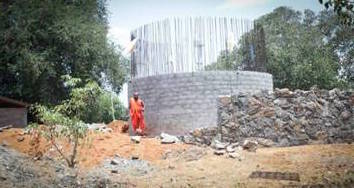
Since May, 2009 viharas/ statues have mushroomed in the Northeast,
especially the north where there is heavy army presence. Here is a short
list of districts where the army/navy has constructed Buddhist
temples/statues though hardly there are Buddhist worshippers. The list
is by no means complete.
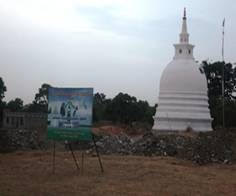
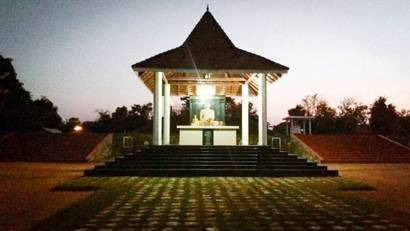
(1) At Kanagarayankulam in Kilinochchi district a Buddha statue and a Stupa have been erected.
(2) At Mankulam in Vavuniya district a Buddhist vihara has been built.
Electricity has been provided to this elaborate structure.
(3) At Iranaimadu in Mullaitheevu district a sculpture of a meditating Buddha has been installed under a peepul (Bo) tree.
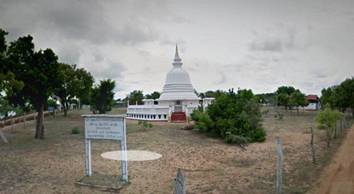
(4) A Buddhist vihara has been constructed at Vadduvaakal in the Mullaitheevu district.
(5) A huge Buddhist vihara is under construction in Kokkulai in
Mullaitheevu district after destroying the Hindu temple Karunaaddu
Pillayar.
(6) A Buddhist vihara named Mahatota Raja Maha Vihara has come up within
50 meters of the famous Thirukethiswaram temple in Mannar district. The
ancient name for Thirukethiswaram area was Mahathottam. The army
planted a 1500 kilo metal Buddha statue on the shores of Palavi
Theertham in the ancient temple. The fear is Thirukethiswaram may be
converted to a Buddhist temple like Kathirkamam temple in the south.

Kilinochchi
Kathirkamam temple, the 2,500 years old Hindu shrine is now in the hands
of Sinhalese. The Ohm sign above the entrance to the shrine has been
removed. Those interested in projecting Kataragama as a Buddhist centre
have capitalised on the colourful festival procession by introducing
Buddhist rituals into it. On the day before the water-cutting ceremony,
Lord Murugan goes to Kiri vihare to the Buddhists. Now, a `relic` is
taken ceremoniously from the Buddhist temple (formerly Perumal Hindu
Temple), to the Murugan temple, and then placed on a caparisoned
elephant and made to lead the procession. Lord Murugan no more
understands Thamil!
Sadly, but not surprisingly the Governor of the Northern province has
strongly defended the building of Buddhist temples in the province
saying that it is only part of a boom in the building of places of
worship there.
“Big Hindu kovils are being built and many Christian denominations have
come up with their buildings. But there are only 13 Buddhist temples in
the entire Northern Province, we don’t object to the Hindu kovils and
Christian churches coming up. We welcome them, I wonder why some should
object if the Buddhists built their viharas” was his answer to a
question put to him by a reporter at a press conference held in Colombo
on 16th August, 2016. The reporter queried him why a Buddhist temple is
being built on a person’s private property at Kokkulai in Mullaitivu
district. A subject that has created tension among the local population.
Kanagarayankulam
Defending his stand, the Governor went on to say that the Buddhist
temple had secured the permission of the local Pradesha Sabha and in a
case against it; the court had upheld the construction. It also has the
support of hundreds of Sinhalese families living there.
The Thamils see the construction of Buddhist temples as an extension of
Sinhalese-Buddhist hegemony in the North after the defeat of the
Liberation Tigers of Thamil Eelam (LTTE). Thamils wonder why Buddhist
temples are being built and Buddha’s statutes are erected in areas where
there are no Buddhist worshippers. What is more irritating is the fact
most of them are constructed by the armed forces. The message is
just a reminder telling the Thamils they are under the Sinhala –
Buddhist regime run by colonial governors. They are second class
citizens with inferior status compared to Sinhalese.
