Peace for the World World ! Your War Our Lives

The Dalai Lama
A Brief Colonial History Of Ceylon(SriLanka)
Sri Lanka: One Island Two Nations
A Brief Colonial History Of Ceylon(SriLanka)
Sri Lanka: One Island Two Nations
(Full Story)
Back to 500BC.

Saturday, October 29, 2016
FILM REVIEW: PRASANNA VITHANAGE’S USAVIYA NIHANDAYI (SILENCE IN THE COURTS)

 By Nanda Pethiyagoda.-27/10/2016
Thanks to the Colombo District Court that was not silent but judged
fairly that the injunction brought against screening Usaviya Nihandayi
produced by H D Premasiri and Prasanna Vithanage and directed by
Vithanage, be set aside. The film is now screened for public viewing. It
was scheduled to be screened at the Regal Cinema and other halls from
October 4 but had to be held back till the enjoining order brought
forward by the chief protagonist of the film, the magistrate, was
over-ruled by the judiciary. .
I saw the film at its premier at the Regal Cinema on 19 September. I
returned home with my head in a fair whirl and my sensibility determined
to unravel the questions and opinions and write a comment on the one
hour Sinhala film with English subtitling.
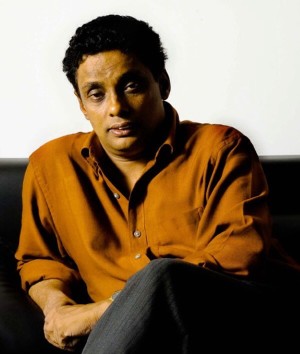
Director Prasanna Vithanage
 First
thought and comment: it was a complete success in a new genré of
Sinhala film. It was stunning; revealing with no hiding of names or
important personages intertwining incidents of rape of two innocent and
helpless women by a power that holds their husbands’ fate in its
detestable, verminous, sexually greedy hand. The hand of a magistrate
supposed to deal justice!
First
thought and comment: it was a complete success in a new genré of
Sinhala film. It was stunning; revealing with no hiding of names or
important personages intertwining incidents of rape of two innocent and
helpless women by a power that holds their husbands’ fate in its
detestable, verminous, sexually greedy hand. The hand of a magistrate
supposed to deal justice!
Advertised as a documentary, the film was completely different to the
run of the mill films, whatever their language. Hence the adducible
corollary that the director and producer have no eye on the box office
nor on sammanas. I feel the motive behind the film was serving humanity
and pleading for social justice, forcefully catalysed and prodded on by
Victor Ivan who appears in much of the film as himself, the
investigative journalist with a feeling for humanity strong in him, and
human rights activist Dayapala Thiranagama. They comment on the reports
they filed, Ivan in the Ravaya.
The first woman raped of the two featured in the film approach the two
of them with her complaint, having gone to the Human Rights Commission,
petitioned the BASL and even the President, with no results. This was
around 1998. After much trauma and actual damage, Victor Ivan’s Ravaya
exposé gets results, not real deserved justice and punishment and
compensation to the gravely harmed family but at least knocking off
temporarily a magistrate from his chair in courts.
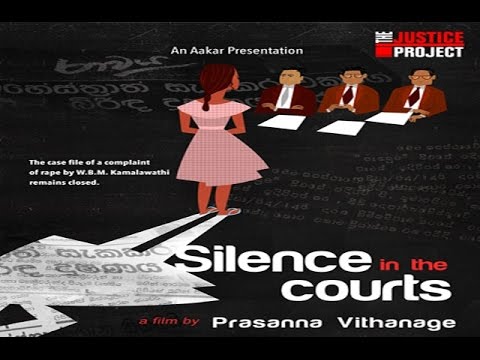
A poster of the film
Narratives
The film deals with two similar stories in the the 1990s where two
working class men are judged to serve time in jail for petty crimes.
Their young wives are summoned by the magistrate hearing the cases,
aided and abetted by an Attorney-at-Law, on the pretext of recording
evidence and being given some papers. The women naturally go as
requested to meet the magistrate. They are raped by him, one far from
her home in the Gampola Resthouse, the other in the Magistrate’s
chambers. The exploitation of the first young woman is shown on screen
in detail: without a word of by-your-leave after imbibing alcohol, the
magistrate rapes her four times. Then he tucks in grossly to rice and
curry.
When the first woman visits her husband the day his case is called after
a lapse of time, he complains of her tardiness in visiting him and
comments on her entirely different facial expression. Like all
unsophisticated and faithful women, she confesses she was raped. Her
husband’s response – a terrible slap through the cell bars to fell her
to the ground and the threat of deserting her. But they make up later.
The second woman’s husband goes berserk and plots and plans revenge as
he says he cannot stand the insult to his manhood. He takes two bags of
feces to courts and throws it at the magistrate, dowsing the rapist
thoroughly with what he deserved. A bottle of some gas is also taken and
when he dashes it against a wall, exploding it, everyone flees fearing a
bomb blast.
Themes
Large and clear is the human condition – not only of the disadvantaged
but the power wielding judicial persons, and brother lawyers who closed
their eyes and ears to the fact that the magistrate had been sacked from
a corporation for cheating and subsequently entered the judiciary. The
fraternity took no notice of Ivan’s stunning headlines and reports in
the Ravaya, until it became so substantiated with stark facts, that it
could no longer be ignored; his calling for a presidential commission of
inquiry to be instituted.
In much larger letters, in my imagination, right across the screen was
written HUMAN NATURE. Yes, particularly the character make-up of the
peasants of Sri Lanka who are depicted commenting in the film; the
suffering wives; the high-ups and more so those who wield power over
life and death, OK, imprisonment or freedom of a disadvantaged person
and the vulnerability of young women with children, left to fend for
themselves. Victor Ivan expresses the thinking of the few persons who
have social consciences, who care for the welfare of their fellow human
beings when he says he got interested in the case and took it on as an
exposé since here was an innocent woman caught in a trap and having no
recourse to any justice. As is the case in this country of ours, he
found himself soon enough the target of threats, but he persisted, even
traveling far out of Colombo when he heard the magistrate had raped
another woman and was transferred to a remoter station down South. By
now a judicial commission had been set up and the magistrate was found
guilty. His punishment – compulsory leave with half pay! I wondered how
he feels now. I do hope he is suffering. No pity felt as it was for the
Supreme Court judge who was pitted against a domestic who he supposedly
raped and tortured too. He fell off his balcony and that was the end of a
silent, most evil man
Extra features to be commended
Silence in the Courts included many scenes with Victor Ivan and a few
with Thiranagama, the former’s appearance prefaced or followed by the
thundering roll of newspaper printing machines. The commission sittings
and other interviews were sketched out and presented as drawings in
shades of sepia. Much footage was of the first girl walking with a small
child in arms and a boy of around six years beside her. She, the other
woman and the men gave evidence or answered questions with facial
silhouettes presented to the camera. Their faces seen sideways was what
filled the screen. There were also scenes of deserted roads in thorn
forests and the last scene which was a repetition of an earlier scene of
a calm wewa surrounded by vegetation as seen from a passing vehicle.
The film starts with the shot of railway lines and pans to the interior
of a moving train. Actual scenes, plus symbolic, to be interpreted as
one wished.
The next thought predominant in the mind, reinforced by the recent court
judgement, is that justice is more alive than it was during the
previous regime. The yahapalana government does not apparently allow
(and definitely should not) extra judicial power to those high-ups in
the legislature or judiciary.
Prasanna Vithanage is a film director of great expertise, and bold. He
represents the social conscience that should be present in all of us
collectively, but is sadly badly missing. He has to his credit films of
merit deserving great credit but earning censorship, such as Oba athuwa,
Oba Nethuwa which dealt with the doomed love between an ex-soldier and a
Tamil girl sent to Bogawantalawa to escape being raped by soldiers in
the North and/or conscripted by the LTTE.
Maybe being censored is a backhand compliment to his artistic excellence
and right thinking. We congratulate him on this new film of his – not
entertainment by any means but a cry, now fortunately not in the
wilderness, but heard and echoed by many. We are, thankfully, living in
better times, but of course exploitation of the disadvantaged still
continues and rape is on the increase.
– courtesy The Island
