Peace for the World World ! Your War Our Lives

The Dalai Lama
A Brief Colonial History Of Ceylon(SriLanka)
Sri Lanka: One Island Two Nations
A Brief Colonial History Of Ceylon(SriLanka)
Sri Lanka: One Island Two Nations
(Full Story)
Back to 500BC.

Friday, October 28, 2016
United Nations Special Rapporteur On Minority Issues: Statement On Sri Lanka


Dr. Asoka Bandarage
The United Nations Special Rapporteur on Minority Issues, Rita Izsak-Ndiaye released a Statement on Sri Lanka on
October 20, 2016 following a ten day visit to the island. Representing
the position of the ‘international community’, her Statement identifies
‘Sinhala-Buddhist majoritarian leadership’ as the main reason behind
minority grievances and Sri Lanka’s ‘long civil war’. The Rapporteur
expresses fears that keeping Article 9 of the Sri Lankan Constitution
which refers to the primacy of Buddhism, ‘could lead to further
suppression of and discrimination against minority religions and
communities’.
The mandate of the U.N. Rapporteur on Minority Issues is to ‘promote and
protect the rights of persons belonging to national or ethnic,
religious and linguistic minorities’, is a laudable one. This mandate,
however, does not grant the Rapporteur freedom to curtail the rights of
those belonging to majority communities using conceptually and factually
flawed approaches. The Rapporteur is deemed an ‘independent expert’ by
the United Nations. Unfortunately, her recent Statement on Sri Lanka
which is built on a narrow majority vs. minority concept and a lack of understanding of historical, regional and international contexts, exhibits neither independence nor expertise.
Majority Aggressor vs. Minority Victims
Like the dominant international perspective on Sri Lanka, the
Rapporteur’s Statement is based on a simplistic dualism: Sinhala
Buddhist majority aggressor vs. Tamil, Muslim, Christian and other
minority victims. This monolithic characterization ignores basic
incongruent realities. For instance, although Article 9 the Sri Lankan Constitution gives
‘foremost place’ to Buddhism (the religion of 70% of the island’s
population) and refers to the duty of the state to protect and foster
Buddhism, Article 10 asserts that “Every person is entitled to freedom
of thought, conscience and religion, including the freedom to have or to
adopt a religion or belief of his choice”.
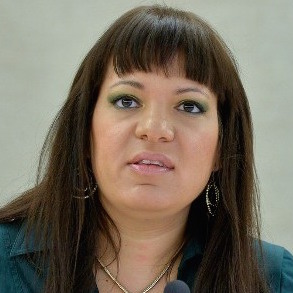
Rita Izsák-Ndiaye
Unlike most other pluralistic countries in the world, Sri Lanka has
Cabinet level Ministries each to protect and foster Hindu, Islamic and
Christian Affairs in addition to Buddhism. The critics of Article 9,
including the U.N. Rapporteur, fail to acknowledge that Article 9 has
not prevented Sri Lanka from allowing widespread Christian
evangelical and Islamic Wahabi proselytization and conversion which are
not permitted in Islamic and many other nations. In contrast,
international attempts to sever the historical link between Buddhism and
the Sri Lankan state, is sowing seeds of disharmony, aggravating
tensions, resistance and inter-religious conflict.
While the U.N. Rapporteur enumerates extensive mechanisms to be put in
place to promote and protect minorities, she does not acknowledge
minority dominance in the Sri Lankan economy and the influential and
strategic Cabinet Ministerships,
in Investment Promotion, Urban Development, Disaster Management,
Industry and Commerce, Tourism, etc. held by persons from minority
communities, especially the Muslims. She also fails to recognize the
powerful government positions recently acquired by members of the Tamil
community and the ethical and legal controversies surrounding some of
those appointments. In a seeming return to the ‘dominant minority’
position they enjoyed during the British colonial period, Tamil elites
have been appointed as the Chief Justice and the Governor of the Central
Bank. A Tamil politician was appointed as the Leader of the
Parliamentary Opposition even though his Tamil National Alliance party
won only 16 seats as opposed to the much larger number of seats gained
by the United People’s Freedom Alliance of the Sinhalese.
