Peace for the World World ! Your War Our Lives

The Dalai Lama
A Brief Colonial History Of Ceylon(SriLanka)
Sri Lanka: One Island Two Nations
A Brief Colonial History Of Ceylon(SriLanka)
Sri Lanka: One Island Two Nations
(Full Story)
Back to 500BC.

Thursday, December 29, 2016
The cruel experiments of Israel’s arms industry
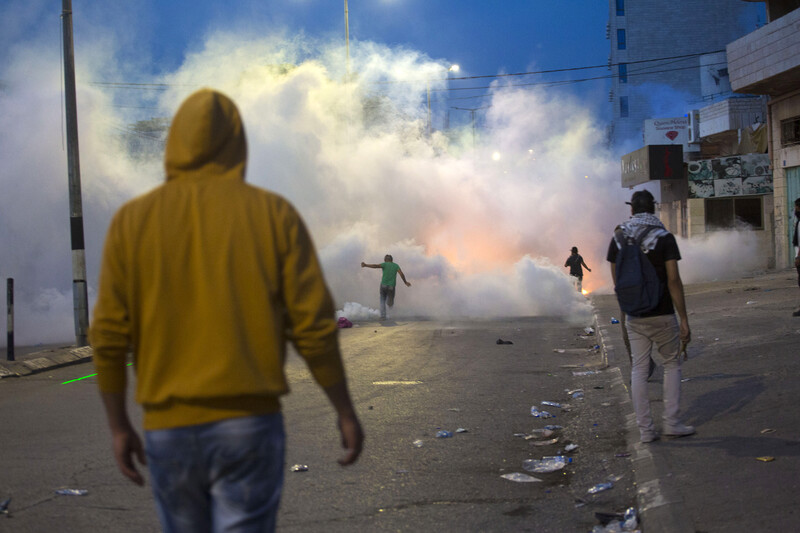
Palestinian protesters stand in a
cloud of tear gas fired by Israeli forces during confrontations in the
West Bank city of Bethlehem in October 2015.ActiveStills
Matt Kennard-27 December 2016

Round the back of Ramallah’s main
hospital lies the house of Iyad Haddad, a 52-year-old human rights
investigator. His home office is the shopfront of a decrepit building
and at first glance it looks like a bric-a-brac shop. But the objects
placed out on the tables are not household trinkets. The surfaces are,
in fact, cluttered with spent ammunition, tear gas canisters, sponge bullets and shell casings.
Haddad has spent the past three decades documenting the violence of the
Israeli forces occupying his people’s land. These ugly little pieces of
memorabilia are his testament to that process.
Many of these weapons have been fired on peaceful demonstrators
protesting against Israel’s wall and settlements in the occupied West
Bank. The villages of Nilin, Bilin and Nabi Saleh have been organizing regular protests for years. To my surprise, Haddad does not approve of those demonstrations.
“Sometimes they are using us so they can know how to use each kind of
weapon,” he said. “For me, these kinds of activities by the Palestinians
become helpful to the Israelis because it makes this area into a
laboratory to test their weapons, to develop them and make it a
commercial industry in order to sell them to other countries.”
The idea that the Israeli arms industry benefits from the occupation
through having a captive population it can test new weaponry on is now
widely accepted.
Israel tries out weapons in the West Bank and Gaza and then presents them as “battle proven” to the international market.
The high-velocity tear gas canister has been heavily tested in Bilin. In 2009, the weapon killed Bassem Abu Rahmah, an unarmed local activist, protesting the wall slicing into that village. At the end of 2011, another protester, Mustafa Tamimi, was killed in Nabi Saleh by a tear gas canister, shot at his head.
There is a sense of weariness in Haddad’s voice. “I have seen how they
are developing their tools and their weapons industry and the ways of
dealing with the community,” he said. “And, in 30 years, I never heard
once that there is any kind of accountability for any soldier.”
But he goes on. He must go on.
“Tested and retested”
“The laboratory of the occupied territories is where things can be fine-tuned, they can be tested, they can be retested,” said Neve Gordon, a politics professor at Ben-Gurion University of the Negev.
“They can say, ‘Hey this was used by the IDF [Israel’s military], this
must be good.’ And that helps the marketing of the goods.”
Later, in Ramallah, I sat down with Abdallah Abu Rahmah,
coordinator of the Popular Struggle Committee against the wall and
settlements in Bilin. Every Friday – for a decade – he and his neighbors
have gone to the wall to protest.
For these efforts, they have been subject to night raids by the Israeli military. Abu Rahmah himself has been arrested and imprisoned by Israel a number of times.
“There are many reports about when they [the Israelis] have tried to
sell military products and they told the buyers about its use in Bilin,”
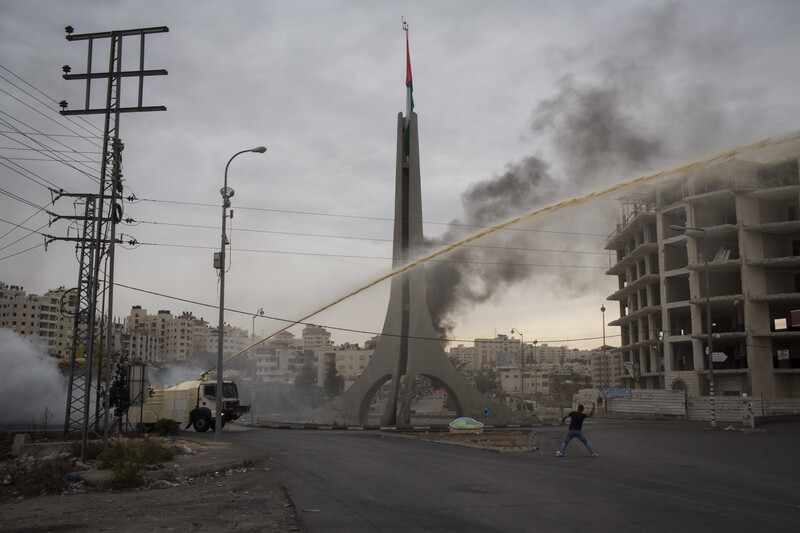
said Abu Rahmah. “Things like skunk water, they used it the first time
in our village.”
Skunk water is
a putrid smelling liquid that is sprayed at protesters in order to get
them to disperse. “Because Bilin is famous, sometimes they come to our
actions and they take video and photographs showing how effective the
weapons are in stopping the action,” Abu Rahmah said.
Jeff Halper, author of War Against the People,
a book on Israel’s arms and surveillance technology industries, said:
“Israel has kept the occupation because it’s a laboratory for weapons.”
“Now, there has always been a tension,” added Halper, also a founder of the Israeli Committee Against House Demolitions.
“Because you’ve had the right wing that look at the West Bank as Judea
and Samaria and Gaza as Gush Katif and, of course, East Jerusalem. So
they want it all as part of the land of Israel.
But then you’ve got another part especially the – I would say the
military and the economic people – that say, ‘Hey, this is a laboratory,
this is really a resource for us, and we really shouldn’t give it up.’”
Eitay Mack, a Jerusalem-based
human rights lawyer and activist, raises the prospect that Israel uses
Palestinians as test subjects for foreign arms companies as well.
Testing America’s bullets
“In East Jerusalem, the Americans give Israel sponge bullets,” Mack
said. “First, they started with a blue sponge bullet but then they
decided – this is their statement – that because the Palestinians wore a
lot of clothes, it was not very effective so then they changed it to a
[more powerful] black sponge bullet, which caused huge damage and there
are dozens of Palestinians that have lost their eyes and other organs of
their body.”
The black sponge bullets are manufactured by Combined Tactical Systems, a Pennsylvania-based firm which also supplies Israel with tear gas.
The company’s brochure for these bullets contains a note marked
“caution.” It reads: “Shots to the head, neck, thorax, heart or spine
can result in fatal or serious injury.”
Israeli troops began using the black bullets in 2014.
The Israeli arms industry is dominated by four companies: Israel Aerospace Industries, Elbit, Rafael and Israel Military Industries.
More than 75 percent of all weapons exported by Israel are made by the first three of those firms. In 2015, the total value of Israel’s arms exports came to $5.7 billion.
The attack on Gaza the previous year enabled Israel to showcase some of its newest weapons. It was reported, for example, that the Hermes-900, one of Elbit’s drones, made its “operational debut” in that assault.
Israel allocates more
than 5 percent of gross domestic product to the military. That means
Israel spends a higher proportion of its national income on the military
than even the US, the world’s only superpower.
“War sells weapons”
Some veterans of the Israeli military have developed careers as experts on the arms industry.
Shlomo Brom is one of them. A retired brigadier general, he now works at the Institute for National Security Studies in Tel Aviv.
I asked Brom if it’s true that Israeli arms companies use the fact that
their products have been tested on Palestinians to gain international
business. “Of course,” he replied. “Why not? Marketing [professionals]
try to use any advantage and if they can use the advantage that this
system was tested operationally and it worked, they will of course use
it for marketing.”
Uzi Rubin, a founder of Arrow, an Israeli anti-ballistic missiles
program, is now a researcher at the Begin-Sadat Center for Strategic
Studies in Bar-Ilan University near Tel Aviv.
He defended the way Israel has marketed its weapons as “battle proven.”
“It is legitimate because the Vietnam War sold a lot of weapons,” he
said. “War usually sells weapons. But this is not to say that Israel is
seeking war in order to sell weapons.”
Barbara Opall-Rome has spent a few decades covering Israel for DefenseNews,
a trade magazine for arms manufacturers. She advocates that Israel
should allocate greater resources into what she calls “less-than-lethal
technologies.”
In her view, the Israeli weapons industry should think beyond weapons
such as tear gas and skunk water that it is already deploying in the
West Bank.
“I’m talking about using the electromagnetic spectrum or high-powered
microwaves to get people dizzy,” she said. “If you’re dizzy you lose
your balance. You know, I’d rather people just get an upset stomach and
really just have to have diarrhea right in the middle of a demonstration
or puke their guts out than to be killed.”
Her comments reveal much about the sadistic mentality of Israel’s
weapons-makers and their promoters. For them, Palestinians are not human
beings worthy of respect but subjects in one cruel experiment after
another.
Matt Kennard is director of the Centre for Investigative Journalism in London. He is the author of Irregular Army: How the US Military Recruited Neo-Nazis, Gang Members and Criminals to Fight the War on Terror(Verso, 2012) and The Racket: A Rogue Reporter vs The American Elite (Zed, 2016). His trip to Palestine was partly funded by the Pulitzer Center on Crisis Reporting.
