Peace for the World World ! Your War Our Lives

The Dalai Lama
A Brief Colonial History Of Ceylon(SriLanka)
Sri Lanka: One Island Two Nations
A Brief Colonial History Of Ceylon(SriLanka)
Sri Lanka: One Island Two Nations
(Full Story)
Back to 500BC.

Friday, February 24, 2017
Don’t Backtrack on Justice for Sri Lanka’s Victims
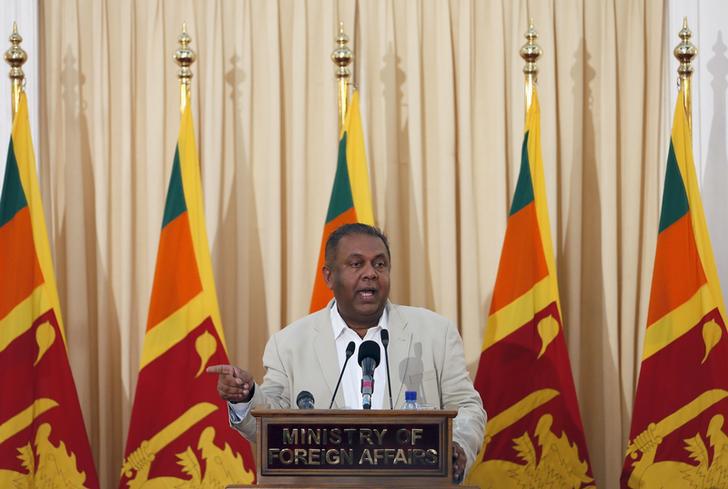
Foreign
Minister Mangala Samaraweera speaks during a news conference on a UN
report about Sri Lanka’s civil conflict, in Colombo on September 17,
2015.© 2015 Reuters

 Meenakshi Ganguly-FEBRUARY 19, 2017
- The draconian Prevention of Terrorism Act (PTA) remains in force, and there have been several arrests under this law in the past year
- Civil society groups are once again able to speak out safely on issues of concern
- There has been no tangible progress in setting up courts with international involvement to bring to trial those responsible for serious wartime violations
Sri Lankan Foreign Minister Mangala Samaraweera told journalists
recently that while his government was committed to justice, it was in
no great hurry to begin the process to ensure accountability for abuses
during the country’s long civil war. ‘Justice delayed, is justice
denied,’ goes the old adage, and one can imagine wartime commanders and
officials who committed atrocities breathing a sigh of relief. But for
the victims of abuses and their family members, the foreign minister’s
remarks must have seemed like another devastating blow to their fight
for justice for the loss of loved ones.
This is especially bad news since Samaraweera had been the leading Sri Lankan government official to recognise the need for justice and accountability particularly for the crimes in the final stages of the conflict with the Liberation Tigers of Tamil Eelam (LTTE), which ended in 2009. In 2015, the Sri Lankan government agreed to a United Nations Human Rights Council resolution that mandates the creation of various transitional justice mechanisms, including an accountability mechanism for war crimes that envisions international involvement. This change in approach won the new government praise, and at the Human Rights Council’s upcoming March session, the government will report on the steps it has taken.
This is especially bad news since Samaraweera had been the leading Sri Lankan government official to recognise the need for justice and accountability particularly for the crimes in the final stages of the conflict with the Liberation Tigers of Tamil Eelam (LTTE), which ended in 2009. In 2015, the Sri Lankan government agreed to a United Nations Human Rights Council resolution that mandates the creation of various transitional justice mechanisms, including an accountability mechanism for war crimes that envisions international involvement. This change in approach won the new government praise, and at the Human Rights Council’s upcoming March session, the government will report on the steps it has taken.
There have been a number of positive developments in Sri Lanka. Civil
society groups are once again able to speak out safely on issues of
concern. The UN High Commissioner for Human Rights and several UN
experts have visited over the last 18 months.
The government passed legislation to create an Office of Missing
Persons, and signed the International Convention against Enforced
Disappearance, two important steps toward tackling a massive
decades-long problem.
It has reportedly also started drafting legislation for truth-seeking
and reconciliation, as well as for reparations and non-recurrence of the
widespread human rights abuses carried out by the army and the LTTE,
which the government asserts are being revised to reflect national
public consultations.
For
the victims of abuses and their family members, the foreign minister’s
remarks must have seemed like another devastating blow to their fight
for justice for the loss of loved ones.
Yet, while substantial progress has been made in many areas, other vital
commitments have not been met. The draconian Prevention of Terrorism
Act (PTA) remains in force, and there have been several arrests under
this law in the past year. Moreover, many imprisoned PTA detainees were
charged after allegedly being tortured to confess. The government has
still not put forth a plan to provide redress for those unjustly
detained under the PTA.
Large tracts of land remain under military control, primarily in the
predominantly ethnic Tamil north and east. Delays plague the creation of
the Office of Missing Persons.
Above all, there has been no tangible progress in setting up courts with
international involvement to bring to trial those responsible for
serious wartime violations. A government appointed task force reported
in January that communities favour international participation in a
justice process.
Despite its inclusion in the Human Rights Council resolution, President
Maithripala Sirisena has increasingly spoken out against foreign judges
and other international involvement. So has former president Chandrika
Kumaratunga, now the head of the Office for National Unity and
Reconciliation who has recently said there was no “necessity to have
courts to probe war crimes” and opposed international participation in
the justice process.
A report issued in January by the government-appointed Consultation Task
Force, concluded that communities in both the country’s north and south
favour international participation in truth-seeking and justice.
While the Sinhalese-dominated south wants international technical
expertise, the Tamil-majority north wants a more robust international
role, including foreign judges, prosecutors and investigators. The
common theme within both communities, however, is that they believe
international participation is necessary due to lack of faith in the
government to ensure accountability.
So when a strong public supporter of justice such as Foreign Minister
Samaraweera appears to backtrack, there is little wonder that the
victims and the advocates on their behalf are deeply concerned. The
sooner the government publicly reinforces its commitment to justice, the
better for all.
If not, governments at next month’s Human Rights Council will have an
important opportunity to express their displeasure with Sri Lanka’s
go-slow approach. The victims of abuses have provided repeated testimony
at personal risk, braved surveillance and threats, and altogether
waited too long. It’s time to make justice a reality in Sri Lanka.
