Peace for the World World ! Your War Our Lives

The Dalai Lama
A Brief Colonial History Of Ceylon(SriLanka)
Sri Lanka: One Island Two Nations
A Brief Colonial History Of Ceylon(SriLanka)
Sri Lanka: One Island Two Nations
(Full Story)
Back to 500BC.

Tuesday, March 28, 2017
SAITM Controversy & Making Of The Middle Class Medical Professional: Net Loss To Sri Lanka!

By Siri Gamage –March 26, 2017

Dr. Siri Gamage
In my article on
class domination in Sri Lanka, I identified two segments of the Sri
Lankan Middle Class, i.e. English speaking vs. Sinhala speaking (we
could easily add Tamil speaking also to the latter). In this paper, I
argue that the SAITM controversy
not only reflects this division, competing interests and discourses
(language forms used for expression) but also the aspiration of the
Sinhala speaking (or Tamil speaking) parents to educate their children
and move their class status from Sinhala or Tamil speaking segment to
the English speaking segment against many odds. This is a broader trend
that is not limited to parents of these children who work hard for their
medical education through public or private universities. It is a trend
one can observe when it comes to the children of university academics,
other professionals, journalists, artists also. Moreover, the same trend
can be observed among the children of politicians, government
bureaucrats, private sector managers, and technocrats also.
This trend has its roots in the colonial impositions on the
Ceylonese/Sri Lankan society where the learning of English language and
learning other subjects through English were considered superior to
learning Sinhala or Tamil and learning through these mother languages
based on the ‘dominant modernist paradigm’ and its assumptions[1].
This trend which is rooted in Sri Lankan middle class psyche has far
reaching implications for the education sector, Sri Lankan identity,
loyalty to the country and diaspora living (via bifurcation of
identity), family structures and parent-children relations, as well as
the net economic gain or loss depending on the host and home country
divide. I elaborate this argument further in the following pages.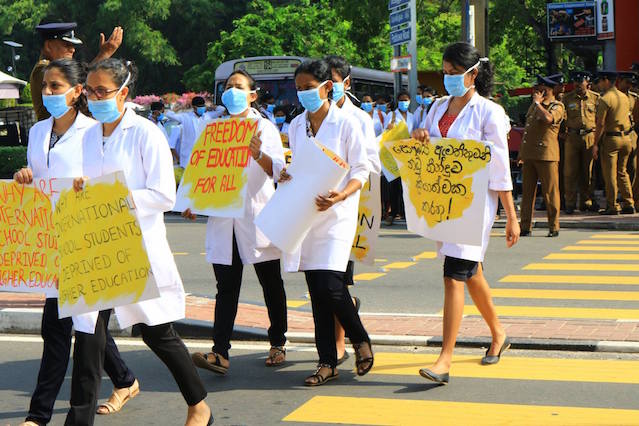
It is a well-known fact that ‘modernist education’, in particular (free)
higher education, produces and reproduces the middle class
professionals out of various cohorts of young people who come to
education institutions from a diversity of backgrounds with specific
values, norms, outlook, perspectives and a worldview[2].
These backgrounds can be as divergent as ethnic, caste, class,
language, religious, and locality. Thus students who grow up in far away
rural locations or born to parents of average income and wealth
‘succeed’ in their educational pursuits due to sheer commitment,
hardwork, encouragement by parents, and sacrifices in personal life.
They navigate complex academic and bureaucratic schooling and higher
education systems and processes –sometimes manipulated by those academic
and bureaucratic elites who make policies and decisions in these
respective fields- during their learning years while trying to follow
the norms and standards set by their superiors and teachers-supervisors
or gate keepers. Given the highly hierarchical nature of Sri Lankan
society, higher education is one avenue available for members of the
deprived classes to aspire to be a middle class professional.
Established parties preserve politics for the kith and kin of the
established political families with access to money and recognition.
Doing business requires capital, knowhow and networks.
