Peace for the World World ! Your War Our Lives

The Dalai Lama
A Brief Colonial History Of Ceylon(SriLanka)
Sri Lanka: One Island Two Nations
A Brief Colonial History Of Ceylon(SriLanka)
Sri Lanka: One Island Two Nations
(Full Story)
Back to 500BC.

Wednesday, April 5, 2017
European parliament backs red lines resolution for Brexit negotiations
Resolution on negotiating mandate insists that transition arrangement for UK after 2019 can last no longer than three years
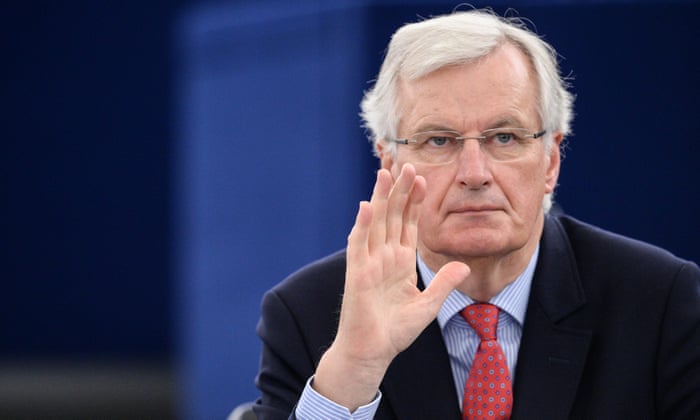
Michel Barnier says parallel divorce and trade talks would be ‘very risky’. Photograph: AFP/Getty Images
 Daniel Boffey in Strasbourg-Wednesday 5 April 2017
The European parliament has overwhelmingly backed a resolution detailing its red lines for Brexit negotiations.
MEPs in Strasbourg approved the negotiating mandate by 516 votes to 133,
with 50 abstentions, comfortably exceeding the two-thirds majority
sought by parliament leaders to show unity behind their approach.
The resolution calls for phased negotiations in the divorce proceedings,
going against the wishes of London, which would like exit talks and
discussions of a future trade arrangement to happen in parallel. It also
asserts that the UK must respect its membership obligations until it
leaves the EU.
Speaking during the debate that preceded the vote, the EU’s chief
negotiator picked apart Theresa May’s argument for a swift Brexit deal,
warning that parallel divorce and trade talks would be “very risky”.
Michel Barnier said it was not a ruse on the part of the EU to insist on
dealing with the UK’s divorce bill first, but an essential precondition
for success.
Citing the British prime minister’s six-page letter notifying the EU of
the country’s intention to withdraw, he said: “Theresa May’s letter
seeks a rapid agreement but, honourable members, the devil is quite
clearly going to be in the detail and the six months of work done so far
points to that.
“A single financial settlement, as a result of UK commitments to the EU,
and the EU commitments to the UK, there your resolution is very clear.
We do not seek to punish the UK but simply ask the UK to deliver on its
commitments and undertakings as a member of the EU.”
Barnier said the European parliament’s resolution, as the first response
to May’s letter by an EU institution, would set the tone for the talks.
The resolution insists that a transition arrangement for the UK after 2019 can last no longer than three years.
The European court of justice would also be responsible for settling any
legal challenges during the transition period, according to the
parliament, and there would be no special deal for the City of London
“providing UK-based undertakings preferential access to the single
marketand, or the customs union”. The parliament has the right to veto
any future deal between the UK and the EU.
Addressing the former Ukip leader, Nigel Farage, who earlier in the
debate accused the EU of behaving like the mafia in making “impossible
demands”, Barnier said: “In fact, Mr Farage, all we are doing is
settling the accounts no more, no less”.
The EU believes that the Treasury will need to pay about €60bn (£51bn)
to cover unpaid budget commitments, pension liabilities, loan guarantees
and spending on UK-based projects.
Some cabinet ministers have dismissed the idea of the UK paying a large
bill on leaving. However, Barnier explained that the EU could not with
confidence discuss the future without the British government having
dealt with its commitments from the past.
“The UK letter makes clear that the UK government will push for parallel
negotiations on the withdrawal and the future relations,” he said.
“This is a very risky approach. To succeed we need, on the contrary, to
devote the first phase of the negotiation to reaching an agreement on
the principles of exit. We are not proposing this to be tactical or to
create difficulties for the UK.
“On the contrary, it is an essential condition to maximise the chance of
reaching an agreement together in two years, which is very short. It is
also our best chance to build trust. To build trust before proceeding
to the second phase of negotiations.”
Barnier explained that, contrary to May’s recent claims that the EU and
UK would negotiate a trade deal after settling the issues of money and
citizens’ rights, the second phase of talks would merely be a matter of
scoping out what a possible deal would look like and coming to an
agreement on a transition arrangement to cushion the UK’s withdrawal on
29 March 2019.
“To put it differently, the sooner we agree on the principles of an
orderly withdrawal, the sooner we can prepare our future relations, a
free and fair trade agreement, a level playing field, but also in
security and defence.”
The European parliament’s Brexit coordinator, Guy Verhofstadt, spoke
sadly of Britain’s withdrawal, but admitted it had “never been a love
affair”. “Perhaps it was always impossible to unite Great Britain with
the continent”, he added.
He said he believed a young leader would in time try to place the UK
back in the EU, when a new generation was able to see Brexit “for what
it is – a catfight in the Conservative party that got out of hand, a
loss of time, a waste of energy, a stupidity”.
