by Iain Marlow and Saket Sundria-April 25, 2017, 5:00 PM EDT
Unit of India state-owned firm may fund oil storage facility
Move comes as Sri Lanka’s Prime Minister visits India
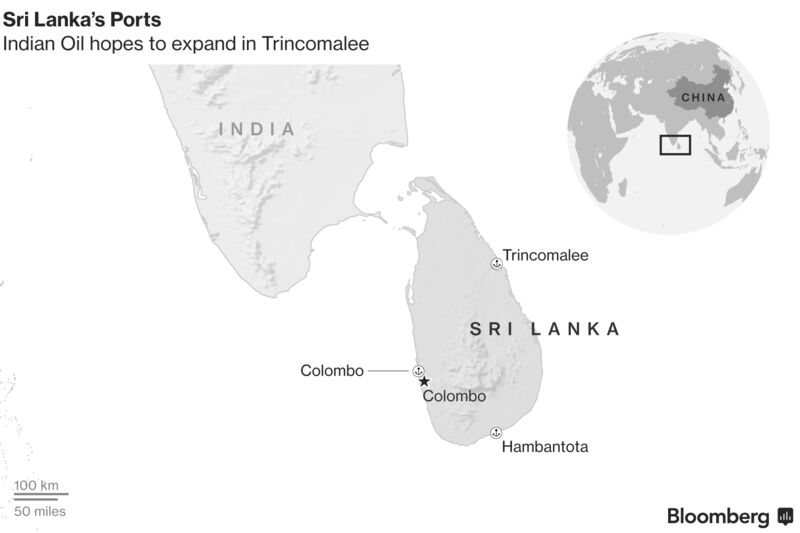
India is looking to invest in a colonial-era Sri Lankan oil-storage
facility as it seeks to further its naval interests in the Indian Ocean
and push China back in the process.
A unit of state-owned Indian Oil Corp.,
the country’s largest refiner, is set to help fund the $350 million
development of an 84-tank facility at the strategically located
Trincomalee port on Sri Lanka’s east coast. India and Sri Lanka are also
discussing setting up a refinery in the island nation, according to
Shyam Bohra, managing director of Indian Oil’s subsidiary Lanka IOC.
The talks come before a meeting Wednesday between Indian Prime Minister
Narendra Modi and Sri Lankan Prime Minister Ranil Wickremesinghe in New
Delhi. Modi is also due to visit Sri Lanka next month.
Still, India’s interests in the Sri Lankan port are probably more
strategic than economic, part of its effort to displace hefty investment
coming into the country from China and preserving a key gateway to the
Indian Ocean. China is expanding both militarily and economically in the
region, and its submarines have docked previously in Colombo.
Analysts cautioned that India has been slow to make big investments in
Trincomalee for decades, partly because New Delhi is content with a
small base that keeps adversaries out. There’s also no business case for
a third major port in the South Asian country of 20 million people,
they said.
‘Military Purposes’
"The biggest Indian strategic concern is that no one else uses that
harbor for military purposes," said David Brewster, a senior research
fellow with the Australian National University’s National Security
College. "And once it has a foothold, there’s a much more difficult
question of whether it will make significant investments."
The port at Trincomalee and its oil storage tanks was built by the
British when Sri Lanka was a colony and was used as a regional base for
the Royal Navy. Fifteen tanks are operational, each with a capacity of
12 million liters, or about 75,500 barrels. A further 84 are slated to
be renovated, bringing the total capacity to almost 7.5 million barrels.
By comparison, the Asian oil trading hub of Singapore has about 63
million barrels of independent storage.
Lanka IOC is managing the 15 tanks and a lubricant blending unit. The
governments of India and Sri Lanka have agreed in-principle to jointly
develop part of the tank farm, Bohra said, adding details are "yet to be
finalized."
The Sri Lankan government has suggested that Lanka IOC retain 74 of the
84 reconstructed tanks through an equal joint venture with Ceylon
Petroleum Corp., Chandima Weerakkody, Sri Lanka’s minister of petroleum
resources development, said by phone. The other 10 would be handed back
to Ceylon Petroleum, he said.
Bohra also said Lanka IOC is open to joint development of the tank farm.
"Something should definitely happen because we are very keen to see to it that the facility is developed,"
Weerakkody said. However, the minister compared India’s investments
unfavorably to China’s. "India should expedite their projects that they
engage in," he said. "Chinese investments, they are pretty quick."
India’s foreign ministry was not immediately available for comment. If
India’s investments materialize, the historic but relatively obscure
port could become a hub for New Delhi, whose navy must go around Sri
Lanka as it crosses from ports on India’s west coast in the Arabian Sea
to those on the east coast in the Bay of Bengal.
But New Delhi’s plans would almost certainly be worth far less than
Beijing’s ambitious infrastructure-building in Sri Lanka. China has
already built a port at Hambantota in Sri Lanka’s south in a move that alarmed Indian observers.
Beijing has also invested heavily in
Gwadar, a port in Pakistan that serves as the terminus of the
China-Pakistan Economic Corridor. Meanwhile, India is making slow
progress on a nearby port at Chabahar in Iran, which could one day allow Indian goods to reach Afghanistan by rail.
Sri Lanka does not want any Indian Oil investment in its existing
refinery at Sapugaskanda, close to Colombo, which processes 50,000
barrels a day for domestic consumption, Weerakkody said, adding the
company is welcome to set up a refinery for exports. Sri Lanka plans to
double the capacity of the refinery.
Geopolitical Priorities
Analysts said Sri Lanka doesn’t need any more ports, and that India’s
geopolitical interest in Trincomalee far outweighs any commercial
interests.
The main port in Colombo is already a major trans-shipment route for
large vessels, whose goods are unloaded, put on smaller ships and sent
to Indian ports, said Manoj Joshi, a distinguished fellow at the New
Delhi-based Observer Research Foundation.
Even Hambantota is not viable as a commercial operation, Joshi said,
noting China is developing a special economic zone surrounding the port
to boost business.
"It’s a tribute to Indian incompetence and Indian inefficiency that
goods are trans-shipped in Sri Lanka," Joshi said, noting that
developing Trincomalee might actually create competition for developing
Indian ports such as Chennai.