Peace for the World World ! Your War Our Lives

The Dalai Lama
A Brief Colonial History Of Ceylon(SriLanka)
Sri Lanka: One Island Two Nations
A Brief Colonial History Of Ceylon(SriLanka)
Sri Lanka: One Island Two Nations
(Full Story)
Back to 500BC.

Wednesday, April 26, 2017
Israel snubs German foreign minister in row over human rights talks
Benjamin Netanyahu cancels talks with Sigmar Gabriel after German foreign minister vows to meet Israeli rights groups
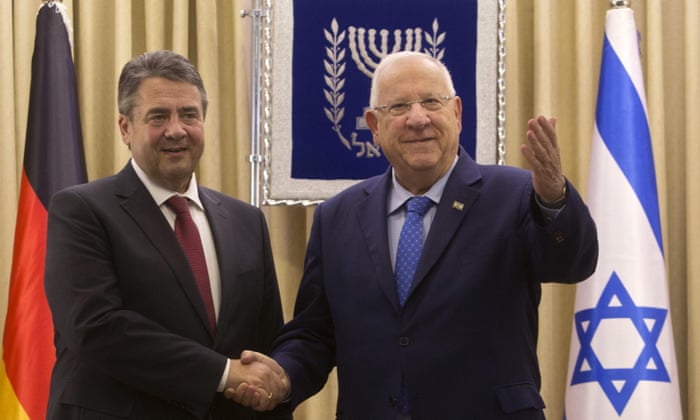
German
foreign minister Sigmar Gabriel (left) with Israel’s president, Reuven
Rivlin, in Jerusalem on Tuesday. Photograph: Sebastian Scheiner/AP

Israel’s prime minister, Benjamin Netanyahu,
has abruptly cancelled a meeting with the visiting German foreign
minister, Sigmar Gabriel, in a high-profile diplomatic row over the
German minister’s plan to meet two Israeli rights groups.
Netanyahu’s snub came after he issued an ultimatum to Gabriel to cancel meetings with military whistleblower group Breaking the Silence and human rights group B’Tselem.
Gabriel had responded by saying it would be “regrettable” if the meeting
were cancelled and indicated his intention to go ahead with them. In
comments to the German TV channel ZDF, he said it would be
“inconceivable” for the German minister to cancel a meeting with the
Israeli leader if the latter chose to meet figures critical of the
German government.
“You never get the full picture of any state in the world if you just
meet with figures in government ministries,” he told the channel.
A statement from the Israeli prime minister’s office said: “Netanyahu’s
policy is not to meet foreign visitors who, on diplomatic trips to Israel, meet with groups that slander IDF [Israel Defence Forces] soldiers as war criminals.
“Diplomats are welcome to meet with representatives of civil society but
Prime Minister Netanyahu will not meet with those who lend legitimacy
to organisations that call for the criminalisation of Israeli soldiers.
Our relations with Germany are very important and they will not be affected by this.”
Breaking the Silence is a group of former Israeli soldiers opposed to
the country’s continued occupation of the West Bank. Israeli leaders
oppose the group’s work, citing the anonymity of the claims and its
efforts to reach foreign audiences.
The row is unusual in that Israel and Germany generally have excellent
diplomatic relations. Gabriel was shunned last year in Tehran by Iran’s
parliamentary speaker, Ali Larijani, after he said that Berlin could
have friendly relations with Tehran if Iran recognised Israel.
It comes, however, amid a campaign by Netanyahu’s government to target groups it claims are critical of Israel.
The spat follows Netanyahu’s demand to Theresa May during an official visit to London that the British government cease funding Breaking the Silence, despite the fact it is not a recipient of direct British aid.
Justifying the Israeli move, an Israeli official said that Netanyahu’s
position remained the same. “It’s a choice between Breaking the Silence
and the prime minister,” said the official, speaking on condition of
anonymity because he was discussing a diplomatic matter.
Such disputes have arisen in the past between visiting foreign officials
and Israel’s government. In February, Israel reprimanded the Belgian
ambassador after the country’s prime minister, Charles Michel, met
B’Tselem and Breaking the Silence during a visit to Israel.
However, there was no public rebuke from the government when the British
foreign secretary, Boris Johnson, met anti-settlement NGO Peace Now
during a visit in March.
Netanyahu and his ministers have become increasingly preoccupied with Breaking the Silence. The group has been the principal target of a new funding law in the Knesset and there have been attempts to ban it from holding events in Israeli schools and public buildings.
Earlier this month, however, two former heads of Israel’s Shin Bet domestic intelligence agency publicly defended the group’s right to speak out.
The news came as Palestinian leaders said on Tuesday that Britain had
rejected their request for an apology for the Balfour Declaration, a
1917 letter that helped pave the way for the creation of the state of
Israel, and they would pursue international court action unless London
backtracked.
The Palestinian president, Mahmoud Abbas, called for the apology in an
address to the UN general assembly in September, but Britain plans to
hold celebrations along with Israeli officials to mark the November
centenary of the declaration.
“The answer came in a written letter to the (Palestinian) foreign
ministry that the apology is refused,” Manuel Hassassian, the
Palestinian ambassador to Britain, told Voice of Palestine Radio on
Tuesday.
