Peace for the World World ! Your War Our Lives

The Dalai Lama
A Brief Colonial History Of Ceylon(SriLanka)
Sri Lanka: One Island Two Nations
A Brief Colonial History Of Ceylon(SriLanka)
Sri Lanka: One Island Two Nations
(Full Story)
Back to 500BC.

Thursday, April 6, 2017
Smoking causes one in ten deaths globally, major new study reveals
Efforts
to control tobacco have paid off, says study, but warns tobacco
epidemic is far from over, with 6.4m deaths attributed to smoking in
2015 alone
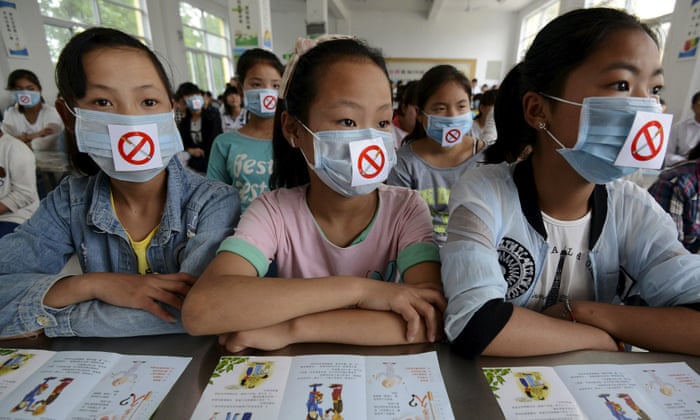
Students
wearing masks with no smoking signs attend an anti-smoking lecture in
Fuyang, China. More than a million deaths a year in China are from
smoking related diseases. Photograph: Reuters
 One
in 10 deaths around the world is caused by smoking, according to a
major new study that shows the tobacco epidemic is far from over and
that the threat to lives is spreading across the globe.
One
in 10 deaths around the world is caused by smoking, according to a
major new study that shows the tobacco epidemic is far from over and
that the threat to lives is spreading across the globe.
There were nearly one billion smokers in 2015, in spite of tobacco
control policies having been adopted by many countries. That number is
expected to rise as the world’s population expands. One in every four
men is a smoker and one in 20 women. Their lives are likely to be cut
short – smoking is the second biggest risk factor for early death and
disability after high blood pressure.
The researchers found there were 6.4m deaths attributed to smoking in
2015, of which half were in just four populous countries – China, India,
USA, and Russia.
Major efforts to control tobacco have paid off, according to the study published by the Lancet medical journal.
A World Health Organisation treaty in 2005 ratified by 180 countries
recommends measures including smoking bans in public places, high taxes
in cigarettes and curbs on advertising and marketing.
Between 1990 and 2015, smoking prevalence dropped from 35% to 25% among
men and 8% to 5% among women. High income countries and Latin America –
especially Brazil which brought in tough curbs on tobacco – achieved the
biggest drops in numbers of smokers.
But many countries have made marginal progress since the treaty was agreed, say the authors of the study from the Institute of Health Metrics
and Evaluation at the University of Washington in the US. And although
far more men smoke than women, there have been bigger reductions in the
proportions of men smoking also, with minimal changes among women.
Senior author Dr Emmanuela Gakidou said there were 933m daily smokers in
2015, which she called “a very shocking number”. The paper focused only
on those who smoke every day. “The toll of tobacco is likely to be much
larger if we include occasional smokers and former smokers and people
who use other tobacco products like smokeless tobacco. This is on the
low end of how important tobacco is,” she told the Guardian.
There is much more that needs to be done, she said. “There is a
widespread notion that the war on tobacco has been won but I think our
evidence shows that we need renewed and sustained efforts because the
toll of smoking in 2015 is much larger than most people would think, so
we absolutely have a lot more to do. We need new and improved strategies
to do it and a lot of effort and political will.”
Traditionally there have been far fewer women smoking around the world than men, but it was a huge problem for both, she said.
“There are some really worrisome findings – for example in Russia female
smoking has increased in the last 25 years significantly. There are
also some western European countries where about one in three women are
smoking. So it is true globally that a lot fewer women smoke than men
but there are some countries where it is a big problem for women,” she
said.
Dr Kelly Henning of Bloomberg Philanthropies, which is committed to
tobacco control and co-funded the study with the Bill and Melinda Gates
Foundation, said: “I think the study highlights the fact that the work
is not finished on tobacco. The good news is the decline in daily
smoking among men and women ... however there are still many smokers in
the world and there is still a lot of work to do. I think we have to
keep our eye on the issue and really do more.”
Countries with some of the highest death tolls such as China and
Indonesia “really don’t need those health problems - they have so many
other issues they are trying to address. But tobacco control is
critically important in those places,” she said.
“China has more than a million deaths a year from smoking related
diseases and China is only beginning to see the effects of their high
male smoking rate. That is only one instance of what is expected to
become an extremely major epidemic,” she said.
Writing in a linked comment, Professor John Britton from the University
of Nottingham said: “Responsibility for this global health disaster lies
mainly with the transnational tobacco companies, which clearly hold the
value of human life in very different regard to most of the rest of
humanity.” British American Tobacco, for instance, sold 665bn cigarettes
in 2015 and made a £5.2bn profit.
“Today, the smoking epidemic is being exported from the rich world to
low-income and middle-income countries, slipping under the radar while
apparently more immediate priorities occupy and absorb scarce available
human and financial resources,” he writes. “The epidemic of tobacco
deaths will progress inexorably throughout the world until and unless
tobacco control is recognised as an immediate priority for development,
investment, and research.”
