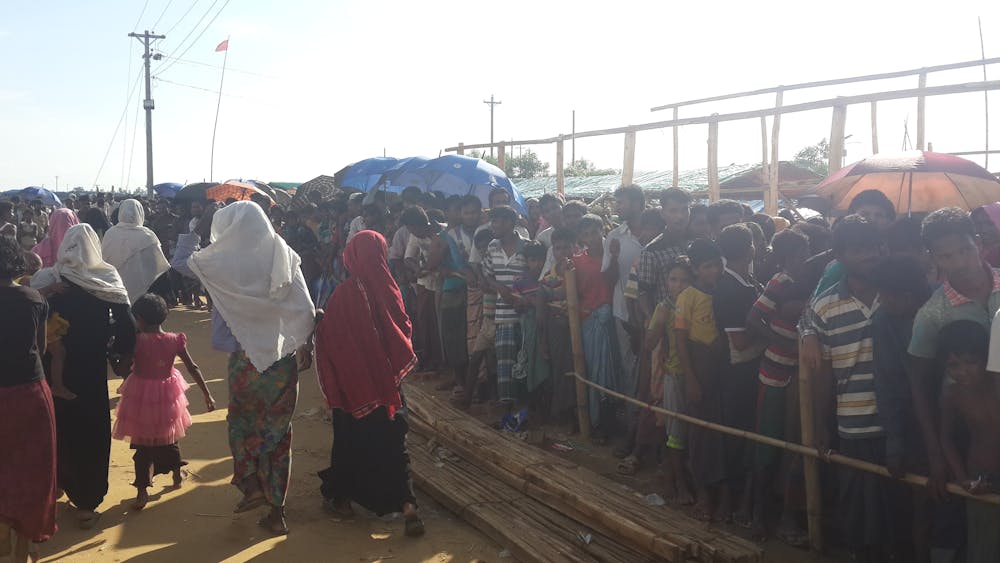
Rohingya refugees wait in line to receive humanitarian aid in Kutupalong
refugee camp near Cox's Bazar, Bangladesh, October 29, 2017. Source:
Reuters/Hannah McKay
IF THERE’s anything positive about the sprawling Rohingya refugee camps
near Cox’s Bazaar, Bangladesh, it’s that the residents – despite their
appalling recent experiences and obvious deprivation – are at least safe
here from Myanmar’s military.
I’ve been visiting Rohingya refugee camps close to the Bangladesh/Burma
(Myanmar) border, and the scale of the forced migration is truly
horrifying. Land unoccupied in late August is now a cramped shanty city
of bamboo, tarpaulin and mud that seems to go on forever.
Interviews in the camps paint a desperately sad picture. The details of
these interviews are invariably confronting and often distressing, and
explain why so many Rohingya fled Burma so quickly.
A farmer becomes understandably emotional when he tells me:
I lost my two sons, and two daughters. At midnight the military come in
my house and burnt the house, but first they raped my two daughters and
they shot my two daughters in front of me.
I have no words to express how it was for me to suffer to look at my
daughters being raped and killed in front of me. My two sons were also
killed by the government. I was not able to get the dead bodies of my
daughters, it is a great sorrow for me.
The Honey Stream at Kutupalong Camp. Source: Ronan Lee, Author provided
Background to the refugee crisis The military’s ongoing “clearance operation” began in late August with the supposed aim of ridding Burma of a recently emerged militant group. But this campaign’s real intent is now widely regarded as being to force the ethnic Rohingya, a Muslim minority, from their homes, away from their land, and out of Burma. Burma’s
military, the Tatmadaw, has used tactics that are brutal,
indiscriminate, and yet sadly familiar to the Rohingya and other groups
in Burma such as the ethnic Kachin and Karen.
Witnesses described to me how, when the Tatmadaw arrived at their
village, the soldiers fired weapons and killed people inside wooden
homes, arrested young men, raped women, told residents to leave, and
then burned homes to prevent the residents’ return.
Burma’s Rakhine State, where the Rohingya have mostly lived, remains
locked down by the Tatmadaw, preventing media and humanitarian access.
But NGO Human Rights Watch has released satellite images showing almost 300 Rohingya villages razed.
In 2015, the International State Crime Initiative published a detailed research report that
concluded the Rohingya were victims of a process of genocide, and
predicted the ferocity and intent of the current Tatmadaw campaign.
Aid queue at the Kutupalong Camp.Ronan Lee, Author provided
Stories from the ground The
result of this crackdown has been one of the fastest and largest forced
migrations in the region since the second world war. Within just eight
weeks, and during the monsoon season, a staggering 600,000 people have fled Myanmar on foot.
These new arrivals are not the only Rohingya here. They are joining
hundreds of thousands already forced to live in Bangladeshi camps who
are victims of previous intensive Burmese military persecutions. This
highlights the decades-long discrimination against the Rohingya there.
I conducted interviews with male residents of unregistered camps and at
Kutupalong Camp. One elderly man who has recently arrived in Kutupalong
Camp explained that ten men were arrested in his village. Their
families, he said, had not heard from them since. He said the military
told his village’s residents to leave:
The military led us to prayer and some kind of religious work, and they
openly told us to go to Bangladesh – otherwise you will be killed.
A Rohingya man, dressed in a traditional Burmese Longyi skirt, said his village was “friendly” and “quiet”:
We were living there, very friendly. At midnight we heard the sound of
bullets, we went outside to see what is happening. I think they behaved
like this – arresting, torturing, shooting, hitting – because we are
Rohingya and Muslim. We’re not at fault, we are really innocent.
When asked if anyone in his village was hurt, he said:
No-one in my family was killed, but some near my home were killed.
A 60-year-old man from Buthidaung explained his village was burnt,
showing me a large bandaged leg wound he said was from a bullet injury:
Among my four sons, one was killed by the military in front of me, and
one arrested, and one of my daughters – my adult daughter – was arrested
but I don’t know where she is.
Explaining how he travelled to Bangladesh, a man in his 20s said:
When our village was burned we moved to another village, and then they
came to burn that village, and we moved another village, and when they
came to burn that village and we moved, and that’s how we came here at
last. They used the helicopter to burn the villages.
I am grateful to camp residents for their courage in sharing still-raw
experiences with me in the hope the international community would hear
them and help them.
Burma has denied the Rohingya their human rights, so it’s up to the
international community to provide the Rohingya with the protections
they are entitled to as human beings. They deserve no less.
A Rohingya man in his 20s asked:
I humbly request to you that, we want to be human, live as a human, but
Myanmar treats us as animals. We want to go back there as humans.
He should not need to ask.
By Ronan Lee, PhD
Candidate, Alfred Deakin Institute for Citizenship and Globalisation,
Deakin University. Yahiya Khan contributed to this article. Originally
published on The Conversation.




 By
By