Peace for the World World ! Your War Our Lives

The Dalai Lama
A Brief Colonial History Of Ceylon(SriLanka)
Sri Lanka: One Island Two Nations
A Brief Colonial History Of Ceylon(SriLanka)
Sri Lanka: One Island Two Nations
(Full Story)
Back to 500BC.

Tuesday, August 28, 2018
Japan's Indo-Pacific Defense Outreach Continues in Sri Lanka and India
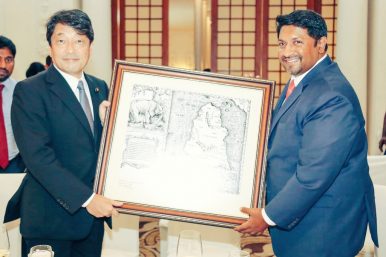
Image Credit: Twitter via @RWijewardene
 By Rupakjyoti Borah-August 27, 2018
The recent visit by Japanese Defense Minister Itsunori Onodera to India
and Sri Lanka shows the increasing focus on these countries on the part
of Tokyo as a part of its free and open Indo-Pacific (FOIP) strategy.
What is important about this visit was that it was the first visit by a
Japanese defense minister to Sri Lanka. This assumes particular
significance in the light of a Chinese-state owned company gaining a
lease of 99 years to the Hambantota port in Sri Lanka, which straddles
the key sea lanes of communication in the Indian Ocean region.
Onodera visited Hambantota port during this visit. In addition, Onodera,
accompanied by the Sri Lankan Navy’s Eastern Area Naval Commander Rear
Admiral Sumith Weerasinghe, also visited Trincomalee harbor, where he
met with the crew of the Japanese Naval ship JS Ikazuchi.
There are indications that Japan is planning to work with countries
like India in Sri Lanka, given India’s close links and geographical
proximity and also given the growing bonhomie between India and Japan.
Tokyo also handed over two coast-guard patrol aircraft to Colombo, which
are worth around $11 million.
China’s Belt and Road Initiative (BRI) has forced all countries,
including Japan, to take notice in the Indo-Pacific. While Japan has
expressed its interest in evaluating projects related to the Belt and
Road Initiative (BRI) on a case-by-case basis, it is yet to join
the initiative itself, while New Delhi has opted to mostly stay out of
the Belt and Road Initiative (BRI) due to sovereignty concerns.
Before visiting Sri Lanka, the Onodera was in India, where he met his
Indian counterpart, Nirmala Sitharaman. It has been reported that India
and Japan are working on a logistics-sharing agreement, similar to the
one India has signed with the United States, the Logistics Exchange
Memorandum of Agreement. This will increase the interoperability between
the Indian and Japanese navies. The two countries are already
collaborating in a big way in the maritime realm with the JIMEX
bilateral exercises and the trilateral Malabar exercises with the United
States. Japan also maintains a base in Djibouti and hence the locations
of India and Sri Lanka assumes a big significance for Japan’s Maritime
Self-Defense Force.
The increasing use of the term Indo-Pacific dovetails with Japan’s
own FOIP concept. It is worth noting here that India, Japan, Australia,
and the United States had also resuscitated the “Quad” on the sidelines
of the ASEAN and the East Asia Summits in Manila in November last year.
Amid all this, Tokyo has also sent its helicopter carrier JS Kaga and
its sister ships on a two-month deployment in the Indo-Pacific region
where it will call at ports in India, Indonesia, Singapore, Sri Lanka,
and the Philippines.
In 2007, Prime Minister Shinzo Abe, in his famous speech “Confluence of
the Two Seas,” had mentioned that “the Pacific and the Indian Oceans are
now bringing about a dynamic coupling as seas of freedom and of
prosperity.” The Japanese defence minister’s recent swing through India
and Sri Lanka only proves that Tokyo is now putting its money where its
mouth is.
Dr Rupakjyoti Borah is with the Institute of South Asian Studies at
the National University of Singapore (NUS). His recent book is The Elephant and the Samurai: Why Japan Can Trust India. He can be reached at rupakj@gmail.com or on Twitter at @rupakj.
