Peace for the World World ! Your War Our Lives

The Dalai Lama
A Brief Colonial History Of Ceylon(SriLanka)
Sri Lanka: One Island Two Nations
A Brief Colonial History Of Ceylon(SriLanka)
Sri Lanka: One Island Two Nations
(Full Story)
Back to 500BC.

Tuesday, December 4, 2018
Fake Prime Minister MR’s Statement On Dissolution “Strange And Misleading”: Lawyers For Democracy
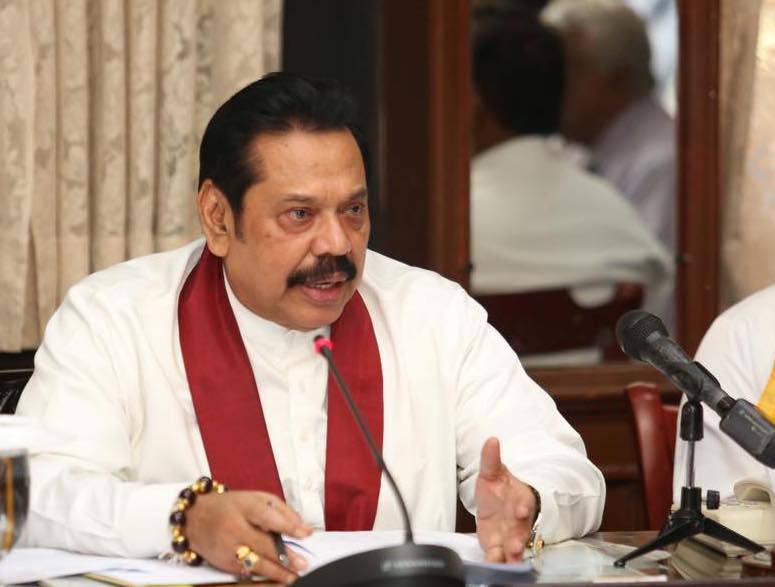

Lawyers for Democracy, issuing a statement, today said former President Mahinda Rajapaksamade a “strange and misleading” statement on the dissolution of Parliament while the matter is pending before the Supreme Court.
“While we are confident that the judiciary of this country, whose
independence has been strengthened by the Nineteenth Amendment, will not
be influenced by misleading statements of politicians, we nevertheless
wish to respond to a number of factual inaccuracies in the said
statement that may mislead ordinary citizens not well-versed in matters
of the Constitution, especially events abroad,” Lawyers for Democracy
said in the statement.
The full statement issued by Lawyers for Democracy is as follows:
Lawyers for Democracy Response to Mahinda Rajapaksa’s Misleading Statement made in the wake of the Supreme Court case
Lawyers for Democracy expresses its serious concern on the attempt by
Mahinda Rajapaksa, MP for Kurunegala District, to mislead the country by
issuing an unusual statement on the matter of the dissolution of
Parliament, while it is
pending before the Supreme Court. While we are confident that the
judiciary of this country, whose independence has been strengthened by
the Nineteenth Amendment, will not be influenced by misleading
statements of politicians, we nevertheless wish to respond to a number
of factual inaccuracies in the said statement that may mislead ordinary
citizens not well-versed in matters of the Constitution, especially
events abroad.
Rajapaksa cites the British constitutional authority A.V. Dicey as
having said that if the Crown is of the view that the opinion of the
public is different to that of the majority in Parliament, the Crown has
the discretion to dissolve Parliament and call a general election.
Dicey who wrote Law of the Constitution as
far back as in 1885, refers to the dissolution of the House of Commons
in 1784 and 1834. But unknown to Rajapakse and his advisors, and this is
not surprising, the United Kingdom has since seen many changes
regarding the Monarch’s power of dissolution. No British Monarch has in
modern times dissolved the House of Commons without the advice of the
Prime Minister. In 2011, Westminster passed the Fixed-term Parliaments
Act, which lays down that an early General Election shall not be called
unless the Commons requests a General Election by a two-thirds majority.
An early election will also take place when a vote of no-confidence is
passed against the Government unless a vote of confidence is passed
within 14 days of the vote of no-confidence, that is unless a new
Government is formed and is to able prove its majority in the Commons
within 14 days. But unlike the United Kingdom where there is no written
constitution, Sri Lanka has a written constitution which has clear
provisions relating o dissolution.
Rajapaksa also states that in 1975, the Governor General of Australia
sacked Prime Minister Gough Whitlam and called a general election
entirely at his own discretion. This is furthest from the truth. Unlike
in Sri Lanka, Australia has two Houses of Parliament. Section 57 of the
Australian Constitution, if the Senate rejects or fails to pass a Bill
that has been passed by the House of Representatives twice the
Governor-General may dissolve both House simultaneously. But by
convention, he would do so only on the advice of the Prime Minister. In
1975, the Senate had deferred two Appropriation Bills which had already
been passed by the Lower House. Prime Minister Whitlam refused to advice
a dissolution and the Governor-General dismissed Whitlam and appointed
Malcolm Fraser as Prime Minister as caretaker Prime Minister upon the
latter undertaking to have the Bills passed in the Senate and that he
would advise the Governor-General to dissolve both Houses. Before doing
so, the Governor-General consulted the Chief Justice who advised him
that the Prime Minister could be replaced in the given circumstances.
The Governor-General then dismissed Whitlam, appointed Fraser as
Caretaker Prime Minister and dissolved both Houses on the advice of
Fraser.
Rajapakse’s says that the Indian President dissolved the Lok Sabha in
1970 and 1979 on his own. This again is utterly misleading. In December
1970 President Giri dissolved the Lok Sabha upon the advice of Prime
Minister Indira Gandhi and a request by the Cabinet of Ministers after
the Congress Party had broken up. Although it was a minority government,
it had not been defeated in Parliament on any question. In 1979,
dissolution was on the advice of Prime Minister Charan Singh while the
Lok Sabha was in prorogation, again on the advice of the Prime Minister.
Read More
