Peace for the World World ! Your War Our Lives

The Dalai Lama
A Brief Colonial History Of Ceylon(SriLanka)
Sri Lanka: One Island Two Nations
A Brief Colonial History Of Ceylon(SriLanka)
Sri Lanka: One Island Two Nations
(Full Story)
Back to 500BC.

Wednesday, November 27, 2019
Sri Lanka’s Presidential Election: Healing the Wounds is the New Task
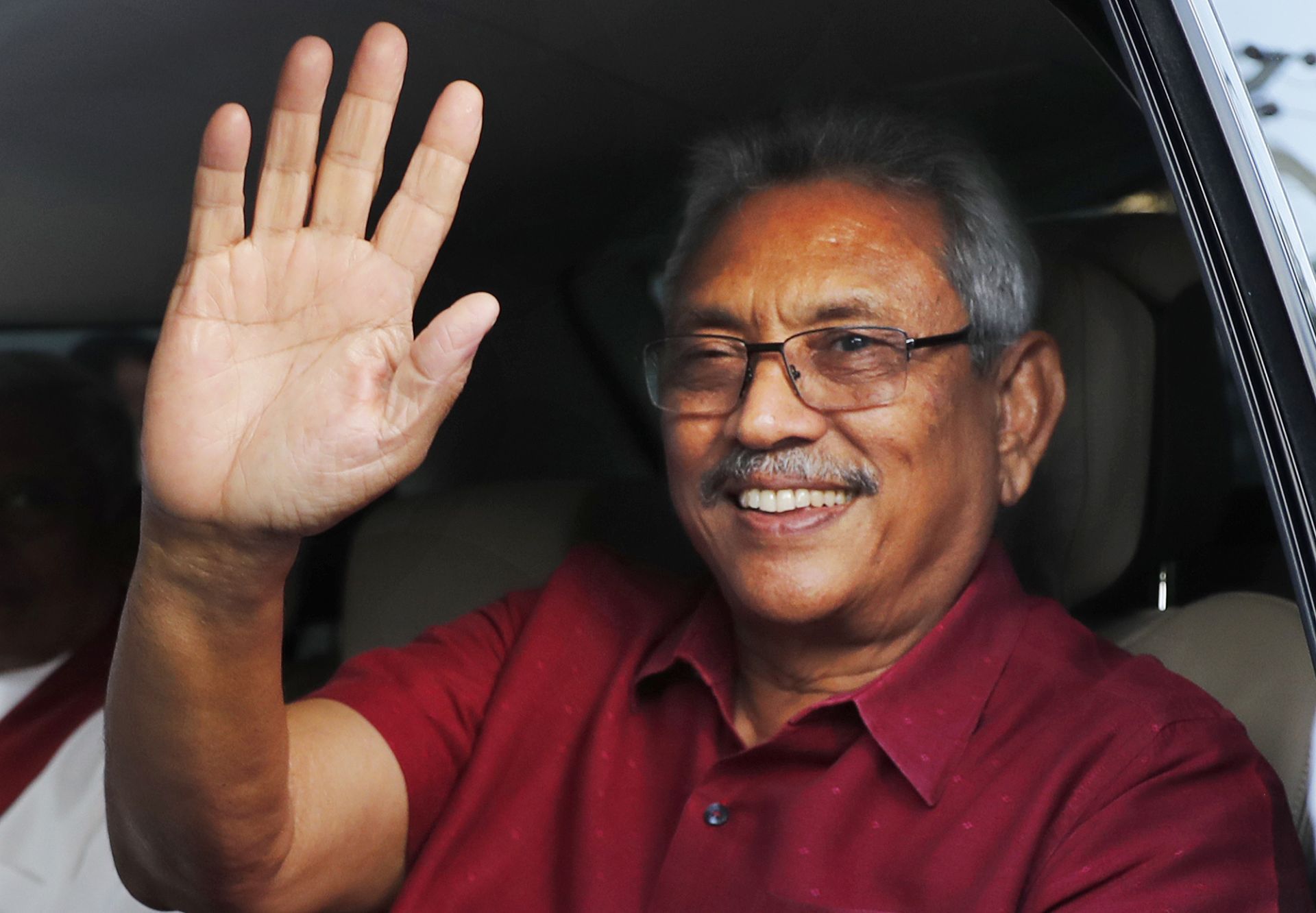
Photo courtesy Star Online
 Sri
Lanka’s eighth presidential election held last Sunday has produced an
outcome that has surprised the winners, the losers as well as the
observers. The most obvious, and arguably disquieting, and utterly
unanticipated trend that became immediately visible is the re-sharpening
of the majority-minority divide in the citizens’ electoral choices
across the country.
Sri
Lanka’s eighth presidential election held last Sunday has produced an
outcome that has surprised the winners, the losers as well as the
observers. The most obvious, and arguably disquieting, and utterly
unanticipated trend that became immediately visible is the re-sharpening
of the majority-minority divide in the citizens’ electoral choices
across the country.
Mr Gotabhaya Rajapaksa, the winner, has received overwhelming backing of
the voters of the majority Sinhalese Buddhist community. Yet he has
been almost totally rejected by the minority Tamil and Muslim voters who
are regionally concentrated in Sri Lanka’s Northern and Eastern
provinces and the central province’s plantation country and some urban
areas of the Western and Southern provinces.
Sajith Premadasa, Rajapaksa’s main challenger, received the support of a
vast majority of Tamil and Muslim voters. Yet he has been soundly
rejected by the Sinhalese voters, in some electorates receiving only
one-third of the votes.
The final percentages of vote share obtained by the two main candidates –
52.55 by Rajapaksa and 41. 99 by Premadasa – show that the new Present
has received a clear mandate that has also rocked his opponent’s
political coalition, New Democratic Front. The winner’s majority exceeds
1.36 million votes, which is quite high in Sri Lankan standards.
Ethnic Polarization
The vote distribution between the two main candidates shows that the
presidential election has re-affirmed the continuity, and not the
weakening, of ethnic polarization in shaping the political destinies of
Sri Lankan society. This is a factor that the new President and his
government should not fail to address in a manner that will heal the
wounds of the past.
The outcome is also a severe blow to candidates who sought to emerge to
form a ‘third force’, with the hope of breaking the monopoly of
country’s two main political coalitions in the near future. These
‘alternative’ candidates could not secure even four percent of the total
votes.
There is one major reason that seems to have contributed to this
polarizing electoral outcome. It is the political impact of the series
of bomb attacks carried out by Muslim terrorists on April 21, the Easter
Sunday, this year. Its far-reaching consequences run parallel to the
way in which 9/11 terrorist attacks on the US changed beyond recognition
the contemporary politics of America and Western Europe.
Easter Sunday Attacks
The suicide blasts took place in Colombo, Negombo and Batticaloa killed
hundreds of worshippers and other civilians and sent shock waves
throughout the country at a time when people had been learning to cope
with the trauma of a three-decades of civil war between the State and
Tamil insurgents. The attacks and the massive devastation they caused
also exposed the utter failure of the government leadership as well as
the defence establishment to prevent them, despite prior warnings.
The political impact of Easter explosions was multiple. It created a
deep sense of insecurity among the citizens along with a huge loss of
faith in the capacity of the government and its leadership to provide
citizens security and safety. Amidst public outrage, the government
immediately began to face an unprecedented crisis of public confidence.
It also set in motion a new wave of Islamophobia, spearheaded by the
social media, and it spread rapidly particularly among the
Sinhalese-Buddhist citizens.
Strong Ruler –Strong Government
This new phase of Sinhalese nationalism gave rise to a fresh political
consensus as well. Its core thesis was that the ‘weak and ineffective’
government should be replaced with ‘a strong government’ headed by ‘a
strong leader’ with capacity and resolve to protect the citizens from a
new generation of terrorists, with international connections and modern
technological capabilities.
By this time, Mr Gotabaya Rajapaksa, Sri Lanka’s former Defence
Secretary who was in charge of the war against the LTTE, had already
begun his campaign to be a candidate for the forthcoming presidential
election. He and the party led by his two brothers, Sri Lanka People’s
Party (Sri Lana Podu Jana Party –SLPP), had also developed a political
campaign focusing primarily on the promise of establishing a national
security regime led by a strong leader free from the shackles of liberal
democracy. That was the alternative they offered to replace the deeply
divided, inept and crisis – ridden government jointly headed by
President Maithripala Sirisena and Prime Minister Wickremasinghe.
Thus, the sudden crisis caused by the Easter Sunday terrorist attacks
provided a new context for a choice between a weak democratic regime and
a strong national security regime.
How did the Sinhalese, Tamil and Muslim societies respond to the two
opposing political alternatives presented by the two principal
candidates?
Election Campaign
Sajith Premadasa is the candidate of the New Democratic Front, which was
a broad coalition formed a few weeks before the election. Its key
partner is United National Party, headed by Prime Minister Ranil
Wickremasinghe. It is also a multi-ethnic coalition supported by the
main Tamil and Muslim parties.
Premadasa, deputy leader of the UNP, was given party candidacy only in
late September, due to internal party differences between two factions
led by him and Wickremasinghe. Having entered the fray rather late,
Premadasa developed a welfare state narrative that countered his own
government’s neo-liberal economic and social reform policy agenda as
well as his opponent’s – Gotabhaya Rajapaksa’s — national security
narrative. During the election campaign, Premadasa also projected his
image as the presidential candidate of the poor and marginalized.
Election results indicate that Premadasa’s central promise of bringing
the welfare state back, with an ideology of paternalistic populism,
failed to make any significant impact on the Sinhalese-Buddhist
electorate. The fact that he was the candidate of a ruling party that
had lost public trust and the resultant anti-incumbency disadvantage has
obviously added to his woes.
In the deep South, Premadasa’s election campaign may have refreshed
among many Sinhalese families those horrific memories of violence
associated with the government headed by his own father during the late
1980s.
However, the most important reason why he was rejected by the Sinhalese
section of the electorate by a substantial margin is the perception that
he was not nationalist enough to be Sri Lanka’s President in the
post-Easter Sunday context.
Community Insecurities
It is also Premadasa’s weak Sinhalese nationalist credentials that
ensured him overwhelming support – in many electorates over 80% of the
valid votes – among Tamil and Muslim voters.
The Tamil and Muslim citizens seem to have had an insecurity problem
different from their Sinhalese counterparts. The source of this minority
insecurity is the political elite of the Sinhalese nationalist
coalition led by the Rajapaksa family. The latter’s past track record,
from the point of view of the minority communities, has had a distinctly
Sinhalese-nationalist orientation.
Rajapaksa’s campaign strategists were also keen to prove the point that
they could win a presidential election without the support of ethnic
minority voters. They seem to have been inspired by the electoral
strategy of benefitting from deep ethnic divisions and the majority’s
security anxieties, as successfully practised by India’s Bharatiya
Janatha Party.
Gotabhaya Rajapaksa’s developmentalit agenda for Tamil and
Muslim-majority provinces could hardly resolve the insecurity dilemma of
the ethnic minorities. Thus, in the districts where the Tamil and
Muslim communities are dominant numerically, Sajith Premadasa has polled
more than one million votes over Gotabhaya Rajapaksa. They have
contributed to Premadasa’s national total as well as the national
average quite significantly. In many electorates in the North and East,
Rajapaksa’s share of votes is as low as 20 percent.
Meanwhile, if the 9/11 altered the politics of Western democracies in a
trajectory away from liberal democracy, multiculturalism, and political
pluralism, and fostered deep insecurities among the majority ethnic
communities, a similar process of change has been taking place in South
Asia too. It also fueled new tensions among ethnic communities in
multi-ethnic societies.
Sri Lanka proved an exception in 2015, but in 2019, it has clearly
joined the global trend. The dismal failure of Sri Lanka’s democratic
reform experiment of 2015 too has provided the context for a shift in
the popular support for a possible retreat from traditional forms of
democracy.
Meanwhile, the pressures of big electoral victories are such that the
new president and his family members, who will constitute the core of
the new regime, might find it difficult to resist the temptation of
giving into the wishes of their Sinhalese nationalist constituency. This
is particularly so in view of the ethnic polarization of the electoral
verdict.
Reconciliation
However, to fulfil his promise of taking the country out of its present
state of deep economic and governance crisis and stagnation as well as
ushering in an era of economic prosperity and political stability, Sri
Lanka’s new President will need to re-build the trust between the
majority and minority communities.
The best, incurring possibly the lowest political cost, to achieving
that goal lays through essentially democratic, inclusive, dialogical,
and accommodative means.
Thus, the outcome of the presidential election highlights once again how
inter-ethnic reconciliation continues to be centrally relevant to any
recovery and reform agenda for post-war Sri Lanka.
Reconciliation is needed for healing, and not aggravating, the wounds in
a country that is struggling to come out from a recent past of
conflict, violence and democratic setbacks.
