Peace for the World World ! Your War Our Lives

The Dalai Lama
A Brief Colonial History Of Ceylon(SriLanka)
Sri Lanka: One Island Two Nations
A Brief Colonial History Of Ceylon(SriLanka)
Sri Lanka: One Island Two Nations
(Full Story)
Back to 500BC.

Wednesday, February 1, 2017

Hours after Trump fired acting attorney general Sally Yates for refusing
to defend his executive order banning certain travelers and refugees,
Democrats blocked a committee from approving the president’s choice for
attorney general. Amid concerns with information provided by his picks
to lead the departments of Health and Human Services and Treasury,
Democrats did not show up at another Senate committee at all.
The theatrics drew more attention to Trump’s recent decisions and the
growing bipartisan concern with his executive order Friday to implement a
travel ban with virtually no consultation of top government officials
or senior lawmakers.
But it also allowed Republicans to attack Democrats for holding up the
formation of Trump’s government. Ultimately, Democrats alone lack the
votes needed to block any of Trump’s nominees from eventually taking
office — and there are no signs of Republican opposition to any of his
picks.
During a hearing of the Senate Judiciary Committee, Democrats criticized
Trump for firing Yates and said that they would not support his nominee
for attorney general, Sen. Jeff Sessions (R-Ala.), because they do not
believe he would ever stand up to Trump in a similar fashion. They also
planned to invoke an arcane rule to block the committee from holding a
roll-call vote on Sessions’s nomination on Tuesday. Republicans said
they would reconvene on Wednesday.
During Sally Yates's 2015 confirmation hearing for deputy attorney general, Sen. Jeff Sessions (R-Ala.) questioned whether Yates was prepared to "say no" to the president if necessary. Yates was fired by President Trump Jan. 30, after refusing to enforce his controversial travel ban executive order. (Monica Akhtar, Deirdra O'Regan/The Washington Post)
During Sally Yates's 2015 confirmation hearing for deputy attorney general, Sen. Jeff Sessions (R-Ala.) questioned whether Yates was prepared to "say no" to the president if necessary. Yates was fired by President Trump Jan. 30, after refusing to enforce his controversial travel ban executive order. (Monica Akhtar, Deirdra O'Regan/The Washington Post)
During Sally Yates's 2015 confirmation hearing for deputy attorney general, Sen. Jeff Sessions (R-Ala.) questioned whether Yates was prepared to "say no" to the president if necessary. Yates was fired by President Trump Jan. 30, after refusing to enforce his controversial travel ban executive order. (Monica Akhtar, Deirdra O'Regan/The Washington Post)
During Sally Yates's 2015 confirmation hearing for deputy attorney general, Sen. Jeff Sessions (R-Ala.) questioned whether Yates was prepared to "say no" to the president if necessary. Yates was fired by President Trump Jan. 30, after refusing to enforce his controversial travel ban executive order. (Monica Akhtar, Deirdra O'Regan/The Washington Post)
Just down the hallway of the Dirksen Senate Office Building, the Senate
Finance Committee met to vote on Steven T. Mnuchin’s nomination to serve
as treasury secretary and Rep. Tom Price’s nomination to be secretary
of health and human services — but Democrats boycotted the meeting,
forcing Republicans to reschedule both votes.
Meanwhile, Democrats once again tried and failed to stall a vote to
advance Trump’s pick for education secretary, Betsy DeVos, to the full
Senate, but Republicans prevailed on a party-line vote.
Amid the rancor elsewhere, senators confirmed Elaine Chao to serve as
Trump’s transportation secretary by a vote of 93 to 6. And the Senate
Energy and Natural Resources Committee approved the nominations of
former Texas governor Rick Perry to be energy secretary and Rep. Ryan
Zinke (R-Mont.) to be interior secretary with bipartisan majorities,
sending them to the full Senate for final up-or-down votes.
Developments in the Judiciary and Finance committees, however, signaled
how defiant Democrats remain in stalling Trump’s nominees.
When the meeting began, Finance Committee Chairman Orrin Hatch (R-Utah)
sat alone at the dais with just three other Republican senators. Having
just come from the Judiciary hearing, Hatch told his colleagues, “Jeff
Sessions isn’t treated much better than these fellas are.”
“Some of this is just because they don’t like the president,” Hatch
said, later adding that Democrats “ought to stop posturing and acting
like idiots.”

Sen. Mike Enzi (R-Wyo.) agreed. “I think this is unconscionable,” he said.
“We did not inflict this kind of obstructionism on President Obama,”
added Sen. Patrick J. Toomey (R-Pa.), the only other senator in the
room. He added that the Democrats were committing “a completely
unprecedented level of obstruction. This is not what the American people
expect of the United States Senate.”
But just four years ago,
Republicans similarly boycotted a Senate committee’s vote on Gina
McCarthy to serve as President Barack Obama’s interior secretary.
Senators said at the time that she had refused to answer their questions
about transparency in the agency.
Other walkouts have happened, most famously in 2003, when Rep. Bill
Thomas (R-Calif.), chairman of the House Ways and Means Committee,
dispatched U.S. Capitol Police officers to find Democrats who left a
hearing where Republicans were trying to pass a pension bill. He later
apologized for his heavy-handed tactics on the House floor.
Shortly before the Finance hearing began, committee Democrats huddled in
the office of the panel’s ranking member, Sen. Ron Wyden (D-Ore.), and
agreed that they would all boycott the session, aides said.
The boycott was prompted by Democrats’ concerns that Mnuchin initially
misstated his personal wealth on financial disclosure forms and
misstated how OneWest Bank, a bank he led as chairman and chief
executive officer, scrutinized mortgage documents. Democrats have also
raised questions about Price and his personal financial investments in
health-care companies and legislation he promoted that could have
benefited several of the same companies. Some of the stock trades, as
well as campaign donations from companies, closely coincided with one
another.
A series of stock buys the lawmaker made in an Australian company,
Innate Immunotherapeutics, has brought scrutiny for weeks. In 2016, he
received a discounted price for his purchases as part of a private
offering made to only a certain number of investors; the questions have
been whether he received certain insider information from Rep. Chris
Collins (R-N.Y.), a company board member and its largest investor, and
whether he got a special price when he bought $50,000 to $100,000 in
shares last year.
The Wall Street Journal reported Monday that Price received a
“privileged” offer that he had mischaracterized in the hearings when he
said such offers “were available to every single individual that was an
investor at the time.”
Standing outside his office as the markup was to begin, Wyden told
reporters that Price’s statements contradicted those by Wilkinson and
other company officials.
“At a minimum,” Wyden said, “I believe the committee should postpone this vote and talk to company officials.”
Sen. Sherrod Brown (D-Ohio) said he was conferring with party colleagues
until late Monday night about how to proceed, and they ultimately
decided to boycott.
“In some ways, we’re doing President Trump a favor,” Brown said. “If
these nominees had been confirmed, and then these stories broke about
how they lied, how they made money on foreclosures, how they made money
off of sketchy health-care stock trades, this would have been a major
scandal for the administration. Now it’s just a problem we can fix.”
Much of the drama of Tuesday morning unfolded along a fluorescent-lit
hallway on the second floor of the Dirksen Senate Office Building. Wyden
and Brown announced their plans to forego the finance panel’s vote to a
pack of reporters situated near Wyden’s office and the committee room
where angry Republicans fumed. A few steps away was the Judiciary
Committee room, where Sessions’s future was being debated and where at
least pair of protesters were removed.
Shuttling between the two committees, Hatch told reporters he had no idea Democrats had planned to protest his hearing.
“That’s one of the most pathetic things I’ve seen in my whole time in the Senate,” he said.
Sen. John Thune (R-S.D.), added that the Democratic boycott of Price
would make it difficult for Republicans to enact crucial elements of
their agenda like revamping the Affordable Care Act.
“It gets a lot harder; we need him there,” Thune said.
In the Judiciary hearing, Sen. Dianne Feinstein (D-Calif.) and other
Democrats strongly defended Yates against Trump’s claim that she had betrayed the Justice Department.
Yates’s defiance of Trump “took guts,” Feinstein said. “That statement
said what an independent attorney general should do. That statement took
a steel spine to have the courage to say no.”
“I have no confidence that Sen. Sessions will do that,” she added.
“Instead, he has been the fiercest, most dedicated and most loyal
promoter in Congress of the Trump agenda.”
Republicans defended Sessions, but said little about Trump’s executive
order. Democrats planned to end hearing by using the obscure “two-hour”
rule that permits either party to stop committees from meeting beyond
the first two hours of the Senate’s official day. During the Obama
administration, Republicans used the same rule against Democratic
Cabinet nominees.
In the Senate, Health, Education Labor and Pensions Committee, Democrats
tried postponing the vote on DeVos, complaining she had just submitted
written responses to hundreds of questions on Monday night and
plagiarized some answers.
The panel then toiled over the actual vote on DeVos’s nomination, with
Democrats complaining that it shouldn’t count because Hatch — a member
of the committee who was simultaneously dealing with events in the
Judiciary and Finance meetings — was allowed to submit a proxy vote.
Without him in the room, the 23-member committee would have deadlocked.
After a recess and several minutes of heated argument, Republicans
ordered a revote with Hatch in the room and approved DeVos along party
lines, 12 to 11.
Amid growing public concern with Trump’s travel ban, Democrats have
faced louder calls from within their party to boldly confront the new
administration.
“This is the exact right type of tactic for this moment,” said Kurt
Walters, the campaign director of the transparency group Demand
Progress. “We’re seeing someone who came into office with a historic
popular vote loss come in and push a radical, unconstitutional agenda.
Yes, radical and bold tactics are what senators should be using in
response.”
The Communications Workers of America labor union said in a statement
that Senate Democrats “should keep it up. Americans deserve a government
that will fight for them and the basic principles of integrity and
honesty.”
But further delays could have far-reaching consequences, as became
evident on Monday night when the Justice Department was plunged into
turmoil by Trump’s decision to fire Yates, an Obama-era appointee, for
refusing to defend his travel ban in federal court. In her place Trump
installed Dana Boente, U.S. attorney for the Eastern District of
Virginia, who is expected to hold the job until Sessions is confirmed as
attorney general.
While senators toil over the qualifications and positions of Trump’s
nominees, he has started meeting with world leaders, reshaping
immigration and trade policy and tasked congressional Republicans with
overhauling the nation’s health-care system — with most of the seats
around the White House Cabinet Room still empty.
Schumer was unapologetic on Monday, telling the Spanish-language network
Univision that “Senate Democrats, we’re the accountability.”
In a sign of the near-toxic level of tension between Democrats and
Republicans, Schumer was one of the six Democrats to vote against
confirming Chao, the wife of Senate Majority Leader Mitch McConnell
(R-Ky.), to lead the Transportation Department. Senate records show that
no nominee for transportation secretary has earned so many “no” votes
since at least Jimmy Carter’s administration.
Kelsey Snell, Kimberly Kindy and David Weigel contributed to this report.

FactCheck Q&A: Trump’s travel ban


Who is affected?
Citizens of Iran, Iraq, Libya, Syria, Somalia, Sudan and Yemen are barred from entering the United States for 90 days.
After a number of twists and turns over recent days, the very latest
advice from the UK Foreign Office is that people with British passports
will not be affected, if they are travelling with a US visa.
That includes Britons with dual citizenship of one of the seven
countries, even if they are flying to the US from that country, the
Foreign Office told us on Monday afternoon.
And people who have indefinite leave to remain in the UK and hold
nationality of one of the seven countries are eligible to apply for US
visas.
A small number of people with the special visas granted to diplomats and
their families and people who work for the UN, Nato and foreign
governments are also exempt, as per the executive order signed by President Trump on Saturday.
Syrian refugees are barred from the US indefinitely, while refugees from
other countries will be prevented from entering for 120 days.
What if you have a green card?
White House Chief of Staff Reince Priebus initially said those who hold
green cards (people who were not born in the US but who are eligible to
live and work there) would be affected by the temporary ban.
But just minutes later in a separate interview, he said “of course they were [exempt]”.
John Kelly, Homeland Security Secretary, issued a statement saying:
“Lawful permanent resident status will be a dispositive factor in our
case-by-case determinations.”
A White House official said on Sunday that more than 170 green card holders were allowed in on that day.
Is it a “Muslim ban”?
Not really. The executive order makes no mention of checking the religion of people attempting to enter the US.
But all seven countries are Muslim-majority, and Trump repeatedly
expressed the desire specifically to halt Muslim immigration while on
the presidential campaign trail.
In December 2015 he announced: “Donald J. Trump is calling for a total and complete shutdown of Muslims entering the United States.”
Now the President seems unhappy that
the US media are referring to this policy as a “Muslim ban”, although
it’s not clear how often this phrase has been used in reporting.
The New York Times used the words in an editorial piece.
Some other news organisations have used the phrase in inverted commas,
and others have referred to “predominantly Muslim” or “mostly Muslim”
countries.
Trump advisor and lawyer Rudy Giuliani told Fox News the President had used the phrase “Muslim ban” and approached Giuliani on advice on how to enact it.
Giuliani said: “When [Trump] first announced it he said: ‘Muslim ban’.
He called me up. He said: ‘Put a commission together. Show me the right
way to do it legally.’
While Trump’s executive order doesn’t single out Muslims, it does say
that when the refugee programme resumes, priority should be given to
claims “made by individuals on the basis of religious-based persecution,
provided that the religion of the individual is a minority religion in
the individual’s country of nationality”.

This suggests that Iraqi Christians might end up getting priority over
Iraqi Muslim refugees, and recent tweets from Trump suggests he has the
plight of Middle Eastern Christians on his mind.
Things don’t look too hopeful for Syrian Christians though, as all
refugees from that country are barred from entering America until
further notice.
CNN reported the case of one Syrian Christian family who flew back to Qatar after apparently being turned back at Philadelphia.
Why these countries?
The Obama administration had already placed some restrictions on certain
travellers who had visited these seven countries, based on an increased
risk from “foreign terrorist fighters”.
In most of the countries, there is an active ongoing conflict involving at least one major terrorist organisation. The US State Departmentdesignates Iran, Sudan and Syria as state sponsors of terrorism.
Some critics have questioned why other countries with a stronger
historical connection to terror attacks on US targets have not been
included.
Of the 19 men who killed around 3,000 people in the September 11, 2001,
terror attacks, 15 were from Saudi Arabia and the others from the United
Arab Emirates, Egypt and Lebanon.
Some commentators have pointed out that the Trump Organization has business interest in Saudi Arabia and other Muslim-majority countries.
White House Chief of Staff Reince Priebus said on Sunday that Trump’s
business activities did not influence the list of countries and more
countries might be added to the list in subsequent executive orders.
According to a new report from
Duke University, 23 per cent of Muslim Americans involved with violent
extremist plots since 9/11 had family backgrounds in these seven
countries. But none of them carried out attacks that caused fatalities.
Indeed, according to New America’s terror
database, every one of the 12 terrorists who has killed anyone in the
United States since 9/11 has been a US citizen or legal resident.
None of them emigrated from, or came from a family that emigrated from, one of the seven countries on the Trump list.
Is Islamic terrorism a major threat?
This point is arguable, but there are statistics available that enable
us to get some measure of the danger posed by Islamic extremism in the
US, in the context of other threats.
The Duke study finds that 123 people have been killed by Muslim American
extremists since the September 11 attacks, 54 of them in 2016.
Last year 188 people were killed in mass shootings in America carried out by non-Muslims. The total death toll for gun crime in 2016 was around 15,000 people.
How will the ban play with voters?
It’s too early to say. Opinion polls carried out before the new travel
restrictions were put in place suggest a majority of Americans backed
the idea of immigration restrictions on terror-prone regions, but most
were unhappy about singling out Muslims.
We don’t know if the events of recent days will have changed people’s opinions.
(UPDATE: Rasmussen Polls has this survey
of 1,000 likely voters, carried out on January 25 and 26, which shows
57 per cent supported the temporary ban, 33 per cent opposed and 10 per
cent were undivided.)
What do US politicians say?
At time of writing, some 60 senators are known to oppose the
restrictions (46 Democrats and 12 republicans) and just four (all
Republicans) support it, while 37 have remained silent on the issue (36
Republicans and one Democrat).
Only one governor has publicly supported President Trump’s order –
Alabama’s Robert Bentley, a Republican – while 15 say they are opposed
(5 Republicans, 10 Democrats) and 35 remain silent (27 Republicans, 7
Democrats, 1 independent).
Fight or flight: Should State Department employees undermine Trump, or just quit?

 BY JANUARY 31, 2017
By Sharon Burke
Best Defense guru
Best Defense guru
“They should either get with the program or they can go,” President
Donald Trump’s spokesman, Sean Spicer, said about career State
Department officials who have allegedly submitted a dissent memo about the Jan. 27 executive order on immigration.
This comment followed last week’s abrupt dismissal of
several high level career officials, including the one who would
ultimately be responsible for implementing parts of the new policy.
This is not the first time the loyalty of career diplomats has been
questioned, of course, nor is it uncommon for career officials in
presidential appointments to be swapped out. But if the reports about
the “dissent channel” memo are accurate, it would be an unprecedented
protest so early in a new administration.
Is it possible that Trump is right in suspecting that career diplomats
are not “with the program”? Will they try to obstruct his agenda?
I recently posed that question to current and retired Foreign Service
officers, who ranged from just a few years of service to one of the most
storied ambassadors in the history of the country. The answer was a
firm no — and maybe a dash of yes. It’s complicated.
First of all, it’s probably true that there aren’t a ton of Trump voters
at the State Department, but that’s not necessarily because they love
the Democratic party. All the diplomats I spoke to were adamant that
personal political views are irrelevant when it comes to doing the
country’s business. Some actually preferred Republican bosses, who they
said were more likely to be good managers.
There’s some optimism about Rex Tillerson, Trump’s pick for secretary of
state, on that score, though there’s no telling if he’ll have a say in
major policy decisions, such as the immigration ban.
From my own experience as both a civil servant and political appointee
in Republican and Democratic administrations, military members,
diplomats, and civil servants are very professional and truly do take
the oath of office seriously. And therein lies one big problem.
That oath is to the Constitution, not the individual sitting in the Oval
Office. Career diplomats will undoubtedly give the new president their
best advice, but what if it’s not what he wants to hear? With a
president who has talked openly about undoing decades of American
diplomacy on everything from NATO to the nuclear balance in Asia, that
seems very likely.
Given what we’ve seen so far from Trump, he may openly disdain advice he
doesn’t agree with — or just ignore it altogether. The serving
diplomats I spoke to said that Trump has basically not asked for much
input to date. This mystifies and alarms them.
“Not every exchange with a foreign leader is a knife fight,” one former
ambassador observed, “but you always want to make sure your guy has a
knife.” And from their point of view, Trump is going into these
conversations unarmed — or worse, his posse sometimes includes family
members.
“We look like a tinpot dictatorship,” one senior diplomat lamented. “We rail against this in other countries.”
Still, it’s highly unlikely that career diplomats will refuse to carry
out a lawful order from the president, even it’s not what they would
recommend. In 2002, for example, Ambassador Ryan Crocker
famously told President George W. Bush that invading Iraq was a bad
idea, prompting questions about his loyalty. Just a few years later, he
was the same president’s point person in Baghdad, delivering “the surge”
with General David Petraeus.
On the other hand, that does not mean career diplomats and civil
servants will rush to implement policies they don’t agree with. That can
take the form of a dissent memo, but more often the bureaucracy just
discreetly slows down or sinks bad ideas (and good ideas sometimes, for
that matter). Call it “affable noncompliance.” Political appointees may
not even realize it’s happening.
Still, that’s usually restricted to relatively small policies, rather
than major decisions such as a trade war with Mexico or a shooting war
in the South China Sea.
In fact, there’s a bigger danger when it comes to Trump-era diplomacy,
which is that the most experienced and talented people at the State
Department will just leave. All of the sitting, senior officials I spoke
to expressed discomfort with serving as the representative of Trump,
more because of his personal conduct than his political views. Though
the dividing line between the personal and political may be a bit fuzzy:
One junior Foreign Service officer, for example, had concerns for his
safety, pointing out that diplomats rely on foreign nationals (including
Muslims and Mexicans) to provide security and other services in U.S.
embassies around the world.
If anything, Trump’s policies to date are going to require great
diplomatic skill to carry out, which puts Spicer’s cavalier attitude in
an ironic light. Still, many experienced diplomats may well stay, both
because they believe in the commitment they made to the country and
because of the lure of efficacy.
“Trust me when I tell you,” one senior Foreign Service officer stressed,
“you have far more impact on the inside than on the outside.”
Sharon E. Burke is a senior advisor at New America. She served at
the State Department in the George W. Bush administration from 2002 to
2005 and at the Pentagon in the Barack Obama administration from 2010
to 2014.
Photo credit: Wikimedia Commons
Indian IT sector warns against U.S. visa bill
Workers are seen at their workstations on the floor of an outsourcing centre in Bangalore, February 29, 2012. REUTERS/Vivek Prakash/Files--Employees
of Indian software company Infosys walk past Infosys logos at their
campus in the Electronic City area in Bangalore in this September 4,
2012 file photo. REUTERS/Vivek Prakash/File Photo


An
employee speaks on a mobile phone as she eats her lunch at the
cafeteria in the Infosys campus in Bengaluru, India, September 23,
2014. REUTERS/Abhishek N. Chinnappa/File Photo---Employees work at the Indian headquarters of iGate in the southern Indian city of Bangalore February 4, 2013. REUTERS/Stringer/Files
| MUMBAI/BENGALURU-Tue Jan 31, 2017

India's IT lobby warned on Tuesday that a bill before the U.S. Congress
aimed at imposing tougher visa rules unfairly targets some of its
members and will not solve a U.S. labour shortage in technology and
engineering.
Industry lobby group Nasscom was responding to a bill introduced by
Congresswoman Zoe Lofgren, a Democrat from California, that would double
the minimum salary required for holders of H-1B visas to $130,000 and
determine how many of the visas were allocated, based on factors such as
overall wages.
India's $150 billion information technology sector, led by Tata
Consultancy Services, Infosys Ltd and Wipro Ltd, uses the H-1B visas to
fly engineers and developers to service clients in the U.S., their
biggest market, but opponents say they are using the visas to replace
U.S. workers.
Concerns about President Donald Trump's immigration policies were heightened by his ban on refugees on Friday.
"The Lofgren Bill contains provisions that may prove challenging for the
Indian IT sector and will also leave loopholes that will nullify the
objective of saving American jobs," Nasscom said.
The industry body said the bill did not address the shortage of skilled
STEM (science, technology, engineering and mathematics) workers in the
U.S., adding that its provisions were "biased against H-1B dependent
companies".
The chief executive of Tech Mahindra, the country's fourth-biggest
software services exporter, said the Indian IT sector was already
looking for alternatives.
"We will have to wait and watch for any impact felt on us after a few quarters," C.P. Gurnani said in a statement.
"Indian IT is already creating jobs and have been investing in form of setting up delivery centers and local hiring."
India's Ministry of External Affairs said in a statement on Tuesday it
had expressed its concerns to the U.S. government, without providing
further details.
"India's interests and concerns have been conveyed both to the U.S.
Administration and the U.S. Congress at senior levels," Vikas Swarup, a
spokesman for the ministry, said.
Shares in India's IT firms have tumbled in recent days on worries about
the impact of the bill. The Nifty IT index fell 3.2 percent on Tuesday
after earlier hitting its lowest since Nov. 24.
Analysts have said the bill would push India's software services
exporters to ramp up automation, reducing the need for workers, although
IT firms would still need to hire more workers in the U.S., including
university graduates, increasing costs.
"All companies will have to bear higher expenditure if this bill gets
passed, and the impact can be quite severe," Dipen Shah, senior vice
president of the Private Client Group Research, Kotak Securities, said.
"There will be a severe hit (to) profitability."
TCS, Infosys and Wipro declined comment, while smaller rival HCL Tech did not respond to requests for comment.
(Writing by Rafael Nam; Editing by Alexander Smith)
Russian cybersecurity experts suspected of treason linked to CIA
Sergei Mikhailov and Dmitry Dokuchayev accused of betraying oaths and working with US intelligence agency, report says
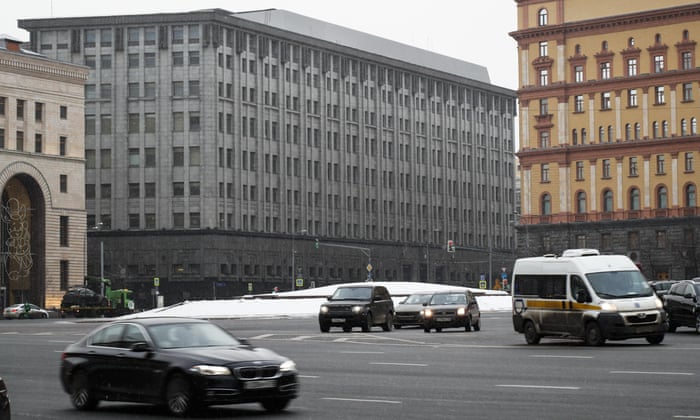
The
FSB headquarters (centre) in Moscow. Sergei Mikhailov was deputy head
of the agency’s Centre for Information Security. Photograph: AP

Two of Moscow’s top cybersecurity officials are facing treason charges for cooperating with the CIA, according to a Russian news report.
The accusations add further intrigue to a mysterious scandal that has had the Moscow rumour mill working in overdrive for the past week, and come not long after US intelligence accused Russia of interfering in the US election and hacking the Democratic party’s servers.
Sergei Mikhailov was deputy head of the FSB security agency’s Centre for
Information Security. His arrest was reported in a series of leaks over
the past week, along with that of his deputy and several civilians, but
Tuesday’s news went much further.
“Sergei Mikhailov and his deputy, Dmitry Dokuchayev, are accused of
betraying their oath and working with the CIA,” Interfax said, quoting a
source familiar with the investigation.
It is unlikely the news agency would have published the story without
official sanction, though this does not necessarily mean the information
is true.
The story did not make it clear whether the pair were accused of being
CIA agents or merely passing on information through intermediaries.
According to earlier reports in the Russian media, Mikhailov was
arrested some time ago, in theatrical fashion, during a plenary session
of the top FSB leadership: a bag was placed over his head and he was
marched out of the room, accused of treason.
His deputy, Dokuchayev, is believed to be a well-known Russian hacker
who went by the nickname Forb, and began working for the FSB some years
ago to evade jail for his hacking activities.
Together with the two FSB officers, Ruslan Stoyanov, the head of the
computer incidents investigations unit at cybersecurity firm Kaspersky
Lab, was also arrested several weeks ago.
Kaspersky confirmed last week that Stoyanov had been arrested and was
being held in a Moscow prison, though it said the arrest was not linked
to his work for the company. Interfax said four people had been arrested
and a further eight were potential witnesses in the case.
It is believed that Dokuchayev and Mikhailov face treason charges, which
carry a penalty of up to 20 years in prison. The treason charge means
any trial will be held in secret.
The arrests and the treason charge, so soon after US intelligence accused Russia of
interfering in the US election process and hacking the Democratic party
servers, have led to inevitable questions about whether the arrests are
linked to the US election story.
Over the weekend the New York Times cited one
former and one current US official as saying human intelligence had
played a major role in helping US authorities determine that Russia was
behind the hacking. The publicly released version of the official report
was largely free of real evidence to back up its conclusions, though if
Russian sources were involved, it is understandable this would not be
made public.
While the information on the arrests has come in difficult-to-decipher
chunks, it has been clear that something very strange has been going on
inside the FSB. In a city where leaks on such sensitive cases are rare,
several Russian outlets have been furnished with varying versions of the
story by insider sources, suggesting either a carefully calibrated
attempt to get information out, or factions struggling to spin the story
in various ways.
The majority of leaks suggest the arrests are linked to Shaltai-Boltai, a
group of hackers who had become notorious for leaking the emails of
Kremlin officials online. A former journalist, Vladimir Anikeev,
believed to be the ringleader of the group, is also among those
arrested, according to reports.
In summer 2014 a representative of Shaltai-Boltai met the Guardian in a
city outside Russia, on the understanding that neither the location nor
the appearance of the man would be described in print.
The interview was set at a little-used boat club on the outskirts of a
European capital. The man, who wore a floral shirt, sailed a boat into
the middle of the river and spoke only when he had turned on loud music
in the cabin to prevent anyone from listening in.
The man, who introduced himself only as Shaltai, said the group was made
up of hackers, and possibly disgruntled officials, and had a large
archive of unused material it may choose to release in future. He
claimed the group possessed everything ranging from records of every
meal Vladimir Putin had eaten for the past several years to thousands of
emails sent by the president’s inner circle.
As evidence, he produced a laptop and opened what looked at first glance
like the full email archive for a leading Kremlin official. He
suggested the group would be willing to provide information to clients
who could pay.
The alleged role of Mikhailov in the Shaltai-Boltai scheme is murky.
Another intelligence source described the alleged scheme to Interfax as
follows: “Each of those involved did their own work. Some people
developed and carried out cyberattacks, while others worked with foreign
intelligence. These things went in parallel, but did not really
overlap.”
Some believe Shaltai-Boltai could have been involved in passing
information to western intelligence, while others suggest the appearance
of the group in the case is a red herring to distract attention from
the real election-hacking story.
“To me, these leaks about Shaltai-Boltai suggest a hastily made cover-up,” said Andrei Soldatov, co-author of a recent book on
the Russian internet and cybersecurity. “Mikhailov and Stoyanov were
real experts in one thing, the Russian digital underground, not the kind
of stuff that Shaltai-Boltai leaked. So if there is anything real about
the treason charges, the kind of information they could pass on would
be about this, perhaps about informal actors in the DNC hacking scheme.”
On Tuesday, Life, an online news portal with close links to the security
services, reported that FSB agents had searched Mikhailov’s home and
dacha and found more than $12m (£10m) in cash stashed in various hiding
places.
Bangladesh: Next general election and the search committee

 by Swadesh Roy-
( February 1, 2017, Dhaka, Sri Lanka Guardian) The
honourable President of Bangladesh has formed a search committee to
select the next election commissioners of Bangladesh. According to the
constitution of Bangladesh, the President has absolute power to appoint
the election commissioners. But, five years back, the former President
of Bangladesh and the nation’s most senior politician of the then time,
Mr. Zillur Rahman, set up a new avenue of democracy in Bangladesh. Even
though, he had the absolute constitutional power, he did not use it;
rather he talked with all major political parties of Bangladesh and took
their opinion to form a new election commission. It is to be said that,
he established a good election commission. The present Chief Election
Commissioner, Mr. Rakibuddin, who is about to retire in mid-February, is
a man of highly common sense. Some critics may say that, in his period,
the general election held in Bangladesh was not inclusive. It is true
that the election held in 2014 was not inclusive but it was not the
fault of the election commission and its total responsibilities went to
the political parties, basically the oppositions, who not only boycotted
the election but also tried to postpone the election by terrorist
activities. They killed more than two hundred people including women and
children, even the pregnant woman with her caring baby; and destroyed
public wealth estimated at least several millions of US dollars.
However, in these circumstances, the Chief Election Commissioner, Mr.
Rakbibuddin did not say a word with the press which was little harmful
for the dignity of the election commission. Besides, when he got chance,
all political parties helped him and his commission conducted a good
election. Recently his commission has conducted a crucial city
corporation election in one of the river port cites named ‘Narayangang’,
near Dhaka. There were many bad rumors before the election but nothing
happened during the election; and the country witnessed a free, fair and
inclusive election. So, Narayangang city corporation election proved
that only election commission is not the factor for conducting a good
election in Bangladesh; rather there are many other components like good
understanding among the political parties, awareness of people and
other logistics support from the administration.
However, the present search committee has started their work by sharing
views with some intellectuals. Their nature of working shows that they
will talk with more stakeholders, list some names to the President as a
proposal so that he can choose the Chief and other election
commissioners from that list. In my opinion, the search committee has
made a mistake in the meantime. They declared that they would invite a
list of proposed names from all political parties. It will create a
misunderstanding and some people in the society will be branded as
several political parties’ identities which is not the reality. To
illustrate, if the biggest party, Awami League proposes ten names,
Bangladesh National Party (BNP) will do the same. And, all members from
two lists will be branded with a political identity according to the
list. So it will create many obstacles to find out the acceptable person
to all parties. That is why, search committee can avoid it; otherwise
most of the efficient persons will face controversy. Not only that, if
they select people by themselves, which is their duty, will face
controversy as well; because when any political party will see that the
members of the election commission is out of their list, they will think
that committee was bias to others.
Therefore, the search committee should sit several times with the
President; because the President of Bangladesh is a renowned season
politician. On the other hand, the election commission is very much
sophisticated political organ of the state. All members of the search
committee are highly knowledgeable and man of dignity; but they are not
that much politically literate as the president of Bangladesh. So they
should talk with the president in every step that Bangladesh can set up a
smart and efficient election commission which will be helpful for
forwarding democracy of Bangladesh, through the next election.
Swadesh Roy, Executive Editor, The Daily Janakantha, Dhaka, Bangladesh he can be reached swadeshroy@gmail.com
Thailand: 2,000 Burmese migrants demand better bonuses, benefits at seafood firm

FILE
- In this Sept. 3, 2013 file photo, migrant workers from Burma clean
fishing nets aboard a trawler after a fishing trip in the Gulf of
Thailand in Samut Sakhon Province, west of Bangkok, Thailand. Pic: AP

31st January 2017
MORE than 2,000 migrant workers at a major Thai seafood exporting
company have called for bigger bonuses and better welfare benefits, a
rare demand in a country that bars foreigners from forming trade unions,
a rights group said.
Seven migrant workers from Burma submitted the request on behalf of more
than 2,000 migrant workers to the government’s labour protection and
welfare office and to Unicord PCL, a leading tuna processor, said the
Migrant Worker Rights Network (MWRN), which supported the effort.
“We believe this negotiation will be successful and lead to a
trickle-down effect where other employees will be empowered and feel
confident to organise and collectively bargain to make demands of their
employers,” said Andy Hall, co-founder of MWRN.
“They will realise the power they have as employees. Workers are powerful human beings.”
Thailand has come under fire in recent years for worker exploitation and
abuses against its migrant labourers – the vast majority from
neighbouring Burma.
Many workers pay exorbitant agent fees to be smuggled into Thailand for
dangerous and demeaning jobs, earning salaries below the minimum wage.
Thailand has pushed through policies in an effort to combat human
trafficking and forced labour, particularly in its seafood industry.
The workers’ demands to Unicord – a subsidiary of the Sea Value Group –
include increased bonuses and benefits, such as benefits for workers
with no absences over a two-week stretch.
Their demands aim to match the benefits provided to workers by other major seafood processors in Thailand, MWRN said.
Officials from Unicord could not immediately be reached by telephone for comment.
A 2015 report by a Finnish advocacy organisation found that Unicord had
improved working conditions since the group began monitoring the company
in 2012, but said its workers paid high recruitment fees.
Unicord reduced the recruitment fees last year after 200 workers
protested outside the factory, Hall said, adding that their success
emboldened them to submit the current demands.
Chanintr Chalisarapong, president of the Thai Tuna Industry Association
and senior vice president of Sea Value, declined to comment on the
negotiation.
“They just submitted it. It takes time to do this. They called for a lot
of things. We can’t comment right now. They (the company) are doing
everything according to law now,” Chanintr said by telephone.
Jason Judd, the International Labour Organization’s programme manager
focused on work conditions in the Thai seafood industry, said unions and
civil society have repeatedly raised the issue of full organising and
bargaining rights for workers in Thailand – regardless of their country
of origin.
“Demands to improve wage protection, working conditions and working time
by migrant workers are not uncommon, but we are hopeful that this new
effort is one of several to advance dialogue between firms and workers
in Thailand’s large food and agriculture industry,” Judd said by email.
– Thomson Reuters Foundation
Malaria drugs fail for first time on patients in UK

The patients had caught malaria when visiting Africa

By James Gallagher-31 January 2017
A key malaria treatment has failed for the first time in patients being treated in the UK, doctors say.
The drug combination was unable to cure four patients, who had all
visited Africa, in early signs the parasite is evolving resistance.
A team at the London School of Hygiene and Tropical Medicine said it was too early to panic.
But it warned things could suddenly get worse and demanded an urgent appraisal of drug-resistance levels in Africa.
Malaria parasites are spread by bites from infected mosquitoes.
It is a major killer of the under-fives with one child dying from the disease every two minutes.
Between 1,500 and 2,000 people are treated for malaria in the UK each year - always after foreign travel.
Most are treated with the combination drug: artemether-lumefantrine.
But clinical reports, now detailed in the journal Antimicrobial Agents
and Chemotherapy, showed the therapy failed in four patients between
October 2015 and February 2016.
All initially responded to therapy and were sent home, but were readmitted around a month later when the infection rebounded.
Samples of the parasite that causes malaria were analysed at the Malaria
Reference Laboratory at the London School of Hygiene and Tropical
Medicine.
Dr Colin Sutherland told the BBC News website: "It's remarkable there's
been four apparent failures of treatment, there's not been any other
published account [in the UK]."
All of the patients were eventually treated using other therapies.
But the detailed analysis of the parasites suggested they were developing ways of resisting the effects of the front-line drugs.
'Clinically challenging'
Dr Sutherland added: "It does feel like something is changing, but we're not yet in a crisis.
"It is an early sign and we need to take it quite seriously as it may be snowballing into something with greater impact."
Two of the cases were associated with travel to Uganda, one with Angola
and one with Liberia - suggesting drug-resistant malaria could be
emerging over wide regions of the continent.
Dr Sutherland added: "There has been anecdotal evidence in Africa of
treatment failure on a scale that is clinically challenging.
"We need to go in and look carefully at drug efficacy."
The malaria parasites all seemed to be evolving different mechanisms
rather than there being one new type of resistant malaria parasite
spreading through the continent.
The type of resistance is also clearly distinct from the form developing in South East Asia that has been causing huge international concern.
Dr Sutherland says doctors in the UK need to be aware the drugs might
not work and argued current treatment guidelines may need to be
reviewed.
Prof David Lalloo, Dean of Clinical Sciences and International Public
Health at Liverpool School of Tropical Medicine, said more studies are
needed.
"This is an interesting and well conducted study and again emphasises
the incredible ability of the malaria parasite to rapidly evolve to
become resistant to antimalarial treatment," he said.
"It is too early to fully evaluate the significance of these findings
but the paper highlights the need to be constantly vigilant when
treating patients with malaria and larger studies are certainly needed
to explore this issue further."
Prof Dame Sally Davies, the chief medical officer for England, said: "This is a stark warning for the future of global medicine.
"We are in dire need of new drugs to keep pace with resistance, in low
and middle-income countries in particular, the consequences of
ineffective drugs are catastrophic."
Follow James on Twitter.
Subscribe to:
Posts (Atom)