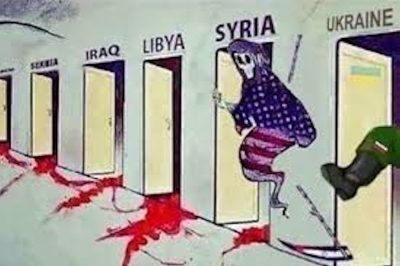
As usual there is amnesia of the ever-recurring big-lie pretext, the
need for another crisis to keep the two-billion-dollar a day NATO war
machine going, the baleful puppet moves of Canada in the process, the
crisis of legitimacy of the lead attacker’s government, and the silent
diversion from the whole nightmare scenario unfolding by all NATO-member
governments, mass media and even ‘peace activist’ organisations.
This time the big-lie pretext is about the alleged poisoning by the
Kremlin/Putin of a double-agent, usually a stock move in espionage
entertainments, but here with no evidence of the claimed origin of the
lethal nerve-agent, but rather expert denial within British defence and
weapons research itself, with devious political word games to get around
the absence of evidence in familiar denunciations of Russia that are
full of aggression and hate. Not even a death is recorded while US-led
and UK-armed ally forces are still mass-murdering poor civilian Yeminis,
drone-murdering endless targets and civilians abroad, continuing on
unblamed for the ongoing NATO-executed eco-genocides of Iraq and Libya
societies, and on the 19-years anniversary of the mass bombing of, once
again a society, Yugoslavia, with the most evolved social
infrastructures of health, education, housing and life security in the
region.
What this latest war pretext for US and NATO-backed aggression is really
about is justifying more war in the Ukraine now that the massive war
preparations along Russia’s Western borders following the self-declared
Nazi-led and proven US- orchestrated and commanded mass-murder coup
d’etat in February 2014 . As usual there is amnesia of the
ever-recurring big-lie pretext, the need for another crisis to keep the
two-billion-dollar a day NATO war machine going, the baleful puppet
moves of Canada in the process, the crisis of legitimacy of the lead
attacker’s government, and the silent diversion from the whole nightmare
scenario unfolding by NATO-member governments, mass media and even
‘peace activist’ organisations.
This time the big-lie pretext is about the alleged poisoning by the
Kremlin/Putin of a double-agent traitor, usually a stock move in
espionage entertainments. Yet there is no confirmed evidence of the
claimed origin of the lethal nerve-agent, but rather denial within
Britain’s own Defence Science and Technology Laboratory unreported in
the press, with devious PR word games of Downing Street crafted to get
around the absence of fact in the familiar denuciations of Russia full
of aggression and hate. Not even a death is recorded as, all the while,
US-led and UK-armed ally forces are still mass-murdering poor civilian
Yeminis, drone-murdering endless targets and civilians abroad,
continuing on unblamed for the ongoing NATO-executed eco-genocides of
Iraq and Libya societies, and on the 19-years anniversary of the mass
bombing of Yugoslavia – yet another a socialist society with the most
evolved social infrastructures of health, education, housing and life
security in the region.
What this latest war pretext for US and NATO-backed aggression is really
about is justifying more war in the Ukraine now that the massive war
preparations along Russia’s Western borders are in place following the
neo-Nazi-led and US-orchestrated mass-murder coup d’etat in February
2014 and the uprising of Eastern Ukraine. As always, the US-directed
mass murder in the Kiev coup was reverse-blamed on the ever shifting
Enemy face – Russia’s allied but duly elected federal government of the
Ukraine. It was only after this violent-coup of the elected government
of Ukraine’s very resource-rich country – “the breadbasket of Europe”
and sitting on newly discovered rich fossil fuel deposits – that Russia
annexed its traditional territory of the Crimea next to Eastern Ukraine.
In predictable censorship by state proclamations and corporate media in
NATO societies, all of these facts are elided.
In reality, Crimea was returned to Russia in a referendum-backed
bloodless transition in reaction to the war-criminal putsch that put it
under the rule of a US-appointed and neo-Nazi-led junta as the
dispossessed Russia-speaking people of Eastern Ukraine simultaneously
fought for their own government – Russia refusing pleas for annexation –
in the now NATO-targeted Donetsk and Lugansk republics (the former by
the way with a publicly adored competitive national soccer team in the
European Champions League).
What is new now is that we are about to enter yet another NATO-member
war build-up against the cornerstone of Western ideology, the designated
Enemy Russia. As usual there is amnesia of the ever-recurring big-lie
pretext, the need for another crisis to keep the two-billion-dollar a
day US-led NATO war machine going, the baleful puppet moves of Canada in
the process, the crisis of legitimacy of the lead attacker’s UK
government, and silent diversion from the whole nightmare scenario
unfolding in NATO-member states, mass media and even ‘peace activist’
organisations.
Cui Bono?
The UK and the US followed by Canada and some of the EU have by
expulsion of Russia diplomats prepared the diplomatic way for war in the
Ukraine to seize back these lost coup-territories, and it will be in
the name of “freedom”, “human rights” and “international law”. But there
is much officially suppressed colour to the warring parties of this
international conflict which reveals who the vile suppressor of human
rights is in reality. Under mass media and corporate-state cover, the
ordering the expulsion of Russia by NATO nations with its
Secretary-General Stoltenberg crowing at the disbelief of Russia is
preparation towards what will only be prevented by public exposure –
NATO plan for war against Russia over Eastern Ukraine and Crimea
separation from the illegal coup-state of Ukraine. The factually absurd
but non-stop pretext of “Russia aggression” constructed out of the
double-agent poisoning affair, with the guilty agents and poison having
no proof but the ever louder UK-led and NATO-state assertion of it in
unison, is the already building pretext.
Yet there is a clear answer to the cui bono question – which party does
all this benefit? Clearly once the question is posed, as opposed to
gagged, Theresa May’s slow-motion collapsing Tory government – now even
challenged for its fraudulent Brexit referendum protecting the big
London banks from EU regulation – has to have such a war-drum
distraction to survive. The old war of aggression pattern reverse-blamed
on the official enemy unwinds yet again. Now NATO-member states are
clearing the way by expulsion of Russia diplomats, and the bigger prize
is armed seizure of the new Eastern Ukraine republics and the Crimea
itself, incalculably rich in natural and strategic resources. But all
this depends on whether the peoples of Britain and NATO buy the string
of big lies that grow before them propounded by hate-Russia propaganda
being dinned people’s heads now.
It is revealing in this context how Canada’s government has no such
ruler need of war – unless it be its Ukraine-descendent Foreign Minister
up front and the very powerful and widely Nazi-sympathizing Ukraine
Liberal vote bank and leadership brought to Canada after 1945 to
overwhelm the preceding active socialist Ukrainian community in Canada.
Canada’s government – not its people – is in any case used to being a
puppet regime in foreign affairs as a twice-colonized rule by big
business (why the NDP is not allowed to govern unless so subjugated).
The Human Rights Question
In light of all of this suppressed factual background and motive for
more war in Ukraine which is unspeakable in the official news,
interaction with the United Nations is of revealing interest. While it
has been the cover for US-led NATO executed genocidal wars of aggression
in the past as in Libya, Afghanistan, Iraq, Yugoslavia and Korea, the
pretexts of ‘human rights’, ‘responsibility to protect’ and ‘stopping
communist aggression’, which are in fact always been the spectacular
opposite on the ground in terms of diseased, mass-murdered and destitute
bodies, these pretexts cannot sell when the background facts are no
longer suppressed from public view. But what state leader yet has
repudiated these false-pretext wars rather than sustained their
illusions and thus the war crimes and crimes against proceeding
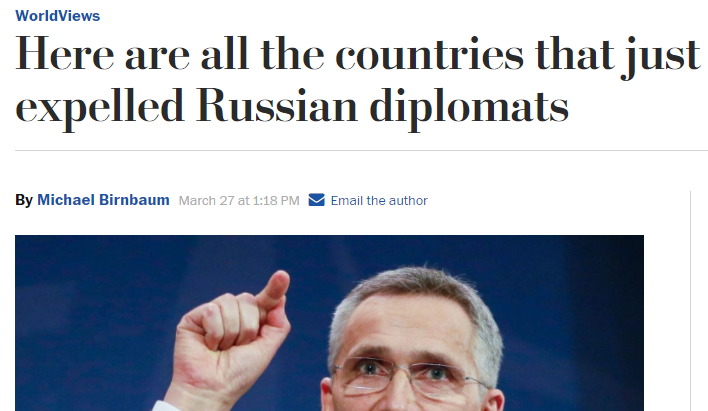
underneath them? Screengrab from The Washington Post. Click here for the full list of countries.
The NATO-executed Ukraine war now being orchestrated is especially
revealing in its actual record of ‘protecting human rights’ through
‘international law’ and ‘norms of civilised nations’. Completely buried
in official records is a United Nations resolution n on Ukraine that the
US and Canada repudiated on November 20, 2015 after the US-led bloody
coup d’etat in Ukraine was in full motion claiming all the vast tracts
of land and resources that were Russia-speaking territory in the past.
The 2015 UN resolution was straightforwardly against “Nazi symbols and
regalia” as well as “holocaust denial”. The Social, Humanitarian and
Cultural Affairs Committee of the UN General Assembly overwhelmingly
voted for a resolution to enable measures against “the glorification of
Nazism, neo-Nazism and other practices that facilitate the escalation of
modern forms of racism, xenophobia and intolerance”. A total of 126
member-states of the UN voted for it for the second time. Over 100
countries also voted for the first resolution in 2014 which also
included “denial of the holocaust and glorification of the Nazi
movement, former members of the Waffen SS organization, including the
installation of memorials to them, and post-coup attempts to desecrate
or destroy the monuments to those who fought against Nazism in Ukraine
during World War II”.
How could any civilised state vote against these United Nations
Resolutions for human rights as Canada and the US have done and stood by
ever since while mouthing opposite commitments? Well instituted group
hatred of the officially designated enemy can justify anything
whatsoever, and is doing so towards the next NATO-executed orgy of war
crime and crimes against humanity, again inside Europe itself, flaunting
reverse-blame lies and slogans as red meat for psychotically trained
masses. It is not by accident that Canada’s Foreign Minister in this
near century-old Nazi loyalist vs. Russia-speaking conflict was before
her appointment the “proud “granddaughter of a leading Nazi war
propagandist during its occupation of Poland and Ukraine described as a
“fighter for freedom”.
Yet on the other hand, we must not lose ourselves in ad hominem
responsibility. Chrystia Freeland, her Canada name, is interestingly
propagandist in itself from her birth – Christian Free Land – but not
observed in the corporate press. Minister Freeland is only a symptom of
something far deeper and more systemically murderous and evil in
state-executed unlimited corporate greed and immiserization of innocent
millions of people masked as ‘human rights’ , ‘freedom’ and ‘the rule of
law’ . Her more sinister double in the US is also a renamed person of
the region, Victoria Nuland (read New Land) who orchestrated the whole
2014 mass-murder coup in Ukraine and now tub-thumps on public television
for the ‘need to teach Putin and Russia a hard lesson’, aka another war
attack by US-led NATO on Russia’s borders.
The difference now is that the absurd pretext and geostrategic
mechanisms now in motion can be seen in front of our eyes beforehand –
that is, if we can still see through the engineered prism of the US-UK
led NATO war machine. This alone will stop it.
John McMurtry March 27, 2018
John McMurtry is a Fellow of the Royal Society of
Canada whose work is translated from Latin America to Japan. His most
recent book is The Cancer Stage of Capitalism: from Crisis to Cure. John McMurtry is a frequent contributor to Global Research.
With a year to go until Brexit happens, Theresa May has spent the day on
a tour of all four nations of the UK. She said she was listening to
people’s hopes for the country after we leave the EU. Former Prime
Minister Tony Blair said he hoped that day would never come – and the
people should have another vote on the final deal before it happened.
Abdel Fattah al-Sisi has officially been taken into custody for a second term as president of Egypt.
The outcome of Egypt’s election this week wasn’t surprising, though in
one sense the whole spectacle was quite odd. The vote was supposed to
give Sisi the electoral legitimacy that he has always lacked. Sure, he
was elected in May 2014 — after first coming to power in a coup the
previous summer — but by then voters had become indifferent, so much so
that polling places were kept open an extra day so that Egyptians could
be bribed and bused in to cast a ballot. But the same thing happened
this time around; if anything, the runup to the vote was significantly
more thuggish. Every marginally credible potential candidate was taken
into custody based on a variety of mostly absurd allegations, all of
which a complicit press and political class of bootlickers worked
tirelessly to justify.
But Sisi’s hollow victory — like the coup that brought him to power in
the first place — fits neatly within the flat arc of modern Egyptian
history. The lesson of that history isn’t that Egyptian citizens are
unprepared for a more just, open, and democratic society. Rather, it’s
that Egypt’s political elites have always benefitted from the country’s
authoritarian system and thus will go to great lengths to defend it.
None of Egypt’s presidents has ever enjoyed the kind of legitimacy that
democracy confers on elected leaders, but one of the country’s stunning
ironies is the way nondemocratic forces have often used democratic, even
liberal, ideas as mechanisms of legitimation. Why bother holding
elections if you have no intention of respecting the rights and views of
those who did not vote for you, of governing through consensus and
compromise, and of submitting to the uncertainty of the electoral
process when your term is up? Yet in the last four decades, Egypt has
had political parties and regularly scheduled elections, even as the
country’s leaders have only ruled by coercion and force.
President Gamal Abdel Nasser built the standard Middle Eastern security
state, but it was his successor, Anwar Sadat, who first sought to
leverage democratic ideas and practices to legitimize authoritarianism
and, in the process, advance his narrow political interests. Thus, there
were Sadat’s dramatic pronouncements about building a “state of
institutions” and the establishment of manabir, or platforms,
within the Arab Socialist Union that eventually became political
parties, which Sadat intended to be loyal oppositions of the left,
right, and center. When they proved not to be, he ignored them and
arrested his opponents. Yet Sadat and his supporters could always claim —
albeit disingenuously — that he corrected Nasser’s excesses and began
Egypt’s path toward democratic change.
About the Author
Steven A. Cook is the Eni Enrico Mattei senior fellow for Middle East
and Africa studies at the Council on Foreign Relations. His new book,
False Dawn: Protest, Democracy, and Violence in the New Middle East, was
published in June. Hosni Mubarak picked up where his predecessor left off.
Never mind that to be in Egypt during one of his presidential
referendums was to exist in a world in which ostentatious “truthiness”
had taken over. Although there was only a single candidate on the ballot
— Mubarak — and voters were asked to simply mark “Yes” or “No,” the
exercise had the trappings of an actual political campaign. The National
Democratic Party and the government press described these referendums
as a marker of Egypt’s democratic development. No one was willing to
comment publicly on the farce of it all, leaving authorities with the
satisfaction that if it looked like a campaign and felt like a
competitive election, then that was good enough to call the endeavor
democratic — something it approximated but clearly was not. The
government even made a mockery of their own mockery, distributing
elections flyers (paid for by five private companies) that declared:
The president, the leader, Mohammed Hosni Mubarak
With you always … with loyalty, appreciation, and recognition
Yes … to the leader who has devoted himself to his nation, his people, and his community
A few years later, Mubarak began talking about how the government had
undertaken a program of “strengthening” and “deepening” democracy. It
was rhetoric that few actually believed, but it served two important,
related purposes, especially toward the end of the Mubarak era: First,
it sought to outmaneuver those who genuinely sought democratic reform
and others like the Muslim Brotherhood, which had also appropriated the
vocabulary of political reform, and, second, it was an effort to deflect
international criticism of Egypt’s predatory politics. Neither worked
very well.
When their chance came after the 2011 uprising that forced Mubarak from
office, the Muslim Brotherhood positioned its members as responsible
stewards of political change for which they were rewarded during the
parliamentary elections. It did not take long, however, to recognize
that the Muslim Brothers were products of a system that saw democratic
practices as a means to establishing political control. The Brotherhood
turned out to be unsuccessful for a variety of reasons, notably its
incompetence and the hostility of those who benefited from the old
order. Yet they also proved themselves no different from the people they
hoped to replace when it came to manipulating the outcome of the
presidential elections — through suspect exit polls and implicit threats
of violence — and power grabs in the name of democratic change.
Sisi’s election referendum only differs from this unfortunate history in the details. The Washington Poststory on
the vote referenced the “ghosts of the Arab Spring” that hovered over
the three days of balloting, but it was the July 3, 2013, coup d’état
that was most resonant. That intervention was planned and executed by
people (not just in the military) who sought to reset what they believe
to be the natural order of politics in Egypt. Five years on, mission
accomplished.
A question now hangs over Washington (or at least that tiny community
inside the Beltway that pays attention to Egypt): What should the United
States do about all this? Among the raft of analyses and reporting on
the election, there is a significant amount of exhortation but little
new in terms of practical advice. Ahead of the vote, Sens. Bob Menendez
(D-N.J.) and Marco Rubio (R-Fla.) declared their support for the rights
of the Egyptian people, which was commendable, but they otherwise did
nothing to alter the conduct of the Egyptian government. Perhaps in the
future, congressional censure will influence Egyptian decision-making.
Still, a skeptic might ask when the U.S. Congress, as a body, ever
really cared about the Egyptian people.
Of course, there is Egypt’s annual military assistance, which is often
invoked as a means of behavior modification. That aid has at various
times been threatened, delayed, or cut to no avail. Perhaps Congress
will see fit to do more in this area, but the Trump administration, like
others before it with an emphasis on fighting terrorists, would likely
regard the aid as a national security priority and waive Congress’s
effort to punish the Egyptians. It is a problem made worse by the fact
that Washington seems to be waking up to the new era of great power
competition that Russia has been waging, starting with the Middle East.
Egypt does not want to replace the United States with Russia, but it
could play both ends for advantage. As a result, the United States will
most likely do what it has always done in Egypt and accommodate itself
to the outcomes that Egyptians themselves produce.
Amal Clooney has confirmed that she will serve as counsel to Wa Lone and
Kyaw Soe Oo, two Reuters reporters facing charges for allegedly
posessing classified government papers. Source: Reuters
INTERNATIONALLY acclaimed human rights lawyer Amal Clooney will be
joining the legal team of the two Burmese reporters on trial in the
Southeast Asian country, her office said on Thursday.
Clooney, a barrister at Doughty Street Chambers specialising in
international law and human rights, has confirmed that she will serve as
counsel to Wa Lone and Kyaw Soe Oo, two Reuters reporters facing charges for allegedly possessing classified government papers
The office in a statement said Clooney has been instructed jointly by Reuters and the two defendants in the case.
The two on trial are investigative reporters who were arrested last
December following their reports of a massacre of 10 Rohingya men and
boys in Rakhine State state during an army crackdown that began in
August, which has sent nearly 700,000 people fleeing to Bangladesh.
They are accused of violating the country’s Official Secrets Act, a
colonial-era statute which carries a maximum prison sentence of 14
years, and are currently detained in a Yangon prison during the criminal
trial.
Detained Reuters journalist Wa Lone is escorted by police after a court
hearing in Yangon, Myanmar March 7, 2018. Source: Reuters/Stringer
“Wa Lone and Kyaw Soe Oo are being prosecuted simply because they
reported the news. I have reviewed the case file and it is clear beyond
doubt that the two journalists are innocent and should be released
immediately,” Clooney, who is married to actor George Clooney, said.
“Yet they have been denied bail and face 14 years in prison. The outcome
of this case will tell us a lot about Myanmar’s (Burma’s) commitment to
the rule of law and freedom of speech.”
Gail Gove, Chief Counsel of Reuters,
said: “We will pursue all avenues to secure our reporters’ release.
Retaining Ms Clooney greatly strengthens our international legal
expertise and allows us to broaden those efforts.”
Zaw Htay, a spokesman for Burma’s civilian government, declined to comment.
Government officials have previously denied the arrests represent an
attack on press freedom, which rights advocates say is under growing
threat in the Southeast Asian country.
Burma’s ambassador to the United Nations, Hau Do Suan, said last month that the Reuters journalists
were not arrested for reporting a story, but were accused of “illegally
possessing confidential government documents”.
Detained Reuters journalist Wa Lone is escorted by police during a break
at a court hearing in Yangon, Myanmar February 1, 2018. Source:
Reuters/Jorge Silva
The pair have told relatives they were arrested almost immediately after
being handed some rolled up papers at a restaurant in northern Yangon
by two policemen they had not met before, having been invited to meet
the officers for dinner.
The district court in northern Yangon will hear arguments from
prosecutors and defence lawyers on the motion to dismiss the case on
April 4.
The corruption in the West extends beyond politicians, presstitutes, and an insouciant public to experts.
by Paul Craig Roberts-
( March 27, 2018, Washington DC, Sri Lanka Guardian) Among
Western political leaders there is not an ounce of integrity or
morality. The Western print and TV media is dishonest and corrupt beyond
repair. Yet the Russian government persists in its fantasy of “working
with Russia’s Western partners.” The only way Russia can work with
crooks is to become a crook. Is that what the Russian government wants?
Finian Cunningham notes the absurdity in the political and media uproar
over Trump (belatedly) telephoning Putin to congratulate him on his
reelection with 77 percent of the vote, a show of public approval that
no Western political leader could possibly attain. The crazed US senator
from Arizona called the person with the largest majority vote of our
time “a dictator.” Yet a real blood-soaked dictator from Saudi Arabia is
feted at the White House and fawned over by the president of the United States.
The Western politicians and presstitutes are morally outraged over an
alleged poisoning, unsupported by any evidence, of a former spy of no
consequence on orders by the president of Russia himself. These kind of
insane insults thrown at the leader of the world’s most powerful
military nation—and Russia is a nation, unlike the mongrel Western
countries—raise the chances of nuclear Armageddon beyond the risks
during the 20th century’s Cold War. The insane fools making these
unsupported accusations show total disregard for all life on earth. Yet
they regard themselves as the salt of the earth and as “exceptional,
indispensable” people.
Think about the alleged poisoning of Skirpal by Russia. What can this be
other than an orchestrated effort to demonize the president of Russia?
How can the West be so outraged over the death of a former double-agent,
that is, a deceptive person, and completely indifferent to the millions
of peoples destroyed by the West in the 21st century alone. Where is
the outrage among Western peoples over the massive deaths for which the
West, acting through its Saudi agent, is responsible in Yemen? Where is
the Western outrage among Western peoples over the deaths in Syria? The
deaths in Libya, in Somalia, Pakistan, Ukraine, Afghanistan? Where is
the outrage in the West over the constant Western interference in the
internal affairs of other countries? How many times has Washington
overthrown a democratically-elected government in Honduras and
reinstalled a Washington puppet?
The corruption in the West extends beyond politicians, presstitutes, and
an insouciant public to experts. When the ridiculous Condi Rice,
national security adviser to president George W. Bush, spoke of Saddam
Hussein’s non-existent weapons of mass destruction sending up a nuclear
cloud over an American city, experts did not laugh her out of court. The
chance of any such event was precisely zero and every expert knew it,
but the corrupt experts held their tongues. If they spoke the truth,
they knew that they would not get on TV, would not get a government
grant, would be out of the running for a government appointment. So they
accepted the absurd lie designed to justify an American invasion that
destroyed a country.
This is the West. There is nothing but lies and indifference to the
deaths of others. The only outrage is orchestrated and directed against a
target: the Taliban, Saddam Hussein, Gaddafi, Iran, Assad, Russia and
Putin, and against reformist leaders in Latin America. The targets for
Western outrage are always those who act independently of Washington or
who are no longer useful to Washington’s purposes.
The quality of people in Western governments has collapsed to the very
bottom of the barrel. The British actually have a person, Boris Johnson,
as Foreign Secretary, who is so low-down that a former British
ambassador has no compunction in calling him a categorical liar.
The British lab Porton Down, contrary to Johnson’s claim, has not
identified the agent associated with the attack on Skirpal as a Russian
novichok agent. Note also that if the British lab is able to identify a
novichok agent, it also has the capability of producing it, a capability
that many countries have as the formulas were published years ago in a
book.
That the novichok poisoning of Skirpal is an orchestration is obvious.
The minute the event occured the story was ready. With no evidence in
hand, the British government and presstitute media were screaming “the
Russians did it.” Not content with that, Boris Johnson screamed “Putin
did it.” In order to institutionalize fear and hatred of Russia into
British consciousness, British school children are being taught that Putin is like Hitler.
Orchestrations this blatant demonstrate that Western governments have no
respect for the intelligence of their peoples. That Western governments
get away with these fantastic lies indicates that the governments are
immune to accountability. Even if accountability were possible, there is
no sign that Western peoples are capable of holding their governments
accountable. As Washington drives the world to nuclear war, where are
the protests? The only protest is brainwashed school children protesting
the National Rifle Association and the Second Amendment.
Western democracy is a hoax. Consider Catalonia. The people voted for
independence and were denounced for doing so by European politicians.
The Spanish government invaded Catalonia alleging that the popular
referendum, in which people expressed their opinion about their own
future, was illegal. Catalonian leaders are in prison awaiting trial,
except for Carles Puigdemont who escaped to Belgium. Now Germany has
captured him on his return to Belgium from Finland where he lectured at
the University of Hesinki and is holding him in jail for a Spanish
government that bears more resembance to Francisco Franco than to
democracy. The European Union itself is a conspiracy against democracy.
The success of Western propaganda in creating non-existent virtues for
itself is the greatest public relations success in history.
The fate of the 19th Summit of the South Asian Association for Regional Cooperation (SAARC) hangs in the balance.
Saturday, 31 March 2018 The
19th Summit was to have been held way back in November 2016, but had to
be postponed indefinitely because India boycotted it complaining of
attacks by Pakistan-based terror groups on Indian military bases in
Pathankot and Uri. Other members like Bangladesh, Afghanistan, Sri Lanka
and the Maldives followed suit for their own reasons.
According to the SAARC charter, the heads of government of the eight
member States should meet once year. But this has not been observed to
the letter. And between 1998 and 2002, no Summits were held, again
because of India-Pakistan conflicts.
This time round too, India-Pakistan bilateral issues appear to be
stalling Pakistan’s efforts to hold the 19th.Summit. It is Pakistan’s
turn to hold the summit. But while Pakistan insists that it is the
legitimate venue, India has a major issue with that claim because, in
its view, there has been no let-up in cross-border terrorism sponsored
by Pakistan since 2016.
And if India decides to boycott a Summit held in Pakistan, the summit
cannot be held as the charter requires the representation of every
member State.
But Pakistan, looking for a role in South Asia (basically to contain
India), is working assiduously but quietly, to garner support for
holding the Summit and holding it in Islamabad as scheduled earlier.
Pakistan sees SAARC as a forum which will help it face India in
conjunction with the rest of the members, who also have issues with
India.
On Thursday, at the Pakistan National Day function in Colombo, High
Commissioner, Dr. Shahid Ahmad Hashmat gave primacy to SAARC in his
speech. Stressing the need for member States to pool in efforts to
strengthen SAARC, he said: “SAARC is needed for political and economic
cooperation in South Asia.”
Hashmat also said that Pakistan’s relations with Sri Lanka are based on
“mutual respect and not mutual interest”, thereby hinting that cold
interest based on real politik should not be the only criterion for
having bilateral and multilateral ties.
Janjua’s visit
Significantly, Pakistan’s Foreign Secretary, TehminaJanjua, chose to
visit Sri Lanka first after taking over the post at the end of 2017. At
her meeting with President Maithripala Sirisena, Janjua extracted a
promise that Sri Lanka would support Pakistan’s stand on the summit.
Janjua’s visit to Colombo came a day after Pakistan scored an important
victory at the UN, when it got a seat at the UN Human Rights Council
thanks to Sri Lanka’s support. Pakistan was grateful to Sri Lanka for
sending its cricket team to play in it after a long gap. There had been
no visit by a Sri Lankan side to Pakistan since the terrorist attack on
it in 2009.
“We
are delighted that the Sri Lankan team is visiting Lahore. Pakistanis
will cheer the Sri Lankans as much as their own team,” Janjua said,
immensely pleasing her Sri Lankan audience.
Subsequently, the Pakistani President, Mamnoon Hussain, invited
President Sirisena to visit Islamabad and the latter obliged him in
March this year. During the visit, President Mamnoon personally came to
the airport to receive Sirisena as a 21-gun salute boomed.
In his meeting with Sirisena, Pakistani Prime Minister Shahid Khaqan
Abbasi, said that Pakistan is committed to the SAARC process and urged
the Sri Lankan President to “play his role for the early convening of
the SAARC Summit in Islamabad.”
Though it is not clear if President assented to the Pakistani request
(the press communiqué gave no clue), it is likely that he would make the
necessary efforts given Sri Lanka’s traditionally friendly ties with
Pakistan. But diplomats caution that often, in such matters, Colombo
finally tends to look to New Delhi for the cue, as ties with India are
far more important to it.
And India’s stance on Pakistan has only hardened since 2016. Only
recently, there had been a row over the surveillance mounted on their
diplomats. The Pakistani Ambassador had even left New Delhi indicating
growing discontent.
With the Indian Parliamentary elections due in May 2019, the hardline
Bharatiya Janata Party-led government could tweak its anti-Pakistan
posture further, in the hope of getting the Indian nationalistic vote in
a closely fought election. During the Gujarat and Uttar Pradesh State
Assembly elections, BJP leaders had dubbed the rival Congress Party a
“stooge” of Pakistan and declared that the latter’s victory would be
“Pakistan’s victory”.
India’s moves
But India too has been cultivating the Sri Lankan leadership. President
Sirisena was given a prominent place in the international solar summit
held in Delhi. And out of respect for India, Sirisena made the visit to
New Delhi on March 11 even though there had been communal clashes in
Kandy district between 2 and 10 March.
Problematic Nepal
While close allies Afghanistan and Bhutan are expected to go along with
India on the SAARC issue, Nepal is likely to exercise independence,
given the fact that communist Prime Minister K.P. Oli and his Maoist
ally, Pushpa Kamal Dahal “Prachanda” are not as well disposed towards
India as the traditionally pro-India Centre-Left party, the Nepali
Congress. Softening Maldives
The Maldives could have go the Pakistan way, given its contradictions
with India since Abdulla Yameen became President in 2013. But
Maldives-India relations have recently improved with Yameen trying to
reach out to New Delhi, and New Delhi’s pledging not to militarily
intervene in the Indian Ocean archipelago where Yameen is locked in a no
holds barred conflict with the opposition.
Bangladesh implacable
Bangladesh too is expected to oppose the location of the summit in
Islamabad because Sheikh Hasina’s regime in Dhaka continues to be
bitterly anti-Pakistan.
Parliamentary elections due in Bangladesh in July 2018. With the
opposition Bangladesh Nationalist Party (BNP) likely to contest and not
boycott as it did the last time, Sheikh Hasina could well queer the
anti-Pakistani nationalistic pitch. In fact, on 25 March, ‘Genocide
Day,’ Hasina told a rally that “those Bangladeshis living in independent
Bangladesh who love Pakistan should be punished.”
Special Bangladeshi courts had sentenced pro-Pakistani leaders to death
for their alleged role in the 1971 killings carried out by the Pakistani
forces and their local allies.
Dangers in blocking continuously
But the question that remains to be answered is: Can India continue to
block the SAARC summit being held in Islamabad, without losing its moral
authority in the grouping which its neighbours consider important?
Some observers feel that the current crisis will blow over as the
1998-2002 crisis did. The four-year gap between the 1998 and the 2002
Summits created by an India-Pakistan row, did not destroy SAARC. And
when the wheels of cooperation started moving again after 2002, SAARC
achieved much.
Others say that SAARC has already been downgraded by India which is now
looking to have closer links with regional organisations which do not
have Pakistan as a member, such as ASEAN and the Bay of Bengal
Initiative for Multi-Sectoral Economic Cooperation (BIMSTEC). It is
trying to linkup with Iran and Central Asia through the Indo-Iranian
Chabahar Port.
But there are commentators who decry downgrading SAARC. As a former Sri
Lankan diplomat said: “SAARC has a lot of achievements to its credit, in
as much as, it has been the only all South Asian forum since the 1980s.
It has brought people and technical experts of the region together to
work towards common goals. BIMSTEC on the contrary is yet to take off
though it has been in existence since 1997.”
And wrecking SAARC through the continuous postponement of the summit
will only further alienate India from its South Asian neighbours, who
see value in SAARC,” the former diplomat added.
FREETOWN (Reuters) - Sierra Leone voted on Saturday in a poll delayed by
fraud allegations to choose a successor to President Ernest Bai Koroma
who leaves a country struggling after the Ebola epidemic and a commodity
price crash.
The face-off between opposition leader Julius Maada Bio and ruling party
standard-bearer Samura Kamara was supposed to take place on Tuesday but
was rescheduled after a complaint about ballot tampering in the first
round of voting this month from a member of Kamara’s All People’s
Congress.
Neither is a clear front runner after a first round that Maada Bio
narrowly won with 43.3 percent of the votes versus 42.7 for Kamara,
short of the 50 percent needed for outright victory. Counting had begun
on Saturday evening and the elections commission said a result would be
announced in the coming days.
Whoever succeeds Koroma, who is stepping aside after his maximum two
five-year terms in office, faces an uphill struggle to overturn years of
hardship. A slump in the price of its commodity exports since 2015 and
the Ebola crisis in 2014 and 2015 crippled the economy, which shrank by a
fifth in 2015.
“I want a better country, I want development for my country, so today I
come to cast my vote for a leader who can develop this country,” said
Mohamed Kamara after casting his vote at a polling station in western
Freetown.
Voting was completed on a hot and humid day in mostly peaceful
conditions though there were clashes between supporters in at least one
polling station, according to witnesses. On the streets of Lumley in
western Freetown, police opened fire during a violent dispute. A Reuters
witness said no one was killed.
Many voters complained that a heavy police presence inside polling stations had deterred people from casting their ballot.
Julius Maada Bio, the presidential candidate for the Sierra Leone
People's Party (SLPP), carries his daughter as he votes during a
presidential run-off in Freetown, Sierra Leone March 31, 2018.
REUTERS/Olivia Acland
Staff at two polling stations said turnout was lower than in the first
round. Many were forced to walk to their nearest voting station because
of a driving ban imposed on election day for security reasons.
“There is low turnout in different parts of the country because of the
huge presence of security forces,” Julius Maada Bio said after voting in
Freetown.
President Koroma also noted the low turnout when he spoke in Freetown, and urged people to head to their polling stations.
Slideshow (3 Images)
Concern
about policing comes after the National Electoral Commission last week
said that police had tried to intimidate staff in the run-up to the
election.
Speaking to the media, army spokesman Major Paow Kagbo said the military
personnel were there to ensure the election was “free and fair”.
Politics in the West African country of over seven million people has
been dominated by two parties: the ruling All People’s Congress, now
fielding ex-foreign minister Samura Kamara, and the Sierra Leone
People’s Party behind Julius Maada Bio, who briefly ruled as head of a
military junta in 1996.
The generally peaceful nature of the election, and the fact Koroma is
stepping down while some other African presidents seek to extend their
mandates, is seen as a positive sign for Sierra Leone that was ripped
apart by a 1990s civil war.
Pupil overcomes needle fear to take part in meningitis vaccine trial
By Ian Westbrook-28 March 2018
Teenagers in Great Britain are being asked to take part in a study to
learn if immunising them against meningitis B could protect them and
other people.
The NHS wants 24,000 to take part in the Oxford Vaccine Group's Be On
The Team trial, which is helped by National Institute for Health
Research funding.
Bacteria at the back of the throat can cause meningitis and the study will see if vaccination can stop this happening.
The trial will take place in four waves of recruitment over the next two years.
Control group
Each of the teenagers who chooses to participate, in Year 12 in England
or the equivalent in Scotland and Wales, will be put into one of three
groups of 8,000 participants and will receive two doses of one of two
vaccines.
Two of these groups will be in the programme for a year, with the third,
which will act as a control group, taking part for 18 months.
The recruitment started this week and is planned to work around school
holidays and exams, taking place in March-April and September-October
this year and in 2019.
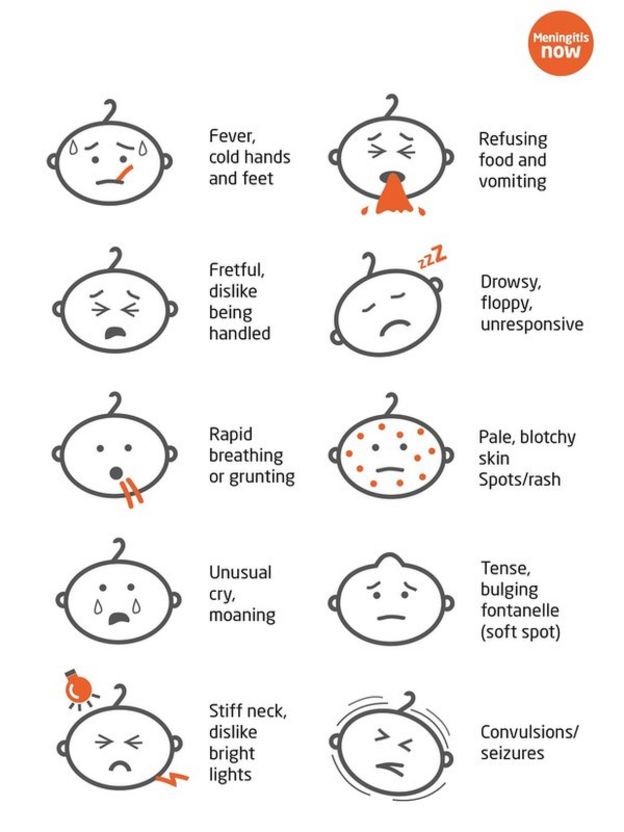
Meningitis B facts
Meningitis B is a bacterial infection that most often affects children below the age of one
It is the most common form of the condition in the UK
Since 2015, children under 12 months have been offered the vaccination
There are about 1,200 meningitis B cases each year in the UK
With early diagnosis and antibiotic treatment, most people will make a full recovery
It is fatal in one in 10 cases
About
one in four of those who survive is left with long-term problems, such
as amputation, deafness, epilepsy and learning difficulties
Dr Matthew Snape, a consultant paediatrician at the Oxford Vaccine
Group, told the BBC: "We've had great enthusiasm from the schools we
have approached, with the majority of Year 12 students interested in
taking part.
"The peak of carriage for the bacteria is from the teenage years through
to young adulthood - there is a lot of carriage with university
students.
"We are doing the study to help us understand whether an immunisation
campaign in teenagers would help us to protect the whole community."
Faye Burdett was taken to an accident and emergency unit with a rash on her forehead but died days later
Dr Snape said the study's findings would be passed on to policymakers
"to inform any future decisions about adolescent meningococcal
immunisation". And there have already been calls for a wider meningitis B
immunisation programme.
Following the death of two-year-old Faye Burdett in 2016, a petition set
up to ask for all children to be routinely vaccinated attracted 820,000
signatures.
One of the report's recommendations was to lower the cost-effectiveness
threshold for immunisation - widescale vaccination against meningitis B
had been rejected as being "not cost effective".
A consultation on the report is running until 21 May.
And Health Secretary Jeremy Hunt apologised for "system failures" that
led to the deaths of two teenagers from the disease in Bristol in 2016.
Claire Donovan, head of research and information at Meningitis Now, told
the BBC: "We support the trial, and it's something we've been waiting
to happen for a number of years - we are very keen that it goes ahead."
Ms Donovan added that if the trial was successful, "then potentially
vaccinating that age group will help protect the rest of the nation".
Dr Tom Nutt, the charity's chief executive, said: "This important study
is a chance for young people to make a real difference to not only their
own health but that of their wider community."



 By Prof. John McMurtry- March 28, 2018
 Screengrab from The Washington Post. Click here for the full list of countries.



 ( March 27, 2018, Washington DC, Sri Lanka Guardian) Among
Western political leaders there is not an ounce of integrity or
morality. The Western print and TV media is dishonest and corrupt beyond
repair. Yet the Russian government persists in its fantasy of “working
with Russia’s Western partners.” The only way Russia can work with
crooks is to become a crook. Is that what the Russian government wants?
( March 27, 2018, Washington DC, Sri Lanka Guardian) Among
Western political leaders there is not an ounce of integrity or
morality. The Western print and TV media is dishonest and corrupt beyond
repair. Yet the Russian government persists in its fantasy of “working
with Russia’s Western partners.” The only way Russia can work with
crooks is to become a crook. Is that what the Russian government wants?
 The
19th Summit was to have been held way back in November 2016, but had to
be postponed indefinitely because India boycotted it complaining of
attacks by Pakistan-based terror groups on Indian military bases in
Pathankot and Uri. Other members like Bangladesh, Afghanistan, Sri Lanka
and the Maldives followed suit for their own reasons.
The
19th Summit was to have been held way back in November 2016, but had to
be postponed indefinitely because India boycotted it complaining of
attacks by Pakistan-based terror groups on Indian military bases in
Pathankot and Uri. Other members like Bangladesh, Afghanistan, Sri Lanka
and the Maldives followed suit for their own reasons. “We
are delighted that the Sri Lankan team is visiting Lahore. Pakistanis
will cheer the Sri Lankans as much as their own team,” Janjua said,
immensely pleasing her Sri Lankan audience.
“We
are delighted that the Sri Lankan team is visiting Lahore. Pakistanis
will cheer the Sri Lankans as much as their own team,” Janjua said,
immensely pleasing her Sri Lankan audience.


 Concern
about policing comes after the National Electoral Commission last week
said that police had tried to intimidate staff in the run-up to the
election.
Concern
about policing comes after the National Electoral Commission last week
said that police had tried to intimidate staff in the run-up to the
election.
 28 March 2018