Peace for the World World ! Your War Our Lives

The Dalai Lama
A Brief Colonial History Of Ceylon(SriLanka)
Sri Lanka: One Island Two Nations
A Brief Colonial History Of Ceylon(SriLanka)
Sri Lanka: One Island Two Nations
(Full Story)
Back to 500BC.

Tuesday, January 1, 2019
Schooling the visually impaired in Sri lanka

DABAL Meeting
When Dr Hudson
Silva began his eye donation campaign somewhere in the late 1950s, he
“marketed” it as a means of achieving merit in this life, because an
earlier campaign to get people to donate corneas had failed. So
successful was this marketing tactic that the first batch of corneas he
got exceeded by a considerable margin what he had expected. Dr Silva
would later be appointed as the President of the International Eye Bank.
Today there are monuments, institutions, and roads named after him. Is
that enough to venerate him for what he did? I certainly hope so.

The lesson that Dr Hudson taught us was this: those who donate expect something in return. That something may not always be financial, but it has to make the giver “feel good”. In a predominantly Buddhist country, where even non-Buddhists believe in acquiring kusal over akusal and where Buddhist terms are liberally appropriated and disseminated by the Christian clergy, it has become the norm to view those who are less abled as being worthy of pity. Sadly, however, that is not enough.
 Looking
through reports, statistics, and interviews of various officials and
experts in the field, I believe that we as Sri Lankans are not doing
enough to help those who are in need of help. In particular, the blind
and the deaf.
Looking
through reports, statistics, and interviews of various officials and
experts in the field, I believe that we as Sri Lankans are not doing
enough to help those who are in need of help. In particular, the blind
and the deaf. Consider the plight of the blind. Around 1.7% of Sri Lankans are blind. That works out to about 364,000 people. The most common reason for this is cataract blindness, followed by diabetes and glaucoma. Among the biggest constraints that stand in the way of preventing blindness are inadequate human resources, information systems, and supplies of spectacles. Add to that the glaring problem of inter-regional disparities (13 government eye surgeons in Colombo, as opposed to one in Anuradhapura) and you see the gravity of this issue: when it comes to the blind, there’s no one to lead them. Especially with regard to blind children.
Blind education in this country goes back to 1912 with the founding of the Ceylon School for the Deaf and Blind. Today, it is a registered charity with three institutions (two in Ratmalana and one in Jaffna), which provides education free of charge to a population of over 600 students. Though it receives a stipend from the government, it is not publicly owned or subsidised. Because of this, it faces financial constraints in the provision of facilities and has to raise Rs. 50 million annually on its own.
The “bursary” that children in these and other blind schools receive is around Rs. 50 a day. What can anyone do with that amount of money? To give a comparable figure, a blind school student in the UK would get around £1,000 per annum, which works out to around £2.73 (or Rs. 817) per day. What with financial constraints and bottlenecks it probably is difficult to raise the bursary to such a level here. But then, if we aren’t concentrating on these disadvantaged youngsters, who will be?
We are a nation of givers, we are told. Doesn’t mean we can’t give more. In that sense there are individuals, groups, organisations, and foundations that have done and are doing more, much more, than the government will. Among those foundations, many are run as exercises in Corporate Social Responsibility. Such foundations do a great deal, but since they depend on corporate profitability they can’t be said to have done enough. There are other foundations, though. Among them, DABAL.
DABAL stands for Deaf and Blind Aid Lanka. Established in 2004, it resorts to new and innovative ways of getting donations that go beyond just corporate funding. It has so far been able to support 16 blind schools in the country, a lot considering the severe financial constraints it has had to put up with at a time of austerity in Britain. DABAL, however, does not as yet have a branch in Sri Lanka, though it has targeted that most marginalised kind of educational institutions, the rural school. It’s “small” in the sense that corporate social responsibility projects are “big”, but the way I see it, it has done more, much more than what those projects can ever achieve.
Consider the plight of the blind. Around 1.7% of Sri Lankans are blind. That works out to about 364,000 people
 Deaf
and Blind Aid Lanka has a patron. Not just a patron, but a guiding
figure. I met him three months ago. His name, Colin Low. Baron Low of
Dalston.
Deaf
and Blind Aid Lanka has a patron. Not just a patron, but a guiding
figure. I met him three months ago. His name, Colin Low. Baron Low of
Dalston. Colin Low currently sits in as an MP in the House of Commons. When he entered the House in 2004 (the same year DABAL was founded), he was considered as the first blind person to sit there, though as he pointed out, “that honour is not quite singular.” Born in 1942 (“halfway through the War”) in Edinburgh, he was left fatherless at the age of two and had to struggle hard to obtain a proper education. Initially educated in Scotland, he left for Oxford in 1961 and to Cambridge in 1965, becoming a lecturer in Law at Leeds University. Over his tenure (1968-1984), he would see Harold Wilson, Edward Heath, James Callaghan, and Margaret Thatcher; the campaign for disability rights would begin with Wilson and culminate with Thatcher’s successor, John Major, when in 1995 the Parliament passed the Disability Discrimination Act.
Baron Low was at the forefront of disability rights in these heady years and decades. He was particularly concerned with rights for blind students, at a time when the notion of disability rights was limited to the Welfare State (“which was hardly enough”). The National Federation for the Blind, the Association for the Blind and Partially Blind, and the National Bureau for Handicapped Students were some of the organisations he was involved with. Tony Blair’s government, which succeeded John Major’s, finally recognised all these efforts when it gave “stronger teeth” to the 1995 Act through the Disability Rights Commission of 1999. In the meantime, Low would become Chairman of the Royal National Institute for the Blind in 2000. Six years later, he was approached by DABAL to be its patron. Which he became in 2007, and which he still is today.
DABAL has visited Sri Lanka frequently, but Baron Low was able to visit it only this year. When I met him a day or two before his departure, he told me that the interest shown by teachers and staff members at the blind schools he had visited (five in total, including the Ratmalana School and also schools in Kandy, Kandalama, Galle, and Matara) was incongruent with the funding that they desperately needed. At one level, it had to do with the attitude of the government towards their maintenance: “These are schools that are in part at least patronised by the State, but to what extent? It seems to me that the State takes responsibility for them only as far as appointment of teachers and principals is concerned. Beyond that, it doesn’t appear to be bothered.”
There’s another problem. Since 2010, it has become a norm for parents to send blind students to normal schools. These include public as well as private schools. But is the quality of education given to them enough? Baron Low told us that doesn’t seem to be the case, “because what happens more often than not is that disabled children, who are blind, deaf, dyslexic, or ‘mentally retarded’ as some like to term it, are holed up in one classroom with indifferent teachers who frankly don’t know how to respond to each in kind.” As an example, he pointed out the case of a school which refused the services of a sign language interpreter that a student had badly wanted.
This, of course, is in keeping with how our culture likes to pile the differently-abled in one basket, treating them not as different, but as separate. It’s discrimination tinged with pity and condescension, an attitude hardly endemic to our culture but certainly symptomatic of a society which marginalises the different on the basis that they probably committed a sin in his or her past life.
We are a nation of givers, we are told. Doesn’t mean we can’t give more
Baron Low, as he himself told me, enjoyed Sri Lanka. “I’ve visited the
subcontinent several times, but never here.” He would have “felt” the
usual images associated with this country: the coconut trees, the
tropical climate, the sun-baked coastlines, and of course the candid
ever smiling people. Such optimism, however, barely if at all masks the
glaring shortcomings of our education system for the differently-abled.
The truth is that the system, like the schools in it, is (as he put it)
in “a basic state of repair.”
He could have said that of many other things in the country. But for the purpose of this article and timely issue, it sums up the reality quite well. The major role for the amelioration of these problems, he put it before wrapping up our interview, “must come from the State.” Private charity will thus never be enough, “because they are determined by the whims of individuals, not the needs of society.”
Will our government respond to DABAL and Baron Low? Will it take stock
of what’s ailing the system and go beyond philanthropy? That, of course,
remains to be seen.
UDAKDEV1@GMAIL.COM

2018: A Recap
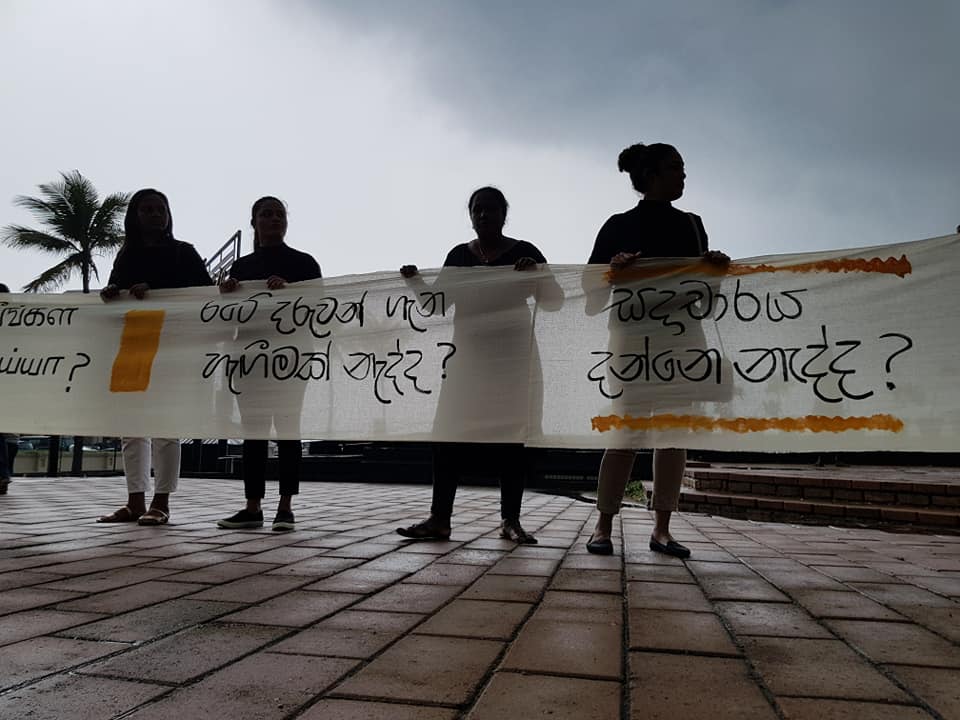
Featured image by Amalini De Sayrah

12/31/2018
2018 saw ethno-nationalism, the role of technology in moderating hate speech and freedom of expression and the impact of foreign debt, including China’s Belt and Road Initiative remain key topics in global discourse. It also saw a growing movement of women speaking out about workplace harassment and sexual assault, through the #MeToo hashtag. Though many questioned the effectiveness of the movement, there was no denying its power.
All of these conversations impacted Sri Lanka in one form or another over the course of the year. In February and March, a series of violent riots in Ampara and Digana left a lasting impacton the Muslim community. In the aftermath of the riots, civil society wrote an open letter to Facebook highlighting the spread of hate speech, including of technology-related violence against women and the LGBTIQ community on its platform. Facebook responded to the open letter, and has made commitments towards improving its response to hate speech and misinformation. A New York Times story on the Hambantota Port increased scrutiny on China’s role in development, including in Sri Lanka.
In 2018, Groundviews continued conversations begun the previous year on the explosion of the #MeToo movement, examining the pervasive nature of sexual violence in Sri Lanka, including around workplace harassment in the private and public sector.
2018 marked a number of important events in Sri Lankan history, including 35 years since the Black July riots, 70 years since Sri Lanka’s Independence, and one year of protests by families of the disappeared and those displaced through militarisation.
In October, the surprise resignation of President Sirisena from the coalition Government in what has been widely termed a “constitutional coup” left shockwaves that endure beyond the re-instatement of Ranil Wickremesinghe as Prime Minister.
Through these myriad events, Groundviews attempted to be a trusted source in times of crisis, to combat misinformation and disinformation, and generate conversation on topics largely underreported in mainstream media.
Below is a list of our top 20 articles for the year.
- An Open Letter to Maithripala Sirisena – Documenting an act of civilian resistance that struck a chord with many
- The Beast Rides Again – On the violence in Ampara and Teldeniya and ongoing cycles of violence
- STF Brutality against Muslims in Digana: March 5 – Report based on eyewitness accounts of STF brutality during riots in Digana
- Sri Lanka’s Pandemic of Sexual Violence – On Sri Lanka’s pervasive culture of sexual violence
- Deranged – On the chaos ensuing the constitutional crisis on October 26, a time of ‘systemic unraveling’
- Namal Rajapaksa, bots and trolls: New contours of digital propaganda and online discourse in Sri Lanka – On the weaponisation of social media by political figures in Sri Lanka
- Sex and gender in the anti-Muslim riots – On sexual and gendered dimensions of the riots in Digana and Ampara
- Smart Phones and Stupid Governments: Blocking Social Media as Sri Lanka Burns – On freedom of expression and censorship of social media platforms during riots in Digana in March
- Money Talks: Some Facts About the Depreciation of the Sri Lankan Rupee – Debunking myths in the wake of reporting around currency depreciation
- From an Electoral Drubbing to a Manufactured Crisis – In the wake of steep losses by the coalition government at the local government elections, reflection on growing dissastisfaction with the Sirisena-Wickremesinghe Government for failing to deliver on campaign promises
- Reigning In The Executive President – On the attack of democratic institutions by a runaway executive, and the need to limit the powers of Presidency
- Facebook Responds to Open Letter by Civil Society – Facebook’s response to an open letter issued by Sri Lankan civil society organisations on the spread of hate speech on its platform
- The Government has failed us. Do we fail ourselves? – On the then impending local government elections and President Sirisena seeking a Supreme Court ruling on his Presidential term
- The Coup de Grace on the Coup d’etat? – On the failed coup attempt by President Sirisena and former President Rajapaksa and the need to work together for a political compromise
- The Parliament Fair – Satirical poem on the violence unleashed on Speaker of the House of Parliament Karu Jayasuriya
- Mental Health and Stigma in Sri Lanka – On the stigma against receiving treatment for mental health in Sri Lanka
- What, to the minority, is democracy? – On enduring racism in Sri Lankan postcolonial politics
- RTI Reveals Lanka E News Blocked on Order from the President’s Office – Article using the Right to Information which finds that Lanka E News was blocked by the President’s office, with implications for freedom of expression
- The Multiculturalism of Sinhala Song: A Review of Sons and Fathers – Movie review examining the multiculturalism of Sinhala music, juxtaposed with identity politics in Sri Lanka
- The Fall of the No-Confidence Motion Against the Prime Minister – A piece looking at the failed no-confidence motion against Prime Minister Ranil Wickremesinghe, and the weakened position of the Government ‘in office but not in power.’
Want to see what people were talking about on Facebook, Twitter, or Instagram? View a short video below:
Groundviews wishes its readers a happy and peaceful new year.
Man is born free but corrupt political system has chained us without any mercy (Part 1)

The country has been captured by a strong group of paranoid political elites belonging to all parties. They have amassed excessive wealth and resources illegally having defrauded public funds running into millions, billions and trillions
– Pic by Shehan Gunasekara
 Monday, 31 December 2018
Why do we want to change the present political system?
Our representative democracy and bureaucratic organisations need vast changes. Both are suffering from increasing deficiencies and legitimacy too. It looks as if we are close to being a ‘failed state’. The country therefore is facing enormous complexities including major governance issues. It is all because the country has been captured by a strong group of paranoid political elites belonging to all parties. They have amassed excessive wealth and resources illegally having defrauded public funds running into millions, billions and trillions.
Such ill-gotten monies are being used unethically and hungrily to defend and prevent any rival elites with good leadership qualities, taking over governance. The prescription essentially involves insulating institutions from corrupt politicos and strengthening democratic practices and forces. In Aristotelian terms, I quote – “the good leader must have ethos, pathos and logos. The ethos is his moral character, the source of his ability to persuade. The pathos is his ability to touch feelings, to move people emotionally. The logos is his ability to give solid reasons for an action, to move people intellectually”.
Our rulers do not take accountability for the wrongful fraudulent acts they had committed such as criminal, civil or administrative. Perpetrators had finally escaped arrest, prosecution, trial and suitable punishments for wrongdoing in terms of the law. An effective anti-fraud strategy which consists of four main components – (a) prevention (b) detection (c) deterrence and (d) response – has also not been introduced to date. Perpetrators are confident that they will not be caught since the prevention controls are seriously lacking in our country. ‘Politics’ is therefore the most lucrative business if you need to be superficially rich within a short period in our country.
In my view, the malaise is all due to the political culture and fragile foundations. It is awfully distressing to understand how one of the oldest democracies in the world has been totally destroyed, including the rule of law. We are therefore unable to govern the governors. As such, we are subject to free rein which is arbitrary, capricious and brutal. They do not promote rule of law after having pledged to the constituents and having got a mandate for the purpose. They act in subtle ways doing everything possible to unplug the concept of rule of law to achieve their self-seeking agenda
We have experienced that almost all the elected representatives invest millions and billions to get elected to representative institutions, including Parliament. It is because they want power by fair means or foul. The concern is that the system is dominated by organised and powerful people who do not want to adopt methods to deal with the problem of fraud, restrict opportunity, and limit the ability for potential fraudsters to commit deliberate acts of fraud.
They also do not introduce deterrent techniques, policies, procedures and controls, and activities such as training and fraud awareness to stop fraud from occurring. According to the KPMG survey carried out sometime back, a majority of public sector institutions have not recovered their stolen assets. It has been found that it is preferable to try to prevent loss from occurring in the first place. The old adage ‘prevention is better than cure’ certainly applies to fraud as well.
Professor Ian Robertson had also stated that: “The longer the politicians are in power they are more likely to abuse it.” I quote: “The artefacts around democracy were invented – such as judiciary, and a free press – because it was observed that leaders often went off the rails and above the law, seeing themselves as special once they gain power.” In Sri Lanka too, we have seen politicians who have gone off the track very long for decades. Cases that had been detected have not been duly investigated. The perpetrators do not take the law seriously. They commit such crimes audaciously, without batting an eyelid, one after the other.
All of them lack moral integrity which is the most valuable and respected quality of good leaders. Impunity therefore was a creation of all those corrupt politicos who held power since 1970s. Robertson who is a Professor of Psychology, Trinity College, Dublin had studied political figures and in his research he had found and I quote: “Power can go to some people’s heads and change the way their brain functions – their personality changes, they have a loss of empathy, they are more narcissistic – and are increasingly of the opinion that without them, everything will fall apart.”
In Sri Lanka too, as Professor Robertson says, power has gone to their heads. He has added that the longer they are in power, they are more likely to abuse it. They have thereby failed to understand public sentiment, I quote: “With public sentiment nothing can fail: without it, nothing can succeed. Consequently, he who moulds public sentiment goes deeper than he who can enact statutes or pronounces decisions” – Abraham Lincoln.
Constitutional experts believe that one of the greatest contributions of the United States Constitution, and perhaps, the most influential section of the US Constitution is its preamble.
Let me therefore draw your attention to the preamble of our Constitution, I quote: “The people of Sri Lanka… and having solemnly resolved by the grant of such mandate and the confidence reposed in their said representatives who were elected by an overwhelming majority, to constitute Sri Lanka into a Democratic Socialist Republic whilst ratifying the immutable republican principles of Representative Democracy and assuring to all people’s freedom, equality, justice, fundamental human rights and the independence of the judiciary as the intangible heritage that guarantees the dignity and wellbeing of succeeding generations of the people of Sri Lanka and of all the people of the world, who come to share with generations the effort of working for the creation and preservation of a just and free society.
“We, the freely elected representatives of the people of Sri Lanka, in pursuance of such mandate, humbly acknowledging our obligations to our people and gratefully remembering their heroic and unremitting struggle to regain and preserve their rights and privileges so that the dignity and freedom of the individual may be assured, just social, economic, cultural order attained, the unity of the country restored, and concord established with other nations, do hereby adopt and enact this Constitution as the supreme law of the Democratic Socialist Republic of Sri Lanka.”
Preambles, the world over, often outline a country’s fundamental goals. The preamble to the Constitution of Japan emphatically states that they are peace-loving, I quote: “Never again shall we be visited with the horrors of war… desire peace for all the time.” Preambles therefore contain statements about the constitutional philosophy, future aspirations, commitment to resolve disputes by peaceful means and many more.
Our leaders since the 1970s have been unethical. It is heartening that the Supreme Court had however ruled unanimously that President Maithripala Sirisena’s order to dissolve Parliament and hold Parliamentary Elections is unconstitutional. This is a historic unparalleled judgement. It is the first time in Sri Lanka that an act, purported to be a constitutional prerogative, has been quashed, by the Supreme Court. It is primarily because the 19th Amendment paved the way for removal of full immunity of an incumbent President.
It is also alleged that Jayampathy Wickramaratne had crafted the relevant Amendment, I quote: “With the support from Ranil’s office, without the involvement of other political parties” – Dr. Rajiva Wijesinha. It proved that Ranil Wickremesinghe succeeded in amending the Constitution to fulfil his needs, perhaps only because he was well aware that he is not electable if he contests for Presidential Elections.
Why is that RW and Jayampathy did not take steps to suitably amend the electoral system and the need to reduce the composition of Parliament almost by half which are the root causes of all these problems?
Under the present preferential system, all candidates spend millions to get elected from the district. They are fully aware that the people had to carry a huge burden having devolved powers to provincial councils under the 13th Amendment. Due to all these, poverty is increasing and 42% of the population live below the poverty line. It could be predicted that this situation will become even worse.
Their priority should have been to replace a top heavy government and avoid political misadventures by addressing the burning issues, i.e. (1) to reform the public sector overall to achieve all sustainable goals, (2) to identify necessary economic reforms to strengthen the economy (3) to increase employment opportunities, (4) to minimise rising inequalities, (5) to address burning issues such as rising cost of living, and (6) to introduce ways and means to minimise corruption, abuse of power, waste, etc.
In my view, the malaise is all due to the political culture and fragile foundations. It is awfully distressing to understand how one of the oldest democracies in the world has been totally destroyed, including the rule of law. We are therefore unable to govern the governors. As such, we are subject to free rein which is arbitrary, capricious and brutal. They do not promote rule of law after having pledged to the constituents and having got a mandate for the purpose. They act in subtle ways doing everything possible to unplug the concept of rule of law to achieve their self-seeking agenda.
We had plenty of elected representatives and public servants in the early ’70s who always respected the Constitution, all formal laws, unwritten rules and norms. They disliked the abuses of power. They ensured that they served the country for the public good and not for personal financial benefit or gain. They protected the citizens from arbitrary and unfair government action. At present, without such public officers, the entire government machinery has now become a chaotic garb.
It is sad that Prime Minister Ranil Wickremesinghe had forwarded a list of names exceeding the Constitutional restriction that the Cabinet should not exceed 30 under any circumstances. I quote: Article 46 (1); “The total number of ministers shall not exceed 30” and (b); “Ministers who are not members of the Cabinet of Ministers and Deputy Ministers shall not, in the aggregate, exceed 40. It is pertinent to mention that all those State Ministers were introduced during the Premadasa rein. It was no doubt a violation of the Constitution since there was no such category or provision in the Constitution at that time.
The authorities have now craftily introduced two categories i.e. ministers who are not in the Cabinet (now known as State Ministers) and Deputy Ministers, when in fact both categories are naturally holding ministerial posts who are not members of the Cabinet Minister. All what they want is to give constitutionality to accommodate greedy politicos. Dr. Harsha de Silva who is now a State Minister said that there is hardly any difference between a Cabinet Minister and a so-called State Minister.
Furthermore, it is frightening that RW has included the names of several politicians as Cabinet Ministers, who have been utterly corrupt and accused of serious corruption issues. Ravi Karunanayake, as we are aware, was one minister who had been compelled to resign over numerous allegations. He too had been reappointed once again without taking legal action against him.
In short, time and time again a number of them in the present Cabinet have committed frauds and have abused their positions for personal gain. They have been reissued with another licence to commit further frauds and financial crimes. They therefore show no interest at all to establish rule of law and good governance, except for a rhetorical comment in that regard.
Owing to these problems, there is destructive and counterproductive conduct, theft, fraud, sabotage, anger, frustration, despondency, pessimism and aggression. In addition, how did political tribalism come about in Sri Lanka? It began, in my view, several decades ago when S.W.R.D. Bandaranaike broke away from the UNP camp and formed the SLFP with a view to promote his own vision. SWRD was a leader who was subsequently assassinated by the very same forces.
J.R. Jayewardene, during his election campaign in 1977, appealed to the nation. I quote: “Give me 120 good men and I assure you we will fulfil our pledges… if we fail you, you are at perfect liberty to vote us out anytime”. The people trusted the then UNP leadership and overwhelmingly voted and elected the UNP regime with an unprecedented mandate of 139 seats in a 168-member Parliament and gave not only a two-thirds, but a five-sixth’s majority as well which was the finest ever victory ever secured by any party since independence.
JRJ used the mandate he received to enact the law and called himself the first ‘elected’ president without being elected to the post. JRJ had stated: “Such an executive is a strong executive, seated in power for a fixed number of years, not subject to the whims and fancies of an elected legislature, not afraid to take correct but unpopular decisions because of censure from its parliamentary party. This seems to me a very necessary requirement in a developing country faced with grave problems such as we are faced today”.
Steps had been taken accordingly to transform the system of governance from a Westminster style parliamentary system to an executive presidential system which had finally paved the way for a weak Parliament. Under the previous Constitutions (Soulbury 1947/Republican 1972), the Executive had been made answerable and accountable to the Parliament which JRJ had wanted changed. A brand new Constitution was thereafter enacted once again to consolidate the presidential system in 1978. The Executive President was deceptively made answerable to the Parliament constitutionally which realistically never happens to date. An impeachment procedure too had been introduced to remove the President.
Dr. N.M. Perera had argued that the “impeachment procedure was a near impossibility in practice”. Hence, crafting a strategy for ending lawlessness and establishing rule of law is a herculean task.
Thirty ministers include Prez, PM
Wijeyadasa on 19-A

By Shamindra Ferdinando-December 31, 2018, 12:15 pm
 UNP
lawmaker Dr. Wijeyadasa Rajapakse, PC, yesterday said that in terms of
the 19th Amendment to the Constitution the number of ministers,
including the President and Prime Minister couldn’t exceed 30.
UNP
lawmaker Dr. Wijeyadasa Rajapakse, PC, yesterday said that in terms of
the 19th Amendment to the Constitution the number of ministers,
including the President and Prime Minister couldn’t exceed 30.
In accordance with the 19th Amendment to the Constitution, a larger
Cabinet was possible only under a properly constituted national
government, the Colombo District MP said.
Parliament enacted 19th Amendment in late April 2015.
Rajapakse stressed that there was absolutely no ambiguity as regards the
relevant section that dealt with the number of cabinet ministers and
non-cabinet ministers in case a national government couldn’t be formed.
The President’s Counsel said so when The Island sought his assertion as
regards recent declarations that 30 MPs could be appointed to the
cabinet in addition to the President and the Prime Minister.
Responding to a query, the former justice minister who played a key role
in ensuring the passage of the 19th Amendment said that the claim that
the UNP could form a national government with a single SLMC member was a
joke. Of the seven SLMC MPs six were elected and appointed on the UNP
list whereas only one entered parliament on the SLMC ticket.
Rajapakse recalled how UPFA MP Vasudeva Nanayakkara had, at the
Committee Stage, ruled out their support unless the government
interpreted national government. Rajapakse said that of the 144
amendments moved by the Opposition only two were accepted. In addition
to those amendments, MP Nanayakkara sought an interpretation of national
government, Rajapakse said, adding that Parliament had been told
national government meant formation of an administration by the party
securing the largest block of seats and the party with the second
highest number of seats.
However, what had been put to the Speaker for approval was very much
different from what had been said in parliament, Rajapakse said. The MP
pointed out that the difference was instead of the union of party with
the highest number of seats and the second highest being the national
government, the gazette referred to the party with the highest number of
seats and other parties in parliament as the national government.
The section in question is 46 of the 19th Amendment.
Parliament website posted the one with the original clause given below: "If at the conclusion of the General
Election held immediately after the coming into force of this Article,
the recognised political party or the independent group obtaining the
highest and the recognised political party or the independent group
obtaining the second highest number of seats in Parliament agree to form
a Government of national unity, then, notwithstanding the provisions of
paragraph (1), the number of Ministers of the Cabinet of Ministers and
the number of Ministers outside of the Cabinet of Ministers and the
Deputy Ministers, may be increased up to forty-five and fifty-five,
respectively, if Parliament agrees to such increase, within two weeks of
the first sitting of such Parliament."
MP Vasudeva Nanayakkara, too, recollected the then Minister Rajapakse’s
reference to the party that secured the highest number of seats and the
party with the second highest in response to his call for an
interpretation of national government. However, the party with the
highest number of seats was more likely to join hands with another with a
fewer number of seats, Nanayakkara pointed out.
Rajapakse said that ongoing efforts to circumvent the limit on the
number of ministers had caused an unnecessary problem. Instead of
addressing vital issues at hand, particularly the state of the national
economy, ways and means to enlarge the cabinet were being discussed. The
former minister said that now that the 19th Amendment was in place, the
Cabinet couldn’t be expanded according to the whims and fancies of
political party leaders.
Responding to another query, Rajapakse said that the parliament
recognised six registered political parties. In addition to the UNP and
the UPFA, there were the TNA (16 members), JVP (6 members), EPDP (one
member) and SLMC (one member), Rajapakse said, adding that the
19th Amendment had caused quite a problem for the government.
Rajapakse said that he opted out of the Cabinet. Rajapakse is among those left out of the Cabinet.
Sri Lanka cricket rated most corrupt by ICC: Minister

The crisis-ridden Sri Lanka Cricket (SLC) is to hold delayed elections in February, which were due last May when the term of president Thilanga Sumathipala ended. (Photo: AFP/Ishara S Kodikara)
 31 Dec 2018
COLOMBO: Sri Lanka has been rated as the most corrupt cricket nation by the world governing body, the country's sports minister said on Monday (Dec 31).
The International Cricket Council feels "Sri Lanka's cricket administration is corrupt from top to bottom", Harin Fernando said, adding that he had been shown a confidential report on the matter at a Dubai meeting.
A host of scandals have rocked Sri Lankan cricket in recent years including a match-fixing controversy revealed in a sting operation carried out for a TV documentary.
The ICC anti-corruption unit has regularly investigated cases in the island nation.
The crisis-ridden Sri Lanka Cricket (SLC) is to hold delayed elections in February, which were due last May when the term of president Thilanga Sumathipala ended.
Sumathipala has been accused of violating ICC rules by holding office despite alleged links to gambling. He denies the charges.
The crisis-ridden Sri Lanka Cricket (SLC) is to hold delayed elections in February, which were due last May when the term of president Thilanga Sumathipala ended. (Photo: AFP/Ishara S Kodikara)
31 Dec 2018COLOMBO: Sri Lanka has been rated as the most corrupt cricket nation by the world governing body, the country's sports minister said on Monday (Dec 31).
The International Cricket Council feels "Sri Lanka's cricket administration is corrupt from top to bottom", Harin Fernando said, adding that he had been shown a confidential report on the matter at a Dubai meeting.
A host of scandals have rocked Sri Lankan cricket in recent years including a match-fixing controversy revealed in a sting operation carried out for a TV documentary.
The ICC anti-corruption unit has regularly investigated cases in the island nation.
The crisis-ridden Sri Lanka Cricket (SLC) is to hold delayed elections in February, which were due last May when the term of president Thilanga Sumathipala ended.
Sumathipala has been accused of violating ICC rules by holding office despite alleged links to gambling. He denies the charges.
"Unfortunately Sri Lanka is being ranked as one of the worst or the top
worst country for cricket corruption," Fernando told reporters after
returning from the meeting with ICC anti-corruption chief Alex Marshall.
"They told me that the problem was not limited to bookies, but even the local game's links with the underworld," he said, adding that the corruption was more to do with cricket administration than players.
Last month former Sri Lankan fast bowler Dilhara Lokuhettige was suspended for corruption during a limited over league in 2017.
Lokuhettige was the third Sri Lankan player charged for violating the anti-corruption code following cases against former captain and ex-chief selector Sanath Jayasuriya and former paceman Nuwan Zoysa.
Jayasuriya was charged for failing to cooperate with a match-fixing probe and concealing information. Zoysa was suspended over match-fixing accusations.
The minister said the ICC would grant an amnesty to Sri Lankan players who disclose details of wrongdoing in the game.
He added that the government wanted to prepare anti-match fixing legislation.
Source: AFP/ec"They told me that the problem was not limited to bookies, but even the local game's links with the underworld," he said, adding that the corruption was more to do with cricket administration than players.
Last month former Sri Lankan fast bowler Dilhara Lokuhettige was suspended for corruption during a limited over league in 2017.
Lokuhettige was the third Sri Lankan player charged for violating the anti-corruption code following cases against former captain and ex-chief selector Sanath Jayasuriya and former paceman Nuwan Zoysa.
Jayasuriya was charged for failing to cooperate with a match-fixing probe and concealing information. Zoysa was suspended over match-fixing accusations.
The minister said the ICC would grant an amnesty to Sri Lankan players who disclose details of wrongdoing in the game.
He added that the government wanted to prepare anti-match fixing legislation.
Deterrent Punishment to Vandalism is a Categorical Imperative


We read the dismal, heart-breaking and saddening news that several
Buddha statues had been damaged in Mawanella over the past few days.
We all stand witness to the mindless devastation of human values and
principles of Buddhism – the sacred teachings of Siddhartha Gautama the
Most Revered Buddha, by a group of idiosyncratic elements and scum of
the earth, where political power is used to mobilizereligious sensibilities of people in order to get their support to capture power; and use it to fulfill their aims.
They use intrigue, engineer a crafty plot and orchestrate such immoral,
malicious and deviant ways to achieve their sinister ends in order to
attempt to win public opinion.
Before
proceeding any further, I would like to first lay emphasis on the fact
that all those who are involved, irrespective of who they are, what
ethnicity they belong to, what political affiliations they may have –
they have to be taken to task and very severe and punitive punishments
meted out. The punishments must be so severe, it should serve as a
deterrent to others, who are even contemplating an ethnic disturbance or
riot.
The cry of the people of Sri Lanka was that when the recent appointment
of Cabinet ministers were sent for approval to the President Maithripala
Sirisena, he wilfully and wantonly, without any just foundation or
provocation, struck off the name of Field Marshal Sarath Fonseka from
the position of Law and Order.
If this position has been awarded to him this type of vandalism,
hooliganism and deliberate destruction of the revered Buddha Statues,
defacement and damage of public as well as other people’s property could
certainly have been arrested.
We all know how Five Podujana Peramuna Pradeshiya Sabha members and
leader of Mahason Balakaya Amith Weerasinghe were among others arrested
in connection with the violence orchestrated and perpetrated mainly in
Digana and Ampara. And no sooner Mahinda Rajapaksa was
appointed as Prime Minister by the Presidednt Maithripala Sirisena,
unconstitutionally and illegally , the first thing they did – was to
manipulate the release of the Three suspects, including Mahason
Balakaya leader Amith Weerasinghe, held in remand custody in connection
with the disturbances created in Digana, Rangala, Udispattuwa and
Moragahamula on March 4 and 5, by Teldeniya District Judge as well as
the the Kandy High Court Judge.
It is also worthy of note that News First carried a headline on 01st December 2018 –
Quote : Protest in Digana calling for election
“Colombo
(News1st): A protest was held in the Manikhinna, Digana with several
members of the UPFA and the SLPP along with Parliamentarian Keheliya
Rambukwella.
The protestors called for an immediate election to be held.” Unquote
Which is more than enough evidence that the whole thing has been
orchestrated by these wily and cunning, deceitful and unreliable
scoundrels to exacerbate an ethnic conflict.
If such disasters have to occur after the denial of appointing Field
Marshall Sarath Fonseka to that most important position of Law &
Order, then it can be irrefutably concluded that political power has had
a vicious hand in it.
Perhaps more than at any time in our history, our beloved country has
been forced to engage in senseless conflict, when the country is facing
natural disasters as well as the disaster created by the country by our
President himself by not even placing his signature on the government
gazette, to mobilize the appointed cabinet of ministers to do their
allotted work for the security and benefit of the country.
He, The President, Maithripala Sirisena, left for Thailand, totally unconcerned, leaving behind a more dangerous, a country more divided, and more toxic.
Sirisena Bans CBK And Her Supporters From Entering SLFP Headquarters

President Maithripala Sirisena has informed all caretakers of the SLFP headquarters at Darley Road that former President Chandrika Kumaratunga and her supporters should not be allowed to enter the premises under any circumstances.
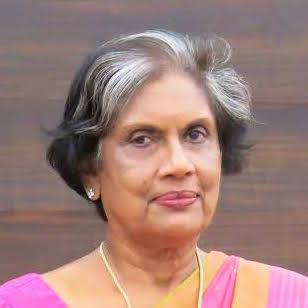
Chandrika
Sirisena has made the order upon his return to the country from a
private holiday in Thailand, Colombo Telegraph reliably learns.
The decision has been made due to fears that Kumaratunga will engineer
an internal revolt in the party challenging Sirisena’s party leadership.
A section of SLFP members have expressed strong opinions against
Sirisena’s decision to enter into an alliance with the Rajapaksa group
who caused irreparable damage to the party by forming the Sri Lanka
Podujana Party (SLPP).
Colombo Telegraph exclusively reported that Sirisena ordered to close down the Darley Road headquarters until his return from Thailand.
The decision to close down the main party office follows a heated
meeting between senior party officials and electorate organizers, on
Saturday, over the current political situation.
At the meeting chaired by SLFP General Secretary Prof. Rohana Lakshman Piyadasa, a group of SLFP organizers severely criticized President Maithripala Sirisena’s decision to form an alliance with the SLPP. Senior party officials including S.B. Dissanayake, Nimal Siripala de Silva, Dayasiri Jayasekera and Duminda Dissanayake also attended the meeting.
At the meeting chaired by SLFP General Secretary Prof. Rohana Lakshman Piyadasa, a group of SLFP organizers severely criticized President Maithripala Sirisena’s decision to form an alliance with the SLPP. Senior party officials including S.B. Dissanayake, Nimal Siripala de Silva, Dayasiri Jayasekera and Duminda Dissanayake also attended the meeting.
Read More
Binod Chaudhary’s wisdom: You can make it big if driven by an undiminished passion for achievement

Binod Chaudhary
An autobiography to inspire everyoneMonday, 31 December 2018
I recommend Binod Chaudhary’s autobiography – ‘Making It Big’ – to all readers. As the title says, the message is that if it is small now, make it big. By implication, it also advises us to make it bigger if it is big and the biggest if it is bigger. In other words, he wants us not to be complacent with what we have. Improve it continuously so that it will be for the benefit of all of us eventually. This is not pampering to greed. It is changing conditions for the better to create a better society for all. The list of the readers to whom the book is recommended is long. But it essentially includes students in management, business starters, industry veterans, politicians, bankers and civil servants. Each one of them can learn an important life lesson from Chaudhary.
 Students
can learn that strategy being used by pragmatic entrepreneurs is
different from what they learn from textbooks. Business starters would
be relieved to note that overcoming the initial fear of trying out new
ideas is the gateway for success in enterprise. Industry veterans would
realise that harbouring ill-feelings about fellow businessmen would harm
them more than their rivals. The politicians will learn of the bitter
truth that it is the entrepreneurs, and not they, who will deliver
prosperity to people. Hence, they had better concentrate on framing
policies for macro goals rather than making micro interventions in the
markets. The bankers will realise that they could increase profits by
facilitating businessmen rather than placing spanners in their path.
Civil servants will learn that their red-tape tactics could keep the
entrepreneurial spirit of hard-willed businessmen under suppression only
for a short period. Eventually, the businessmen will win the
battle-making civil servants irrelevant.
Students
can learn that strategy being used by pragmatic entrepreneurs is
different from what they learn from textbooks. Business starters would
be relieved to note that overcoming the initial fear of trying out new
ideas is the gateway for success in enterprise. Industry veterans would
realise that harbouring ill-feelings about fellow businessmen would harm
them more than their rivals. The politicians will learn of the bitter
truth that it is the entrepreneurs, and not they, who will deliver
prosperity to people. Hence, they had better concentrate on framing
policies for macro goals rather than making micro interventions in the
markets. The bankers will realise that they could increase profits by
facilitating businessmen rather than placing spanners in their path.
Civil servants will learn that their red-tape tactics could keep the
entrepreneurial spirit of hard-willed businessmen under suppression only
for a short period. Eventually, the businessmen will win the
battle-making civil servants irrelevant.Chaudhary has taught us these good lessons in the form of stories in ‘Making It Big’.
We need stories to live by
Thus, Chaudhary’s autobiography is a collection of stories, arranged in chronological order, enchanting readers with inspirational spirit. It is a story of an ordinary man who has been cushioned to take both successes and failures with the same equanimous mind-frame. In that sense, he is a hero. Stories of such heroes are to motivate the young to become achievers later in life, according to American psychologist David McClelland of ‘The Achieving Society’ fame. More recently, the Oxford historian now based in Israel, Yuval Noah Harari, has put it more cogently in his Homo Deus, ‘A Brief History of Tomorrow’. Harari says that we Homo sapiens need stories to live by and there are enough creative story-tellers around us to keep us filled with a continuous flow of stories.
Don’t be restricted to national boundaries
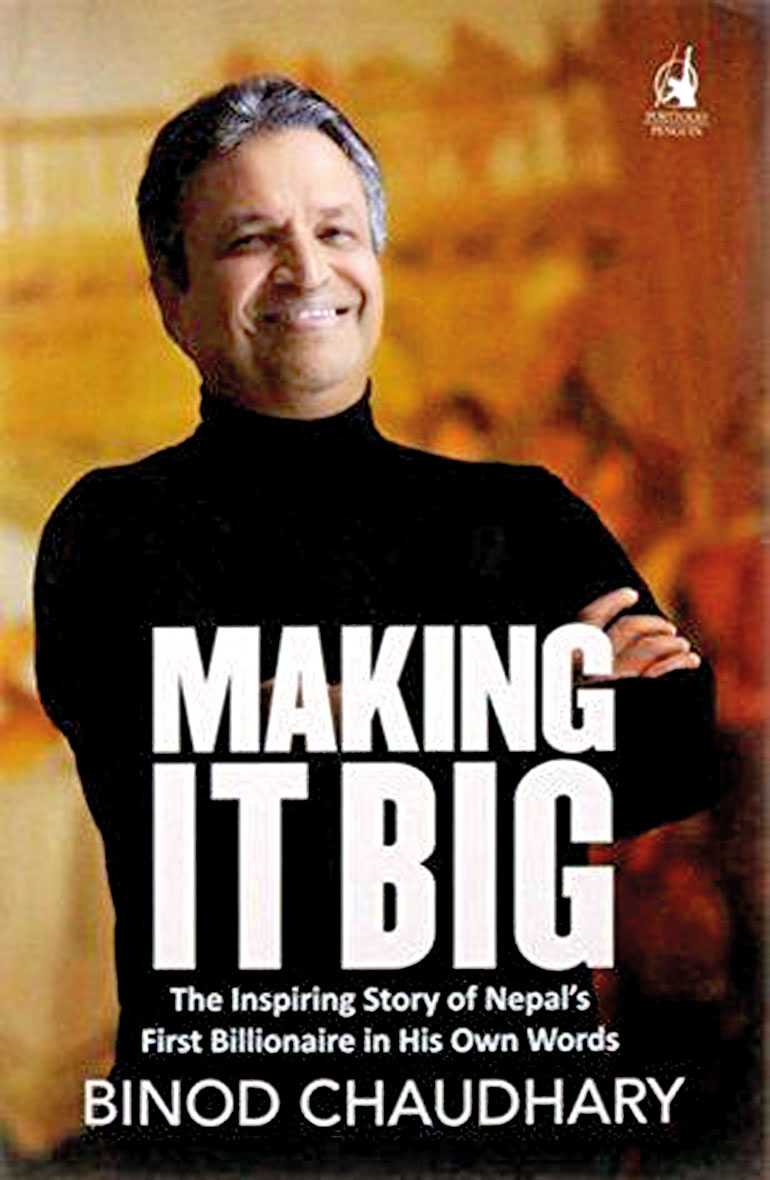 I
was inspired by Chaudhary’s autobiography not because he became the
first billionaire in Nepal, a country rampant with poverty. Nor was I
inspired by the success he made by transforming himself from nobody to
somebody. I was inspired by the central message he has conveyed in the
book. That message says that if we want to make it big, we got to move
to the wide world out there, breaking the limitations imposed on us by
national boundaries. Anyone who restricts himself to the boundary of the
nation to which he is born – known as a neonational – has to remain
forever ‘small’. It is a ‘give and take’ business. Neonationals want to
take as much as possible without giving anything to outsiders. Chaudhary
has been a modern-day entrepreneur who would do both giving and taking
simultaneously.
I
was inspired by Chaudhary’s autobiography not because he became the
first billionaire in Nepal, a country rampant with poverty. Nor was I
inspired by the success he made by transforming himself from nobody to
somebody. I was inspired by the central message he has conveyed in the
book. That message says that if we want to make it big, we got to move
to the wide world out there, breaking the limitations imposed on us by
national boundaries. Anyone who restricts himself to the boundary of the
nation to which he is born – known as a neonational – has to remain
forever ‘small’. It is a ‘give and take’ business. Neonationals want to
take as much as possible without giving anything to outsiders. Chaudhary
has been a modern-day entrepreneur who would do both giving and taking
simultaneously.Contrary to what neonationals proclaim, competent people like Chaudhary would step out of the boundary for better prospects. This was emphatically put by the 4th century BCE Indian Guru, Chanakya – also known as Kautilya – in his ‘Ethics of Chanakya’ when he said that ‘no place is far away for a trader’. Hence, even in ancient times, if someone was interested in becoming wealthy, he should have necessarily broken away from the national boundaries to reach the wide world out there.
Chaudhary belongs to the third generation of a family that had migrated to Nepal from India’s Rajasthan State during the British rule in the early 20th century. His grandfather had been an assistant to a trading family that had trodden to Nepal from Rajasthan on the invitation of its Prime Minister, Bir Shumsher, a powerful figure in the country at that time.
Being very young in age, his grandfather had to learn the tactics of trading in an alien country from A to Z by working in the field. Through a determined will and unwavering perseverance as his guiding angel, he had learned the art and the science of trading pretty fast becoming a master of trade between India and Nepal. This has compelled him to start his own business as a trader in textiles imported from India.
He did not have a textile shop. Instead, he visited his customers, including the royal family, with a bale of clothes and textiles as a mobile trader. That business was neither comfortable nor pleasurable. Yet, Chaudhary’s grandfather managed to make a living engaging Chaudhary’s father, still a pre-teenage boy, as his most trustworthy trading assistant. The apprenticeship training which Chaudhary’s father had got from his father had been invaluable.
He learned the marketing tactic of selling new design sarees brought from India to queens and princesses in the royal palace. Only Chaudhary’s father, a boy at that time, was allowed to enter the private chambers of royal ladies who had not been permitted to mingle with males outside the royal family. He used that concession and his outwit as a marketer to the maximum to unload all the new design sarees to them despite they were unsolicited sales.
But, if a son just follows father’s business without change or improvement, there is no progress. This rule has applied to Chaudhary as well as to his father equally. Hence, armed with his business knowledge and the skills he had developed during the apprenticeship with father, Chaudhary’s father decided that he should now go on in his own separate way. He decided to open a textile retail shop in Kathmandu. That small shop soon became a departmental store catering specifically to tourists from India. With success in trading, Chaudhary’s father entered other areas of business such as construction, hospitality and manufacturing. That was the beginning of the Chaudhary Empire which Binod Chaudhary carried forward by taking his business outside the country and into new areas.
Similarities in South Asia
Chaudhary’s autobiography is a social, political, economic and cultural history of Nepal from around 1950s, looked at from the point of view of an outside observer. Though he has been a part of that system, he has read of its main features independently, allowing readers to make their own judgments. Thus, it is like an impartial historian writing the history of a nation relevant to a particular era. A historian collects facts, analyses them using accepted scientific methods and presents them without taking a side. What Chaudhary has followed when he wrote his autobiography has been the same method. As such, given the similarities which Nepal shares with other South Asian countries, one can safely conclude that what is observed in Nepal by him is exactly relevant to any country in this regional bloc.
The list of the readers to whom the book is recommended is long. But it essentially includes students in management, business starters, industry veterans, politicians, bankers and civil servants. Each one of them can learn an important life lesson from Chaudhary. Students can learn that strategy being used by pragmatic entrepreneurs is different from what they learn from textbooks. Business starters would be relieved to note that overcoming the initial fear of trying out new ideas is the gateway for success in enterprise. Industry veterans would realise that harbouring ill-feelings about fellow businessmen would harm them more than their rivals. The politicians will learn of the bitter truth that it is the entrepreneurs, and not they, who will deliver prosperity to people. Hence, they had better concentrate on framing policies for macro goals rather than making micro interventions in the markets. The bankers will realise that they could increase profits by facilitating businessmen rather than placing spanners in their path. Civil servants will learn that their red-tape tactics could keep the entrepreneurial spirit of hard-willed businessmen under suppression only for a short period. Eventually, the businessmen will win the battle-making civil servants irrelevant
Extracting institutions
It is a common practice among many academics in this region to advocate for an expanded government sector. They frown upon the private sector and uphold the state sector without examining the pitfalls which such a society would bring forth. Whatever the system of government that prevails, whether it is a monarchy, dictatorship or a democracy, the expanded state sector means giving extraordinary powers to those in power. Many people will rally round the power centre in society to appropriate for themselves an overwhelmingly larger share of the wealth of the nation.
As presented by Daron Acemoglu and James Robinson in their 2012 book under the title ‘Why Nations Fail,’ monarchs, dictators and unchecked democrats will establish an economic system that would extract wealth for their own use rather than making it available for the general welfare of people. The continuation of such a system without controls and checks is the surest way for a nation to fail.
Nepalese monarchy, a worst type of an extractive institution
Chaudhary presents a number of examples in his book to support Acemoglu-Robinson thesis. The monarchy in Nepal which had enjoyed uncontrolled absolute powers for centuries had been an extractive institution in that country.
The business opportunities have been doled out to private entrepreneurs in Nepal by the monarchy only on one condition: 51% of the equity of such a business enterprise should be given to a member of the royal family free of charge. It is the approval and protection fee which a businessman should pay to a higher authority in power. It is thus a system where private entrepreneurs have to contribute 100% of the capital, allow a compulsory majority ownership to an outsider, run the business with his own money and eventually share the fruits with such parties in bigger doses.
To the extent that the output is sold to Nepalese, the prices have to be jacked up in order to cover these losses. Hence, ultimately, it is the citizens who pay as an unavoidable tax by buying the goods and services involved. Since there is no record of these payments and the royal family members are not subject to income taxation, there is no a reflow these extracted moneys back to society. Thus, it is a one way payment unlike the taxes which the citizens pay to the government where the government gives back the tax money to society by way of government services. The extractive institutions in poor countries use their ill-gotten wealth in luxurious consumption locally or in extravagant expenses incurred abroad.
From simple ideas to big empires
A creative businessman would always make use of simple ideas observed in the environment to build big empires.
The founder of Nike, Phil Knight, observed that every human being possesses two feet and visualised in mind that if they are persuaded to run, he could sell billions of pairs of running shoes. Steve Jobs of Apple fame had got the idea for inventing the iPod from an April fool joke of Sir Richard Branson. Branson had played a joke with the magazine Rolling Stone that he had come up with a new digital technology to store thousands of songs in a single device replacing the existing long playing record or LPR system. Jack Welch of General Electric noted that if a company concentrates on technologies that cannot be easily copied, it could successfully out-beat its competitors.
Chaudhary’s successful introduction of Wai Wai noodles first to the Nepalese market and later to the large market out there was conceived when he observed that Nepalese had developed a crazed appetite for noodles. He in fact revolutionised the noodle market by introducing for the first time a precooked noodle that could be eaten as a snack.
When a master in the noodles market had warned him that he would not be able to sell even 30,000 packets a day, he still pursued the idea and eventually built a market that was as large as 1.5 million packets a day. What is necessary for the success of a businessman is the flexibility and perseverance, as found by the market researcher, Sarah Stanley Fallaw who produced her thesis in a book published this year under the title ‘Next Millionaire Next Door: Enduring Strategies for Building Wealth’. Chaudhary has a lot of both and it has been the key to his success.
India, an opportunity
Many business people in South Asia tend to view India as an exploiter. Its mere big size with a population of 1.2 billion people and an economy of $ 2.1 trillion would naturally frighten them away. What they forget is that people do not conduct trade with countries but with individuals. Hence, the size is immaterial for productive trade to take place.
Chaudhary did not believe that India was an exploiter. Instead, it was viewed as a one big opportunity provider for trade. Guided by this wisdom, he opened factories in India and captured that large market available for business opportunities. From India, he expanded his empire to South East Asia and now to Africa. Had he confined himself only to Nepal with a population of just 29 million people and economy of $ 27 billion, he would not have come thus far. The lesson he has left for all of us is that, if any entrepreneur wants to enjoy economies of scale, he needs to look for a market bigger than the market prevailing in his country.
10 Mantras for success
Chaudhary has identified 10 Mantras or disciplines that have contributed to his success. The examination of these Mantras shows that they are useful to all of us if we want to attain success in life. They are not expensive or difficult to be adopted. By following these mantras, Chaudhary was ambitious, given to organisational building, adept at persistence, competent in market astuteness, inclined to conservatism, patient, driven for success, cost conscious, disciplined and continuously updated. These 10 mantras will come in handy for anyone seeking success.
There is a saying that behind the success of everyman, there is a woman; in Chaudhary’s case, that woman was Lily, his wife. She is not a woman with business acumen. Yet, she knew how to drive her man to success.
(W.A. Wijewardena, a former Deputy Governor of the Central Bank of Sri Lanka, can be reached at waw1949@gmail.com.)
Ecstasy pills worth Rs.3.5 mn meant for NYE party seized

 2018-12-31
A stock of psychedelic drugs also known as Ecstasy pills worth more than Rs.3.5 million meant for a New Year’s Eve party in Colombo was seized by Colombo Excise Station officials in Thotalanga on Friday.
On information obtained from a private informant, Excise officials contacted a person living at Bopitiya in Pamunugama and seized the narcotics when he was lured into a fake deal.
Nearly 988 Ecstasy pills weighing around 457 grams which were in the suspect's possession were seized. An official said a tablet is usually sold at Rs.3,500 to consumers.
Colombo Excise Station OIC Chief Inspector Chanaka Nanayakkara told Daily Mirror the 24-year-old suspect was acting as a caretaker of a Negombo house belonging to a 40-year-old Sri Lankan identified as Dominic now living in France.
He said they believe that Dominic might have smuggled the pills on his half-yearly visits to Sri Lanka.
The suspect has told Excise officers that his employer gave instructions about distributing the pills to selected buyers and to collect the money. He had also been told to hand over a stock of pills to a certain recipient in Colombo meant for a party, which was to be held on New Year’s Eve.
Excises sources said the house owner paid the youth lavishly for all for the services rendered apart from looking after the house.
The Ecstasy, which is a psychedelic drug consisted of chemical substance 3,4-Methyl enedioxy methamphetamine (MDMA) and usually consumed by young party goers.
Chief Inspector Nanayakkara is conducting investigations with Excise Inspector Indralal Mahawatte, Excise Sergeant Duhulkumbura, Excise Guards Mohan, Lahiru, Manawadu and Dias on the instructions of Assistant Excise Commissioner B A Dayaratne and Excise Superintendent Vijitha Gamanayake.
The suspect was produced before the Maligakanda Magistrate and ordered to be remanded till today. (Kurulu Koojana Kariyakarawana)
Subscribe to:
Posts (Atom)