Peace for the World World ! Your War Our Lives

The Dalai Lama
A Brief Colonial History Of Ceylon(SriLanka)
Sri Lanka: One Island Two Nations
A Brief Colonial History Of Ceylon(SriLanka)
Sri Lanka: One Island Two Nations
(Full Story)
Back to 500BC.

Friday, February 1, 2019
On Sri Lanka Naming Shavendra Silva Army Chief of Staff Still Silence from UN Guterres As ITJP Details War Crimes
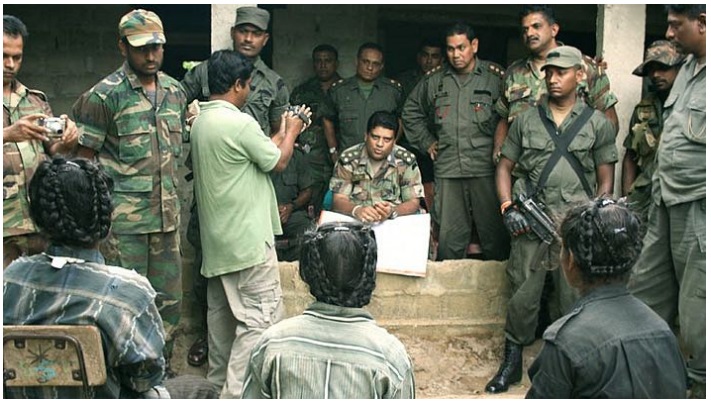
 By Matthew Russell Lee, CJR PFT Lanka
UNITED NATIONS GATE, January 28 – Once Mahinda Rajapaksa who oversaw the 2009 war crimes dubbed the bloodbath on the beach on October 26 was named the country's prime minster by Sirisena whom UN Secretary General Antonio Guterres has praised, Guterres was very slow in making any comment, despite or continuing the UN's shameful history on Sri Lanka including pulling out and allowing and covering up the slaughter in 2008 and 2009. Now Shavendra Silva, who despite his UN documented rolein the killings in 2008 and 2009 was allowed for a time to advise the UN Secretary General on Peacekeeping and host a movie screening with the pro-Guterres correspondents group, has been named Army Chief of Staff.
 By Matthew Russell Lee, CJR PFT Lanka
UNITED NATIONS GATE, January 28 – Once Mahinda Rajapaksa who oversaw the 2009 war crimes dubbed the bloodbath on the beach on October 26 was named the country's prime minster by Sirisena whom UN Secretary General Antonio Guterres has praised, Guterres was very slow in making any comment, despite or continuing the UN's shameful history on Sri Lanka including pulling out and allowing and covering up the slaughter in 2008 and 2009. Now Shavendra Silva, who despite his UN documented rolein the killings in 2008 and 2009 was allowed for a time to advise the UN Secretary General on Peacekeeping and host a movie screening with the pro-Guterres correspondents group, has been named Army Chief of Staff.
On Sri Lanka Naming Shavend... by on Scribd

By giving a ‘war criminal’ the top Army post, Sri Lanka proves Tamil lives don’t matter
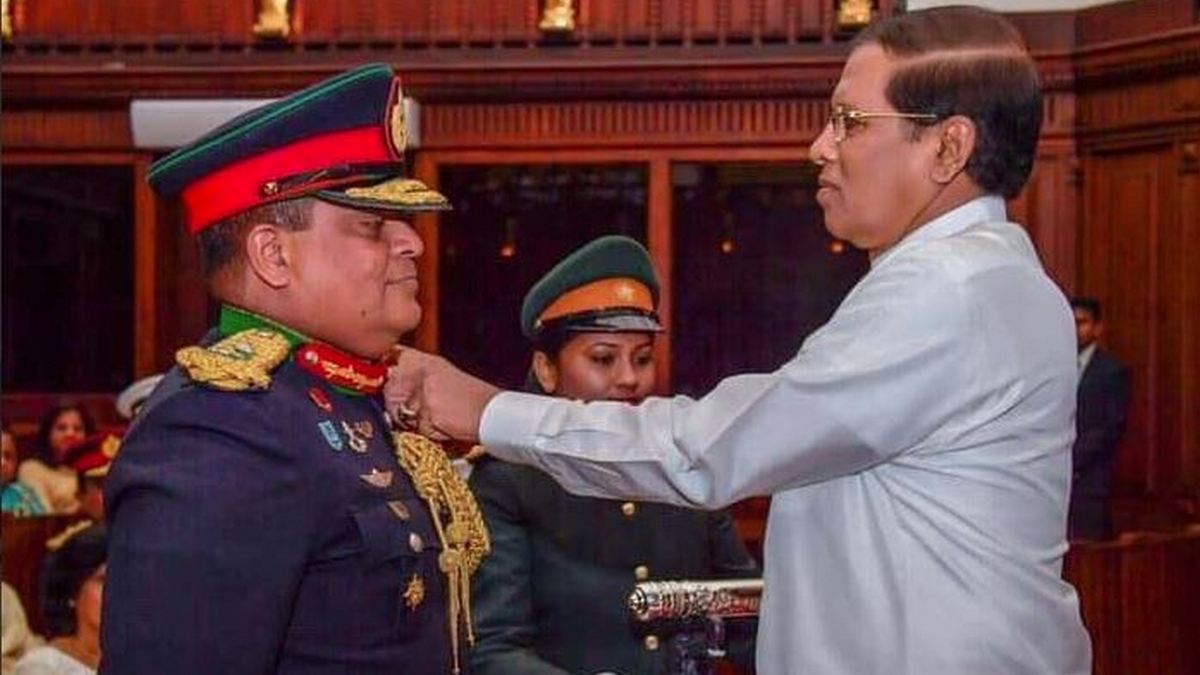
Major General Shavendra Silva with Sri Lankan President Maithripala Sirisena | @MaithripalaS/Twitter
President
Sirisena has made it abundantly clear that the Sri Lankan military will
not be held accountable for wartime violations.
 Sri Lanka’s abysmal record in dealing with alleged war criminals is well documented. And, with the recent appointment of
Major General Shavendra Silva—an alleged war criminal—as second in
command in the Sri Lanka Army, the South Asian nation has drawn fresh
international ire.
Sri Lanka’s abysmal record in dealing with alleged war criminals is well documented. And, with the recent appointment of
Major General Shavendra Silva—an alleged war criminal—as second in
command in the Sri Lanka Army, the South Asian nation has drawn fresh
international ire.
In 2012, he was removed from a UN advisory committee due to alleged war crimes and other egregious violations.
That same year, he was prevented from assuming a diplomatic position in
South Africa. Yet, in March 2017, Silva was appointed adjutant general
of the Sri Lanka Army.
His recent promotion attests to the fact that in Sri Lanka, the more things change the more they stay the same.
History repeats itself
In October 2018, Sri Lanka entered a period of profound crisis.
President Maithripala Sirisena fired Prime Minister Ranil
Wickremesinghe and replaced him with his erstwhile ally Mahinda
Rajapaksa, an alleged war criminal who served as president from 2005 to
2015. The coalition government that had ruled for the past several years
deteriorated. Chaos and confusion engulfed the country for over seven
weeks; Sirisena and Rajapaksa trampled the constitution and Sri Lanka
lacked a functional government.
The crisis appears to have settled—the coup attempt failed—and Wickremesinghe has been reinstated as prime minister.
In the days leading up to the crisis, an important development went largely unnoticed. The United Nations (UN) requested that the commander of its peacekeeping force in Mali, Sri Lanka’s Lt Col Kalana Amunupure, be sent home.
The request was the result of new evidence pertaining to his human
rights record—his involvement in crimes against humanity that were committed during Sri Lanka’s civil war.
And Amunupure was not the first to face such accusations.
His repatriation was the result of efforts by the International Truth
and Justice Project (ITJP), an organisation that has done excellent work
to record the egregious human rights violations committed by Sri Lankan
security personnel.
ITJP has continued to document major violations which have occurred since Sirisena became president in January 2015.
In a press release,
ITJP mentioned: “For the first time, the UN has asked the Government of
Sri Lanka to repatriate a peacekeeper because of his participation in
alleged war crimes during the country’s civil war.”
Amunupure played a notable role during the end of Sri Lanka’s civil war
and it would be utterly naive to think he doesn’t have blood on his
hands. Of course, a deeper and more thorough examination of Sri Lankans
hoping to become UN peacekeepers is long overdue.
After all, the consistent shelling of hospitals and the slaughter of
Tamil civilians (among a range of other appalling human rights
violations) have been documented extensively through credible investigations and reports.
The Tamil Tigers too committed wartime violations, but virtually most of
their leadership died during the war—it is widely believed that the
majority were killed extrajudicially by Sri Lankan government forces.
Zero accountability policy
Accountability for Sri Lanka’s wartime abuses—if at all—is guaranteed to
be a long, hard slog. And let’s keep in mind that there is not going to
be any real accountability through a purely domestic (Sri Lankan)
judicial mechanism. In such a milieu, an international mechanism is
essential.
Sri Lanka, of course, doesn’t want such intervention. President Sirisena
has made it abundantly clear that members of the Sri Lankan military
will not be held accountable for wartime violations.
What is more, significant security sector reform—which the country
urgently needs—has never been on the agenda. Besides, given the recent political crisis in Sri Lanka, it is clear that the window for meaningful reform will remain closed in the foreseeable future.
Sirisena, unsurprisingly, has promoted alleged war criminals on other occasions and will probably continue to do so.
Much ado about repatriations
Repatriations obviously don’t constitute justice. They are, however,
reminders that the way the country’s civil war ended remains relevant.
These war crimes allegations aren’t going away. In fact, Sri Lanka’s
continued failure to address wartime crime foments impunity in a country
that has already witnessed much violence.
In recent times, Tamil affairs have ostensibly gained currency because
Colombo had sought to placate international actors, deflect
international pressure and differentiate itself from the Rajapaksa
regime.
But the fact remains that Colombo doesn’t care about addressing Tamil grievances.
And Silva’s appointment sends a very clear message to the Tamil
community: Tamil issues don’t matter to the central government. They
certainly didn’t when Rajapaksa was in power. And, now that he’s out of
power, they still don’t.
The author is an Adjunct Fellow at Pacific Forum. Follow him on Twitter @taylordibbert.
Sri Lanka: What Next?


At a meeting convened by the Punarudaya Movement, which was attended by
46 people’s organisations on 19 January at Kobbekaduwa Institution,
Colombo, the topic of making a new constitution for the country was
discussed at length reaching a consensus on as to how the proposed new
constitution should be framed. The consensus reached and the points
agreed upon at this meeting can be summarised as follows.
The right to vote in elections enjoyed by the people at present can be
considered the only provision that they have been granted by the current
and the previous constitutions to exercise their sovereignty which is
now considered inadequate and an outdated system.
Therefore, besides the right to vote in elections, it is important that a
new constitution consisting of new provisions and methodologies that
provide for the people to participation in the decision making process
in regard to the issues of public importance be adopted. This implies
that the proposed new constitution should be adopted by a constituent
assembly which has a majority representation of the people rather than
restricting it only to the members of the Legislature.
To achieve this objective, a decision was taken to set up an
organisation called ‘Movement for Making a People’s Constitution’ and
allow all people’s organisations that attended the Punarudaya meeting to
become members of it with equal entitlements. Moreover, it was decided
to create a wider sphere of people’s organisations and encourage them to
join the ‘Movement for Making a People’s Constitution’ and also to form
a powerful consortium or a “grand alliance” of people’s organisations,
placing more weight on the people which exceeds the power of political
parties so that the people could get the opportunity to participate in a
substantial way in the process of making a new constitution capable of
effecting far reaching and profound changes. It was also agreed that the
members of the Movement for Making a People’s Constitution should work
wholeheartedly and conscientiously towards achieving this object.
This can be considered a very important and pioneering effort displayed
in deviating from the obsolete and outmoded thinking that is prevalent
in the sphere of constitution making in Sri Lanka.
Constitution making and practice
Sri Lanka cannot claim to have a proud history in regard to the
constitution making. Its history in this sphere is awful. Within 71
years of independence, Sri Lanka had adopted three constitutions. Yet,
it still finds itself in a constitutional impasse being unable to move
forward without going for a fourth constitution. Obviously the country
has not taken into consideration the policies and traditions that ought
to be considered in making a constitution.
All constitutions, adopted so far, can be considered as the
constitutions introduced with trickery by using the majority power of
the ruling party to suit its own agenda rather than with the consensus
of the all parties concerned. None of these constitutions were subjected
to a referendum for ratification by the people.
On the other hand, Sri Lanka has set a unique record in violating the
Constitution. The provisions available for constitutional amendments had
been mostly used or rather abused to achieve parochial objects and to
violate the Constitution itself, rather than to rectify the drawbacks of
the Constitution. There are instances in which the Executive had
violated the Constitution blatantly. Similarly, there are instances in
which the Legislature as well as the Judiciary had violated it. There is
no political culture in the country in which the violation of the
Constitution is perceived to be a serious offence.
It appears that the adoption of a constitution by a limited circle of
political elites or the representatives of the Legislature had been the
only model of constitution making known to Sri Lanka. All three
constitutions adopted so far, in Sri Lanka, one way or the other had
been framed using this model. The constitution that Ranil Wickremesinghe
has been trying to introduce too has followed the same conceptual
framework.
Participatory constitutional making
The old model that I mentioned above does not suit the needs of the
present. It is considered an obsolete system by the theoreticians on
modern constitution making. In the past, the people did not have a
direct role to play in constitution making. What they considered
important was only the content of the constitution. They were not
concerned with how it was adopted. This system is now considered an
extremely obsolete system by the constitution making theoreticians.
Under the circumstances, people’s participation is considered an
essential condition in constitution making today.
Similarly, in present-day constitution making, equal importance is
attached to the process of making the constitution as much as the
content of it. A mere statute created by a democratic government is no
longer considered to be a democratic constitution. It is expected to be
adopted following a democratic process. It should be a product of a
close dialogue between all parties concerned.
In making a constitution with the participation of the people, it is
considered an essential condition to have all community groups that
represent the society in terms of ethnicity, caste, religion, language,
sex or livelihood involved in it. The theoreticians who advocate the
importance of people participated constitution making are of the view
that for some reason, if any one of these groups were ignored, it would
not be easy to rectify the error and the injustice caused to that group.
Professor Vivian Hart, a leading expert on participatory theory of
constitution making has pointed out the following important fact in
regard to the American Constitution adopted in 1789. In adopting the
constitution, the makers of the American Constitution had not taken into
account the interests of not only the aboriginal communities and the
Americans of African origin; they had even ignored the interests of
American women as well. Later, when they demanded legitimate
recognition, there was no immediate solution that the American
Constitution could offer to them, the reason being that amending the
constitution had been a long process which is complicated and time
consuming. Consequently, these issues, even to date, remain as problems
not fully settled.
Participatory constitution making model can be considered the most
accepted conceptual framework for constitution making today. But it is
still in an experimental phase and not reached a conclusive stage yet.
Countries such as Nicaragua, Uganda, Brazil, South Africa, Northern
Ireland, Kenya, and Rwanda are several countries which had tried the
participatory constitution making model. This model has been recognised
by international law. It must be said that the right of the people to
actively participate in the constitution making process of the country
in which they live is recognised by the international law as well. It is
an inalienable right that the people have received.
International law
The judgment passed by the United Nations Human Rights Committee in 1991
with regard to the complaint made by Mikmaq Tribal Society against the
Canadian Government (known as Marshal Vs Canada (CCPR/C/43/D/205/3
December 1986-1991) can be considered as the first judgment that had
impacted the international law on the right of people to participate in
making of a constitution.
Even though the Mikmaq Tribal Society was not fully successful in
winning their claim, the United Nations Human Rights Committee admitted
the right of the Mikmaq Tribal society to actively participate in
constitution making process without discrimination and unreasonable
restrictions.
Thereafter, on 25 July 1993, the UNCHR Textual Authority produced an
interpretation on Article 25 of the International Covenant on Civil and
Political Rights. By that, pursuant to a common analysis of the Article
25, the right of the people to participate in the constitution making
processes has been elaborated as follows: “On instances where the
citizens believe that a constitution should be adopted, it being
considered a public affair, the citizens shall take part in the
exercise, directly or through freely chosen representatives without
unreasonable restrictions.”
Professor Vivian Hart, commenting on the Article 25 of the International
Covenant on Civil and Political Rights states that it was a unique
concept remained latent in the philosophy of political claims of the
United Nations. Yet, this concept had not been utilised adequately and
therefore it remains to be improved.
The judgment given by the Supreme Court of Canada in 1998 in regard to
the legality of the claim for self-government of Quebec Province of
Canada is an important judgment which had legally strengthened the
concept of participatory constitution making process. This judgment
highlighted the democracy as being the major principle among all other
principles of the Canadian constitution. It has further stressed that
the participatory constitution making is the most important determinant
in the process of making a legal and democratic constitution.
Considering all these important judgements and interpretations, it can
be presumed that they had contributed to build a model that could be
applied practically for making a constitution by consolidating the legal
right of the people to take part in constitution making process
actively.
But, it should not be misconstrued as a simple and easy module to be
implemented. According to Professor Vivian Hart, comparatively it is an
easy task to make a constitution when it becomes a legal and expert
document drafted by a limited group of social elite. Even, the time
taken would be rather limited. But, it would not be simple to make a
constitution following a comprehensive dialogue with all groups of the
political society in a country. It is a complex and time-consuming
exercise. Though it may not lead to reconcile all disputes,
participatory constitution making can still be considered the best
method that can be used in adopting a constitution that would pave the
way for creating an atmosphere for everyone to live peacefully and
harmoniously.
The path to be chosen by Sri Lanka
The veritable crisis that the country, the society and the State have
faced is not simple. It is in an unusually complex and complicated mess.
The present crisis of Sri Lanka can be considered a gradual development
of a situation which had occurred as a result of our failure to fulfil
the necessary conditions best suited to our needs which were created by
independence. Also, the inability to resolve the problems that emerged
as an outcome thereof has resulted in aggravating the crisis into a
maximum height.
The independence gained in 1948 cannot be considered an outcome of a
strong and organised social struggle. Thus, the independence gained
through devious and crafty means did not become a powerful social
phenomenon capable of promoting social harmony and integration. It did
not contribute to create a strong democratic political atmosphere or
generating matured political leaders. It did not become a social
phenomenon capable of developing a common identity integrating and
harmonising the society irrespective of ethnic, caste, religious or
linguistic differences.
None of the leaders who emerged after independence attempted to
integrate and build the nation disregarding the recognition accorded to
ethnic, caste, religious or linguistic differences. Instead, what they
have done was aggravate the differences. In fact, since independence,
Sri Lanka has become a country going from crisis to crisis. As an
outcome of it, it had become a country of protracted and large-scale
violent conflicts and bloodshed. Even after ending the large-scale
violent conflicts and bloodshed, the country has failed to engage in a
committed effort to realise the serious errors and rectify them.
The final outcome of this situation is such that the country, the
society and the State have degenerated into a veritable state of extreme
bankruptcy, failure and wretchedness.
The Constitution of the country having been violated repeatedly has now
become a weak document which cannot be used any longer. In spite of the
fact that the political leaders do not seem to have penitence on the
destruction that they had caused to the Constitution, the supreme law of
the country, all of them admit the need for a new constitution. But,
the political leaders have not made it a priority item in their
political agenda. They all are dreaming of the forthcoming election.
The ship sails in the distance sea. The sea is rough. The captains who
navigate the ship know that the compass is out of order and beyond
repairs. Yet, they all seem to believe that the ship should be navigated
to the destination even in the absence of a compass and the question of
the compass could be attended to after completing the journey. They do
not realise the importance of delaying the journey till a new compass is
secured, considering the big risk involved in navigating the ship
without a compass to guide them.
Responsibility of the people
If the people of the country feel the need to adopt a new constitution,
it can be converted into a golden opportunity to rescue the country from
the wretched level it has fallen into. By making it a people’s program
without letting it be an exercise confined only to the Legislature under
the old model, as had been the case in the past, the proposed new
constitution could certainly be converted into a democratic and
revolutionary creation capable of effecting a complete transformation of
the country, its society and the State for good.
If the people’s organisations in the country can get together and form a
consortium or a “Grand Alliance which exceeds the people’s power
commanded by the political parties, then it would be possible to make
the Legislature also a part of it. Thus, if it can be made the main
machinery that guides the people’s participation in the constituent
assembly, it would certainly be possible to make a revolutionary change
in the overall picture of the constitution making process in Sri Lanka.
By now all political parties in Sri Lanka and their leaders are in a
deep crisis in which they have not only lost the public confidence but
also have lost their proper sense as well. Though they refuse to admit
it openly, they all know for sure that they are responsible for the
wretched state of the country. They all know that they are the main
source of the corruption of the State. They are also aware that they are
unable to control the way things happen in the country now.
There is no capacity for the Legislature or the political parties to
oppose but adapt themselves, willingly or unwillingly, to a constitution
making process which does not exclude the Legislature, but gives more
power to the people. They all know that the sovereignty lies not with
them but with the people. A constitution is an agreement entered into
between the ruling party and the ruled. In Sri Lanka’s context, the head
of the Executive and the members of the Legislature can be considered
the ruling party. Therefore they cannot have the capacity to oppose a
constitution making process with active participation of the people.
If this golden opportunity offered by the history to the people’s
organisations to join in district, provincial and national level and
form in to a consortium or a grand alliance of people’s organisations,
the impact it could make on the constitution making process will be
immense. It could be geared for nation building.
A new state that wins the respect of everyone can be recreated. A modern
constitution that would not confine the sovereignty of the people into a
narrow frame of exercising their vote at elections only, can be
adopted; it will allow the people to participate actively in the
governances process of the country and all loopholes leading to
corruption, bias and inefficiency can be closed thereby ushering a new
era for the country.
Shouldn’t the intelligent, sensible people and the people’s organisations of the country seriously think about it?
The mirage that is COPE

MP Sunil Handunnetti
 Friday, 1 February 2019
 COPE Chairman Sunil Handunnetti has very candidly stated inter-alia in his seventh COPE report under the Chairman’s Note as follows: “Whether the public will have confidence in COPE and in Parliament in general or not depends entirely on the trust that the public is able to establish based on our practice and our pragmatic actions.”
While it is an admitted fact that the public have lost their confidence in Parliament in general, the trust they would place on the findings reported by the COPE depends on two factors. Firstly, the practice the COPE follows and secondly, the procedure and the action taken by the committee to address the salient issues in exercising the fiscal powers vested in the Parliament.
 COPE
with its limited time and application has to rely on the Auditor
General’s report and centres its focus on the institutions mainly on the
profitability criteria. Matters highlighted in the audit reports serve
as the principal foundation for the disclosures made in the COPE
reports. Needless to state that this procedure overlooks and ignores
several other important and relevant factors that have to be addressed
to determine the appropriate fiscal performance of a State enterprise.
COPE
with its limited time and application has to rely on the Auditor
General’s report and centres its focus on the institutions mainly on the
profitability criteria. Matters highlighted in the audit reports serve
as the principal foundation for the disclosures made in the COPE
reports. Needless to state that this procedure overlooks and ignores
several other important and relevant factors that have to be addressed
to determine the appropriate fiscal performance of a State enterprise.Hence the conjecture of the COPE Chairman regarding public trust and confidence is justified to that extent. The question of whether the actions are pragmatic or evasive is a matter for the public to assess further.
 Another escapade
Like many other happenings in the Parliament the outcome of the COPE findings has become another escapade. COPE reports published do not appear to disclose any new findings beyond what is given in the audit reports. Even remedial actions proposed where warranted, too, appear to be mere eyewash with no serious follow up or further monitoring.
COPE focuses mainly on the loss making aspect in its scrutiny. There are many other shortcomings such as mal-administration, fraudulent activities, corrupt deals and wastage in the ongoing operations of an institution while showing book profits. If such matters are not addressed or made to be investigated properly, COPE reporting may become a fruitless exercise and only a mandatory routine.
There was a time that assurances given on the floor of the House regarding the steps to be taken on COPE findings by those responsible to make such a response would be honoured. But now the situation is different. Some statements made by the Leader of the House who happens to be the main spokesman on behalf of the Government have simply evaporated into thin air with scanty follow-up action or as in some instances completely consigned to oblivion with callous disregard of the responsibility.
The irregularities or the violations disclosed continue with such audacity, causing much embarrassment to those who await rectification and creating a sense of a virtual mockery and ridicule of parliamentary authority in the public eye.
Those officials who get exposed for plunder and become answerable for disregard of general orders, when allowed to continue without any reprimand would be further tempted to carry on regardless committing more foul acts recklessly. They make a parody of procedural controls and develop immunities, baffling everybody and imparting a bizarre sense about some godfather protection afforded to them. No one knows where they get the power from to resist and avoid penalty. This is something for which those in authority should be held responsible in the same way as the wrongdoers are made culpable.
We can cite many examples in this regard but would refer to some obvious instances which have already attracted public attention.
People’s Bank
COPE looking into the operations of People’s Bank has commented on several irregularities there. Some of the things pinpointed required immediate correction and fixing. It transpired that a number of contract employees who were recruited as far back as year 2000 along with a foreigner to function as a CEO are still continuing in the bank.
They were recruited as hired persons through a recruitment company for certain special areas. The purpose of this recruitment was to supplement the permanent staff in special areas of work with a view to implement a succession plan for the permanent cadres to take over the functions after sometime. But as it has been revealed to the COPE they not only continued in the service of the bank till now, but were made eligible for placement in the permanent cadre positions of the bank discharging extremely important operational duties with high risk exposures while serving in the capacity of contract employees.
This was seen as a vulnerable operation from the point of view of the future risk and financial responsibility of the bank as a State-owned institution. However due to laxities of controls and administrative lapses this state of affairs continued and finally one such contract employee became the CEO of the bank bypassing several other eligible employees in the permanent cadre. The others recruited in this manner were promoted as deputy general managers and were entrusted with all decision making powers including lending activities and internal administration.
Quite strangely when some of them were discontinued from the bank, they were readily placed in topmost decision making positions of the subsidiary companies of the bank such as People’s Leasing and People’s Insurance. This on one hand creates an impression of indispensability and that there is some force behind responsible for their continuation in some form or the other come what.
It was revealed to the COPE that these contract employees were made entitled to extremely extravagant remuneration packages. On an average they were paid close upon a million a month as salary alone while providing a range of benefits costing the bank a huge amount. They were provided with brand new luxury vehicles for their personal use while they were freely utilising the fleet of bank vehicles made available to them for official travel.
The contract employee who was elevated as CEO as was revealed to the COPE is drawing a monthly salary of nearly Rs. 2.5 million along with 4x2.5 million as annual bonus. It was also brought to the notice of the COPE that the CEO was using three luxury vehicles which were dedicated to his personal use.
COPE has failed to note that these special consultants have involved People’s Bank in the infamous oil hedging deal as a result of which bank had to write off over Rs. 5 billion from the books of the bank to set off the hedging losses.
Several other lending operations spearheaded by these contract employees while occupying key decision making positions in the bank have caused massive losses; due to write offs and those loans being transferred to non-performing category. Very recently following a special CBSL investigation a large number of loans which should have been transferred to NPL were detected in the current sections.
The NPL portfolio during the period of these specialist contract consultants has increased tremendously and once the transfers are made the Capital Adequacy (CAR) and the profit figures of the bank will be seriously affected. The COPE has not been able to ascertain how the bank’s balance sheet would be affected in consequence to these lapses.
When COPE learned that the CEO is completing 60 years of age, they demanded an assurance from the then Minister in charge and the Leader of the House on his removal. Although the Minister gave an assurance, this CEO is still continuing in service in the same capacity contrary to all accepted regulations!
COPE has failed to address the impact of increasing NPL balances to the profitability and the capital adequacy requirements of the bank. Very likely the bank would reflect a repeat performance of the state of affairs that prevailed in the 1990s when the two State banks were declared insolvent by a Minister of Finance following an international audit conducted on the initiation of the World Bank at that time.
SriLankan Airlines
SriLankan Airlines is another example of the same phenomenon due to mismanagement, poor administration and extravagant executive remuneration. The two State banks are at the receiving end, making matters worse for them due to politically motivated directed lending to the airline company huge sums amounting to over Rs. 60 billion from both BOC and PB. It has to be understood that these sums have been granted without any tangible security against letters of comfort issued by the Treasury from time to time.
According to banking practice and CBSL regulations when a borrower shows a negative net worth of their assets, facilities granted to such companies have to be classified as having a high potential risk and transferred to NPL. The negative net worth of SriLankan Airlines is reported to be over Rs. 70 billion. If the two State banks follow this procedure their individual asset base will be affected with the consequences of having to recapitalise in order to meet the required capital adequacy ratios.
What is so intriguing is, in the COPE examinations, the boards of directors of the institutions are not found fault with. Politically-appointed chairmen, some of whom serve as full-timers, and members of the boards of directors almost always get away scot free without having to hold any responsibility in respect of the irregularities in the institutions.
What is going on in institutions such as SriLankan Airlines and People’s Bank are very serious matters. COPE should view this as a dangerous signal and a ruse towards privatising of not only SriLankan Airlines but even the State banks which run the imminent risk of facing consequential severe capital shortages.
It is hoped that the new Presidential Commission of Inquiry proposed to look into the performance of the SOEs during the period 2015 to 2019 will be addressing this incompleteness of COPE in this regard.
(The writer is a former Chairman, Bank of Ceylon, and a member of the CMC.)
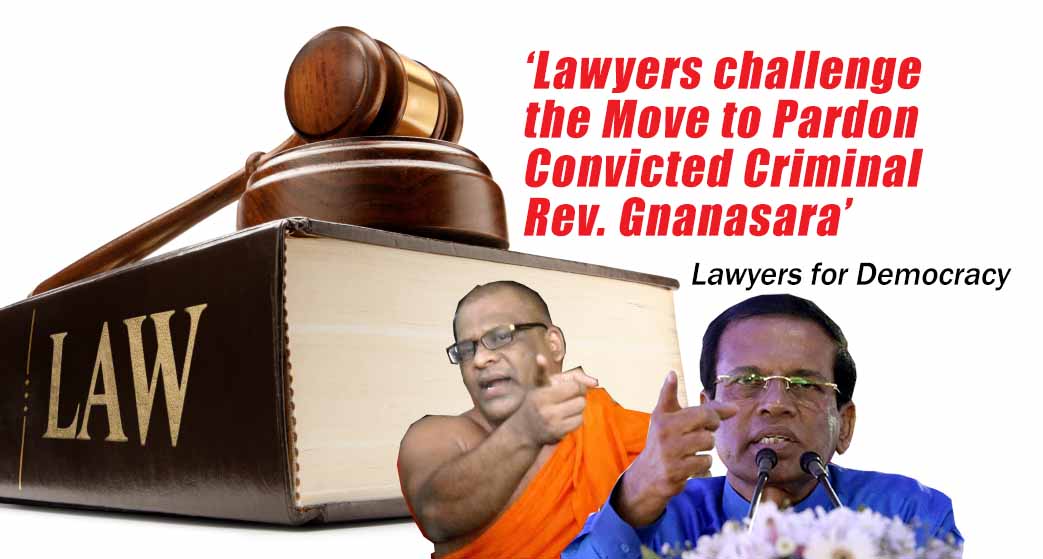
Lawyers challenge the Move to Pardon Convicted Criminal Rev. Gnanasara
 (Lanka
e News -31.Jan.2019, 5.25PM) Lawyers for Democracy (LfD) is concerned
by reports indicating a possible grant of presidential pardon to Rev.
Galagoda Aththe Gnanasara, who is well known for his aggressive conduct
and inciting of violence, particularly communal hatred. Rev Gnansara has
a long history of fueling ethnic and religious tension in this country.
It is unfortunate and telling that no formal legal measures has been
taken against him thus far except in an instance of contempt of court
and of intimidating Mrs. Sandya Ekneligoda. On 24th May 2018, he was
convicted of intimidating a victim witness in the case of the alleged
enforced disappearance of political journalist Prageeth Ekneligoda in
2018.
(Lanka
e News -31.Jan.2019, 5.25PM) Lawyers for Democracy (LfD) is concerned
by reports indicating a possible grant of presidential pardon to Rev.
Galagoda Aththe Gnanasara, who is well known for his aggressive conduct
and inciting of violence, particularly communal hatred. Rev Gnansara has
a long history of fueling ethnic and religious tension in this country.
It is unfortunate and telling that no formal legal measures has been
taken against him thus far except in an instance of contempt of court
and of intimidating Mrs. Sandya Ekneligoda. On 24th May 2018, he was
convicted of intimidating a victim witness in the case of the alleged
enforced disappearance of political journalist Prageeth Ekneligoda in
2018.We wish to publicly raise the following concerns and urge President Maithripala Sirisena to consider the rule of law & constitutional implications of deciding to so grant a pardon:
1. In August 2018, Rev. Galagoda
Aththe Gnanasara was convicted by the Court of Appeal on four charges of
contempt of court for disturbing the criminal proceedings in the well
of the Magistrate's Court of Homagama, inter alia, threatening the State
Counsel. The incident has been immediately subsequent to a refusal of
an application for bail by military intelligence officers who were
suspects in a disappearance case. He was sentenced to 19 years of
rigorous imprisonment to be served concurrently to be completed within 6
years. He was also previously convicted by the Homagama Magistrate in
June 2018 for intimidating witness-victim Mrs. Sandya Ekneligoda in the
court and sentenced to 6 months rigorous imprisonment.
2. We have come to know that Rev. Gnanasara has a previous conviction on 22-5-200 in Magistrate Court case number 6315/200 in Colombo Traffic Court on the charge of causing an accident while driving under the influence of alcohol. We are made to understand that there are investigations pending against him regarding other criminal conduct including the communal riots in Aluthgama.
3. The President's power to pardon a convict is subject to judicial review. In our view, prior to pardoning a criminal, report should be called from the Hon. Attorney General and Ministry of Justice. We are aware that neither the Attorney General nor the Minister of Justice has submitted any report regarding the pardoning of this convict. These observations become indispensable as the pardon that will be administered will be for the offence of contempt of court and will signal to the public that it is possible to act in such threatening manner in a court room and with complete disregard to the judiciary and officers of law, and thereafter use the fact that the criminal belongs to the priesthood and through political influence obtain such a pardon. A pardon if not exercised with due diligence and careful consideration of the rule of law implications will contribute to a culture of impunity.
4. We are surprised to read the letter of the Minister of Buddha Sasana forwarding several requests from personalities claiming to be religious leaders addressed to the President in respect of seeking a pardon. We emphasize that the Minister of Buddha Sasana has no legitimate role to play in pardoning a criminal.
5. This is a rear instance of a convict who was sentenced to imprisonment due to his intimidatory behavior in the well of the Court and intimidate the prosecuting State Counsel. Pardoning him will have a chilling effect on the judiciary and the Attorney General's Department.
6. We have seen an unfortunate build-up of media reports justify pardoning of this convict suggesting that he has contributed immensely to Buddhism. It is our view that this media hype appears to have vested political interest. Contrary to the position that appears to be promoted by this reportage, Rev. Gnanasara is seen an aggressive violent individual who worked against ethnic and religious harmony of this country and who was an active politician.
7. We have no doubt that his release will have serious adverse impact on the Ekneligoda disappearance case and all other pending cases of political significance particularly those involving the military. Such a pardon will strengthen impunity in Sri Lanka and discourage victims and witnesses from pursuing justice, as the system would be seen as failing them. This will also create a negative antecedent, particularly of the office of the President which will be perceived as protecting a convict who disrupted and threatened legitimate judicial proceedings. It will also diminish respect for and in the office of the Hon. Attorney General.
We urge the President to consider the broad public implications of the decision to grant a pardon to Rev. Gnanasara and to decide against such pardon based on the immensely negative impact it will have. We will be compelled to resort to all available avenues to resist and redress such reprehensible abuse of power.
Conveners
Lal Wijenayaka
K.S. Ratnavale
J.C. Weliamuna
Sudarshana Gunawardane
Sudath Neththasinghe
Prabodha Rathanyaka
Harishke Samaranayaka
30th January 2019
On behalf of
2. We have come to know that Rev. Gnanasara has a previous conviction on 22-5-200 in Magistrate Court case number 6315/200 in Colombo Traffic Court on the charge of causing an accident while driving under the influence of alcohol. We are made to understand that there are investigations pending against him regarding other criminal conduct including the communal riots in Aluthgama.
3. The President's power to pardon a convict is subject to judicial review. In our view, prior to pardoning a criminal, report should be called from the Hon. Attorney General and Ministry of Justice. We are aware that neither the Attorney General nor the Minister of Justice has submitted any report regarding the pardoning of this convict. These observations become indispensable as the pardon that will be administered will be for the offence of contempt of court and will signal to the public that it is possible to act in such threatening manner in a court room and with complete disregard to the judiciary and officers of law, and thereafter use the fact that the criminal belongs to the priesthood and through political influence obtain such a pardon. A pardon if not exercised with due diligence and careful consideration of the rule of law implications will contribute to a culture of impunity.
4. We are surprised to read the letter of the Minister of Buddha Sasana forwarding several requests from personalities claiming to be religious leaders addressed to the President in respect of seeking a pardon. We emphasize that the Minister of Buddha Sasana has no legitimate role to play in pardoning a criminal.
5. This is a rear instance of a convict who was sentenced to imprisonment due to his intimidatory behavior in the well of the Court and intimidate the prosecuting State Counsel. Pardoning him will have a chilling effect on the judiciary and the Attorney General's Department.
6. We have seen an unfortunate build-up of media reports justify pardoning of this convict suggesting that he has contributed immensely to Buddhism. It is our view that this media hype appears to have vested political interest. Contrary to the position that appears to be promoted by this reportage, Rev. Gnanasara is seen an aggressive violent individual who worked against ethnic and religious harmony of this country and who was an active politician.
7. We have no doubt that his release will have serious adverse impact on the Ekneligoda disappearance case and all other pending cases of political significance particularly those involving the military. Such a pardon will strengthen impunity in Sri Lanka and discourage victims and witnesses from pursuing justice, as the system would be seen as failing them. This will also create a negative antecedent, particularly of the office of the President which will be perceived as protecting a convict who disrupted and threatened legitimate judicial proceedings. It will also diminish respect for and in the office of the Hon. Attorney General.
We urge the President to consider the broad public implications of the decision to grant a pardon to Rev. Gnanasara and to decide against such pardon based on the immensely negative impact it will have. We will be compelled to resort to all available avenues to resist and redress such reprehensible abuse of power.
Conveners
Lal Wijenayaka
K.S. Ratnavale
J.C. Weliamuna
Sudarshana Gunawardane
Sudath Neththasinghe
Prabodha Rathanyaka
Harishke Samaranayaka
30th January 2019
On behalf of
Lawyers for Democracy
Peoples’ Perspective For National Budget 2019

By Emesha Piumini Perera –JANUARY 30, 2019

Emesha Piumini Perera
 Lanka
is now recovering from the political chaos due to the constitutional
coup leading to the ouster of the Prime Minister. The economic
volatility remains. Sri Lanka requires a well –planned budget that also
takes into consideration principles of fairness and equity that will
improve the lives of people. Moreover the budget is a mirror that
reflects the government‘s direction and commitment towards ensuring
human rights particularly economic, social and cultural rights.
Lanka
is now recovering from the political chaos due to the constitutional
coup leading to the ouster of the Prime Minister. The economic
volatility remains. Sri Lanka requires a well –planned budget that also
takes into consideration principles of fairness and equity that will
improve the lives of people. Moreover the budget is a mirror that
reflects the government‘s direction and commitment towards ensuring
human rights particularly economic, social and cultural rights.
Mr. Juan Pablo Bohoslavsky, United Nations Independent Expert visited Sri Lanka (3-11
September 2018). In his report he highlighted the effects of foreign
debt and other related international financial obligations on the
advancement of human rights, particularly economic, social and cultural
rights (ESCR). His report is an eye-opener and one that the government
(at all levels) and the civil society organizations should take into
account and use as a prism through which to review the programs on
development – both in their design and execution. It appears that so
when far none of the governments have taken the human rights dimension
into account formulating economic and development policies. Human rights
tend to be confined to the political arena but not to the economic and
social spheres. The report of the independent expert calls for a
paradigm shift so that total development efforts are approached from a
human rights perspective.
The report grapples with four objectives, namely, a) to examine the
effects of public debt, structural adjustment, fiscal consolidation and
other economic reform policies on the realization of human rights; b) to
assess the efforts made by the Government to curb illicit financial
flows; c) to analyse the effects of international development assistance
and lending to Sri Lanka from a human rights standpoint, and; d) to
study the efforts deployed by the Government to integrate human rights
standards in the financial sector with a particular interest on micro
finance.
On June 11, 1980, nearly forty years ago, the Government of Sri Lanka
(GoSL) ratified the International Covenant of Economic, Social and
Cultural Rights (CESCR) pledging that it would take necessary steps
towards the progressive realization of ESCR within the given limits of
country’s maximum available resources. Though the Sri Lankan
constitution of 1978 recognizes some of the ESCR as directive principles
of the state under Article 27, they are not enforceable in any court or
tribunal. The attempts were made 2016, during discussions around the
draft constitution to include them as justiciable. However, the proposal
of the Subcommittee Report on Fundamental rights 2016, have floundered
along with the broader constitutional reform process.
The UN independent Expert recognised that, “while maintaining
macroeconomic stability is an important concern, this aim should not
prevent human rights assessments of these planned reforms, in line with
international human rights standards.” In Sri Lanka, the government’s
focus is to maintain fiscal consolidation with the goal of achieving a
budget deficit of 3.5 percent of the GDP (Gross Domestic Product) (GDP)
by 2030. It transpires this target stems from the conditionalities
associated with structural reforms prescribed by the International
Monetary Fund and other finacial agencies.Sri Lanka is a constant
receiver of IMF financial assistance. The Sri Lankan government received
another extension of IMF loan of $1.5 billion for three years under the
Extended Fund Facility (EFF) on 3rd of
June 2016. The loan granted was to support “the country’s economic
reform agenda” which is to be based on the six pillars of neoliberal
policies. As prescribed by the IMF, the government’s strategy to address
short-term imbalances and medium-term challenges rests on 1) Fiscal
consolidation 2) Revenue mobilization 3)Public financial management 4)
State enterprise reform 5) Enhancing monetary policy 6) Trade and
investment facilitation. These pillars, are premised on the needs for
fiscal consolidation and revenue mobilization together with Public
financial managements. They are premised on the imposition of austerity measures and a substantial reduction of public expenditure.
These budget cuts mainly affects eduction, health, welfare and other
social security programs. For example, there is a 20.7 percent decline
of budgeted expenditure on education in 2017, fueled by around 2 percent
reduction in the recurrent expenditure and more than 40 percent drop
down in the capital expenditure. This is a worrisome fact since the
capital expenditure is the most vital segment of investments required
for improving the education sector while recurrent expenditure focuses
on the maintenance of the existing infrastructure. An underutilization
of budgeted funds can also be observed in both the education and health
sectors in the recent past. For instance, in 2016 the government has
only spent 71 percent of what it had been budgeted on education and 79
percent of the amount that had been allocated for health. Sri Lanka can
be proud of the free health and education provided to its citizens,.
This policy has maintained the literacy and health standards at a
reasonably high level. However, in recent years the investments in these
sectors have declined and standards have declined.
In
the words of the UN independent expert, “These efforts of public
private partnerships should not replace the Government’s primary
obligation of ensuring the economic, social and cultural rights equally
among everyone and its obligation in allocating maximum available
resources.”As such the government cannot undermine the provision of
these services to the citizen in the framework of ensuring the ESCR and
this must be taken in to account in preparation of the budget estimates
of for 2019.
It is noteworthy that these so called austerity measures were not
successful in many countries that obtained the same prescription from
the international financial agencies and were harshly criticized by the
economists such as Joseph Stiglitz, Paul Krugman and Mark Blyth.
According to their argument raising taxes and cutting public expenditure
too aggressively can potentially lead to a recession and can result
worse outcomes during a period of economic contraction. Even if total
debt is reduced, the debt to GDP ratio can increase because the gross
domestic product (GDP) can shrink in tandem. As
Krugman noted in his column titled “The Austerity delusion”, the more
austere the countries are, the lower the rates of growth. In the cases
of Greece, Spain, Argentina and Portugal, the austerity measures have
devastated the economies. The troika (the European commission, the
European Bank and IMF) tyranny forced austerity measures on Greece and
although it was followed by the biggest bailout in the world’s economic
history, it only made the situation worse. As such, the failure of these
austerity measures both in the social sphere but also in economic
sphere has been confirmed.
Read More
About ‘The Frozen Fire’ – Beyond Art – Part 3


Except for carrying out public campaigns on lifting the party
proscription, if the party had no desire to come to the open, then why
did the party used me to discuss that issue directly with the President?
This was not the first time the JVP had negotiated with the
government’s political leadership. On various occasions comrades Rohana,
Gamanayaka, Kelly Senanayake and I had met and negotiated with Messrs J
R Jayewardene and R. Premadasa and also had phone conversations with
them.
In 1987, the government said it wanted to enter into discussions with
the JVP. They released Comrade Shantha Bandara, a member of the
Politburo and a few others who were in custody. Around 1988, I recollect
the government proclaiming an agreement to stop violence signed by
Rohana Wijeweera and Upatissa Gamanayaka for the JVP and the Minister of
Defence, Lalith Athulathmudali for the state. Father Tissa Balasuriya,
OMI initiated this process as a result of a bogus mediation made by a
person called K C Senanayake (many had mistakenly taken him to be
comrade Kelly Senanayake). However, the government followed up that
agreement and issued a gazette notification repealing the proscription
of the JVP. The ban on the student and trade union organisations was
also lifted and the raids carried out in the south were also halted.
That agreement included a clause to the effect that the JVP will stop
its violence and arrange to hand over all the weapons they possessed.
However, the day after that agreement was made public, Comrade Rohana
issued a press communiqué followed up by another by Comrade Gamanayaka
stating that no such discussions were held between the JVP and the
government. It went on to say that the JVP will not in the open or in
secret bargain with the government and that the agreement Mr
Athulathmudali had published was entirely false. This was identified as a
conspiracy of the government and the United Socialist Front to slander
the JVP and its leadership. The attempt of the government, whether it is
genuine or not, failed. By that time the possibility of bargaining with
the government was fading fast.
During the same period, some of the conditions the Patriotic People’s
Movement, the armed wing of the JVP, had laid down as a basis for
discussion were:
1. the abolition of the Indo-Lanka Accord;
2. removal of the Indian Peace Keeping Forces;
3. abolition of the provincial councils;
4. repealing of the Provincial Councils Act;
5. freeing all those held in custody;
6. dismissing some sections of the armed forces; and
7. holding a presidential election and a general election.
What appears from the above is that from around 1986 the state, while
intensifying repressive measures against the JVP, would have also
desired to come to a temporary compromise given the escalating
instability the country was facing. During this period, the opposition,
if elected to power, was even prepared to offer ministerial positions to
the JVP.
After 1988, the JVP had clearly overestimated its power to influence
events. For example, the JVP would have taken the public obeying their
orders that were enforced ruthlessly using force, as an indication of
popular support. I strongly believe that the JVP, in an attempt to
discourage or weaken the armed forces, would not have decided to
assassinate family members of the soldiers or officers who did not quit
military service, unless they had overestimated their ability to capture
state power soon. With that decision, the state repression against the
JVP reached its bloody and brutal climax. From the catastrophe that was
occurring at the ground level, it was clear that the repression had
reached a stage, in which the state or the JVP could not turn back.
In the period soon after the proscription, if Comrade Rohana could not
engage in open politics, someone like comrade Gamanayaka could have come
out and exposed the lies of the government and the conspiracies hatched
against the party, in particular exposing the secret circular the JVP
said to have had in its possession. If such a death threat prevailed at
that stage, why couldn’t comrade Rohana go abroad for some time?
Engaging in clandestine politics for some time could have led to the
tragic decision to launch an armed struggle. Did the unpreparedness of
the leadership to engage in open politics during that period until most
of the leaders were killed, contribute to strengthening the campaign of
repression and violence?
According to comrade Gamini, comrade Rohana had a strong desire to be in
direct contact with me, or for me to maintain some relationship with
the party. Even on several occasions comrade Rohana had come to Colombo
to have discussions with me, he says, even when financial rewards were
offered for information on his whereabouts. The last Politburo meeting I
attended was in January 1984 somewhere around Ja-Ela. One of the
decisions taken there was to arrange a meeting with comrade Rohana to
discuss my political issues once more. Accordingly, in early February I
was taken to a rural area in Mathugama by comrade Amarasinghe on his
motorbike. However, Comrade Rohana did not turn up at the discussion as
expected. Meanwhile, I came to know that the member of Politburo comrade
Rathnayaka had also left the party in October 1983 due to political
issues similar to those of mine about the destination the party was
heading.
I cannot think of any obstacles that existed then or afterwards if they
wished to contact me, although no political initiative to contact me had
been forthcoming. I clearly saw a marked change in the political
direction and the forward vision of the party; the significant change
being the refusal to recognize the right to self-determination. When the
ruling elite wanted to block the path towards building a better and
fairer future by shamelessly using chauvinist and racist positions,
unfortunately even the JVP itself could not stay away from that process.
Even if there was a discussion between comrade Rohana and me, I suspect
whether it could have led to a productive outcome. By then, the JVP had
opportunistically surrendered themselves to racists and nationalists,
even by sharing the same platform with them. Finally, this led to
consolidating and entrenching in society nationalist and racist
positions. Since the presidential election in 1982 and during the second
armed uprising in 1987, the question why the party leadership was so
inclined towards reactionary racist positions is an important subject
matter that still needs to be discussed.
Comrade Gamini’s statement that comrade Rohana had shown a strong desire
to maintain direct contact with me or for me to maintain contact with
the party is flawed. That is because of the slanderous attack the party
launched against me when I tendered my letter of resignation. This sadly
was not a new phenomenon. If one had a different political position to
the one comrade Rohana held, hostility was a common response. Until I
was released from detention in December 1983, the party maintained
contacts with me through comrades Chitra and Daya Wanniarachchi. As soon
as I tendered my letter of resignation the party launched various
slanderous campaigns directed at me. Among those slanders were that I
betrayed the party while being held in detention, that I surrendered to
Catholic Action through comrade Chitra, and that I fled due to the fear
of repression the state had launched against the party. Despite this
hostility directed at me by the party, any actions of the bourgeois
regime against the JVP did not gain my support at all.
When I bid farewell to the party in February 1984, my last request was
to make my letter of resignation available for access to all members of
the party. However, in light of the new political direction the party
had adopted, it is not surprising that the party did not accede to my
request. Thus, any democratic discussion regarding the issues I had
raised in my resignation letter such as the party organisation, culture,
political orientation and direction was scuttled. The issues I raised
and the reasons why I left the party have come to light only recently.
Since I wrote the article ‘Frozen Fire’ – Art and Political Reality, I
saw for the first time in my political life, one or two comments
maliciously implying that I betrayed the party by joining the UNP. I
challenge those who make such comments to come up with concrete evidence
and if none is forthcoming, for them to stop their slandering campaign.
The only thing I could say to those who raise such allegations is that
you have swallowed not a simple rope, but a giant one!
Subscribe to:
Posts (Atom)