Peace for the World World ! Your War Our Lives

The Dalai Lama
A Brief Colonial History Of Ceylon(SriLanka)
Sri Lanka: One Island Two Nations
A Brief Colonial History Of Ceylon(SriLanka)
Sri Lanka: One Island Two Nations
(Full Story)
Back to 500BC.

Wednesday, May 1, 2019
Japan’s Reiwa era may be less than harmonious


In this file photo taken on January 2, 2010 Japanese Emperor Akihito (R)
and Crown Prince Naruhito (L) wave to well wishers as the Imperial
family receives new year greetings at the Imperial Palace in Tokyo. When
the 85-year-old Japanese Emperor Akihito steps down on April 30, 2019
it will be the latest in a string of historic abdications that have
included the pope and several monarchs. Source: Toshifumi Kitamura/AFP

APRIL 29, 2019
WHEN Japan’s Emperor Akihito abdicates on Tuesday, the gengo — or era name — of Heisei (‘achieving peace’) under his 1989–2019 reign will come to an end.
A new era will begin when his son, Crown Prince Naruhito, ascends the
throne on May 1. The new era will be known as Reiwa (‘beautiful
harmony’) as revealed by the Abe Cabinet to an eagerly awaiting Japanese
public on April 1.
Although the Japanese government and people use both the Western
calendar and the Japanese imperial period system, the latter has had a
special place in Japanese history for over thirteen centuries. In modern
Japan, landmark public and personal memories are still often identified
with era names.
The era of Showa (‘enlightened harmony’), under Emperor Hirohito’s
1926–1989 reign, was divided into two periods: the pre-war years of
militarism, war and defeat, and the post-war years of rebuilding, peace
and economic prosperity.
During his reign, Hirohito underwent an extraordinary transformation
from being pre-war an absolute monarch of near-divine status to the more
humanised post-war symbolic monarch with no real political power under
the democratic constitution. Hirohito was haunted in the latter period
by the question of his wartime responsibility as he was excused by the
US-led Allied powers from facing the Tokyo War Crimes Tribunal.
Unlike his aloof and conservative father, the personable and open-minded
Akihito broke with archaic Imperial House tradition by marrying a
commoner, Michiko. She also broke tradition by raising her children
herself under the same roof.
Although Heisei era Japan suffered from economic stagnation caused by
the bursting of Japan’s asset price bubble in the early 1990s and a
number of devastating natural disasters, the Imperial House of Emperor
Akihito and Empress Michiko earned solid popularity both at home and
abroad. The couple came to symbolise a modern, liberal and open court
which stayed close to the people.

Japan’s Emperor Akihito (R) and Empress Michiko leave after praying at
the altar of late Prince Tomohito, a cousin of the Emperor, in Tokyo
June 19, 2012. Source: Reuters/Itsuo Inouye
One of the most noteworthy legacies of Emperor Akihito will be his
tireless efforts to travel, both at home and abroad, to promote peace
and reconciliation with the victims of the 1931–1945 Asia Pacific War
waged in his father’s name. Expressing his remorse and regret to peoples
across the region, including in Okinawa, Hiroshima, the Korean
peninsula, China and the Philippines and elsewhere, Emperor Akihito
represented Japan’s commitment to pacifism as ‘the symbol of the State
and of the unity of the people’.
Emperor Akihito and Empress Michiko also promoted the welfare of the
Japanese people as part of their duties, tirelessly engaging in
compassionate work for social causes. They were concerned with
marginalised peoples — the poor, the disabled and ethnic minorities.
They comforted and encouraged survivors of natural disasters.
After the 1995 Kobe earthquake and the 2011 Tohoku earthquake and
tsunami, the couple visited thousands of survivors in shelters. Images
of the Emperor and the Empress getting on their knees on shelter floors
won over the hearts of the Japanese people.
August 2016 saw another unprecedented move, with Akihito announcing that
he had lost confidence in his capacity to serve as a symbol of national
unity due to illness and age. He indirectly conveyed his desire to
abdicate, something which is not permitted under Imperial Household Law.
SEE ALSO: Can Japan do better than muddle through?
The conservative Prime Minister Shinzo Abe, tagged for his right-wing
nationalist political ideology, was unlikely to have welcomed the
Emperor’s proposition. Yet he improvised a one-time cabinet decision to
make it possible, as the Japanese public overwhelmingly believed that
the Emperor should be allowed to retire.
The Japanese media has recognised the widening gap between Emperor
Akihito, who embraces the pacifist course, and Prime Minister Abe, who
is implementing a more assertive foreign policy — including establishing
Japan’s first-ever National Security Council and
National Security Strategy. The Abe government also reinterpreted the
Article 9 ‘peace clause’ of the Constitution to permit Japan’s
Self-Defense Forces (SDF) the right to engage in limited forms of
collective self-defence.
When Crown Prince Naruhito ascends the throne, many expect him to follow
his father as a champion of pacifism, civil liberties and the welfare
of the people. But as the Abe government continues to pursue
constitutional revision to recognise the SDF, the new Emperor may be
standing at a crossroads.
Given the constitutional limitations on Japanese Emperors it is hard to
tell what Naruhito can or will do, but compared with his father’s mild
manner and humility, the Oxford-educated Naruhito is known to be more
individualistic, independent and outspoken.
Besides the issue of abdication, the Imperial Household Law may be long
overdue for amendment on the question of succession. The law stipulates
that the Chrysanthemum Throne must be succeeded by a male, but Crown
Prince Naruhito only has a daughter, Princess Aiko.
In the age of increasing gender equality the law seems anachronistic to
most liberals, but the conservative Abe Cabinet does not seem interested
in amending it. Will the new Emperor and his Western-educated wife,
Masako, be content with accepting the old tradition?
In contrast to its moniker of ‘beautiful harmony’, the Reiwa era may
begin with some less than harmonious dialogue between the Imperial House
and the Abe cabinet.
Noriko Kawamura is an Associate Professor in the Department of History at Washington State University.

A symbol of slavery — and survival
Angela’s arrival in Jamestown in 1619 marked the beginning of a subjugation that left millions in chains. The sun sets on the James River in April, seen from Historic Jamestown in Williamsburg, Va. (Matt McClain/The Washington Post)
By DeNeen L. Brown-
APRIL 29, 2019
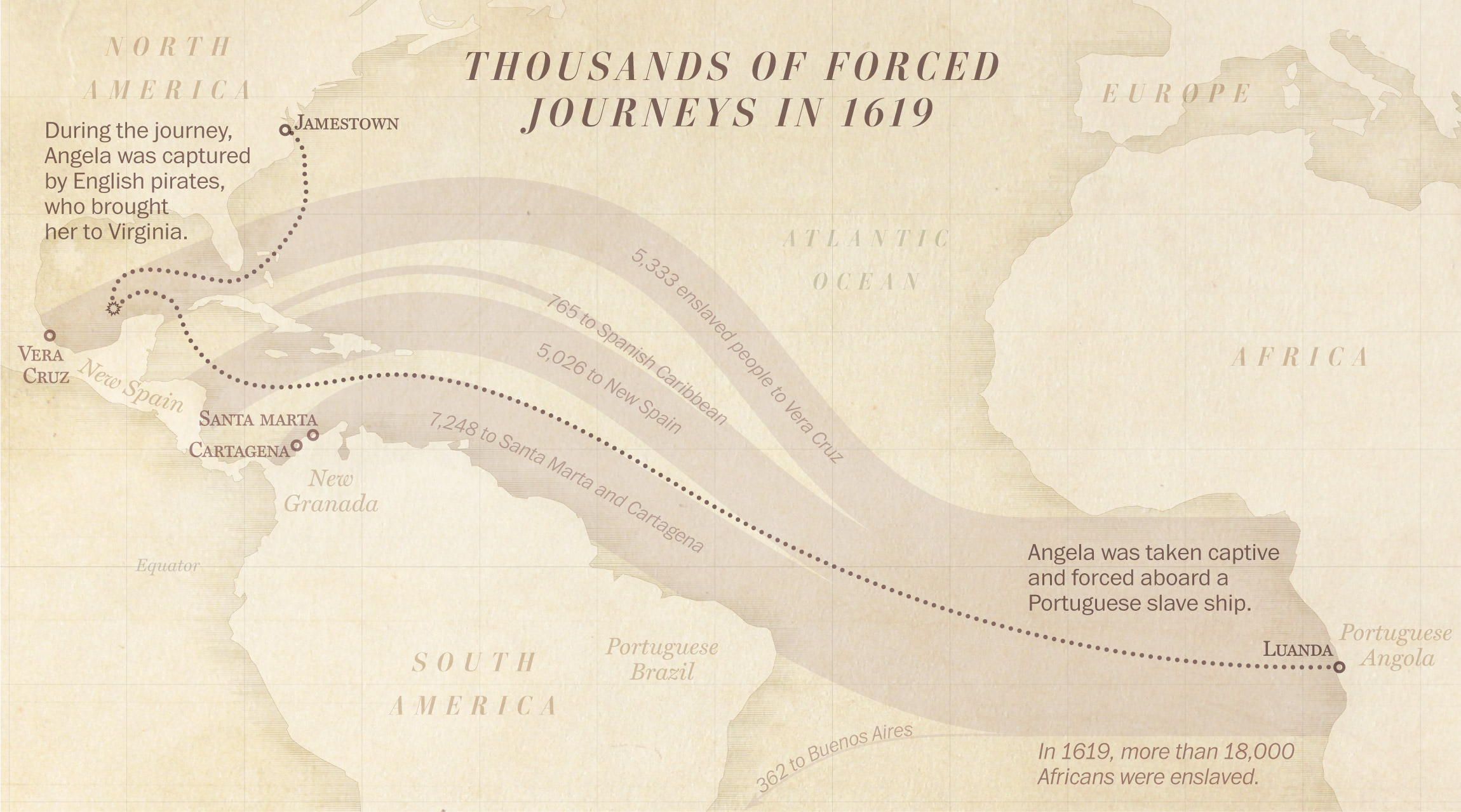
By the time Angela was brought to Jamestown’s muddy shores in 1619, she had survived war and capture in West Africa, a forced march of more than 100 miles to the sea, a miserable Portuguese slave ship packed with 350 other Africans and an attack by pirates during the journey to the Americas.
“All of that,” marveled historian James Horn, president of the Jamestown Rediscovery Foundation, “before she is put aboard the Treasurer,” one of two British privateers that delivered the first Africans to the English colony of Virginia.
Now, as the country marks the 400th anniversary of the arrival of those first slaves, historians are trying to find out as much as possible about Angela, the first African woman documented in Virginia.
They see her as a seminal figure in American history — a symbol of 246 years of brutal subjugation that left millions of men, women and children enslaved at the start of the Civil War
Two years ago, researchers launched an archaeological investigation in Jamestown at the site of the first permanent English settlement in North America to find any surviving evidence of Angela.
She is listed in the 1624 and 1625 census as living in the household of Capt. William Pierce, first as “Angelo a Negar” and then as “Angela Negro woman in by Treasurer.” By then, she had survived two other harrowing events: a Powhatan Indian attack in 1622 that left 347 colonists dead and the famine that followed.
Yet little is known about her beyond those facts.
[The Dawn of American Slavery: Jamestown 400 special report]
“It is presumed she was youngish — maybe in her early 20s,” said Cassandra Newby-Alexander, a history professor at Norfolk State University and co-author of “Black America Series: Portsmouth, Virginia.” “Angela was her Anglicized name. We don’t know what her original name was.”
“If they find the remains, we can know how old she was when she arrived,” Newby-Alexander said.
“Did she have children? What did she die of? We will know more about this person, and we can reclaim her humanity.”

The Angela Site where excavation work is taking place at Historic Jamestown. (Matt McClain/The Washington Post)
The transatlantic slave trade was already more than a century old and thriving when the first Africans reached Virginia.
“The trade is full-blown in 1619,” said Daryl Michael Scott, a Howard University history professor. The Portuguese controlled much of the market, transporting “huge numbers of Africans taken from what becomes Portuguese Angola.”
Between 5,000 and 8,000 people from Kongo, Ndongo and other parts of West Africa were being shipped each year to Portuguese and Spanish colonies in the Americas. The total number of Africans captured and transported to the Americas between 1501 and 1867 would eventually grow to more than 12.5 million.
[Scientific racism: a brief history of the phony theories that perpetuate white supremacy]

“The ship was overcrowded,” Horn said. “It suffered horrible mortality on the voyage to Vera Cruz.” More than 120 Africans aboard died en route.
In the middle of passage, the slave ship was attacked by two English pirate ships — the Treasurer and the White Lion. The pirates climbed aboard the Bautista, hoping to find a bounty of gold.
Instead, they found humans, desperate people. The pirates took 60 or so Africans, splitting them between the White Lion and the Treasurer. Historians surmise that the pirates took the young, healthiest captives. Angela was among them.
“I’ve got no evidence that she was young,” Horn said. “I base it on the general model that slavers would try to take the younger people, including children, women and males they would get the most money for. That is a chilling aspect of the slave trade. People are being treated like livestock. The capability of women to have children was in slavers’ minds. To survive a journey like that, my own sense is she was young and possibly very young. Where there is no evidence, it is fair to speculate.”
The arrival of the White Lion was reported by colonist John Rolfe, who is best known for marrying Pocahontas in 1614. He wrote: “About the latter end of August, a Dutch man of Warr of the burden of a 160 tunes arrived at Point-Comfort, the Comandors name Capt Jope, his Pilott for the West Indies one Mr Marmaduke an Englishman. … He brought not any thing but 20. and odd Negroes, w[hich] the Governo[r] and Cape Merchant bought for victuall[s].”
The Treasurer was next to arrive. A number of historical accounts reported that the Treasurer turned around quickly after being anchored near Point Comfort, avoiding an order by the governor to detain the ship and question its captain “about his involvement in acts of piracy in the Spanish Indies,” according to Horn.
The Treasurer, these accounts reported, headed for Bermuda before returning to Virginia. But Horn says new evidence he found in December while researching archives in London show that the Treasurer arrived in Virginia four days after the White Lion with 28 to 30 Africans that had been captured on the Portuguese slave ship.
One of those two or three Africans was Angela, who wound up in the household of Pierce.
“The majority of the Angolans were acquired by wealthy and well-connected English planters including Governor Sir George Yeardley and the cape, or head, merchant, Abraham Piersey,” according to Jamestown Rediscovery. “The Africans were sold into bondage despite Virginia having no clear-cut laws sanctioning slavery.”
But that would change.
[‘The haunted houses’: Legacy of Nat Turner’s slave rebellion lingers, but reminders are disappearing]


TOP: Historic Jamestown in Williamsburg. BOTTOM LEFT: Remnants of the
slave ship Sao Jose on display in March at the National Museum of
African American History and Culture in Washington. BOTTOM RIGHT: Lee
McBee, supervising archaeologist at the Angela Site, works on a piece of
pottery in March. (Photos by Matt McClain/The Washington Post)
Angela’s arrival coincided with another milestone in American history: the meeting of the first General Assembly in Jamestown’s newly built wooden church. The assembly is billed by Jamestown Rediscovery as “the oldest continuous law-making body in the western hemisphere.”
The legislative body was made up of the governor, his four councilors and 22 burgesses elected by every free white male settler in the colony. Its work from July 30 to Aug. 4, 1619, represented the nation’s first experiment with democracy, and its 400th anniversary is being marked this year.
It is a great irony, Horn said, that American slavery and democracy were created at the same time and place.
He said that “1619 gave birth to the great paradox of our nation’s founding: slavery in the midst of freedom. It marked both the origin of the most important political development in American history, the rise of democracy, and the emergence of what would become one of the nation’s greatest challenges: the corrosive legacy of racial discrimination and inequality that has afflicted our society since its earliest years.”
The conditions endured by settlers and enslaved people alike were awful.
The colony, which had been established in 1607, stretched from Point Comfort to what is now Richmond. There were plantations scattered for about 100 miles along the banks of the James River. Jamestown itself probably had a population of about 100.
The colonists had, at one point, nearly been wiped out. In 1609, they were under siege by the Powhatan and facing starvation that led to cannibalism. Capt. John Smith described that horror in a 1624 letter:
“October 1609 — March 1610, there remained not past sixtie men, women and children, most miserable and poore creatures; and those were preserved for the most part, by roots, herbes, acornes, walnuts, berries, now and then a little fish: they that had startch in these extremities, made no small use of it; yea even the very skinnes of our horses.
"Nay, so great was our famine, that a Salvage we slew and buried, the poorer sort tooke him up againe and eat him; and so did divers one another boyled and stewed with roots and herbs: And one amongst the rest did kill his wife, powdered [i.e., salted] her, and had eaten part of her before it was knowne; for which hee was executed, as hee well deserved: now whether shee was better roasted, boyled or carbonado’d [i.e., grilled], I know now; but of such a dish as powdered wife I never heard of.”
[Anthony and Mary Johnson were pioneers on the Eastern Shore whose surprising story tells much about race in Virginia history]
Angela lived through what is called the “Second Starving Time.” “Many people died during the Second Starving Time,” Horn said. “There isn’t enough corn to support” the large numbers of arriving settlers. “You have a period where food prices, particularly for Indian corn, are astronomical. A lot of poor servants and white indentured servants perished or died of disease. It is a grim period.”
Angela probably survived because she lived on the plantation of Pierce, one of the wealthiest men in the colony. “We know some Africans died during that period,” Horn said. “We know there were 32 Africans living in the colony in 1620. We know only 23 Africans were living in the colony in 1625.”
But by 1626, Angela disappears from the census records. Her fate is unknown.

The 1624-1625 Jamestown census lists an “Angelo a Negar.” (Matt McClain/The Washington Post)
Jamestown Rediscovery recently released an illustration depicting
Angela, circa 1625, standing on the banks of the James River as ships
are anchored in the background.“We wanted to provide a setting for Angela that reflected what was going on in Jamestown at the time,” Horn said. “She would have been living in Jamestown six years around 1625, which is a good date for the drawing. She certainly would have been dressed in English clothing. The dockside, it is quite possible she would have spent time down there, which was a few yards from the Pierce house.”
Horn said the artist wanted to give Angela a sense of dignity and autonomy. She is not dressed in rags.
“Her clothing would not have been fancy,” Horn said, “but everyday working clothing. Essentially, she is dressed in the clothing of a working young woman for the Pierce family.”
The illustration allows viewers to fill in the gaps in history, paying due to the colony’s first documented African woman.
“I see her not so much as a kind of Eve figure for Africans,” Horn said. “There were other Africans in the colony in Virginia. I see the significance of Angela being able to put a name to her and identify her in a place.”
And to remind Americans 400 years later what she managed to survive.
Graphics by Lauren Tierney and Armand Emamdjomeh. Map and chart data sourced from Slave Voyages.
Anger as Corbyn faces down calls for Labour to back new Brexit vote
Labour NEC resists pressure to unequivocally support second referendum in EU election manifesto Pro-EU campaigners outside the Labour party’s national executive committee offices in central London. Photograph: Andy Rain/EPA
 Heather Stewart-
Jeremy Corbyn has faced down a challenge spearheaded by his deputy, Tom Watson, for Labour to signal its unequivocal backing for a second Brexit referendum in the forthcoming European election campaign.
In a move that sparked an immediate backlash among remain-supporters, Labour’s ruling national executive committee (NEC), announced that its manifesto for the election would be “fully in line” with its longstanding policy.
That means continuing to support “Labour’s alternative plan” for Brexit – “and if we can’t get the necessary changes to the government’s deal, or a general election, to back the option of a public vote”, a Labour source said.
The wording falls well short of the position set out recently by Watson, and by the shadow Brexit secretary, Keir Starmer, who told the House of Commons in April: “At this late stage it is clear that any Brexit deal agreed in this parliament will need further democratic approval.”
Some Labour MPs reacted with fury to the NEC’s decision. Bridget Phillipson, who represents Houghton & Sunderland South, speaking for the People’s Vote campaign, said: “The manifesto’s mealy-mouthed wording still maintains the fiction that there is a deal out there that can satisfy all the promises made three years ago, avoid real costs to jobs and living standards, or end the endless crisis around Brexit.
“This means Labour risks demoralising activists, depressing turnout among supporters and decreasing the share of the vote for candidates who – like the overwhelming majority of our party – are fighting for a people’s vote on any Brexit deal.”
The cautious restating of Labour’s stance comes as cross-party Brexit talks with the government enter a critical phase, with both sides insisting there is fresh impetus behind the attempt to find a consensus.
Negotiations are expected to resume on Wednesday, with Downing Street setting an informal deadline of the middle of next week for significant progress to be made.
The Tories have been stung by a string of recent polls suggesting public support has collapsed since the decision to delay Brexit for a second time. An Opinium poll for the Observer this week had Labour level-pegging with Nigel Farage’s Brexit party on 28% of the vote, with the Conservatives on just half that level.
Labour’s divisions on Brexit have been exposed afresh by the row over the party’s European manifesto, which earlier involved Watson staging what he insisted was a “polite” walkout of a meeting of the shadow cabinet, after members were told they would not be handed a draft.
Corbyn is keen to avoid Labour being pigeon-holed as a remain party, not least because he hopes to make significant gains at Thursday’s local elections, including in Brexit-supporting areas.
But he is under intense pressure, not just from Watson, Starmer and the shadow foreign secretary, Emily Thornberry, who has also made clear she would like a referendum on any Brexit deal, but from an increasingly vocal group of leftwing MPs, including Clive Lewis and Rachael Maskell.
MPs from both sides of Labour’s Brexit divide claimed victory after the meeting. Referendum-supporters seized on the fact that the statement said Labour would “back the option” of a public vote, rather than keep it “on the table”.
Wes Streeting, the MP for Ilford North, tweeted: “Glad the NEC made the right call and confirmed that a public vote will be in our manifesto.”
But MPs in leave-supporting seats, including Gloria De Piero, who represents Ashfield in Nottinghamshire, cheered the fact that a referendum would be merely “an option” for Labour, if talks with the government break down.
A Labour spokesperson said: “Labour is the only party which represents both people who supported leave and remain. We are working to bring the country together after the chaos and crisis created by the Tories.”
The meeting followed a public spat last week when some Labour MPs reacted angrily to a draft leaflet for the European elections that failed to mention a referendum.
Corbyn was supported at the lengthy meeting inside the party’s Southside headquarters in Victoria, London, by a clear majority of NEC members, including all of those backed by Momentum, the grassroots pro-Corbyn campaign group.
Just one vote was held, on an amendment proposed by the TSSA union, that would have committed Labour to a “confirmatory” referendum on any Brexit deal – even if the government caves in to all Labour’s demands. It was rejected by a “clear” margin, NEC sources said.
Manuel Cortes, the TSSA’s general secretary, described the outcome of the meeting as, “Labour’s latest Brexit fudge”, adding that the party’s “unicorn demands” for a Brexit deal, would “in effect make us a rule-taker colony of Brussels”.
“That’s the naked truth and we have missed an opportunity to tell it to voters like it is. We face a stark choice – a no-deal economic crash, vassalage or the best option, no Brexit at all,” he said.
However, some senior party figures drew comfort from the fact that the NEC is not meant to be a policymaking body; and the process for agreeing a general election manifesto would be different, involving shadow ministers in setting policy for their respective brief.
One NEC member said: “Politically, it was necessary for some people to turn this into a fight about a second referendum but in reality this meeting was not going to change party policy.
“If we have a general election manifesto meeting when we need to decide a policy on a second referendum, it will be very different, but most people are happy to have this compromise right now.”
The breakaway Change UK group seized on the outcome of the NEC meeting. Mike Gapes MP, the former Labour MP who is the party’s foreign affairs spokesman, said: “If you’re a Labour supporter and dismayed by Labour’s latest fudge on Brexit, send Corbyn a message by lending Change UK your vote.”
Can Courts Clear the Fog of War?
As online attacks blur the lines, the future may be perpetual conflict.


BY ELISABETH BRAW |
What constitutes an act of war? A military invasion, sure. Hostile acts by smaller armed formations, sure. The blowing up of a bridge by commandos or the poisoning of water, very likely. But a cyberattack? Zurich, one of the world’s leading insurers, claims that’s the case. The confectionary giant Mondelez, one of its customers, argues the opposite. This isn’t an abstract discussion: Two years ago, Mondelez was laid low by NotPetya, a computer virus unleashed by Russia against Ukrainian targets. Now the two companies are battling out the definition of war in court—and regardless of how the ruling turns out, a new fog of war is still settling over society.
NotPetya struck with devastating force in June 2017. First, the virus—subsequently traced to hackers working for Russian military intelligence—brought down virtually all of Ukraine’s government along with Ukrainian hospitals, power companies, airports, and banks. That was probably its real target.
Then, however, the virus traveled on in a less predictable fashion. It crippled Maersk, the Danish shipping giant, and the global law firm DLA Piper. FedEx subsidiary TNT Express was hit, too, as was the U.S. pharmaceutical giant Merck and French construction company Saint-Gobain. Several of them lost hundreds of millions of dollars as a result of the attack.
After several months, the Five Eyes—a close-knit intelligence union comprising the United States, the United Kingdom, Canada, Australia, and New Zealand—concluded that the Russian government was ultimately behind the assault, and in March 2018 Britain’s attorney general, Jeremy Wright, said that “the U.K. considers it is clear that cyberoperations that result in, or present an imminent threat of, death and destruction on an equivalent scale to an armed attack will give rise to an inherent right to take action in self-defense, as recognized in Article 51 of the U.N. Charter.”
When Mondelez tried to claim its $100 million losses on its insurance policy with Zurich, the insurer—perhaps unsurprisingly, in light of statements such as those by Wright—refused, categorizing the attack as a “hostile or warlike action in time of peace or war” and as such excluded from insurance payouts. The two giants are now battling over the definition of warlike actions at a court in Illinois. DLA Piper and its insurer, Hiscox, are conducting a similar battle over whether a cyberattack such as NotPetya qualifies for insurance payouts.
Insurers do have weight behind their arguments. With countries increasingly staging cyberattacks against their adversaries—and key companies and organizations located in those countries—cyberattacks effectively form part of modern warfare. U.S. Cyber Command is thought to be battling some 30 hostile states in cyberspace. The Council on Foreign Relations’ Cyber Operations Tracker lists 22 countries (including the United States and the U.K.) as sponsoring cyberoperations. That, of course, doesn’t mean all cyberoperations are acts of war.
Indeed, Thomas Rid argues in his book Cyber War Will Not Take Place that because changing code doesn’t involve violence, cyberattacks can’t count as acts of war. Many cyberassaults, however, can be just as potent, or even more so, than physical sabotage. Proxy groups linked to the Russian and Chinese governments—or their sponsors themselves—have infiltrated the U.S. power grid, the German government, and countless companies. In targeting civilians, the attacks break international law. They just don’t involve enough physical violence to qualify as traditional acts of war. Making matters even more complicated, unlike soldiers and military hardware, weapons of cyberattacks and malign influence are virtually impossible to quantify.
Activities between war and peace have long existed alongside warfare. Indeed, the separation of war and peace is a relatively recent concept, one that medieval and Renaissance Europeans would have been unfamiliar with. Contemporary officers have been taught to view many such acts of aggression as criminal damage related to a potential act of war. But in reality, anything less than a full-blown military attack is usually treated as a police matter. If, say, the landing points of the undersea cables that carry the world’s internet were to be sabotaged, the perpetrators—if found—would face the justice system, not the armed forces. But in recent years, the fog of war has been thickening, both on- and offline. “[T]here are no clear guidelines any longer on what constitutes war. Moreover, since ‘war’ is forbidden by the charter of the United Nations except in self-defense or if authorized by the Security Council, states hardly ever declare military actions to be ‘war’ any more — they are always self defense, police actions, interventions or the like,” Nikolas Gvosdev and Andrew Stigler pointed out in a New York Times op-ed in 2011.
That’s the dilemma. The outlawing of war in the U.N. Charter was a milestone, as Oona A. Hathaway and Scott J. Shapiro document in their book, The Internationalists: How a Radical Plan to Outlaw War Remade the World, but it has simply led to warfare being labeled something else or nothing at all. (Land conquests have, however, dramatically declined since World War II.)
The cyber-engineers who launched NotPetya did not declare war on the Ukrainian government, Ukrainian companies, Mondelez, DLA Piper, or anyone else—but neither did Russia in eastern Ukraine. Most armed conflicts since World War II have not included declarations of war.
The cyber-engineers who launched NotPetya did not declare war on the Ukrainian government, Ukrainian companies, Mondelez, DLA Piper, or anyone else—but neither did Russia in eastern Ukraine. Most armed conflicts since World War II have not included declarations of war.What’s more, today belligerents are often not even nation-states but proxies operating on their behalf. In 2013, a U.N. body decided that, referring to information and communication technologies (ICT), “State sovereignty and the international norms and principles that flow from it apply to States’ conduct of ICT-related activities and to their jurisdiction over ICT infrastructure with their territory; States must meet their international obligations regarding internationally wrongful acts attributable to them.” Even so, governments unashamedly keep sponsoring cyberattacks.
“There’s a feeling among many states that other states are carefully calibrating their cyber-aggressions so they fall below the threshold of war,” said Gary Brown, a former U.S. Air Force judge advocate who now teaches cyberlaw at the National Defense University in Washington. “That makes it challenging for the targeted country to respond. It’s neither war nor peace—it’s constant competition.”
Politicians and analysts refer to cyberattacks, malign influence
campaigns, and other nonkinetic aggression as part of hybrid or “gray
zone” warfare. But in legal terms, hybrid warfare means nothing. The
court in the Mondelez v. Zurich case may provide some clarity,
but that’s only the first step. Brown suggests an additional way
forward, one that is reportedly being discussed by at least two
countries: a treaty among a small number of nations defining the rules
of cyberconflict. Other countries could then join the treaty,
essentially a club of countries committed to a rules-based order in
cyberspace.
The gray zone is taking over. It’s no longer just the bastard companion of organized warfare: It can, once again on its own, be the warfare. The German philosopher Immanuel Kant has influenced generations with his treatise Perpetual Peace. Instead, we’re living with perpetual quasi-war. The recognition matters to ordinary citizens, who deserve to be informed whether they are living under war, peace, or a warlike condition.
Because war cancels most insurance coverage, the recognition of a warlike condition also matters greatly to insurance companies and their customers, who need clarity about what will—or won’t—be covered. And it matters urgently to governments, which have to consider if, and how, to respond to cyberattacks and malign influence campaigns against them, their populations, and companies located in their countries. Should the Danish armed forces have responded when NotPetya struck Maersk, Denmark’s largest company, rendering it virtually unable to operate? Or would that have been inappropriate, as NotPetya claimed no Danish lives?
The additional complication is this: Even though some countries turn to aggression such as cyberattacks precisely because it’s so unlikely to be treated as an overt act of war, the perpetual quasi-war doesn’t mean the specter of physical war has gone away. On the contrary, without rules for nonkinetic aggression—that is, aggression that involves no collective violence by armed forces—countries can easily slide into traditional war. What would have happened if the Danish armed forces had struck their Russian counterparts in response to NotPetya? Behind the shadow of quasi-war hides the possibility of real war.
The gray zone is taking over. It’s no longer just the bastard companion of organized warfare: It can, once again on its own, be the warfare. The German philosopher Immanuel Kant has influenced generations with his treatise Perpetual Peace. Instead, we’re living with perpetual quasi-war. The recognition matters to ordinary citizens, who deserve to be informed whether they are living under war, peace, or a warlike condition.
Because war cancels most insurance coverage, the recognition of a warlike condition also matters greatly to insurance companies and their customers, who need clarity about what will—or won’t—be covered. And it matters urgently to governments, which have to consider if, and how, to respond to cyberattacks and malign influence campaigns against them, their populations, and companies located in their countries. Should the Danish armed forces have responded when NotPetya struck Maersk, Denmark’s largest company, rendering it virtually unable to operate? Or would that have been inappropriate, as NotPetya claimed no Danish lives?
The additional complication is this: Even though some countries turn to aggression such as cyberattacks precisely because it’s so unlikely to be treated as an overt act of war, the perpetual quasi-war doesn’t mean the specter of physical war has gone away. On the contrary, without rules for nonkinetic aggression—that is, aggression that involves no collective violence by armed forces—countries can easily slide into traditional war. What would have happened if the Danish armed forces had struck their Russian counterparts in response to NotPetya? Behind the shadow of quasi-war hides the possibility of real war.
The existential crisis of Pax Americana

By Andrew Sheng-April 28, 2019, 6:55 pm
 Is
the world in crisis or is it only a crisis of the neo-liberal order?
Last year, American historian Walter Russell Mead identified the
following traits of the current American and global discomfort:
"ineffective politicians, frequent scandals, racial backsliding,
polarized and irresponsible news media, populists spouting quack
economic remedies, growing suspicion of elites and experts, frightening
outbreaks of violence, major job losses, high-profile terrorist attacks,
anti-immigrant agitation, declining social mobility, giant corporations
dominating the economy, rising inequality, and the appearance of a new
class of super-empowered billionaires in finance and technology-heavy
industries."
Is
the world in crisis or is it only a crisis of the neo-liberal order?
Last year, American historian Walter Russell Mead identified the
following traits of the current American and global discomfort:
"ineffective politicians, frequent scandals, racial backsliding,
polarized and irresponsible news media, populists spouting quack
economic remedies, growing suspicion of elites and experts, frightening
outbreaks of violence, major job losses, high-profile terrorist attacks,
anti-immigrant agitation, declining social mobility, giant corporations
dominating the economy, rising inequality, and the appearance of a new
class of super-empowered billionaires in finance and technology-heavy
industries."
However, akin to present day conditions, he was actually describing the
35 years (1865-1901) after the American civil war, when the US emerged
to become the major challenger to the British Empire. It took another 45
years, at the end of the Second World War, to realize Pax Americana,
confirming the US as the dominant global military, economic and
political power.
But having acquired global power, what was the strategy going forward?
The neo-liberal order was the strategy to bring the New Deal of
President Franklin Delano Roosevelt to the world. Use Keynesian spending
to revive the global economy, win friends and convert them to Pax
Americana.
The spread of American culture of global consumerism was a promise of
five freedoms – freedom of speech, freedom to vote, freedom of trade,
capital and migration. This was a convincing American dream, that every
individual could have all he wants under Pax Americana. Consumption in
excess of income must be funded by debt. As America remains a major food
producer to the world and then a provider of global public goods, the
rest of the world pays for the nuclear umbrella and support free trade
and ideas of more freedoms under the multilateral system, through the
holding of more US debt.
This is why the 1944 Bretton Woods Conference was crucial in shaping the
current global financial architecture. As we know, the US rejected the
multinational currency system using Bancor as proposed by Keynes, in
favour of the current architecture, centred around the dollar. Pax
Americana is funded by the central position of the US dollar, which
allows the US to run deficits unsustainable for any other country.
The subtle but crucial difference between the Keynesian proposal and
what we have today is that the US adopted a unipolar multilateral model,
in which the US had the final say on the global military, political and
financial architecture. As Professor Drezner stated succinctly in the
latest issue of Foreign Policy magazine, "having global rules of the
game benefits everyone, but the content of these rules benefited the
United States in particular."
As US/Belgian economist Triffin recognized in the 1970s, the US could
run trade deficits through an ‘exorbitant privilege’, because the rest
of the world, which was growing faster than the US, needed more global
monetary liquidity and dollars as a store of value.
But all this changed with the global financial crisis (GFC) of 2007,
when the anchor of the international financial system, essentially the
US, European (including UK) financial system was found to be
endogenously unstable. Even though the US feared the loss of monetary
sovereignty because growing US debt was held by the Chinese and other
surplus economies, the GFC revealed the reverse. It was the Fed’s
ability to conduct quantitative easing, including the provision of
dollar swaps to American allies, plus the willingness to run very large
fiscal deficits, that restored American stability and eased global
liquidity.
The Europeans bungled their crisis by using quantitative easing but did
not resolve their internal debt imbalances through creating a unitary
fiscal system that would have eased Southern European debt. The Chinese
overshot their stimulus package through excessive debt creation.
As a result, instead of a ten-year cycle of financial crisis, we ended
up with a political crisis where the middle class swung to populist
ideas both on the right and left, a polarized world divided by insecure
identities of who we are and where do we go next. They are fed up with
the neo-liberal promises of freedom, where in practice the 0.1%
increasingly control the levers of income, wealth and power.
Beyond the noise of excessive chaos, one signal is becoming increasingly
clear. Pax Americana is changing because the no-longer unipolar power
is re-thinking its global and national game. One major reason is because
the White House acts transactionally like the classic American
businessman who operates on a quarterly reporting basis, whereas the
long-term Grand Strategy of a stable world run by a strong and stable
America has lost its shelf-life.
In other words, contrary to stated policy of Pivoting to the East,
America first pivoted outward to Europe, then got stuck in the Middle
East, and struggles to pivot East. Actually, America is pivoting inward
to what she really wants.
The current bilateral trade negotiations to solve her trade deficits and
asking allies to pay more for defense spending all signal that the
United States finds her global burden getting too heavy to bear. She
cannot continue to spend another $7 trillion in the Middle East with no
end-game in sight, other than another loss like the Vietnam War. She
needs to spend more at home to deal with fraying infrastructure,
improved medical care and welfare to deal with growing inequalities. And
she needs to face up to the looming global warming crisis, of which her
carbon emission is one big driver.
The Pax Americana crisis is not global, it starts at home.
The recently published Mueller Report and the controversies regarding
what to do with it reveals that democracy has so far been all about all
checks and no balance. This creates a situation where the Executive
wants less checks in order to change the balance of power internally. In
other words, the rest of the world recognizes the emergence of
autocratic leadership in Washington DC that is being practiced almost
normally elsewhere.
The crisis of Pax Americana has historical echoes in Pax Romana. When
Julius Caesar crossed the Rubicon river in 49 BC to establish control
over squabbling politics in Rome, the Roman Republic was changed
forever.
This is not to say that Pax Americana will not persist for decades to
come, but its character is changing radically. The rest of the world may
have to shift from a receiver of global public goods to having to pay
for such services.
From Pax to Tax, that’s the global dilemma.
(Andrew Sheng writes on global issues from an Asian perspective.)
Muslim Brotherhood blacklist: Trump's push threatens Muslim Americans
Some say the designation may 'jeopardise' the Muslim community and boost Islamophobia
Muslim activists protest outside the Trump Hotel in Washington during the Women's March in January (MEE/Ali Harb)
 30 April 2019
As Donald Trump works to designate the Muslim Brotherhood as a terrorist
group, advocates in the United States say such a move will have serious
implications for Muslim-American communities across the country.
Some say the designation may "jeopardise" the rights of Muslim Americans and boost Islamophobia.
It would also signal "another effort to call Muslims out and associate
them with political violence", said Sally Howell, a professor of Arab
American studies at the University of Michigan-Dearborn.
The US president is working to blacklist the Muslim Brotherhood,
a transnational Islamist group, the New York Times reported on Tuesday,
citing administration officials, including a White House spokeswoman.
The designation would debilitate the group's ability to operate
internationally and open up individuals in the US who are linked to the
Islamist movement to prosecution on various charges, including providing
material support to a terrorist group.
'All it does is stigmatise and single out the Muslim community in a strange, unnatural, ahistorical way'- Sally Howell, University of Michigan-Dearborn
Already, Muslim-American organisations and politicians are often called out for purported links to the Muslim Brotherhood.
Blacklisting the movement would open up these groups to greater scrutiny
from the federal government and legitimise hate against Muslims, Howell
said.
"To put this label 'terrorist organisation' on a group that has a very
complex history serves no purpose," said Howell, who has studied the
crackdown on Muslim-American charities and civil rights groups after
9/11.
"All it does is stigmatise and single out the Muslim community in a
strange, unnatural, ahistorical way that jeopardises many, many
Muslim-American institutions," she told Middle East Eye.
Groups targeted
One such institution may be the Council on American Islamic Relations
(CAIR), which describes itself as the country's "largest Muslim civil
rights and advocacy organisation".
Right-wing commentators and politicians have long accused CAIR of being a part of the Muslim Brotherhood.
Despite having dozens of chapters across the US and regularly hosting
officials and cooperating with mainstream organisations, anti-Muslim
activists have smeared politicians for associating with CAIR.
In 2014, the United Arab Emirates designated CAIR and the Muslim
American Society, another US-based advocacy group, as terrorist
organisations, placing the groups in the same category as al-Qaeda and
Boko Haram militants.
'The idea of designating an entire section of society, and an entire transnational social movement, as a terrorist organisation doesn't even make sense'- Abbas Barzegar, CAIR
That same year, the UAE and Saudi Arabia - themselves Islamic
theocracies - also designated the Brotherhood as a terrorist group.
Abbas Barzegar, director of research at CAIR, said he is "confident"
that the designation will not go through because the administration's
legal justification for it "has no standing".
"The Muslim Brotherhood is simply a social movement. It is simply an
80-year-old network of organisations and ideas that are very different
and very vast," Barzegar told MEE.
"And so, the idea of designating an entire section of society, and an
entire transnational social movement, as a terrorist organisation
doesn't even make sense."
Barzegar said he is counting on the Pentagon and State Department to be "smart enough" to reject the decision.
But if it does go through, he vowed that CAIR and other Muslim groups will push back against it.
"If and when something like this were to happen, the American-Muslim
community is well-prepared through first and foremost its legal
advocacy. We will defend American-Muslim rights - our institutions, our
individuals, our families - against this kind of smear tactic," Barzegar
said.
"So we will fight back. We will fight back in the media. We will fight
back in politics. And we will defend ourselves according to the
constitution of the United States."
The Brotherhood
Ultimately, a move by the White House to blacklist the Brotherhood would
further align Trump's policies with those of Saudi Arabia, the UAE and
Egypt, which have all aggressively repressed the Islamist group.
The Muslim Brotherhood was founded in 1928 by Egyptian Islamic scholar
Hassan al-Banna. Despite its transnational charter, its main branch
remains in Egypt, where it was banned after the 2013 coup.
The organisation says it is committed to peaceful activism. It also has
politically active offshoots participating in elections in Turkey,
Jordan, Lebanon, the Palestinian territories, Tunisia and Morocco.
In Egypt, the Brotherhood won the first freely held presidential
election in the country's history in 2012. But President Mohamed Morsi
was toppled a year later in a coup led by Abdel Fattah el-Sisi, who went
on on to become president.

Since then, Sisi has embarked on a widespread campaign of repression,
jailing more than 50,000 activists, censoring all forms of criticism
against his government, and executing hundreds of people.
During a recent visit to Washington, Sisi lobbied Trump to blacklist the Brotherhood, the NYT reported on Tuesday.
Indeed, Trump's push to blacklist the Brotherhood echoes his previously
expressed admiration of the Egyptian president and depiction of
political Islam as inherently violent.
The cozy relationship between the two leaders also is fuelling human
rights abuses in the North African country, experts told MEE last month.
At the time, Dalia Fahmy, a political science professor at Long Island
University, said that Trump is actively supporting repression in Egypt.
"I actually don't think Trump is turning a blind eye; I think what Trump is doing is actually supporting it," she told MEE.
Venezuela’s Guaidó calls for uprising against Maduro


“This is the moment” – the words of Venezuelan opposition leader
Juan Guaido early this morning in Caracas, flanked by military
defectors. He called his supporters out on to the streets and asked for
the rest of the Army to join him to oust President Nicolas Maduro. But
after violent scenes, in which armoured vehicles hit protestors, the
Maduro government still seems to be in charge.
Subscribe to:
Posts (Atom)