Peace for the World World ! Your War Our Lives

The Dalai Lama
A Brief Colonial History Of Ceylon(SriLanka)
Sri Lanka: One Island Two Nations
A Brief Colonial History Of Ceylon(SriLanka)
Sri Lanka: One Island Two Nations
(Full Story)
Back to 500BC.

Saturday, June 1, 2019
Buddhist monk hunger strikes calling for removal of Muslim minister
 31 May 2019
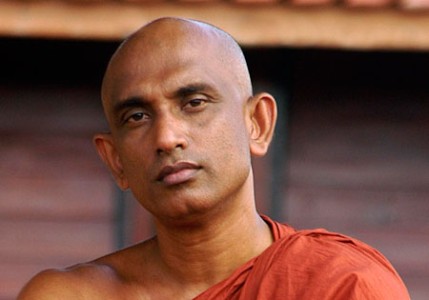
A senior Buddhist monk, Athuraliye Rathana today launched a hunger
strike in Kandy calling for the removal of a Muslim minister and two
Muslim governors from their posts.
Rathana has accused Minister Rishad Bathiudeen and the Eastern and
Western Province governors, M L A M Hizbullah and Azath Salley of being
associated with the Islamist extremism.
The incident follows the Easter Sunday suicide bombings by Islamist
extremists supportive of Islamic State, which left over 250 people
dead.
Rathana is conducting his hunger strike outside the Temple of the Sacred Tooth Relic.
In the aftermath of the bombings, several Muslim homes, businesses and
mosques were destroyed by Buddhist mobs, with images showing that monks
and Sri Lankan military personnel were also involved in racist rioting.

Pardoning Gnanasara: Impunity & Political Culture At It Worst!

Lakmal Harischandra
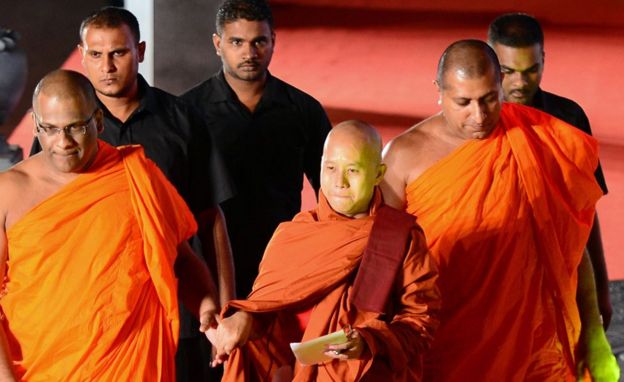
 When Ven Galagoda Atte Gnanasara (GST)walked
out of prison, probably no-one was surprised as it was the end-result
of much political behind-the- curtain activities, but well known in the
public domain, which led to the
granting of Presidential pardon by the head crackpot Sirisena (MS).
After the end of the war in 2009, this fiery monk has been used as a
political pawn and tool by the Rajapaksas to stay in power exploiting
the racist sentiments among the Sinhala Buddhist people and now it
appears that MS too, seeing sure signs of doom at the next election is
also attempting to use GST for his camp’s political survival. However,
the Minister of Buddha Sasana, Gamini Jayawickrama too earlier endorsed
requests by religious and political third parties to issue the pardon,
and numerous members of the government also have spoken out and acted in
support of it for political expediency. Thus, Ranil camp cannot escape
responsibility by blaming this decision upon MS alone.
When Ven Galagoda Atte Gnanasara (GST)walked
out of prison, probably no-one was surprised as it was the end-result
of much political behind-the- curtain activities, but well known in the
public domain, which led to the
granting of Presidential pardon by the head crackpot Sirisena (MS).
After the end of the war in 2009, this fiery monk has been used as a
political pawn and tool by the Rajapaksas to stay in power exploiting
the racist sentiments among the Sinhala Buddhist people and now it
appears that MS too, seeing sure signs of doom at the next election is
also attempting to use GST for his camp’s political survival. However,
the Minister of Buddha Sasana, Gamini Jayawickrama too earlier endorsed
requests by religious and political third parties to issue the pardon,
and numerous members of the government also have spoken out and acted in
support of it for political expediency. Thus, Ranil camp cannot escape
responsibility by blaming this decision upon MS alone.
It was thus a sad day for Sri Lanka where the height of impunity went to
another appalling low level, signifying a chronic impunity crisis
affecting the process of justice in this Dharma Dweepa. When GST was let
off the hook and allowed to go free, the last remnants of the rule of
law also went vanished. Analysts point out that the pardon specifically
signals that some are more equal than others, when some categories of
citizens, such as the Buddhist clergy, can expect to enjoy preferential
treatment when it comes to obeying the law. It also sets a dangerous
precedent whereby properly tried, convicted and sentenced persons can be
released on the whims of the President and government. The timing of
his presidential pardon in the aftermath of the Easter Sunday massacre
is significant as well, where GST’s dubious record as an incessant
Islamophobe will play a pivotal role in further exacerbating the hate
campaign against the Island’s Muslim population. It is indeed the second
rising of the Sri Lankan version of Wirathu
of Myanamar. He is already coming out with his version of ‘I told you
so’ which appears to echo well with the anti-Muslim hate lobbies barking
loud through the social media.
The rogue character of GST came into prominence with the
well-orchestrated hate campaign against the Muslims during the second
term of MR’s tenure of office. After his (largely mysterious) visit to
Norway, his dreaded BBS shot into prominence creating havoc in the civic
life in this country, along with their sister hate outfits – Sihala
Ravaya and Ravana Balaya – all of whom enjoyed State patronage in their
halcyon days. What
happened in Sri Lanka, when he went all over the country setting fire
to the inner sentiments of the people in the name of Sinhala Buddhism
and patriotism were well known. What happened in Aluthgama where GST’s
fiery racist speech led to much carnage and damage was also well known.
Now, no-one should tell us that this Aluthgama anti-Muslim attack took place because
few Muslim youth assaulted a Budddhist monk; for four years after, they
were released without charges as there were no supporting evidence.
This shows that attacks of this nature are pre planned. Fast forwarding
to Yahapalana times, he appeared to tone down his antics, but his visit
to the funeral house of the victim in Digana after the road rage
incident appeared to provide more impetus to Amitha and his gang to
exploit the feelings of the people to engage in the anti- Muslim
communal violence.
Be it as it may, the incident in question which led to GST’s jail
sentence was not related to his anti-Muslim rampage. This hardline rogue
monk was found guilty of having threatened the woman activist Sandya
Ekneligoda, who was seeking justice for her husband who mysteriously
disappeared during MR time. In 2016, GST interrupted a court hearing
over the abduction of this journalist, Prageeth Ekneligoda, in which
military intelligence officials were accused. He shouted at the judge
and lawyers because the military officials had not been allowed bail,
and threatened Ekneligoda’s wife in filthy language. GST also faced a
separate contempt of court case over the same incident. When, he was put
behind bars, there were wide discourses all over the country initiated
by the top hierarchy in the various chapters about the permissibility of
disrobing this monk in jail and getting him to don a jumper. This
concern was interestingly not shown when many other rogue Bikkhus were
arrested and jailed for numerous offences. Amnesty International also
then said
that the verdict was a victory for human rights defenders in Sri Lanka.
“This is an important verdict for all people who fight for human rights
in Sri Lanka. A clear message has gone out to those who seek to
intimidate, threaten and silence people seeking justice”. However, he
was granted bail. Then in late 2018, we commenced his sentence of 19
years of rigorous imprisonment to be completed within 6 years.. It was
not even few months behind bars when this fresh concerns were shown to
gain his release by way of a Presidential pardon through a concerted
social media cum political lobbying campaign led by rogue sections of
the Maha Sangha. His receiving pardon stands in contrast with another
Sinhala writer who serving a jail sentence for apparently writing a
fiction which some monks thought was insulting of Buddhism.
Granting Presidential pardon to GST has made a mockery of the powers
vested in the President under the country’s constitution. It is
pertinent to quote the statement of the Centre for Policy Alternatives
in this regard. ‘CPA stresses that presidential pardons exist to correct
miscarriages of justice and are to be exercised with extreme caution
and gravity. The pardon of Gnanasara Thero cannot be called a fit and
proper exercise of that power by any metric. The trial, conviction and
sentencing of the Thero raised no legitimate questions of any
miscarriage of justice and there was ample opportunity for the Thero to
fully exercise his right to a fair trial by appealing his conviction.
Indeed this option was pursued by him at both the Court of Appeal and
the Supreme Court which both duly dismissed the appeals. As such, the
pardon itself amounts to an undue interference with the legal process…
The pardon raises a number of very serious concerns. First, it
legitimises the view that it is possible to act with contempt for the
judiciary, be punished through a legitimate judicial process, and then
enjoy impunity through a pardon granted on political considerations. Second, the
pardon comes amidst the ongoing and extremely tense situation in the
country. The pardon, however indirectly, represents a worrying
endorsement of such anti-minority sentiment, and can only heighten the
anxiety and fear being felt by Muslim Sri Lankans today’. In this
context, as CPA statement calls for , the
government as a whole must justify, with stated reasons, why the grant
of a pardon in this case will not be inconsistent with the Constitution,
the rule of law, and the administration of justice in Sri Lanka and
will not exacerbate inter-communal tensions. Anything less will directly
undermine the legitimacy of Sri Lanka’s democracy.
Sri
Lanka’s poor human rights situation is clearly being exacerbated by the
weakness of state institutions and the judicial system. Sri Lanka is
facing a crisis of impunity. As ICJ Report in 2012 says, ‘It has become a
cliché to speak of a ‘culture of impunity’ but the phrase is entirely
apt in describing the situation in Sri Lanka, where impunity has over
the years become institutionalized and systematized: mechanisms to hold
state actors to account for their actions have been eroded; checks on
the arbitrary use of power have been diluted, if not dissolved’. We saw
impunity in the case of spate of communal violence of 1983, Aluthgama and Digana.
The 1978 Constitution essentially took away much powers of the
Parliament and gave the President excessive power, presumably to balance
representation with governability. The powers given to one individual
in the person of the Executive President has been abused time and again
by the various holders of this high office since JRJ. The country saw in
October 2018, how MS in a fit of lunacy abused his Presidential powers under the Constitution, not only taking Sri
Lanka and the world by surprise, but also put the nation on a serious
mode of reflection about the suitability of the Executive Presidential
system to Sri Lanka, imposed by JRJ in 1978 and the quality of our
Legislature. Prof. S. Sarath Mathilal de Silva- Attorney-at-Law in an
article in CDN on ‘Presidential immunity: Scope and application’ (May
2018) commented; ‘It appears that both presidential immunity and other
indemnity provisions within the law contribute significantly towards
the culture of impunity in Sri Lanka’. Now, MS has shown that his powers
to grant pardon too needs serious review. MS should be criminally
answerable for all the offences and abuses committed by him during the
course of his administration in fairness to the people of this country who are asked to abide by the rule of law.
The timing of granting pardon to GST is also significant when the
anti-Muslim sentiments are at an all-time high reaching its’ peak. This
is the 09/11 experience for Sri Lankan Muslims witnessing their religion
being demonised and being alienated in society. There is deep suspicion
that GST will aggravate this dangerous trend and help earn valuable
Sinhala Buddhist votes for the MS/MR camp, playing the Sinhala
Supremacist card. Already, Muslims have been projected as the bogeyman
by rogue sections of the Sinhala media both print and TV- Hiru, Ada
Derana and Divaina. Recent media sensationalism as seen in the editing
of speeches by Muslim spokesmen and also so-called Sterilization story
are causing much concern among the Muslims driven to a corner and put on
a victim hood mode. All what is left is for a foul-mouthed GST
to lit the pyre- a disaster which a far thinking personality like the
Catholic Cardinal has been doing his utmost to avert. This does not mean
that Muslim extremism should be pussy footed. It should be confronted .
However, to be successful, it
is imperative that the Muslim community is fully on-board with the rest
of us without making this fight against extremism – a war against the
entire community as a whole. It is a fact that the mainstream Muslims are also victims of this growing extremism and radicalism by a fringe group among them.
Read More
Sexism, slander, hatred: Sri Lanka’s culture of online abuse
From politicians to members of the LGBTQI community, social media in Sri Lanka is a hotbed of harassment and hostility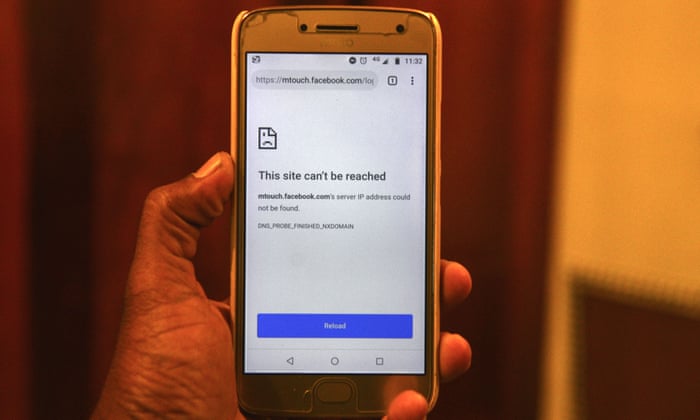
A mobile browser unable to connect to Facebook after Sri Lanka’s government shut down the platform in response to unrest following the Easter Sunday attacks. Photograph: Lakruwan Wanniarachchi/AFP/Getty Images
 Raisa Wickrematunge -
The threats began after Jegatheeswaram Jeyachandrika decided to contest local government elections.
Clutching a file of printouts, Meena, as she is known, points to a Facebook post in which she is pictured, circled in red, among a group of people.
“We opened some new shops that day, part of a collective project,” she says. “This post implies that I’m the mistress of one of the ministers in the photo.”
That was one of the milder offerings. Meena has been called a sex worker, among other things, and hateful comments have been made towards her immediate family. Several volunteers helping with her campaign dropped out following the repeated threats.
Stones have been thrown at Meena’s house, and flyers containing defamatory claims against her have been distributed. She went to the police, but received no response to her complaints. As with the Facebook posts, there have been no consequences for the perpetrators.
“Unless people take action, how are women to move forward?” she asks, adding that such incidents only push women out of politics. Despite the recent implementation of a 25% quota for female representation in local government in Sri Lanka, significant barriers to equal political participation remain.
But Meena’s story also highlights the pervasive nature of online violence in Sri Lanka – and the inability of state mechanisms to respond effectively to it.
Researchers have found that, in Sri Lanka, a culture of casual sexism, misogyny and objectification prevails on Facebook, which is by far the country’s most widely used social media platform, with more than 6 million users as of 2018. Leaked intimate photos and videos of young girls are also shared on the platform.
“Boys befriend girls and coerce them into sending them their nude photos. Once the relationship goes bad, they leak them online … 17-year-old girls have taken their own lives over cases like this,” says Ananthi*, an activist.
In Sri Lanka, where same-sex relationships have not yet been decriminalised, members of the LGBTIQ community also face threats including surveillance, extortion, discrimination and online sexual abuse and exploitation.
Sometimes this surveillance occurs at family and community level, but rights organisations such as Equal Ground have also reported intimidation, violence and discrimination against individuals and groups on the basis of sexual orientation, both offline and on social media.
Facebook has also been used to amplify hate and misinformation. Following the devastating suicide bomb attacks on churches and hotels on Easter Sunday, the government responded by twice blocking Facebook and Facebook-owned platforms Instagram and WhatsApp. It first adopted this approach in March 2018, in the aftermath of riots targeting the Muslim community, claiming that this helped to curb hate and misinformation. However, research shows that people have found ways to continue posting online.
In April 2018, 13 Sri Lankan civil society organisations wrote an open letter to Mark Zuckerberg, the Facebook CEO, expressing “deep frustration” over the platform’s “little to no support” for attempts to report content on gender-based violence, violence against the LGBTIQ community and hate speech, particularly in local languages like Sinhalese and Tamil. Facebookresponded, promising to increase content reviewers and work with government and civil society to curb hate speech and better understand the local context, including training their staff to identify inflammatory content in local languages, especially Sinhalese.
Yet the problem persists.
Sri Lanka’s own penal code has several sections that can be used to address different aspects of technology-based violence, and it is a signatory to a number of international conventions, including the International Covenant on Civil and Political Rights.
“Various government bodies together with civil society partners are in the midst of conducting research on prevalence and varied manifestations of cyber harassment and violence,” says Hans Billimoria, director of the Grassrooted Trust. “That said, civil society partners on the ground and those at the forefront of the struggle against gender-based and intimate partner violence still lack the information they need to fully support victims and their families.”
Those who do report online violence often get no response – that is, if they know where to go in the first place. The main body tasked with dealing with such issues, the cyber crimes division of the criminal investigation department, is based in Colombo, and those living outside the capital have to travel there to make a report. Those reporting instances of leaked intimate images said the insensitivity of officers handling their cases often caused fresh trauma.
Meena says her experiences left her needing counselling. “I expected nearly 1,000 votes [in the election]. Because of the slander and harassment in real life, that number fell by more than half. Now, I’m left with my 333 votes, and a file full of printouts of the harassment that I have received online.”
• Name has been changed
Raisa Wickrematunge is editor of the civic media initiative Groundviews in Colombo, Sri Lanka

Fri, May 31, 2019, 11:51 pm SL Time, ColomboPage News Desk, Sri Lanka.

 May
31, Colombo: Sandya Eknaligoda, wife of missing journalist Prageeth
Eknaligoda has filed a petition in the Supreme Court requesting the
court to re-enforce a six month sentence issued by the Homagama
Magistrate's Court against the controversial monk venerable
Galagodaaththe Gnanasara thera.
May
31, Colombo: Sandya Eknaligoda, wife of missing journalist Prageeth
Eknaligoda has filed a petition in the Supreme Court requesting the
court to re-enforce a six month sentence issued by the Homagama
Magistrate's Court against the controversial monk venerable
Galagodaaththe Gnanasara thera.The Apex Court has decided to take up Ms. Ekenligoda's petition for consideration on the 22nd of June.
Ekneligoda in her petition, appeals the court to convert the suspended sentence against the Bodu Bala Sena Secretary Ven. Galagodaaththe Gnanasara Thera to a mandatory sentence.
The petition was taken up today for consideration before a three member bench comprising Judges Sarath de Abrew, Gamini Amarasena and Murdu Fernando.
The Homagama Magistrate sentenced Gnanasara thera to a six month imprisonment on the 18th of June 2018 for intimidating and threatening Sandya Eknaligoda at the Homagama Magistrate�s complex.
The Magistrate sentenced the hardline Thero to two six-month terms of imprisonment to be served concurrently.
Gnanasara thera filed a petition challenging the verdict of the Homagama Magistrate before the Homagama High Court. The Homagama High Court subsequently issued an order to suspend the sentence issued by the Homagama Magistrate's Court.
Ekneligoda pointed out that the decision to suspend the Gnanasara Thera from serving the sentence by the Homagama High Court is contrary to the law.
The petitioner requests the Supreme Court to quash the Homagama High Court's order and issue an order for the Thera to serve a mandatory sentence.
Acquittal of Ven. Gnanasara Thera and 12 others from another case confirmed

 Lakmal Sooriyagoda-Friday, May 31, 2019
The Colombo High Court was yesterday informed that an appeal petition filed by the Attorney General (AG) challenging the Colombo High Court’s decision to acquit Bodu Bala Sena (BBS) General Secretary Ven. Galagoda Atte Gnanasara Thera and 12 others from 11 charges including for attacking a church in Thalahena had been withdrawn by the Attorney General.
On April 2, 2014, the Colombo High Court had acquitted all the accused from 11 charges following a trial. Accordingly, the judgement to acquit all accused including Ven.Gnanasara Thera will be effective since there is no any legal impediment.
Filing an appeal in the Court of Appeal, the Attorney General had moved to set aside the judgment of the Colombo High Court and convict and sentence the accused according to law.
However, on November 11, 2018, the Attorney General decided to withdraw the appeal petition citing a legal issue.
The thirteen accused S.A. Athula Seneviratne, W.M. Sudu Banda, H. Thamara Beatrice, A.K. Denzil Premakumara, D.S.P.Kandana Arachchi, T.K. Somadasa, E.M.V. Ratnayake, K.W. Karunananda, E.M.H. Rathnayake, Ven. Aththaragama Gnanawimala Thera, Ven. Galagoda Atte Gnanasara Thera, Ven. Agulgalle Siri Jinananda Thera and Dhanushka Sanjeewa had been indicted in the Colombo High Court by Attorney General for committing the offences of being members of an unlawful assembly to attack the Calvary church in Thalahena in 2008.
They were further accused for causing mischief to the said church, robbery of two gold chains worth Rs.15,000 and 50,000 belonging to person called Rohan Anderson and causing injuries to John Anton Anderson.
Demonization And Criminalization Of Religions

Experiencing the bright and dark, both faces of life, are we filled with love, kindness, compassion, and non-judgment toward others and also ourselves.
 by Zulkifli Nazim-2019-05-31
'If a person foolishly does me wrong, I will return to him the
protection of my boundless love. The more evil that comes from him the
more good will go from me. I will always give off only the fragrance of
goodness.' (Lord Buddha).
Like the air pervading the whole planet, nationalism is both omnipresent
and impalpable. It interpenetrates the psyche and the minds of every
individual. This behavior can be seen as both conservative and as a
revolutionary force, threating the status quo.
Over the past years, rising nationalism is seen everywhere and in
everything. From the time of election of Mr. Mahinda Rajapaksa to the
establishment of Mr. Maithripala Sirisena as presidents of this country.
The end of nationalism has been predicted multiple times by historians
and scholars. However, neither is there an inevitable tide of
nationalism that is engulfing the world, nor is nationalism universally
in decline. Despite shared dynamics and integration, Sri Lanka remains
too diverse to be caught up in a single torrent of nationalism, because
of the tolerance of Buddhism and true Buddhists in this country.
Buddhism is humanistic, in that it rejoices in the possibility of a true
freedom as something inherent in human nature. For Buddhism, the
ultimate freedom is to achieve full release from the root causes of all
suffering: greed, hatred and delusion, which clearly are also the root
causes of all social evils.
It is the belief of great minds among the Buddhists is, that they
believe that world peace can only be achieved if we first establish
peace within our minds. Buddhists believe people can live in peace and
harmony only if, we as Buddhists abandon negative emotions such as anger
in our minds and cultivate positive emotions such as love and
compassion.
The Buddha does not link violence with mimeticism – hysterical neurosis -
He does warn against thinking of human relationships in terms of
rivalries to be won or injuries to be avenged, and he urges his
followers not to imitate the example of those who wrong them.
But what the President and his people, who seem to be proclaiming that
they are the defenders of Buddhism, seem to be doing everything to the
contrary; in that they are conspicuously, offensively and blatantly
involved in anything and everything that is evil and quite perverse and
quite adverse to Buddhist teachings – They are no better than those who
promulgate extremism and terrorism under the guise of the religion of
Islam.
It is no wonder we can see an unholy alliance between the two evils.
Both parties seem to be recklessly determined on demonization and
criminalization of both religions.
This attitude clearly shows a defiant disregard for danger or
consequences to the people of this country where their main aim is to
grab power by hook or by crook. Malicious behaviour without any attempt
at concealment by the leaders and their supporters - openly and
blatantly violating every law and every form of human decency
Let us take a look at the current scenario:
We have here two parties - The Sri Lanka Podujana Peramuna (SLPP -
Pohottuwa) and The Sri Lanka Freedom Party (SLFP) One is the evil party,
and the other is the stupid party, respectively. And the president
seems to be very proud to be a member of the stupid party. Frequently,
the two parties get together to do something that's both evil and
stupid. And that is called bipartisanship.
Political corruption is an essential characteristic of organized crime.
The two go hand in hand, organized crime tries to buy political
influence and to provide space for or eliminate blockages to their
illegal practices. This relates to bribery of police, judges,
politicians and whatnots and infiltration of these offices of government
by organized crime, commonly referred to as state capture.
State Capture is defined as the efforts of a small number of firms or
such groups as the military, ethnic groups and kleptocratic politicians,
to shape the rules of the game to their advantage through illicit,
non-transparent provision of private gains to public officials.
Attempts to remove and actually removing honest professionals to appoint
dishonourable and incompetent people at the highest echelons of our
political and justice systems have severely undermined the rule of law
in Sri Lanka.
The World Justice Project defines “rule of law” as ‘the process by which
the laws, in a democracy, are enacted, administered, and enforced is
accessible, fair, and efficient’. This means that the level of a
country’s democracy is determined by its adherence to the basic
principles in which all people – regardless of their economic, political
or ethnic status – are subject to equal legal rules.
This principle is critically important for the success of any country.
It provides a clear national system that is to be applied fairly to
every group and person. Without this, the system will increasingly lose
credibility and public trust.
Criminality and instability will increase, putting everyone at risk. Our
justice system is the cornerstone for ensuring the rule of law
functions in an effective and healthy way.
Over the past few years, the conduct of various top prominent officials
in our country, has severely and gravely undermined this constitutional
principle and the very foundation of our democracy. Following careful
consideration of the hard evidence placed before various courts, a
number of judges and luminaries in the judiciary have independently
questioned the integrity and conduct and behaviour of some of our most
senior so-called “responsible” officials.
Our people actually rely on the individuals who occupy these eminent and
distinguished positions, to exercise their considerable powers in
tackling organised crime and corruption. However, quite the contrary, it
has emerged through various court cases and legal processes they seemed
to use their powers to protect various individuals facing serious
criminal allegations.
Our investigation and analysis seem to point to a hidden network of
profoundly dishonest individuals within the government and the justice
system, who have either been appointed by top-level politicians, or are
acting with the primary purpose of protecting certain powerful people
from criminal sanction, rather than in the public interest.
Today we see and are experiencing corruption and organised crime, drugs,
fraud, money-laundering and racketeering, by all accounts, have
increased substantially since the incumbent president came to power.
A malfunctioning law enforcement provides a suitable breeding ground for
organized crime. Where criminals of brands and types are firmly rooted;
police and the justice system become weakened by bribery and
intimidation.
We should perceive the prevalence of organized crime and political
corruption as an important indicator of the presence or absence of the
rule - Where no rule of law exists, poverty eradication is purposeless,
superfluous and meaningless.
"Without a functioning justice system, both the government and civil
society are defenseless against rampant crime and corruption and
development is likely to stagnate - strengthening the rule of law,
however, makes no sense if political will is lacking.
Great spiritual leaders and philosophers have said that wisdom takes us
above the basic instincts. It doesn’t let us be reduced to mere puppets
in the hands powerful manipulators for our instant gratification. Wisdom
gives our mind the power to differentiate between justified and
unjustified and act accordingly.
Experiencing the bright and dark, both faces of life, are we filled with
love, kindness, compassion, and non-judgment toward others and also
ourselves.
Winding up with these words of wisdom from a person no less than Chief Seattle:
"You must teach your children that the ground beneath their feet is the
ashes of our grandfathers. So that they will respect the land, tell your
children that the earth is rich with the lives of our kin. Teach your
children what we have taught our children -- that the earth is our
mother. Whatever befalls the earth, befalls the sons of the earth. If
men spit upon the ground, they spit upon themselves. This we know.
The earth does not belong to man; man belongs to the earth. This we
know. All things are connected like the blood which unites one family.
All things are connected.
Whatever befalls the earth befalls the sons of the earth. Man did not
weave the web of life; he is merely a strand in it. Whatever he does to
the web, he does to himself ..."
[Chief Seattle - c.1786 – June 7, 1866 was a Suquamish and Duwamish chief – Blake Island, Washington.]
MPLRAG Cautions Govt Against Implementing MMDA Reforms Motivated By Majoritarian Entitlement

The Muslim Personal Law Reform Action Group (MPLRAG) expresses concern over growing interest in reforms in the Muslim Marriage and Divorce Act,
motivated by majoritarian entitlement amd crass opportunism aimed at
capitalizing at a point when the Muslim Community is feeling vulnerable.
In a statement, the MPLRAG emphazises on the importance of ensuring that
any reform to MMDA is focused on addressing the long-term grievances
clearly articulated by Muslim women for over three decades.
“It should seriously consider what Muslim women have put forward as
solutions based on their lived realities and their beliefs informed by
faith, rights, and the constitution,” the statement notes.
The MPLRAG further cautions that any approach that does not take this
into consideration will lead to further victimization and oppression.
“We do not consider All Ceylon Jamiyyathul Ulama (ACJU) as representing
the interests of the Muslim women and girls. Their past conduct
demonstrates that they have contributed to the control and oppression in
self-interest.”
We publish below the statement in full:
MPLRAG response to the public conversation on MMDA: The antidote to extremism is ensuring equality, rights and freedoms for all
After the tragic and dastardly Easter Sunday attacks of April 21, Muslim Personal Law Reform Action Group (MPLRAG) issued a statement of condolence and
thereafter remained silent in our advocacy for the past month in memory
of those who were killed. We wanted to respect and participate in the
space for grieving by families and communities. The events of the past
month have overwhelmed our nation and we call for more attention to be
paid to all the families affected and to take much needed space and time
for reflection and healing.
Sadly, but predictably, we also saw forces of hatred and misogyny
intensify and permeate the discussions in public and private places,
print, air-waves and internet as well as in Parliament and policy
spaces. We could hear the voices of sanity drowned out by those steeped
in prejudice and sanctioned ignorance. We saw Muslims being forced into
performative atonement and self-policing. We also saw prejudice and hate
dictate regulations and attempting to dictate law. As expected, Muslim
women are bearing the brunt of it. To the oppression from within the
community, an oppression from the state was introduced. The lived
realities of Sri Lanka’s Muslim women just got worse.
Many eyes on MMDA
It is in this context that we have observed, with a great deal of
anxiety, an increased attention among many to the Muslim Marriage and
Divorce Act (MMDA) and particular attention to the lack of a minimum age
of marriage for Muslims of Sri Lanka. The principled calls for reform
of MMDA particularly by Muslim women spans over 30 years and has been
more visible in the public domain at least for the last three years. We
note with trepidation, that the current heightened interest towards
reforms to the MMDA is motivated by prejudice, majoritarian entitlement
and crass opportunism to capitalise at a time when the community is
feeling vulnerable.
We
therefore demand that any reform to MMDA should focus on addressing the
long-term grievances clearly articulated by Muslim women for over three
decades. It should seriously consider what Muslim women have put
forward as solutions based on their lived realities and their beliefs
informed by faith, rights, and the constitution.
We caution that any approach that does not take this into consideration
will lead to further victimization and oppression. We do not consider
All Ceylon Jamiyyathul Ulama (ACJU) as representing the interests of the
Muslim women and girls. Their past conduct demonstrates that they have
contributed to the control and oppression in self-interest.
The best interest of the Muslim women and girls
MMDA reform has been pushed into the government’s agenda in a policy
environment that is emotionally charged for Muslim communities and
driven by prejudice of certain non-Muslim quarters. Therefore MPLRAG,
which consists of lawyers, scholars, and activists, considers it
imperative to raise its voice. The reform exercise must remain true to
its principal constituency – Muslim women and girls. At this juncture,
we will work to ensure that the reform conversation is not hijacked by
those forces who are not interested in the wellbeing of the community
nor leave it to be held in continuous hostage by anti-reform forces
within the community.
Read More
Need a common guiding principle for all religious education

The faithful of each religion would argue that their particular religion preaches a message of love and peace. While passages from Quran are often quoted to depict Islam as an intolerant or even a violent religion, some argue that the Bible has as many messages of intolerance as the Quran. The Buddhist scriptures have no room for hate or denigration of women, but Buddhism as practiced in Sri Lanka is ripe with discrimination by caste, race and gender – Pic by Shehan Gunasekara
 Friday, 31 May 2019
 After the evil Easter attack of 2019 by terrorists claiming to be Islamists, spotlight is on Islamic religious education in ‘madrasas’ and Islam-based higher education.
The decision to bring the proposed Batticaloa University College, feared to be a Sharia College, under the purview of the Ministry of Higher Education and the University Grants Commission is correct, but it begs the question why this was not done in the first place. The disarray in post-secondary education in Sri Lanka is a topic for another column.
As for religious education in other settings, conflicting measures are proposed. The Ministry of Muslim Religious and Cultural Affairs has submitted a draft Act to regulate madrasas. The Prime Minister recently spoke of bringing the madrasas under the Ministry of Education and have their curricula developed by the National Institute of Education (NIE). But what exactly is meant by a madrasa in the Sri Lankan context is not articulated.
Muslim Religious and Cultural Affairs Director M.R.M. Malik has said that there are 1,669 Islam ‘madrasa’ schools and 317 Arabic schools registered under the Department of Muslim Religious and Cultural Affairs all over the country. How many of these are informal ‘Sunday schools’ and how many are full-time schools for the training for priesthood. What is the extent of oversight on them?
 We
have four main religions in this country – Buddhism, Hinduism, Islam
and Christianity – not counting various denominations in each. Religion
is taught in three different settings – (a) as a subject in school (b)
outside of school in ‘Sunday schools’ and (c) training for priesthood.
We
have four main religions in this country – Buddhism, Hinduism, Islam
and Christianity – not counting various denominations in each. Religion
is taught in three different settings – (a) as a subject in school (b)
outside of school in ‘Sunday schools’ and (c) training for priesthood.Any new legislation should take into account the full scope of religious education in this country and be guided by the fundamental rights and limitations to such fundamental rights that are already specified in the Constitution, and should not target any one religion unfairly.
Elements of intolerance in every religion
The faithful of each religion would argue that their particular religion preaches a message of love and peace. While passages from Quran are often quoted to depict Islam as an intolerant or even a violent religion, some argue that the Bible has as many messages of intolerance as the Quran. The Buddhist scriptures have no room for hate or denigration of women, but Buddhism as practiced in Sri Lanka is ripe with discrimination by caste, race and gender.
All in all, it is safe to assume that religious education has the potential to regress towards intolerance and we need to draft legislation of guidelines accordingly. The challenge is to curtail the spread of intolerance through religious education without taking away the fundamental rights of people to practice or learn their religion.
The Constitution
as a guide
towards tolerance
The right to practice one’s religion or manifest ones beliefs is guaranteed in Sri Lanka by Article 14(e) as, “Every citizen is entitled to the freedom, either by himself or in association with others, and either in public or in private, to manifest his religion or belief in worship, observance, practice and teaching.”
This right is however tempered by Article 15(7) which states: “The exercise and operation of all the fundamental rights declared and recognised by Articles 12, 13(1), 13(2) and 14 shall be subject to such restrictions as may be prescribed by law in the interests of national security, public order and the protection of public health or morality, or for the purpose of securing due recognition and respect for the rights and freedoms of others, or of meeting the just requirements of the general welfare of a democratic society”.
 Taken together, these two clauses give a guiding principle for religious education in Sri Lanka, I believe.
A recent publication by Philosophy of Education Society of Great Britain further expands and articulates these principles by bringing together the interests of parents and society as well as the interests of the children, as follows:
“Parents’ freedom to educate their children as they prefer should be constrained by (i) children’s interest in receiving their fair share of educational goods, and (ii) the wider society’s interest in the cultivation of educational goods such as democratic competence, tolerance and mutual respect (Philosophy of Education Society of Great Britain, 2018).”
This articulation is also consistent with the national objectives of education identified by the National Education Commission of Sri Lanka in 1992 where the first three out of the eight national objectives embody principles of democratic competence, tolerance and mutual respect.
Religion as a subject in schools
Religion is a compulsory subject at school from Years 1-12 and is one of the core subjects compulsory for all children sitting for the GCE (O/L). The curricula for all four religions are developed by NIE and delivered by trained teachers. Most children also spend time in religious education classes outside of the school at least one-half a day a week, typically on Sundays, hence called ‘Sunday Schools’ as a catchall phrase.
The question whether ethics and citizen education should replace religion as a subject keeps appearing in the education policy landscape, but it is unlikely that any regime would want to touch the subject, at least in the near future, for fear of resistance from interest groups, the Buddhist clergy in particular.
Religion in ‘Sunday Schools’
 The
Vajirarama Temple of Colombo gives a useful distinction between
religion taught in school and outside of school. They say that while
schools teach facts of religion, Sunday schools are more about the
practice of religion. However, by the school’s own admission, training
students for examinations conducted by the Ministry of Buddha Sasana
takes pride of place in the Daham Pasalas.
The
Vajirarama Temple of Colombo gives a useful distinction between
religion taught in school and outside of school. They say that while
schools teach facts of religion, Sunday schools are more about the
practice of religion. However, by the school’s own admission, training
students for examinations conducted by the Ministry of Buddha Sasana
takes pride of place in the Daham Pasalas.The concern today is the content of what is taught behind the doors in those schools, the Islamic schools in particular, but heavy-handed regulation of Sunday schools would be unwise and impractical.
Currently, the curricula for these schools are set by non-governmental religious bodies. In the case of Daham Pasals, the entity is the Young Men’s Buddhists Association (or YMBA) for historical reasons. In Christian schools, each church establishment is in charge. Similarly, a mainstream Islamic organisation should be in charge of the curricula for Islamic Sunday schools, with all religious organisations mandated to abide by guiding principles to be declared by the Ministry of Education. Taking Sunday schools under the charge of the Ministry of Education and the NIE would over burden these institutions.
Schools for training in religion
Sri Lanka has a tradition of schools for the instruction of the Bhikkus since the arrival of Buddhism in Sri Lanka in the 3rd Century BC. The Pirivena Education Act of 1979 formalised this system of preparation for Bhikkus. There are seminaries managed by various denominations of Christianity, but not much is known about preparation of Moulavis or Islamic priests.
Before a new Act to formalise Madrasas is enacted, it would be wise to survey the landscape of religious education in Sri Lanka, and as a first step, bring them all under a common guiding principle that their teachings abide by democratic values embodied in our Constitution.
Open data system of registered religious institution
This day and age where technology allows the availability of large amounts of information over the internet, the transparency afforded by such openness should be exploited to the maximum. The Muslim Affairs Ministry gives a list of various registration processes including the processes for registration of Mosques, Arabic Colleges, Ahadiyya (Dhaham) Schools, Hiflul Quran Madrasa, Islamic Associations Islamic Pre Schools and Islamic Priests (Moulavi).
If the listed institutions and individuals can be made publicly available, concerned public can be more vigilant on unauthorised institutions or individuals, or those that departure from guiding principles of religious education.
Going down the Bharatiya Road

In India the tendency of criminals getting elected increases
They all have their kith here too
 31 May 2019
Indian elections for Lok Sabha that concluded last week, shattered all
‘independent and expert’ predictions leaving pro-BJP forecasts perfectly
right. 
The BJP with Modi romped home with an historical win, backed by all Hindu segments of Indian society rallying around it.
That left out Tamil Nadu, Kerala and Andhra. All three in the Dravidian South of India.
Numbers show, under Modi’s style of political Governance, there is a very conspicuous bundling together of ‘Hindu’ votes at every level of society.
The BJP with Modi romped home with an historical win, backed by all Hindu segments of Indian society rallying around it.
That left out Tamil Nadu, Kerala and Andhra. All three in the Dravidian South of India.
Numbers show, under Modi’s style of political Governance, there is a very conspicuous bundling together of ‘Hindu’ votes at every level of society.
Compared with the 2014 Lok Sabha elections that again was a stunner, the
Modi-led DNA has this time improved further on the percentage of
Scheduled Caste (SC) votes from 17.7 per cent to 34.3 per cent.
Scheduled Tribes (ST) from 38.2 per cent to 42.2 per cent. From the poorest 20 per cent at the bottom from 31.9 to 39.2 per cent.
The richest 20 per cent at the top, from 27.8 to 33.1 per cent.
Considered the rich, urban middle class, the second 20 per cent at the top from 27.7 to 33.0 per cent.
Modi increased his number of constituencies from 190 to 207 in rural India as well.
These have all been increases from Hindu votes in all those social segments.
Modi’s parental organisation the RSS and its extreme Hindu affiliates were used against marginalised communities including Christians and exclusively against Muslims to establish an aggressively dominant Hindutva Order in social life.
Scheduled Tribes (ST) from 38.2 per cent to 42.2 per cent. From the poorest 20 per cent at the bottom from 31.9 to 39.2 per cent.
The richest 20 per cent at the top, from 27.8 to 33.1 per cent.
Considered the rich, urban middle class, the second 20 per cent at the top from 27.7 to 33.0 per cent.
Modi increased his number of constituencies from 190 to 207 in rural India as well.
These have all been increases from Hindu votes in all those social segments.
Modi’s parental organisation the RSS and its extreme Hindu affiliates were used against marginalised communities including Christians and exclusively against Muslims to establish an aggressively dominant Hindutva Order in social life.
Their anti-Muslim campaign was used as the binding factor in bundling
the whole Hindu population of one billion into a single voting bloc.
That includes 43 per cent of Hindus termed ‘Backward Class’ in India.
Presenting her Commission’s Annual Report this March, UNHR High Commissioner Ms Michele Bachelet said they have received reports of increasing violence against minorities, in particular against Muslims in India.
The previous day, the Indian Chapter of the Amnesty International released their report that said, the number of hate crimes including assault, rape and murder against marginalised groups in 2018 were ‘disturbing’.
On February six this year, Modi’s Government was compelled to present details of religious violence to the Lok Sabha, which they termed ‘sectarian’ violence. Numbers revealed growing violence with the year 2016 recording 703 cases of violence accounting for 86 deaths and over 2,300 reported injured and in 2017 the numbers increasing to 822 cases of violence accounting for 111 deaths and over 2,380 reported injured.
Presenting her Commission’s Annual Report this March, UNHR High Commissioner Ms Michele Bachelet said they have received reports of increasing violence against minorities, in particular against Muslims in India.
The previous day, the Indian Chapter of the Amnesty International released their report that said, the number of hate crimes including assault, rape and murder against marginalised groups in 2018 were ‘disturbing’.
On February six this year, Modi’s Government was compelled to present details of religious violence to the Lok Sabha, which they termed ‘sectarian’ violence. Numbers revealed growing violence with the year 2016 recording 703 cases of violence accounting for 86 deaths and over 2,300 reported injured and in 2017 the numbers increasing to 822 cases of violence accounting for 111 deaths and over 2,380 reported injured.
Violence was most witnessed in States where the BJP was in control.
Uttar Pradesh in particular, where the overwhelming majority is Hindu
and the BJP is heading the State Government, 195 cases of religious
violence were recorded with 44 deaths and over 450 injured in the year
2017.
Vinay Katiyar, a BJP Lok Sabha MP told media in New Delhi on February seven this year, Muslims had no business being in India and should go to Pakistan or Bangladesh.
Modi openly tagging his BJP with such ‘Hindutva’ extremists for this 2019 Lok Sabha elections was done with purpose. BJP fielded Pragya Singh Thakur a suspect facing criminal charges for her involvement in a series of bombings in 2008that left 06 people dead. She won the Bhopal constituency very comfortably.
The tendency of ‘criminals’ coming in as candidates and getting elected had been in the increase at every election since India was opened to the global market economy.
After the 2014 Lok Sabha elections, 34 per cent elected had criminal charges filed against them from extortion, rape, murder, attempted murder to kidnapping. This 2019 Lok Sabha elections have 233 (43 per cent) with criminal charges elected as MPs, an increase of 09 per cent from the previous Lok Sabha according to a study by National Election Watch (NEW) and Association for Democratic Reforms (ADR).
Vinay Katiyar, a BJP Lok Sabha MP told media in New Delhi on February seven this year, Muslims had no business being in India and should go to Pakistan or Bangladesh.
Modi openly tagging his BJP with such ‘Hindutva’ extremists for this 2019 Lok Sabha elections was done with purpose. BJP fielded Pragya Singh Thakur a suspect facing criminal charges for her involvement in a series of bombings in 2008that left 06 people dead. She won the Bhopal constituency very comfortably.
The tendency of ‘criminals’ coming in as candidates and getting elected had been in the increase at every election since India was opened to the global market economy.
After the 2014 Lok Sabha elections, 34 per cent elected had criminal charges filed against them from extortion, rape, murder, attempted murder to kidnapping. This 2019 Lok Sabha elections have 233 (43 per cent) with criminal charges elected as MPs, an increase of 09 per cent from the previous Lok Sabha according to a study by National Election Watch (NEW) and Association for Democratic Reforms (ADR).
Of the 303 BJP MPs elected, 116 have criminal charges filed against
them. All these numbers are indications of how much muscle power would
have been used during election campaigning to boost Hindutva arrogance
against Muslims and other minorities in their constituencies.
This criminalisation of Indian politics in the largest democracy on earth goes hand in glove with the free market economy and Modi’s Hindutva extremism.
There is a political nexus between RSS and other extremist affiliates organising ‘vigilante groups’ in local areas and Hindutva Crorepatis getting into direct politics.
This political nexus and the ‘neo Hindutva’ dominance that has emerged as a result, is the product of a reformed RSS and Sangh Parivar as politically active affiliates of the Modi Government.
This criminalisation of Indian politics in the largest democracy on earth goes hand in glove with the free market economy and Modi’s Hindutva extremism.
There is a political nexus between RSS and other extremist affiliates organising ‘vigilante groups’ in local areas and Hindutva Crorepatis getting into direct politics.
This political nexus and the ‘neo Hindutva’ dominance that has emerged as a result, is the product of a reformed RSS and Sangh Parivar as politically active affiliates of the Modi Government.
Their dominance at the local level with patronage from the Central
government and from most State administrations has turned State
authorities including law enforcement agencies into pro-Hindutva agents
and a major reason for impunity. That is backed by the ‘neo Hindutva’
dominated media that was considered professionally independent and free,
some time in history.
Once a freelance journalist for the ‘Pulitzer Centre for Crisis Reporting’ and a political observer of the Indian Sub-continent, Aman Madan wrote to ‘The Diplomat’ on 23 January, 2019 ‘…..today, the BJP has doubled down and transformed previously independent media outlets into State mouthpieces for the sake of minimizing criticism and disseminating their own narrative.’ Elaborating how the Hindutva ideology is being fostered Aman Madan writes”
“While the systematic co-optation of the country’s media works in the BJP’s favour as the party prepares for elections in 2019, control over the country’s media is about something more sinister. Control over the nation’s press is an attempt to promote a Hindu nationalist or Hindutva agenda across all of India’s institutions. It is also an attempt to hegemonize its communal narrative in an officially secular country with a large Hindu majority.”
Once a freelance journalist for the ‘Pulitzer Centre for Crisis Reporting’ and a political observer of the Indian Sub-continent, Aman Madan wrote to ‘The Diplomat’ on 23 January, 2019 ‘…..today, the BJP has doubled down and transformed previously independent media outlets into State mouthpieces for the sake of minimizing criticism and disseminating their own narrative.’ Elaborating how the Hindutva ideology is being fostered Aman Madan writes”
“While the systematic co-optation of the country’s media works in the BJP’s favour as the party prepares for elections in 2019, control over the country’s media is about something more sinister. Control over the nation’s press is an attempt to promote a Hindu nationalist or Hindutva agenda across all of India’s institutions. It is also an attempt to hegemonize its communal narrative in an officially secular country with a large Hindu majority.”
This is more revealing as to how the Modi government intrudes into the social psyche with its own
fixed narrative.
“In order to achieve this, the government relies primarily on one network: Republic TV. Republic TV began in 2017 and was anchored by one of Indian media’s most famous media personalities, Arnab Goswami. Republic TV appealed to the worst of the Indian media’s characteristics. It was loud, brash, and theatrics mattered more than civil discourse,” wrote Aman Madan in The Diplomat.
He also says ‘it is not uncommon for the various regional language channels to display a level of acquiescence to the Government’s communal narrative.’
It is not just the RSS, the Shiv Sena, the Sangh Parivar and other Hindu Parishads, cannibalising grassroots politics for Hindutva dominance that resulted in this unprecedented 2019 Modi victory.
fixed narrative.
“In order to achieve this, the government relies primarily on one network: Republic TV. Republic TV began in 2017 and was anchored by one of Indian media’s most famous media personalities, Arnab Goswami. Republic TV appealed to the worst of the Indian media’s characteristics. It was loud, brash, and theatrics mattered more than civil discourse,” wrote Aman Madan in The Diplomat.
He also says ‘it is not uncommon for the various regional language channels to display a level of acquiescence to the Government’s communal narrative.’
It is not just the RSS, the Shiv Sena, the Sangh Parivar and other Hindu Parishads, cannibalising grassroots politics for Hindutva dominance that resulted in this unprecedented 2019 Modi victory.
It is also the media, both nationally and regionally, that continued to
create and socially cement the Hindutva fanaticism across India that
helped Modi victory.
Added is the seriously growing ‘criminal factor’ in local politics with the ‘filthy rich’ from a heavily corrupt free market economy taking to direct politics.
This newly elected Lok Sabha has 88 per cent (475) Crorepatis sitting as MPs, higher than the 2014 Lok Sabha with 82 per cent and the 2009 Lok Sabha with only 58 per cent. Most of those 233 presently elected MPs with criminal charges are definitely within these 475 Crorepatis elected to the Lok Sabha proving Modi’s election victory is all about criminalising politics with a neo Hindutva nationalist cry against minorities and in
particular the Muslims.
Added is the seriously growing ‘criminal factor’ in local politics with the ‘filthy rich’ from a heavily corrupt free market economy taking to direct politics.
This newly elected Lok Sabha has 88 per cent (475) Crorepatis sitting as MPs, higher than the 2014 Lok Sabha with 82 per cent and the 2009 Lok Sabha with only 58 per cent. Most of those 233 presently elected MPs with criminal charges are definitely within these 475 Crorepatis elected to the Lok Sabha proving Modi’s election victory is all about criminalising politics with a neo Hindutva nationalist cry against minorities and in
particular the Muslims.
Interestingly, a ‘name change’ here with Sinhala Buddhist labels, would
provide an insight into the unfolding anti-Muslim campaign begun in
Aluthgama-Beruwala in June 2014 through Gintota, Ampara and to Digana in
2018 March.
The same actors and sponsors are seen queueing up since the Easter Sunday attacks creating uncertainty and fear in Kurunegala district, once again focused on the Muslim community.
The RSS, Shiv Sena and Sangh Parivar certainly have Sinhala Buddhist parallels. So is the co-opted Indian media and the Republican TV with its main anchor Arnab Goswami.
They all have their kith here too. Then comes the ‘filthy rich’ that emerged with the free market economy getting into direct politics, bargaining for Sinhala Buddhist political power and the extent to which, local politics has been criminalised with impunity.
On impunity, the Human Rights Commission (HRC) of SL after a field visit to badly affected areas in Kurunegala District, writes to the Acting IGP on May 24 thus
“In Bandara Koswatte, the mob attacked the main mosque despite Police and Army presence. In Kottampitiya, the villagers were asked by the Police to move off the main road because of possible attacks, but failed to prevent the mob from attacking the village.’
There are many complaints against Police and security forces over inaction and also questions on ‘release of suspects’.
The same actors and sponsors are seen queueing up since the Easter Sunday attacks creating uncertainty and fear in Kurunegala district, once again focused on the Muslim community.
The RSS, Shiv Sena and Sangh Parivar certainly have Sinhala Buddhist parallels. So is the co-opted Indian media and the Republican TV with its main anchor Arnab Goswami.
They all have their kith here too. Then comes the ‘filthy rich’ that emerged with the free market economy getting into direct politics, bargaining for Sinhala Buddhist political power and the extent to which, local politics has been criminalised with impunity.
On impunity, the Human Rights Commission (HRC) of SL after a field visit to badly affected areas in Kurunegala District, writes to the Acting IGP on May 24 thus
“In Bandara Koswatte, the mob attacked the main mosque despite Police and Army presence. In Kottampitiya, the villagers were asked by the Police to move off the main road because of possible attacks, but failed to prevent the mob from attacking the village.’
There are many complaints against Police and security forces over inaction and also questions on ‘release of suspects’.
The letter says:
“Upon examining the
records of the Bingiriya Police station, our Commission observed that,
while the suspects had been taken in for engaging in communal riots
(bailable only in exceptional circumstances by the High Court) they had
been released on police bail for mischief.”
None different from allegations against law-enforcement and Hindutva racism under Modi government.
None different from vigilante campaigns and attacks against Muslim communities under Modi rule.
None
different from media coverage that promoted the Hindutva agenda across
all institutions in India. Coincidentally, a photo that went about
projecting Modi as Mr Clean was one where Modi carries a Lotus flower.
Here down the Bharatiya Road, it is still a Lotus Bud yet to bloom.
Subscribe to:
Posts (Atom)