Peace for the World World ! Your War Our Lives

The Dalai Lama
A Brief Colonial History Of Ceylon(SriLanka)
Sri Lanka: One Island Two Nations
A Brief Colonial History Of Ceylon(SriLanka)
Sri Lanka: One Island Two Nations
(Full Story)
Back to 500BC.

Friday, October 1, 2021
Red Alert: Need to quarantine imported organic fertilisers


By CHANDRE DHARMAWARDANA- 2021/09/27
Canada
When the government suddenly banned the import of fertilisers and pesticides in April 2021 and went ‘100 percent organic’, many scientists warned of dire danger ahead.
The hubris of becoming the world’s first to be free of alleged agricultural toxins made the government stand firm. Its rag-tag of ideologically motivated advisors pointed to roadside mounds of leaves, or Salvinia on rivers, and claimed that enough organic fertiliser can be produced, locally, to meet all needs. It was claimed falsely that Lanka’s ancients had even made it the ‘granary of the East’.
A decades-old ‘good food for health’ movement, among elite circles and fashionable eco-activists, gained a foothold among Sri Lankan nationalists as well. They falsely claimed that even the Chronic Kidney disease of Rajarata is caused by agrochemicals and that Lankans die of cancer due to the use of agrochemicals. According to one politicised doctor, the ancients ate toxin-free food and lived to 140 years, while modern Lankans have eaten poisoned food since 1970 (see https://dh-web.org/green/cdw-Padeniya18May2021.pdf, or Pethiyagoda: https://www.youtube.com/watch?v=qnmRk3BRtQc).
According to news reports, Sri Lanka is to import organic fertilisers costing Rs 3.8 billion, to cultivate 1.1 million hectares. This is alarming news. Organic fertilisers should not cross borders, as microbes, viruses and other components in them, benign in the local biosphere, may become harmful in a different biosphere.
More alarmingly, the organic fertilizer is from China! China is the country using the MOST amount of the harshest types of agrochemicals and industrial toxins. Its ‘organic fertiliser’ is made of urban waste, raw ‘night soil’, seaweeds or whatever, and processed for local use according to standards satisfactory for those ecosystems; but certainly ‘not’ for Sri Lankan ecosystems. Sri Lanka uses very low amounts per hectare of agrochemicals, even in the tea estates, as compared to most countries (see: The Island, 2021/05/6 ‘Political rhetoric, or sounding death knell for Sri Lanka’s agriculture?’ https://island.lk/political-rhetoric-or-sounding-death-knell-for-sri-lankas-agriculture/).
So, importing Chinese ‘organic fertilizer’ is like exporting bags of ‘processed’ Meethotamulla garbage to some country foolish enough to pay 3.8 billion rupees for it! While such humus is useful to the soil, the universally valid chemistry of proteins shows that such ‘organic fertiliser’ cannot contain significant amounts of nitrogen or phosphorus needed for plant growth. Claims of organic fertiliser, with unusually high nitrogen, content are pure propaganda.
Precautionary principle
Viruses, bacteria and other organisms in any imported product mutate and infect the host country rapidly. This danger is well understood and reflected in Sri Lanka’s import control standards.
Dr. Chris Panabokke, Director General of Agriculture some decades ago, strongly opposed suggestions to even ‘test’ the use of imported nitrogen-fixing bacteria, to enhance Sri Lanka’s relatively poor soils. A ‘good’ bacterium of a foreign ecosystem may become dangerous in a new ecosystem. Even an accidental release is a catastrophe. So the so-called ‘precautionary principle’ becomes relevant.
If a traveller had even visited a farm in a foreign country, or brought a mere twig of a plant, strict rules are applied at immigration, even though invasive pathogens and pests hitching a ride on imports is inevitable. Such invasions, including the invasion of the COVID-19 virus, are processes that countries have learnt to control as much as possible.
Importation of fertilisers and other agrochemicals, be they inorganic or organic, requires that the product be sterile, which means free of living organisms, and free of soils. Impurities like heavy metals and chemical residues should only occur at levels below the maximum allowed limits (MALs).
No country willingly imports potentially dangerous materials that can irreversibly implode a country’s food system and the health of its citizens. The organic fertiliser needed to cultivate 1.1 million hectares may be anywhere from 50-500 million metric tonnes, depending on the planted crops and soil conditions. No exporter of organic fertiliser, anywhere in the world, is set up to sterilise such large quantities of organic fertiliser or remove any residual soils from such fertilizer. So it is safe to distrust any large export.
Facing danger when much is at stake
No country can properly sample a huge amount, 30 to 500 million metric tonnes of a non-uniform material like organic fertiliser. Elementary statistical theory shows that for such non-uniform materials a fraction 1/e of the total, where “e=2.718” (the base of the Napierian logarithm) must be sampled. Even all the analytical chemistry labs of the whole world working for the President of Sri Lanka, cannot do the job!
However, a non-uniform material contaminated with pathogens has billions of pathogens. So even a few samples may show SOME pathogens, though not all types of pathogens, and that is the red alert.
News reports say that two advanced samples were found to be contaminated with Erwinia and Bacillus bacteria dangerous to crops, and also other pathogens harmful to humans. This is extremely alarming news. The food security of the country, the health of its residents, and prospects for generations are at stake. When so much is at stake, the precautionary principle must be applied.
Steps to take in facing the ‘Red Alert’
These so-called organic fertilizers are likely to arrive in Sri Lanka anytime soon. Drastic steps are needed to avert an irreversible tragedy. Humpty Dumpty cannot be put back on the wall, and his splinters should not spew havoc all over the island. Hence, here are the steps to take:
1.
Leading agricultural and health scientists should file a fundamental rights petition, based on the intrinsic impossibility of fulfilling the plant and biohazard quarantine rules at the scale of the planned imports.
2.
Require that the imported material on arrival be quarantined in an off-shore facility (an army-controlled island, for example) and sterilised to free it of pathogens.
3.
Once sterilised, the heavy metals content must be reduced below the Maximum Allowed Limits, as discussed below.
4.
The only technically viable option for the mass sterilisation of millions of tonnes of a metrical is via gamma-ray irradiation. An off-shore facility must be built where the foreign organic material is slowly and repeatedly rolled over a battery of gamma-ray sources (see, for example, N. Halis, Med Device Technol. 1992 Aug-Sep; 3(6):37-45.)
5. The sterilized organic fertiliser must then be freed of heavy metals such as Arsenic, Cadmium, Lead, Mercury that are extremely harmful to human and animal health.
Considering Cadmium (Cd) as an example, and the European average of 50 mg of Cd per kilogram of inorganic fertiliser as the MAL, the safe amount in organic fertiliser (applied in tonnes and not kilos) should be hundreds of times less. In fact, almost all the heavy metals have to be removed. Chemically removing all the heavy metals from millions of tonnes of fertiliser is impossible, and creates the bigger problem of disposing of the impurity. The only option is to render the heavy metals inert and ineffective using a cheap, non-poisonous but powerful chemical chelating agent that is also available in commercial quantities.
The only substance that fits the bill is glyphosate. It is known to promote the growth of earthworms and increase useful microorganisms when applied to contaminated soils (see: Environmental Toxicology, 2014 https://doi.org/10.1002/etc.2683). The imported sterilised organic fertiliser must be mixed with the appropriate amount of glyphosate, in mixing vessels similar to cement mixers at each farming site.
6.
Alternatively, the import should be returned to China and Lanka suffers its loss, but avoids steps 1 to 5.
7.
The recent ambiguous gazette notification on limiting the import of agrochemicals should be challenged by importing a few kilos of urea and TPS as legal tests.
Once the first batch of organic fertilizer is handled according to the steps indicated above, no more organic fertiliser should be imported to avert irreversible tragedy.
Only locally made organic fertiliser must be used to provide ‘organic food’ for those who want it. Local composting must be technically controlled, to sequester dangerous greenhouse gases like methane and CO2 that should not be released into the atmosphere (see: R. Lal, https://royalsocietypublishing.org/doi/abs/10.1098/rstb.2007.2185). The major part of the market can be supplied via conventional agriculture, which is much safer from an environmental and human-health point of view than organic agriculture.
(The author was a professor of chemistry and a Vice-Chancellor of the Sri Jayewardenepura University in the 1970s, then known as the Vidyodaya University. Currently, he is affiliated with the National Research Council of Canada and the University of Montreal)

GOVT’S FERTILIZER DEAL A HIGH-RISK ADVENTURE?


30 September 2021
The much controversial fertilizer tender, that was offered to China without analyzing samples to check its compliance with the standards published by the Sri Lanka Standard Institution, has been suspended due to the continuous failures in proving the samples are free of microorganism.
Director General Agriculture in a statement has said that any contaminated fertilizer cannot be imported to Sri Lanka; and this is said to be the reason behind the Agriculture Minister suspending the tender.
Director National Plant Quarantine Services (NPQS) Dr. W.A.R.T. Wickramarachchi confirmed with the Daily Mirror that the second batch of samples received on September 24, too were highly contaminated with gram positive and gram negative bacteria which is Bacillus SPP and Erwinia SPP which can be pathogenic to plants.
“The samples that we received on August 31 and September 24 are the same. We are yet to release the full report, but I confirm with you that the second sample too is very harmful to the local condition,” Dr. Wickramarachchi.
After the first sample report appeared in the media and when questioned regarding that, Minister Mahindananda Aluthgamage said that he suspects sabotage as the packets of samples received were damaged and probably some interested party may have got it contaminated.
However, when this newspaper inquired from Director NPQS whether the first sample they received was not sent under a sealed cover, Dr. Wickramarachchi said both first and second samples were sent under sealed covers and were in good intact.
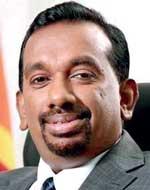
I only said that the samples have reached the NPQS in an unofficial way. The NFS has asked the supplier to send a sample as we have never imported organic fertilizer earlier.
-Agriculture Minister Mahindananda Aluthgamage
Details emerged how the Agriculture Ministry followed a dubious tender procedure; which method was the first to be followed in the annals of the country’s tender history.
The Ministry of Agriculture in early July invited seal bids from pre-qualified bidders to supply 99,000 MT of organic fertilizer and natural minerals. The tender was closed on July 28, 2021 and was awarded to the selected bidder- Qingdao Seawin Biotech Group Co. Ltd, China, on August 11, 2021. The normal procedure before awarding a fertilizer tender involves sending samples from all qualified bidders to the National Fertilizer Secretariat (NFS) of the Ministry of Agriculture for analysis in order to ascertain its compliance to the standards published by the Sri Lanka Standard Institution (SLS). However, this tender has been awarded without obtaining samples from the bidders to determine the suitability for the local condition.
It is alleged that this new procedure has been followed to favour the local agent of the fertilizer manufacturer, Chelinaa Capital Corporation Pvt Ltd. This company is said to be owned by a close family member of a senior high ranking official at the Prime Minister’s Office.
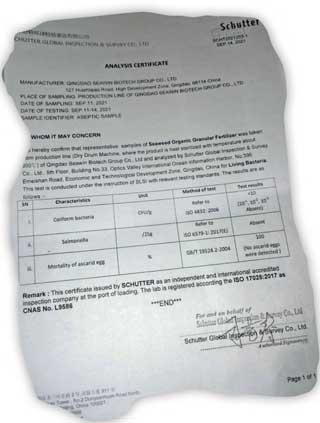
Schutter Global Inspection and Survey Company lab report that says there are Coliform bacteria in the sample |
A member of the Technical Evaluation Committee (TEC), on strict condition of anonymity, said that they did not obtain samples when tenders were called to check the suitability of local conditions, but considered other factors; whether they can supply the required bulk on time, the price and most importantly the European Union (EU) Certification. “We paid attention to the EU Certification, then on the price and whether they can supply the required bulk stocks for the ‘maha’ season. We didn’t have time to check samples and offer the tender. We got down the samples after the agreement was signed,” sources said.
According to this source, all the bidders shortlisted were in the international organic business. “We selected those who were having OMRI (Organic Materials Review Institute) Certification. OMRI is an independent body that gave us an independent review on the product. Seawin Biotech has the EU recognition and there is nothing suspicious in selecting them as we are sure about the quality of their fertilizer,” the source claimed.
Although the source claimed that the TEC was very confident of the selected bidder’s product, the lab report issued by the National Plant Quarantine Services (NPQS) states that the two samples carry culturable microorganism; which is harmful. When asked as to how the TEC is confident of the selected product when the NPQS report says that it carries harmful bacteria, the sources claimed that proper procedure had not been followed when the samples were imported.
“There are questions about the packing as the parcels were not sent under a sealed cover and it was torn. Although NPQS issued a negative report, the report given by the international accredited laboratory which was nominated by the SLS, says there were no living bacteria in the sample received,” he said. However NFS sources speaking on terms of anonymity said that the sample bags sent to NPQS were properly sealed, but it was learnt that the samples sent to the Colombo University and the international accredited laboratory have been tampered with.
“We were told that the initial report issued by the Industrial Technology Institute (ITI) also states that the samples are highly contaminated. Why doesn’t the NFS take these two lab reports into consideration? Unless, the NPQS report was leaked to the media, no one would have known that these fertilizer samples were contaminated with culturable microorganism,” sources alleged.
When inquired from a TEC source whether there are concerns regarding how the said samples have been packed, the manner in which it was received and the time period taken to deliver them to the lab and how can the NFS trusts the international accredited lab report, the TEC member said that it is up to the Agriculture Ministry to decide on it.
“This Chinese company exports organic fertilizer to 60 countries including USA and Japan and it hasn’t had any issue so far. The issue here is with the sample. This particular bacteria is common in Sri Lanka. Although some parties with a vested interest claim that if there are more than 4% Nitrogen in fertilizer it cannot be consider as organic this is a myth. Nitrogen enriched modern fertilizer should have a Nitrogen content of 10-15 %. They have increased the Nitrogen percentage from a special bacteria culture. This is a 100% soluble fertilizer and is good for our soil,” the TEC source added.
According to the source, the local agent has signed a bond agreeing to adhere to protocol. “If the bulk consignment proves to be contaminated the Agriculture Ministry has the right to ask the local agent to re-ship despite we making payments. As I said earlier, we place trust on the EU certificate. There were bidders from India whose prices were much lower than the Chinese product. Since its Nitrogen content is low (4%) if we purchase the Indian fertilizer, then there is a need to purchase more fertilizer as we have to put double or even more fertilizer to the crop to give the plants the required Nitrogen percentage,” he added. This newspaper is in possession of the test report of the solid organic fertilizer issued by the NPQS. These samples have been submitted by the NFS on August 31, 2021 to analyse whether they comply with the SLS standards.
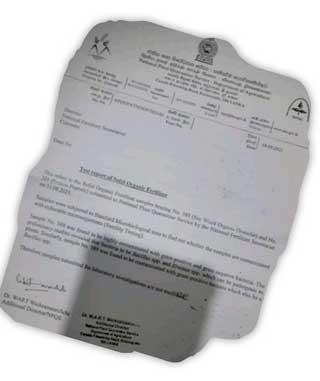
The report dated September 8, 2021 addressed to the Director NFS, by Additional Director National Plant Quarantine Services Dr. W.A.R.T. Wickramarachchi, states that the two samples submitted are highly contaminated with culturable microorganism.
The report states, ‘This refers to the solid organic fertilizer samples bearing number 388 and 389, submitted to National Plant Quarantine Services by the National Fertilizer Secretariat on August 31, 2021.
‘Samples were subjected to Standard Microbiological tests to find out whether the samples are contaminated with culturable microorganism.
‘Sample No: 388 was found to be highly contaminated with gram positive and gram negative bacteria. The preliminary studies revealed the bacteria to be Bacillus SPP and Erwinia SPP which can be pathogenic to plants. Similarly sample No: 389 was found to be contaminated with gram positive bacteria which also becomes a Bacillus SPP.
“Therefore samples submitted for laboratory investigations are not sterile” Additional Director National Plant Quarantine Services Dr. W.A.R.T. Wickramarachchi’.
This newspaper is in possession of the analysis report issued by a German laboratory in China, which is an international accredited lab recommended by the SLS- Schutter Global Inspection and Survey Company Limited. According to this report dated September 14, 2021 there are Coliform bacteria found in the sample.
The Analysis Certificate states,
‘ i) Place of Sampling: Production Line of Quingdao Seawin Biotech Group Co. Lt
ii) Date of Sampling: September 11, 2021,
iii) Date of Testing : September 11- 14, 2021’.
The report further states, ‘We here by confirm that representative samples of seaweed organic granular fertilizer were taken from production line (Dry Drum Machine where the production is heat sterilized with a temperature of about 600 degrees Celsius) of Quingdao Seawin Biotech Group Co. Ltd and analyzed by Schutter Global Inspection and Survey Company Limited 5th Floor, Building No: 33, Optics Valley International Ocean Information Harbour, No: 396, Emeishan Road, Economic and Technological Development Zone, Qingdao, China for living bacteria. This test is conducted under the instruction of SLSI with relevant testing standards. The results are as follows-
1.Coliform bacteria - test results : less than 10
2.Salmonella - test results: Absent
3.Mortality of ascarid egg -test results: 100 (No eggs were detected)’
‘Remark: This certificate issued by Schutter as an independent and international accredited inspection company at the port of loading. This lab is registered according to ISO 17025:2017 as CANS No: L9586’.
NFS sources said that although the Agriculture Ministry and the Fertilizer Secretariat are trying to maintain that according to the German lab report there is only a lesser amount (less than 10 cells) of Coliform bacteria in the sample, even if there is less than one (1) cell, that has to be considered seriously.
According to SLS 1704:2021, which standard is subjected to restrictions imposed under the plant protection Act No: 35 of 1999, sterilized solid organic fertilizer shall not contain any material hazardous to plant, animal or human health. It provides plant nutrients and enhances physical, chemical and biological properties of the soil.
Clause 3.12 of the SLS standard says, ‘Destroying the microbial populations and seeds and vegetative organs of weeds within the organic fertilizer
Clause 3.13 says, ‘Sterilized solid organic fertilizer – any product in solid form of plant (except from product from petroleum industries), or animal origin that has undergone substantial decomposition that can supply total nutrienats to plants comprising Nitrogen (N), Phosphorus (P) and Potassium (K) should be at a minimum of 8%. This shall not obtain microorganism but shall contain naturally occurring minerals with no added chemicals or inorganic fertilizer material in the finished product to affect the nutrient content’. Meanwhile, Dr. Warshi Dandeniya, Soil Microbiologist and Senior Lecturer Department of Soil Science, University of Peradeniya raised concern about how the Agriculture Ministry ignored the expert advice and entered into an agreement with the selected bidder to proceed with importing fertilizer that has a 10% Nitrogen content which is contaminated with microorganism.
“Now the tender has been suspended, but we cannot consider that the Government’s ploy is over. The Agriculture Ministry and the NFS deliberately ignored the SLS standard that clearly states ‘sterilized solid organic fertilizer shall be free from any living organism or their viable forms’. When there is ample evidence that two samples collected on two different days submitted to two different labs for analysis (on August 31 to NPQS and on September 11 to Schutter Global Inspection and Survey Company Limited), the labs have issued adverse reports which state there are living microorganism in the fertilizer. On what basis they are trying to import this hazardous fertilizer to the country? It should be noted that both labs conducted analyses targeting only a small fraction of living microorganisms that could present in these samples. Even with these analytical limitations the presence of microorganisms in the fertilizer is confirmed. Despite this, what is the reason for the NFS to go ahead with the proposed plan?” queried Dr. Dandeniya.

“It should be noted that both labs conducted analyses targeting only a small fraction of living microorganisms that could present in these samples. Even with these analytical limitations the presence of microorganisms in the fertilizer is confirmed. Despite this, what is the reason for the NFS to go ahead with the proposed plan?”
-Dr. Warshi Dandeniya
Referring to what Agriculture Minister Mahindananda Aluthgamage once said that the fertilizer is a ‘tailor made’ product for Sri Lanka, Dr. Dandeniya said that Quingdao Seawin Biotech Group webpage that gives details on seaweed compound granular fertilizers clearly states two granular fertilizer products that has 10% Nitrogen content. One fertilizer consists of 10% sea-weed extract, 7% Urea Nitrogen and 3% Ammonium Nitrogen and therefore not qualified as an input for organic farming. The other fertilizer contain 20% sea-weed extract and 35% organic matter and has ‘Ecocert’ certificate.
“True, from the information we have received this fertilizer can be tailor- made for Sri Lanka. The products this company imports to the USA has 4% or less Nitrogen contents and has ‘Ecocert’ certificate qualifying their use as inputs in organic crop production. These certified fertilizers imported to USA are more expensive and a metric ton is almost eight times higher than the price they have agreed to supply us. As featured in the company website, to increase the Nitrogen level in compound granular fertilizers they have added urea. Among their products there are already two granular fertilizers that has 10% Nitrogen. But only one has received Ecocert certifiaction while others contain urea. What is the composition of this so called tailor made product supplied to us? This fertilizer should not be allowed to enter to the country,” she added.
Failure to analyze samples for plant pathogens
According to her, if a DNA test is carried out the exact type of pathogen present in the samples can be detected.
“The test carried out by the German lab (Schutter Global Inspection and Survey Company Limited) proves the absence of Salmonella which does not mean the tested sample is free of organisms. They have failed to analyse the samples for plant pathogens. Most importantly the Coliform bacteria count in their test report is not zero. Coliforms includes Escherichia coli (E.coil) which usually indicate contamination of samples with fecal matter,” Dr. Dandeniya further said.
Biodiversity Scientist and former Chairman Sri Lanka Tea Board, Rohan Pethiyagoda told the Daily Mirror that the tender that was forced to be cancelled was awarded to import composted sea weeds from China which is made from the millions of tons of seaweeds also called as sea lettuce which is a kind of algae of the genus Ulva, which infests Chinese beaches.
“Organic agriculture is all about not using fertilizers, so the term ‘organic fertilizer’ is something of an oxymoron. But it is clear that unless some nutrients are added to the soil, the yields of all crops in Sri Lanka will fall, maybe by as much as 30%. The problem with organic fertilizer is that it is invariably made from waste, such as sewage, animal waste, plant waste or municipal garbage. The most important risk is that these fertilizers may carry pathogens such as E. coli or salmonella, which can contaminate our food. And remember, because all herbicides are now banned, we can no longer deal with an outbreak if that happens. Right now, my understanding is that the government intends to import composted sea weeds from China.
According to Pethiyagoda, the problem with sea lettuce is that it is very good at absorbing heavy metals from seawater, such as cadmium, copper, zinc and lead.
“Unless the compost is cleaned before export, these metals can enter our food chain, for example our tea, leading to importing countries banning our tea. Heavy metals in food can be very toxic to humans. There are also other issues. For example, Buddhists and Muslims may have concerns about eating food that has been grown using compost made from abattoir waste involving cows, pigs and chickens. Finally, there is the issue of how effective these organic fertilizers are. You may end up importing tens of thousands of tons of it and find that they don’t really work,” said Pethiyagoda.
Pethiyagoda further states, “It seems to me that the Government has embarked on a high-risk adventure that could have some dreadful consequences. And I’m concerned about this because the victims of these mistakes will be the poorest in our community: small scale farmers. About two million Sri Lankan people who farm rice, tea and vegetables stand to be driven into poverty as a result of this policy. The economic consequences are one thing. But aid from abroad can fix that. Social consequences are a much bigger problem. I worry that we may see a farmers’ insurrection before long, and such things never end well” he said.
Meanwhile, NFS sources accused Minister Aluthgamage for his recent statement made against the findings of Erwinia in the fertilizer samples claiming it has been imported to Sri Lanka in an unofficial manner. “How can the Minister make such an irresponsible statement when there is a Cabinet decision to ban all imports of chemical fertilizers to the country? In such a background how can samples of fertilizers be imported to the country without an import licence? How can the Sri Lanka Customs release them if there wasn’t an import licence? Why the did the NPQS accept these samples that have been brought to Sri Lanka illegally? Was it the local agent that has imported this unofficially? If so why cannot the Minister lodge a complaint to the CID to investigate as to how this was brought to Sri Lanka,” sources queried.
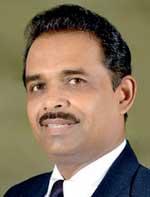
“We shortlisted five bidders and selected the most suitable bidder. When selections were made we looked for the best company that has the ISO Certification, the OMRI review report, the EU certification and all other recognized certifications.
-Secretary, State Ministry of Fertilizer M.N. Ranasinghe
“By letter dated September 1, 2021, fertilizer importers have addressed Agriculture Minister requesting to pay the long overdue fertilizer subsidiary to them. According to the letter, the total overdue to the private sector importers to date is over Rs.18, 000 million. Although a paltry sum of Rs.400 million has been approved on August 30, it is yet to be released by the State Ministry to the fertilizer importers. They have also found out that the NFS has been extremely slow in submission of their subsidy claims to the General Treasury. Hence the Treasury is unaware of the overdue amount. The letter further states that these importers have borrowed in excess of Rs.16, 000 million to pay for what they have imported for the 2020/2021 ‘Maha’ season and their combined monthly interest is Rs.110 million which they claim as a wasteful expenditure,” sources said. Although the Minister said that the samples have been brought in an unofficial manner, by letter dated August 12, 2021, to Director NFS, Secretary to the State Ministry of Agriculture, M.N. Ranasinghe has informed about the procedure that has to be followed when importing organic fertilizer
‘This refers to the Cabinet decision No.21/0964/323/030 on the Memorandum dated 31/05/2021 submitted to the Cabinet of Ministers by the Minister of Agriculture to implement Cabinet approvals granted in terms of decision No.21/0746/301/013 on “Towards a Green Socio Economic Pattern with Sustainable Solutions to Climate Change”. ‘Clause 4 (ii) states: ‘The Director National Fertilizer Secretariat (NFS) shall inform the Director General of Agriculture/Director General, Animal production and Health to issue permits for the importation of fertilizer samples to the National Plant Quarantine Service if plant material is used for the production of those organic fertilizer and to the National Animal Quarantine Service if animal raw material is used as the case may be.’
‘Clause 5 states: ‘The Director National Fertilizer Secretariat should take action to issue Import Permit to enable getting samples of the respective products to be tested by the following institutions. Sri Lanka Standards Institute (SLSI), SLSI approved laboratory selected by the Director NFS, Atomic Energy Board and Sri Lanka Plant Quarantine Unit’.
Seawin Biotech Group Co. Ltd web pages that show 10% Nitrogen consist of --- 7% Urea Nitrogen and 3% Ammonium Nitrogen |
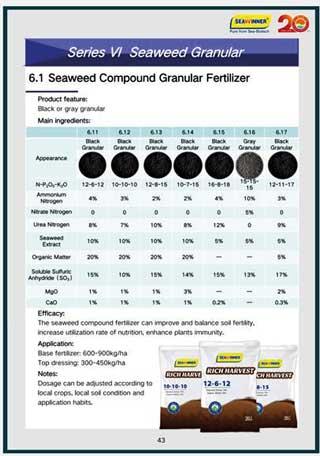
The sources further alleged that the Eastern Port City of Qingdao in China from where the fertilizer is expected to be imported, is experiencing the worst ever algae infestation in the region, with more than 1,700 square km of coastal area blanketed by harmful green seaweed, also known as “green tide”.
“We have suspicious whether the ‘tailor-made’ fertilizer is manufactured from these harmful green seaweed. Qingdao has suffered from this algae for 15 the past years,” sources added.
Meanwhile, the sources further queried as to why the government agreed to make the full payment before the consignment arrives Sri Lanka? “The general practice is to withhold 25% of the value of the cargo until it is confirmed that the product is acceptable to the country. But in this tender, the government has agreed to make an advance payment before loading and the balance on submission of shipping documents to the local banks. It takes 14 to 20 days for the cargo to reach Sri Lanka from the port of loading. Before the cargo arrives they are allowed to courier the shipping documents to the local banks. Before the consignment arrives the country has made the full payment to China without any recourse to the normal 25% retention and to the normal 10% of value Performance Guarantees; which is approximately US$ 6 million,” sources alleged.
The sources further revealed as to how attempts were made to increase the rate of discharge from 1600MT per day to 3200MT per day which was foiled by the trade unions of State owned fertilizer companies. “Once the consignment arrives, if the workers clear the stock before the agreed period, the shipper is relieved from paying statutory charges to the Port. Hence incentives are paid to state company workers for faster discharge. By increasing the rate of discharge from 1600MT to 3200MT per day, these workers could have not been able to get the incentives. Fertilizer Corporation workers planned to instigate a trade union action and delay clearing the stocks from the port which will result the shipper bearing additional port charges for keeping the ship more than the agreed period. Understanding what the consequences would be, the rate of discharge was brought back to 1600MT per day by the NFS,” sources claimed. Agriculture Minister Mahindananda Aluthgamage however declined to accept that the imported fertilizer samples were brought to Sri Lanka in an ‘unofficial manner’.
“I never stated so. I only said that the samples have reached the NPQS in an unofficial way. The NFS has asked the supplier to send a sample as we have never imported organic fertilizer earlier. We have a doubt about these samples and these packs have been idling at the courier service for seven days. The packings have been broken. The NFS says they suspect sabotage in this process in order to put the blame on us,” the Minister said. According to Aluthgamage the SLS has to recommend an international accredited lab which he failed to name which has released the report stating there were no living organism in the samples. “We received new samples on September 23 and got it cleared from the Customs under tight security. Even the Colombo University issued a report saying that there are no bacteria in the sample. I personally think the scientists at the Colombo University are very efficient and genuine. It is very easy to infect these samples with bacteria and carry out a sabotage to derail the government genuine effort,” he added.
National Plant Quarantine Service lab report (dated September 8) that there are bacteria in the sample |
When asked as to why a different procedure was followed without obtaining samples from the bidders and awarding this tender without checking how suitable the fertilizer is to the country, the Minister said that there is no way to do this as this bulk arrives in five shipments. “Before loading they will send us a lab report recommended by the SLSI lab and once it arrives in Sri Lanka we take another sample- a joint sample and get it checked. If we get a positive report we would unload the stock and if not we would send it back of their own expense.
“This company exports its products to 12 countries including USA, Japan and Australia. None of these countries have not made any complain against the fertilizer. Here, we have not violated a single tender condition and the process we followed is transparent,” Aluthgamage said.
When asked as to why the tender document laid a condition that the fertilizer should have 10% Nitrogen whereas the experts say it should not have had more than 4% maximum, the Minister said that the fertilizer that is sent to all other developed countries carries 10% and urea is not added to the organic fertilizer. Secretary, State Ministry of Fertilizer M.N. Ranasinghe told the Daily Mirror that according to the contract, the efficacy of the fertilizer is carried out after the contract is signed.
“We shortlisted five bidders and selected the most suitable bidder. When selections were made we looked for the best company that has the ISO Certification, the OMRI review report, the EU certification and all other recognized certifications. We also paid the attention to which party that can supply the fertilizer uninterruptedly. Some bidders failed to supply a nutrient product and others bidding prices were much higher. Only the selected party could supply us to the international standard,” Ranasinghe said.
When asked as to how the tender board knew that the selected bidder will supply an international stander fertilizer, when the samples were not obtained when calling tenders, Ranasinghe said that the international certifications the selected bidder has submitted proved the quality of its products. “The stock will be brought in five shipments. So how can we check the quality of these five shipment when the tender process were going on? We have all the rights to instruct the supplier to send back the consignment if the quality fails,” Ranasinghe added.
When asked whether import licence was issued for the samples that failed the NPQS test, Ranasinghe said that unless there is a licence, it is strictly prohibited to import banned items. “We have a doubt about the samples that have been sent to NPQS. It is alleged that the parcels have been tampered with. Although the NPQS report said that there are living organism in the samples, none of the other reports revealed that there are bacteria in it,” he added.
Despite the earlier claims by Ranasinghe, after the tender was forced to be cancelled he could not be contacted by this newspaper to obtain a comment.
Thursday, September 30, 2021
Israel kills six Palestinians in 48 hours

Mourners carry the body of Osama Subuh during his funeral in the occupied West Bank village of Burqin on 26 September.
APA images
Tamara Nassar -28 September 2021
Israeli occupation forces ran over a Palestinian child with a military vehicle after shooting him, a human rights group stated on Monday.
Yousef Muhammad Odeh, 15, was among six Palestinians killed in multiple areas in the West Bank in recent days.
All but one were killed by Israeli forces during a major arrest operation in different areas of the occupied West Bank on Sunday.
The military targeted Hamas “military infrastructure” in the Ramallah and Jenin areas “after intelligence showed the group was planning to carry out attacks in Israel,” according to the Tel Aviv daily Haaretz.
The operation involved two death squads: Duvdevan, an elite Israeli military unit whose members often disguise themselves as Palestinians in order to carry out extrajudicial executions, and Yamam, a unit of Israel’s paramilitary Border Police whose members shot and killed two Palestinian police officers in Jenin earlier this year.
Gunfire exchange
Israeli forces launched their arrest operation late Saturday in the city of Jenin and nearby Kafr Dan in the northern occupied West Bank where two Palestinians were arrested without any exchange of fire, according to The Times of Israel.
Soldiers then surrounded a house in Burqin village, where a wounded Palestinian was arrested following a firefight.
Shortly after, Burqin was the scene of another gunfight during which Osama Subuh, a 22-year-old member of the Islamic Jihad resistance group, was killed by Israeli fire.
An Israeli soldier and an officer were injured by friendly fire during the raid, according to Haaretz.
Israeli forces also killed 15-year-old Yousef Muhammad Odeh in Burqin.
Odeh arrived at the scene at the same time during the early morning hours that a Palestinian shot at invading Israeli soldiers near the entrance of the town on Sunday morning, eyewitnesses told Defense for Children International Palestine.The Palestinian gunman, who was injured in the leg by Israeli soldiers, dropped his weapon and fled.
Odeh had allegedly picked up the firearm when an Israeli sniper shot him in the leg. He dropped the gun, picked it up again and fired two shots at an Israeli military vehicle located 400 feet away.
An Israeli sniper fired at Odeh again, striking him in the leg and head.
“After he was shot, an Israeli military vehicle approached Yousef and ran over his body,” DCIP said.
Soldiers then evacuated Odeh’s body, which has not been transferred to his family for burial, according to the rights group.
Three killed in raid
Three Palestinians were killed by the Yamam unit of Israel’s Border Police in another gunfight in the village of Beit Anan in the Jerusalem governorate in the occupied West Bank.
They were identified as Ahmad Zahran, Zakaria Badwan and Mahmoud Humeidan. They were from the nearby village of Biddu.
Their bodies are being held by Israel, the Tel Aviv daily Haaretz reported. No Israeli soldiers were injured, the military told media.
Badwan worked at the Palestinian Museum, which closed its building in Birzeit, near Ramallah, on Sunday in mourning.
“We remember Zakaria for his cheerful face and kind manners,” the museum stated.A Hamas media spokesperson pointed to high-level meetings between Palestinian Authority officials and Israeli ministers in Ramallah in the days leading up to deadly raids.
He cited the continued collaboration between the Palestinian Authority and Israeli lawmakers under the banner of “security coordination.”
The spokesperson said the meetings “encouraged the occupation once again to pursue the resistance, kill its rebellious youth and commit more crimes against our people.”
Killed in Beita
Meanwhile, Israeli occupation forces shot Muhammad Ali Khabisa, 28, in the head with live ammunition on Friday in Beita, a village near the northern West Bank city of Nablus.
Khabisa, father to an infant, died of his wounds hours later.
Khabisa was wounded by Israeli army fire during a demonstration in Beita two weeks earlier.Israeli forces have killed several Palestinians in the village this year, including two children who were friends.
Beita residents are protesting the building of a colonial settlement on a hill belonging to Palestinian villages.
The new outpost, named Evyatar, was established on Jabal Subeih in May.
Israel has previously evacuated Evyatar but is permitting structures there to remain following an agreement made with settlers.
Subscribe to:
Posts (Atom)