Peace for the World World ! Your War Our Lives

The Dalai Lama
A Brief Colonial History Of Ceylon(SriLanka)
Sri Lanka: One Island Two Nations
A Brief Colonial History Of Ceylon(SriLanka)
Sri Lanka: One Island Two Nations
(Full Story)
Back to 500BC.

Saturday, January 1, 2022
Turkey's lira logs worst year in two decades under Erdogan
A money changer holds Turkish lira and U.S. dollar banknotes at a currency exchange office in Ankara, Turkey December 16, 2021. REUTERS/Cagla Gurdogan


A money changer counts Turkish lira banknotes at a currency exchange office in Ankara, Turkey September 27, 2021. REUTERS/Cagla Gurdogan

ANKARA, Dec 31 (Reuters) - Turkey's lira has logged its worst year since President Tayyip Erdogan came to power nearly two decades ago, despite his appeal on Friday for Turks to trust his unorthodox policies of slashing interest rates in the face of soaring inflation.
The lira - by far the worst performer in emerging markets in 2021, as well as in the last few years - shed 44% of its value against the dollar over the year and 19% in the last week alone.
The currency crisis accelerated in recent months, rattling the $720 billion economy, largely due to Erdogan's "new economic programme" focused on exports and credit despite the lira's collapse and inflation of more than 21%.
To ease the turmoil, the president unveiled a scheme two weeks ago in which the state protects converted local deposits from losses versus hard currencies, sparking a sharp 50% rally in the lira with support from the central bank.
On Friday, Erdogan - whose opinion poll ratings are sliding ahead of an election in 2023 - called on Turks to keep all their savings in lira and shift gold into banks, saying the market volatility was largely under control.
"As long as we don't take our own money as a benchmark, we are doomed to sink. The Turkish Lira, our money, that is what we will go forward with. Not with this foreign currency or that foreign currency," he told a business group.
"We have been waging the battle to save the economy from the cycle of high interest rates and high inflation," he said, reiterating his unorthodox view that high rates lift prices.
In response, the lira weakened to as far as 13.63 before recovering to end the day flat at 13.1875.
The currency crisis, the second since 2018, has badly eroded Turks' savings and earnings while the record volatility has upended households' and businesses' budgets and future plans.
The lira has whipsawed from 18.4 to 10.25 versus the dollar in the last two weeks, capping its worst year since 2001, when International Monetary Fund support stemmed a crisis in Turkey.
Erdogan's conservative AK Party began governing the next year. Subsequent economic gains reversed around 2013 when measures of Turks' prosperity, equality and employment began sliding. read more

INFLATION RISING
The currency crash was triggered by the central bank's 500 basis points of rate cuts to 14% since September, carried out under pressure from Erdogan, who appointed the bank governor in March and has since replaced much of its leadership.
Economists and former central bankers have called the easing reckless given inflation is expected to hit 30% in December due to the lira depreciation. Goldman Sachs expects it to reach as high as 40% by mid-2022. read more
The new deposit scheme is intended to reverse a tide of dollarisation. Under it, the state covers the difference between deposit rates and the foreign exchange and gold rate for lira converted into the new instrument.
Marek Drimal at Societe Generale said it provided some backstop, though "market participants need to see tangible steps to address underlying problems in the economy".
Many economists have warned that if the lira continues to depreciate, the scheme could further stoke inflation and add to the state's fiscal burden.
Some political analysts say Erdogan is betting that protecting deposits, along with a 50% hike in the minimum wage, will halt the slide in his poll ratings and open a window for early elections. read more
PROTECTING SAVINGS
Finance Minister Nureddin Nebati said earlier in the week that Turks' dollar holdings have fallen, but official data showed local holdings of hard currencies, which includes companies, soared to a record $238.97 billion last week. read more
At the same time the central bank's net foreign currency holdings - its effective buffer against financial crisis - plunged to a near two-decade low of $8.63 billion. read more
The central bank announced five direct interventions to support the lira in early December, including more than $2 billion in the first three efforts. read more
It has announced none since the anti-dollarization scheme was unveiled on Dec. 20, though its reserves drop-off signals it backed some $8 billion in additional state interventions, according to bankers and others. read more
Erdogan's economic policy has sent real yields deeply negative and amounted to a red flag for foreign investors, who have fled Turkey in the last five years, a period in which the lira has shed some three-quarters of its value.
The premium demanded to hold Turkish hard currency sovereign bonds over safe-haven U.S. Treasuries soared by 136 basis points throughout 2021, based on the JPMorgan EMBI global diversified index (.JPMEGDTURR).
The cost of insuring exposure to Turkish debt based on five-year credit default swaps (CDS) nearly doubled over the year to 566 basis points from 305 , IHS Markit data showed.

Additional reporting by Karin Strohecker in London and Daren Butler in Istanbul; Writing by Jonathan Spicer; Editing by Alex Richardson and Hugh LawsonBy Ece Toksabay and Tuvan

Britain – Heaven for Corrupt People
People of different countries such as Russia, India, Pakistan and Africa are enjoying their retired life in the UK with looted money. Even, the Indian government asked British authorities to extradite corrupt Indians who are living in the UK on self-exiled after financial embezzlements in India.


by Asad Ali-31 DEC 2021
United Kingdom (UK) is amongst the world’s strongest democratic states. It is famous for following the laws of the land. Furthermore, it also claims to uphold its commitment to combat corruption and financial crimes but only when it involved other states. However, the situation on the ground is very tricky and different, which is far away from reality. As per available and verified media reports, billions of looted dollars are pouring into Britain every year. This money is coming from developing states, which are already struggling to find mechanisms to boost their economic system. The corrupt leaders of developing states, who governed their countries, looted this money through illegal means such as corruption or by evading taxes and eventually sent them to the UK, considering it a secure place for illicit investment. With this increasing trend, the international community must own the responsibility and take actions to stop this illegal inflow of money, which is pouring into the UK. The international community must initiate the process to stop this illegal inflow of money to the UK and give it back to respective states.
The British soil has become a cauldron of illegal inflow of money and money launderers. London, which is among the biggest financial hubs of the world has become an increasingly attractive place for criminals to protect their illegal wealth and money. As of today, the UK has become the safest place for money launderers to hide their illegal money. British govt has benefited so greatly from this plundered wealth of the corrupt elite. It would be wise to say that the British government loves fugitive billionaires, irrespective of their race, religion and nationality.
People of different countries such as Russia, India, Pakistan and Africa are enjoying their retired life in UK with looted money. Even, the Indian government asked British authorities to extradite corrupt Indians who are living in the UK on self-exiled after financial embezzlements in India. Similarly, Transparency International, in its report in 2018, has identified £4.4 billion worth of UK properties bought with suspicious wealth and more than a fifth of these properties were purchased by Russian individuals and the remaining amount belongs to people from India, Pakistan and African politicians. Meanwhile, a quarter of all Tier 1 investment visas were granted by the British government during the period of 2008 to 2015, this was the time when no checks were carried out on source of wealth.
Likewise, international organizations have taken little steps to stop this illegal inflow of money into the UK. Amnesty International called the British government to urgently initiate constitutional legal proceedings to overseas companies who buy British property to reveal who their real owners are and use new Unexplained Wealth Orders to better investigate British assets of corrupt individuals. If the British government initiate this process, the inflow of illegal money pouring into to the UK will decrease extensively.
High property prices, which allow corrupt to launder large sums within a single purchase, and a vast network of professionals who facilitate a range of transactions, make Britain’s financial system attractive to super-rich crooks. British governmental authorities are equally responsible for providing safe havens to corrupt people coming from other countries. In addition to this, the British government has been using this money to accomplish its strategic objectives abroad such as spending money on the Syrian war. Consequently, the British government welcomed looted money, money launderers and corrupt people. Though the British government says it is helping innocent civilians in Syria, however, independent organizations say non-state actors also benefited from this money.
The role of the Financial Action Task Force (FATF) has increased owning to these British safe heavens to corrupt people. It should take serious note of the alleged safe havens for corrupt people. As Pakistan is tirelessly working to prevent money laundering, FATF must acknowledge its efforts. Pakistan’s steps will stop the inflow of illegal money to the UK. But, the British government is still viewing Pakistan through the prism of financial embezzlements. This British biased attitude needs to be stopped. Britain must no longer be a safe haven for the corrupt as Panama Papers underlined Britain’s unparalleled links to secretive offshore territories.The British government should introduce legislation that would require foreign companies wishing to purchase UK property or bid for public contracts to disclose their beneficial owners. This legislation is dire need of the hour as it will increase the overall wealth of developing nations.
The writer is Islamabad based expert of strategic affairs
What is going on with inflation?

By December 31, 2021
Anyone who has gone to the grocery store this year has noticed the prices of basic food items are going up. For many people in Canada, especially those just making ends meet, this rise in everyday prices is a concern.
By November of 2021 the year-over-year inflation rate in Canada soared to 4.7%. This is the highest rate of inflation we have seen since the early 1990s, aside from a brief moment of inflationary pressure that gripped the Canadian economy in the lead up to the Iraq war in 2003. Growing inflation is not just happening in Canada, most countries around the world are faced with inflationary pressures as they recover from the pandemic.
The Bank of Canada has maintained its inflation target of roughly 2%, so what is driving this rising inflation? And is this increased rate of inflation temporary or something that’s likely to stick around?
What causes inflation?
Inflation is a measure of the decline of the value of currency relative to the price of goods. For people who don’t own assets or productive goods – the working class – high inflation is bad news because it eats into the purchasing power of people’s wages and savings.
For businesses and owners of assets, moderate inflation can be a good thing. It signals a growing economy and favourable government policies. High inflation, hyper-inflation or deflation, on the other hand, signal economic problems that the ruling class tries to avoid.
Inflation may seem simple enough but its causes are imperfectly understood. Most economists explain inflation as a result of the money supply growing faster than the economy. This monetarist explanation of inflation sees central bank and government policy as the source of, and solution to, inflation.
The problem with the monetarist understanding of inflation, where an increase in the money supply increases inflation, is that it doesn’t align with real world events. When the pandemic first gripped the world economy in 2020, governments and central banks opened their coffers to increase the money supply but inflation didn’t budge. This is in part because the rate at which money is spent and distributed in society also changes.
Governments and central banks may increase the money supply in the banking system but that doesn’t mean it will be invested in the broader economy. Time and again the monetarist explanation fails to explain real world events.
Some Keyensian economists understand inflation as being more of a product of costs of production rising – namely, the cost of labour – but other inputs like energy costs could factor in. Keynesian economists will see a relationship between unemployment, the cost of labour and inflation. Known as the Phillips curve, this theory argues that as unemployment lessens, the price of labour increases and creates an inflationary pressure on prices in the broader economy. This can sometimes trigger what is known as a wage-price cycle.
The last decade is a good example of how the Keynesian explanation of inflation also falls short. The Canadian economy saw record low unemployment rates from 2016 through 2019 yet maintained record low levels of inflation. Conversely, in the 1970s inflation was very high in Canada yet unemployment was growing.
Perhaps a better way to understand inflation is to see the concept of inflation as linked to that of value creation. Money is not simply fiat currency: it has a relation to value creation in the capitalist economy. In other words, when the rate of profit is running high in capitalism – where capitalists are successfully upping the rate of labour exploitation and creating new surplus value – this creates inflationary pressure.
Of course, how this is handled by the ruling class can determine whether that inflationary pressure gets out of control. Likewise, how the underlying health of the capitalist economy (from a capitalist perspective) interacts with exogenous factors – such as a pandemic or climate change or the availability of certain resources – impacts inflation.
What is driving inflation now?
The current rise in inflation is happening across the globe. This is the outcome of a confluence of factors very much driven by how ruling classes have chosen to address the pandemic and its economic impact.
Central banks around the world have kept interest rates at near-zero for much of the pandemic in order to stimulate economic activity. A good chunk of companies are essentially only surviving because of ultra-low interest rates. Many central banks are also engaged in aggressive bond and asset purchasing in order to flood the financial system with liquidity.
Trillions of dollars flowed into the financial system during the course of the pandemic. On top of that, many governments rolled out large fiscal spending programs to prop up businesses and see people through the acute phase of the pandemic.
Initially, as economic activity slowed worldwide, these measures did not result in any substantial rise in inflation. However, by the spring of 2021 prices started to rise. This reflected rising economic activity and the snap back effect of economies across the globe.
Demand for raw materials and inputs for business dipped in 2020 only to rise later that year. This whipsaw created all sorts of supply chain problems in the global economy. Prices for commodities like lumber, copper, and aluminium spiked, along with the demand for oil and gas. The global supply chain has been organized around a just-in-time system in order to maximize profits, but the pandemic has thrown that supply chain model into crisis.
The fiscal and monetary policies pursued by governments around the world stabilized the financial system and averted deep sustained recessions in most countries, but they have also led to a speculative frenzy in the asset market. Stock prices have ballooned and driven inequality to new heights.
The trading value of just the derivatives market on Tesla stock averages $241 billion a day in recent weeks. Tesla stock and its options market are bigger than Amazon and the rest of the S&P combined. Likewise, the housing market in countries like Canada have surged to record highs. This speculative frenzy has also produced what Marx called “a feverish attempt to make money without the mediation of the process of production,” in the form of NFTs, meme stocks and Bitcoin.
The level of inflation in Canada – running at just under 5% – is high in comparison over the last 30 years, but the Canadian economy certainly has seen worse bouts of inflation. As David Macdonald of the Canadian Centre for Policy Alternatives notes, inflation in Canada is being driven primarily by the rise in prices of commodities like oil and gas, housing, meat and cars.
There is every indication that inflation will continue to run hot through 2022, with food prices continuing to climb. For workers this is bad news. Inflation always bites harder for the working class which doesn’t see the benefit from rising asset prices and which has little protection against price increases of day-to-day items. The only recourse for workers is to fight for higher wages and, where possible, indexation of wages to inflation.
It is unlikely that red hot inflation will be a permanent fixture of the post-pandemic world. But the current inflationary pressure does put the ruling class in a bit of a bind. Earlier this year most economists and central bankers were predicting some growth in inflation as the global economy got back to growth. This inflationary growth was dubbed “transitory” by U.S. Federal Reserve Chairman Jerome Powell and U.S. Treasury Secretary Janet Yellen. Both Yellen and Powell are now admitting that inflation is not just a short-term phenomenon.
To combat higher than expected inflation, central bankers around the world are considering interest rate hikes and winding down bond purchasing programs. Canada’s central bank has already ended its bond purchasing program and is likely to raise interest rates in the new year. The U.S. federal reserve is looking to reduce its bond purchasing program, though with a major loophole, and raise interest rates.
The ultra-easy money policy pursued by many governments and central banks looks to be ending. While this may dampen inflation, it will not solve supply chain issues and could likely stall economic recovery in many countries.
The cheap credit and easy money policies – combined with the massive fiscal stimulus from governments – averted a massive economic crisis, but they also created a situation where increases in interest rates, or the pull back of fiscal support for businesses, could trigger a real slowdown in the economy. The impact of the COVID-19 omicron variant is hard to know.
We can probably expect economic growth to continue in 2022 and inflation is likely to remain high for the first part of the year.
Make the rich, not workers, pay
This current inflation spike presents all sorts of contradictions for the ruling class. If they choose to aggressively tackle inflation by ending cheap credit and easy money policies, they risk stalling economic recovery. But if they choose to let inflation ride they risk drawing the ire of working people whose demand for action will grow louder.
The ruling class will try to blame workers for rising inflation, claiming that CERB/CRB has given workers undo leverage in the labour market.
While the decent work movement forced Ontario Premier Doug Ford to raise the minimum wage to $15 per hour, he will resist the call to raise it to $20 using the familiar myths that raising wages results in price increases – thus blaming workers for capitalist-caused inflation. But we shouldn’t underestimate how easily this argument can be picked up as common sense when faced with rising prices and food insecurity.
We should celebrate where workers win higher wages and frame the fight for higher wages as essential for keeping up with the rising cost of living.
For workers in the public sector, fighting against legislative pay caps, like Bill 124 in Ontario, is also key. It is workers who have sustained society through the pandemic – from nurses whose wages have been frozen by Bill 124, to minimum wage grocery workers, to migrant farm workers (who are excluded from the minimum wage). A recovery from the health crisis also demands economic justice.
While the 1% will try to solve capitalism’s inflationary problems on the backs of workers, workers need to keep fighting for higher wages and make sure that the rich pay.
Can TikTok help young LGBT people in Togo find community?
Social media has offered people around the world new spaces to express themselves and find allies. But anti-LGBT laws still instil fear
 Illustration: Inge Snip. All rights reserved

Sylvio Combey-14 October 2021
He starts with his eyebrows, brushing them into perfect, neat arcs. Then Nono L’Arcadien applies foundation and concealer before dabbing his eyelids with bright pink eyeshadow, all the while bopping his head to the sounds of Nigerian street-hop.
By the end of his video make-up tutorial, the young Togolese TikToker has completed his look with dramatic eyeliner, false eyelashes, lip gloss and an elegant headwrap. He looks directly into the camera and blows a kiss to his 37,000 followers on the platform.
It would be unlikely to find a man wearing such clothes or make-up on the streets of Togo – a Francophone West African country where gender roles are strict, homosexuality is criminalised and the “promotion of immorality”, including LGBT identities, is banned.
However, some people are finding new spaces online in which to express themselves, experiment with styles that challenge gender norms, and show their support for LGBT people.
“Why should I be ashamed?” L’Arcardien asked me defiantly, about what he called his “effeminate” appearance. The 21-year-old recalled being challenged for it repeatedly, including by a priest during his childhood. “Since then [...] I’ve embraced it.”
He said he used to do his and his friends’ hair and make-up in his spare time, and started using TikTok for fun. As his following grew, he realised that he could use the platform to share his talents, and his perspectives, more widely.
A rainbow flag – a symbol of solidarity with LGBT people – is visible in many of his videos. But, like others I spoke to, L’Arcardien does not discuss his sexuality or gender identity online.
‘Why should I be ashamed?’ L’Arcardien asked me defiantly, about what he called his ‘effeminate’ appearance
Another Togolese TikToker, 21-year-old Kalisha LaBlanche, told me she was recently forced to move out of her mother’s home and rent her own apartment because of her sexuality. A priest also declared “war” on her, she said.
“A few months ago, my mother forced me to go to a pastor for so-called prayer and deliverance sessions. She believed I was really under the influence of an evil spirit,” LaBlanche said, describing what sounds like anti-LGBT ‘conversion therapy’.
Though she says her mother “in the end, gave up”, these sessions and the pressure she faced from her family was difficult, and took a toll on her mental health. TikTok provided an escape – and a safe space in which to connect with LGBT-friendly people.
LaBlanche, who often dances in her videos, currently has more than 35,000 followers. That’s a significant number in Togo, a small country of just eight million people of whom only 19% (1.5 million people) have internet access, according to data from 2019. It’s comparable to someone in the UK (population: 67 million) having more than 2.7 million followers.
Abused and criminalised
Although TikTok and other social media have been celebrated for offering marginalised people new spaces in which to share their experiences and connect with like-minded allies, in places like Togo their impact is limited. And expressing yourself online still carries risks.
“He struggles to handle the harsh criticism he gets online,” one person said of their gay friend, who is active on TikTok, but cautious and fearful of backlash after offensive comments were posted below his videos.
Other people I spoke to said harsh responses to their videos caused them to consider whether they should quit TikTok – the social media of choice for many young people in Togo (where the average age is 19), and elsewhere in the world.
“At first it bothered me a lot – it made me think a lot – but I ended up getting used to it,” said L’Arcadien, about the online abuse he’s received. “Today, it doesn't bother me at all.”
In June 2021, at the United Nations in Geneva, Togo’s human rights minister Christian Trimua reiterated that homosexual acts are criminalised in the country.
Article 88 of Togo’s penal code states that anyone who commits an “indecent or unnatural act with an individual of his or her own sex” will be punished by imprisonment for up to three years and a fine of up to 500,000 francs.
In their daily life, LGBT people in Togo (and even those merely suspected of being gay) face insults and sometimes physical attacks.
Amid this hostility, the videos made by young Togolese TikTokers appear revolutionary to viewers such as Hyppolite, an 18-year-old truck driver who told me that she is a lesbian and that having to hide her sexuality has made her withdraw from public life.
“When I go out, I don't talk to anyone in my neighbourhood. When I come home, I'm in my room,” she said. Once, a friend caught her kissing her girlfriend. “She promised me that it would remain a secret between us, and I want to believe her.”
But she has been inspired by L’Arcadien’s videos, she said, and is considering opening a TikTok account – and joining her generation of trailblazers using the internet to gain some, even if limited, safe space.
January should bring colder weather and snow chances to D.C. area

The Tidal Basin was coated with two inches of snow on Jan. 31, 2021. (Kevin Ambrose for The Washington Post)

By Matt Rogers-31 December 2021
We predict temperatures to average between 36.5 and 38.5 degrees, which is within one degree of the most recent (1991-2020) 30-year average (37.5 degrees) and slightly colder than last year (38.6 degrees). For precipitation, we believe January can deliver between 2.5 and 3.5 inches of rain and melted snow, close to the average of 2.86 inches and wetter than last year’s 1.93 inches. We expect between 3 and 6 inches of snow, close to the average of 4.9 inches.
Normally, with La Niña conditions in the tropical Pacific, Washington experiences generally mild and dry conditions but, at least for this January, the computer weather models are favoring a strong chunk of cold air in western Canada to finally break free and advance in waves across the Lower 48. As a result, Washington is favored to see three cold pushes in the next two weeks.
Check out this visual buffet of temperature outlooks for the United States for the first half of January (top row) and the second half (bottom row) from different models:

Notice that Washington sits right on the fence between mild conditions in the Southeast and cold weather in the Midwest. La Niña patterns tend to favor the coldest weather from Chicago to Calgary, as shown on most maps above, but the eastern extension should reach the East Coast at times, too.
Having Washington on that boundary between warm and cold means that storm tracks should also travel that route. This is shown fairly clearly on the NOAA CFS model month-ahead outlook (mean of the most recent 20 model runs) for temperature (left) and precipitation (right) departures from normal:

Notice that the model projects near-normal temperatures and above-normal precipitation. At first glance, this is an exciting potential for a snow-starved city. However, during La Niña, we often see the weather swing from warm and wet to cold and dry — meaning more rain than snow.
With that said, the models still hint at snow opportunities over the next two weeks. The American and European modeling systems both predict near-average amounts of snow during the first half of January:

Although models tend to overdo snow forecasts, it seems we have a legitimate chance to see some of it even if we cut their predicted amounts by half. That said, most recent Januarys have seen below-average amounts, the exceptions being 2019 (11.5 inches) and 2016 (18.8 inches).

Climate Crisis Fuels Late-December Wildfires Ravaging Colorado
BY Jake Johnson, December 31, 2021

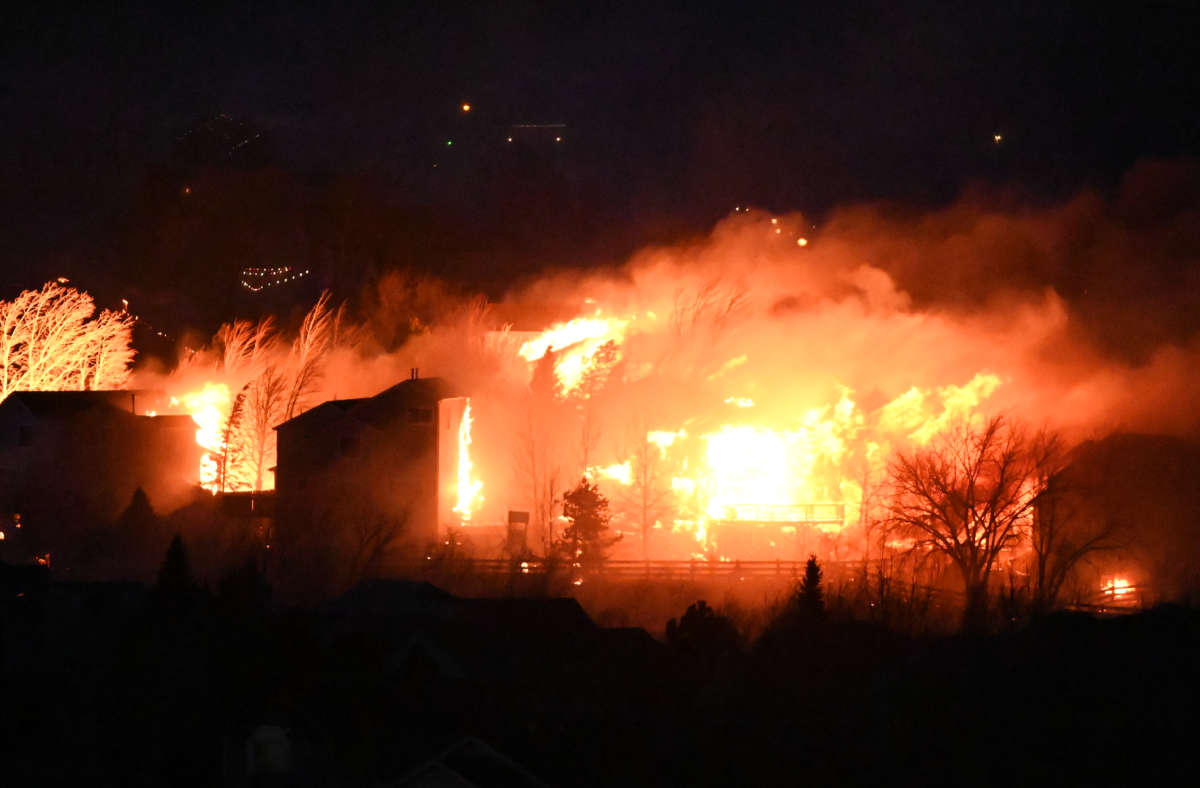
Tens of thousands of Coloradans were forced to flee their homes Thursday as two fast-moving wildfires — whipped up by wind gusts reaching 110 mph — tore through communities just outside of Denver, engulfing entire neighborhoods in flames and destroying hundreds of buildings.
Colorado Gov. Jared Polis has declared a state of emergency to help aid the disaster response as officials characterized the late-December fire event as among the worst in the state’s history.
“None of this is normal,” said Colorado state Rep. Leslie Herod (D-8). “We are not OK.”
Experts said the combination of months of unusually dry conditions, warm winter temperatures, and ferocious winds set the stage for the devastating blazes, which meteorologist Eric Holthaus viewed as further evidence that “we are in a climate emergency.”
The Colorado branch of the Sunrise Movement agreed, writing on social media that the fires were “fueled by the climate crisis.” A growing body of evidence has detailed the extent to which human-caused climate change is driving more frequent and intense wildfires in the U.S. and across the globe.
“People are losing their homes and running for their lives from a fire that started December fucking 30th,” Sunrise Colorado tweeted before turning its attention to Sen. Joe Manchin (D-W.Va.) and the Big Oil-friendly infrastructure law he helped craft.
“Sen. Manchin, your Exxon highway bill isn’t going to save our homes or our lives,” the group said. “Your greed and corruption is not only torching our future. It’s burning our communities and destroying lives tonight.”
Manchin, a close ally of the fossil fuel industry, is currently blocking progress on Democrats’ Build Back Better Act, a $1.75 trillion reconciliation package containing hundreds of billions of dollars in climate-related investments.
Officially known as the Marshall and Middle Fork fires, the blazes have thus far torched nearly 600 homes and 1,600 acres in the Boulder County area. Avista Adventist Hospital, a 114-bed facility in Louisville, was forced to evacuate its intensive care units.
No deaths and several injuries had been reported as of late Thursday as firefighters worked to contain the damage, an effort they hope will be assisted by a forecasted New Year’s Eve snowstorm.
Colorado Public Radio observed that while the exact cause of the destructive blazes is not yet clear, “early evidence suggests a sparking power line could have ignited the fires.”
“Late-December wildfires aren’t unheard of in Colorado, but the colder fall and winter months used to mean a break from the state’s peak fire season,” the outlet noted. “Scientists and fire ecologists say climate change, fueled by human-made carbon emissions, has added 78 days to the fire season since the 1970s.”
Environmentalist Bill McKibben likened the horrific images emerging from Colorado to “when the comet hits in ‘Don’t Look Up,'” a globally popular new film satirizing climate denial.
“So look. Long and hard,” McKibben said. “And then get to work breaking the power of the fossil fuel industry.”
Subscribe to:
Posts (Atom)