Peace for the World World ! Your War Our Lives

The Dalai Lama
A Brief Colonial History Of Ceylon(SriLanka)
Sri Lanka: One Island Two Nations
A Brief Colonial History Of Ceylon(SriLanka)
Sri Lanka: One Island Two Nations
(Full Story)
Back to 500BC.

Tuesday, February 1, 2022
Goal of thriving or surviving
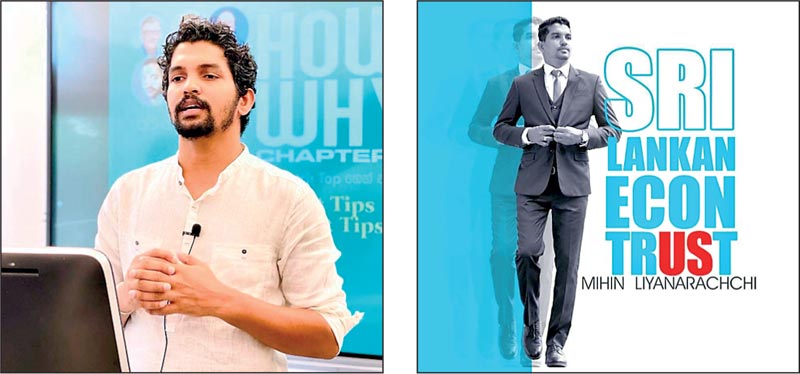
Mihin Liyanarachchi exclusive tuition master during pandemic
“Education is the best weapon through which we can fight poverty, ignorance, and freedom” and “one child, one teacher, and one pen can change the world”
– Malala Yousafzai –

Saturday, 29 January 2022 COVID-19 is an ongoing global health crisis and one of the major threats globally. This subsequently identified as the pathogen named coronavirus and currently breeds in different variants around the world. Sri Lanka is also facing this ongoing crisis. As a result of this health crisis, the education process has changed drastically with the distinctive rise of e-learning, whereby teaching is undertaken remotely and on digital platforms.
This pandemic has hit on children’s lives indirectly and it has massively disrupted educational pathways for children. Education must be a top priority in society. But due to this pandemic, access to education has become much harder to process, but critically important to ensure no child loses the opportunity to fulfil their potentials. The Ministry of Education started online- learning programs for schools for three months and as a result – the traditional way of learning tutorials and teaching sessions has been converted to an alternative learning method. Some are debating that a relatively brief period out of school may have a lasting negative impact on children.
The more serious concern is that when schools close for such a long period, many children will begin to forget what they already know. But through the online sessions, children tend to be more independent and self-learning than before. As a result of this new lifestyle, children are more creative and innovative. This virtual learning helps to make a good relationship between students-teachers during the lockdown. And e-learning is an efficient way to deliver lessons via tools like PDF, video recording, and podcasts.

Econ Trust is one of the famous Econ online classes among Advanced Level students in Sri Lanka these days. With the vision of ‘Heena wenuwen Kriyapadayaka’, the online class had started with many students but due to the pandemic all the tuition classes have been banned and shut down. A few months later the tuition masters have started to survive by commencing their classes online. Tuition was one of the industries that the pandemic has hit severely. But there is a very popular saying in Sinhala, ‘Rajakariya Devakariya karaganeema’; this directly can be seen by one of the tuition masters during the pandemic.
Mihin Liyanarachchi is the sir who has suffered a lot from this pandemic since the tuition fees were his only earnings. But he has never failed, since once the lockdown started from 15 March 2019; from the 20th onwards, he made a plan to continue their teaching via WhatsApp, telegram, and YouTube groups first.
He was the first teacher who gave access to the students from around the country to join his online classes free of charge after the lockdown started. He has shared papers to the students via WhatsApp and discussed the corrections via the YouTube channel. During that lockdown period, no one was allowed to go outside and this tuition master also stuck to his classroom and he continued this Econ classes free of charge program to the students until the lockdown ended (15 June 2019).
He was such a committed tuition master as we can say since he devoted his knowledge and commitment to the students while eating only samaposha during the lockdown period, because of the closures of shops and supermarkets. These are some examples of the kind-hearted teachers in Sri Lanka and the way they dedicatedly taught during the pandemic. All the classes being conducted free of charge by him was a significant moment in this entire education system.

The pandemic has exacerbated around the country, therefore adapting to the new normal life is exactly what we should begin with. Surviving only is not what we should expect to do – thriving is the way we can achieve our goals and aims in this critical situation. If there is a crystal-clear goal to your life there would be a success for your life no matter what happens in your life.

AKD & Sajith Apart, Is There Any Other On The Field?


By Vishwamithra –JANUARY 29, 2022
“I believe that if one always looked at the skies, one would end up with wings.” ~ Gustave Flaubert
In an ever-widening field of political activism, Sri Lanka is further being portrayed as a rudderless boat, floating astray not because it’s lacking any exchange of qualitative ideas and opinions but more so because its citizenry including some of its academia and the private sector-oriented pundits have become part of that corrupt and incompetent State machinery. They are using the absence of a credible alternative to the Rajapaksas as an excuse to continue their plunder with unbridled mayhem.
Both Anura Kumara Dissanayake (AKD) and Sajith Premadasa are too engrossed in their own ego cum power-trips. Although AKD seems to have a massive advantage over Sajith, when reckoned for leadership of the nation, especially in the sphere of mass-confidence and leadership-authenticity, AKD’s international exposure or lack thereof, would play a very decisive role in months to come. Being a country so geographically situated along the silk route, as China would like to call it, and given her close proximity to big brother India paying more than close attention to her closest neighbor, AKD is at a decisive disadvantage.
Sajith Premadasa on the other hand, might have a slight advantage over AKD in international recognition, yet a conspicuous lack of any tangible accomplishment as a Minister in the last ‘Yahapalanaya’ era, is one of his weak points lending to the ‘all talk-no action’ narrative.
For a nation on the verge of a political explosion, given the tremendous crisis-laden status the country is in, dearth of leadership-talent is not a very heartening manifestation. The electorate will have to look for other options and the field looks hardly fertile.
When considering other options, rumour mill is saturated with three other names. Sarath Fonseka and Champika Ranawaka are two of them. Both these personalities are being talked about in a positive manner by the electorate, not really as great towering leaders of men, but their accomplishments in the recent past are being subjected to superficial inquiry more so in the case Sarath Fonseka than that of Champika.
Field Marshal Sarath Fonseka undoubtedly stands alone in one sphere of reckoning and that is tangible achievements: leading the Sri Lankan military forces to total victory in the war against the Liberation Tigers of Tamil Elam (LTTE) and its fearsome leader Velupillai Prabhakaran. In an increasingly polarized electorate along ethno-religious lines, Sarath Fonseka holds a clear advantage against any other Opposition leader, especially amongst Sinhalese Buddhists, provided that aspect of his official accomplishments is marketed as a distinct quality when compared with others who might be on the field at the time. I may be getting too much ahead of events yet to come. Nevertheless, Fonseka’s leadership and little or total absence of ownership in the war-victory against the Tigers cannot be understated when the Rajapaksas are making every possible effort to declare themselves as the sole reason for such a significant victorious moment.
But Fonseka’s battle on the political field might be much harder than the ones he fought on the gruesome battlefields in the North and the East.
The second name I penned about is Patali Champika Ranawaka. Patali has a totally different political beginning which is even more akin to the shades of Sinhalese Buddhist fundamentalism. But that was in the early nineteen nineties flowing into the twenty first century. But whatever political life Patali enjoyed in the span of his whole political life, he has yet failed to appear as a leading or a dominant leader at a national level. Those Sinhalese Buddhists he so fondly talked about and held a seemingly pro-Sinhala line, relative lack of name-recognition is a conspicuous negative in the current context. But Patali’s image, at least among the political pundits and city-dwelling pukka sahibs, is quite a formidable one. But would that be sufficient to catapult him to greater heights is the question one has to answer before trudging on this path any further.
Apart from Patali Champika Ranawaka and Sarath Fonseka, the third political figure I would like to write about is our own old friend Karu Jayasuriya. KJ, as he is fondly referred to, has one singular advantage over all others on the current Opposition political field and that is one single feature which our electorate holds so close to their hearts, credibility. In the present backdrop of severe economic conditions and the pathetic governance model the Rajapaksas are adopting against all reasonable advice, credibility of our Chief Executive, President of the country, is one solitary quality all citizenry are yearning for. KJ has positive past baggage to brag about. When the country’s very existence as a decent and committed-to-the-hilt to democracy as a way of governance was challenged, it was he who stood alone. He displayed that raw courage, a characteristic that is often missing amongst almost all of the rest in the field, and for that matter, inside the House of Parliament, the very temple of our democracy. At a time when the fragility of our democracy was in display, KJ threw himself to his own one-man battle against the marauding hooligans who call themselves Minsters and Members of Parliament belonging to the Rajapaksa regime.
Of the above three men, any one of them could be a better bet against either Anura Kumara Dissanayake or Sajith Premadasa. An agreement amongst all Opposition political parties on a single issue that binds all of them together needs to be reached if one expects to be successful against such a daunting opponent as any member of the Rajapaksa family.
Read More
JVP or SJB in pole-position?


by Kumar David- 2022/01/30
By all accounts the JVP’s star is rising; everybody says so. We have had similar scenarios before where it seemed the JVP was at peak but the outcome in the subsequent election was disappointing. Will it be the same again? No one can say till the results of local government (LG) or provincial council (PC) elections, due early and later this year, respectively, are known. The regime like a headless chicken is scampering to foil elections; it fears the JVP or SJB, or both will do well while pro-government entities will flop. But election forecasting is black-magic; let us watch. If the government does badly at LG or PC polls a new game begins. Or before that president and regime may scrap elections; this danger is real but I will not pursue that line of thought today though Burkina Faso became the latest domino to fall to the military on Sunday. Still, unbelievably all Sri Lankas’s entities, political and civilian are sleep walking into the abyss. The political and economic situation today is reminiscent of January 1962 at the time of the attempted coup .
Back to my topic. The SJB must sell to the people the conventional liberal-democratic, market-economy; the conventional capitalist development strategy. People are accustomed to it; this has both advantages and disadvantages. The big obstacle is that Sajith will not agree to dump the presidential system though a majority of people of all races and faiths are fed up with it. The JVP-NPP has a harder sell despite belief that a new broom will sweep cleaner. There are two things to do; one, better present the alternative state and economic strategy, the key word is alternative; second, convince people that the wild old ways are gone. The bad old days are heavy laden with two problems; a proclivity to foolhardy violence and an unsound position on the national question. I have said my part, for now, about how it can spruce up the alternative constitutional and economic outlook in my columns of 2, 9 and 16 January on the NPP manifesto, therefore will give that a slip today. I will comment on the “bad old days” conundrum in this column.
There is a reserve of voters who would like to vote JVP-NPP but remain reluctant because of recollections of 1971 and 1989; either personal recollections or they know all about it. This means that not only one-foot-in-the-grave old folk but younger voters too are put off by the gonibilla stories. How can the JVP change this? It’s not going to be easy; words, apologies and promises cut no ice in the cut and thrust of practical politics. But a point to note is that this stain has not rubbed off on the NPP which did not exist in those bad old days, and more important, now includes people who at risk to life and limb fought that madness. Were they to wield authority now, they will not permit anything of this sort to recur. Hence one adjustment that will help reassure voters is if the NPP wields significant power in the alliance with a degree of authority to veto decisions. Does this sound as if I am whistling for the tail to wag the dog? Maybe it does, but cross transfer of leading personnel will be reassuring. There will have to be an NPP presence in the leading bureaus and committees of the JVP. If the JVP says “No” it needs to explain how it intends to win public confidence that the ultra-left excesses of yesteryear will not be repeated.
My suggestion of cross-fertilisation of personnel will provoke dissent but the JVP leadership needs to face facts. Recently the JVP established a Consultative (or Advisory) Council of significant people; three of them of long Marxist political vintage I know well (Lal Wijenayake, Prof Vijaya Kumar and Dr Michael Fernando). I am sure there are others who are important. Such persons can serve a better purpose if they are not on peripheral advisory councils but in JVP ‘hard-core’ decision making bodies. I say this bearing in mind the future of the JVP not the NPP. The former not the latter is the crucial element in the relationship and balanced power sharing is needed for the benefit of the JVP. JVP leaders participate in NPP gatherings and no doubt report back to the party but this is not the same thing.
I had an email from an ex-LSSP comrade Jumpy who is in a sense an ally of the JVP-NPP alliance. He said “I read your piece on Sunil Handunetti in Colombo Telegraph with interest. The JVP has not changed and is using the NPP as a mask. I know you will not agree”. True, I do not agree with Jumpy but the perception of lurking post-election left-authoritarianism in the mind of the electorate and democratic leftists must be addressed. The JVP must take structural steps to change the perception. This is a more general need than simply promising not repeating 1971 and 1989 type ultra-left excesses. The examples of Nicolo Maduro and Daniel Ortega renew such fears in the public mind at every turn.
The SJB does not suffer from perceptions of internal power imbalances, although the ex-UNP wing is predominant. The role of other partners is clear and the Front is seamless to outsiders. The presence of influential leaders with clout who do not have the same organisational genesis as Sajith – Champika Ranawaka for example – establishes a more equitable power distribution. The JVP will not gladly accommodate my suggestions for changes in power relationships, but honestly, I don’t see a way forward for the NPP and more significantly for the JVP except by opting for a less-closed, less old-fashioned semi-Blanquist structure. I hope for constructive comments from others; there is time enough for reconsideration and discussion.
The relationship of the JVP to the national minorities is also tricky. It appeared from Anura Kumara’s statements that the JVP was reassessing its reactionary position on the national question and close to admitting that its association with state forces that brutalised Tamil civilians during the civil war was wrong. However, that apart from Anura no other JVP leader has said anything similar or attempted to mend fences with the Tamils, Ceylon or Upcountry. (Forgive me if I am ill informed). Sunil Handunetti’s interview with Sirimantha Ratnasekera, Sunday Island, 16 Jan seemed to confirm my fears. His topic was opposition to “India’s plan to capture the Trinco oil tank farm and to take forward its expansionist intentions”. This is not a matter on which I have views; I have not studied it. What startled me was his next comment.
“The government has been compelled to sign this agreement. It is Déjà vu of the Indo-Lanka agreement which was pushed down the throat of Lanka on July 29, 1987. India got the JR Jayewardene government to sign the agreement by coercion. They dropped ‘parippu’ here, violating our air space. They sent an army of 150,000 while Sri Lanka’s army had only 72,000 cadre strength. This time they have used economic means for coercion”.
Let’s take a long view. I think it is correct to say that this is the opinion of four in five of Sinhalese people. However, I am also certain that four in five of Tamils distrust and fear the military and are pleased with the ‘parippu’ drop. (Many, from unpleasant experience however, are livid with the IPKF). Now I am not asking which view is correct; that’s not my point at all. The crucial matter is that there is not one uniform consciousness or common stance of the two communities on an event as serious as this. There are two different consciousnesses! And this is so in respect of much else of the conversation about ethnicity. A left party needs to take the fullest cognisance of this.
This puts a certain onus on the left about how to navigate these waters. I think the LSSP from the inception up to about 1960, and the Vama Samasamaja movement from its inception and the NSSP in its early days (I have no idea what the NSSP stands for anymore) did navigate this issue with leftist, liberalist and Marxist common-sense. However, it is difficult to believe that a conversation of depth and seriousness has taken place within the JVP on the “national question”. This perhaps is why the views of different leaders is disjointed and at times discordant. The JVP would do itself a favour if it set aside a goodly period of time and commissioned a thoroughgoing discussion of what its theoretical stance on the Tamil minority question is. What the NPP’s manifesto says is perhaps adequate for electoral purposes but a serious-minded party must have a thoroughly worked-out understanding, not bitty comments by this leader or that. The JVP needs to evolve from a robust and radical political party and reach the stature of an alternative government.
In other countries, say in North and South America and India there is vigorous dialogue among thinkers and activists about race. In the United States it is framed in terms such as critical race theory, the legacy of slavery and reparations, “black lives matter”, the case made by white supremacists, the looming Trump-Republican threat to curtail voting rights for people of colour, poverty and race, and so on. There is no dialogue of even remotely comparable depth or sophistication in our country. The SJB is sterile and has nothing new or old to say on the matter. The JVP must perforce move forward from a formula position to lively, no-holds barred open internal dialogue; the more open and the more outsiders are invited to participate the more productive it will be.
Urea Phobia and Organic Disaster: Catastrophic Economic Outlook

1 February 2022
Fertilizers can make or break a farm. Farming systems and practices have evolved from farmers’ experience and technological advancement over a long period of time. Any sudden changes by government regulations can result in serious adverse social and economic impacts. Sri Lanka has more than 2000 years of agricultural history.
Hence, farmers possess a significant amount of traditional knowledge for growing crops successfully. The Green Revolution in the 1950’s made significant changes to agriculture globally by introducing new technologies such as crop breeding and agro-chemicals to enhance food production to meet the ever-increasing demand. The mass scale urea production and usage were a result of that effort.
According to science, one major limiting factor for crop growth is nitrogen. The green leaves (chlorophyll) are made up of nitrogen.Since the 1950s, humans have doubled global nitrogen availability for crops by applying nitrogen fertilizers.
What is urea
Urea is a common type of nitrogenous chemical fertilizer used globally. Urea is made from natural ingredients of nitrogen from air (air is composed of almost 80% nitrogen), hydrogen (derived from natural gas) and carbon dioxide (www.sciencedirect.com/topics/engineering/haber-bosch-process). The chemical formula for urea is CH4 N2O. Urea does not contain any heavy metals or human toxicants. Urea can be mixed with straw and fed to cows with no ill-effects. Urea comes in small dry granules and is usually packed in bags. Its transportation, storage, and applications are very easy and simple compared to liquid forms of fertilizers. Hence, urea is recognized as the “king” of fertilizers.

Global context
The world’s leading agricultural countries, such as Israel and the Netherlands, use a massive amount of urea. Switzerland was identified as the largest supplier of Urea to Israel, comprising 43% of total imports. Russia came in second with a 14% share of Israel’s total imports. It was followed by the US, with a 12% share. Countries with the highest volumes of urea production in 2020 were China (26 million tonnes), India (25 million tonnes) and Russia (9.6 million tonnes), with a combined share of 42% of global production. Levels of chemicals fertilizer used in a scale of kg per hectare are listed online by county statistics database Index Mundi
(www.indexmundi.com/facts/indicators). According to this source, Singapore uses the highest amount of chemical fertilizer in the world, whereas Sri Lanka falls at 68th.
Interestingly, no major agriculture producing countries have identified urea as a food toxicant and has imposed sanctions over its usage.
Fate of urea in soil
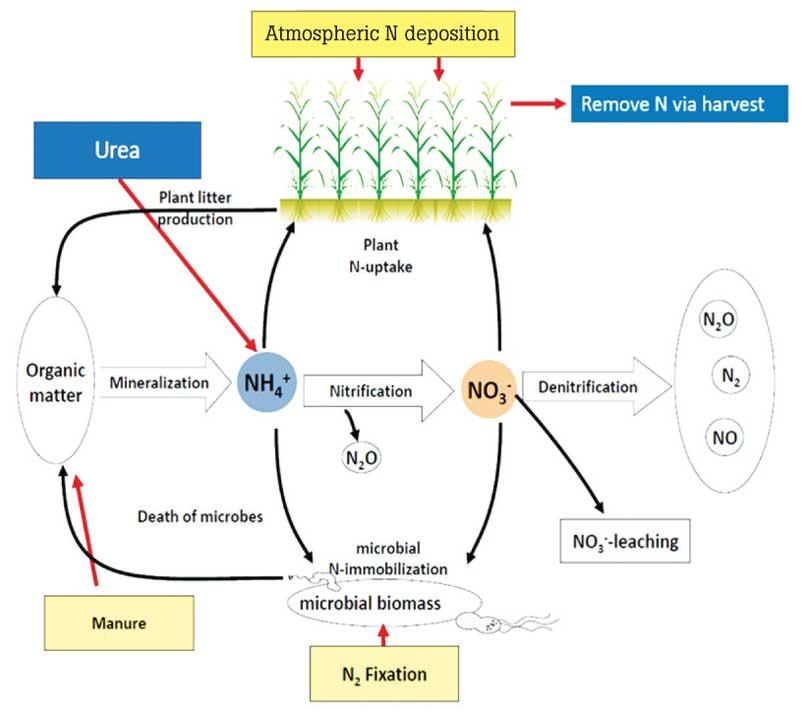
When urea is applied to soil, chemical reactions such as “hydrolysis” occur with water and the chemical changes into ammonium (NH4+) and nitrate (NO3-). Ammonium and nitrate are forms of nitrogen that crop can consume. All forms of nitrogen fertilizer (chemical or organic) need to be transformed into ammonium or nitrate in the soil so that crops can absorb them via their root system as part of the crops food. The crop is indifferent to the type of fertilizer applied to soil.
Fate of nitrogen
(N) in soil
Ammonium generally sticks to soil particles and does not readily move out of the soil. However, nitrate dissolves in water and so is easily washed down, potentially polluting groundwater, and river water. This is a major environmental concern world wide as this can lead to excessive weed growth (eutrophication) and harm fish and other living creatures in the waterways. High nitrate levels in groundwater can also cause problems in newborn babies (blue baby syndrome which is not reported in Sri Lanka). The World Health Organization’s recommended maximum limit for nitrate in drinking water is a relatively high, with a concentration of 50 mg/Litre (50g in 1000 litres of water). Nitrate levels in Sri Lankan groundwater water, however, is not a major environmental concern at the moment. Apart from possible nitrogen pollution in waterways, there are no other major bad environmental issues with using urea as a fertilizer.
Currently, Europe, USA, New Zealand and Australia have serious issues with nitrogen pollution in waterways, but a fertilizer ban has never been implemented due to the importance of urea being a reliable, cost effective, chemical fertilizer.
Sri Lanka’s Chemical Fertilizer ban
Amidst this backdrop, Sri Lanka’s ban on the chemical fertilizer imports lacks logic and scientific explanation. The claims that urea usage in agriculture has led to food poisoning and related health issues lacks adequate substance and proof. According to research conducted thus far, Chronic Kidney Disease (CKD) is not related to nitrogen fertilizers. The evidence-based information suggests that the drinking water from shallow wells is the major contributor to CKD. Therefore, providing alternative drinking water sources must be considered. The blame on chemical fertilizers uses such as urea appears to be incorrect based on the assumption that it is related to kidney disease.
Sri Lanka has very limited land area available for agriculture;the average farm size is in fact less than one acre. Therefore, intensive agriculture is practiced (2 or 3 crops per year) in order for farmers to make a reasonable living. This intensive agriculture continuously removes the nitrogen in soil in a rapid way.The replacement of this depleted nitrogen is vital to maintain productive crops. The most efficient, convenient, and effective way of replacing this nitrogen is to add chemical fertilizers such as urea.In such context, changes to regulations on the use of urea needs careful consideration and planning. Challenges in fully organic agriculture policy.
There is no doubt that organic agriculture is a great concept, but it needs specific management plans and a reasonable time-frame for system change to be effective. Farmers should be given options and crop types;specific cropping systems and markets should be established for organic products. The consumption of organic product is considered a luxury reserved for wealthy demographics. When a large portion of a population is likely to become malnourished from the much lower crop yields of organic farming, it does not seem a logical agriculture option.
Agricultural research worldwide clearly indicates that yields from organic crops are considerably lower than chemically fertilized crops such as those grown using urea. Mathematical modelling and computer-based simulation techniques are commonly used to understand the impact of fertilizer use on crop yield. A simulation scenario conducted using historical climate data with no chemical fertilizers, clearly indicated long-term yield reductions as shown in the following graphic (blue bars-crop yield, green line – crop nitrogen stress index).
The adverse impacts are likely to take a few years to show up as the native soil fertility runs down with continual export of nitrogen in the harvested component of the crop (grain, fruit, or leaf). In the absence of adding fertilizers, all the crops (e.g., rice, tea, vegetable, fruits, minor export crops etc.) will have significantly less production over time. Sri Lanka simply cannot afford for this to happen.
There is no guarantee that organic fertilizer can be risk free. Generally, organic fertilizer is made from animal wastes or green residues. Many countries such as China use the remaining solid component of the sewage treatment process (bio-solids) as an organic fertilizer. But modern sewage often contains toxins such as heavy metals and fluorine substances that concentrate in the bio-solids. While this can be used in non-food crops such as forests, its usage for food crops should be carefully monitored and managed. Australia is considering halting bio-solid applications to land due to harmful chemicals.
Finally, it is not as cost-effective as it claims to be. Decomposed organic material, often called a soil enhancer rather than fertilizer has less than 2% nitrogen. Based on nitrogen content, around 25 bags of organic materials are required to replace one bag of Urea. The handling, storage, transport, and application of those organics will have a massive labour demand, and it is far too costly for typical subsistence farmers. Furthermore, the area needed to produce the organic matter will easily exceed the area used for food production. Applying excessive organic matter into soil has a detrimental effect on crop growth.
Considering all of the above challenges, imposing fully organic agriculture practice is not affordable for Sri Lanka.
The Way Forward
Thus, it is important to take these concerns into consideration prior to making swift and sudden policy changes. A shift in agriculture policy requires specific management plans and a reasonable time-frame for system change to be effective. Using science and technology in understanding the problem and finding a solution is important. Appropriate technical and scientific advice for changing agricultural policies must be sought and taken from suitably qualified persons and institutions. Sri Lanka’s finest organizations such as the Department of Agriculture and research institutes for rice, tea, rubber, and coconut must be coordinated for advice before any major policy change involving the use of fertilizer is made.
Most importantly, farmers should be given options and crop types; specific cropping systems and markets should be established for organic products. The consumption of organic product is considered a luxury reserved for wealthy demographics. When a large portion of a population is likely to become malnourished from the much lower crop yields of organic farming, it does not seem a logical agriculture option.
In the light of the on-going COVID-19 pandemic reducing tourism, agriculture is the only remaining economic lifeline for Sri Lanka to sustain its national Gross Domestic Production (GDP). Banning fertilizer imports at this point will be detrimental to the nation’s GDP and food security. Such thoughtless policies also have the risk of repeating the failures of 1970s during when then political administration of the time imposed impractical agriculture policies that led to government change in 1977.
Urea phobia is purely hypothetical. There is no scientific basis to support any adverse human health impacts from using urea to grow crops. In a context where more than 90% of world population consumes food grown with chemical fertilizer without ill effect, we should not make speculations on the usage of chemical nitrogen fertilizer. Given how Sri Lanka’s life expectancy has improved over the years, on what basis can we blame the use of urea on the reduced quality of life? While there is no argument on the benefits and importance of organic farming, such policies should only implement while complementing with the mass agriculture. If not, the agricultural productivity clock back to the first half of the 20th century, during when the South Asian region experienced widespread malnutrition.
The writer is a Principal Scientist at the Queensland Department of Environment and Science based in Australia, can be reached on sunil.tennakoon@gmail.com or on mobile ++61405320080.
Prominence to renewable energy would have averted electricity crisis
|
 The country is threatened with power cuts with insufficient oil due to foreign exchange shortages. The country’s maximum demand is around 2,800 MW. If wind power producers were allowed to continue after 2014, by now they would be producing over 1,000 MW. If solar power development was not restricted Small Solar Producers Association members would be producing an additional 1,500 MW. Solar power could fulfil a substantial quantity of day-time need, saving water for the night demand. If the 2,500 MW from wind and solar were allowed, entire thermal power would be redundant, at least theoretically. There would be no power shortages and a large percentage of oil imports could be averted, saving foreign exchange. Thus, for the country’s forward march wind, solar and bio-energy projects suspended by CEB for years need to be implemented immediately. Problem would be how
Monday, 31 January 2022
The country is facing a situation similar to late 1990s, with some forecasting four-hour power-cuts, but CEB Engineers Union forecast 1.5-to-9-hour power-cuts. The President at a meeting with Minister Gamini Lokuge ordered no power-cuts, but for how long? The situation could worsen by March/April when hydro reservoirs run dry.
Power-cuts are blamed on the inability of Ceylon Petroleum Corporation to fulfil fuel demands of CEB, with most power plants running on imported fuel. Last year with exceptionally heavy rainfall, the country had no issues, hydro-power reservoirs were full and ran 24 hours. With dry-season inflow got reduced and water levels are coming down. The heavy downpour last year could result in a long dry season possibly till May/June, worsening power issues during the hottest period.
History
After the Accelerated Mahaweli scheme’s multiple hydro-power plants by the mid-1980s, the country had excess electricity and politicians boasted of exporting to India. Their boasts were short-lived with power-cuts by early 1990s, reaching six hours in a few years. The Government’s invitation for power generation was grabbed by the private sector. The Government signed 10-to-20-year power purchase agreements at exorbitant prices.

As a long-term measure the Government proposed large coal power plants, but dragged on with disputes over locations and finally Norochcholai was selected. First unit of coal plant generated electricity in 2011, but faced frequent breakdowns. Units 2 and 3 were commissioned by 2014.
Although several proposals were made for LNG based power, less polluting than coal, only power plant materialised was the 300 MW Yugadanavi by Lanka Transformers Ltd., a subsidiary of CEB, capable of running on LNG, but continuing to run on diesel at a higher price. The plant came on-line in 2015.
In 2016, the Government called for proposals to construct a 300 MW LNG based power plant in Kerawalapitiya. After a long delay the tender was awarded in mid-2021.
Although wind and solar based power plants started since 2010, low contribution is due to poor attention given by CEB. President Gotabaya in his election manifesto proposed 80% renewable energy by 2030, but later revised it to 70%. But the implementation is very slow.
Renewable energy
Electricity generated from hydro-power, wind, solar and bio-energy are referred to as renewable energy (RE). The country’s hydro power sources are almost exhausted, except for small power plants developed by local companies, but stopped by CEB over the past seven years. Wind and solar power have enormous potential, initial investments are slightly higher than thermal, running costs are low, without imports.
Solar is during the day, wind throughout day and night, but wavering over months as well. Highest electricity demand is from 6:30 to 9:30 p.m., thus solar could meet the day time demand with hydro contributing to higher night demand. To balance the demand batteries could be used, presently expensive but prices expected to come down soon.
 Wind power
From the Middle Ages Europe had windmills, which were extended to generate electricity. Hambantota wind farm 3 MW capacity owned by CEB commissioned in 1999, but was dismantled in late 2018.
A World Bank report of August 2007 identified nearly 5,000 sq. km with good-to-excellent wind resource potential of 24,000 MW. About 4,100 sq. km of land and 700 sq. km in lagoons, largely concentrated in the north western coast from Kalpitiya Peninsula north to Mannar Island, Jaffna Peninsula also central highlands.
CEB accepted wind farms on “first-come, first-served” basis resulting in 15 privately owned wind power plants by 2014 producing 127 MW, constructed by six companies and ten were over 10 MW. But the system was suspended in 2014 claiming underhand dealings.
In November 2019, CEB called for proposals for 60 MW wind power plants of 1-10 MW capacity on BOT basis. CEB overlooked that existing wind power plants, by private investors, were over 10 MW.
CEB installed a 103 MW wind power plant in Mannar Island with ADB assistance, and started production in 2021.
Wind passing over Strait of Mannar
A strong stream of wind passes through the Strait of Mannar. Using the same State of Tamil Nadu installed six wind power projects, becoming the leader in India producing 7,450 MW. Of these, Muppandal Wind Farm is the largest in India, 1,500 MW capacity, spread over villages showing the ability of wind farms for peaceful co-existence with villagers.
Mini-hydro and biomass power
For a number of years CEB has blocked approving mini-hydro and biomass power producers, demanding them be tendered, irrespective of the established law of feed-in tariffs. The refusal was the Attorney General’s interpretation of the law that tenders need to be called. Although solar projects and mini-hydro projects under 10 MW were allowed earlier, the sudden decision prevented progress.
Sri Lanka Bio-Energy Association claims dendro-power projects of nearly 100 MW have been blocked since December 2015.
Rooftop solar
Sri Lanka Sustainable Authority (SLSEA) introduced rooftop solar power units in 2010 became a success. The electricity produced was purchased at Rs. 22 for 7 years and Rs. 15.50 for 13 years. Over five years, 6,000 domestic solar rooftops added 31 MW to the national grid.
Surya Bala Sangramaya
The success resulted in the ‘Battle for Solar Energy’ (‘Soorya Bala Sangramaya’) in 2016 with the target of establishing one million rooftop solar systems adding 1,000 MW to the main grid. Under the project, the power produced would be purchased by CEB under three systems: 1. Net metering system: (original system), 2. Net accounting and 3. Net plus.
Changes to the system
Earlier, SLSEA accepted solar power produced by small private producers up to 5 MW. Since January 2016, CEB blocked all NCRE projects.
In June 2017 under Sooryabala Sangramaya Phase II, CEB called bids for 60 solar power plants of 1 MW capacity at 20 locations. Out of 63 bids received, 36 were accepted under rates of Rs. 12.73 to Rs. 18.37 per unit, averaging Rs. 17.22. The prices displayed the reduced costs of solar power production, in dry regions with low rain and cloud cover.
Small Solar Producers Association protests that 617 prospective producers registered with SLSEA and having paid over Rs. 100 million were denied by CEB to install 1-5 MW power projects with 1,555 MW capacity.
Minister Ravi Karunanayake announced that from August 2019, only Net Plus would be in place. Under the same, rooftop solar producing up to 50 KWs would be paid a Rs. 19.75 flat rate for 20 years while systems above 50 KWs are paid Rs. 18.75.
Patali Champika Ranawaka
Under the Yahapalanaya government, Patali Champika Ranawaka an Electrical Engineer from University of Moratuwa became the Minister for Power and Energy, but only from January to August 2015. He presented the ‘Sri Lanka Energy Sector Development Plan for a Knowledge-based Economy, 2015-2025’. The plan proposed to increase generation capacity to 6,400 MW by 2020, develop renewable power as bio-mass, mini-hydro, solar and wind-power to generate 1,114 MW. If he continued the ministership, most of the current power generation issues would have been addressed.
CEB obstructions to power generation
In 2014 CEB deliberately obstructed implementing wind power projects developed since 2010. Meanwhile, politicians failed to give policy support to renewables. With political support, wind power capacity would have reached 1,000 MW by now, eliminating the power crisis. Now, CEB wishes to call tenders claiming the least cost principle is applied.
1. CEB stopped approving solar rooftops in the north and east, claiming grid connections are not available. When customers apply for solar connectivity, face higher application fees and refuse accepting capacity over 50 KW.
2. When 617 prospective producers registered to produce up to 5 MW totalling 1,555 MW, CEB called tenders under 1 MW totalling 60 MW, near grid stations, generally located in a suburb; also, small productions make overheads higher. Even under these conditions 36 investors tendered and CEB accepted submissions averaging Rs. 17.22. The process took two and a half years.
3. For wind power, tenders were called for 1 to 10 MW for a total of 60 MW. If tenders were called for 5 to 20 MW, the country would have got over 200 MW less than Rs. 12 a unit.
4. CEB, by a circular dated 8 April 2021, obstructed solar projects on roofs of commercial establishments, limiting the capacity to maximum power consumed during the last six months. Meaning commercial establishments need to wait one year after commencement of operations. CEB overlooked that most factories and hotels have their own transformers, collecting excess power would help CEB.
Government’s lethargy
The President’s policy during elections promised to generate 80% (later changed to 70%) of the country’s electricity from renewable energy sources by 2030. The policy was agreed at a President’s meeting with the State Ministry of Solar, Wind and Hydro Power Generation Projects Development and the Power Minister.
However, the Section 5 of Sri Lanka Electricity Act, No. 20 of 2009, to give effect to a policy decision, the policy needs Cabinet acceptance. The Secretary to the Power Ministry needs to draft the Cabinet paper and submit for approval. Once approved, needs incorporation in General Policy Guidelines of the Electricity Industry and gazetting. Thereafter, PUCSL will direct the CEB to comply with the new policy guidelines.
Finally, the Cabinet of Ministers cleared the proposal only in September 2021. Until then, CEB engineers were able to refuse and delay acceptance of RE projects.
CEB’s policy planning
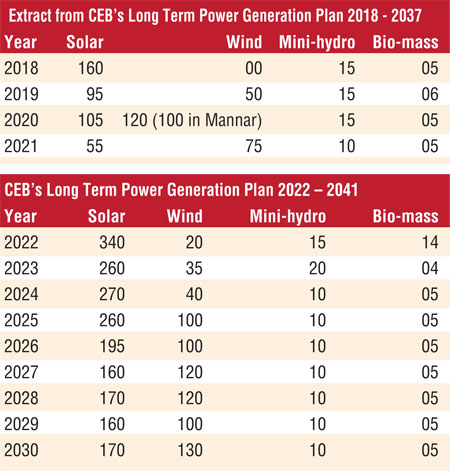
For over a decade CEB has been publishing its Long-Term Power Generation Plan as per government policy for acceptance of PUSCL. Thereafter, acceptance of power projects is based on the Plan. Until 2015 solar and wind power were not even mentioned in the Plan.
Figure 1 shows the 2018-2037 plan, when private investors produced 127 MW in 2014 through wind power projects, allocation for 2018 was zero.
Even with the CEB’s plan for 2022-2041 prepared with the new government in power, there is no substantial increase in RE production. But allowed 300 MW coal plants, also 2,358 MW of oil and LNG powered plants, completely ignoring the President’s 70% renewable energy policy.
CEB refused to entertain solar and wind power plants proposed by private investors claiming the investments are not according to CEB’s accepted Policy. But after the government policy gazetted in September 2021, PUSCL may have instructed CEB to revise LTPG Policy.
CEB engineers’ corrupt practices
When electricity was purchased from Private Power Producers (PPPs) the purchase price included capital and running costs. After ending the contract period, the purchase price is continued the same, thus allowing space for corrupt practices. Also, coal is imported by a company under CEB. RE development was obstructed to allow room for corrupt practices of CEB engineers.
The front page of a Sunday Sinhala newspaper reported that a Malaysian Company had filed a case with an Arbitration Authority in Singapore alleging that the permit given by CEB to establish wind and solar power plants were cancelled. An officer has demanded a sum of $ 2 million from the Malaysian company and the refusal led to cancellation of permit. The incidence shows the bribery within project approvals.
Urgency of renewable power
The country is threatened with power cuts with insufficient oil due to foreign exchange shortages. The country’s maximum demand is around 2,800 MW. If wind power producers were allowed to continue after 2014, by now they would be producing over 1,000 MW. If solar power development was not restricted Small Solar Producers Association members would be producing an additional 1,500 MW. Solar power could fulfil a substantial quantity of day-time need, saving water for the night demand. If the 2,500 MW from wind and solar were allowed, entire thermal power would be redundant, at least theoretically. There would be no power shortages and a large percentage of oil imports could be averted, saving foreign exchange. Thus, for the country’s forward march wind, solar and bio-energy projects suspended by CEB for years need to be implemented immediately. Problem would be how?
An efficient minister
The Minister of Power and Energy needs to be an efficient person understanding intricacies of power generation. The only MP within the government capable of handling the Power and Energy ministry is Nalaka Godahewa, with a BSc Honours degree from University of Moratuwa in Electronics and Telecommunication Engineering and a PhD in economics. His experience in the business sector would allow him to understand the issues.
Way forward – Emergency law
Now, the President’s RE policy has been gazetted, CEB need be instructed to amend its LTPGP accordingly and immediately. Also, the Electricity Act needs revision removing restricting clauses on RE development.
The country is facing a Power Emergency and the President needs to bring in an Emergency Law by-passing current CEB’s restrictions. Also, legislation for an “Emergency RE Development Plan”, valid for three years only, under the Emergency Law. In addition, a “Project Committee” be appointed under the Minister, with authority to approve power projects. The Committee included CEB engineers, but not the majority.
The tendering system for RE be removed for proposals within 10 MW of solar and 20 MW of wind. The proposal made by Ravi Karunanayake offering Rs. 16 for solar below 10 MW and Rs. 12 for wind below 20 MW, be implemented with rates adjusted to devaluation of Rupee to Dollar. To encourage investors for early implementation, they could be offered additional Rs. 2 for power generation within the first year and a Rupee for second year.
The Project Committee needs to allow 617 registered to produce up to 5 MW totalling 1,555 MW. Also, the investors who have submitted proposals over two years ago will be accepted immediately. For projects over above the rates could be negotiated by the Project Committee depending on the quantity and the location. Also, foreign investors such as Indian company Adani need to be negotiated and accepted early.
Setting up a Project Committee alone will not eradicate problems among developers, CEB engineers are extremely shrewd, and would device means to obstruct and delay new projects.
For new projects detailed project proposals demanded by CEB could be replaced with short proposals. Proposals with issues are returned within two weeks and others are accepted within one month.
CEB claims they were forced to hold back RE Projects due to unavailability of grid connections. Also, more solar power at non-peak hours cannot be handled by the national grid. Thus, CEB needs to lay required power lines. CEB’s technical issues are not confined to Sri Lanka and have been resolved in other countries. Thus, the President could seek help from India for technical assistance.
Few years ago India signed an agreement offering $ 200 million for solar development. In addition, the Government signed a loan agreement in September 2018 with ADB for $ 59.8 million, could be used to import solar panels.
Meeting the power challenge
If the President could implement the proposal given above, reducing the project acceptance period, electricity generation from new RE projects would start in six months, with the possibility of reaching 60% electricity from RE sources in three years, allowing the Power Emergency to be lifted.
Afterwards, solar projects of over 10 MW and wind over 40 MW only be accepted, enabling electricity to be delivered below Rs. 10 a unit, meanwhile roof-top solar could continue. The progress would allow most fuel powered generation plants to be discontinued, making CEB to run at a profit. In five years, the country could reach 80% RE energy as promised in the President’s original proposal.
Monday, January 31, 2022
Germany: New website to inform journalists about their employer protections

Credits: Andrea Piacquadio via Pexels

26-01-2022
Journalists in Germany can now find out whether their employers or clients have joined the code of conduct to better protect journalists via the website Schutzkodex. The European Federation of Journalists (EFJ) joins its German affiliates, the German Journalists Association (DJV) and the German Journalists Union (dju in ver.di), in welcoming this further development of the initiative to better protect journalists.
Violence against media workers is increasing in Germany as well as throughout Europe, whether it be hate speech, (online) threats or physical attacks in the streets. This strongly imperils journalists and press freedom in general. Consequently, if more and more journalists turn their backs to such dangerous work environments, freedom of information is endangered. “Therefore, it is all the more important that media houses acknowledge their responsibility”, said Frank Überall, DJV chair.
Against this backdrop, in spring 2021, an alliance of journalists’ organisations, media unions and advisory institutions launched the protection code. Media companies signing up to the code declare their willingness to implement important standards to protect their employees and freelancers. The code includes a number of practical measures, such as permanent contact persons at the employing organisation as well as psychological, legal and financial support for those affected in the event of verbal or physical violence including their families.
“Media companies have to fulfill their duty of care for their permanent and freelance workers, who now carry out their work at great risk to themselves and their families. The best way to do this is to join the protection code and implement it consistently,” said Monique Hofmann, the General Secretary of dju in ver.di.-------------------------
Now, journalists can easily check whether their employer or client already joined the code of conduct. At the moment, the media outlets SPIEGEL, ZEIT, ZEIT ONLINE, Frankfurter Rundschau, dpa, Süddeutsche Zeitung, taz and Südwestdeutsche Medienholding have joined the initiative. Media houses can easily follow via the website.
The new website also offers online get-togethers for small groups of affected journalists in a safe space. The next meeting will take place on 22 March 2022 and registrations are open.
Renate Schroeder, EFJ Director said: “This is a good practice hopefully to be followed by other affiliates throughout Europe. Now it is up to German media houses to join this important code of conduct and show they mean it seriously with protecting their staff. It is indeed high time!”
In 2021, the Media Freedom Rapid Response mechanism monitored 119 attacks against press workers and media in Germany, a strong increase compared to the previous two years. The number of unreported cases is expected to be much higher.
Subscribe to:
Posts (Atom)