Peace for the World World ! Your War Our Lives

The Dalai Lama
A Brief Colonial History Of Ceylon(SriLanka)
Sri Lanka: One Island Two Nations
A Brief Colonial History Of Ceylon(SriLanka)
Sri Lanka: One Island Two Nations
(Full Story)
Back to 500BC.

Tuesday, February 1, 2022
Sri Lanka’s elevated corruption perception needs immediate attention

|
 Corruption is simply the use of power that has been given to you for your private benefits. The purpose of giving that power to you is to facilitate your serving others. But, instead of using it for that purpose, you use your power to earn an unearned remuneration. That you do at the cost of others which at the end will amount to a daylight robbery of their wealth
- A child’s guide to Corruption Perception Index

Monday, 31 January 2022
Aseni, whiz kid in economics, has been perturbed by the news that Sri Lanka’s corruption perception has been elevated in 2021 according to the Berlin-based Transparency International which compiles the global corruption perception annually. According to news, Sri Lanka’s corruption perception score has fallen from 38 in 2020 to 37 in 2021. As a result, its global ranking among some 180 countries has also fallen from 94 to 102. Aseni has learned at school that the existence of a corruption-free society is an essential ground level requirement for a country to attain a high economic growth and sustain that growth over the time. She wanted to probe into this and decided to ask her grandfather, Sarath Mahatthaya, an ex-official of the Ministry of Finance.
The following is the discussion that ensued between the two:
Aseni: Grandpa, it is hot news on every news channel that Sri Lanka’s position in the corruption perception index has worsened. Sri Lanka’s score has fallen from 38 in 2020 to 37 in 2021 pushing down its global ranking from 94 to 102. Who compiles this index and why corruption perception and not the actual corruption?
Sarath: This index, abbreviated as CPI, is compiled by Transparency International, an organisation fighting against global corruption and based in Berlin, Germany. This was started in 1993 by a retired World Bank official named Peter Eigen who had a firsthand experience in rampant corruption in East Africa. It had been a topic not spoken in public because it had been considered a taboo subject. Eigen teamed with nine other likeminded persons and established a small organisation to tackle corruption worldwide by studying, analysing, and exposing corrupt practices. This was the birth of the Transparency International.
Their motto is that corruption should be fought globally as well as locally. That is based on the understanding that global revelations of corruption will help countries to fight corruption locally. If societies become transparent and not covered or opaque, they have a better chance of eliminating corruption. That is why Transparency International advocates for transparency in all public affairs.
Corruption is simply the use of power that has been given to you for your private benefits. The purpose of giving that power to you is to facilitate your serving others. But, instead of using it for that purpose, you use your power to earn an unearned remuneration. That you do at the cost of others which at the end will amount to a daylight robbery of their wealth.
But that actual corruption cannot be measured unless those corrupt people are brought before justice. That happens very rarely in every society. Those who have power can protect themselves from the long arm of the law. That is why you read in papers stories of some powerful people brought before courts of law are being discharged due to lack of evidence or procedural weaknesses. But these corrupt acts are in the minds of people and lead to the formation of perceptions about the existence of corruption in society. Those perceptions are also as bad as actual corrupt practices.
You will recall that an adage relating to old Roman society was that Caesar’s wife must be above suspicion. Therefore, what is being measured is the feeling which people have about corruption. That is called corruption perception. People form this perception through their experience over a long period of time. Hence, if the perception about corruption is high, the suffering of people is also high. That is because corruption saps their resources and condemns them to a life of uncertainty, inescapable fate, and deprivation of wealth. That is why perception is measured instead of actual corruption.
To learn of perception, the Transparency International surveys a cross-section of citizens living in the respective countries. That includes people who are mostly affected by instances of corruption like businesspeople, ordinary people, and community leaders. In addition, the Transparency International uses the published reports by global bodies like the World Bank and the World Economic forum on corruption levels in these countries. CPI 2021 is calculated by using 13 different data sources from 12 different institutions that has knowledge of corruption perception in the country concerned during 2020 and 2021. Therefore, it is the outcome of a wide consultative process completed by Transparency International.
National governments whose scores are low and ranked among highly corrupted countries make objections to CPI when it is released without knowing how it is compiled. All they have to do is not to protest but to take action to change the opinions of their own citizens. They do not know that it is their own citizens who report on the perception of corruption to be used in CPI.

Aseni: How do they select those different institutions? Are there some key factors which they look at when selecting them?
Sarath: They do not select those institutions arbitrarily. There are some qualifications which they must meet. One is that they should be involved in quantifying the risk factors of perception of corruption in the public sector. Another is that they should regularly update their assessments. They should also be reputed organisations that use a reliable and valid methodology to assess the perception. They should also assess the corruption perception of a sufficient number of countries. Therefore, the Transparency International has built into its system only reputed organisations to get information needed. Two of the most important sources used for calculating corruption perception of Sri Lanka are the World Economic Forum, and the rule of law index of the World Justice Project.
|
Aseni: How is the score calculated? What does it mean?
Sarath: CPI is on the corruption perception in the public sector of the country concerned. It does not mean that the private sector is without corruption. The reason for concentrating on the public sector is due to its global impact on the lives and welfare of people. The private sector corruption is mainly localised and has a limited impact on people.
Hence, CPI has captured the instances of bribery by people holding public office, diversion of public funds for uses not authorised, getting private benefits through public office, adhering to nepotism or unjustly remunerating relatives, and capturing of the state power for personal benefits. The country is given a score by the level of perception held by those who are being consulted. If a country has scored 100, that country does not have any corruption perception or is viewed as absolutely clean. If on the other hand, its score is 0, it is fully corrupt. In CPI for 2021, South Sudan has got the lowest score of 11. On the other end of the scale, three countries, Denmark, Finland, and New Zealand, have scored the highest. That score is 88. All other countries are in-between these two limits.
Sri Lanka’s score in 2021 is 37. On that score, it is ranked among 180 countries in the 102nd position. This is a fall in the score from 38 in 2020 and 94th position among other world nations in that year. But Sri Lanka’s performance in corruption perception during the last 10 years has been at this level. During the previous Yahapalana Government during which corruption was expected to be low, Sri Lanka’s score was between 37 and 38. Its ranking among other countries was between 89 and 95. What this means is that there has not been any change in the perception of the businesses and leading citizens about the public sector corruption.
This is not an achievement about which Sri Lanka can be happy. Its ranking has become worse year after year. In 2012, it was ranked at the 79th position among other nations. After 10 years, it has slipped to 102nd position. This poor performance is like that of a student who has got two or three S passes at GCE Ordinary Level exam and who has been ranked toward the lower end of the students who have sat the exam. Year after year, the number of passes he gets at the exam comes down. Sri Lanka’s position is also like that. Its overall score as well as the ranking has worsened over the years. Therefore, Sri Lanka cannot ignore this worsening development anymore. It needs to tackle the issue at source by introducing effective measures to check on the instance of corrupt practices.
Aseni: What are those effective measures which Sri Lanka should take? Aren’t its existing measures strong enough?
Sarath: What is important is perception and people now have the perception that corrupt practices are condoned in Sri Lanka. That is why we have slipped in the score as well as in the ranking. There was an attempt at establishing a strong corruption fighting machinery in the country under the 19th Amendment to Constitution. But that has now been diluted under the 20th Amendment. What do you think will happen to perceptions of people, if the country’s bloodhound in eradicating corruption, the Bribery or Corruption Commission, comes before courts and tells them that its procedures were erroneous and therefore it does not propose to continue with the charges against the accused?
True, its procedures would have been erroneous. But that admission has already done the damage to worsen the perceptions of people which cannot be eradicated easily. When this happens, it gives a wrong signal to those in power that they can always escape through the holes in the legal system. It is not good for corruption as well as corrupt practices. They become rampant eventually engulfing the whole society. When corruption is recognised as a socially acceptable practice, no one can stop the breeding of corruption.
Aseni: What can the rulers do about it?
Sarath: It is not only rulers who have to do the job. It is both rulers and society together that must take action. From the side of the rulers there should be commitment as well as demonstration of that commitment through words and deeds that they are for creating a corruption-free society. It comes from setting an example by the top in the government. Singapore’s corruption perception is very low and has been ranked among the second group of countries with low corruption perception. This has not been attained by that country overnight. It is through hard policy as well as hard action that they have attained that position.
Aseni: How have the Singaporeans done that miracle?
Sarath: It is by dedication, commitment and example at all levels of the government. Singapore’s first prime minister, Lee Kuan Yew, in the second volume of his autobiography, From Third World to First, has elaborated in detail how it was done as a group. Their motto has been that they should show honesty and cleanliness in both personal behaviour and public life.
To establish a clean government, it was necessary to apply the laws equally to everyone, both your party men and ordinary citizens. If you favour the first group, you lose credibility of your action and trust of the latter. That is why Lee and his team applied laws equally to everyone. For that purpose, the Corrupt Practices Investigating Bureau or CPIB, a relic from the British, was strengthened. To eliminate corruption among small people in the government, permit systems were abolished and clear guidelines as to how public service should be delivered to citizens. When this was transparent, citizens also who knew of their rights began to demand for quality and honest services from low level public servants. That was how corruption at low levels were eliminated. By dual approach of transparency and empowering the citizens.
To catch big fellows like ministers, special instructions were issued to CPIB. Corruption was redefined to include anything in value, and not necessarily a remuneration in money. As a result, if a minister received a free trip from a friend to a holiday destination or a place of worship, it was considered a corrupt practice. If you use this wider definition in Sri Lanka, you will see that almost all politicians should be out of job. Then, courts were empowered to treat as proof of corruption if someone has accumulated wealth beyond his means. What this means is that if a politician has accumulated property which he could not afford to have by his normal income declared to income tax authorities, he is considered as having received or accepted a bribe. This law was applied equally to ministers as well as to political opponents.
Lee says that several ministers who were his close allies lost their job because of this equal treatment. But the advantage of that equal treatment was that Singaporeans as well as foreigners began to believe that in Singapore, fighting corruption is not just a promise but a serious business. The corrupt practices were applied not only to the minister concerned, but also to his spouses, children, close relatives and in laws. Lee says that when foreign companies knew of these tough laws in Singapore, and when some ministers or those who are close to them had asked for various favours, those companies reported such instances to CPIB. At the end, the ministers had to take responsibility for the actions of their allies and leave politics.
|
Aseni: What this means is that Sri Lanka’s political authorities should not only promise but also deliver those promises if they are truly interested in having a corruption-free society.
Sarath: With one correction. They should not only deliver their promise but also people should feel that they are delivering their promise as well. Remember in justice, the adage is that justice should not only be done, but also appear to be done. Hence, perceptions are more important than actual instances of corruption.
(The writer, a former Deputy Governor of the Central Bank of Sri Lanka, can be reached atwaw1949@gmail.com.)

Let Us Cheer The Paksas; Hip Hip Hora, Hip Hip Hora, Hip Hip Hora


By Suranimala –JANUARY 30, 2022
Sri Lanka is teetering on the brink of bankruptcy, If standard accounting practice is applied the Democratic Socialist Republic of Sri Lanka is not a going concern. Fact.
The world at large and the arms that are collaborative do not allow a country to go down the pipe. Why? The knock-on effect it will have on other nations. The resultant chaos and misery on a populace who follow democracy by a simple act of placing a cross on a ballot paper and handing over untrammeled power to a set of rogues (for a loss of a better word) to chart their future has stunted generations since Independence. A bailout for Sri Lanka will have to come from people’s taxes of other nations. Natural disasters, acts of God can be justified as a principle for assistance, but looting by its elected leaders will not be tolerated indefinitely. Sooner than later taxpayers of other nations are bound to object to assisting countries that do not hold their rogue leaders to account.
The present set of Rajapaksa’s has sunk Sri Lanka to depths never imagined. Their greed has spawned pseudo businessmen who accept paying filthy lucre as a way of life. They may masquerade as “Good Buddhists, Good Christians, Good Muslims or Hindus”. But they are rogues too. The people too have accepted this as a way of life to loot. Down the ladder, the people’s needs also fall in line with the system. A government job, entering a child to a school, a small contract from a government department to fixing a public water tap, and so on.
Reams of paper and millions of social media posts have been published recording corruption, bribery, and looting by politicians. Nothing happens, Sri Lankans talk about it, laugh about it and forget it. If that status quo remains Sri Lanka will never develop nor change. Everyone knows the problem. How does Sri Lanka fix it?
There is no shortcut. Lessons have to be taught and learned. There is absolutely no purpose in opposition parties haranguing publicly about corruption in government. The need of the day is to have a united front from the opposition parties to hold to account the looters and punish them legally. Pointing out corruption and not following up to a satisfactory conclusion has only exacerbated the levels of looting to what is today.
What is the value of the Rajapaksa family? Only two members have ever done a job in their lifetime. One as a Police Officer and the other as an Army Officer. Just chew on that. There are many other politicians of a similar hue.
Time has come for a joint operation of all opposition parties to launch concerted worldwide scrutiny to unearth the stolen billions of dollars. It must be a unanimous national effort. It can be done and must be. There is no other shortcut for Sri Lanka. Such an effort WILL BE SUCCESSFUL. There would be willing assistance from many institutions to locate such hidden, laundered loot.
If the political parties in the opposition simply use such accusations to come into power, lessons will never be learned and the current system of bribery and corruption will continue unabated. Do not worry about new constitutions et al. Have a joint opposition agreement to scour the world to locate the looted funds and even check if they have been re-routed to buy up legitimate venture back in Sri Lanka. Nail them, jail them and throw the keys across the Port City into the sea. It can be done as mechanisms exist worldwide. Here’s what will follow;
Read More
Purism in the era of mass politics


by Uditha Devapriya- 2022/01/30
In claiming that all mainstream parties have failed the country, the JVP-NPP has made a necessity out of virtue. The JVP has always touted itself as the better alternative, and in the present conjuncture, it feels it’s the best alternative we have.
That may explain why its manifesto, “Rapid Response”, reads like a rushed job, full of rhetoric but no real substance. It’s the policy statement of a party which tries to please everyone and ends up pleasing no one. This is a necessary offshoot of how it perceives itself: since it considers itself superior to every other outfit, it assumes that people will vote purely or exclusively on the strength of their dissatisfaction with mainstream politics.
The JVP-NPP’s political vision is, essentially, the leftwing version of Mangala Samaraweera’s Radical Centre. Like that initiative, the JVP-NPP concentrates on political systems rather than ideologies, and engages with corruption to the exclusion of more structural issues. That is why its pamphlet has more, much more, to say about bribery than about the state of the economy, the latter of which it views through the prism of post-1977 liberalisation.
This is a far cry from the approach taken by the Latin American Left, an irony considering that the JVP-NPP has more or less recommended Pink Tide strategies.
“Developments in Latin America are being closely watched by progressive groups and movements globally. Peru recently voted in a left-wing teacher as President after a closely fought election. Boric has been congratulated by the old guard of the left from Cuba, Venezuela, and Mexico. Colombia and Brazil are due to have elections in 2022 and in both countries, left-wing leaders are sensing possible victory. Most importantly, these shifts are signalling a deep dissatisfaction with the status quo and a desire for political and economic models that are less divisive and unequal.”
Laudable and accurate, but have leftwing outfits in Sri Lanka taken stock of these “developments”? We need to ask three questions here: what lessons the Sri Lankan Left should learn from the second Pink Tide, whether the Left has learnt them, and what course of action the Left, particularly the JVP-NPP, should go for to go ahead.
The way I see it, the second Latin American Pink Tide taught us three lessons. First, it saw a return to fundamental economic concerns: Peru’s Pedro Castillo, a member of that country’s marginalised indigenous community, dwelt on immediate priorities, like income and wealth inequalities and the country’s dependence on imports, putting them at the forefront of his presidency. Second, as the Mexican election showed, the Left in the region encompassed not just orthodox Marxists, but also social democrats, centre-left reformists and populists, though the latter’s backtracking, as seen in Gabriel Boric’s statements about Venezuela and Nicaragua, remains open to question.
Thirdly, and most importantly, the Latin American Left consistently portrayed itself, not as the moral superior to other political formations, but as the only viable alternative to the status quo. If ever a JVP-NPP outfit made an appearance in the Pink Tide last year, it was in Chile, where certain leftist commentators claimed that there was no “essential difference” between Boric and his rightwing opponent. Indeed, unimpressive as Boric’s compromises on foreign policy were, his camp considered these as being necessary expedients in the larger fight against rightwing neo-Pinochetianism. The tactic, in other words, wasn’t to be morally or ethically superior, but to win the race and end the war.
Perhaps the biggest issue with the first Latin American Pink Tide was its failure to connect with the European Left and to make headway with forces that had elected it to power, namely peasants and urban workers. Opposed and then supported by reactionary forces, it caved into the demands of corporate interests and ensured its own demise, culminating in Jair Bolsonaro’s election in 2019. By the looks of it, those leading the second Pink Tide seem to have learnt their lesson there, opting for a “Back to Basics” approach that highlighted material issues affecting ordinary people. Themes like bribery and corruption did enter the fray, but these did not swamp other, more important concerns.
Latin America has always been a wide canvas, a potpourri of political systems and cultures. What bound it together was its staunch anti-imperialist legacy, reinforced by decades of besiegement from its big neighbour to the north. In organising a viable opposition, then, progressive forces didn’t so much adhere to orthodox prescriptions as adapt theory to context, making use of mass electoral politics. From Cuba to Nicaragua, it was mass politics, and popular hatred of authoritarian rule, that helped overthrow rightwing regimes. This is something the heirs of Fidel Castro and Hugo Chavez have understood well.
Has the Sri Lankan Left picked up these lessons? History should tell us that it has not. The Old Left, which gained a reputation for debating important issues like free education and independence in and fighting over them outside the legislature, later disintegrated into almost never-ending sectarian squabbles. To its credit, the LSSP and the Communist Party acknowledged that it could not set aside Sri Lanka’s legacy as Asia’s oldest democracy in its agenda, and that any transformation of society had to involve mass politics. In ignoring these imperatives, conversely, the breakaway Left engineered its own demise long before the LSSP’s and the Communist Party’s fallout from the 1977 election.
The New Left, namely the JVP, suffered from another failure: its inability to tolerate dissent, within or without. From its inception, it embraced an adventurist spirit which caused it to shift to the extreme left under a leftwing government and to the extreme right under a rightwing government. After 1994, it entered the democratic mainstream, though without acknowledging the failures of its past, and over the next two decades it chose to pander to a burgeoning middle-class. These developments compelled it to compromise on its radical potential. Not surprisingly, the JVP-NPP today stands as a case in point for how the centre-left can lose track when responding to shifting class demographics.
The problem with oppositional forces calling themselves progressive in Sri Lanka is their almost casual disregard for mass electoral politics. The irony is that those among them who came to power, the JVP included, could not have done so without electoral politics. The yahapalana regime, for instance, would not have been able to defeat the Rajapaksas on the strength of reformist rhetoric alone; it had to listen to voters, and it had to pay attention to their more genuine concerns. In doing so, it had to pander to those concerns.
That explains why Maithripala Sirisena distanced himself from left-liberal talk of cutting down Sri Lanka’s security apparatus, declaring in an interview with Padma Rao Sunderji that any withdrawals from the north and east would be phased out and not immediate. The UNP faction of the yahapalana regime, by contrast, failed to grasp this, which explains its fallout. Slow as it was, the SLFP realised the pitfalls of the UNP’s approach and extricated itself from the UNP’s embrace, saving itself with a last-minute alliance with the SLPP.
Now, the paradox at the heart of oppositional politics in Sri Lanka today, which one simply does not find among the Latin American Left, is the disconnect between its advocacy for a fairer, better order and its casual indifference to electoral politics. Hence, while calling for the government to resign and pave the way for better leadership, the JVP-NPP’s Anura Kumara Dissanayake rejects offers to ally with not just the SJB – which has its own problems regarding its direction – but also the FSP. The latter, for its part, has been more forthcoming about its policy stances, which would make it the ideal partner for the JVP-NPP, but which has otherwise been ignored and cast aside.
Indeed, instead of listening to the people, which is what any sane opposition, leftwing or otherwise, should be doing, these outfits are gambling on the support of particular social groups, especially the forever upward-aspiring middle classes.
It’s a testament to the power and influence of Sri Lanka’s suburban and urban middle class that it continues to pull the strings of every other oppositional outfit. From the SJB’s Ranilist wing to Champika Ranawaka’s 43 Senankaya, everyone is coveting support from this class, and everyone is adjusting to its demands. To give just one example of how much the middle-class has altered the political landscape, Ranawaka’s turnaround over the abolition of the Executive Presidency, which his allies dismiss as a molehill that Marxists have turned into a mountain, echoes the Sinhala nationalist middle-class’s shift from constitutional reform to what they see as the immediate priority of overthrowing the Rajapaksas.
I have outlined the dangers of pandering to these groups from a Left perspective before in this paper, but the point needs reiterating: as long as the crisis we are in continues to radicalise the middle-class, the Left can and will win by tapping into their discontent and taking advantage of their stances on issues like political corruption. Yet the moment their radicalism slips up, obviously once the crisis comes to an end, the Left might be forced to take stands antithetical to their progressive foundation. This is where the JVP-NPP is going wrong, where the FSP has not gone wrong, and where the Left in general needs to course correct and return to a saner, and commonsensical, approach.
To usher in our own Pink Tide, we need to think beyond the rhetoric of political corruption, going back to the basics. To that end the JVP-NPP needs to wake up, and fast.
The writer can be reached at udakdev1@gmail.com
Feb 4: The independence and beyond

- With cradle to grave free health care, free education and a Westminster Parliamentary system, Ceylon should have evolved into a happy society. However, the pitfalls that the country would run into in the future is also engrained into its fabric from the very beginning

1 February 2022
Sri Lanka celebrates the 74th Independence Day this week under the most precarious conditions in its independent history. This is by far the economically weakest hour in recent memory, and the countries options to dig it out of the hole are narrowing with every passing day of political vacillation. Rather than lamenting the spilt milk, or ravishing the good old days- which never existed- these turbulent times should be the moment to take stocks of the past and plan for the future.
Most accounts of Sri Lanka (then Ceylon) at its independence is overly rosy. Every other pundit would say the newly independent island nation had the second-highest per capita in Asia at the time. But that was because, some other successful British colonies such as Malaysia, or Singapore, which left the Malay federation had not yet gained independence. Many commodity economies in Africa, such as Ghana, Ivory Coast and Kenya, which were still colonies also had higher GDP per capita per se. However, the strength of Ceylon at the independence was the overall wellbeing of the people in a functioning welfare state, with social indicators well above most nations, a feat that Sri Lanka has managed to sustain even now, though the relative loss of these achievements against better economically performing countries is becoming increasingly clear.

With cradle to grave free health care, free education and a Westminster Parliamentary system, Ceylon should have evolved into a happy society. However, the pitfalls that the country would run into in the future is also engrained into its fabric from the very beginning.
Multi-ethnicity or multiculturalism is not necessarily an asset, but not all could be a crippling burden either. Though the ethnic differences in Sri Lanka were not intractable, they were made so by the persistent ethnic biddings by the political elites. Many blame the Sinhala Only Act of 1956 being the watershed event of ethnic polarization, which is only partially true. The Northern Tamil political elites were opposing the Sri Lankan state from its very independence. The stubborn fact, though politically unpalatable for some, is that the incipient new state was a hotbed for one of the most intractable forms of Dravidian ethno-political nationalism, which had a much larger geographical scope, from language riots in Tamil Nadu, ethnic troubles in Singapore and Malaysia.
Also, political calculations were intertwined in ethnic biddings. For instance, the Ceylon Citizenship Act disenfranchised all but 100,000 of 700,000 Tamils of Indian origin at the time. While the measure might be described as travails that new nations encounter in the nation-building process, overt political calculations of the then prime minister D.S. Senanayake was to exclude a large part of the estate Tamil constituency that overwhelmingly voted for leftist political parties.
While the Northern Tamil elites and their campaign was a drag on the Sri Lankan state, they were not the primary problem for the country’s meagre economic achievements for the next three decades. Many elders are nostalgic of the better days in the 1960s, but in truth, it was the time, that Sri Lanka gradually squandered the advantages it inherited from the British. For the first decade since independence, the GDP per capita grew by only US $ 20 from US$ 80 at the independence. Another disastrous economic experiment under Sirimavo Bandaranaike’s left-leaning government saw GDP growth dropping to an annual 2% during 1970-77.
No time in the past, up until 1977, the Sri Lankan leadership had a sense of urgency for economic development.
However, J.R. Jayawardene who liberalized the economy failed to keep momentum. Instead, the country was engulfed in two insurgencies; one metamorphosed into a maximalist terrorist campaign. Sri Lanka’s opportunity to leapfrog in economic growth dissipated into thin air.
There is also a thought-provoking point: Why did Sri Lanka, with a history of regular elections and peaceful transfer of power become a subject of repeated violent insurgencies. First by the leftist youth against the most left-leaning government of all times. Another by Tamils who could pass a resolution supporting cessation and then get elected to Parliament and become the main opposition by euphoria created by the Vaddukkottai resolution. Do that in Singapore or Malaysia, that would have warranted a life in prison.
That was possible because Sri Lanka was a democracy. However, popular political mobilization in Sri Lanka since the independence overwhelmed, and constrained, the institutional empowerment of the state. Instead, independent institutions could not keep track of mass empowerment and that created a disjuncture. Had the economy performed well enough, some of the unintended consequences could have been avoided. That effectively created permissive and cost-effective conditions for the disaffected groups, with a perceived grievance to challenge the state in the most lethal means. When the state later resorted to death caravans in the South or enforced disappearances in the North, it had already been forced to the wall and had been fighting for survival.
Even the measures to strengthen the state against many forms of peripheral opposition has been lopsided. JR’s executive presidency created a vacuum of legitimacy which was exploited by the disgruntled parties. Gotabaya Rajapaksa, the incumbent president, dismantled the 19th amendment and concentrated the powers of the state at the expense of many independent institutions. Then, with one overnight arbitrary decision, he decimated the livelihood of 1.8 million local farmers, just like Velupillai Prabakaran ruined the lives of his captive Tamils.
Today, nearly 45 years after the liberalization of the economy, Sri Lanka stands penniless, a looming case of debt default. Its export basket has not changed since 1995, and countries such as Vietnam, which exported as little as Sri Lanka did in the 90s, are now global manufacturing powerhouses. Decades of economic indecisiveness and political calculations that overwhelmed the long-term national interest have their toll. While some of the usual culprits are more inclined to blame the free market economy for the plight, the primary fault lies with not liberalizing fast enough to keep up with the global changes. Each free trade agreement or liberalizing initiative have hotly opposed by a minority of privileged groups who by their persistent opposition to change has created a captive market at home. Sri Lankan economy is one large wheeler-dealing exercise, not because of liberalization, but due to lack or near absence of it.
After JR and the short-lived administration of R. Premadasa, Mahinda Rajapaksa is the only leader who realized the urgency of economic development. Notwithstanding some of the vestige projects, Mr. Rajapaksa changed the infrastructure landscape in the country. However, simply putting up ports and highways have not created the desired impetus for the investors. Sri Lanka has failed to develop software- investor-friendly legislation, land reforms, modernizing education. Instead, the country has plummeted from 82 in 2012 to 99 in 2019 in ease of doing business.
This is time to face the music. It is the seven decades of economic indecisiveness, and persistent opposition to reform that ail the country. There is a historical analogy across the Palk Straits. In 1991, India confronted a world-class foreign exchange crisis which resulted in New Delhi shipping its gold to London to obtain a temporary credit relief. That moment of truth finally compelled the Indian leadership to liberalize the Indian economy and dismantle licence, Raj. Sri Lanka, the first South Asian nation to open its economy is sadly in a similar predicament today. That should also be the case to speed up economic reforms for good.
National Audit Office detects massive misappropriation in ETF: Cabraal invested Rs 5 B in 2013, no returns yet!

- No returns on Rs. 5 billion invested in hotel complex: NAO
- Companies EPF invested in have lost 15% market value
- Fund has invested over Rs. 8.3 billion in 83 listed companies

An audit of the Employees’ Provident Fund (EPF) conducted by the National Audit Office (NAO) has shed light on a massive misappropriation of funds.
The revelation came to light in a report published by the NAO recently. The EPF is the country’s largest and most widespread social security scheme.
The audit has revealed that a total of Rs. 5 billion or 56% of the investments made by the EPF in equity of unlisted companies has been invested for the construction of the Canwill Holdings’ hotel complex in 2013.
[Ajith Nivard Cabraal was the governor of Central Bank from 1 July 2006 to 9 January 2015′ Most of these massive corrupt investments have taken place under him. ]
However, even by the end of the first quarter of last year (2021), business activities of the hotel complex had not commenced. Therefore, the audit had concluded that no return had been received for those investments.
The fund had also lost an amount of Rs. 205 million during the year under review due to the revocation of the licence of the The Finance Company, the audit report revealed.
In addition, the NAO in its report had highlighted that even though the fund had invested Rs. 83,463 million in 83 listed companies, the market value of those investments had declined by Rs. 12,656 million or 15% up to Rs. 70,807 million by 31 December 2020.
Furthermore, dividends amounting to Rs. 466 million had been received only from two companies out of the investments in unlisted companies during the year under review.
In its response to the audit findings with regard to the investment of Rs. 5 billion in a hotel project, the EPF management had stated that Canwill Holdings had resumed the hotel construction as per the approval granted at the meeting of the Cabinet of Ministers held on 7 August 2020.
Furthermore, with regard to the losses incurred from investments made on the share market, the management admitted that the listed shares showed an unrealised loss as at the relevant date as compared with the cost.
Regarding the receiving of dividends, the EPF management had stated that West Coast Power (Pvt.) Ltd. represented the majority of the dividends earned from investments in equity of unlisted companies and its payment of dividends depended mainly on the settlements made by the Ceylon Electricity Board (CEB), therefore there was a fluctuation in the dividend income earned by investing in the unlisted shares of the fund.
The EPF was established under Act No. 15 of 1958 and it had an asset base of Rs. 2,814 billion as at end 2020. The aim of the EPF is to assure financial stability to the employee in the retirement stage of life and to reward the employee for his/her role in the country’s economic growth.
Commissioner General of Labour Prabath Chandrakeerthi told The Sunday Morning that the investments from the EPF were being conducted by the Central Bank of Sri Lanka (CBSL) and the decisions with regard to those investments were also being taken by the Monetary Board of the CBSL.
“We have no involvement in the EPF investments. What we do is we get involved when we receive any complaint when an employee is not receiving the EPF money or an employer does not deposit the required EPF money,” he explained.
However, attempts made by The Sunday Morning to contact CBSL Governor Ajith Nivard Cabraal with regard to what action the bank would take to recover the losses incurred due to bad investments were futileග.
By Maheesha Mudugamuwa/The Morning
Oh, what a circus! Oh what a shame!
We the voters may be the ‘Donkey Serenade’ packed with ‘Istharam Meeharak’ like me. But however helpless our lot maybe, we are not that naïve. We do know how the cookie has been crumbling for the last 73 years. The problem is we have no answer.


by Capt Elmo Jayawardena-Monday, 31 January 2022
No, this time it is not Argentina that has gone to town, but good old Sri Lanka, my beloved paradisiacal homeland. Only thing missing is a flamboyant Evita-type to come and sing the haunting ‘Don’t cry for me’ to complete the carnival. Maybe they should show “Cry the beloved country” on Sirasa, Derana and Rupavahini so that at least it may wake most of us who are dreaming in technicolor of the coming of ‘milk and honey’. We need to wake up to reality. Yes 73 years is a long time to enjoy freedom from the colonial shackles. That is more than adequate for us to charter our own path to prosperity. Sadly, that has not happened and is not happening and seems like nothing will happen as long as the onus is on us the so called ‘democratic Donkey Serenade’ to choose our own leaders.
In 2025 we will have the presidential elections and that will be followed by the general elections. These two all-important events will decide who will govern Mother Lanka for another 5 years. That is the laid-out roadmap, like what we saw from the day we became an independent nation. The leadership we sent to the parliament strutted on stage and left, some remained venerated, and some converted themselves to prize-winning villains. Let me get back to all that later. Now I got to set the tone for this story. I want to deal first with the “Donkey Serenade” that is us, the voters. We talk of democracy and our choice, and our vote and we go to the polls. But do we really know for whom to vote? Did we know that for the last 73 years? If we had the sense to know who should be sent to the parliament would we be living today in a paradise that is totally misplaced and slowly crawling to become a Paradise Lost?
I agree that it is we who vote and elect the saints to govern us, we the ‘IM’ types. I bet you do not know what an ‘IM’ is? It is a classic definition, ISTHARAM MEEHARAK (first class buffaloes) and I categorically state that I have been a leading ‘IM’ for all the years I have voted. It is not only me but the country’s entire constituency. Be it the man from the North or from the East, or from the South or the West, we who cast our votes are nothing but ‘Istharam Meeharak’, irrespective of which race we belong to or what god we worship. We read the same newspapers, follow the same electronic media, watch the same television shows on the political scene such as Face the Nation, Rathu Ira and Satana and absorb the same information. Then we have Chamuditha or Chethika and their fellow anchor buddies giving voice to angels and archangels from Diyawanna Oya who paint rainbows for themselves and colour their opponents blacker than the very devil. We the ‘IM’ comrades hear all this tomfoolery and swallow hook, line and the fisherman himself when the panelists make the same fairy tale promises. That is how we triumphantly go and waste our valuable votes on the same leaders who have led us ‘down the pallan’ as if it was their birthright to do so.
I wonder whether any of us have the faintest idea whom we should vote for in 2025? Or is there any logical way we could deduce who the right candidates should be? Aren’t you and I both confirmed ‘IM’ types filled with blissful ignorance to the real facts as to why Mother Lanka has steadily disintegrated to a pauperized debt-ridden Paradise?
The elections will come and the contestants will paint themselves in Lily White and promise the moon and the Milky Way. As for us the ‘IM’s, we will wake with the sun and toddle to the booths and paint our thumbs purple and cast our vote to ruin ourselves and our country for another 5 years.
The only thing that will be left for us is the stupid celebration after the voting is over. Yes, we can light crackers and eat kiribath while our much-loved motherland steps into another slippery slope.
That is the ‘Democratic Donkey Serenade’ we eagerly wait for in 2025.
Let’s now change course and see what the ruling class contesting the elections comprises. There is a simple definition, we do not need appointed committees and pastured judiciary to come with their scales of justice and measure who’s guilty and who remains innocent. For all our years of independence was there anyone who paraded in the parliament ever sent behind bars? We must not forget that kissing goes by favour. Either you are embraced and kissed or thrust aside and kicked. That is how the first lady Prime Minister of the world lost her civic rights and the Field Marshall who led the Army to victory stood in line wearing prison garb and carrying a bucket. No politician was sent behind bars for corruption. The two who were in jail, the man from Hanguranketha and the celluloid hero, wore the prison attire for contempt of court. That has been our democracy, Man! For 73 years all the politicians on a corruption parade hasbeen as clean as whistles.
How then can we define even a semblance of a solution to the political quagmire we are stuck in? We need to admit the truth on dirty dealing and begin from there to seek a remedy. From all facts and figures that are available to the voting ‘Donkey Serenade’ it is clear that the ‘Par for the Diyawanna Oya course’ is nothing but CORRUPTION.
Of course, there are some among the leadership who play below par and even some who have the distinct honour and integrity of a zero handicap. Like in golf that is the best. Such men and women may seem insignificant in numbers and voiceless in the melee, but they are our only hope. We cannot paint them with the same dark brush as the ‘Forty Thieves’. There are genuine politicians who are honest as the day that dawns. But unfortunately, the majority are corrupt to the core, well- represented by all parties. They play way above par and are hell-bent on serving themselves the Lion’s share the moment the spoon is in their hands. So much so it is almost the norm of the system to be in the above par category when one starts wielding political power. “He that is without sin among thee, let him cast the first stone”. So says the good book. The tragedy is the stones are all there, piled up to mete justice. But unfortunately, there is hardly anyone innocent of corruption to cast even a a single pebble.
We the voters may be the ‘Donkey Serenade’ packed with ‘Istharam Meeharak’ like me. But however helpless our lot maybe, we are not that naïve. We do know how the cookie has been crumbling for the last 73 years. The problem is we have no answer. We are no different to the mythological Sisyphus, pushing the big boulder up the steep hill. We do it every 5 years with all our guile and strength and reach the top. Then the inevitable happens. The rock slips and rolls down shattering to smithereens all our fervently-expected political hopes.
Hasn’t that happened before? Then why not again?
2025 is not far away. It is time for us to get ready again to go around the political Mulberry Bush. Already we have seen the big guns preparing to hit the trail with meticulous planning. They are sure to be ready to run to the winning post with all barrels firing. The cards are shuffled, and the hands are dealt, and the bargaining and trading will go on till the last day. Prospective parliamentarians will get pigeon-holed under the symbols of their godfathers. All this is done to get our vote and collect the number of seats required to rule the parliament. The strategy is fool proof, proven beyond a decibel of a doubt during our entire independent democratic years.
I do not think that the coming election in three years’ time will be any different. One powerful reason for that is the ‘Donkey Serenade’ filled with people like you and me who will follow the script and cast our votes the way we did before. Remember what happened to the two Army Commanders? They thought they could shake the pillars like the biblical Samson. Sadly, it was they who fell, the pillars held. Apart from the military men there were others who believed they could change the tide. Maybe with the best of intentions. They are lucky if they got away by losing only their deposits and avoided getting crucified in the shadows.
The elections, if the truth be voiced, are for the Grand Political Masters and their not so grand platform promises. That is the covenant for the Istharam Meeharak who vote and elect them.
The day we vote for someone who can take the tiller and eradicate corruption from Diyawanna Oya is the day Sri Lanka will turn around and become the Paradise it ought to be.
Then the question is …….will it ever happen?
Goal of thriving or surviving
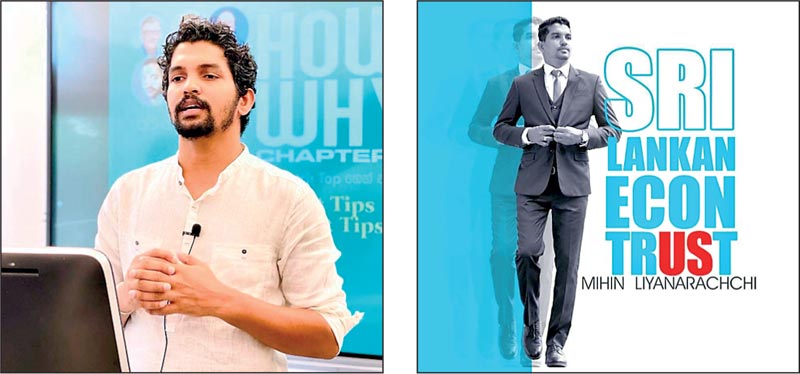
Mihin Liyanarachchi exclusive tuition master during pandemic
“Education is the best weapon through which we can fight poverty, ignorance, and freedom” and “one child, one teacher, and one pen can change the world”
– Malala Yousafzai –

Saturday, 29 January 2022 COVID-19 is an ongoing global health crisis and one of the major threats globally. This subsequently identified as the pathogen named coronavirus and currently breeds in different variants around the world. Sri Lanka is also facing this ongoing crisis. As a result of this health crisis, the education process has changed drastically with the distinctive rise of e-learning, whereby teaching is undertaken remotely and on digital platforms.
This pandemic has hit on children’s lives indirectly and it has massively disrupted educational pathways for children. Education must be a top priority in society. But due to this pandemic, access to education has become much harder to process, but critically important to ensure no child loses the opportunity to fulfil their potentials. The Ministry of Education started online- learning programs for schools for three months and as a result – the traditional way of learning tutorials and teaching sessions has been converted to an alternative learning method. Some are debating that a relatively brief period out of school may have a lasting negative impact on children.
The more serious concern is that when schools close for such a long period, many children will begin to forget what they already know. But through the online sessions, children tend to be more independent and self-learning than before. As a result of this new lifestyle, children are more creative and innovative. This virtual learning helps to make a good relationship between students-teachers during the lockdown. And e-learning is an efficient way to deliver lessons via tools like PDF, video recording, and podcasts.

Econ Trust is one of the famous Econ online classes among Advanced Level students in Sri Lanka these days. With the vision of ‘Heena wenuwen Kriyapadayaka’, the online class had started with many students but due to the pandemic all the tuition classes have been banned and shut down. A few months later the tuition masters have started to survive by commencing their classes online. Tuition was one of the industries that the pandemic has hit severely. But there is a very popular saying in Sinhala, ‘Rajakariya Devakariya karaganeema’; this directly can be seen by one of the tuition masters during the pandemic.
Mihin Liyanarachchi is the sir who has suffered a lot from this pandemic since the tuition fees were his only earnings. But he has never failed, since once the lockdown started from 15 March 2019; from the 20th onwards, he made a plan to continue their teaching via WhatsApp, telegram, and YouTube groups first.
He was the first teacher who gave access to the students from around the country to join his online classes free of charge after the lockdown started. He has shared papers to the students via WhatsApp and discussed the corrections via the YouTube channel. During that lockdown period, no one was allowed to go outside and this tuition master also stuck to his classroom and he continued this Econ classes free of charge program to the students until the lockdown ended (15 June 2019).
He was such a committed tuition master as we can say since he devoted his knowledge and commitment to the students while eating only samaposha during the lockdown period, because of the closures of shops and supermarkets. These are some examples of the kind-hearted teachers in Sri Lanka and the way they dedicatedly taught during the pandemic. All the classes being conducted free of charge by him was a significant moment in this entire education system.

The pandemic has exacerbated around the country, therefore adapting to the new normal life is exactly what we should begin with. Surviving only is not what we should expect to do – thriving is the way we can achieve our goals and aims in this critical situation. If there is a crystal-clear goal to your life there would be a success for your life no matter what happens in your life.
Subscribe to:
Posts (Atom)